


Abstract
This paper discusses an important issue for today’s mobile world striving for sustainable development, namely ecotourism. The major objective of the study presented in this article was to carry out a comparative analysis of the conventional tourist trip along the Kharkov (Ukraine)–Varna (Bulgaria) route in an electric car and by air transport. The main criteria for comparing two variants of tourist trip were cost price, time, mobility, and incidental cost. The authors used the Pareto method and the shortest distance to the target method. Comparative analysis of the travel options “electric car” and “air transport” by the Pareto method and the method of the shortest distance to the target showed that traveling by electric car is almost one and a half times more profitable than traveling by plane.
1. Introduction
Automobile transport occupies an important place in tourism, as mobility and comfort of movement play a significant role for the modern tourist. In recent years, the development of the automotive branch has led to the discovery of new opportunities for tourism. Car facilities with up-to-date technical solutions, such as GPS navigators, cruise control, telephones, and TV, have increased the attractiveness of family trips. The increase in tourist traffic also led to an increase in the ecological load on the environment, to the extent that the question of introducing special standards for harmful emissions into the atmosphere became acute in Europe. In this regard, more and more tourists began to use air transport, which in most cases leads to discomfort; an accurate flight schedule, waiting at airports, delays, and transfer of flights create difficulties for free planning of tourist routes and increase the cost of such a trip. The use of an electric vehicle in such cases minimizes the loss of time and makes free movement possible.
The development of ecotourism has recently been influenced by a variety of factors, and some current trends have emerged. First of all, as new forms and manifestations emerge, ecotourism is becoming increasingly diverse. Secondly, ecotourism is increasingly integrating with other types of tourism and the tourism industry. Those who respect the real point of ecotourism and pay attention to the environmental issues, and who are confused by the negative impact of the large flows of ecotourism, are given the opportunity to prohibit any form of tourism in particularly protected natural areas. In spite of its position, ecotourism is already a part of the destination of the masses. For example, short visits to nature reserves, as well as to national parks, but also other natural areas, are considered to be a part of cultural education and beach excursions. Naturally, with new trends, the primary sense and importance of ecotourism has been changed, and the concept of ecotourism is frequently diluted. Nowadays, ecotourism is becoming a very promising and quickly developing area of tourism and takes the most prominent position. Following experts’ opinions, ecotourism makes up between 10 and 20% of the tourism market’s overall profits. In Australia, Germany, Finland, Ireland, the United Kingdom, Asia, and South Africa, ecological tourism has developed the world. As experts claim, products and services required to meet the expectations of ecotourism will cost USD 55 billion. Costa Rica’s ecotourism income reaches USD 650 billion a year; on the other hand, in Kenya, annual revenues from the usage of national parks amount to USD 450 million. Moreover, Ecuador collects over USD 180 million each year [1].
As the infrastructure develops, the number of tourists from abroad in different tourist destinations in Europe increases, resulting in the development of the tourism region’s economy and the rise in the number of tourists in creating national GDP. This, in turn, has led to many problems, such as the lack of environmental friendliness. It must be highlighted that the traditional five environmental pollutants include transport emissions. It is worth emphasizing that much research has been carried out on the issue of transport pollution and its toxicity; for example, [2,3]. Around 40 percent of air eutrophication includes the share of land-based motor transport [4,5,6].
Scientists have found that cars emit 10 kg of benzene, 140 kg of carbon dioxide, 20 kg of dangerous carbon and hydrogen compounds, 30 kg of nitrogen derivatives, 4 kg of sulfur dioxide, and 1.5 kg of solid dangerous waste during their working year [7].
Using standard arithmetic data, 500 million cars emit approx. 700 million tons of carbon monoxide and other harmful substances each year on our planet. Besides the chemical elements listed, the most hazardous lead compounds, and others, enter the atmosphere. When it comes to the role of internal combustion engine emissions in cars, they are enormous at a global level and individually. In many countries around the world, electric vehicles are an excellent alternative to existing cars. Not only are they more economical, but they do not harm the environment [8,9,10].
The major objective of this research is to perform a comparative analysis of the conventional tourist trip along the Kharkov (Ukraine)–Varna (Bulgaria) route in an electric car and by air transport. This paper concludes our work by discussing the expected research aspect in this area, which is still open to academic and industrial sectors.
In general, our contributions, insights, and work are as follows:
- We present a review of up-to-date literature, based on which we have been motivated to select the presented research topic;
- We analyze the current worldwide market situation of ecotourism and electric cars and their prospects;
- We carry out a comparative analysis of the conventional tourist trip along the Kharkov (Ukraine)–Varna (Bulgaria) route in an electric car and by air transport;
- We conclude our work by discussing the results.
Finally, we briefly summarize the results and present opportunities for further research.
This article consists of five parts. Section 2 describes the current state of the art of electric cars. Section 3 presents the methodology of research. Section 4 sums up the results of the conducted research on the comparison of electric cars and aircraft in terms of the economic efficiency. Section 5 presents the conclusions.
2. Related Work
Electric cars were first introduced in the late 1800s and have gained popularity in recent years as the technology matures. By definition, electric cars are vehicles driven by an independent power source (for example, batteries, capacitors, or fuel cells) or an internal combustion engine [11]. The number of electric cars on the road worldwide has increased. Several studies predict the important role of electric cars in the future, reflecting the large investment in vehicle development, commercialization, and charging infrastructure. Thus, a vast amount of literature has been created which explores various aspects of electric vehicles, as well as their role in transport and energy systems. Electric vehicles have a low cost of transportation. The following cars consume the presented amount of current per km: Ford Ranger, 0.25 kWh; Toyota RAV4 EV, 0.19 kWh. In the United States, the average annual driving distance is 19,200 km (52 km). It is worth noting that the electricity cost in the USA is from USD 0.05 to 0.20 per kWh, the Ford Ranger’s annual driving cost is USD 240 to 1050, and the RAV4’s annual driving cost is USD 180 to 970.
Electric vehicles are becoming more and more popular. More and more motorists prefer electric car models, especially since the price of them is starting to fall and they are becoming more affordable [12,13].
Petrol and gas cars, of course, are more popular, but electric cars are gradually gaining their niche. They have a number of benefits:
- Complete environmental friendliness—the engine is safe, reliable, and there are no emissions or carbon monoxide;
- A great option for trips around the city—one battery charge is enough for about 180 km. On average, the travel distance of such a car will depend on the engine power, but in any case, it is at least 200 km with a full charge;
- The engine is much more durable than a conventional gasoline engine, with proper operation and timely charging;
- Higher efficiency compared to conventional vehicles;
- There are practically no extraneous noises when moving;
- Maneuverability—almost all models are compact in size; it is very convenient to move around the city (traffic jams) in such a car;
- There is an electromagnetic brake—emergency braking, which increases reliability and safety.
Hybrid electric vehicles are a truly versatile, reliable, safe, and environmentally friendly mode of transport. Even despite their high price, they are quite economical because it will cost you less to charge the battery than to buy a full tank of gasoline. Electric filling stations in Ukraine are gradually beginning to develop. If before, it was a real problem to charge the battery, now there will be practically no difficulties with this. Of course, there are practically no electric charging stations in small settlements currently, but in a few years, the situation will completely improve and stabilize [14,15,16,17].
On the one hand, electric vehicles are popular because they have close to zero carbon emissions, but on the other, how electricity is produced in some countries should be considered. Solar, wind, hydroelectric, and nuclear power produce almost zero carbon. Conversely, the electricity that is produced from coal has a high carbon intensity. For example, in Poland, the largest share of electricity production was from coal (almost 80%) in September 2022 [18]. Nevertheless, electric car technology is promising for achieving a sustainable transport sector in the future, due to their high efficiency, very low carbon emissions, and low noise. Furthermore, they can be considered as a viable solution to alleviating climate change problems. At present, the world’s industry is actively looking for alternatives to hydrocarbon fuels [19,20,21] and innovative activities in the field of environmental protection [22,23,24,25,26]. Many developed countries are making progress in this area. Electric cars are one of the private types of electric transportation. At present, electric cars are used to transport goods and people in large cities, city parks, forests, and recreational areas, where environmental safety issues are most pressing [27,28,29]. Some researchers highlight the trends of electric vehicles when it comes to road passenger and freight transport [30]. Accordingly, according to the Ukrainian Government, up to 60% of environmental damage is caused by passenger transportation via car. Cargo transportation accounts for approximately 27 percent and bus transportation for approximately 13 percent of environmental damage. Nitrogen oxides (44.5 percent), acrolein (7.5 percent), steam (7.4 percent), and carbon monoxide (6 percent) determine the percentage of harmful emissions; environmental and public health hazards resulting from transport emissions in cities also include sulfur dioxide (3.4 percent), formaldehyde (2.8 percent), benzopyrene (1.3 percent), and acetaldehyde (1.1 percent) [31,32,33].
One of the solutions to reduce car pollution in urban environments is to use alternative, cleaner energy sources. Many developed countries are undertaking intensive work in this direction. The major automotive manufacturers are investing billions of dollars in the development of transportation and alternative energy technologies. One alternative is traction-based vehicles. The fact that modern electric engines have mechanical characteristics that perfectly meet the requirements of driving traction, and are efficient, in addition to avoiding toxic emissions to the environment, supports designers’ attention to electric traction vehicles [34,35,36,37,38].
The most famous electric car models on the market include the ZAP Xebra, ZENN, Chevrolet Volt, General Motors EV1, Tesla Model S, Tesla Roadster, Volvo C30 BEV, Modec EV, Renault ZOE, Toyota RAV4 EV, Renault Series ZE, Reva NXR, Nissan LEAF, Tazzari ZERO, and others. Furthermore, Ukraine registered 12,119 electric vehicles on 1 April 2019 and the average age of the vehicles is 4.9 years. Interestingly, the Nissan Leaf dominates, comprising 67% of total sales [39,40].
In Europe, active efforts have been made to introduce electric vehicles and infrastructure. By 2020, the German Government intended to introduce one million electric vehicles, hybrid cars, and complete hybrid vehicles (PHEVs) onto the roads [31]. Mass production started in 2011. EUR 500 million from the budget was planned for this purpose in 2012 [41,42,43]. The Norwegian Government plans to completely convert all cars to electric vehicles by 2025, while the Swedish Government plans to give up selling petrol-powered cars completely by 2030 [44,45].
As already mentioned, the electric car industry is rapidly growing. Another aspect to consider while traveling by electric car is fast charging hubs. The service and charging sphere of these vehicles is also developing very quickly. Electric cars and charging stations are crucial elements of electricity demand management [46,47]. The first test of energy transfer from a car to an electrical network (Vehicle-to-Grid (V2G)) was launched in 2009 in Newark, Delaware, United States [16]. The charging stations include the following main types: the standard alternating current charging stations (which are distinguished by low cost and a charge time of about 10 h) and the direct current fast-charging stations (standard). They are well known for charging within one hour, but they are expensive. ABB, a Swedish company, uses Terra High-Power DC, which is the fastest and most powerful electric car charger. This device is powered by 350 kW, which is three times the power of a Tesla supercharger charging station [48]. In some countries in Europe, e.g., Germany, fast charging hubs are generally available [49,50,51], but there are also countries, including Bulgaria and Poland, where this solution is not so advanced. Thus, in such countries, more charging stations will be necessary to accommodate the growing number of electric cars on the road. However, it should be taken into account that rapid-charging hub networks are a preferred solution but should be planned and used in a way that avoids both unnecessary infrastructure, which represents overinvestment, and “charge deserts” [52]. Such infrastructure can also be built with the use of modern manufacturing technologies; for example, 3D printing [53].
Electric cars, including both battery electric vehicles and hybrid plug-in electric vehicles, are gradually entering the global market. The number of new electric vehicles registered each year is increasing steadily. Due to advances in electric-car-related technologies, in 2021, sales of electric vehicles (EVs) doubled compared to the previous year and reached a new record of USD 6.6 million. In the first quarter of 2022, the global sales of electric cars reached 2 million, an increase of 75% from the same period in 2021. Sales mostly originated from China, Europe and the US. By contrast, in India, Indonesia and Brazil, fewer than 0.5% of car sales are electric [54]. It should be noted that major countries in the field of electric mobility have provided financial incentives, such as tax cuts over the years, aimed at stimulating the sale of such cars. Moreover, electric shared mobility industry has become more developed in some cities [55]; however, this industry has faced many unexpected problems because of the pandemic [56,57,58,59].
3. Methods
For a comparative analysis of the conventional tourist trip along the Kharkov (Ukraine)–Varna (Bulgaria) route in an electric car and by air transport, we used the Pareto method and the method of the shortest distance to the target. From among the possible options for the trip, you need to form the initial set of alternative options, which are evaluated by the relevant set of criteria. When justifying a set of criteria, it is important to avoid availability of values in one set with close functional or correlation links (interrelated criteria). The main point of this method is to identify options that dominate other accepted criteria.
To solve this problem, we take an existing conventional electric car, the cost of which is not taken into account when comparing its use.
A comparative analysis of travel by electric car and air transport for tourism purposes was carried out, studying a determination of travel costs, mobility, movement, and environmental fees. Based on the empirical research conducted using the Pareto method, it should be concluded that the use of an electric car for tourism purposes compared to air travel allows the following:
- The tourist can plan the route independently;
- Reduced travel costs;
- Mobility of movement;
- Avoiding taxes;
- Avoiding environmental fees.
All these advantages of electric car travel for tourism compared to air travel influence the greater interest and choice of electric car travel of transport service users, thus, influencing the quality of electric car travel transportation service in line with the needs and expectations of electric car users.
The selection of the Pareto method made it possible to identify the strong and weak factors of the comparative analysis of travel for tourism by electric car and airplane.
The Pareto method was invented and first used by Vilfredo Pareto, an Italian economist and sociologist, in the 20th century. It is a practical method of identifying the main factors affecting performance. In 1940, this principle was generalized and called the management rule by Joseph M. Juran, who noted in his research that 80% of problems stem from 20% of causes. The Pareto method is applicable in various scientific fields; for example, in transportation, logistics, and marketing activities.
This method made it possible to identify and select the most optimal and commodious means of transport, taking into account costs, profit, and losses in the comparative analysis of travel for tourism purposes using the above-mentioned means of transport. A comparative analysis of travel for tourism by electric car and airplane was carried out to determine the quality of service of users of the two means of transport.
The problem of the selected topic is up to date and innovative and provides a rationale for further research in this area.
4. Discussion of the Results
The main criteria for comparing the two variants of tourist trip are the following:
- Cost price (C, EUR). According to the airlines, the price of a return ticket of economy class will cost the tourist approximately EUR 750 (as of April 2019). If the price of the ticket has already been determined by the airline for air travel, then the pricing of the trip on the electric car should take into account the cost and the amount of battery charge, as well as depreciation. The general expenses for a trip by an electric car are calculated using Formula (1):
- Time (t, hours). A return trip flight will take about 10 h, plus about 2 h for registration and execution of accompanying documents; as a result, 12 h are obtained. Using the electric car, you will have to spend about 42 h to travel the road distance, plus 13 battery charges for about an hour, which is in all about 55 h.
- Mobility (m, %). Mobility when traveling in one’s own electric car is taken as 100%, whereas the flight is taken as 50%, because the time required for check-in at the airport, a clear flight schedule, etc., result in a mobility decrease. As the Pareto method subtends the tendency of all variables to zero, we take the reverse values for the mobility parameter, i.e., 0.01 for an electric car and 0.02 for air transport.
- Incidental cost (P, EUR). The term “incidental cost” includes insurance fees, airport transfer services, lunch, etc.
Table 1 presents all basic data for comparing a tourist trip by air and electric car. The area of the polygons of each variant is also given in the table.

Table 1.
Formation of basic data.
To illustrate the selection process, we use the graphical method (Figure 1). To do this, we scale off the criteria values on radial scales. Scales are built in such a way that the improvement of the criterion goes to the center (point 0). To join the plotted point on the scales for each variant, we obtain polygons. At the minimum values of the criteria, we construct a polygon using the best variant. The value of the polygon’s area for each variant, as well as the corresponding values of the criteria, are calculated using Formula (2):
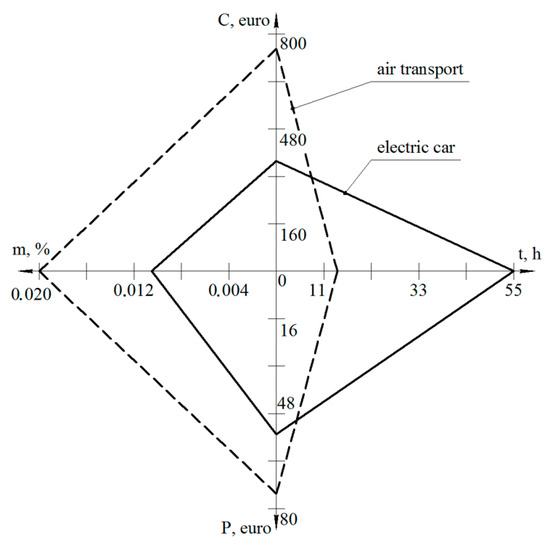
Figure 1.
Graphic method of the shortest distance to the target.
The main point is to compare the criteria of the i-th variant with some idealized variant. This is mainly a conditional variant to which the best values of the criteria for the number of variants being compared are attributed. We calculate the polygon area of the idealized variant; the obtained values are presented in Table 2.
Table 2.
Criteria for choosing an idealized variant according to the method of the shortest distance to the target.
From the analysis of Table 2, it can be seen that the ratio of the “electric car” variant to the idealized variant is 1.69, and the ratio of the “air transport” variant to the idealized variant is 2.83, which is 1.14 more than the “electric car” variant.
5. Conclusions
Nowadays, an electric vehicle is a rapidly increasing alternative to combustion engines and contributes to reducing CO2 emissions in the transport sector, especially if energy for it is produced from renewables.
The advantages of using an electric car as follows:
- Eco-friendliness;
- Modern look;
- Ergonomics;
- Increased performance;
- Higher efficiency compared to an internal combustion engine;
- Low failure rate;
- Ecological engine;
- Cost stabilization;
- Security.
It should be said that electric cars increase the comfort of car users. Quiet operation, smooth and dynamic driving, pleasant driving, comfortable suspension, soft seats, no vibration, ergonomic and easy-to-use interfaces, and a package of special services are the main benefits of using electric cars. Electric driving offers many benefits when it comes to both users and designers. Factors that influence the efficiency of electric transportation include technical factors and non-technical factors.
Technical factors include issues related to vehicle technical and operating parameters, i.e., range, drive system technical data, number of seats, weight, dimensions, etc.
Non-technical factors consist of the following three categories:
- Economic—operating costs, insurance, and repair;
- Organizational—routes, lines, and stops organization, and optimal selection of a transportation mode for lines;
- Social—societal structure, vehicle age, aesthetic impression (car appearance), innovation (for example, the access to Wi-Fi in buses), and safety.
To sum up, it should be noted that the quality of the transport service with regard to the use of electric cars should be consistent with the requirements of electric car users and with its expectations and requirements. The service quality is inextricably linked with the customer. Customer service is defined as the ability to satisfy the needs, requirements, and expectations of an electric car user. Customer satisfaction plays an important role in customer service, ensuring that service providers fulfill customers’ needs and perform a service in an appropriate manner, according to specific tasks linked with the use of electric cars.
The expediency of using an electric car for tourist purposes is confirmed by the cheapness of travel in comparison with air travel, mobility in movement, and the absence of taxes and environmental fees. Moreover, such a trip will allow the tourist to plan the route himself. The active development of the network of charging stations in Europe makes it possible to obtain a universal route without fear of remaining on the side of the road “without charge”. Comparative analysis of the travel options “electric car” and “air transport” by the Pareto method and the method of the shortest distance to the target showed that traveling by electric car is almost one and a half times more profitable than traveling by plane.
The topic of comparison of electric cars and aircraft is very broad. This research can be extended in the future in many directions. One of the directions is to take into account different distances for traveling. In this topic, pollution can also be studied for the selected means of transport. Therefore, green and sustainable aspects can also become the subject of in-depth research. The number of travelers is also an interesting field for future study.
Author Contributions
Conceptualization, K.M., K.S. (Kirill Sirovitskiy), A.S., O.P., N.V., M.S., S.K., T.S., T.K., E.S.; methodology, K.M., A.S., K.S. (Kirill Sirovitskiy), O.P., N.V., M.S., S.K., T.S., T.K., E.S.; software, K.M., K.S. (Kirill Sirovitskiy), O.P., N.V., M.S., S.K., T.S., A.S., T.K., E.S.; validation, K.M., K.S. (Kirill Sirovitskiy), A.S., O.P., N.V., M.S., S.K., T.S., K.S. (Kinga Stecuła), T.K., E.S.; formal analysis, K.M., K.S. (Kirill Sirovitskiy), O.P., N.V., M.S., S.K., T.S., A.S., T.K., E.S.; investigation, K.M., A.S., K.S. (Kirill Sirovitskiy), O.P., N.V., M.S., S.K., T.S., T.K., E.S.; resources, A.S., K.M., K.S. (Kirill Sirovitskiy), O.P., N.V., M.S., S.K., T.S., T.K., E.S.; data curation, K.M., K.S. (Kirill Sirovitskiy), O.P., N.V., M.S., S.K., T.S., A.S., T.K., E.S.; writing—original draft preparation, A.S, K.M., K.S. (Kirill Sirovitskiy), O.P., N.V., M.S., S.K., T.S., K.S. (Kinga Stecuła); writing—review and editing, K.M., K.S. (Kirill Sirovitskiy), A.S., O.P., N.V., M.S., S.K., T.S., K.S. (Kinga Stecuła); visualization, K.M., A.S., K.S. (Kirill Sirovitskiy), O.P., N.V., M.S., S.K., T.S.; supervision, K.M., A.S, K.S., O.P., N.V., M.S., S.K., T.S., K.S. (Kinga Stecuła); project administration, K.M., K.S. (Kirill Sirovitskiy), A.S., O.P., N.V., M.S., S.K., T.S.; funding acquisition, K.M., A.S., T.K. All authors have read and agreed to the published version of the manuscript.
Funding
This research was funded by Silesian University of Technology.
Institutional Review Board Statement
Not applicable.
Informed Consent Statement
Not applicable.
Data Availability Statement
Not applicable.
Conflicts of Interest
The authors declare no conflict of interest. The funders had no role in the design of the study, in the collection, analyses, or interpretation of data, in the writing of the manuscript, or in the decision to publish the results.
References
- Alekseeva, E.V.; Dreval, E.V.; Yudin, A.G.; Kartseva, E.V. Ecological Tourism: Problems and Prospects. Probl. Environ. Nat. Resour. 2015, 8, 99–112. [Google Scholar]
- Kuranc, A.; Caban, J.; Šarkan, B.; Dudziak, A.; Stoma, M. Emission of selected exhaust gas components and fuel consumption in different driving cycles. Commun. Sci. Lett. Univ. Zilina 2021, 23, B265–B277. [Google Scholar] [CrossRef]
- Tucki, K.; Mruk, R.; Orynycz, O.; Botwińska, K.; Gola, A.; Bączyk, A. Toxicity of exhaust fumes (CO, NOx) of the compression-ignition (diesel) engine with the use of simulation. Sustainability 2019, 11, 2188. [Google Scholar] [CrossRef]
- By What Are Frightful Car Emissions? Available online: https://ecocars.com.ua/chem-strashnyi-vyibrosyi-avtomobilya (accessed on 2 June 2022).
- Markowska, K.; Flizikowski, J.; Bieliński, K.; Tomporowski, A.; Kruszelnicka, W.; Kasner, R.; Bałdowska-Witos, P.; Mazur, Ł. The Comparative Assessment of Effects on the Power System and Environment of Selected Electric Transport Means in Poland. Materials 2021, 14, 4556. [Google Scholar] [CrossRef]
- Bazhinov, A.; Bazhinova, T.; Podrigalo, M.; Kholodov, M. Dynamics Hybrid Vehicle Driven with Electric Motor Driving Wheels from Batteries; SAE Technical Paper; SAE International: Warrendale, PA, USA, 2022. [Google Scholar]
- Bazhinov, O.V.; Bazhinova, T.O.; Kravtsov, M.M. Fundamentals of efficient selection of environmentally friendly cars: Monograph. In FOP Panov; KHNADU: Kharkov, Ukraine, 2018; p. 200. [Google Scholar]
- Electric Car Ownership: Pros and Cons. Available online: https://ecolease.com.ua/news/vladenia-elektrokarom-plusy-i-minusy-46 (accessed on 28 May 2022).
- Migal, V.; Lebedev, A.; Shuliak, M.; Kalinin, E.; Arhun, S.; Korohodskyi, V. Reducing the vibration of bearing units of electric vehicle asynchronous traction motors. J. Vib. Control 2021, 27, 1123–1131. [Google Scholar] [CrossRef]
- Bazhinova, T.O. Intellectual information and keruvial system of hybrid and electric vehicles. Bull. KHNADU Sb. Sci. VIP 2019, 86, 148–155. [Google Scholar]
- Bazhynova, T.; Kurilo, I. Development of Electric Mobility; KhNTUSG: Kharkov, Ukraine, 2021. [Google Scholar]
- The Number of Registered Passenger and Light Commercial Electric Vehicles and Hybrids in Ukraine. Available online: http://irsgroup.com.ua/wp-content/ (accessed on 28 May 2022).
- Germany Aiming for 1M EVs and PHEVs by 2020. Available online: https://www.greencarcongress.com/2008/11/germany-aiming.html (accessed on 28 May 2022).
- World’s Fastest EV Charger Gives Drivers 120 Miles in 8 Minutes. Available online: https://newatlas.com/abb-350kw-fast-charger/54377 (accessed on 28 May 2022).
- The California Utility Wants to Figure Out EV Owners’ Level of Price Sensitivity. Available online: https://www.greentechmedia.com/articles/read/sce-tests-electric-vehicles-for-demand-response (accessed on 28 May 2022).
- Newark, Delaware Tests Vehicle-to-Grid Technology. Available online: https://renewenergy.wordpress.com/2009/01/30/newark-delaware-tests-vehicle-to-grid-technology/ (accessed on 28 May 2022).
- BDEW Energy. Wasser. Leben. Available online: https://www.bdew.de/presse/presseinformationen/zahl-der-stromtankstellen-steigt/ (accessed on 28 May 2022).
- Available online: https://www.rynekelektryczny.pl/ (accessed on 3 September 2022). (In Polish).
- Market Brief—E-Mobility in France. Available online: https://www.export.gov/article?id=Market-Brief-E-Mobility-in-France-2016uploads/e-cars-UA-Mar19.jpg (accessed on 28 May 2022).
- Stecuła, K.; Tutak, M. Causes and Effects of Low-Stack Emission in Selected Regions of Poland. In Proceedings of the 18th International Multidisciplinary Scientific GeoConference SGEM, Albena, Bulgaria, 2–8 July 2018; Volume 18, pp. 357–364. [Google Scholar]
- Markowska, K.; Ciesielski, D. The impact of protected areas on the designing of expressways. In Transport Problems 2020: XII International Scientific Conference, IX International Symposium of Young Researchers, Katowice, Poland, 30 November–2 December 2020; Sładkowski, A., Bąkowski, H., Czech, P., Cieśla, M., Haniszewski, T., Juzek, M., Kamiński, W., Marzec, P., Wojnar, G., Eds.; Silesian University of Technology (PolSL): Gliwice, Poland, 2020. [Google Scholar]
- Kulpa, J.; Kamiński, P.; Stecuła, K.; Prostański, D.; Matusiak, P.; Kowol, D.; Kopacz, M.; Olczak, P. Technical and Economic Aspects of Electric Energy Storage in a Mine Shaft—Budryk Case Study. Energies 2021, 14, 7337. [Google Scholar] [CrossRef]
- Dyczko, A.; Kamiński, P.; Stecuła, K.; Prostański, D.; Kopacz, M.; Kowol, D. Thermal and mechanical energy storage as a chance for energy transformation in Poland. Polityka Eneretyczna 2021, 24, 43–60. [Google Scholar] [CrossRef]
- Stecuła, K. Decision-making Dilemmas in Mining Enterprise and Environmental Issues, i.e. Green Thinking in Mining. In Proceedings of the 18th International Multidisciplinary Scientific GeoConference SGEM, Vienna, Austria, 3–6 December 2018; Volume 18. [Google Scholar]
- Stecuła, K.; Brodny, J. Decision-making Possibilities in the Field of Excavated Material Quality Shaping in Terms of Environmental Protection, i.e. how to be Greener in Mining. In Proceedings of the 18th International Multidisciplinary Scientific Geoconference SGEM, Vienna, Austria, 3–6 December 2018; Volume 18, pp. 243–250. [Google Scholar]
- Jachimowski, R.; Szczepański, E.; Kłodawski, M.; Markowska, K.; Dąbrowski, J. Selection of a container storage strategy at the rail-road intermodal terminal as a function of minimization of the energy expenditure of transshipment devices and CO2 emissions. Annu. Set Environ. Prot. 2018, 20, 965–988. [Google Scholar]
- Govt Plan to Have 10% of All Cars Electric by 2020. Available online: https://www.belfasttelegraph.co.uk/breakingnews/ireland/govt-plan-to-have-10-of-all-cars-electric-by-2020-14080506.html (accessed on 28 May 2022).
- Kozlovsky, V.N.; Maleev, R.A.; Zayatrov, A.V. Analysis of the influence of operational, production and design factors on the reliability indicators of passenger cars. Truck 2012, 3, 22–24. [Google Scholar]
- Polyakova, E.V. Multivariate study of the quality of cars. Truck 2015, 7, 2–6. [Google Scholar]
- Stopka, O.; Stopková, M.; Ližbetin, J.; Soviar, J.; Caban, J. Development trends of electric vehicles in the context of road passenger and freight transport. In Proceedings of the 2020 XII International Science-Technical Conference AUTOMOTIVE SAFETY, Kielce, Poland, 21–23 October 2020; pp. 1–8. [Google Scholar]
- Polyakova, E.V. Modern methodical-algorithmic apparatus for measuring the quality of a complex of electrical equipment for cars. Electron. Electr. Equip. Transp. 2015, 4, 39–43. [Google Scholar]
- Idiatullin, A. The product quality indexation system is an important element of a harmonious digital economy. Economist 2017, 10, 8–12. [Google Scholar]
- Noisiness of Various Cars. Available online: www.auto-shum.ru/stati/31-shumnost-razlichnykh-automobilej (accessed on 26 May 2022).
- Stroganov, V.I.; Sidorov, B.N. Review of methods for quantitative assessment of indicators of quality and reliability of electrical equipment of cars. Autom. Control. Tech. Syst. 2013, 1, 116–121. [Google Scholar]
- Stroganov, V.I.; Kozlovsky, V.N.; Kleimenov, S.I. Comprehensive assessment of consumer satisfaction with the quality of cars. Stand. Qual. 2013, 5, 92–94. [Google Scholar]
- Stroganov, V.I. The concept of ensuring the quality and reliability of electric vehicles and vehicles with a hybrid power plant. Electron. Electr. Equip. Transp. 2012, 5–6, 49–55. [Google Scholar]
- Fashiev, K.A. Quality problems in the automotive industry. Mashinostroitel 2000, 1, 34–38. [Google Scholar]
- Nemtsev, A.D. The Strategy of Forming the Competitiveness of Machine-Building Products; Sarat Publishing House: Saratov, Russia, 2001; p. 100. [Google Scholar]
- Nemtsev, A.D. Modeling as a tool for product quality management. Automot. Ind. 2003, 10, 1–5. [Google Scholar]
- Klauenberg, J.; Rudolph, C.; Zajicek, J. Potential Users of Electric Mobility in Commercial Transport—Identification and Recommendations. Transp. Res. Procedia 2016, 16, 202–216. [Google Scholar] [CrossRef]
- Carrilero, I.; González, M.; Anseán, D.; Viera, J.C.; Chacón, J.; Pereirinha, P.G. Redesigning European Public Transport: Impact of New Battery Technologies in the Design of Electric Bus Fleets. Transp. Res. Procedia 2018, 33, 195–202. [Google Scholar] [CrossRef]
- Xiong, Y.; Wang, B.; Chu, C.; Gadh, R. Vehicle grid integration for demand response with mixture user model and decentralized optimization. Appl. Energy 2018, 231, 481–493. [Google Scholar] [CrossRef]
- Vacheva, G.; Hinov, N.; Kanchev, H.; Stanev, R.; Cornea, O. Energy Flows Management of Multiple Electric Vehicles in Smart Grid. Elektron. Elektrotechnika 2019, 25, 14–17. [Google Scholar] [CrossRef]
- Plötz, P.; Funke, S.Á.; Jochem, P. The impact of daily and annual driving on fuel economy and CO2 emissions of plug-in hybrid electric vehicles. Transp. Res. Part A Policy Pract. 2018, 118, 331–340. [Google Scholar] [CrossRef]
- Zhang, Q.; Ou, X.; Zhang, X. Future penetration and impacts of electric vehicles on transport energy consumption and CO2 emissions in different Chinese tiered cities. Sci. China Technol. Sci 2018, 61, 1483–1491. [Google Scholar] [CrossRef]
- Teixeira, A.C.R.; Sodré, J.R. Impacts of replacement of engine powered vehicles by electric vehicles on energy consumption and CO2 emissions. Transp. Res. Part D Transp. Environ. 2018, 59, 375–384. [Google Scholar] [CrossRef]
- Trost, T.; Sterner, M.; Bruckner, T. Impact of electric vehicles and synthetic gaseous fuels on final energy consumption and carbon dioxide emissions in Germany based on long-term vehicle fleet modelling. Energy 2017, 141, 1215–1225. [Google Scholar] [CrossRef]
- Yu, A.; Wei, Y.; Chen, W.; Peng, N.; Peng, L. Life cycle environmental impacts and carbon emissions: A case study of electric and gasoline vehicles in China. Transp. Res. Part D Transp. Environ. 2018, 65, 409–420. [Google Scholar] [CrossRef]
- Kaleg, S.; Hapid, A.; Kurnia, M.R. Electric vehicle conversion based on distance, speed and cost requirements. Energy Procedia 2015, 68, 446–454. [Google Scholar] [CrossRef]
- Available online: https://fastnedcharging.com/hq/fastned-and-tesla-open-germanys-largest-fast-charging-hub/ (accessed on 3 September 2022).
- Available online: https://autovista24.autovistagroup.com/news/shell-and-abb-to-launch-worlds-fastest-ev-charger-network-in-germany/ (accessed on 3 September 2022).
- Pearre, N.S.; Swan, L.G.; Burbidge, E.; Balloch, S.; Horrocks, L.; Piper, B.; Anctil, J. Regional Electric Vehicle Fast Charging Network Design Using Common Public Data. World Electr. Veh. J. 2022, 13, 212. [Google Scholar] [CrossRef]
- Orzeł, B.; Stecuła, K. Comparison of 3D Printout Quality from FDM and MSLA Technology in Unit Production. Symmetry 2022, 14, 910. [Google Scholar] [CrossRef]
- IEA (International Energy Agency). Global EV Outlook 2022. 2022. Available online: https://www.iea.org/reports/global-ev-outlook-2022 (accessed on 3 September 2022).
- Turoń, K.; Kubik, A.; Chen, F.; Wang, H.; Łazarz, B. A holistic approach to electric shared mobility systems development—Modelling and optimization aspects. Energies 2020, 13, 5810. [Google Scholar] [CrossRef]
- Turoń, K.; Kubik, A.; Chen, F. Electric shared mobility services during the pandemic: Modeling aspects of transportation. Energies 2021, 14, 2622. [Google Scholar] [CrossRef]
- Orzeł, B.; Wolniak, R. Clusters of Elements for Quality Assurance of Health Worker Protection Measures in Times of COVID-19 Pandemic. Adm. Sci. 2021, 11, 46. [Google Scholar] [CrossRef]
- Orzeł, B.; Wolniak, R. Digitization in the Design and Construction Industry—Remote Work in the Context of Sustainability: A Study from Poland. Sustainability 2022, 14, 1332. [Google Scholar] [CrossRef]
- Arribas-Ibar, M.; Nylund, P.A.; Brem, A. The risk of dissolution of sustainable innovation ecosystems in times of crisis: The electric vehicle during the COVID-19 pandemic. Sustainability 2021, 13, 1319. [Google Scholar] [CrossRef]
Disclaimer/Publisher’s Note: The statements, opinions and data contained in all publications are solely those of the individual author(s) and contributor(s) and not of MDPI and/or the editor(s). MDPI and/or the editor(s) disclaim responsibility for any injury to people or property resulting from any ideas, methods, instructions or products referred to in the content. |
© 2023 by the authors. Licensee MDPI, Basel, Switzerland. This article is an open access article distributed under the terms and conditions of the Creative Commons Attribution (CC BY) license (https://creativecommons.org/licenses/by/4.0/).