


Abstract
The amount of sewage sludge produced in Poland is increasing every year. Once stabilised and hygienised, sewage sludge is a valuable product, rich in biogenic elements such as nitrogen and phosphorus, which are essential for plant growth. However, in addition to the compounds that are beneficial to the soil, this sludge can also contain harmful substances such as heavy metals. The aim of this assessment is to analyse the content of seven heavy metals in sewage sludge from urban and rural wastewater treatment plants (WWTPs) located in Poland. This analysis allows for the suitability of sludge from the studied wastewater treatment plants for natural management to be assessed. The concentration ranges of Cd, Cu, Ni, Pb, Zn, Cr, and Hg in sludge samples from rural wastewater treatment plants were 0.6–9.5, 9.3–524, 4.8–90.0, 8.8–275.2, 575–1732, 7.5–170.0, and 0–3.8 mg/kg dry matter, respectively. In sludge samples from urban wastewater treatment plants, the concentration ranges of Cd, Cu, Ni, Pb, Zn, Cr, and Hg were 1.07–16.7, 32–195, 1.3–128.9, 21.2–322.4, 20–5351.1, 12.7–2759.8, and 0.1–1.55 mg/kg dry matter, respectively. Only one of the analysed wastewater treatment plants (Skarżysko-Kamienna) exceeded the limit values.
1. Introduction
According to Alloway and Ayres, heavy metals are defined as a group of metals and semimetals with a density greater than 6 g/cm3. However, this is not a strict definition, and the term is usually used to describe metals associated with toxicity and environmental pollution, such as Cd, Cr, Cu, Hg, Ni, Pb, and Zn [1]. They are widespread in the environment, occurring in various forms, such as oxides, hydroxides, sulphates, sulphides, phosphates, and silicates. A consequence of soil and air pollution is the contamination of plants due to their tendency to absorb and accumulate heavy metals [2]. The main source of heavy metals in sewage sludge is human activity, especially advanced industry, which emits large quantities of these elements into the environment every year.
Sewage sludge is a by-product of the wastewater treatment process [3,4]. It is composed of mineral and/or organic compounds and is separated from the liquid phase through sedimentation. The most cost-effective method for the management of sewage sludge is its natural utilisation [5]. Sewage sludge contains biogenic elements essential for plant growth and development [3,6]. It is also a valuable source of macro- and micro-elements as well as organic matter, but on the other hand, it is a potential threat to humans and the environment due to the presence of organic pollutants, pathogens, and heavy metals [7,8,9,10,11,12,13,14,15]. When added to soil, it enhances soil fertility, improves volumetric density and porosity, and increases water-retention capacity. It also reduces the need for mineral fertilisers, resulting in economic benefits. Municipal sewage sludge can be utilised provided it is stabilised and appropriately prepared to eliminate any potential risks to the environment or human health [15,16,17,18,19]. The heavy metals found in soil are not immediately absorbed by plants; however, over time, they can slowly form hazardous solutions. Heavy metals, such as Fe, Co, Cu, Cr, Mo, Mn, Se, Ni, and Zn, are necessary for the development of some organisms in trace amounts, but at higher concentrations, they become toxic. Elements such as Sb, Pb, Hg, Ag, and As are toxic and unnecessary for living organisms. However, most sewage and waste contain heavy metals in sufficient amounts to cause toxicity to crops [20]. The impact of heavy metals on the soil environment and plant is different. Lead in high concentrations has a toxic effect on soil microorganisms, leading to inhibition of the decomposition of organic matter. It also interferes with the metabolism and normal development of plants. Cadmium is one of the toxic metals. Absorbed from the soil by plants, it mainly accumulates in the roots and interferes with photosynthesis. Nickel, as a trace element, is essential for plants in trace amounts; however, excess amounts are toxic. When taken up by plants, it blocks the access of other elements needed for growth. Zinc is one of the micronutrients essential for plant vegetation; however, both deficiency and excess are undesirable. A deficiency of this element mainly results in stunted plant growth. Excessive uptake of these elements by plants is stored in the roots, where it impairs photosynthesis, calcium metabolism, and the binding of copper, iron, and other essential elements. Copper is an essential plant nutrient, but a deficiency can prevent normal growth, while an excess can inhibit photosynthesis. Chromium is an undesirable element, as its excessive availability for plants causes chlorosis, which leads to a disruption of the water balance and damage to growth cones and the root system [21]. Mercury (Hg) is considered a global pollutant. For plants, mercury is not an essential trace element, and its positive biological functions are not known. Usually, 2–10 mg/kg of Hg in the soil is phytotoxic. The plants accumulate mercury primarily in their roots, and in most of the cases, its transfer to aboveground organs is low [22]. Typically, the content of Zn and Cu in municipal sludge is high, while the content of Cd, Hg, and As is low. Heavy metals in sediments have strong geographical distribution characteristics. Higher contents of heavy metals in municipal sludge will occur in regions with greater industrial development [23]. The content of heavy metals in sediments also varies from country to country due to different national industrial characteristics [24,25,26,27,28]. Also, the permissible upper concentration values of heavy metals in sewage sludge that is intended for natural applications vary from country to country; it is important to note that the use of sludge must comply with all relevant regulations [15].
The objective of this assessment is to analyse the content of heavy metals in sewage sludge from municipal and rural sewage treatment plants and fill the gap associated with the lack of such comparisons. The analysis will assess the suitability of sludge from selected sewage treatment plants for use in agriculture, which is important information because this use is their basic management in Poland, and according to the literature [29,30], it constitutes 49% of the total use. Prior to selecting a sludge management method, it is essential to conduct an in-depth analysis of sludge composition, taking into account the presence of heavy metals and their concentrations.
2. Sludge Regulations in Poland
On 14 December 2012, the Waste Act [31] entered into force. It is a transposition of European Union regulations, including the following:
- Council Directive 86/278/EEC of 12 June 1986 on the protection of the environment and, in particular, of the soil when sewage sludge is used in agriculture [32].
- Council Directive 91/271/EEC of 21 May 1991 concerning urban sewage [33].
The Waste Act [19] identifies methods for managing waste and reducing its environmental impact. It provides measures for reducing the effects of resource use and improving resource efficiency. The Act prohibits the use of municipal sewage sludge outside the province where it was generated. An exception to the prohibition of sludge application in another province is when the distance between the sludge production site and the application site in another province is less than the distance to the application site in the same province (Art. 20 Section 2). The land application of previously dried municipal sewage sludge is also prohibited.
According to Article 96 (1) of the Waste Act [31], sewage sludge can be used as follows:
- –
- in agriculture, understood as the cultivation of all marketable agricultural crops, including crops intended for the production of feed;
- –
- for the cultivation of plants intended for the production of compost;
- –
- for the cultivation of non-food and non-fodder crops;
- –
- for land reclamation, including land for agricultural purposes;
- –
- for the adaptation of land to specific needs resulting from waste management plans, spatial development plans, or decisions on the conditions of development and land use.
To ensure its safety and efficacy, municipal sewage sludge must be stabilised and properly treated before use. This can be achieved through biological, chemical, thermal, or other treatments that eliminate environmental and health risks and reduce the sludge’s susceptibility to compaction.
The limit values for specific heavy metals in municipal sewage sludge intended for natural use are given in Table 1.

Table 1.
The maximum permissible levels of heavy metals in sewage sludge used for natural purposes, expressed in milligrams per kilogram of dry matter (mg/kg d.m.) [34].
3. Materials and Methods
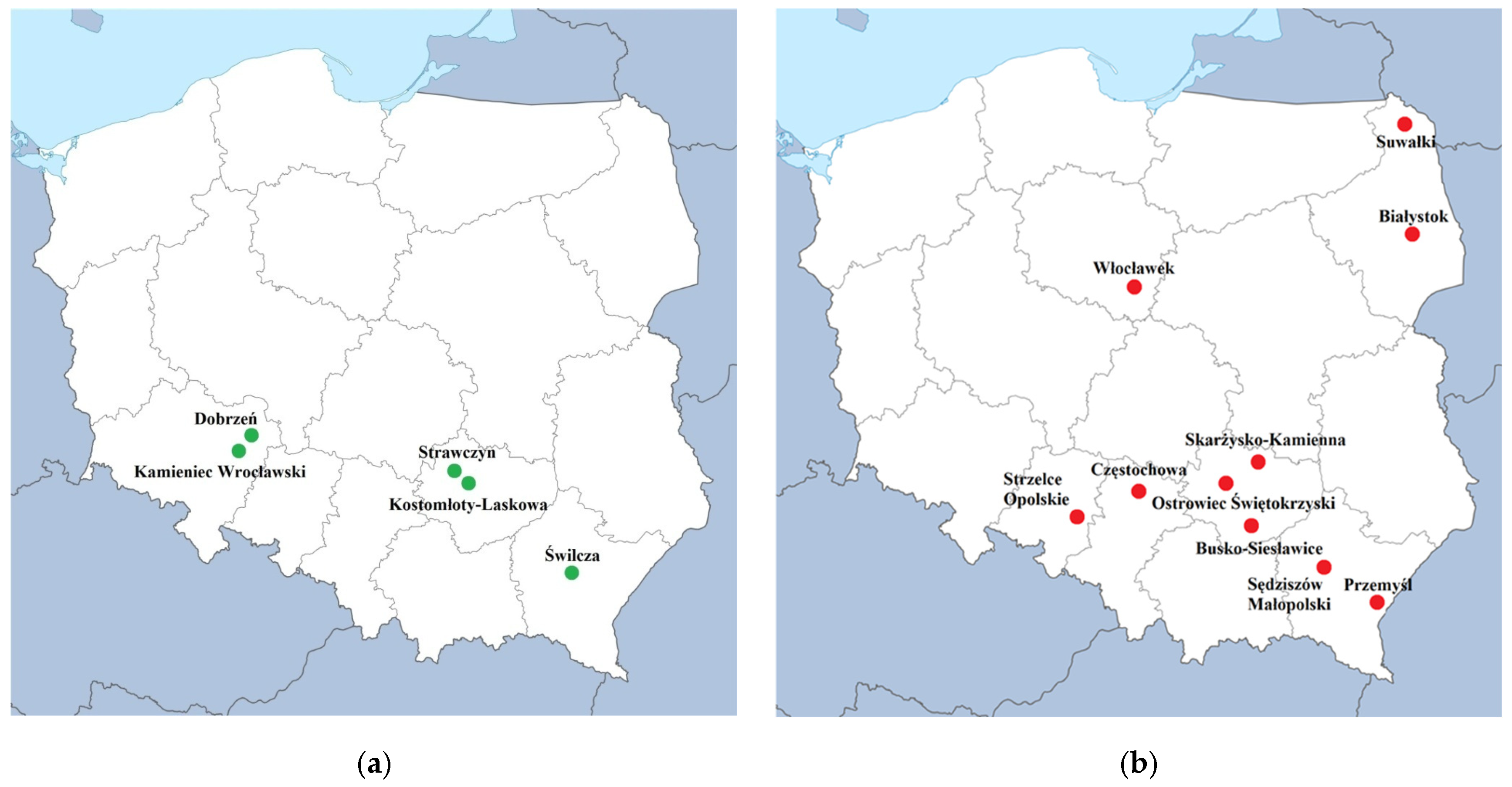
The aim of this study is to analyse the content of seven heavy metals in sewage sludges from urban and rural wastewater treatment plants located in Poland. The sites selected for analysis were chosen primarily on the basis of the availability of literature data, the location of the plants (the least and most industrialised parts of Poland), and the different WWTP capacities (Table 2). The heavy metal concentrations collected in this article are from measurements carried out by various authors between 2004 and 2021 [35,36,37,38,39,40,41,42,43,44,45,46,47,48,49]. This analysis allows for the suitability of sludge from the studied wastewater treatment plants for natural management to be assessed in accordance with the Regulation of the Minister of Climate and Environment of 8 November 2022 on municipal sewage sludge [34]. The locations of the analysed rural and municipal sewage treatment plants are shown in Figure 1.
Table 2.
Locations and characteristics of the sewage treatment plants and the areas.
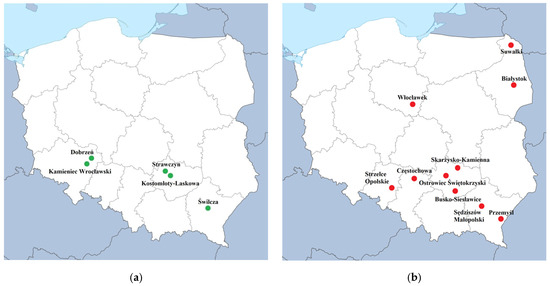
Figure 1.
The locations of the analysed wastewater treatment plants. (a) rural; (b) urban WWTP.
3.1. Determination of Total Heavy Metal Concentrations
The total concentrations of the selected heavy metals (Pb, Cd, Cr, Cu, Ni, and Zn) were determined in the sludge samples by atomic absorption spectrometry AAS-FAAS [35,36,38,39,41,42,43,45] after microwave closed mineralisation in aqua regia or concentrated acids [35,36,39,41,47] or by using inductively coupled plasma—optical emission spectroscopy ICP–OES [31,34] after four-stage sequential extraction (BCR) [38,42,43,45,47]. In the case of Świlcza [37], the authors report that the results presented in their paper are based on data provided by the Wastewater Treatment Plant in Świlcza. For Włoclawek, the samples were determined in the laboratory of the Institute of Environmental Protection, but the determination methodology is not provided [49]. In accordance with [34], there are two reference methods for testing municipal sewage sludge for determining the content of the heavy metals lead, cadmium, mercury, nickel, zinc, copper, and chromium, and these are atomic absorption spectrometry after mineralisation in aqua regia or concentrated acids or inductively coupled plasma—optical emission spectroscopy ICP–OES.
3.2. Statistical Analysis
All calculations were performed using Excel 2013 (Microsoft Corporation, Washington, DC, USA). The occurrence of a linear correlation between analysed variables was evaluated by Pearson’s correlation coefficient (r). A confidence level of 95% was assumed.
4. Results and Discussion
The analysis included in this study was to determine the heavy metal contents of sewage sludge from both rural and urban wastewater treatment plants in terms of its natural use. The concentrations of individual heavy metals were compared with the permissible limits set by current legislation and with the results of the metal content of sludge generated at individual wastewater treatment plants. Table 3 and Table 4 compare the content of heavy metals in sewage sludge from the sixteen analysed sewage treatment plants. The values marked in Table 3 and Table 4 in bold exceed the permissible levels of heavy metals in sewage sludge presented in Table 1 [34].
Table 3.
Heavy metal content in mg/kg d.m. of sludge from rural wastewater treatment plants.
Table 4.
Heavy metal content in mg/kg d.m. of sludge from urban wastewater treatment plants.
According to the data presented in Table 3 and Table 4, no exceedances of the permissible cadmium content in sewage sludge were found in the analysed wastewater treatment plants. The highest concentrations of cadmium were recorded at two municipal wastewater treatment plants—Busko-Siesławice (16.7 mg/kg d.m.) and Skarżysko-Kamienna (12.1 mg/kg d.m.). In the case of the wastewater treatment plant located in Strzelce Opolskie, there is no data on the content of this element in the sludge.
The permissible copper content in sewage sludge was not exceeded in any of the analysed wastewater treatment plants. It is worth noting, however, that the highest concentrations of copper (524 mg/kg d.m.) in sewage sludge were detected at a rural wastewater treatment plant located in Kamieniec Wrocławski.
It can be observed that, in all analysed wastewater treatment plants, nickel concentrations did not exceed the limit values. It can also be observed that there was little overall sludge contamination with this element. In only one of the analysed wastewater treatment plants did the nickel concentration exceed 100 mg/kg d.m.–128.9 mg/kg d.m., which was at the wastewater treatment plant located in Częstochowa. Slightly elevated concentrations may be related to the activities of the metal industry in the city. Częstochowa is a city with a rich industrial tradition and a developed metal industry.
No exceedances of the limit values for lead were recorded at the analysed wastewater treatment plants; the highest concentration of lead was in the sewage sludge coming from the municipal wastewater treatment plant located in Busko-Siesławice, and it contained 322.4 mg/kg d.m. of this element. Slightly increased cadmium and lead concentrations may be caused by the national road No. 73 running through the centre of the city of Busko-Zdrój, which is a road with heavy traffic.
According to the data in Table 4, at the municipal wastewater treatment plant located in Skarżysko-Kamienna, the level of zinc (5351.1 mg/kg d. m.) exceeded the requirements for the use of sewage sludge in agriculture, for land reclamation for agricultural purposes, for land reclamation for non-agricultural purposes, for the adaptation of land to specific needs, for the cultivation of plants intended for the production of compost, and for the cultivation of plants not intended for consumption and the production of fodder. The area of Skarżysko-Kamienna is home to industrial plants, which, combined with the high volume of traffic in the city, is not indifferent to the heavy metal content of the sewage sludge from the city’s wastewater treatment plant. No exceedances of the limit values were found at the other wastewater treatment plants. A slightly increased zinc concentration of 2046 mg/kg dry weight was observed in sewage sludge from the wastewater treatment plant located in Częstochowa, which may be (like the increased nickel concentration) related to the activities of the metal industry in the city. No data are available on zinc concentrations at the rural wastewater treatment plant in Świlcza.
Mercury concentrations in the analysed wastewater treatment plants did not cause exceedances of the limit values, with as many as nine cases of sludge being characterised by the absence of mercury contamination (Dobrzeń, Kostomłoty-Laskowa, Strawczyn, Przemyśl, Ostrowiec Świętokrzyski, Busko-Siesławice, Skarżysko-Kamienna, Sitkówka-Nowiny, Strzelce Opolskie). The highest mercury concentrations were recorded at a rural wastewater treatment plant located in Kamieniec Wrocławski (3.8 mg/kg d.m.). In the case of the wastewater treatment plant in Częstochowa, there are no data on mercury concentrations in the sludge.
As in the case of zinc content in sewage sludge, the only treatment plant where exceedances of the limit values for chromium were observed was the municipal wastewater treatment plant in Skarżysko-Kamienna. The high concentration of chromium (2759.8 mg/kg dry weight) disqualifies the use of the sludge in agriculture, for land reclamation for agricultural purposes, for land reclamation for non-agricultural purposes, for adapting land to specific needs, for growing plants intended for the production of compost, and for growing plants not intended for food and feed production. In other cases, the chromium content of the sewage sludge did not result in exceedances. Close to the limit value for the use of sewage sludge in agriculture and for land reclamation for agricultural purposes was the sludge from the wastewater treatment plant located in Włocławek. The chromium concentration there was 443 mg/kg dry matter. Włocławek is a highly industrialised centre with a very strongly developed chemical industry, which explains the high chromium content in the sewage sludge. It is home to one of Poland’s largest chemical companies, Anwil S.A. (production of PVC and nitrogenous fertilisers) and the chemical complex Orlen S.A. (production of paraxylene and terephthalic acid).
The sewage sludge from the wastewater treatment plant in Przemyśl did not exceed the limit conditions specified in the Regulation [34]. Przemyśl is not one of the highly industrialised areas, dominated by the wood, clothing, and furniture industries. There is one factory producing household chemicals—Pollena Astra—and one cosmetics factory—Inglot. Ostrowiec Świętokrzyski is a heavily industrialised city with strong metallurgical and foundry traditions. The largest industrial plant located on its territory is Huta Ostrowiec, which manufactures steel products. An industrial zone of 500 ha is located around the steelworks, where other companies from the metallurgical processing sector are also located. Despite the industrialised nature of the city, no exceedances of the limit values given in the Regulation [34] were recorded in the sewage sludge coming from the wastewater treatment plant located in Ostrowiec Świętokrzyski.
The areas from which wastewater flows to the treatment plant located in Sędziszów Małopolski are characterised by low industrialisation. The treatment plant mainly receives wastewater from households [38]. This fact explains the very low content of heavy metals in the sewage sludge from this treatment plant.
The dominant industries in the Suwałki area are the agro-food industry and the timber industry. These are industries that do not emit heavy metals into the environment. The absence of heavy industry means low levels of heavy metals in the sewage sludge, which is confirmed in Table 4, and there were no exceedances of the limit values.
As a result of treatment processes, heavy metals in wastewater are removed from it and accumulate in the resulting sludge. Due to the increasing number of wastewater treatment plants being built and modernised as well as an increase in the population using the sewage network, the amount of sewage sludge generated will increase in the coming years. Sewage sludge containing certain quantities of metals can be treated and managed in various ways. Thermal sewage sludge treatment methods are not only environmentally safe but are also an economically viable solution. Until 2016, the predominant method of sludge management had been landfilling, although this is now prohibited. Another common method is the natural use of sludge, although this is linked to compliance with strict standards in terms of heavy metals.
Typically, the contaminant metal concentrations in sewage sludge decrease in the order Zn > Cu > Cr ≈ Pb ≈ Ni > Cd [50]. The analysis showed that the trend of metal concentrations in sludge from rural WWTPs was as follows Zn > Cu > Cr > Pb > Ni > Cd for Dobrzeń, Zn > Cu >Cr > Ni > Pb> Hg > Cd for Kamieniec Wocławski, Cu > Pb > Cr > Ni > Cd > Hg for Świlcza, Zn > Pb > Cr > Cu > Ni > Cd > Hg for Kostomłoty-Laskowa, and Zn > Cu > Pb > Cr > Cd > Ni for Strawczyn.
In the case of sludge from urban WWTPs, the relationships between heavy metal concentrations were as follows: Zn > Cu > Cr > Ni > Pb > Cd > Hg for Białystok, Zn > Cu > Cr > Pb > Ni > Cd for Przemyśl and Ostrowiec Świętokrzyski, Zn > Ni > Cu > Pb > Cr > Cd > Hg for Sędziszów Małopolski, Zn > Pb > Cu > Cr > Cd > Ni for Busko-Siesławice, Zn > Cr > Pb > Ni > Cu > Cd for Skarżysko-Kamienna, Zn > Cr > Cu > Pb > Ni > Cd for Sitkówka-Nowiny, Zn > Cu > Pb > Cr > Ni > Cd > Hg for Suwałki, Zn > Cr > Cu > Pb > Ni > Hg > Cd for Włocławek, Zn > Pb > Ni > Cu > Cr > Cd for Częstochowa, and Zn > Cu > Ni > Cr > Pb for Strzelce Opolskie. As can be observed, the results varied slightly, but in all cases, Zn and Cu showed the highest concentrations and Cd the lowest. Overall, the distribution pattern found in the WWTPs was similar to that found for sludge produced in other WWTPs [44,50,51,52].
In this assessment, the concentration ranges of Cd, Cu, Ni, Pb, Zn, Cr, and Hg in the sludge samples from rural wastewater treatment plants were 0.6–9.5, 9.3–524, 4.8–90.0, 8.8–275.2, 575–1732, 7.5–170.0, and 0–3.8 mg/kg dry weight, respectively. In the sludge samples from urban wastewater treatment plants, the concentration ranges of Cd, Cu, Ni, Pb, Zn, Cr, and Hg were 1.07–16.7, 32–195, 1.3–128.9, 21.2–322.4, 20–5351.1, 12.7–2759.8, and 0.1–1.55, respectively. This assessment suggests that sewage sludge from rural wastewater treatment plants can be used for natural management, but in the case of municipal sludge, some sludge should not be used directly for agricultural purposes unless it is remediated to reduce the heavy metal load to a permissible level. Metal concentrations in sludge can vary from country to country, but typical metal concentrations in all countries are similar to those presented in this assessment [9,51,52,53,54,55,56,57,58,59,60,61]. However, it should be noted that metal concentrations in European and Japanese sludge are generally lower than in sludge from other countries [50].
The Pearson correlation test was used to analyse the possible relationship between heavy metal contents in sewage sludge from rural and urban WWTPs (Table 5 and Table 6).
Table 5.
Correlation matrix (Pearson correlation coefficients (r)) for metal concentration values in sewage sludge from rural WWTPs.
Table 6.
Correlation matrix (Pearson correlation coefficients (r)) for metal concentration values in sewage sludge from urban WWTPs.
The Pearson correlation coefficients (r) shown in Table 5 indicate a strong positive correlation between Cu and Ni, Cu and Cr, Cu and Hg, Ni and Hg, Ni and Cr, Hg and Cr, Zn and Cr, Zn and Hg, and Zn and Ni in sludge from rural WWTPs. In the case of sludge from urban WWTPs (Table 6), a strong positive correlation exists between Zn and Cr, Cu and Hg, and Cd and Pb.
5. Conclusions
- Due to the presence of biogenic elements and organic matter in its composition, sewage sludge can be used to fertilise the soil and can also be used as a substitute for organic fertilisers.
- The natural use of sewage sludge is considered the cheapest method for its management. The use of sewage sludge has ecological benefits as the fertilising substances contained in the sludge are reused.
- The analysis showed that the concentrations of heavy metals in sewage sludge from Polish wastewater treatment plants are very low. Only one of the sixteen analysed sewage treatment plants exceeded the permissible values.
- Failure to meet the required criteria occurred at the municipal sewage treatment plant located in Skarżysko-Kamienna. This is due to the fact that the city is a large industrial centre with numerous production plants as well as a transport hub where two national roads intersect.
- Rural treatment plants tend to have a lower heavy metal content in sludge due to the nature of the wastewater delivered to them, which is mainly domestic wastewater.
- In most of the analysed sewage treatment plants, the concentrations of heavy metals in sewage sludge are several times lower than the most restrictive limits applicable to the use of sewage sludge in agriculture and for agricultural purposes.
- This assessment, therefore, suggests that sewage sludge from rural wastewater treatment plants can be used for natural management, but in the case of urban wastewater treatment plants, some sludge should not be used directly for agricultural purposes unless it is remediated to reduce the heavy metal content to an acceptable level.
Funding
This research received no external funding.
Conflicts of Interest
The authors declare no conflict of interest.
References
- Alloway, B.J.; Ayres, D.C. Chemical Principles of Environmental Pollution; Blackie Academic and Professional: Oxford, UK, 1993. [Google Scholar]
- Bezak-Mazur, E. Elements of Environmental Toxicology, Skrypt nr 32; Wydawnictwo Politechniki Świętokrzyskiej: Kielce, Poland, 2001; pp. 1–172. (In Polish) [Google Scholar]
- Kondej, D. Heavy metals—Benefits and risks to health and the environment. Bezpieczeństwo Pr. 2007, 2, 25–27. (In Polish) [Google Scholar]
- Woo, D.C.Y.; Goh, Q.H.; Poh, P.E.; Chew, I.M.L. A technoeconomic analysis of sewage sludge valorization for carbon emission reduction. Biomass Convers. Biorefinery 2023, 13, 13591–13604. [Google Scholar] [CrossRef]
- Aparicio, I.; Santos, J.L.; Alonso, E. Limitation of the concentration of organic pollutants in sewage sludge for agricultural purposes: A case study in South Spain. Waste Manag. 2009, 29, 1747–1753. [Google Scholar] [CrossRef] [PubMed]
- Wang, C.; Hu, X.; Chen, M.L.; Wu, Y.H. Total concentrations and fractions of Cd, Cr, Pb, Cu, Ni and Zn in sewage sludge from municipal and industrial wastewater treatment plants. J. Hazard. Mater. 2005, B119, 245–249. [Google Scholar] [CrossRef] [PubMed]
- Jasińska, A. The importance of heavy metal speciation in the aspect of natural management of sewage sludge. Eng. Environ. Prot. 2018, 21, 239–250. [Google Scholar] [CrossRef]
- Latosińska, J. Risk assessment of soil contamination with heavy metals from sewage sludge and ash after its incineration. Desalination Water Treat. 2020, 199, 297–306. [Google Scholar] [CrossRef]
- Mahmoudi, A.; Mousavi, S.A.; Darvishi, P. Performance and recent development in sewage sludge-to-bioenergy using microbial fuel cells: A comprehensive review. Int. J. Hydrogen Energy 2024, 50, 1432–1455. [Google Scholar] [CrossRef]
- Wang, J.; Xu, S.; Zhao, K.; Song, G.; Zhao, S.; Liu, R. Risk control of antibiotics, antibiotic resistance genes (ARGs) and antibiotic resistant bacteria (ARB) during sewage sludge treatment and disposal: A review. Sci. Total Environ. 2023, 877, 162772. [Google Scholar] [CrossRef] [PubMed]
- Giebułtowicz, J.; Nałęcz-Jawecki, G.; Harnisz, M.; Kucharski, D.; Korzeniewska, E.; Płaza, G. Environmental Risk and Risk of Resistance Selection Due to Antimicrobials’ Occurrence in Two Polish Wastewater Treatment Plants and Receiving Surface Water. Molecules 2020, 25, 1470. [Google Scholar] [CrossRef] [PubMed]
- Aydin, S.; Ulvi, A.; Beduk, F.; Aydin, M.E. Pharmaceutical residues in digested sewage sludge: Occurrence, seasonal variation and risk assessment for soil. Sci. Total Environ. 2022, 817, 152864. [Google Scholar] [CrossRef] [PubMed]
- Ajibola, A.; Zwiener, C. Occurrence and risk assessment of antibiotic residues in sewage sludge of two Nigerian hospital wastewater treatment plants. Water Air Soil Pollut. 2022, 233, 405. [Google Scholar] [CrossRef]
- Buta, M.; Hubeny, J.; Zielinski, W.; Harnisz, M.; Korzeniewska, E. Sewage sludge in agriculture—The effects of selected chemical pollutants and emerging genetic resistance determinants on the quality of soil and crops—A review. Ecotoxicol. Environ. Saf. 2021, 214, 112070. [Google Scholar] [CrossRef] [PubMed]
- Janaszek, A.; da Silva, A.F.; Jurišević, N.; Kanuchova, M.; Kozáková, L.; Kowalik, R. The Assessment of Sewage Sludge Utilization in Closed-Loop Economy from an Environmental Perspective. Water 2024, 16, 383. [Google Scholar] [CrossRef]
- Singh, R.P.; Agrawal, M. Potential benefits and risks of land application of sewage sludge. Waste Manag. 2008, 28, 347–358. [Google Scholar] [CrossRef] [PubMed]
- Filipiak, J.; Przybyła, C.; Jakobsze, M. Impact of agricultural use of sewage sludge on changes in soil abundance. Zesz. Probl. Postęp. Nauk Rol. 2008, 532, 101–110. (In Polish) [Google Scholar]
- Szruba, M. Sludge management. Nowocz. Bud. Inżynieryjne 2015, 3, 54–59. (In Polish) [Google Scholar]
- Urbaniak, M.; Wyrwicka, A.; Toloczko, W.; Serwecinska, L.; Zieliński, M. The effect of sewage sludge application on soil properties and willow (Salix sp.) cultivation. Sci. Total Environ. 2017, 586, 66–75. [Google Scholar] [CrossRef] [PubMed]
- Kowalik, R.; Gawdzik, J.; Bąk-Patyna, P.; Ramiączek, P.; Jurišević, N. Risk Analysis of Heavy Metals Migration from Sewage Sludge of Wastewater Treatment Plants. Int. J. Environ. Res. Public Health 2022, 19, 11829. [Google Scholar] [CrossRef] [PubMed]
- Kabata-Pendias, A.; Mukherjee, A.B. Trace Elements from Soil to Human; Springer: Berlin/Heidelberg, Germany, 2007; ISBN 978-3-540-32713-4. [Google Scholar]
- Simon, L. Potentially Harmful Elements in Agricultural Soils. In PHEs, Environment and Human Health; Bini, C., Bech, J., Eds.; Springer: Dordrecht, The Netherlands, 2014. [Google Scholar] [CrossRef]
- Praspaliauskas, M.; Pedisius, N. A review of sludge characteristics in Lithuania’s wastewater treatment plants and perspectives of its usage in thermal processes. Renew. Sustain. Energy Rev. 2017, 67, 899–907. [Google Scholar] [CrossRef]
- Urbaniak, M.; Baran, A.; Giebułtowicz, J.; Bednarek, A.; Serwecińska, L. The occurrence of heavy metals and antimicrobials in sewage sludge and their predicted risk to soil—Is there anything to fear. Sci. Total Environ. 2024, 912, 168856. [Google Scholar] [CrossRef] [PubMed]
- Xiao, D.; Li, H.; Wang, Y.; Wen, G.; Wang, C. Distribution Characteristics of Typical Heavy Metals in Sludge from Wastewater Plants in Jiangsu Province (China) and Their Potential Risks. Water 2023, 15, 313. [Google Scholar] [CrossRef]
- Tytła, M.; Widziewicz, K.; Zielewicz, E. Heavy metals and its chemical speciation in sewage sludge at different stages of processing. Environ. Technol. 2014, 37, 899–908. [Google Scholar] [CrossRef] [PubMed]
- Duan, B.; Feng, Q. Risk Assessment and Potential Analysis of the Agricultural Use of Sewage Sludge in Central Shanxi Province. Int. J. Environ. Res. Public Health 2022, 19, 4236. [Google Scholar] [CrossRef] [PubMed]
- An-nori, A.; Ezzariai, A.; El Mejahed, K.; El Fels, L.; El Gharous, M.; Hafidi, M. Solar Drying as an Eco-Friendly Technology for Sewage Sludge Stabilization: Assessment of Micropollutant Behavior, Pathogen Removal, and Agronomic Value. Front. Environ. Sci. 2022, 10, 814590. [Google Scholar] [CrossRef]
- Przydatek, G.; Wota, A.K. Analysis of the comprehensive management of sewage sludge in Poland. J. Mater. Cycles Waste Manag. 2020, 22, 80–88. [Google Scholar] [CrossRef]
- Collivignarelli, M.C.; Abb’a, A.; Miino, M.C.; Caccamo, F.M.; Argiolas, S.; Bellazzi, S.; Baldi, M.; Bertanza, G. Strong minimization of biological sludge production and enhancement of phosphorus bioavailability with a thermophilic biological fluidized bed reactor. Proc. Saf. Environ. Protect. 2021, 155, 262–276. [Google Scholar] [CrossRef]
- Waste Act (J.L. 2013, No. 0, Item. 21). Available online: https://isap.sejm.gov.pl/isap.nsf/download.xsp/WDU20130000021/T/D20130021L.pdf (accessed on 19 March 2022).
- EU Council. EU Council Directive of 12 June 1986 on the protection of the environment, and in particular of the soil, when sewage sludge is used in agriculture (86/278/ EEC). Off. J. 1986, L181, 6–12. [Google Scholar]
- EU Council. Urban Wastewater Treatment Directive 91/271/EEC of 21 May 1991 concerning urban waste-water treatment. Off. J. Eur. Communities L. 1991, 135, 1–13. [Google Scholar]
- Minister of Climate and Environment. Notice of the Minister of Climate and Environment of November 18, 2022, on the Announcement of the Consolidated Text of the Regulation of the Minister of the Environment on the Use of Municipal Sewage Sludge (J. L. 2023, Item. 23); Minister of Climate and Environment: Warsaw, Poland, 2023.
- Rajmund, A.; Bożym, M. Assessment of the heavy metal content of rural sewage sludge and composts in terms of their natural use. Woda Sr. Obsz. Wiejskie. 2013, 13, 103–113. (In Polish) [Google Scholar]
- Czyżyk, F.; Kozdraś, M. Chemical properties and composting of sludge from rural wastewater treatment plants. Woda Sr. Obsz. Wiej. 2004, 11, 559–569. (In Polish) [Google Scholar]
- Niemiec, W.; Wójcik, M. Possibilities of using municipal sewage sludge in selected wastewater treatment plants. Adv. Mech. Mater. Eng. 2015, 32, 339–347. (In Polish) [Google Scholar] [CrossRef][Green Version]
- Gawdzik, J. Mobility of Selected Metals in Sewage Sludge; Monografie, Studia, Rozprawy; Wydawnictwo Politechniki Świętokrzyskiej: Kielce, Poland, 2013. (In Polish) [Google Scholar]
- Wiater, J.; Butarewicz, A. Methods of using sludge from the Bialystok Sewage Treatment Plant. Inżynieria Ochr. Sr. 2014, 17, 281–291. (In Polish) [Google Scholar]
- Wydro, U.; Jabłońska-Trypuć, A.; Hawrylik, E.; Butarewicz, A.; Rodziewicz, J.; Janczukowicz, W.; Wołejko, E. Heavy Metals Behavior in Soil/Plant System after Sewage Sludge Application. Energies 2021, 14, 1584. [Google Scholar] [CrossRef]
- Ilba, E.; Masłoń, A.; Tomaszek, J.; Kutwicka, A. Evaluation of the heavy metal content of sewage sludge from the municipal treatment plant in Przemyśl in terms of its use in agriculture. Czas. Inżynierii Lądowej Sr. Archit. 2014, 61, 55–65. (In Polish) [Google Scholar]
- Gawdzik, J.; Długosz, J. Mobility of heavy metals in sewage sludge from the Ostrowiec Świętokrzyski wastewater treatment plant. Arch. Gospod. Odpad. Ochr. Sr. 2013, 15, 9–16. (In Polish) [Google Scholar]
- Gawdzik, J. Heavy metal speciation in sewage sludge using a selected municipal treatment plant as an example. Ochr. Sr. 2010, 32, 15–19. (In Polish) [Google Scholar]
- Kowalik, R.; Latosinska, J.; Gawdzik, J. Risk Analysis of Heavy Metal Accumulation from Sewage Sludge of Selected Wastewater Treatment Plants in Poland. Water 2021, 13, 2070. [Google Scholar] [CrossRef]
- Kazanowska, J.; Szaciło, J. Analysis of the quality of sewage sludge and the possibility of its natural use. Acta Agrophysica 2012, 19, 343–353. (In Polish) [Google Scholar]
- Available online: https://www.mpwik.wloclawek.pl/309,grupowa-oczyszczalnia-sciekow (accessed on 29 May 2024).
- Nowak, M.; Kacprzak, M.; Grobelak, A. Sewage sludge as a soil substitute in remediation and reclamation processes of heavy metal contaminated sites. Inżynieria Ochr. Sr. 2010, 13, 121–131. (In Polish) [Google Scholar]
- Szwedziak, K.; Woźniak, A. Characteristics of sewage sludge from the Strzelce Opolskie wastewater treatment plant. Infrastrukt. Ekol. Teren. Wiej. 2005, 2, 147–156. (In Polish) [Google Scholar]
- Siuta, J. System of cultivation and composting of plants at the Janikowo landfill using sewage sludge. Inżynieria Ekol. 2007, 19, 38–58. (In Polish) [Google Scholar]
- Feng, J.; Burke, I.T.; Chen, X.; Steward, D.I. Assessing metal contamination and speciation in sewage sludge: Implications for soil application and environmental risk. Rev. Environ. Sci. Bio/Technol. 2023, 22, 1037–1058. [Google Scholar] [CrossRef]
- Spanos, T.; Ene, A.; Styliani Patronidou, C.; Xatzixristou, C. Temporal variability of sewage sludge heavy metal content from Greek wastewater treatment plants. Ecol. Chem. Eng. 2016, 23, 271–283. [Google Scholar] [CrossRef]
- Schiptsova, N.; Larionov, G.; Vasilyev, O.; Fadeeva, N.; Terentyeva, M. Effect of sewage sludge application on heavy metals contamination in soil and carrot. IOP Conf. Ser. Earth Environ. Sci. 2020, 604, 012034. [Google Scholar] [CrossRef]
- Zorpas, A.A.; Inglezakis, V.J.; Loizidou, M. Heavy metals fractionation before, during and after composting of sewage sludge with natural zeolite. Waste Manag. 2008, 28, 2054–2060. [Google Scholar] [CrossRef] [PubMed]
- Hundal, L.S.; Kumar, K.; Cox, A.; Zhang, H.; Granato, T. Improvements in biosolids quality resulting from the Clean Water Act. Water Environ. Res. 2014, 86, 134–140. [Google Scholar] [CrossRef] [PubMed]
- Yang, J.; Lei, M.; Chen, T.; Gao, D.; Zheng, G.; Guo, G. Current status and developing trends of the contents of heavy metals in sewage sludges in China. Front. Environ. Sci. Eng. 2014, 8, 719–728. [Google Scholar] [CrossRef]
- Siebielec, G.; Stuczyński, T. Trace metals in municipal sewage sludge produced in Poland. Proc. ECOpole 2008, 2, 479–484. [Google Scholar]
- Chen, H.; Yan, S.H.; Ye, Z.L.; Meng, H.J.; Zhu, Y.G. Utilization of urban sewage sludge: Chinese perspectives. Environ. Sci. Pollut. Res. 2012, 19, 1454–1463. [Google Scholar] [CrossRef] [PubMed]
- Dai, J.; Xu, M.; Chen, J.; Yang, X.; Ke, Z. PCDD/F, PAH and heavy metals in the sewage sludge from six wastewater treatment plants in Beijing, China. Chemosphere 2007, 66, 353–361. [Google Scholar] [CrossRef]
- Sánchez, C.H.; Gutiérrez, Á.; Galindo, J.M.; González-Weller, D.; Rubio, C.; Revert, C.; Burgos, A.; Hardisson, A. Heavy Metal Content in Sewage Sludge: A Management Strategy for an Ocean Island. Rev. Salud Ambient. 2017, 17, 3–9. [Google Scholar]
- Turek, A.; Wieczorek, K.; Wolf, W.M. Digestion Procedure and Determination of Heavy Metals in Sewage Sludge—An Analytical Problem. Sustainability 2019, 11, 1753. [Google Scholar] [CrossRef]
- Ji, L.; Luo, G.; Gao, J.; Yuan, S.; Du, J.; Wang, Z. Quantitative evaluation of potential ecological risk of heavy metals in sewage sludge from three wastewater treatment plants in the main urban area of Wuxi. China Chem. Ecol. 2015, 31, 235–251. [Google Scholar]
Disclaimer/Publisher’s Note: The statements, opinions and data contained in all publications are solely those of the individual author(s) and contributor(s) and not of MDPI and/or the editor(s). MDPI and/or the editor(s) disclaim responsibility for any injury to people or property resulting from any ideas, methods, instructions or products referred to in the content. |
© 2024 by the author. Licensee MDPI, Basel, Switzerland. This article is an open access article distributed under the terms and conditions of the Creative Commons Attribution (CC BY) license (https://creativecommons.org/licenses/by/4.0/).