


Abstract
We are living in a world filled with artifacts, including daily-use and durable products. In the context of sustainable consumption and production (SCP), the term “sufficiency” is an essential keyword. The concept of sufficiency is important for grasping the overall contribution of product functions to the fulfillment of human needs in terms of social sustainability. Sufficiency is also understood to be a necessary component for reducing the environmental impact of daily-use and durable products on the natural environment. Therefore, sufficiency is regarded as a key factor in promoting environmental sustainability. Generally, a product itself is not as essential as the functions it provides to the user. However, product functions have not only positive aspects that satisfy human needs, but also negative aspects that do not. Most existing methods for assessing the satisfaction of human needs are based on direct approaches, such as life satisfaction surveys, which do not take product functions into account. In the previous study, we proposed a living-sphere approach that integrates the traditional engineering design framework with Max-Neef’s framework of needs, relating product functions to fundamental human needs. In Max-Neef’s framework, a key concept is the “satisfier,” which refers to a conceptual method of satisfying universal human needs; however, this concept varies according to regional or local circumstances, such as culture, climate, and history. This study proposes a method to evaluate net sufficiency, which is the overall impact of product functions, both positive and negative, on fulfilling fundamental human needs. Through introducing not only a satisfier that fulfills but also a barrier that obstructs fundamental human needs, it is possible to comprehensively evaluate the degree to which a product’s functions fulfill such needs. Two case studies from Osaka and Hanoi were carried out independently, showing that the proposed method enables comprehensive evaluation of the net sufficiency of meeting fundamental needs in terms of the positive and negative aspects of product functions.
1. Introduction
Sustainable consumption and production (SCP), also referred to as “responsible consumption and production”, is one of the United Nations’ Sustainable Development Goals and is an important issue for achieving a sustainable society [1,2]. Currently, manufacturing companies provide a large number of industrial products to their customers through mass production and customization systems within a capitalist framework. The diffusion of various products has enabled humans to live more conveniently. This trend is driven by an optimistic assumption of a linear view of production and well-being; namely, that higher increases in the production and consumption of goods will lead to higher increases in satisfaction and well-being [3,4]. However, the mass consumption of goods also produces a massive amount of waste and environmental damage, and does not necessarily improve the well-being of ordinary people [5].
One of the main indicators of achieving SCP is eco-efficiency, which measures the performance of each product function relative to the total environmental load over a product’s life cycle [6]. The aim of the efficiency approach is to improve the eco-efficiency of a product while maintaining its existing demand. Improvements in energy and resource efficiency are typical examples of the efficiency approach. However, such an approach is limited in terms of achieving absolute sustainability [7]. The reason for this is that, in the calculation of eco-efficiency, an increase in environmental impact is cancelled out by an increase in product performance; that is, increases in the environmental impact will not be considered problematic if the product performance increases proportionally to the environmental impact. Therefore, the use of eco-efficiency makes it difficult to evaluate the feasibility of a doughnut economy operating within the planetary boundaries [8].
In contrast, the sufficiency approach—which aims to reduce the overconsumption of natural resources by focusing on the demand for needs satisfaction—is starting to be promoted [1,9]. For example, country-by-country studies focusing on the association between consumption and subjective well-being (SWB) have been reported [10]. However, these sufficiency studies have focused on total consumption in monetary units, and the contributions of product functions to well-being remain unknown. From the perspective of industrial ecology, possible pathways to sustainable consumption include not only eco-efficiency but also slow consumption and increasing product lifespans, all based on the sufficiency concept [11]. Furthermore, sustainable household consumption has been discussed in terms of consumption-side sufficiency strategies [12]. Another sufficiency approach has been proposed that involves measuring the satisfaction of basic needs within the planetary boundaries [13]. Thus, research on sustainable consumption patterns related to industrial, durable, and daily-use products is becoming increasingly important in terms of promoting SCP and establishing the manufacturing industry as a key player in the development of future products.
The relationship between products and human need sufficiency depends on specific regional or local circumstances [14]. Max-Neef devised a framework for realizing human scale development (HSD) based on the relationship between fundamental human needs and their satisfiers [15]. In his framework, fundamental human needs are assumed to be finite, categorizable, few in number, interrelated, and universal, regardless of the culture or time period. The means by which these fundamental needs are met or impeded are referred to as “satisfiers”. Satisfiers change both through culture and over time. Based on HSD and design engineering perspectives, we propose the living-sphere approach, which explores the relationship between products and satisfiers proposed by Max-Neef [16].
Product functions may have not only positive benefits but also negative side effects. For example, a smartphone can fulfill multiple needs; on the other hand, it also has side effects due to heavy use, such as deteriorated eyesight and cognitive ability [17,18]. Therefore, it is fair to say that satisfying human needs through product use consists of both positive and negative aspects. It has been suggested that product functions could be a potential barrier to satisfying human needs; however, to the authors’ knowledge, few studies of such relationships under specific cultural conditions have been reported. In short, existing studies have not addressed the relationship between everyday products and the satisfaction of fundamental human needs at the local or regional level, including both the positive and negative effects of product functions on the satisfaction of human needs.
The purpose of this study is to propose a method for evaluating the contributions of the positive and negative aspects of product functions to the satisfaction of fundamental human needs based on the living-sphere approach. In the following section, related studies are reviewed, and an evaluation method is proposed. Subsequently, case studies in Japan and Vietnam are presented for general verification of the proposed formulation. Following a discussion of its significance, limitations, and future works is this study’s conclusion.
This study also extends the authors’ previous work on the living-sphere approach [14,16], which primarily focused on the positive roles of product functions by mapping them to satisfiers. The novelty of this research lies in the integration of barriers—concepts that represent how product functions may obstruct fundamental human needs—and the formulation of a quantitative indicator called net sufficiency. This indicator enables the simultaneous consideration of positive and negative contributions of product use. The proposed framework represents a theoretical advancement by shifting from a qualitative mapping to a quantitative evaluation model and by expanding the conceptual scope of sufficiency-based evaluation in the field of sustainable consumption and production.
2. Related Works and Approach to This Study
2.1. Index of Human Well-Being
Various indices for assessing human well-being from different viewpoints have been reported. An example list of well-being indices has been provided in [19].
The Human Development Index (HDI) was developed as an alternative to gross domestic product, which focuses only on economic aspects, to indicate a country’s development [20]. The HDI focuses on three aspects: “long and healthy life”, “knowledge (education)”, and “living standard”. For this purpose, the HDI is calculated using the following four measures: life expectancy at birth, expected years of schooling, mean years of schooling, and gross national income per capita. The HDI, which estimates future basic capability [21], has been used to rank 189 countries [20].
Developed by the Organisation for Economic Co-operation and Development (OECD), subjective well-being (SWB) is an indicator of mental well-being that includes all various evaluations—both positive and negative—that people make of their lives and the affective reactions of people to their experiences [22]. For this purpose, SWB covers the following three concepts of well-being: life evaluation, affect, and eudaimonia (psychological “flourishing”). Life evaluation captures a person’s self-evaluation of their life or a particular aspect of it, affect represents a measure of a person’s feelings or emotional state, and eudaimonia refers to a sense of meaning and purpose in life or good mental functioning. Data from private surveys, such as Gallup polls, are often used to calculate SWB. Tsurumi et al. [10,23] conducted a quantitative analysis of the relationship between SWB and material consumption in monetary terms, but, as in the case of the HDI, it remains unclear which products are related to SWB and how they interact. For measuring overall human well-being, the perspective of the OECD is that SWB should be placed alongside measures of non-subjective outcomes, such as income, health, knowledge and skills, safety, environmental quality, and social connections [5].
The Sustainable Society Index (SSI) consists of 22 indicators and five categories, and it is performed at the national scale [24]. The five categories are “personal development”, “clean environment”, “well-balanced society”, “sustainable use of resources”, and “sustainable world”. In [24], the SSI values of 150 countries were calculated. Although the SSI considers basic needs, such as food, drink, and sanitation, and both economic and environmental aspects, it does not address SWB and the contribution of products to human needs.
The U.S. EPA’s Human Well-Being Index (HWBI) was developed to identify the well-being of the U.S. population related to ecosystem service provisioning [25]. The HWBI is a composite index consisting of eight domains, 25 indicators, and 79 metrics. Each indicator is aggregated as a population-weighted sum of the scores from all metrics. The domain score is calculated as the sum of the indicator scores, with no weight applied to the indicators. Then, the overall element scoring for the area, encompassing economic, environmental, and social elements, is calculated using the relative importance value of the domain elements [26]. Finally, the HWBI is calculated as the weighted sum of the overall element scores using the relative importance value of each element’s contribution to well-being [26].
Table 1 shows a comparison of the evaluation elements between the existing indices and this study. Although these indices vary in terms of evaluation scale and elements, these indices do not address the relationship between products and needs sufficiency under specific regional or local conditions.

Table 1.
Evaluation elements represented in reviewed indices. N denotes the national scale, R denotes the regional scale, L denotes the local scale, and X indicates that the element is directly represented and addressed in the index.
2.2. Satisfaction of Human Needs
Various arguments have been made regarding how to satisfy human needs. Kamenetzky [27] provided one of the earliest studies on the diagram of human needs satisfaction. In his view, human needs bring about desires that are not satisfied by products and services directly, but rather via the concept of “satisfactors”; that is, all the entities that satisfy human needs. Doyal and Gough [28] devised a theory of human needs that emphasizes the optimum fulfillment of two universal basic needs—survival/health and individual autonomy/learning—in addition to other societal needs. They also clearly distinguished between “needs”, which implies basic needs for all people, and “wants”, which refers to the desires derived from individual preferences or the social/cultural environment.
As introduced in the previous section, Max-Neef [15] proposed a framework for realizing HSD qualitatively based on the relationship between fundamental human needs and satisfiers. Unlike Maslow’s five-stage needs [29], Max-Neef’s fundamental human needs are neither hierarchical nor superior/inferior to each other. Specifically, fundamental needs can be classified into nine categories based on value–ethical (axiological) categories and four existential categories concerning their mode of existence—namely, “being”, “having”, “doing”, and “interacting”—resulting in a matrix with a total of 36 cells, as shown in Table 2 [15]. The fundamental needs according to axiological categories are “subsistence”, “protection”, “affection”, “understanding”, “participation”, “idleness”, “creation”, “identity”, and “freedom”.
Table 2.
Max-Neef’s matrix for fundamental human needs.
The means by which these fundamental needs are met or impeded are referred to as “satisfiers.” Satisfiers are in sync with cultural change, and therefore, their cycles of change are not short-term. Satisfiers can be identified in terms of spatial, temporal, and individual differences at the regional or local level using the workshop method. Practically, satisfiers are identified as concepts through a defined workshop, using a matrix that places the nine fundamental needs vertically and their four forms of existence horizontally (Table 2). Many applications of this matrix have been reported in sustainable development studies [30], and for local sustainable development in Spain [31] and Australia [32]. In the present study, we also apply Max-Neef’s needs framework and workshop method to identify satisfiers.
2.3. Concept Connection Method in Product Design
In the early stages of product design, product functions are established to satisfy customer requirements [33]. At this stage, quality function deployment (QFD), which deploys customer requirements into functional characteristics using the so-called QFD-I matrix, is utilized [34,35]. As an example of another representation, the means–end chain theory describes the route from concrete product attributes via functional and psychological consequences to universal values [36,37]. In order to examine a specific means–end chain, laddering is typically applied [38]. In product design, a value graph mapping the concepts of product structure, function, customer requirements, and product value was proposed [39]. Additionally, Murata and Kobayashi [40] proposed a conceptual connection method from product structure to satisfiers via functions and customer requirements using bottom-up methods, namely, reverse engineering and laddering methods. These examples suggest that skilled analysts can make conceptual connections from product functions to satisfiers using matrices and schematic representations.
2.4. Approach of This Study
This study adopts the living-sphere approach [16], which defines the “living sphere” as the spatial and functional scope of daily activities of the target population. These activities include commuting, education, healthcare visits, shopping, and exercise, and are analyzed at the regional or local scale. The approach integrates Max-Neef’s needs matrix and satisfier concepts into a structured framework for systematically analyzing how fundamental human needs are fulfilled through the functions of various products. As illustrated in Figure 1, the framework combines Max-Neef’s theory with the value graph, a design support tool. It is organized hierarchically: fundamental needs at the top, satisfiers in the middle, and product functions at the bottom. Placing fundamental needs at the top reflects the approach’s focus on universal human needs rather than limitless desires in the context of sustainability. Satisfiers—context-dependent means of fulfilling these needs—are influenced by regional, cultural, and environmental factors. Products are interpreted as means that express specific functions through their structures and, in turn, fulfill satisfiers through these functions. Therefore, product functions are linked to satisfiers, which ultimately serve to fulfill fundamental needs. Further clarification of this approach is provided from multiple perspectives:
- Spatial: Max-Neef’s framework, originally proposed for Human Scale Development (HSD), is applicable at regional or local levels. This study similarly operates within the spatial scope of everyday life.
- Temporal: Satisfiers evolve over cultural cycles, typically spanning 10–20 years. The data used in this study—satisfiers, barriers, and product lists—were collected within such a timeframe.
- Individual: To reduce variability, satisfiers and barriers were aggregated from workshop data using the Max-Neef method, enabling the study to disregard outlier individual differences.
- Functional: In line with design engineering principles, a product’s function can be defined even if its structure is not. For example, a refrigerator’s primary function is understood as “cooling food”.
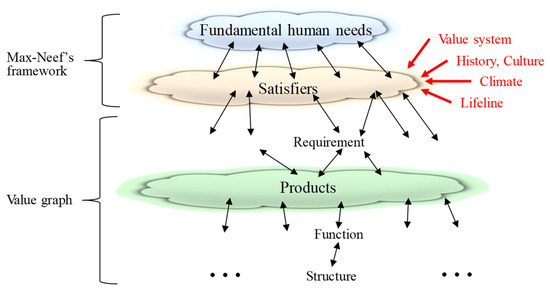
Figure 1.
Framework of the living-sphere approach.
Figure 1.
Framework of the living-sphere approach.
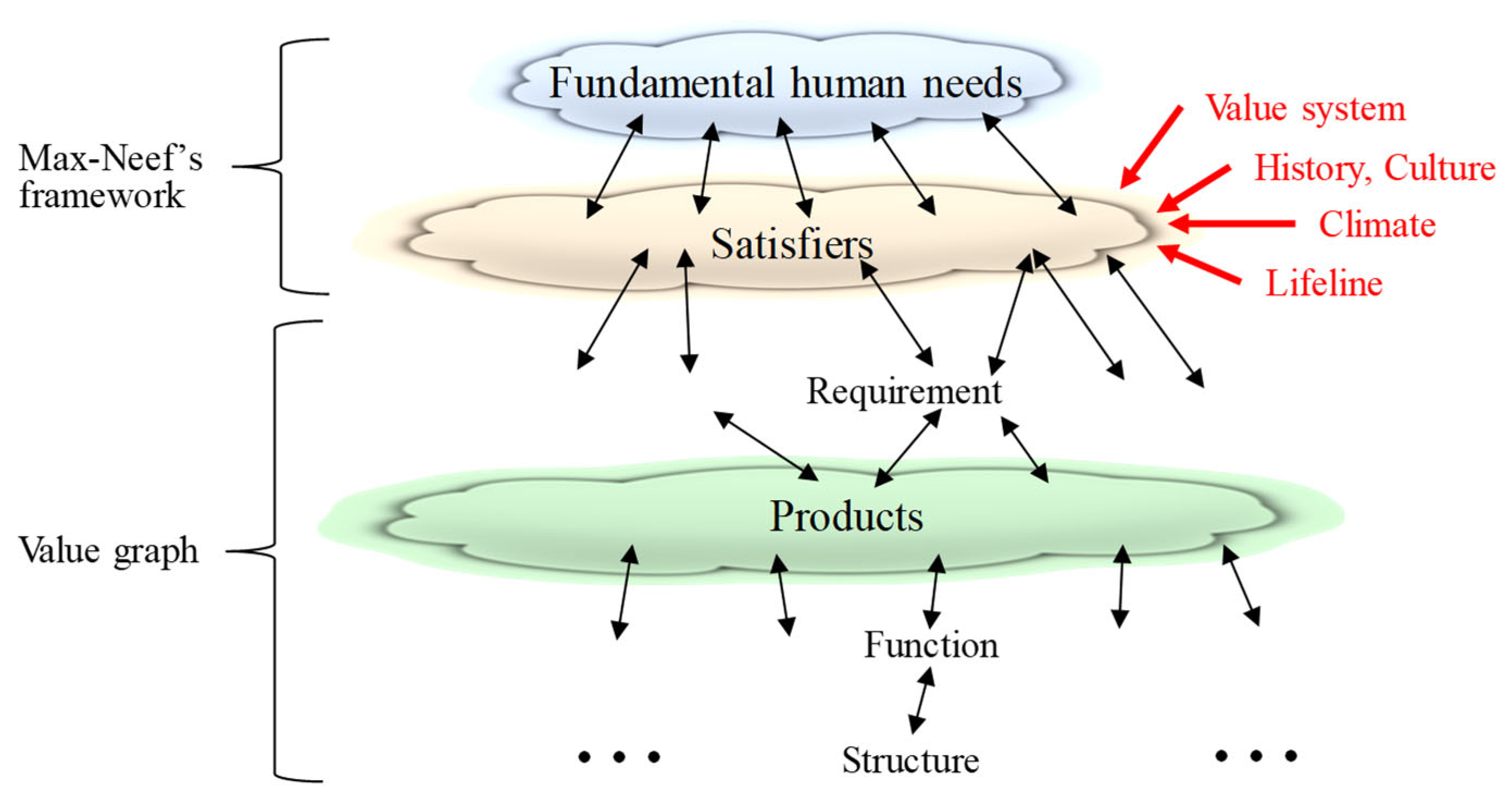
This study extends the conventional living-sphere framework by incorporating the negative effects of product functions and the barriers associated with them. While Max-Neef introduced the concept of negative satisfiers (referred to here as barriers) [15], his framework did not allow for the quantitative integration of positive and negative satisfiers or the explicit inclusion of product functions. This study addresses these limitations.
3. Method
3.1. Assumptions
In this study, the following important assumptions are set:
- I.
- The nine fundamental needs proposed by Max-Neef are fulfilled simultaneously. As a result, the hierarchy of fundamental needs is eliminated, and all have equal importance. This assumption is based on that of Max-Neef.
- II.
- A fundamental human need can be satisfied to some extent by utilizing product functions. On the other hand, the same functions might cancel out the satisfaction of other human needs.
- III.
- The satisfaction of fundamental needs increases with increasing connections between product functions and satisfier concepts, and decreases with increasing corresponding barrier connections. In addition, the positive and negative aspects of product functions can be offset in daily life. This assumption is inspired by the “net affect,” which describes mood in the field of psychology [41] and is calculated by subtracting the average score of each negative emotion from that of each positive emotion felt during daily life. In the same way, a total evaluation method for a design concept consisting of multiple solution ideas, in which positive and negative functional effects of the concrete ideas are offset, is widely used in the field of design engineering [42]. In this way, this assumption is grounded in the knowledge integration of psychology and design engineering.
- IV.
- The satisfaction of fundamental needs has both upper and lower limits, and the convergent path to the upper limit is assumed to be similar to that of the diminishing sensitivity of the value function in the prospect theory proposed by Kahneman and Tversky [43] and of the must-be requirements in the model proposed by Kano et al. [44]. The reason for this is to clarify the distinction between satisfying fundamental needs and unlimited desires.
3.2. Evaluation Procedure
The evaluation was carried out using the following four steps.
- Step 1: Setting the target areas, population, and products used in the target living sphere.
We set the age group, gender, attributes, and number of workshop participants according to the research objectives. For example, if the objective was “to explore a set of product functions that contribute to meeting fundamental human needs in Osaka ten years from now,” then it would be desirable for the workshop participants to be from the generation expected to have the greatest influence in the future—currently the younger generation—and to ensure a gender balance.
- Step 2: Identification and integration of satisfiers and barriers using Max-Neef’s workshop method.
Each participant considered satisfiers and barriers for each element of the matrix shown in Table 2 and wrote them on a sticky note (1 min). The participants then shared the satisfiers and barriers they thought of with their group (2 min). Other satisfiers and barriers could be added during the group discussion. A facilitator counted the number of participants who agreed with the satisfiers and barriers (1 min). Then, the facilitator selected the satisfiers and barriers agreed upon by more than half of the participants in each group. After all cells were filled, the matrix of satisfiers and barriers made during the workshops was synthesized by considering their commonality. A detailed example of this process is described in [45].
- Step 3: Identifying the conceptual connection from product functions to satisfiers and barriers.
The product functions and satisfiers and barriers were connected at the concept level using the concept connection matrix shown in Table 3. As the process is similar to the application of the QFD matrix, an expert analyst in product design can carry out this task. After that, multiple experts confirmed the result as investigator triangulation in order to increase credibility [46].
Table 3.
A portion of the matrix for the conceptual connection between product functions and satisfiers. X indicates that the product function is related to the satisfier.
- Step 4: Calculation of the net sufficiency of fundamental needs.
An analyst calculated the net sufficiency using the formulation described in the next section.
3.3. Formulation
In general, products are considered to have not only positive but also negative aspects in regard to their fulfillment of fundamental needs. The present study proposes a net sufficiency evaluation framework and a specific indicator considering both the satisfaction and obstruction of fundamental needs fulfillment by product function.
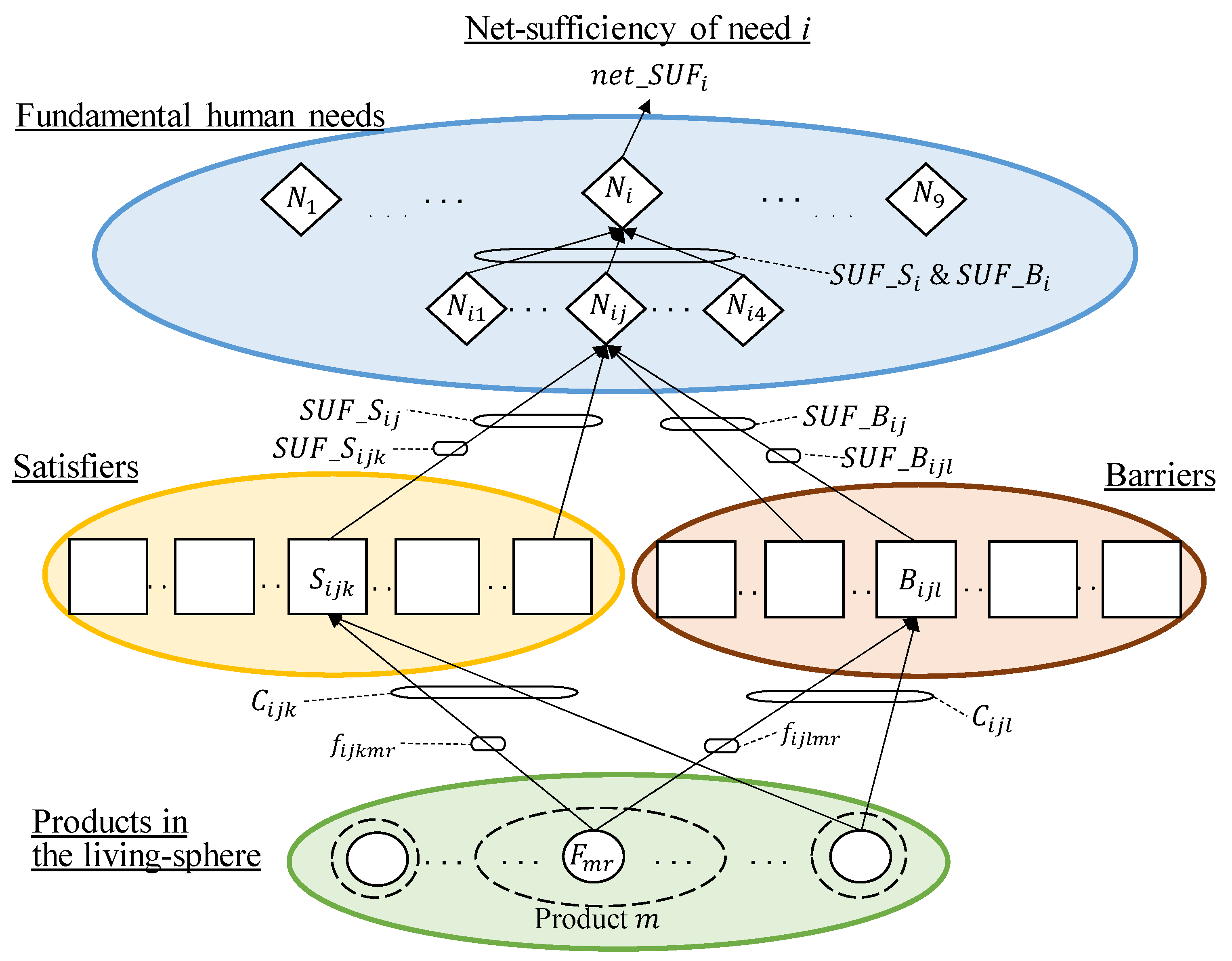
Figure 2 shows the evaluation framework for the net sufficiency. From the bottom up, it shows how the fulfillment of fundamental needs increases when the product’s functions are connected to satisfiers, whereas the fulfillment of fundamental needs decreases when the main functions are connected to barriers. In this study, fundamental needs according to the axiological categories i (i = 1, 2, …, 9) proposed by Max-Neef are denoted as , the needs according to the existential categories j (j = 1, 2, 3, 4) are denoted as , the satisfiers corresponding to needs are denoted as , and the barriers are denoted as . Here, and indicate the number of satisfiers and barriers, respectively, in the ij-cell of Max-Neef’s needs matrix.
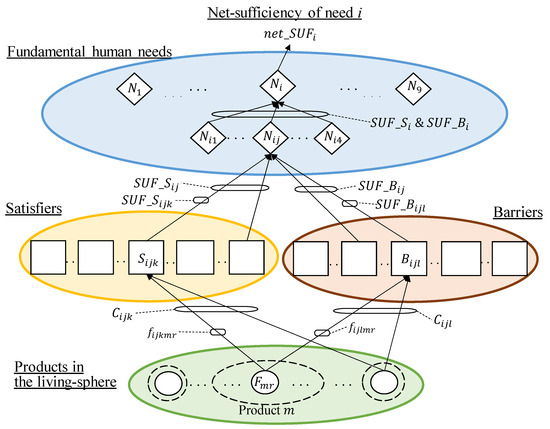
Figure 2.
Evaluation framework of net-sufficiency.
The relationships between the elements described above are formulated as follows. First, the relationship between product used in the target living sphere and the satisfiers or barriers is defined. According to the living-sphere approach, it is assumed that satisfiers can be activated by daily-use products, specifically, by the functions of the products. This study focused on the product’s function F and introduced the intensity of connection f based on assumption II, which expresses the degree of association between the function and a satisfier or barrier. Here, is the intensity of the connection between the r-th function of product and satisfier . In addition, is the intensity of the connection between the product function and barrier . Although the numerical value of f is assumed to be between 0 and 1 based on assumption IV, the value of f was set as 1 in the case studies. The connectivity between the group consisting of M product types and the satisfier and the connectivity between the product type and the barrier are formulated as Equations (1) and (2), respectively. is the number of functions of product .
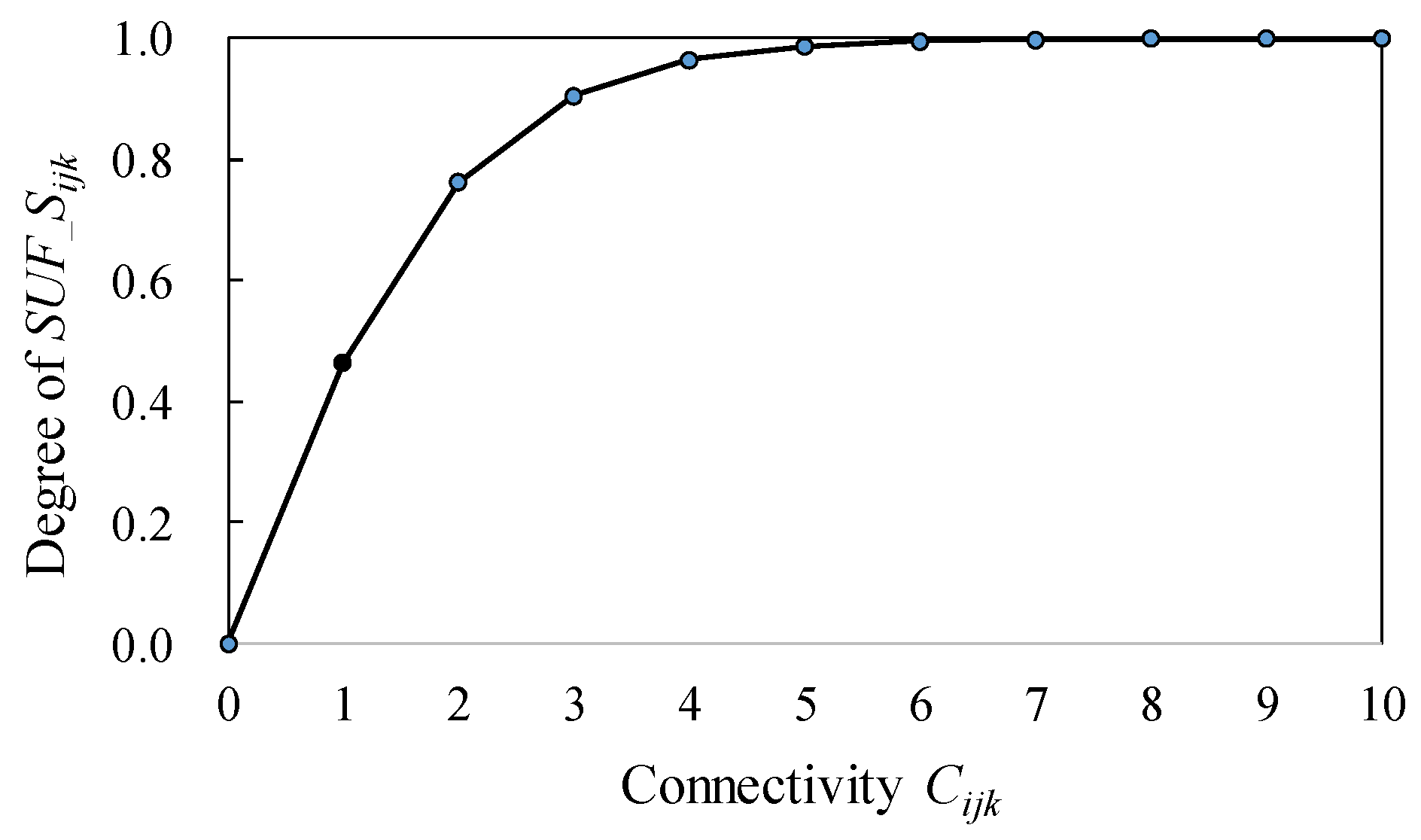
Next, , representing the degree to which satisfier contributes to needs satisfaction, and , representing the degree to which barrier obstructs needs satisfaction, are formulated as Equations (3) and (4), respectively. Here, the standard logistic function is a monotonically increasing continuous function expressed as with an inflection point at ( = 0, = 0.5), and and are regarded as and , respectively, based on assumption IV. Under the conditions of = 0 when = 0, , and the differential coefficient of with respect to is a negative value, then and are formulated as adjusted logistic functions, respectively. For example, the relationship between and is shown in Figure 3. As shown in Figure 4, approaches the upper limit asymptotically and becomes saturated at almost six connections between product functions and satisfiers.
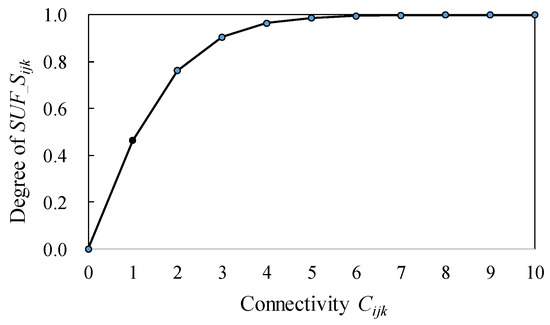
Figure 3.
Relationship between and .
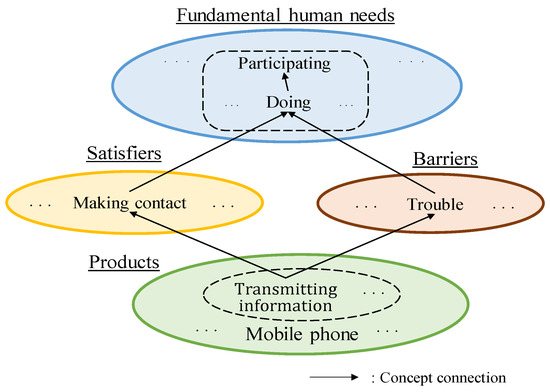
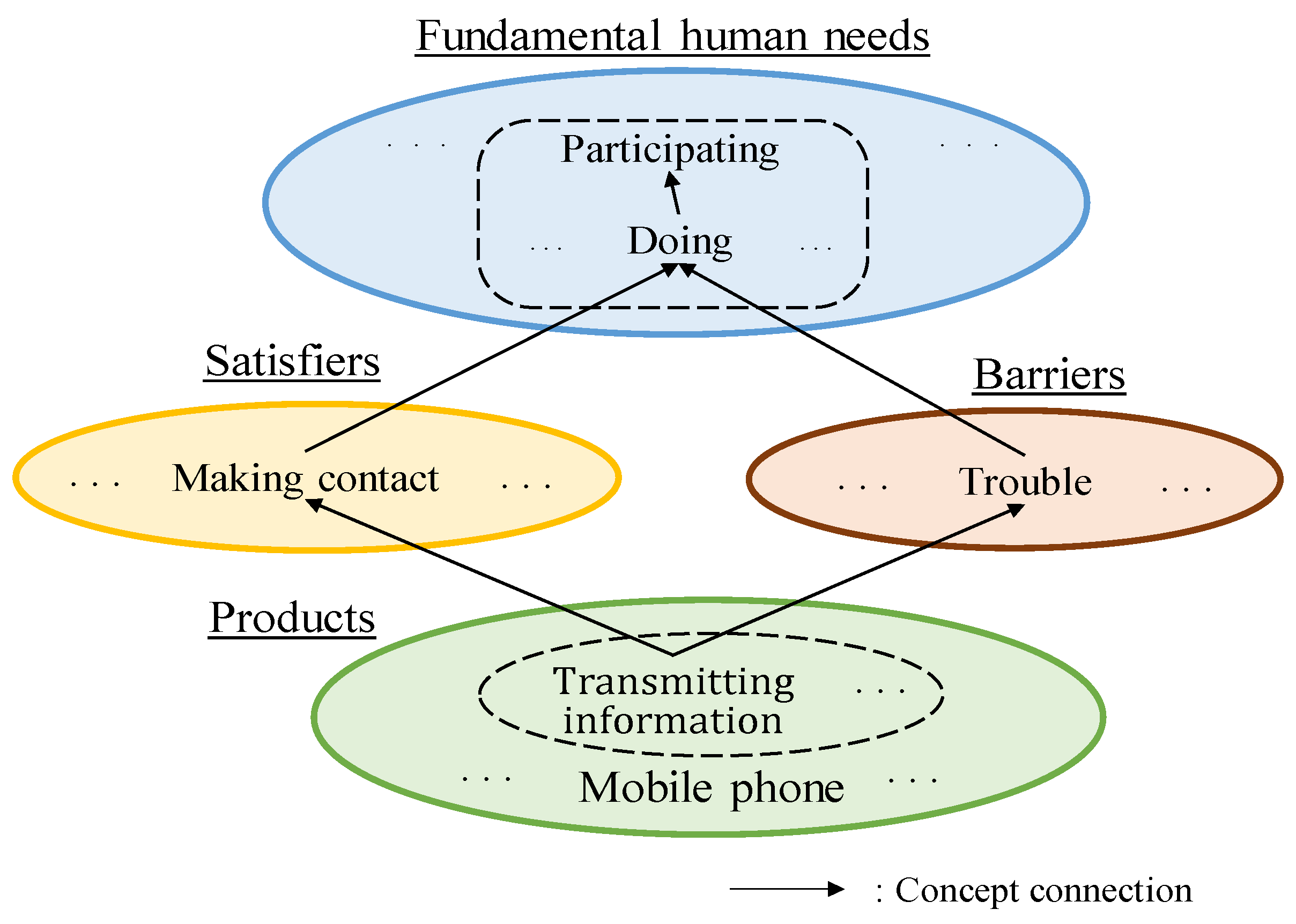
Figure 4.
Example of a concept connection between the main function of a mobile phone and a related satisfier and barrier.
Based on assumption I, the net sufficiency of need is formulated as Equation (9) using Equations (5)–(8). Note that .
Based on assumption III, the net sufficiency of fundamental need is formulated as Equation (9).
4. Case Studies
4.1. Setting Target Areas, Population, and Products
The target areas of the case study were Osaka, Japan, and Hanoi, Vietnam. These case studies were not designed for a statistical comparative study; therefore, these results should not be compared quantitatively but, instead, analyzed independently. Osaka is the largest urban city in western Japan, and Hanoi is the capital of Vietnam. Satisfiers and barriers were identified from students and working people under the age of 40 years who were living in Osaka or Hanoi. This age group was intentionally selected because younger generations are expected to play a leading role in shaping future patterns of consumption, product usage, and sustainability values. Their perspectives are therefore particularly relevant for the development of forward-looking sufficiency strategies. Although this focus may limit representativeness with respect to older or rural populations, it enhances the relevance of the findings for urban-oriented SCP policy and design aimed at the coming decades. In terms of geographic focus, Osaka and Hanoi were selected as representative urban centers in developed and emerging economies, respectively. Given the projected increase in urban population density, understanding sufficiency needs in such settings is critical for designing sustainable and resource-efficient consumption systems.
As the targets in this study, 154 products used in Osaka were selected from a retail price survey [47], and 53 products used in Hanoi were selected from a list integrating two statistics, namely, the Statistical Yearbook of Vietnam [48] and the Hanoi Statistical Office [49]. In this study, net sufficiency was calculated under the condition that these products are owned by or available in average households (i.e., a 100% diffusion rate). After selection, the main functions were set for each product. The product lists are shown in Table A1 and Table A2.
4.2. Identification and Integration of Satisfiers and Barriers
We identified satisfiers and barriers from the participants of the workshops held in Osaka and Hanoi, which were held in 2018 and 2019, respectively. The workshop groups were set up with students and young working adults to identify satisfiers and barriers, because young people’s preferences are important for the design of a sustainable society in the future. The gender balance was maintained across the groups, and participant totals and breakdown are shown in Table A3.
The workshops followed a structured three-step process inspired by Max-Neef’s needs matrix. First, each participant independently filled in the matrix by proposing satisfiers and barriers for each of the 36 need-satisfier cells, with a time limit of one minute per cell. Second, participants shared their responses in small groups and discussed their reasoning, with two minutes allocated for each cell. Third, the facilitator asked participants to indicate which items they agreed with. Only the items supported by more than half of the participants in a group were retained.
After each workshop, the resulting matrices were synthesized in two stages:
- (1)
- For each matrix cell, only satisfiers and barriers that were supported by a majority within both subgroups (students and working adults) were retained.
- (2)
- The matrices from the 2018 and 2019 workshops were integrated by merging common items across the two years and preserving unique items from either year that were not contradictory.
This approach ensured that the final set of satisfiers and barriers reflected shared understandings across time and subgroups, while reducing random or idiosyncratic inputs. The integrated satisfiers and barriers based on the above procedure are shown in Table A4, Table A5, Table A6 and Table A7. The numbers of integrated satisfiers and barriers were 138 and 59 in Osaka, and 105 and 44 in Hanoi, respectively. Table 4 and Table 5 show the number of satisfiers and barriers in Osaka and Hanoi used for the calculation, respectively. Details of the workshop held in Hanoi are reported in Kobayashi et al. [45], while the Osaka workshop was conducted in a similar way.
Table 4.
The number of satisfiers and barriers used for sufficiency calculation in Osaka.
Table 5.
The number of satisfiers and barriers used for sufficiency calculation in Hanoi.
4.3. Concept Connection
The concept of the function of the product was connected to the concepts of the satisfiers and barriers by one of the authors, according to the method described in Step 3 in the evaluation procedure. The validation process of the connections was employed by graduate students in another sustainability research group. For example, Figure 4 shows the connection results for the typical function of a mobile phone as “transmitting information.” Using the mobile phone function “transmitting information” makes it possible to contact others and provides the satisfier “making contact.” On the other hand, “transmitting information” also creates the possibility of encountering problems with others. Therefore, the function of “transmitting information” is also connected to the barrier “trouble.” In this example, these satisfiers and barriers are connected with the fundamental need “participating.” Similarly, connections were established between satisfiers and barriers and the functions of daily-use products in Osaka and Hanoi.
4.4. Calculation of the Net Sufficiency
This section presents the results of net sufficiency calculations for Osaka and Hanoi separately. While the same methodology is applied in both cases using Equations (7)–(9), the purpose here is not to enable direct cross-regional comparison, but rather to offer parallel insights grounded in their respective cultural and socioeconomic contexts. Each subsection highlights locally relevant patterns in the relationship between product functions, satisfiers, and barriers.
4.4.1. Results in Osaka
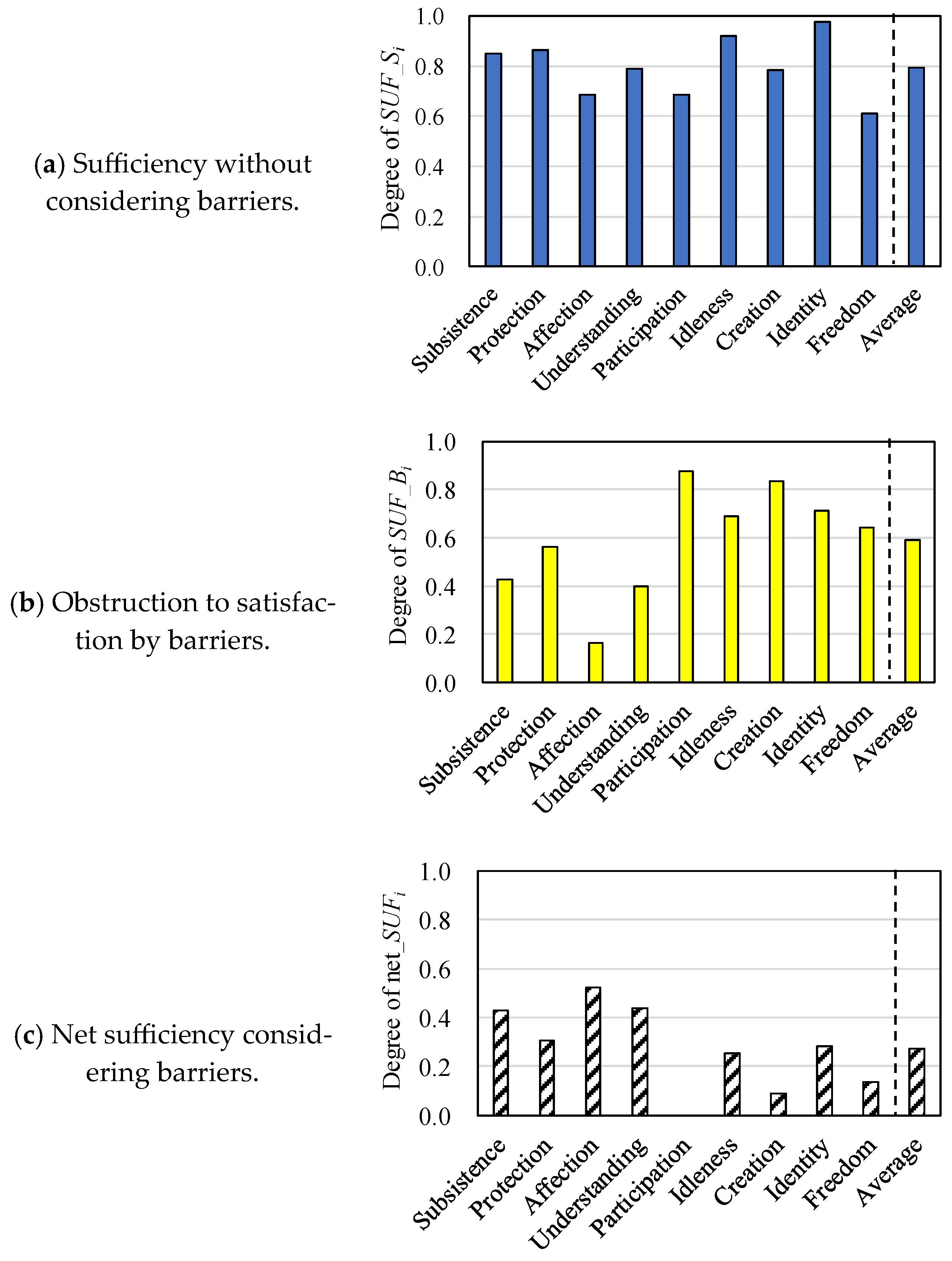
Equations (7)–(9) were used to calculate the positive aspects of products regarding need sufficiency, the negative aspects, and the net sufficiency, considering the negative aspects for the Osaka case. Figure 5 presents the calculation results based on data obtained from young participants in Osaka. Figure 5a–c show the degrees of sufficiency without considering barriers, obstruction to satisfaction by barriers, and net sufficiency considering barriers, respectively. The average values suggest that sufficiency without considering barriers contributes to the fulfillment of each need in a balanced way, with an average value of 0.80 (Figure 5a).
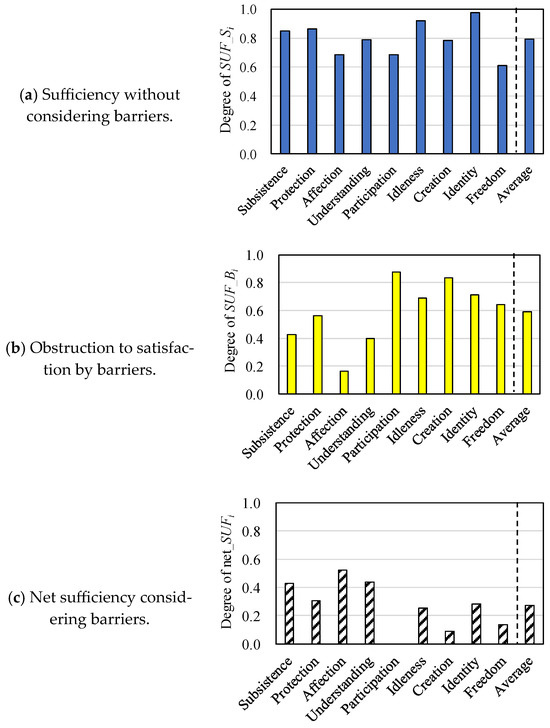
Figure 5.
Calculation results of fundamental needs sufficiency in Osaka: (a) sufficiency without considering barriers; (b) obstruction to satisfaction by barriers; (c) net sufficiency considering barriers.
Figure 5b shows a high degree of obstruction for five needs: participation, idleness, creation, identity, and freedom. The need for participation had the highest number of barriers (12); such as “being busy”, “having a sickness”, and “causing trouble”, which increases the degree of obstruction to participation (see Table 4 and Table A5). There are many connections between “causing trouble” and product functions, and the connected products are mobile phones, personal computers, home gaming consoles, and so on. These connections are consistent with real-life observations, such as internet and smartphone addiction among young Japanese adults [50]. The literature points out that serious problems occur as a result of playing online games for significantly longer periods of time. The number of barriers related to idleness, creation, identity, and freedom was not necessarily high, but each barrier had a high association with product function and thus led to high obstruction scores. In contrast, while the subsistence need had a similarly high number of barriers (eleven), items such as “war” and “food shortage” were less connected to daily-use product functions and therefore resulted in a lower degree of obstruction.
4.4.2. Results in Hanoi
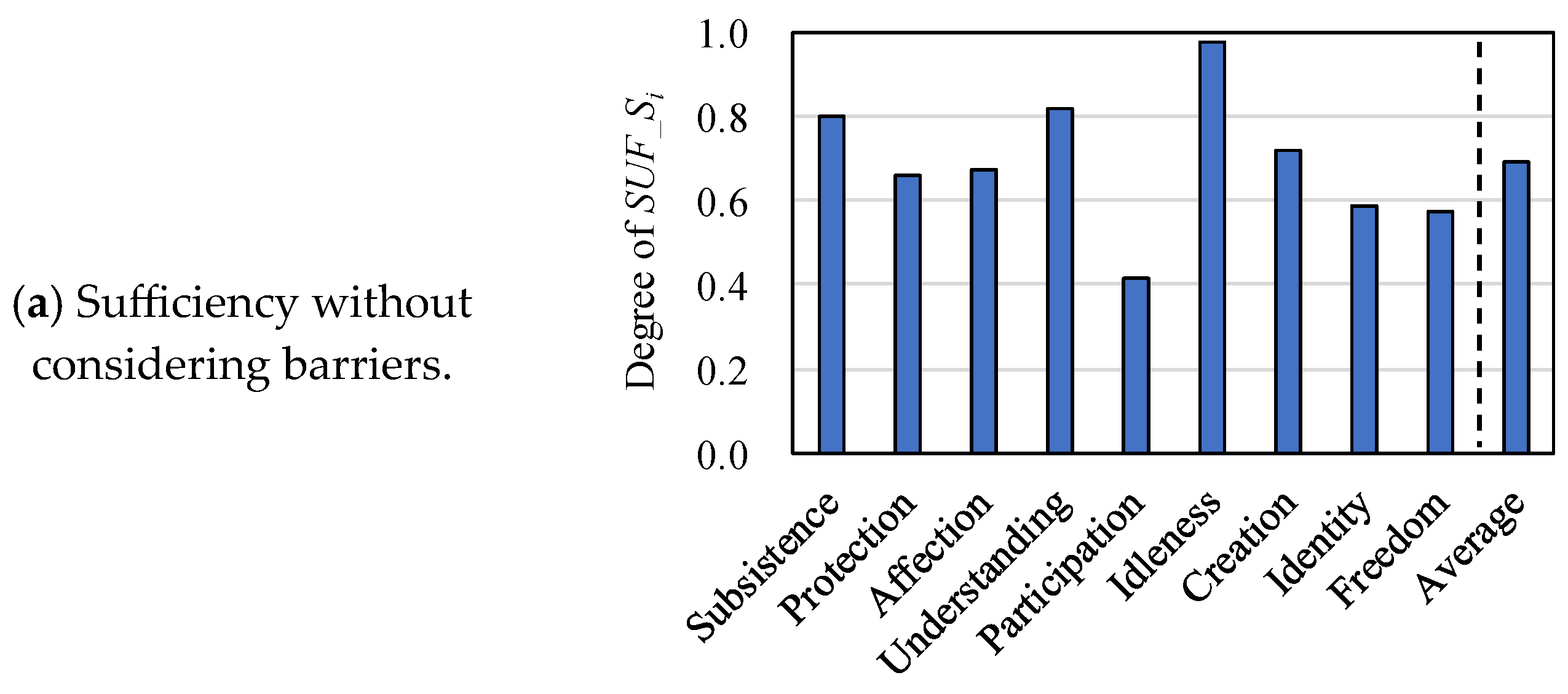
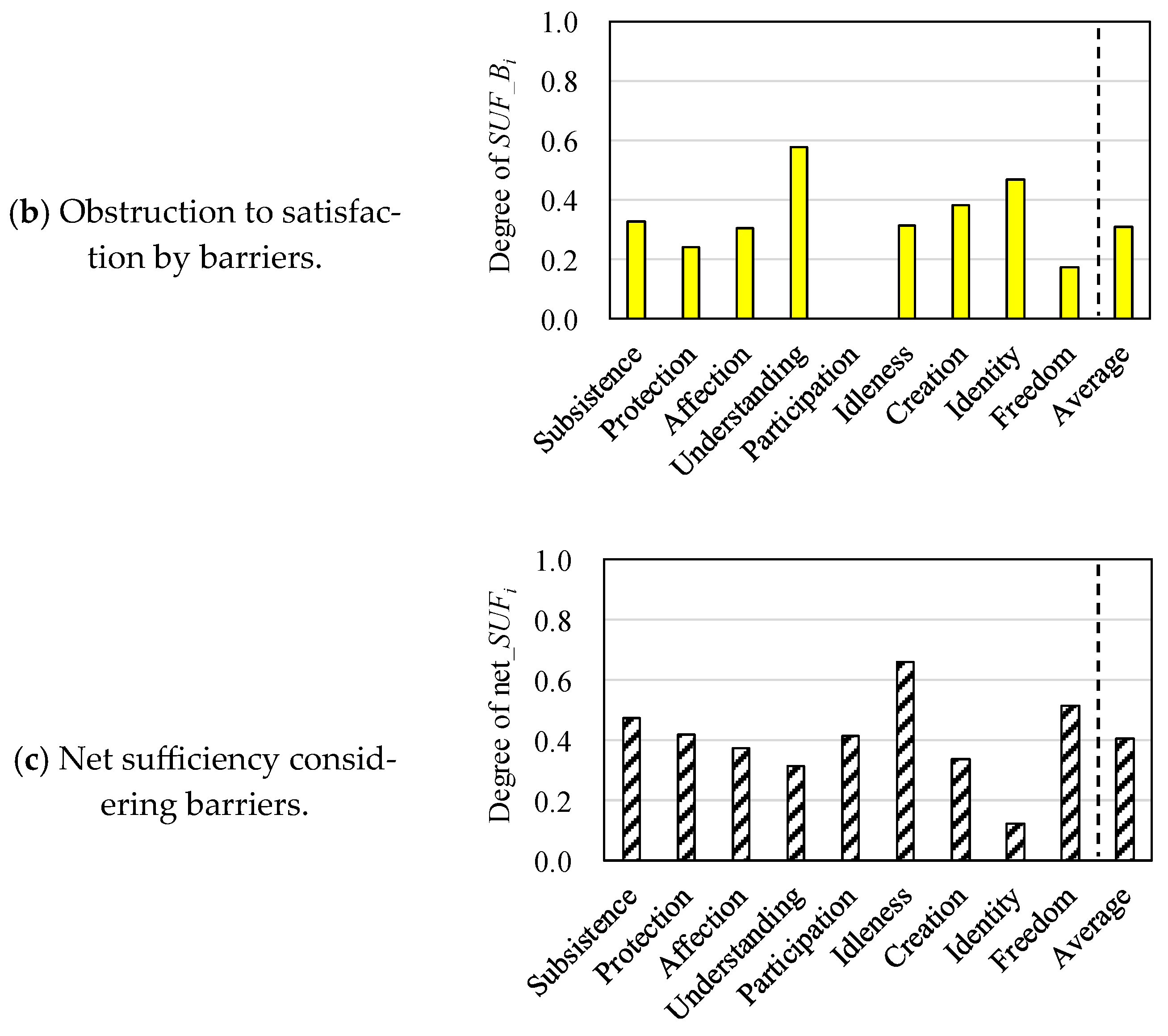
Figure 6a–c show the degrees of sufficiency without considering barriers, obstruction to satisfaction by barriers, and net sufficiency considering barriers, respectively. The highest sufficiency without considering barriers was observed for the idleness need and the lowest for participation, with an overall average of 0.69 (Figure 6a). Idleness, which represents a key cultural value in Vietnamese daily life, showed high sufficiency, and product functions are connected to satisfiers related to the idleness need, such as “being refreshing”, “being comfortable”, “being restful”, “having games” and “playing games” (see Table A6). As shown here, game or gaming is a very important satisfier for young Vietnamese adults. This phenomenon is supported by academic research, for example, it has been pointed out that gaming allows an escape from the tight cultural pressures, expectations, and social norms of day-to-day life for many Vietnamese [51].
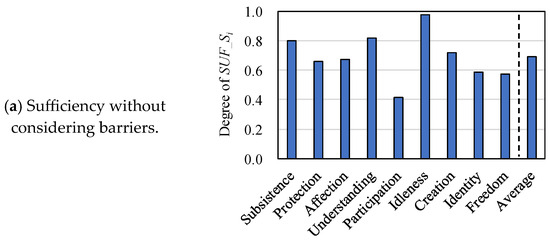
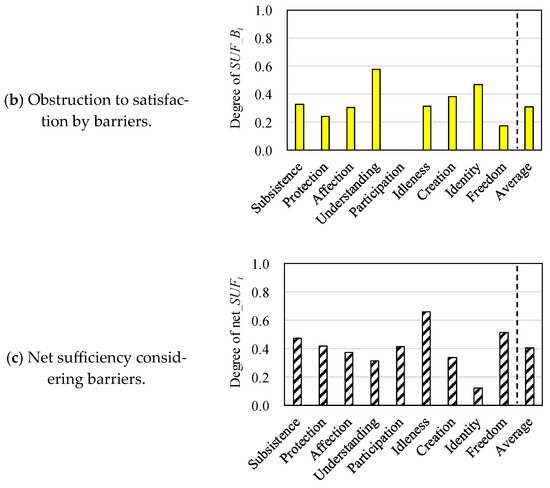
Figure 6.
Calculation results of fundamental needs sufficiency in Hanoi: (a) sufficiency without considering barriers; (b) obstruction to sufficiency by barriers; (c) net sufficiency considering barriers.
As shown in Figure 6b, the degree of obstruction was generally low across needs, particularly for participation, which had an obstruction degree of zero. This reflects the small number of identified barriers related to participation and their limited connection to product functions (e.g., “limited time” and “acting irregularly”). Figure 6c shows the resulting net sufficiency, indicating high sufficiency for the idleness and freedom needs and no functional obstruction to participation.
5. Discussion
5.1. Calculation Method of the Net Sufficiency
The proposed method is considered to be relevant in the field of SCP as it focuses on the relationship between products and their satisfiers and barriers, and enables the degree of needs fulfillment to be quantified according to region-specific product use. Although it cannot be used for quantitative comparisons between countries or broader regions like the existing indices shown in Section 2.1, its significance lies in its ability to capture regional differences in products, satisfiers, and barriers.
The key to this study is the validity of the assumptions, especially assumption III. We used the concept of net affect, which assumes that positive and negative affections can be offset, since affection is one of Max-Neef’s human needs, it can be inferred that offsetting positive and negative needs is valid. In addition, offsetting the positive and negative effects of design ideas is a well-known method for mitigating trade-offs between functions in product design, and offsetting positive and negative effects at the functional level is also valid. However, the validity of the assumptions that integrate such ideas cannot be proven theoretically, but rather through the usefulness of the evaluation method designed in accordance with the assumption. As in the case study, not only the overall evaluation results but also the details of the evaluation results could be analyzed without contradiction, thereby demonstrating the usefulness of the proposed method.
The expected users of the indicator are policymakers and product designers.
For policymakers:
- Policy subsidies could be implemented to promote the uptake of products connected to satisfiers.
- Policy support could also be provided to ban the use of products connected to barriers or to develop alternatives.
For product designers:
- Design products to increase the number of product functions connected to satisfiers or reduce the number of product functions connected to barriers.
- This evaluation information can be used to design a product set that provides the highest net sufficiency with the lowest total material consumption.
5.2. Uncertainty Analysis of the Intensity of Connection Between Product Functions and Satisfiers or Barriers
Table 6 and Table 7 show the mean values and standard errors estimated by generating a random value, n = 1000, to trial times within the range of 0 for no connection and 0 < f ≤ 1 for a connection, representing the intensity of connection f. As shown in Table 6 and Table 7, the standard errors were very small (<10−2). The results suggest that the intensity of the connection between a product’s function and its satisfier or barrier is not very important, but the connection itself is crucial to its evaluation value.
Table 6.
The mean values and standard errors of net sufficiency in Osaka.
Table 7.
The mean values and standard errors of net sufficiency in Hanoi.
On the other hand, there may be realistic ranges for the intensity of a connection. In this study, the analyst only determined the presence or absence of a connection and did not identify the intensity of the connection. This is because there was no evidence to determine the intensity value, although the presence or absence of a connection alone was considered to be quite certain, even when relying on the analyst’s feelings. How to set and assign appropriate ranges of connection intensity is an issue that should be considered in future research. For example, it may be possible to estimate the intensity range and median value by conducting a questionnaire using a Likert scale with local people instead of analysts; however, there are also concerns that the cost of data collection would be too high and that it would depend on the knowledge and experience of those people.
5.3. Limitations and Future Work
The methodological limitations of this study are the result of the framework itself, which evaluates needs fulfillment in terms of the conceptual connection between the main functions of products and their satisfiers and barriers. The limitations caused by the use of product functions, satisfiers, or barriers, as well as the representation of their concepts using natural language, are discussed as follows.
- Although the value of a product is determined by not only its functional use value but also its total economic and emotional values [52], this indicator focuses only on the function of the product during use and cannot reflect emotional aspects related to the product’s structure and attributes, such as memories and attachment, despite the fact that these are related to needs satisfaction. Furthermore, fundamental needs are not satisfied solely by artifacts, such as industrial products; they can also be fulfilled by human communication activities, such as family services and sporting activities, or natural objects, such as pets, wildlife, and the appreciation of mountains and seascapes. The proposed evaluation method excludes such possibilities and focuses solely on the contribution of the functions of products. Therefore, even if the net sufficiency of a product is 1, it does not necessarily mean that all fundamental needs are fully met. The value of net sufficiency is meaningful for relative comparisons when analyzing the artifact environment.
- In this study, regional and cultural differences reflected in satisfiers or barriers and daily-use products were taken into account. The proposed method is computable in any region of the world. However, computability does not necessarily mean that its application is appropriate. Two independent case studies were conducted during this research, and while they provide a reasonable explanation in their individual contexts, it is still too early to conclude whether the evaluation framework can be universally applied in a wider range of contexts.In order to discuss on possibility of cultural interpretation, qualitative comparisons between Osaka and Hanoi are shown. For example, “having food” for satisfying subsistence needs is focused (see Table A4 and Table A6). The number of product functions connected to “having food” was 18 in Osaka and 12 in Hanoi. These included the common products “rice cooker”, “microwave oven” and “refrigerator”, while products representing cultural differences included “system kitchen”, “sealed food containers”, and “plastic wrap” for the former and “threshing machine”, “chemical fertilizers”, and “household ceramics” for the latter (see Table A1 and Table A2).Japanese cuisine demonstrates significant diversity, particularly within urban households such as those in Osaka. In addition to traditional rice-based meals that utilize seasonal ingredients, culinary practices increasingly incorporate both Western and other Asian ingredients [53]. Modern kitchen appliances, sealed containers, and plastic wrap are commonly employed to facilitate the preparation and preservation of various food items. Conversely, in Hanoi, many caregivers—particularly mothers—express considerable concern regarding food safety, often distrusting supermarket claims due to potential chemical contamination [54]. Consequently, there is a growing tendency to cultivate food independently, including vegetables, in urban garden settings [55]. In these cases, the use of threshing machines and chemical fertilizers has been observed or inferred.As this example illustrates, regional and cultural differences can be effectively analyzed using the proposed method. Nonetheless, the study faces limitations arising from ambiguities in product listing and the identification of satisfiers or barriers. These issues warrant continued investigation.
- The inability to eliminate natural language dependency in the conceptual representation of satisfiers, barriers, and functions may have serious consequences for international comparisons. Specifically, the problem is that different languages express vocabulary, grammar, metaphors, and so on, in different ways, such that it is not easy to express subtle concepts, including nuances, equally in different natural languages. In this case study, all workshops to identify satisfiers and barriers in Japan and Vietnam were conducted by local people in each country, namely, facilitators and participants. The satisfiers and barriers written in Vietnamese were then translated into Japanese, and then, the authors developed the conceptual connections. Therefore, Vietnamese-specific nuances may not be reflected in the conceptual connections. The same problem would remain even if the analysts were Vietnamese.
Sampling bias in the case studies is also discussed as follows:
- Another limitation lies in the demographic scope of the workshop participants. The workshops focused on young urban residents (students and working adults under the age of 40) because it was thought that this group would influence future consumption and sustainability trends. However, the values, preferences, and lifestyles of this group may not be representative of older populations, rural communities, or individuals with different cultural or socioeconomic backgrounds. This could affect the types of satisfiers and barriers identified, as well as the perceived importance of various product functions. To mitigate sampling-related bias, the study employed a dual integration process—first within subgroups (students and working adults), and then across two consecutive years—to enhance internal consistency. Nevertheless, the results may still reflect a limited social perspective. Future case studies should expand the scope of the sample to include a broader demographic range, exploring whether alternative or minority viewpoints generate significantly different sufficiency profiles.
Possible topics for future work are as follows.
- The net sufficiency value depends on the contents of the set of satisfiers and barriers. Although workshops for identifying satisfiers and barriers are proceduralized, uncertainty remains because of the participants, in addition to the facilitation, atmosphere, and circumstances of the workshop. In this study, to reduce the uncertainty caused by sampling participants as much as possible, common satisfiers and barriers were selected through two combinations: commonization within and integration between the workshop groups. Although this reduced the variation in the set of satisfiers and barriers, it also sacrificed diversity. When diversity is maintained, a trade-off occurs between diversity and the region representativity of the satisfiers and barriers. Furthermore, care is needed when making a product list. Critical products with high sensitivity to need fulfillment or obstacles have to be described in product lists.
- Essentially, a product’s function is the result of the subjective recognition of its potential use by users based on various motivations. The satisfiers and barriers are also concepts that share the subjective recognition of the workshop participants. Therefore, subjectivity in the analysis cannot be excluded when forming a connection between the product’s functions and the concepts of satisfiers or barriers. In this study, the validity of the connections was verified by several people to reduce personal bias while establishing the relationships.
- Product possession status, such as the diffusion rate, should be incorporated. In this case study, all households owned the products given in the list of products (i.e., the diffusion rate was assumed to be 100%); however, to assess the sufficiency of the average household in the target area, sufficiency should be assessed considering the diffusion rate of each product. Incorporating actual diffusion rates to the intensity of the connection between function and satisfier or barrier would significantly improve the actual applicability of the evaluation for policy and design decisions. Future versions of the model should be explored how changes in diffusion rates affect net sufficiency outcomes. Currently, statistical data on the diffusion rate of household products is limited to some durable appliances such as refrigerators and washing machines, and data on other small consumable products is not available. It is necessary to consider methods for estimating the actual diffusion rate of these small products.
- A method that considers differences in the level of functional value realization (i.e., grade and performance differences) and reflects this in the intensity of connectivity should be developed. Appropriate reflection of differences in the mode of function offering, such as product ownership or leasing, in connection intensity could also be an issue for the future.
- A verification method should be established. As the scope, target, and focus of this indicator differ from other similar indicators (e.g., SWB), a simple comparison with the evaluation results of other indicators is not possible. It may be useful to survey the residents of the target area regarding their degree of life satisfaction with the product groups considered to contribute to the fulfillment of fundamental needs, and to examine the relationship between this and the degree of fulfillment.
- The proposed method targets product functions within the living sphere and, as such, does not consider user experience or services directly provided by humans and the environment. In the future, a more comprehensive understanding of universal and fundamental needs sufficiency will be possible if a method is devised to combine or integrate the net sufficiency with such factors.
- The means–end hierarchy [36,37,38] has a somewhat similar structure to the proposed evaluation framework, in terms of the concept connection between a product’s attributes and functions and its psychological consequences and terminal values. However, the connection between a product’s functions and its satisfiers or barriers in the proposed framework differs. An application of means–end hierarchies for cross-cultural studies has been reported, and multivariate statistical analysis was adopted [56]. This method is applicable when the number of terminal values and product attributes is not too high. Therefore, if a standardized method for evaluating product functions and satisfiers or barriers is developed, then cross-cultural comparison of net sufficiency may be possible. Furthermore, the cognitive structure of means–end chains of high-context cultures, such as in China and Japan, tends to be more complex than that of low-context cultures, such as in the USA and Germany [57]. Therefore, it is suggested that the difficulty of the concept connection between a product’s function and its satisfier or barrier varies. Understanding the relationship between concept connection and cultural context is also a subject for future work.
- Integrating emotional or symbolic product value and usage value by product function is also future work. Generally, the emotional value of a product is strongly related to product appearance, namely attributes, structures, surfaces, materials, and so on. We have developed a method for connecting concepts from structures via functions to satisfiers or barriers by reverse engineering and the laddering method [40]. This concept connection method can be used to expand the proposed evaluation framework. Furthermore, Kansei Engineering is a technology that meets consumers’ emotional demands by quantifying their sensibilities through engineering methods to support product design [58,59]. In future applications, these methods could provide a way to incorporate the emotional aspect into the net sufficiency framework from an engineering perspective.
6. Conclusions
In this paper, we proposed a novel net sufficiency evaluation method that quantifies both the fulfillment and obstruction of fundamental needs through the functions of daily-use products in the living sphere. By applying the proposed method to two independent case studies, we have shown that needs satisfaction, as net sufficiency, can be calculated based on the available functions of products and location-specific satisfiers and barriers.
The practical significance of this study is that it provides a comprehensive evaluation of the positive and negative effects of the functions of daily-use products in relation to the fulfillment of fundamental human needs, which is useful for planning an artificial environment that improves net sufficiency. The theoretical value of this study is that it presents a formulation for calculating net sufficiency quantitatively based on the concept of connection. Theoretical evolution of the proposed formulation can be carried out by modifying the formulation.
However, as pointed out in Section 5, this method is limited to only evaluating functions by product use. Other enablers of fundamental needs satisfaction, such as product structures, human communication, and natural elements, are outside of the evaluation method’s scope. Therefore, a more comprehensive evaluation may be achieved through the use of an appropriate combination of the proposed and existing evaluation methods for sustainable consumption. These attempts could be examined through more application cases in the future.
Author Contributions
Conceptualization, H.K. and R.K.; methodology, R.K and H.K.; software, R.K.; validation, R.K. and H.K.; formal analysis, R.K. and H.K.; investigation, H.M., R.K. and H.K; resources, H.M., R.K. and H.K; data curation, R.K. and H.K.; writing—original draft preparation, R.K.; writing—review and editing, H.K.; visualization, H.K.; supervision, H.K.; project administration, H.K.; funding acquisition, H.K. All authors have read and agreed to the published version of the manuscript.
Funding
This research was funded by the Environment Research and Technology Development Fund (S-16-1, JPMEERF16S11610) of the Environmental Restoration and Conservation Agency of Japan.
Institutional Review Board Statement
Not applicable.
Informed Consent Statement
Not applicable.
Data Availability Statement
The original contributions presented in the study are included in the article; further inquiries can be directed to the corresponding author.
Acknowledgments
We thank Shota Arai and Yu Kojima for the concept development of the sufficiency evaluation and data collection, respectively.
Conflicts of Interest
The authors declare no conflicts of interest. The funders had no role in the design of the study; in the collection, analyses, or interpretation of data; in the writing of the manuscript; or in the decision to publish the results.
Correction Statement
This article has been republished with a minor correction to resolve spelling and grammatical errors. This change does not affect the scientific content of the article.
Abbreviations
The following abbreviations are used in this manuscript:
| HDI | Human Development Index |
| HSD | Human Scale Development |
| HWBI | Human Well-Being Index |
| QFD | Quality Function Deployment |
| SCP | Sustainable Consumption and Production |
| SSI | Sustainable Society Index |
| SWB | Subjective Well-Being |
Appendix A
Table A1.
List of products used in daily life in Osaka [47].
Table A1.
List of products used in daily life in Osaka [47].
| System bus | Warm water bidet seat | Water heater | System kitchen | Carport |
| Locks | Paint | Propane gas | Kerosene | Rice cookers |
| Microwave oven | Electric kettles | Gas stoves | Electric refrigerators | Electric vacuum cleaners |
| Electric washing machines | Electric irons | Room air conditioners | Oil heaters | Electric blankets |
| Air purifiers | Wardrobes | Kitchen cabinets | Dining sets | Alarm clocks |
| Lighting fixtures | Carpet | Curtains | Bedding | Sealed food containers |
| Tableware | Cookware | Scrub brushes | Lampshades | Towels |
| Mats | Clothes hangers for drying | Vinyl hoses | Health meters | Water purifiers |
| Plastic wrap | Plastic bags | Kitchen paper | Tissue paper | Toilet paper |
| Dishwashing detergent | Laundry detergent | Fabric softener | Insecticide | Insect repellent |
| Deodorant spray | Clothing | Men’s socks | Footwear | Fabric boots |
| Athletic shoes | Cold medicine | Fever and pain reliever | Nasal allergy medication | Digestive medicine |
| Vitamin supplements (vitamin-containing health supplements) | Vitamin supplements (vitamin-based medicinal preparations) | Energy drinks | Skin medication | Pain-relieving patches |
| Eye drops | Traditional Chinese medicine | Bath additives | Sanitary napkins | Face masks |
| Glasses | Thermometers | Disposable diapers (infant) | Disposable diapers (adult) | Contact lenses |
| Contact lens solution | Blood pressure monitors | Hearing aids | Support braces | City bicycles |
| Electric bicycles | Motorcycles | Gasoline for cars | Car tires | Car batteries |
| Car navigation systems | Electronic toll collection (ETC) devices for cars | Car wax | Landline phones | Mobile phones |
| Liquid crystal display (LCD) TVs | Portable audio players | Video recorders | Cameras | Video cameras |
| Educational study aids | Personal computers | Printers | Electronic dictionaries | Ballpoint pens |
| Markers | Notebooks | Transparent adhesive tape | Pencil cases | Scissors |
| Office paper | Printer ink | Gloves | Golf clubs | Tennis rackets |
| Fishing rods | Sports shoes | Training pants | Swimwear | Dolls |
| Handicap-accessible vehicles | Assembled assistive devices for people with disabilities | Home gaming consoles | Video games | Video software |
| Cut flowers (carnations) | Cut flowers (chrysanthemums) | Cut flowers (roses) | Horticultural fertilizers | Horticultural soil |
| Plant pots | Potted plants | Pet food | Pet litter box supplies | Dry batteries |
| Recordable disks | Memory cards | Newspapers | Electric shavers | Toothbrushes |
| Facial soap | Shampoo | Hair conditioner | Toothpaste | Hair dye |
| Body soap | Facial cleanser | Hair gel | Hair tonic | Body cream |
| Toner | Foundation makeup | Lipstick | Lotion | Men’s umbrellas |
| School backpacks | Rings | Watches | Handkerchiefs |
Table A2.
List of products used in daily life in Hanoi [48,49].
Table A2.
List of products used in daily life in Hanoi [48,49].
| Pet food | Towels | Socks | Leather shoes | Laundry soap |
| Paint | Glass and glassware | Light bulbs | Tobacco | Textiles |
| Clothing | Footwear | Boots | Athletic shoes | Paper and cardboard |
| Newspapers and other printed materials | Chemical fertilizers | Nitrogen, phosphorus, potassium (NPK) fertilizers | Insecticides | Pesticides |
| Shampoo | Conditioner | Toothpaste | Shower cream | Facial wash |
| Soap | Car tires | Motorcycle and bicycle tires | Car tire tubes | Motorcycle and bicycle tire tubes |
| Plastic packaging materials | Household ceramics | Sanitary ceramics | Bricks | Tiles |
| Printers | Telephones | Mobile phones | Televisions | Battery power source |
| Lighting fixtures | Rice cookers | Microwave oven | Home refrigerators and freezers | Vacuum cleaners |
| Water heaters | Home washing machines | Home fans | Air conditioning | Threshing machines |
| Automobiles | Motorcycles | Bicycles |
Table A3.
Number of participants in the workshops.
Table A3.
Number of participants in the workshops.
| Osaka | Hanoi | ||||||||
|---|---|---|---|---|---|---|---|---|---|
| Students | Young Working Adults | Students | Young Working Adults | ||||||
| Year | Gender | For Satisfiers | For Barriers | For Satisfiers | For Barriers | For Satisfiers | For Barriers | For Satisfiers | For Barriers |
| 2018 | Male | 2 | 3 | 2 | 3 | 3 | 3 | 2 | 3 |
| Female | 3 | 2 | 3 | 2 | 3 | 3 | 3 | 2 | |
| 2019 | Male | 3 | 3 | 3 | 2 | 2 | 3 | 3 | 2 |
| Female | 2 | 2 | 2 | 2 | 3 | 2 | 2 | 3 | |
Table A4.
Satisfiers identified from the workshops held in Osaka.
Table A4.
Satisfiers identified from the workshops held in Osaka.
| Being | Having | Doing | Interacting | |
|---|---|---|---|---|
| Subsistence | Healthy Food available Able to lead a daily life | Money Food A place to live A guardian Ability to think | Eating Sleeping Talking Exercising | Water Electricity Air Temperature Moderate temperature Family and friends |
| Protection | Protected by a home or building Loved | Family Insurance | Acting with consideration for others Treating others with love | No hindrance to survival Local community People are close to each other |
| Affection | Happy Able to help companions Considerate With a partner | Someone to love Compassion A partner A pet Friends | Having a conversation Being interested in someone Treating others with care Showing consideration Expressing feelings Meeting | N/A |
| Understanding | Able to have a conversation Understand the language Able to explain to others Able to think logically Empathic Understanding the other person’s thoughts | Knowledge An open mind Tolerance Language skills | Having a conversation Educating Having interests Obtaining information Trying to know someone | Environment for exchanging opinions Place to gain knowledge Same language Something to learn Social networking services (SNSs) |
| Participation | Belonging somewhere Motivated | Necessary knowledge A shared purpose Curiosity Determination Friends | Promoting oneself Making contact Taking the initiative Joining a community Going out Asserting an opinion Acting Belonging | Understandable language Freedom of speech Means of communication |
| Idleness | Unproductive Relaxed Well-rested At ease | Time A calming space Freedom A margin Wealth | Lying down Doing nothing Sleeping Resting | Uninterrupted Unrestricted Safe and relaxing place No impending danger Place to unwind |
| Creation | Mindful Relaxed mind Time enough Expressive In a writing state | Knowledge Skills and abilities Materials A purpose to create Imagination Money Experiences Tools to express oneself | Gathering information Gathering materials Challenging oneself | People to evaluate Freedom to act Ability to interact with others People willing to cooperate Unlimited resources, facilities |
| Identity | Recognized by others Affirmed | People who accept you Hobbies | Recognizing Becoming absorbed in something Knowing the difference from others Facing oneself | Acceptance Unrestricted environment Freedom to decide what to do |
| Freedom | Unburdened by time constraints Unrestrained | N/A | Doing what you want to do | Minimal bias in thinking Peaceful Respect for human rights Freedom of speech |
Table A5.
Barriers identified from the workshops held in Osaka.
Table A5.
Barriers identified from the workshops held in Osaka.
| Being | Having | Doing | Interacting | |
|---|---|---|---|---|
| Subsistence | Illness Affected by a disaster Sleep-deprived Short of money Stressed | An illness An earthquake-prone house | N/A | War Lack of infrastructure Food shortage Social isolation and individualism |
| Protection | Lonely | Grudges Prejudices | Rejecting | Lack of support Inadequate social security |
| Affection | Without family | N/A | Acting violent Refusing to have a conversation Dominating | Life without feeling loved |
| Understanding | Unable to communicate because of a language barrier Short on communication Prejudiced Selfish | Biases | N/A | N/A |
| Participation | Financially poor Unmotivated Busy Prejudiced | A job Children A sickness Tasks | Causing trouble | No means of transportation Busy environment Conformity pressure |
| Idleness | Busy | Work | Working | N/A |
| Creation | Financially poor | A satisfied life | Denying | Pressure to conform and be like everyone else Lack of outlets for self-expression |
| Identity | Under pressure | Preconceptions | Copying others | Conformity pressure Refusal to acknowledge differences Tendency to criticize quickly |
| Freedom | Busy | Responsibilities A family A job | Restraining or restricting Committing a crime | N/A |
Table A6.
Satisfiers identified from the workshops held in Hanoi.
Table A6.
Satisfiers identified from the workshops held in Hanoi.
| Being | Having | Doing | Interacting | |
|---|---|---|---|---|
| Subsistence | Joyful Fit Sufficient | A home Food Money Drinking water Clothes | Enjoying leisure time Breathing Eating Drinking Resting Exercising Working | Interactions Conversations Love Clean air Good society |
| Protection | Sound Protected | Protective gear Insurance | Staying healthy Having, showing interest Helping | Environmental protection Prevention of flood disasters Rule of law |
| Affection | Beloved Happy Enjoyable Interested | Spouse/partner/lover | Loving Sharing Kissing Hugging Taking care of someone Having, showing interest Communicating, exchanging | Interactions Care Love |
| Understanding | Knowledgeable | Books Knowledge Qualifications Life skills Learning materials | Researching Reading books Learning | Group learning Kind community |
| Participation | Enthusiastic Excited Fun Sociable Proactive Friendly | Responsibilities | Expressing opinions Participating in social activities Working Going out to play Becoming more proactive | N/A |
| Idleness | Refreshing Comfortable Restful | Games A car Time | Playing games Reading books Playing Participating in social activities | Group participation Talking |
| Creation | Imaginative Thoughtful | Wisdom Sensibility | Drawing pictures Understanding issues | Considering others’ opinions |
| Identity | Active Passionate Outgoing Diligent Mindful | N/A | Going to festivals | Cultural enlightenment activities Civilized and equal society Open society |
| Freedom | In control | Money Vested interests A private space | Talking Going on trips Doing things one likes Shopping Listening to music | N/A |
Table A7.
Barriers identified from the workshops held in Hanoi.
Table A7.
Barriers identified from the workshops held in Hanoi.
| Being | Having | Doing | Interacting | |
|---|---|---|---|---|
| Subsistence | Poor | No food No money | Losing a job | Illness War Disaster Environmental pollution |
| Protection | Threatened | Too much money | N/A | N/A |
| Affection | Lonely Heartbroken | N/A | Getting jealous Cheating on (a partner) | Lack of intimacy |
| Understanding | Conservative Arrogant Not eager to learn | No excellent teachers No access to the Internet Poor social skills | Unable to endure studying Neglecting to understand | Lack of interaction |
| Participation | N/A | Limited time | Acting irregularly | N/A |
| Idleness | Scared Boring | N/A | Doing a job Overthinking Getting married, having a family | Harsh weather |
| Creation | N/A | Lacking knowledge | Not thinking Imitating | N/A |
| Identity | Inferiority complex Unpassionate | N/A | Judgment from society Imitating a large crowd | Lack of respect |
| Freedom | Forbidden Anxious | N/A | N/A | Interstate conflicts |
References
- United Nations Environment Programme (UNEP). ABC to SCP. 2010. Available online: https://sustainabledevelopment.un.org/index.php?page=view&type=400&nr=945&menu=1515 (accessed on 26 March 2025).
- United Nations Development Program (UNDP). Sustainable Development Goals. 2023. Available online: https://www.undp.org/sustainable-development-goals (accessed on 26 March 2025).
- Jackson, T. Motivating Sustainable Consumption—A Review of Models of Consumer Behavior and Behavioral Change, A Report to the Sustainable Development Research Network. 2005. Available online: https://timjackson.org.uk/wp-content/uploads/2018/04/Jackson.-2005.-Motivating-Sustainable-Consumption.pdf (accessed on 26 March 2025).
- Jackson, T. Live better by consuming less?—Is there a “double divided” in sustainable consumption? J. Ind. Ecol. 2005, 9, 19–36. [Google Scholar] [CrossRef]
- Organisation for Economic Co-Operation and Development (OECD). How’s Life? 2020: Measuring Well-Being. 2020. Available online: https://www.oecd.org/en/publications/how-s-life/volume-/issue-_9870c393-en.html (accessed on 26 March 2025).
- Kobayashi, Y.; Kobayashi, H.; Hongu, A.; Sanehira, K. A practical method for quantifying eco-efficiency using eco-design support tools. J. Ind. Ecol. 2005, 9, 131–144. [Google Scholar] [CrossRef]
- Hauschild, M.; Kara, S.; Røpke, I. Absolute sustainability: Challenges to life cycle engineering. CIRP Ann.-Manuf. Technol. 2020, 69, 533–553. [Google Scholar] [CrossRef]
- Rawarth, K. Doughnut Economics; Random House Business Books: London, UK, 2017. [Google Scholar]
- Hirao, M.; Tasaki, T.; Hotta, Y.; Kanie, N. Policy development for reconfiguring consumption and production patterns in the Asian region. Glob. Environ. Res. 2021, 25, 3–14. [Google Scholar]
- Tsurumi, T.; Yamaguchi, R.; Kagohashi, K.; Managi, S. Material and relational consumption to improve subjective well-being: Evidence from rural and urban Vietnam. J. Clean. Prod. 2021, 310, 127499. [Google Scholar] [CrossRef]
- Cooper, T. Slower consumption–Reflections on product life spans and the “throwaway society”. J. Ind. Ecol. 2005, 9, 51–67. [Google Scholar] [CrossRef]
- Tukker, A.; Cohen, M.J.; Hubacel, K.; Mont, O. The impact of household consumption and options for change. J. Ind. Ecol. 2010, 14, 13–30. [Google Scholar] [CrossRef]
- Schlesier, H.; Schafer, M.; Dsing, H. Measuring the doughnut: A good life for all is possible within planetary boundaries. J. Clean. Prod. 2024, 448, 141447. [Google Scholar] [CrossRef]
- Kobayashi, H.; Fukushige, S.; Murata, H. A framework for locally-oriented product design using extended function-structure analysis and mixed prototyping. Glob. Environ. Res. 2021, 25, 43–50. [Google Scholar]
- Max-Neef, M.A. Human Scale Development; The Apex Press: New York, NY, USA, 1991. [Google Scholar]
- Kobayashi, H.; Fukushige, S. A living-sphere approach for locally oriented sustainable design. J. Remanufacturing 2018, 8, 103–113. [Google Scholar] [CrossRef]
- Hadar, A.; Hadas, I.; Lazarovits, A.; Alyagon, U.; Eliraz, D.; Zangen, A. Answering the missed call: Initial exploration of cognitive and electrophysiological changes associated with smartphone us and abuse. PLoS ONE 2017, 12, e0180094. [Google Scholar] [CrossRef] [PubMed]
- Fu, S.; Chen, X.; Zheng, H. Exploring an adverse impact of smartphone overuse on academic performance via health issues: A stimulus-organism-response perspective. Behav. Inf. Technol. 2021, 40, 663–675. [Google Scholar]
- Summers, J.; Smith, L.; Harwell, L.; Case, J.; Wada, C.; Straub, K.; Smith, H. An index of human well-being for the U.S.: A TRIO approach. Sustainability 2014, 6, 3915–3935. [Google Scholar] [CrossRef]
- United Nations Development Program (UNDP). Human Development Report 2020. Available online: https://hdr.undp.org/content/human-development-report-2020 (accessed on 26 March 2025).
- Sen, A. Capability and well-being. In The Quality of Life; Nussbaum, M., Sen, A., Eds.; Oxford University Press: New York, NY, USA, 1993; pp. 30–53. [Google Scholar]
- Organisation for Economic Co-operation and Development (OECD). Guidelines on Measuring Subjective Well-Being. 2013. Available online: https://www.oecd.org/en/publications/oecd-guidelines-on-measuring-subjective-well-being_9789264191655-en.html (accessed on 26 March 2025).
- Tsurumi, T.; Yamaguchi, R.; Kagohashi, K.; Managi, S. Sustainable consumption in terms of subjective well-being in Asia. Glob. Environ. Res. 2021, 25, 93–99. [Google Scholar]
- Van de Kerk, G.; Manuel, A. A comprehensive index for a sustainable society: The SSI—The sustainable society index. Ecol. Econ. 2008, 66, 228–242. [Google Scholar] [CrossRef]
- US EPA. Indicators and Methods for Constructing a U.S. Human Well-Being Index (HWBI) for Ecosystem Services Research; Report # EPA/600/R-12/023; US EPA: Washington, DC, USA, 2012.
- Smith, L.; Cas, J.; Harwell, L.; Smith, H.; Summers, J. Development of relative importance values as contribution weights for evaluating human wellbeing: An ecosystem services example. Hum. Ecol. 2013, 41, 631–641. [Google Scholar] [CrossRef]
- Kamenetzky, M. The economics of the satisfaction of needs. Hum. Syst. Manag. 1981, 2, 101–111. [Google Scholar] [CrossRef]
- Doyal, L.; Gough, I. Theory of human needs. Crit. Soc. Policy 1984, 4, 6–38. [Google Scholar]
- Maslow, A. A theory of human motivation. Psychol. Rev. 1943, 50, 370–396. [Google Scholar]
- Guillen-Royo, M. Sustainability and Wellbeing—Human Scale Development in Practice; Routledge: New York, NY, USA, 2016. [Google Scholar]
- Guillen-Royo, M.; Guardiola, J.; Garcia-Quero, F. Sustainable development in times of economic crisis: A need-based illustration from Granada (Spain). J. Clean. Prod. 2017, 150, 267–276. [Google Scholar] [CrossRef]
- Cuthil, M. From here to utopia: Running a human-scale development workshop on the Gold Coast, Australia. Local Environ. 2003, 8, 471–485. [Google Scholar] [CrossRef]
- Paul, G.; Beitz, W. Engineering Design: A Systematic Approach; The Design Council: London, UK, 1988. [Google Scholar]
- Akao, Y. Quality Function Deployment; CRC Press: New York, NY, USA, 2004. [Google Scholar]
- Clausing, D. Total Quality Development; ASME Press: New York, NY, USA, 1993. [Google Scholar]
- Gutman, J. A means-end chain model based on consumer categorization processes. J. Mark. 1982, 46, 60–72. [Google Scholar]
- Walker, B.; Olson, J. Means-end chains: Connecting products with self. J. Bus. Res. 1991, 22, 111–118. [Google Scholar]
- Sorakunnas, E.; Konu, H. Digitally customized and interactive laddering: A new way for examining tourists’ value structure. Empir. Res. Artic. 2022, 62, 626–643. [Google Scholar]
- Ishii, K. Textbook of ME217 Design for Manufacture: Product Definition; Stanford University: Stanford, CA, USA, 1998. [Google Scholar]
- Murata, H.; Kobayashi, H. Conceptual Modeling Method for Living-Sphere Approach. JSME Transactions of the JSME. 2020. Available online: https://www.jstage.jst.go.jp/article/transjsme/86/886/86_19-00390/_article/-char/en (accessed on 26 March 2025).
- Kahneman, D.; Krueger, A.B. Developments in the measurement of subjective well-being. J. Econ. Perspect. 2006, 20, 3–24. [Google Scholar]
- Kobayashi, H. Strategic evolution of eco-products: A life cycle planning methodology. Res. Eng. Des. 2005, 16, 1–16. [Google Scholar]
- Kahneman, D.; Tversky, A. Prospect theory: An analysis of decision under risk. Econometrica 1979, 47, 263–291. [Google Scholar]
- Kano, N.; Seraku, N.; Takahashi, F.; Tsuji, S. Attractive quality and must-be quality. J. Jpn. Soc. Qual. Control 1984, 14, 39–48. [Google Scholar]
- Kobayashi, H.; Sumimura, Y.; Dinh, C.N.; Tran, M.; Murata, H.; Fukushige, S. Needs-based workshops for sustainable consumption and production in Vietnam. In Smart Innovation, Systems and Technologies; Ball, P., Huatuco, L., Howlett, R., Setchi, R., Eds.; Springer: Singapore, 2019; Volume 155, pp. 35–47. [Google Scholar]
- Thurmond, V. The point of triangulation. J. Nurs. Scholarsh. 2001, 33, 253–258. [Google Scholar]
- Ministry of Internal Affairs and Communications. Retail Price Survey, Section of Trends. 2020. Available online: https://www.stat.go.jp/english/index.html (accessed on 26 March 2025).
- General Statistical Office of Vietnam, Statistical Yearbook of Vietnam. Niên giám thống kê; VISTA PS: Japan, 2016; pp. 223–227. ISBN 4907379390.
- Hanoi Statistical Office. Cục Thống kê Hà Nội, “Niên giám thống kê”. 2014; pp. 302–304. Available online: https://www.nso.gov.vn/du-lieu-va-so-lieu-thong-ke/2019/10/nien-giam-thong-ke-2014/ (accessed on 1 June 2025).
- Tateno, M.; Teo, A.; Ukai, W.; Kaanazawa, J.; Kaatsuki, R.; Kubo, H.; Kato, T. Internet addiction, smartphone addiction, and hikikomori trait in Japanese young adult: Social isolation and social network. Front. Psychiatry 2019, 10, 455. [Google Scholar] [CrossRef]
- McCauley, B.; Nguyen, T.; McDonald, M.; Wearing, S. Digital gaming culture in Vietnam: An exploratory study. Leis. Stud. 2020, 39, 372–386. [Google Scholar] [CrossRef]
- Chapman, J. Emotionally Durable Design, 2nd ed.; Routledge: New York, NY, USA, 2015. [Google Scholar]
- Bestor, T.; Bsetor, V. Cuisine and identity in contemporary Japan. Educ. About Asia 2011, 16, 13–18. [Google Scholar]
- Wertheim-Heck, S.; Raneri, J. Food policy and the unruliness of consumption: An intergenerational social practice approach to uncover transforming food consumption in modernizing Hanoi, Vietnam. Glob. Food Secur. 2020, 26, 100418. [Google Scholar] [CrossRef]
- Faltmann, N. Urban gardening in Ho Chi Minh city: Class, food safety concerns, and crisis of confidence in farming. Food Cult. Soc. 2023, 26, 927–944. [Google Scholar] [CrossRef]
- Valette-Florence, P. A causal analysis of means-end hierarchy in a cross-cultural context: Methodological refinements. J. Bus. Res. 1998, 42, 161–166. [Google Scholar] [CrossRef]
- Fu, C.; Wu, W. The means-end cognitions of web advertising: A cross-cultural comparison. Online Inf. Rev. 2010, 34, 686–703. [Google Scholar] [CrossRef]
- Nagamachi, M. Kansei engineering: A new ergonomic consumer-oriented technology for product development. Int. J. Ind. Ergon. 1995, 15, 3–11. [Google Scholar] [CrossRef]
- Nagamachi, M. Kansei engineering as a powerful consumer-oriented technology for product development. Appl. Ergon. 2002, 33, 289–294. [Google Scholar] [CrossRef]
Disclaimer/Publisher’s Note: The statements, opinions and data contained in all publications are solely those of the individual author(s) and contributor(s) and not of MDPI and/or the editor(s). MDPI and/or the editor(s) disclaim responsibility for any injury to people or property resulting from any ideas, methods, instructions or products referred to in the content. |
© 2025 by the authors. Licensee MDPI, Basel, Switzerland. This article is an open access article distributed under the terms and conditions of the Creative Commons Attribution (CC BY) license (https://creativecommons.org/licenses/by/4.0/).