


Abstract
The gradual replacement of conventional materials with materials tailored to the green development goals is one of the needs of the day. Correspondingly, this article reviews and integrates, for the first time, the gathered knowledge on the use of the adsorbents based on polymeric biomasses (biosorbents) for a cleaner separation of cobalt (Co) from synthetic and actual solutions. It is a two-part comprehensive approach that debates the Co biosorption potential of bio-based polymers from the perspective of their virtual and real applications for decontamination, recovery, and analytical purposes. First, the removal performances of these materials to batch and fixed column biosorption of Co(II) from mono-component and multi-metallic laboratory solutions are systematized and discussed. Following that, the focus of the first part is shifted to the analytical capabilities of the biosorbents proposed for Co(II) quantification from synthetic solutions. The second section considers the polymeric biomasses successfully incorporated in practical strategies for the removal and recovery of Co(II) from real solutions. The opportunities provided by the use of biosorbents for the development of accurate and greener procedures in Co(II) analysis are also highlighted. The directions in which the research on this topic should be continued and strengthened are suggested.
1. Introduction
The element of interest for this work, namely cobalt (Co), which may exist in the 0, +2, and +3 states of oxidation, has many common features with other members of the heavy metals family to which it belongs, but also radioactive properties [1]. It is ranked as a critical metal [2] and, depending on its concentration level, can act both as a priority pollutant and an essential element for metabolic activities [3]. Taking into account the prevalence of this form in environmental conditions, divalent cobalt, Co(II) receives the most attention.
Co falls currently into the category of critical materials on the basis of its economic significance and the risk of supply shortcomings [4]. Besides the notorious uses in rechargeable lithium-ion batteries and super alloys, Co is also critical for plenty of industries, such as hydrometallurgical, electroplating, petrochemical, electronics, and ceramics, as well as for nuclear power plants, and medicine [5,6,7]. This intensive Co utilization can cause natural resources depletion. On the other hand, the wide spectrum of Co applications results in a continuous aggravation of its pollution impact and more and more serious problems in public health [8]. Therefore, the remediation of Co contaminated aqueous media is an important contemporary society task. Having as main objective the meeting of ever-increasing demand for Co, which is estimated at 183% in 2030 [9], the recovery of Co from waste solutions is also beneficial for environmental protection. One other benefit is the contribution of recovered Co use to the reduction of CO2 generation [10]. All these aspects highlight the key role of an efficient method of separation/preconcentration that is able to cope with the requirements imposed for complete removal, quantitative recovery, and accurate analysis of Co from different effluents and sources.
The approaches developed for the above mentioned goals focus on separation methods of Co from aqueous solutions, such as adsorption [11,12,13], ion exchange [14,15], chemical precipitation [16,17], membrane processes [18], solvent extraction [19,20] and solid-phase extraction [21]. However, the applicability of adsorption predominates over all the other conventional methods [22,23]. The adsorption popularity is due, to some extent, to the rise of its sustainable variant, known as biosorption, and is considered an innovative tool of the 21st century technology of separation [24]. The driving force of the booming interest in the biosorption process is represented by the easily available, renewable, and recyclable polymer materials engaged as biosorbents [25,26,27,28,29,30], and is characterized by unicity in diversity. An impressive number of critical reviews emphasized the high capability of biological materials to develop biosorption-based approaches for removal-recovery of heavy metals from liquid effluents [31,32,33,34,35,36,37,38,39,40] and their analysis from a wide range of samples [41,42,43,44,45,46]. At the same time, their common recommendation is that, in order to promote the transition from virtual applications to practical applications, the strength of the biosorption potential must be confirmed in the context of real situations.
Despite the fact that Co(II) is regarded as a good model pollutant for research [47], it has been very rarely addressed in the review articles on biosorption topic and is mostly oriented towards other heavy metals, such as Cu, Zn, Cd, and Pb. The opportunities and constraints of the use of 11 categories of adsorbents, including those based on natural materials, agricultural waste materials, and biopolymers for Co(II) uptake from contaminated waters, were pointed out [22]. The attributes of filamentous fungi species in Co and Cu biosorption from synthetic aqueous solutions and the influencing factors (initial concentration of solution, biomass dose, pH, incubation time, temperature) were recently reviewed [25]. However, to the best of the author’s knowledge, no other review dealing exclusively with Co biosorption has been published to date.
In light of the above, the main goal of this work is to provide a useful tool for a step forward to cleaner removal, recovery, and determination of Co(II) in real-world conditions, by gathering together, for the first time, information on the separation of Co(II) from diluted aqueous solutions on biosorbents. Unlike the current scenario in the studies on heavy metals biosorption, this review is different because it discusses the biosorption features of polymeric biomasses on two levels, that is, as potential biosorbents and practical biosorbents for efficient separation/preconcentration of Co(II) with environmental, economic and analytical relevance. The main issues addressed are related to: (i) biosorbents for batch and fixed-bed column removal of Co(II) from mono-element synthetic solutions; (ii) biosorbents for Co(II) uptake from multi-component synthetic solutions; (iii) biological sorbents for analytical preconcentration of Co(II) from diluted synthetic solutions; (iv) real applications of biosorbents to Co(II) removal/recovery; (v) analytical procedures based on biosorbents for trace Co(II) determination from real samples.
2. Biosorbents Are Recommended as Promising Candidates for Co(II) Separation from Synthetic Solutions
2.1. Biosorption Capabilities of Polymeric Biomass
Biosorption is a green multidimensional process of metal retention from aqueous solutions on biological materials or materials derived from biological sources [32,48]. The irreplaceable advantages of the biosorption process include variety, variability, wide availability of eco-polymeric materials, its high efficiency for large volumes of wastewaters and very low concentrations, easy procedure, short operational time, versatility, low pollution, and low cost. The bio-based materials with biosorption ability can be categorized into three main classes: (i) dead biomass of microorganisms; (ii) agro-industrial wastes; (iii) other polysaccharide materials (chitin, chitosan, alginate) [37,49,50,51,52]. The first two categories of biosorbents have been most intensively investigated from the perspective of their integration in strategies for the bioseparation of heavy metals from real samples (Table 1). Contrasting with conventional adsorbents that contain a single kind of binding site, the biosorbents in Table 1 are rich in miscellaneous functional groups with multiple potentialities of binding, allowing for high retention of metals by a variety of mechanisms [35,36,37,38,39,40]. Moreover, the biosorbents stand out for their high bio-preconcentration potential, multifaceted applications, adaptability to batch and continuous (fixed-bed columns) systems, and their ability to work on the 3R principles (reduce, recycle, reuse) that govern the circular economy.

Table 1.
Focus on the most targeted biosorbents of heavy metals.
However, the biosorption performances of the biomasses’ native forms in Table 1 do not, in many cases, fall within the coordinates of practical applicability. One solution to this problem was to apply a method of immobilization, modification, or immobilization/modification that folds on the desired improvement of biosorbent surface characteristics and/or functionalities [39,69,70,71,72].
After these opening remarks, the reports in the literature on the biologically based polymeric materials proposed over time for the biosorption of Co(II) from synthetic solutions are systematized and debated in the next sections.
2.2. Biosorbents for Batch and Fixed-Bed Column Removal of Co(II) from Mono-Element Synthetic Solutions
The preference of biomaterials for the metal ion under study is mainly due to their high content in surface functional groups with oxygen as the donor atom (hydroxyl, carboxyl carbonyl, etc.) which are able to manage the Co(II) binding by interaction mechanisms of electrostatic interactions, ion exchange, complexation, and chelation. On the basis of FTIR spectral multivariate statistical analyses, biosorbents with the largest amounts of-OH of alcohols and C–H, C–O–C, C–N and P–O of polysaccharides were assumed to have a propensity to uptake Co(II) superior to other biomaterials [73].
The best part of the investigations on Co(II) biosorption was limited to lab batch biosorption studies briefly described in Table 2. They mainly address fundamental research. Due to the practical limitations of the batch operation mode, the biosorption technology transfer from the lab to the industrial scale is inconceivable without continuous fixed-bed column studies. The principal aspects targeted in the few studies dealing with dynamic biosorption of Co(II) are also presented in Table 2. Both types of biosorption experiments should be accompanied by desorption studies focusing on the selection of the best desorbing agent and the determination of the minimum number of cycles of biosorbent reusability.
Table 2.
Outline of the batch and fixed-bed column studies regarding the removal of Co(II) from aqueous solutions by biosorbents.
Among the microorganisms reported as potential biosorbents for batch biosorption of Co(II) from mono-metallic aqueous solutions are the following: six species of green, brown, and red seaweed [74]; Padina sanctae crucis brown marine alga [75]; 2-Hypnea Valentiae alga [76]; Synechocystis pevalekii cyanobacterial alga [6]; fungi (Trichoderma, Penicillium, Aspergillus, Geotrichum, Monilia, Fusarium species) [25]; Gram-negative bacteria, including Shewanella spp. [77] and Serratia marcencens [78]. However, the microbial biosorbents are clearly outclassed by the agro-industrial wastes, which are addressed in about 75% of fundamental research studies on biosorption of Co(II). These attempts are in line with the current trend of converting waste into valuable and useful resources for sustainable development and advanced strategies of waste management. The waste biomaterials with promising applicability in batch Co(II) biosorption from synthetic mono-component aqueous solutions include: banana and orange peels [79]; black carrot (Daucus carrota L.) residues [80]; almond green hull [81]; corn silk [82]; Amaranthus hydridus L. stalk wastes [83]; agricultural waste Luffa cylindrica [84]; powders of groundnut seed cake, sesame seed cake and coconut cake [85]; forestry wastes of pine sawdust [86] and eucalyptus bark [87]; bones of animal [88], cuttlefish [89] and Lates niloticus fish [90]; biomass derived from the pulp of Saccharum bengalese [91]; Chrysanthenum indicum flower biomass [92]; dead neem leaves [93]; clearing nut seed powder [94]; sludge of sewage treatment plants [95,96,97].
Before their feasibility as agents of Co(II) decontamination was studied, the surface of many aforementioned biomass raw forms was chemically or magnetically modified. The most popular methods are the pretreatment of biomaterials via inorganic and organic chemical modifying agents, mainly applied for biomasses cleaning and the substantial increase of their biosorptive activity. To highlight this enhancement, Figure 1 juxtaposes the maximum capacity of Co(II) biosorption of the selected biosorbents based on untreated and modified biomasses.
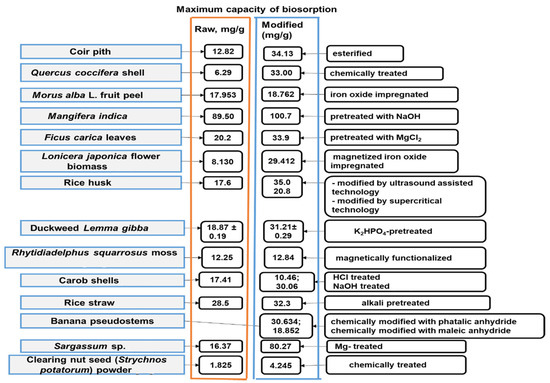
Figure 1.
Comparison between raw and modified biomasses for batch removal of Co(II) from synthetic solutions [27,29,94,98,99,100,101,102,103,104,105,106,107,108,109,110].
From Figure 1, it is obvious that the application of a chemical or magnetic modification gives an edge to modified biosorbents. Moreover, Figure 1 shows that the level of improvement in biomasses features for biosorption goals strongly depends on the nature of chemical modifications. Thus, ultrasound-assisted technology was reported as more effective than the supercritical CO2 technology for the increase in the rice husk biosorption potential [105]. Among the acid and alkaline pretreatments performed on the carob shell, the one with sodium hydroxide ensured a remarkable increase in the maximum capacity of Co(II) biosorption [108]. The same favorable effect of sodium hydroxide pretreatment compared to the other chemical modifications by means of hydrochloric acid, nitric acid, phosphoric acid, acetic acid, benzene, formaldehyde, and hydrogen peroxide was reported for Mangifera indica waste biomass [102].
The narrow group of biosorbents successfully used for the mono-component sorption of Co(II) in fixed-bed column systems encompasses: the brown algae Sargassum wightii [74] and Sargassum glaucescens [111]; green alga Ulva reticulata [112]; sunflower biomass [113]; Chrysanthenum indicum flower [114]; native Tectona grandis leaves [115] and spent leaves of green tea, peppermint tea, and chamomile [116]; Ficus benghalenesis L. [117]; chemically modified sugarcane bagasse by oxidation [118] and esterification [119]. The general finding is that the Co(II) concentrations studied in column mode were at a high mg/L range and no more than five biosorbents based on pretreated biomasses were tested. Thus, the removal efficiency of Co(II) in concentrations of 100 mg/L was reported as 40.7%, 78.65% and 79.4% in fixed-bed biosorption using Ulva reticulata [112], Sargassum wightii [74], and carboxylated sugarcane bagasse [119], respectively. The Thomas column capacity of Co(II) biosorption for spent tea leaves followed the trend: peppermint tea (59.7 mg/g) > green tea (25.2 mg/g) > chamomile (24.9 mg/g) [116]. The value of column biosorption capacity was 65.2% lower than in the batch systems based on oxidized sugarcane bagasse for Co(II) removal [118].
It is very well known that the deciding features for practical applicability of biosorbents with remediation purposes are biosorption capacity and recyclability. The literature scan revealed two opposite trends. On one hand, the uptake capacity is described in all reviewed papers in which biosorbents were proposed as eligible green polymeric materials for Co(II) removal from aqueous solutions. On the other hand, the evaluation of their regeneration and reuse by means of desorption studies is still seldom conducted. From this perspective, Table 3 displays the results of some studies on the batch and fixed-bed column biosorption of Co(II) chosen on the basis of the data available on both the uptake capacity and reusability of the investigated biomass. The description of these characteristics in Table 3 is conclusive of the promising suitability of the corresponding biosorbents in the treatment processes of real wastewaters laden with Co.
Table 3.
Selected potential biosorbents for Co(II) sequestering from mono-element aqueous solutions.
The research articles that covered the fundamental concepts of Co(II) biosorption given in Table 2 and the results of which were reported in Table 3 were carried out with synthetic laboratory solutions and process conditions that significantly varied from one experimental approach to another. Therefore, the comparisons between the biosorbents made in all parametric studies cannot be an accurate reference for the selection of the biosorbent that works in optimum conditions to perform the best efficiency of Co(II) removal. For such goals, the modeling and optimization of the process of Co(II) biosorption through the response surface methodology and artificial neural network methods may be very helpful [113,117,121]. In this context, the following findings for real applications should be considered:
- -
- By applying the response surface methodology combined with the central composite design, the highest efficiency of Co(II) batch removal (~84.82%) from an aqueous solution of 10 mg Co/L was obtained with 15 g/L of Cocos nucifera leaf powder, in 70 min, at pH = 5 and 303 K [122];
- -
- Following the same optimization method, the use of Ficus benghalensis leaf powder ensured the achievement of 98.73% removal of Co(II), under the following optimized batch conditions: initial concentration of Co(II) solution: 20 mg/L; biomass dose: 25 g/L; pH = 5; temperature: 303 K [123];
- -
- Performing batch experiments based on the models of artificial neural networks and genetic programming, the biosorption of Co(II) on the Rafsanjan pistachio shell could be maximized up to 69.4%, at pH = 5, with an initial concentration of 10.2 mg/L of Co(II) solution, a biosorbent dose of 0.8 g/L and a temperature of 25° [124].
Future research prospects should target the following issues: (i) expand the range of biosorbents to be tested for Co(II) removal from aqueous solutions of concentrations that reflect industrial reality; (ii) investigate increasingly cleaner methods of biosorbent modification; (iii) conduct much more research on the fixed-bed column biosorption of Co(II); (iv) increase the number of desorption studies.
2.3. Biosorbents for Co(II) Uptake from Multi-Component Synthetic Solutions
The chemical composition complexity of real matrices brings into the foreground the relevance of the studies on multi-component biosorption of Co(II) for successful practical applications. The works on this topic, which are still very few, mainly consider the batch operation mode by addressing the following issues: (a) exploring the effects of heavy metal ions [76,78,98,125,126,127,128,129,130,131,132,133,134], light metal ions [92,108,135,136,137,138,139,140] and anions (nitrate, sulfate, carbonate, phosphate) [92,141,142] on the uptake of Co(II) by biosorbents; (b) evaluation of the biosorbents’ efficiency for the removal of Co(II) from synthetic complex multi-element solutions that simulate industrial effluents [26,73,77,98,137,143,144,145,146,147].
The significant reported results of the studies, which describe the impact of other metal ions on the behavior of biomaterials in the batch biosorption of Co(II) from multi-metal solutions, are recorded in Table 4. Most published papers refer only to batch binary systems in which Co(II) is associated with Cu(II), Zn(II), or Ni(II) ions, which are frequently present in industrial wastewaters. As can be seen from Table 4, the maximum capacity of Co(II) biosorption for each biosorbent in polymetallic solutions was lower than that obtained in the corresponding monometallic solution. This drop in biosorption capacity is caused by the competition between the metal ions for the active sites on the biosorbent. The competitiveness degree that dictates the level of uptake capacity decrease, as shown in Table 4, depends on the number and addition order of the metal ions, their physico-chemical features (atomic weight, charge, coordination number, electronic configuration, ionic radius, electronegativity), and their concentration [148,149,150]. However, the heterogeneity of the experimental conditions and methodological approaches, and data scarcity generally prevent valid conclusions from being drawn. Therefore, the results in Table 4 can be viewed as a basis for improving the current knowledge on competitive biosorption of Co(II) through further studies on increasingly complex solution.
Table 4.
Batch biosorption systems for Co(II) retention from polymetallic synthetic solutions.
Table 4 also shows the high degree of tolerance of biosorbents to multi-metal uptake. For this reason, the identification of biosorptive materials with relative selectivity for Co(II) that are able to ensure its removal under realistic conditions at a sufficiently low level is essential for biosorption development. Biosorbents suitable for such a purpose proved to be those based on fruit wastes. Thus, quantitative biosorptive removal of Co(II) from 50 mL of synthetic nuclear power plant coolant water sample, with 1 mg/L of Co(II), 4 mg/L of Cr(III), and 15 mg/L of Ni(II) in its composition, was reached at pH 4.6 with coir pith (100 mg) [98]. The successful treatment of 320 L of synthetic wastewater containing low concentrations of Co(II) and different other ions, by means of 1 kg of alkali-treated lemon peels, was reported [137]. Another biosorbent based on NaOH-treated lemon peel (300 mg) was removed, under batch conditions (pH = 5; 60 min; room temperature) 70.98% of the Co(II) from 50 mL of seven metal solution with a total concentration of 350 mg/L [145]. The percentage of batch biosorption of Co(II) from 100 mL of a synthetic solution containing 5 ppm of Cr, Cu, Mn, Co, Ni, Pb, and 2 ppm of Cd and Zn by chemically modified tangerine peel was 94.70% (pH = 5; 20 min; 300 mg of biosorbent) [146].
In order to extend the real applicability of the biosorptive separation of Co(II), emphasis should be placed, in particular, on a thorough understanding of the complicated interactions and dependences characteristic of multi-component systems of biosorption.
2.4. Biological Sorbents for Analytical Preconcentration of Co(II) from Diluted Synthetic Solutions
The quantification of Co(II) is of major importance for areas, such as environmental monitoring, quality, and process control, agriculture, medicine, etc. However, the direct determination of Co(II) by a given analytical method is, in many cases, very difficult or even impossible. This is due to its very low concentrations and the high content of interfering components of real matrices [151]. A preconcentration step prior to the measurement process is very useful for overcoming these limitations and improving the analytical performances of the determination methods.
In the current trend of analytical protocols greening, the preconcentration by solid-phase extraction based on the biosorption of trace heavy metals from various matrices was proposed as one of the best options [152]. According to this scheme, the research on the function of biosorbents as analytical preconcentrators for Co(II) quantification is of growing interest. Only one of the reported Co(II) bio-preconcentration procedures successfully incorporated sawdust pretreated with sodium hydroxide in the batch biosorption system, preceding its determination by flame atomic absorption spectrometry [153]. All the other studies were performed in continuous mode, focusing on the investigation of the quantitative biosorption conditions of Co(II) (effect of solution pH, type, flow rate, and volume of eluent, flow rate, and volume of sample, matrix influences, etc.) and the application of the proposed biosorption procedure to Co(II) determination from real samples. Moving forward, the studied biosorbents and their properties of analytical usefulness will be under consideration. The favorable effect of these features of biosorbents on the analytical merits and practical applicability of the developed methods will be underlined in the subsequent part of this review.
Pulverized banana peel [154] and pulverized peel of unmodified and modified pumpkin (Cucurbita pepo L.) [155] proved to be efficient biosorbents for the flame atomic absorption spectrometry determination of Co(II). Biosorbents based on pine sawdust and malt sprouts modified with orthophosphoric acid and carbamide were introduced for the preconcentration of Co(II) combined with determination by inductively coupled plasma optical emission spectrometry [156]. However, the solution of choice is represented by the microorganisms, especially bacteria and fungi, immobilized on solid supports [70]. Although Pilayella littoralis immobilized on silica gel [157] and Penicillium digitatum loaded on pumice stone [158] were proposed for the analytical preconcentrations of Co(II), the most targeted inert supports for biomass immobilization were synthetic resins. Among these, Amberlite XAD-4 resin was one of the most selected. The popularity of immobilized microorganisms is because a proper combination of a biological and supporting material provides the opportunity to tune the characteristics of the Co(II) biosorbents for analytical purposes. For instance, the values of analytical recovery of Co(II) at pH = 6 were reported to be 100%, <80%, and <40% on a column filled with Bacillus sphaericus loaded Diaion SP-850 resin, Diaion SP-850, and Bacillus sphaericus, respectively [159]. The sequence of analytical recovery percentage of Co(II) after fixed-bed column biosorption was in the following order: Aspergillus fumigatus immobilized Diaion HP-2MG > Diaion HP-2MG without Aspergillus fumigatus > Aspergillus fumigatus without Diaion HP-2MG [160]. In addition, the use of immobilized microorganisms, such as Penicillium italicum immobilized on Sepabeads SP 70 [161], Bacillus thuringiensis var. israelensis immobilized on Chromosorb 101 [162], and Pleurotus eryngii immobilized on Amberlite XAD-16 [163] in continuous flow procedures, eliminated the need to use chelating/complexing agents, Co(II) being preconcentrated directly.
Table 5 characterizes the fixed-bed column systems based on immobilized bacterial and fungal biomasses that reported the optimal value of the pH of sample solution for Co(II) analysis of about 8. To provide a reliable description, the selection in Table 5 was made by corroborating the importance of the pH of the solution on the biosorption process with the finding that most of the Co(II) biosorbents recommended for analytical utilization achieved optimum performances at the initial solution pH = 8. Besides the reasonable uptake capacity, the immobilized microorganisms in Table 5 are propitious by the low degree to which they are subject to interferences from possible matrix components and high stability for repeated use.
Table 5.
Biosorbents based on immobilized microorganisms for analytical column preconcentration of Co(II) from model solutions of pH = 8.
In recent years, there has been little work on fungal magnetized biomasses, such as Boletus edulis loaded with γ-Fe2O3 magnetized nanoparticles [169] and Coprinus micaceus immobilized on Fe2O3 magnetic nanoparticle [170], described as viable biosorbents for preconcentration of trace levels of Co(II), aiming its determination by inductively coupled plasma optical emission spectrometry. This appears to be a promising area for future study, along with further research on immobilized biomasses to improve their selectivity, the use of sustainable and biodegradable materials as support, and assess the analytical potential of more and more microorganisms.
3. Biosorbents Integrated into Practical Approaches for Removal/Recovery and Determination of Co(II) from Real Samples
The biosorption feasibility, as a cleaner alternative to conventional methods of separation–preconcentration, notably depends on the degree to which the biosorbents are able to access all specific requirements for realistic circumstances. For decontamination and recycling purposes, these are represented by high uptake capacity, selectivity, and efficiency, good stability, favorable kinetics, tolerance to a broad spectrum of environmental conditions, advanced regenerability and reusability, easiness in separation, and adaptableness to systems of different designs [24,33,36,40,52,171,172]. Besides a significant level of the biosorption capacity, selectivity, and stability, the biological sorbents for practical analytical goals should present good surface contact with the processed solution, high values of the distribution coefficient for the metal under study, quick quantitative biosorption–desorption, and tolerance to high flow rates in column procedures [35,41,46,52,152]. Despite the effervescence from the biosorption research field, the foregoing dependence, and the biosorption suitability of actual matrices are still very little known.
Similar to all other reports on the practical applications of the separation of heavy metal ions from real samples by using green biosorptive materials, those targeting Co(II) are in their pioneering phase. The aspects that have been tackled to date recorded practical approaches, schematically described in Figure 2, will be further discussed. As can be seen from Figure 2, the core of the developed strategies was the biosorption-based preconcentration of Co(II) from real solutions via batch procedures for metal remediation and in continuous fixed-bed column mode for Co(II) quantification. While the efficiency of the biosorption process aiming at Co(II) removal from real effluents has been under investigation, the recyclability of biosorbents in real industrial conditions has been scarcely studied. Instead, in analytical methodologies, the biosorption of Co(II) from large volumes of real matrices goes hand in hand with its desorption and determination in small volumes of concentrated desorption solution by an adequate method of instrumental analysis.
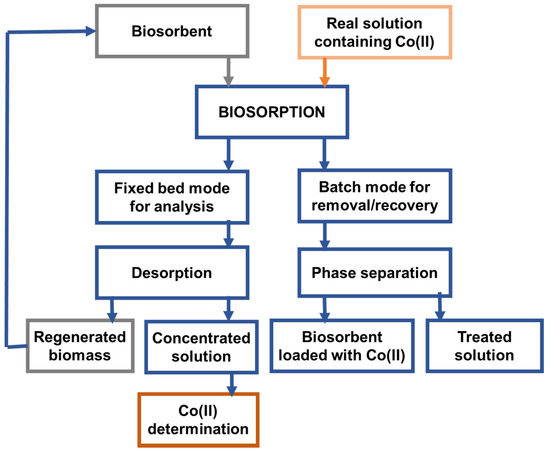
Figure 2.
Schematic representation of the main biosorption-based procedures reported in the literature for removal, recovery, and analysis of Co(II) from actual matrices.
3.1. Real Applications of Biosorbents to Co(II) Removal/Recovery
Guided by the remediation or recovery purpose of the biosorption process’ practical applicability, two types of real matrices have been tested: wastewaters and leached solutions of lithium-ion batteries.
The confined information available for the biosorption removal of Co(II) from real wastewaters is depicted in Table 6. Because the investigations were done in batch mode, the significance of the studies in Table 6 is restricted to small amounts of wastewaters. Taking into account the high metal loading of real effluents in Table 6 and their Co concentrations ranging from 0.005 mg/L to 20 mg/L, the efficiency of the tested biosorbents in removing Co(II), along with other heavy metals, is distinguished. The performances of bisorbents are also reflected in the contact time values in Table 6.
Table 6.
Summary of the reports on the treatment of real wastewaters containing Co(II) by using biosorbents.
There are very few considerations related to the compatibility of the biosorbents with the real systems of treatment of wastewaters containing Co from reusability and cost viewpoints. Hence, it has been demonstrated that the efficiency of the Co(II) biosorption from industrial wastewater on regenerated algal biomasses of Corralina mediterranea, Galaxaura oblongata, Jania rubens, and Ptredocladia papillacea was almost unchanged for two consecutive cycles [174]. A cost estimation indicated that peanut husk powder used for the treatment of a real effluent [175] was 5 times cheaper than another biosorbent based on lemon peel proposed for Co(II) removal from synthetic wastewater [181] and 50 times cheaper than the commercial activated carbon.
The only two batch studies with real leachates of lithium-ion batteries processed by biosorbents can be considered concept proof. They reported high percentages of Co(II) recovery by means of waste biomass [182] and dried algal biomass [183]. Under optimum batch conditions (pH = 6, 4 h contact time, 318 K), a dose of 10 g/L of chitin (seafood industry waste) was able to recover 95% of Co(II) from 50 mL of real leached solution with a Co concentration of 98.3 ± 5.1 mg/L and a Li concentration of 12.3 ± 3.6 mg/L [182]. Furthermore, 82% of the Co contained in real leachate (113.3 ± 4.9 mg/L) was recovered by Spirulina biosorption treatment, at an extremely acidic pH of 1 and in the presence of Li with a concentration of 20.2 ± 2.5 mg/L [183].
Apart from a drastic increase in the works on biosorptive removal and recovery of Co(II) from real matrices, the expected advances towards the practical applications strongly require pilot- and full-scale studies. Moreover, future research should be focused on addressing issues related to cost, energy requirements, desorption–regeneration with real effluents, and the disposal of exhausted biosorbents.
3.2. Analytical Procedures Based on Biosorbents for Trace Co(II) Determination from Real Samples
As previously demonstrated, the immobilized bacteria and fungi have the potential to be alternative tools of analytical preconcentration in fixed-bed column systems. The proposed procedures linked Co(II) enrichment by biomass, mostly with detection by inductively coupled plasma optical emission spectrometry or flame atomic absorption spectrometry. The reported values of the preconcentration factor ranged from 11 [157] to 111.1 [184]. This implies that the associated approaches have attractive analytical features since they satisfy the requirement that a method is only good if it achieves a preconcentration factor of at least 6 [185]. They were effectively applied to the Co(II) determination from environmental and food samples after being validated by the analysis of certified reference materials.
The transposition of biosorption potential in sustainable methodologies for Co(II) determination from actual samples of the above-named types is described in Table 7. To emphasize distinctive achievements, only the studies that conducted a comparative analysis of the developed procedures towards literature conventional preconcentration methods for Co(II) were systematized in Table 7. Against this background, the procedures in Table 7 were evaluated as having a lower limit of detection with higher preconcentration factors and a wider linear range. On the other hand, the relative standard deviation was, in many reports, in Table 7, less than 5%, being consistent with a satisfactory reproducibility of the process of Co(II) biosorption [42]. The systematized results in Table 7 also showed a very good correlation between the concentrations found for Co(II) and the certified values.
Table 7.
Studies on the determination of Co(II) from real samples based on column biosorptive preconcentration in conjunction with instrumental analysis.
The prospects of research on this topic might be: (a) further refinement of the already proposed procedures; (b) the adjustment of more and more biosorption processes to the rigors of instrumental methods of analysis; (c) and a substantial broadening of the spectrum of real samples analyzed by means of biosorbents.
4. Conclusions
This review is focused on the ability of polymeric biomasses with evolved biosorption activity to carry out a triple task in the removal, recovery, and analysis of Co(II) from diluted aqueous solutions. According to the type of solution processed by means of Co(II) biosorbents, these were differentiated and reviewed as viable candidates for practical applicability and materials, ensuring good efficiency in real applications. Unfortunately, so far, the first group is much larger than the second. It primarily consists of biosorbents based on modified biomasses that performed very well in the removal of Co(II) from synthetic solutions, as well as immobilized bacteria and fungi with superior analytical features for Co(II) quantification. The results of the studies on the small number of the second group biosorbents provide evidence for the benefits of incorporating biosorption into practical strategies for the treatment and analysis of real waste solutions containing Co(II). In order to promote a significant change in the ratio between the member number of the two classes of biosorbents, researchers should concentrate their efforts on increasing continuous biosorption–desorption studies under competitive industrial conditions, expanding the range of processed real wastewaters and leached solutions, transitioning from laboratory tests to pilot-scale experiments, and performing economic analyses. More research on the valorization of the analytical potential of biosorbents for the development of eco-friendly methodologies of Co(II) determination from a wider range of actual samples is needed from an analytical standpoint.
Funding
This research received no external funding.
Data Availability Statement
Not applicable.
Conflicts of Interest
The author declares no conflict of interest.
References
- Kim, J.H.; Gibb, H.J.; Howe, P. Cobalt and Inorganic Cobalt Compounds; World Health Organization: Geneva, Switzerland, 2006; ISBN 978-924-153069-9. [Google Scholar]
- Blengini, G.A.; Mathieux, F.; Mancini, L.; Nyberg, M.; Viegas, H.M.; Salminen, J.; Garbarino, E.; Orveillon, G.; Saveyn, H.; Mateos Aquilino, V.; et al. Recovery of Critical and Other Raw Materials from Mining Waste and Landfills: State of Play on Existing Practices; EUR 29744 EN; Publications Office of the European Union: Luxembourg, 2019; ISBN 978-92-76-03391-2. [Google Scholar] [CrossRef]
- Mahey, S.; Kumar, R.; Sharma, M.; Kumar, V.; Bhardwaj, R. A critical review on toxicity of cobalt and its bioremediation strategies. SN Appl. Sci. 2020, 2, 1279. [Google Scholar] [CrossRef]
- Yu, Z.; Han, H.; Feng, P.; Zhao, S.; Zhou, T.; Kakade, A.; Kulshrestha, S.; Majeed, S.; Li, X. Recent advances in the recovery of metals from waste through biological processes. Bioresour. Technol. 2020, 297, 122416. [Google Scholar] [CrossRef]
- Acosta-Rodríguez, I.; Rodríguez-Pérez, A.; Pacheco-Castillo, N.; Enríquez-Domínguez, E.; Cárdenas-González, J.; Martínez-Juárez, V.-M. Removal of Cobalt (II) from Waters Contaminated by the Biomass of Eichhornia crassipes. Water 2021, 13, 1725. [Google Scholar] [CrossRef]
- Fawzy, M.A.; Hifney, A.F.; Adam, M.S.; Al-Badaani, A.A. Biosorption of cobalt and its effect on growth and metabolites of Synechocystis pevalekii and Scenedesmus bernardii: Isothermal analysis. Environ. Technol. Innov. 2020, 19, 100953. [Google Scholar] [CrossRef]
- Kaba, B.; Trak, D.; Kenduzler, E.; Tomul, F.; Arslan, Y. Separation and preconcentration of cobalt(II) from water samples with Amberlite CG-120 resin. Iran. J. Chem. Chem. Eng. 2020, 39, 181–189. [Google Scholar]
- Sheikh, I. Cobalt Poisoning: A Comprehensive Review of the Literature. J. Med. Toxicol. Clin. Forensic Med. 2016, 2, 100017. [Google Scholar] [CrossRef]
- Alves Dias, P.; Blagoeva, D.; Pavel, C.; Arvanitidis, N. Cobalt: Demand-Supply Balances in the Transition to Electric Mobility; EUR 29381 EN; Publications Office of the European Union: Luxembourg, 2018; ISBN 978-92-79-94311-9. [Google Scholar] [CrossRef]
- Dodson, J.R.; Hunt, A.J.; Parker, H.L.; Yang, Y.; Clark, J.H. Elemental sustainability: Towards the total recovery of scarce metals. Chem. Eng. Process. Process Intensif. 2012, 51, 69–78. [Google Scholar] [CrossRef]
- Dehghani, M.H.; Yetilmezsoy, K.; Salari, M.; Heidarinejad, Z.; Yousefi, M.; Sillanpää, M. Adsorptive removal of cobalt(II) from aqueous solutions using multi-walled carbon nanotubes and γ-alumina as novel adsorbents: Modelling and optimization based on response surface methodology and artificial neural network. J. Mol. Liq. 2019, 299, 112154. [Google Scholar] [CrossRef]
- Joseph, I.V.; Tosheva, L.; Doyle, A.M. Simultaneous removal of Cd(II), Co(II), Cu(II), Pb(II), and Zn(II) ions from aqueous solutions via adsorption on FAU-type zeolites prepared from coal fly ash. J. Environ. Chem. Eng. 2020, 8, 103895. [Google Scholar] [CrossRef]
- Awual, R.; Hasan, M.; Islam, A.; Asiri, A.M.; Rahman, M.M. Optimization of an innovative composited material for effective monitoring and removal of cobalt(II) from wastewater. J. Mol. Liq. 2019, 298, 112035. [Google Scholar] [CrossRef]
- Al-Jubouri, S.M.; Holmes, S.M. Immobilization of cobalt ions using hierarchically porous 4A zeolite-based carbon composites: Ion-exchange and solidification. J. Water Process Eng. 2020, 33, 101059. [Google Scholar] [CrossRef]
- Alguacil, F.J. La eliminación de metales tóxicos presentes en efluentes líquidos mediante resinas de cambio iónico. Parte XI: Cobalto(II)/H+/Lewatit TP260. Rev. Met. 2019, 55, 154. [Google Scholar] [CrossRef]
- Ilaiyaraja, P.; Deb, A.K.S.; Ponraju, D.; Venkatraman, B. Removal of cobalt from aqueous solution using xanthate functionalized dendrimer. Desalin. Water Treat. 2013, 52, 438–445. [Google Scholar] [CrossRef]
- Biswal, B.K.; Jadhav, U.U.; Madhaiyan, M.; Ji, L.; Yang, E.-H.; Cao, B. Biological Leaching and Chemical Precipitation Methods for Recovery of Co and Li from Spent Lithium-Ion Batteries. ACS Sustain. Chem. Eng. 2018, 6, 12343–12352. [Google Scholar] [CrossRef]
- Rana, D.; Matsuura, T.; Kassim, M.; Ismail, A. Radioactive decontamination of water by membrane processes—A review. Desalination 2013, 321, 77–92. [Google Scholar] [CrossRef]
- Cheng, C.Y.; Barnard, K.R.; Zhang, W.; Robinson, D.J. Synergistic Solvent Extraction of Nickel and Cobalt: A Review of Recent Developments. Solvent Extr. Ion Exch. 2011, 29, 719–754. [Google Scholar] [CrossRef]
- Sunder, G.S.S.; Adhikari, S.; Rohanifar, A.; Poudel, A.; Kirchhoff, J.R. Evolution of Environmentally Friendly Strategies for Metal Extraction. Separations 2020, 7, 4. [Google Scholar] [CrossRef]
- Türker, A.R. Separation, Preconcentration and Speciation of Metal Ions by Solid Phase Extraction. Sep. Purif. Rev. 2012, 41, 169–206. [Google Scholar] [CrossRef]
- Islam, A.; Morton, D.; Johnson, B.B.; Pramanik, B.; Mainali, B.; Angove, M.J. Opportunities and constraints of using the innovative adsorbents for the removal of cobalt(II) from wastewater: A review. Environ. Nanotechnol. Monit. Manag. 2018, 10, 435–456. [Google Scholar] [CrossRef]
- Corda, N.; Srinivas, M. Recent studies on adsorption of Pb(II), Zn(II) and Co(II) using conventional and modified materials: A review. Sep. Sci. Technol. 2020, 55, 2679–2698. [Google Scholar] [CrossRef]
- Chojnacka, K. Biosorption and bioaccumulation—The prospects for practical applications. Environ. Int. 2010, 36, 299–307. [Google Scholar] [CrossRef] [PubMed]
- Dusengemungu, L.; Kasali, G.; Gwanama, C.; Ouma, K.O. Recent Advances in Biosorption of Copper and Cobalt by Filamentous Fungi. Front. Microbiol. 2020, 11, 3285. [Google Scholar] [CrossRef] [PubMed]
- El-Naggar, N.E.-A.; Hamouda, R.A.; Abuelmagd, M.A.; Abdelgalil, S.A. Bioprocess development for biosorption of cobalt ions and Congo red from aquatic mixture using Enteromorpha intestinalis biomass as sustainable biosorbent. Sci. Rep. 2021, 11, 14953. [Google Scholar] [CrossRef] [PubMed]
- Dabbagh, R.; Moghaddam, Z.A.; Ghafourian, H. Removal of cobalt(II) ion from water by adsorption using intact and modifiedFicus caricaleaves as low-cost natural sorbent. Desalin. Water Treat. 2015, 57, 19890–19902. [Google Scholar] [CrossRef]
- Lucaci, A.R.; Bulgariu, D.; Ahmad, I.; Bulgariu, L. Equilibrium and Kinetics Studies of Metal Ions Biosorption on Alginate Extracted from Marine Red Algae Biomass (Callithamnion corymbosum sp.). Polymers 2020, 12, 1888. [Google Scholar] [CrossRef] [PubMed]
- Rodrigues, N.F.M.; Santana, S.A.A.; Bezerra, C.W.B.; Silva, H.A.S.; Melo, J.C.P.; Vieira, A.P.; Airoldi, C.; Filho, E.S. New Chemical Organic Anhydride Immobilization Process Used on Banana Pseudostems: A Biopolymer for Cation Removal. Ind. Eng. Chem. Res. 2013, 52, 11007–11015. [Google Scholar] [CrossRef]
- Khraisheh, M.; Al-Ghouti, M.A.; AlMomani, F. P. putida as biosorbent for the remediation of phenol and cobalt from waste wastewaters. Environ. Technol. Innov. 2020, 20, 101148. [Google Scholar] [CrossRef]
- Park, D.; Yun, Y.-S.; Park, J.M. The past, present, and future trends of biosorption. Biotechnol. Bioprocess Eng. 2010, 15, 86–102. [Google Scholar] [CrossRef]
- Michalak, I.; Chojnacka, K.; Witek-Krowiak, A. A State of the Art for the Biosorption Process—A Review. Appl. Biochem. Biotechnol. 2013, 170, 1389–1416. [Google Scholar] [CrossRef]
- Vijayaraghavan, K.; Balasubramanian, R. Is biosorption suitable for decontamination of metal-bearing wastewaters? A critical review on the state-of-the-art of biosorption processes and future directions. J. Environ. Manag. 2015, 160, 283–296. [Google Scholar] [CrossRef]
- De Freitas, G.R.; Da Silva, M.G.C.; Vieira, M.G.A. Biosorption technology for removal of toxic metals: A review of commercial biosorbents and patents. Environ. Sci. Pollut. Res. 2019, 26, 19097–19118. [Google Scholar] [CrossRef] [PubMed]
- Escudero, L.B.; Quintas, P.Y.; Wuilloud, R.G.; Dotto, G.L. Recent advances on elemental biosorption. Environ. Chem. Lett. 2018, 17, 409–427. [Google Scholar] [CrossRef]
- Beni, A.A.; Esmaeili, A. Biosorption, an efficient method for removing heavy metals from industrial effluents: A Review. Environ. Technol. Innov. 2019, 17, 100503. [Google Scholar] [CrossRef]
- Singh, S.; Kumar, V.; Datta, S.; Dhanjal, D.S.; Sharma, K.; Samuel, J.; Singh, J. Current advancement and future prospect of biosorbents for bioremediation. Sci. Total Environ. 2019, 709, 135895. [Google Scholar] [CrossRef] [PubMed]
- Blaga, A.C.; Zaharia, C.; Suteu, D. Polysaccharides as Support for Microbial Biomass-Based Adsorbents with Applications in Removal of Heavy Metals and Dyes. Polymers 2021, 13, 2893. [Google Scholar] [CrossRef]
- Qin, H.; Hu, T.; Zhai, Y.; Lu, N.; Aliyeva, J. The improved methods of heavy metals removal by biosorbents: A review. Environ. Pollut. 2019, 258, 113777. [Google Scholar] [CrossRef] [PubMed]
- Calderón, O.A.R.; Abdeldayem, O.M.; Pugazhendhi, A.; Rene, E.R. Current Updates and Perspectives of Biosorption Technology: An Alternative for the Removal of Heavy Metals from Wastewater. Curr. Pollut. Rep. 2020, 6, 8–27. [Google Scholar] [CrossRef]
- Godlewska-Żyłkiewicz, B. Microorganisms in inorganic chemical analysis. Anal. Bioanal. Chem. 2005, 384, 114–123. [Google Scholar] [CrossRef]
- Pacheco, P.H.; Gil, R.A.; Cerutti, S.E.; Smichowski, P.; Martinez, L.D. Biosorption: A new rise for elemental solid phase extraction methods. Talanta 2011, 85, 2290–2300. [Google Scholar] [CrossRef]
- Özdemir, S.; Okumuş, V.; Dündar, A.; Kılınç, E. Preconcentration of metal ions using microbacteria. Mikrochim. Acta 2013, 180, 719–739. [Google Scholar] [CrossRef]
- Teixeira, L.S.G.; Lemos, V.A.; Melo Coelho, L.; Rocha, F.R.P. Applications of biosorbents in atomic spectrometry. Appl. Spectrosc. Rev. 2016, 51, 36–72. [Google Scholar] [CrossRef]
- Escudero, L.B.; Maniero, M.Á.; Agostini, E.; Smichowski, P.N. Biological substrates: Green alternatives in trace elemental preconcentration and speciation analysis. TrAC Trends Anal. Chem. 2016, 80, 531–546. [Google Scholar] [CrossRef]
- Smichowski, P.; Londonio, A. A retrospective and prospective of the use of bio- and nanomaterials for preconcentration, speciation, and determination of trace elements: A review spanning 25 years of research. Anal. Bioanal. Chem. 2020, 412, 6023–6036. [Google Scholar] [CrossRef] [PubMed]
- Musapatika, E.T.; Onyango, M.S.; Aoyi, O. Cobalt(II) removal from synthetic wastewater by adsorption on South African coal fly ash. S. Afr. J. Sci. 2010, 106, 1–7. [Google Scholar] [CrossRef]
- Fomina, M.; Gadd, G.M. Biosorption: Current perspectives on concept, definition and application. Bioresour. Technol. 2014, 160, 3–14. [Google Scholar] [CrossRef]
- De Gisi, S.; Lofrano, G.; Grassi, M.; Notarnicola, M. Characteristics and adsorption capacities of low-cost sorbents for wastewater treatment: A review. Sustain. Mater. Technol. 2016, 9, 10–40. [Google Scholar] [CrossRef]
- Chakraborty, R.; Asthana, A.; Singh, A.K.; Jain, B.; Susan, A.B.H. Adsorption of heavy metal ions by various low-cost adsorbents: A review. Int. J. Environ. Anal. Chem. 2020, 102, 342–379. [Google Scholar] [CrossRef]
- Tony, M.A. Low-cost adsorbents for environmental pollution control: A concise systematic review from the prospective of principles, mechanism and their applications. J. Dispers. Sci. Technol. 2021, 1–23. [Google Scholar] [CrossRef]
- Tofan, L.; Bojoaga, C.-N.; Paduraru, C. Biosorption for the recovery and analysis of rare earth elements and platinum group metals from real samples. A review. Environ. Chem. Lett. 2022, 20, 1225–1248. [Google Scholar] [CrossRef]
- He, J.; Chen, J.P. A comprehensive review on biosorption of heavy metals by algal biomass: Materials, performances, chemistry, and modeling simulation tools. Bioresour. Technol. 2014, 160, 67–78. [Google Scholar] [CrossRef]
- Zeraatkar, A.K.; Ahmadzadeh, H.; Talebi, A.F.; Moheimani, N.; McHenry, M.P. Potential use of algae for heavy metal bioremediation, a critical review. J. Environ. Manag. 2016, 181, 817–831. [Google Scholar] [CrossRef] [PubMed]
- Anastopoulos, I.; Kyzas, G. Progress in batch biosorption of heavy metals onto algae. J. Mol. Liq. 2015, 209, 77–86. [Google Scholar] [CrossRef]
- Senthilkumar, R.; Prasad, D.R.; Lakshmanarao, G.; Krishnan, S.; Prasad, B.N. Ocean-based sorbents for decontamination of metal-bearing wastewaters: A review. Environ. Technol. Rev. 2018, 7, 139–155. [Google Scholar] [CrossRef]
- Dhankhar, R.; Hooda, A. Fungal biosorption–an alternative to meet the challenges of heavy metal pollution in aqueous solutions. Environ. Technol. 2011, 32, 467–491. [Google Scholar] [CrossRef]
- Siddiquee, S.; Rovina, K.; Azad, S.A.; Naher, L.; Suryani, S.; Chaikaew, P. Heavy metal contaminants removal from wastewater using the potential filamentous fungi biomass: A review. J. Microb. Biochem. Technol. 2015, 7, 384–393. [Google Scholar] [CrossRef]
- Ayele, A.; Haile, S.; Alemu, D.; Kamaraj, M. Comparative Utilization of Dead and Live Fungal Biomass for the Removal of Heavy Metal: A Concise Review. Sci. World J. 2021, 2021, 5588111. [Google Scholar] [CrossRef]
- Vijayaraghavan, K.; Yun, Y.-S. Bacterial biosorbents and biosorption. Biotechnol. Adv. 2008, 26, 266–291. [Google Scholar] [CrossRef]
- Aryal, M.; Liakopoulou-Kyriakides, M. Bioremoval of heavy metals by bacterial biomass. Environ. Monit. Assess. 2014, 187, 1–26. [Google Scholar] [CrossRef] [PubMed]
- Aryal, M. A comprehensive study on the bacterial biosorption of heavy metals: Materials, performances, mechanisms, and mathematical modellings. Rev. Chem. Eng. 2021, 37, 715–754. [Google Scholar] [CrossRef]
- Nguyen, T.; Ngo, H.; Guo, W.; Zhang, J.; Liang, S.; Yue, Q.; Li, Q. Applicability of agricultural waste and by-products for adsorptive removal of heavy metals from wastewater. Bioresour. Technol. 2013, 148, 574–585. [Google Scholar] [CrossRef]
- Anastopoulos, I.; Pashalidis, I.; Hosseini-Bandegharaei, A.; Giannakoudakis, D.A.; Robalds, A.; Usman, M.; Escudero, L.B.; Zhou, Y.; Colmenares, J.C.; Núñez-Delgado, A.; et al. Agricultural biomass/waste as adsorbents for toxic metal decontamination of aqueous solutions. J. Mol. Liq. 2019, 295, 111684. [Google Scholar] [CrossRef]
- Alalwan, H.A.; Kadhom, M.A.; Alminshid, A.H. Removal of heavy metals from wastewater using agricultural byproducts. J. Water Supply Res. Technol. 2020, 69, 99–112. [Google Scholar] [CrossRef]
- Bhatnagar, A.; Sillanpää, M. Utilization of agro-industrial and municipal waste materials as potential adsorbents for water treatment—A review. Chem. Eng. J. 2010, 157, 277–296. [Google Scholar] [CrossRef]
- Ahmaruzzaman, M. Industrial wastes as low-cost potential adsorbents for the treatment of wastewater laden with heavy metals. Adv. Colloid Interface Sci. 2011, 166, 36–59. [Google Scholar] [CrossRef] [PubMed]
- El-Sayed, H.E.M.; El-Sayed, M.M.H. Assessment of Food Processing and Pharmaceutical Industrial Wastes as Potential Biosorbents: A Review. BioMed Res. Int. 2014, 2014, 146769. [Google Scholar] [CrossRef] [PubMed]
- Gautam, R.K.; Mudhoo, A.; Lofrano, G.; Chattopadhyaya, M.C. Biomass-derived biosorbents for metal ions sequestration: Adsorbent modification and activation methods and adsorbent regeneration. J. Environ. Chem. Eng. 2014, 2, 239–259. [Google Scholar] [CrossRef]
- Velkova, Z.; Kirova, G.; Stoytcheva, M.; Kostadinova, S.; Todorova, K.; Gochev, V. Immobilized microbial biosorbents for heavy metals removal. Eng. Life Sci. 2018, 18, 871–881. [Google Scholar] [CrossRef]
- Ramrakhiani, L.; Ghosh, S.; Majumdar, S. Surface Modification of Naturally Available Biomass for Enhancement of Heavy Metal Removal Efficiency, Upscaling Prospects, and Management Aspects of Spent Biosorbents: A Review. Appl. Biochem. Biotechnol. 2016, 180, 41–78. [Google Scholar] [CrossRef]
- Bilal, M.; Ihsanullah, I.; Younas, M.; Shah, M.U.H. Recent advances in applications of low-cost adsorbents for the removal of heavy metals from water: A critical review. Sep. Purif. Technol. 2021, 278, 119510. [Google Scholar] [CrossRef]
- Massimi, L.; Giuliano, A.; Astolfi, M.L.; Congedo, R.; Masotti, A.; Canepari, S. Efficiency Evaluation of Food Waste Materials for the Removal of Metals and Metalloids from Complex Multi-Element Solutions. Materials 2018, 11, 334. [Google Scholar] [CrossRef]
- Vijayaraghavan, K.; Jegan, J.; Palanivelu, K.; Velan, M. Biosorption of cobalt(II) and nickel(II) by seaweeds: Batch and column studies. Sep. Purif. Technol. 2005, 44, 53–59. [Google Scholar] [CrossRef]
- Forountan, R.; Esmaeili, H.; Abbasi, M.; Rezakazemi, M.; Mesbah, M. Adsorption behaviour of Cu(II) and Co(II) using chemically modified marine alga. Environ. Technol. 2017, 39, 2792–2800. [Google Scholar] [CrossRef] [PubMed]
- Vafajoo, L.; Cheraghi, R.; Dabbagh, R.; McKay, G. Removal of cobalt (II) ions from aqueous solutions utilizing the pre-treated 2-Hypnea Valentiae algae: Equilibrium, thermodynamic, and dynamic studies. Chem. Eng. J. 2018, 331, 39–47. [Google Scholar] [CrossRef]
- Mamba, B.; Dlamini, N.; Mulaba–Bafubiandi, A. Biosorptive removal of copper and cobalt from aqueous solutions: Shewanella spp. put to the test. Phys. Chem. Earth Parts A/B/C 2009, 34, 841–849. [Google Scholar] [CrossRef]
- Díaz, A.; Marrero, J.; Cabrera, G.; Coto, O.; Gómez, J.M. Biosorption of nickel, cobalt, zinc and copper ions by Serratia marcescens strain 16 in mono and multimetallic systems. Biogeochemistry 2021, 33, 33–43. [Google Scholar] [CrossRef] [PubMed]
- Annadurai, G.; Juang, R.-S.; Lee, D. Adsorption of heavy metals from water using banana and orange peels. Water Sci. Technol. 2003, 47, 185–190. [Google Scholar] [CrossRef]
- Güzel, F.; Yakut, H.; Topal, G. Determination of kinetic and equilibrium parameters of the batch adsorption of Mn(II), Co(II), Ni(II) and Cu(II) from aqueous solution by black carrot (Daucus carota L.) residues. J. Hazard. Mater. 2008, 153, 1275–1287. [Google Scholar] [CrossRef]
- Ahmadpour, A.; Tahmasbi, M.; Bastami, T.R.; Besharati, J.A. Rapid removal of cobalt ion from aqueous solutions by almond green hull. J. Hazard. Mater. 2009, 166, 925–930. [Google Scholar] [CrossRef]
- Yu, H.; Pang, J.; Ai, T.; Liu, L. Biosorption of Cu2+, Co2+ and Ni2+ from aqueous solution by modified corn silk: Equilibrium, kinetics, and thermodynamic studies. J. Taiwan Inst. Chem. Eng. 2016, 62, 21–30. [Google Scholar] [CrossRef]
- Eglia, J.N.; Dauda, B.E.N.; Jimoh, T. Biosorptive removal of cobalt (II) ions from aqueous solution by Amaranthus hydridus L. stalk wastes. Afr. J. Biotechnol. 2010, 9, 8192–8198. [Google Scholar] [CrossRef]
- Bouzidi, A.; Djedial, M.; Ad, C.; Benzalia, M.; Hafez, B.; Elmsellem, H. Biosorption of Co(II) from aqueous solutiuons using Luffa Cylindrica: Adsorption and characterization studies. Mor. J. Chem. 2021, 9, 156–167. [Google Scholar] [CrossRef]
- Pavan Kumar, G.V.S.R.; Srinivasa, R.K.; Imranb, S. Utilization of low cost bio adsorbents in their native as well as carbonized form for the removal of cobalt(II) from aqueous solutions. J. Indian Chem. Soc. 2019, 96, 399–405. [Google Scholar]
- Musapatika, E.T.; Singh, R.; Moodley, K.; Nzila, C.; Onyango, M.S.; Ochieng, A. Cobalt removal from wastewater using pine sawdust. Afr. J. Biotechnol. 2012, 11, 9407–9415. [Google Scholar] [CrossRef][Green Version]
- Essaadaoui, Y.; Lebkiri, A.; Rifi, E.H.; Kadiri, L.; Ouass, A. Adsorption of cobalt from aqueous solutions from aqueous solu-tions onto Bark of Eucalyptus. Mediterr. J. Chem. 2018, 7, 145–155. [Google Scholar] [CrossRef]
- Dimović, S.; Smičiklas, I.; Plećaš, I.; Antonović, D.; Mitrić, M. Comparative study of differently treated animal bones for Co2+ removal. J. Hazard. Mater. 2009, 164, 279–287. [Google Scholar] [CrossRef]
- Sandesh, K.; Kumar, R.S.; JagadeeshBabu, P.E. Rapid removal of cobalt (II) from aqueous solution using cuttlefish bones; equilibrium, kinetics, and thermodynamic study. Asia-Pac. J. Chem. Eng. 2012, 8, 144–153. [Google Scholar] [CrossRef]
- Rezk, R.; Galmed, A.; Abdelkreem, M.; Ghany, N.A.; Harith, M. Detachment of Cu (II) and Co (II) ions from synthetic wastewater via adsorption on Lates niloticus fish bones using LIBS and XRF. J. Adv. Res. 2018, 14, 1–9. [Google Scholar] [CrossRef]
- Din, M.I.; Mirza, M.L.; Ata, S.; Athar, M.; Mohsin, I.U. Thermodynamics of Biosorption for Removal of Co(II) Ions by an Efficient and Ecofriendly Biosorbent (Saccharum bengalense): Kinetics and Isotherm Modeling. J. Chem. 2012, 2013, 528542. [Google Scholar] [CrossRef]
- Vilvanathan, S.; Shanthakumar, S. Biosorption of Co(II) ions from aqueous solution using Chrysanthemum indicum: Kinetics, equilibrium and thermodynamics. Process Saf. Environ. Prot. 2015, 96, 98–110. [Google Scholar] [CrossRef]
- Tsamo, C.; Paltahe, A.; Fotio, D.; Vincent, T.A.; Sales, W.F. One-, Two-, and Three-Parameter Isotherms, Kinetics, and Thermodynamic Evaluation of Co(II) Removal from Aqueous Solution Using Dead Neem Leaves. Int. J. Chem. Eng. 2019, 2019, 6452672. [Google Scholar] [CrossRef]
- Ranaweera, K.H.; Godakumbura, P.I.; Perera, B.A. Adsorptive removal of Co(II) in aqueous solutions using clearing nut seed powder. Heliyon 2020, 6, e03684. [Google Scholar] [CrossRef] [PubMed]
- Frišták, V.; Pipíška, M.; Horník, M.; Augustín, J.; Lesný, J. Sludge of wastewater treatment plants as Co2+ ions sorbent. Chem. Pap. 2013, 67, 265–273. [Google Scholar] [CrossRef]
- Frišták, V.; Valovčiaková, M.; Pipíška, M.; Lesný, J. The influence of chemical modification on the Co2+ ion sorption process by anaerobic sludge. Pol. J. Environ. Stud. 2014, 23, 705–712. [Google Scholar]
- Frišták, V.; Pipíška, M.; Valovčiaková, M.; Lesný, J.; Rozložník, M. Monitoring 60Co activity for the characterization of the sorption process of Co2+ ions in municipal activated sludge. J. Radioanal. Nucl. Chem. Artic. 2013, 299, 1607–1614. [Google Scholar] [CrossRef]
- Parab, H.; Joshi, S.; Shenoy, N.; Lali, A.; Sarma, U.; Sudersanan, M. Determination of kinetic and equilibrium parameters of the batch adsorption of Co(II), Cr(III) and Ni(II) onto coir pith. Process Biochem. 2006, 41, 609–615. [Google Scholar] [CrossRef]
- Parab, H.; Joshi, S.; Shenoy, N.; Lali, A.; Sarma, U.; Sudersanan, M. Esterified coir pith as an adsorbent for the removal of Co(II) from aqueous solution. Bioresour. Technol. 2008, 99, 2083–2086. [Google Scholar] [CrossRef]
- Karaoglu, M.H.; Ugurlu, M.; Kula, I. Adsorption characteristics of Co(II) ions onto chemically treated Quercus coccifera shell: Equilibrium, kinetic and thermodynamic studies. BioResources 2011, 6, 1954–1971. [Google Scholar]
- Koduru, J.R.; Chang, Y.-Y.; Yang, J.-K.; Kim, I.-S. Iron Oxide Impregnated Morus alba L. Fruit Peel for Biosorption of Co(II): Biosorption Properties and Mechanism. Sci. World J. 2013, 2013, 917146. [Google Scholar] [CrossRef]
- Nadeem, R.; Zafar, M.N.; Afzal, A.; Hanif, M.A.; Saeed, R. Potential of NaOH pretreated Mangifera indica waste biomass for the mitigation of Ni(II) and Co(II) from aqueous solutions. J. Taiwan Inst. Chem. Eng. 2014, 45, 967–972. [Google Scholar] [CrossRef]
- Lingamdinne, L.P.; Koduru, J.R.; Jyothi, R.K.; Chang, Y.-Y.; Yang, J.-K. Factors affect on bioremediation of Co(II) and Pb(II) ontoLonicera japonicaflowers powder. Desalin. Water Treat. 2015, 57, 13066–13080. [Google Scholar] [CrossRef]
- Lingamdinne, L.P.; Yang, J.-K.; Chang, Y.-Y.; Koduru, J.R. Low-cost magnetized Lonicera japonica flower biomass for the sorption removal of heavy metals. Hydrometallurgy 2016, 165, 81–89. [Google Scholar] [CrossRef]
- Franco, D.S.; Cunha, J.M.; Dortzbacher, G.F.; Dotto, G.L. Adsorption of Co(II) from aqueous solutions onto rice husk modified by ultrasound assisted and supercritical technologies. Process Saf. Environ. Prot. 2017, 109, 55–62. [Google Scholar] [CrossRef]
- Reyes-Ledezma, J.; Nacional, I.P.; Ramírez-Rodríguez, A.; Ballinas-Cesatti, C.; Cristiani-Urbina, E.; Morales-Barrera, L. K2HPO4-pretreatment significantly enhances the biosorption capacity of Co2+ by Lemna gibba. Rev. Mex. Ing. Quím. 2021, 20, 581–605. [Google Scholar] [CrossRef]
- Pipíška, M.; Zarodňanská, S.; Horník, M.; Ďuriška, L.; Holub, M.; Šafařík, I. Magnetically Functionalized Moss Biomass as Biosorbent for Efficient Co2+ Ions and Thioflavin T Removal. Materials 2020, 13, 3619. [Google Scholar] [CrossRef]
- Farnane, M.; Tounsadi, H.; Elmoubarki, R.; Mahjoubi, F.; Elhalil, A.; Saqrane, S.; Abdennouri, M.; Qourzal, S.; Barka, N. Alkaline treated carob shells as sustainable biosorbent for clean recovery of heavy metals: Kinetics, equilibrium, ions interference and process optimisation. Ecol. Eng. 2017, 101, 9–20. [Google Scholar] [CrossRef]
- Swelam, A.; Awad, M.; Salem, A.; El-Feky, A. An economically viable method for the removal of cobalt ions from aqueous solution using raw and modified rice straw. HBRC J. 2018, 14, 255–262. [Google Scholar] [CrossRef]
- Soleymani, F.; Khani, M.H.; Pahlavanzadeh, H.; Manteghian, M. Study of cobalt (II) biosorption on Sargassum sp. by experimental design methodology. Int. J. Environ. Sci. Technol. 2015, 12, 1907–1922. [Google Scholar] [CrossRef]
- Ebrahimi, M.; Panahi, R.; Dabbagh, R. Evaluation of Native and Chemically Modified Sargassum glaucescens for Continuous Biosorption of Co(II). Appl. Biochem. Biotechnol. 2008, 158, 736–746. [Google Scholar] [CrossRef]
- Vijayaraghavan, K.; Jegan, J.; Palanivelu, K.; Velan, M. Biosorption of copper, cobalt and nickel by marine green alga Ulva reticulata in a packed column. Chemosphere 2005, 60, 419–426. [Google Scholar] [CrossRef]
- Oguz, E.; Ersoy, M. Biosorption of cobalt(II) with sunflower biomass from aqueous solutions in a fixed bed column and neural networks modelling. Ecotoxicol. Environ. Saf. 2014, 99, 54–60. [Google Scholar] [CrossRef]
- Vilvanathan, S.; Shanthakumar, S. Modeling of fixed-bed column studies for removal of cobalt ions from aqueous solution using Chrysanthemum indicum. Res. Chem. Intermed. 2016, 43, 229–243. [Google Scholar] [CrossRef]
- Vilvanathan, S.; Shanthakumar, S. Column adsorption studies on nickel and cobalt removal from aqueous solution using native and biochar form of Tectona grandis. Environ. Prog. Sustain. Energy 2017, 36, 1030–1038. [Google Scholar] [CrossRef]
- Tesfagiorgis, K.; Navarro, A.E.; Chen, B.M.; Herrera, N.; Hernandez, J.; González-Álvarez, Á.; Savane, O.S. Simulations of breakthrough curves for fixed-bed column adsorption of Cobalt (II) ions on spent tea leaves. Water Sci. Technol. 2020, 81, 2410–2421. [Google Scholar] [CrossRef] [PubMed]
- Hymavathi, D.; Prabhakar, G. Modeling of cobalt and lead adsorption by Ficus benghalenesis L. in a fixed bed column. Chem. Eng. Commun. 2019, 206, 1264–1272. [Google Scholar] [CrossRef]
- Rodrigues, J.A.V.; Martins, L.R.; Furtado, L.M.; Xavier, A.L.P.; De Almeida, F.T.R.; Moreira, A.L.D.S.L.; Melo, T.M.S.; Gil, L.F.; Gurgel, L.V.A. Oxidized Renewable Materials for the Removal of Cobalt(II) and Copper(II) from Aqueous Solution Using in Batch and Fixed-Bed Column Adsorption. Adv. Polym. Technol. 2020, 2020, 8620431. [Google Scholar] [CrossRef]
- Xavier, A.L.P.; Adarme, O.F.H.; Furtado, L.M.; Ferreira, G.M.D.; Da Silva, L.H.M.; Gil, L.F.; Gurgel, L.V.A. Modeling adsorption of copper(II), cobalt(II) and nickel(II) metal ions from aqueous solution onto a new carboxylated sugarcane bagasse. Part II: Optimization of monocomponent fixed-bed column adsorption. J. Colloid Interface Sci. 2018, 516, 431–445. [Google Scholar] [CrossRef]
- Reyes-Ledezma, J.L.; Cristiani-Urbina, E.; Morales-Barrera, L. Biosorption of Co2+ Ions from Aqueous Solution by K2HPO4-Pretreated Duckweed Lemna gibba. Processes 2020, 8, 1532. [Google Scholar] [CrossRef]
- Witek-Krowiak, A.; Chojnacka, K.; Podstawczyk, D.; Dawiec, A.; Pokomeda, K. Application of response surface methodology and artificial neural network methods in modelling and optimization of biosorption process. Bioresour. Technol. 2014, 160, 150–160. [Google Scholar] [CrossRef]
- Hymavathi, D.; Prabhakar, G. Optimization, equilibrium, and kinetic studies of adsorptive removal of cobalt(II) from aqueous solutions using Cocos nucifera L. Chem. Eng. Commun. 2017, 204, 1094–1104. [Google Scholar] [CrossRef]
- Hymavathi, D.; Prabhakar, G. Studies on the removal of Cobalt(II) from aqueous solutions by adsorption with Ficus benghalensis leaf powder through response surface methodology. Chem. Eng. Commun. 2017, 204, 1401–1411. [Google Scholar] [CrossRef]
- Moradi, P.; Hayati, S.; Ghahrizadeh, T. Modeling and optimization of lead and cobalt biosorption from water with Rafsanjan pistachio shell, using experiment based models of ANN and GP, and the grey wolf optimizer. Chemom. Intell. Lab. Syst. 2020, 202, 104041. [Google Scholar] [CrossRef]
- Hajahmadi, Z.; Younesi, H.; Bahramifar, N.; Khakpour, H.; Pirzadeh, K. Multicomponent isotherm for biosorption of Zn(II), CO(II) and Cd(II) from ternary mixture onto pretreated dried Aspergillus niger biomass. Water Resour. Ind. 2015, 11, 71–80. [Google Scholar] [CrossRef]
- Simate, G.S.; Ndlovu, S. The removal of heavy metals in a packed bed column using immobilized cassava peel waste biomass. J. Ind. Eng. Chem. 2015, 21, 635–643. [Google Scholar] [CrossRef]
- Mohapatra, H.; Gupta, R. Concurrent sorption of Zn(II), Cu(II) and Co(II) by Oscillatoria angustissima as a function of pH in binary and ternary metal solutions. Bioresour. Technol. 2005, 96, 1387–1398. [Google Scholar] [CrossRef] [PubMed]
- Sun, X.-F.; Wang, S.-G.; Liu, X.-W.; Gong, W.-X.; Bao, N.; Gao, B.-Y. Competitive biosorption of zinc(II) and cobalt(II) in single- and binary-metal systems by aerobic granules. J. Colloid Interface Sci. 2008, 324, 1–8. [Google Scholar] [CrossRef]
- Lakshmipathy, R.; Sarada, N. Application of watermelon rind as sorbent for removal of nickel and cobalt from aqueous solution. Int. J. Miner. Process. 2013, 122, 63–65. [Google Scholar] [CrossRef]
- Galedar, M. Biosorption of ternary cadmium, nickel and cobalt ions from aqueous solutions onto Saccharomyces cerevisiae cells: Batch and column studies. Am. J. Biochem. Biotechnol. 2013, 9, 47–60. [Google Scholar] [CrossRef]
- Ramos, S.N.D.C.; Xavier, A.L.P.; Teodoro, F.S.; Elias, M.M.C.; Gonçalves, F.J.; Gil, L.F.; Freitas, R.; Gurgel, L. Modeling mono- and multi-component adsorption of cobalt(II), copper(II), and nickel(II) metal ions from aqueous solution onto a new carboxylated sugarcane bagasse. Part I: Batch adsorption study. Ind. Crop. Prod. 2015, 74, 357–371. [Google Scholar] [CrossRef]
- Ramos, S.N.D.C.; Xavier, A.L.P.; Teodoro, F.S.; Gil, L.F.; Gurgel, L.V.A. Removal of cobalt(II), copper(II), and nickel(II) ions from aqueous solutions using phthalate-functionalized sugarcane bagasse: Mono- and multicomponent adsorption in batch mode. Ind. Crop. Prod. 2016, 79, 116–130. [Google Scholar] [CrossRef]
- Shi, J.; Fang, Z.; Zhao, Z.; Sun, T.; Liang, Z. Comparative study on Pb(II), Cu(II), and Co(II) ions adsorption from aqueous solutions by arborvitae leaves. Desalin. Water Treat. 2016, 57, 4732–4739. [Google Scholar] [CrossRef]
- Akbari, M.; Hallajisani, A.; Keshtkar, A.R.; Shahbeig, H.; Ghorbanian, S.A. Equilibrium and kinetic study and modeling of Cu(II) and Co(II) synergistic biosorption from Cu(II)-Co(II) single and binary mixtures on brown algae C. indica. J. Environ. Chem. Eng. 2015, 3, 140–149. [Google Scholar] [CrossRef]
- Ngwenya, N.; Chirwa, E. Single and binary component sorption of the fission products Sr2+, Cs+ and Co2+ from aqueous solutions onto sulphate reducing bacteria. Miner. Eng. 2010, 23, 463–470. [Google Scholar] [CrossRef]
- Marešová, J.; Pipíška, M.; Rozložník, M.; Horník, M.; Remenárová, L.; Augustín, J. Cobalt and strontium sorption by moss biosorbent: Modeling of single and binary metal systems. Desalination 2011, 266, 134–141. [Google Scholar] [CrossRef]
- Singh, S.; Shukla, S.R. Adsorptive removal of cobalt ions on raw and alkali-treated lemon peels. Int. J. Environ. Sci. Technol. 2015, 13, 165–178. [Google Scholar] [CrossRef]
- Salem, D.M.; Moawad, M.N.; El-Sayed, A.A. Comparative study for bioremediation of cobalt contaminated aqueous solutions by two types of marine macroalgae. Egypt. J. Aquat. Res. 2021, 47, 13–19. [Google Scholar] [CrossRef]
- Tounsadi, H.; Khalidi, A.; Abdennouri, M.; Barka, N. Biosorption potential of Diplotaxis harra and Glebionis coronaria L. biomasses for the removal of Cd(II) and Co(II) from aqueous solutions. J. Environ. Chem. Eng. 2015, 3, 822–830. [Google Scholar] [CrossRef]
- Dahiya, S.; Tripathi, R.; Hegde, A. Biosorption of heavy metals and radionuclide from aqueous solutions by pre-treated arca shell biomass. J. Hazard. Mater. 2008, 150, 376–386. [Google Scholar] [CrossRef]
- Kuyucak, N.; Volesky, B. Accumulation of cobalt by marine alga. Biotechnol. Bioeng. 1989, 33, 809–814. [Google Scholar] [CrossRef]
- Saeid, A.; Chojnacka, K. Multi-cation biosorption by Chlorella kessleri. Open Chem. 2015, 13, 959–966. [Google Scholar] [CrossRef]
- Vijayaraghavan, K.; Balasubramanian, R. A comparative evaluation of sorbents for the treatment of complex metal-bearing laboratory wastewaters. J. Environ. Chem. Eng. 2013, 1, 473–479. [Google Scholar] [CrossRef]
- LoIacono, S.; Crini, G.; Martel, B.; Chanet, G.; Cosentino, C.; Raschetti, M.; Placet, V.; Torri, G.; Morin-Crini, N. Simultaneous removal of Cd, Co, Cu, Mn, Ni, and Zn from synthetic solutions on a hemp-based felt. II. Chemical modification. J. Appl. Polym. Sci. 2017, 134, 45138. [Google Scholar] [CrossRef]
- Šabanović, E.; Memić, M.; Sulejmanović, J.; Selović, A. Simultaneous adsorption of heavy metals from water by novel lemon-peel based biomaterial. Pol. J. Chem. Technol. 2020, 22, 46–53. [Google Scholar] [CrossRef]
- Abdić, Š.; Memić, M.; Šabanović, E.; Sulejmanović, J.; Begić, S. Adsorptive removal of eight heavy metals from aqueous solution by unmodified and modified agricultural waste: Tangerine peel. Int. J. Environ. Sci. Technol. 2018, 15, 2511–2518. [Google Scholar] [CrossRef]
- Mongioví, C.; Morin-Crini, N.; Lacalamita, D.; Bradu, C.; Raschetti, M.; Placet, V.; Ribeiro, A.; Ivanovska, A.; Kostić, M.; Crini, G. Biosorbents from Plant Fibers of Hemp and Flax for Metal Removal: Comparison of Their Biosorption Properties. Molecules 2021, 26, 4199. [Google Scholar] [CrossRef] [PubMed]
- Abdulaziz, M.; Musayev, S. Multicomponent Biosorption of Heavy Metals from Aqueous Solutions: A Review. Pol. J. Environ. Stud. 2017, 26, 1433–1441. [Google Scholar] [CrossRef]
- Costa, F.; Tavares, T. Biosorption of Multicomponent Solutions: A State of the Art of the Understudy Case. Biosorption IntechOpen 2018. [Google Scholar] [CrossRef]
- Mahamadi, C. On the dominance of Pb during competitive biosorption from multi-metal systems: A review. Cogent Environ. Sci. 2019, 5, 1635335. [Google Scholar] [CrossRef]
- Sibal, L.N.; Espino, M.P.B. Heavy metals in lake water: A review on occurrence and analytical determination. Int. J. Environ. Anal. Chem. 2018, 98, 536–554. [Google Scholar] [CrossRef]
- Godage, N.H.; Gionfriddo, E. Use of natural sorbents as alternative and green extractive materials: A critical review. Anal. Chim. Acta 2020, 1125, 187–200. [Google Scholar] [CrossRef]
- Baki, M.H.; Shemirani, F.; Khani, R. Potential of Sawdust as a Green and Economical Sorbent for Simultaneous Preconcentration of Trace Amounts of Cadmium, Cobalt, and Lead from Water, Biological, Food, and Herbal Samples. J. Food Sci. 2013, 78, T797–T804. [Google Scholar] [CrossRef]
- Šabanović, E.; Memić, M.; Sulejmanović, J.; Huremović, J. Pulverized Banana Peel as an Economical Sorbent for the Preconcentration of Metals. Anal. Lett. 2014, 48, 442–452. [Google Scholar] [CrossRef]
- Šabanović, E.; Memić, M.; Sulejmanović, J.; Huremović, J. Sorption of Metals on Pulverized Pumpkin (Cucurbita pepo L.) Peels. Anal. Lett. 2016, 49, 2446–2460. [Google Scholar] [CrossRef]
- Losev, V.N.; Buyko, O.V.; Borodina, E.V.; Samoilo, A.S.; Zhyzhaev, A.; Velichko, B.A. Biosorbents based on pine sawdust and malt sprouts for preconcentration and ICP-OES determination of nonferrous, heavy, and precious metals in the environmental samples. Sep. Sci. Technol. 2018, 53, 1654–1665. [Google Scholar] [CrossRef]
- Carrilho, E. The use of silica-immobilized brown alga (Pilayella littoralis) for metal preconcentration and determination by inductively coupled plasma optical emission spectrometry. Talanta 2003, 60, 1131–1140. [Google Scholar] [CrossRef]
- Baytak, S.; Rehber Turker, A. Penicillium digitatum loaded on pumice stone as a solid phase extractor for preconcentration of Co (II), Fe (III) and Ni (II). Curr. Anal. Chem. 2011, 7, 146–156. [Google Scholar] [CrossRef]
- Tuzen, M.; Uluozlu, O.D.; Usta, C.; Soylak, M. Biosorption of copper(II), lead(II), iron(III) and cobalt(II) on Bacillus sphaericus loaded Diaion SP-850 resin. Anal. Chim. Acta 2007, 581, 241–246. [Google Scholar] [CrossRef]
- Soylak, M.; Tuzen, M.; Mendil, D.; Turkekul, I. Biosorption of heavy metals on Aspergillus fumigatus immobilized Diaion HP-2MG resin for their atomic absorption spectrometric determinations. Talanta 2006, 70, 1129–1135. [Google Scholar] [CrossRef]
- Mendil, D.; Tuzen, M.; Soylak, M. A biosorption system for metal ions on Penicillium italicum—Loaded on Sepabeads SP 70 prior to flame atomic absorption spectrometric determinations. J. Hazard. Mater. 2008, 152, 1171–1178. [Google Scholar] [CrossRef]
- Mendil, D.; Tuzen, M.; Usta, C.; Soylak, M. Bacillus thuringiensis var. israelensis immobilized on Chromosorb 101: A new solid phase extractant for preconcentration of heavy metal ions in environmental samples. J. Hazard. Mater. 2008, 150, 357–363. [Google Scholar] [CrossRef]
- Özdemir, S.; Okumuş, V.; Kılınç, E.; Bilgetekin, H.; Dündar, A.; Ziyadanogullan, B. Pleurotus eryngii immobilized Amberlite XAD-16 as a solid-phase biosorbent for preconcentrations of Cd2+ and Co2+ and their determination by ICP-OES. Talanta 2012, 99, 502–506. [Google Scholar] [CrossRef]
- Duran, C.; Bulut, V.N.; Gundogdu, A.; Soylak, M.; Belduz, A.O.; Beris, F.S. Biosorption of Heavy Metals by Anoxybacillus gonensisImmobilized on Diaion HP-2MG. Sep. Sci. Technol. 2009, 44, 335–358. [Google Scholar] [CrossRef]
- Türker, A.R.; Baytak, S. Use of Escherichia coli Immobilized on Amberlite XAD-4 as a Solid-Phase Extractor for Metal Preconcentration and Determination by Atomic Absorption Spectrometry. Anal. Sci. 2004, 20, 329–334. [Google Scholar] [CrossRef] [PubMed]
- Baytak, S.; Türker, A.R. Determination of Iron(III), Cobalt(II) and Chromium(III) in Various Water Samples by Flame Atomic Absorption Spectrometry After Preconcentration by Means of Saccharomyces carlsbergensis Immobilized on Amberlite XAD-Mikrochim. Acta 2005, 149, 109–116. [Google Scholar] [CrossRef]
- Baytak, S.; Türker, A.R. The use of Agrobacterium tumefacients immobilized on Amberlite XAD-4 as a new biosorbent for the column preconcentration of iron(III), cobalt(II), manganese(II) and chromium(III). Talanta 2005, 65, 938–945. [Google Scholar] [CrossRef] [PubMed]
- Aydemir, N.; Tokman, N.; Akarsubasi, A.T.; Baysal, A.; Akman, S. Determination of some trace elements by flame atomic absorption spectrometry after preconcentration and separation by Escherichia coli immobilized on multiwalled carbon nanotubes. Mikrochim. Acta 2011, 175, 185–191. [Google Scholar] [CrossRef]
- Ozdemir, S.; Yalcin, M.S.; Kilinc, E.; Soylak, M. Boletus edulis loaded with γ-Fe2O3 nanoparticles as a magnetic sorbent for preconcentration of Co(II) and Sn(II) prior to their determination by ICP-OES. Mikrochim. Acta 2017, 185, 73. [Google Scholar] [CrossRef]
- Özdemir, S.; Mohamedsaid, S.A.; Kılınç, E.; Soylak, M. Magnetic solid phase extractions of Co(II) and Hg(II) by using magnetized C. micaceus from water and food samples. Food Chem. 2018, 271, 232–238. [Google Scholar] [CrossRef]
- Atkinson, B.W.; Bux, F.; Kasan, H.C. Considerations for application of biosorption technology to remediate metal–contaminated industrial effluents. Water SA 1998, 24, 129–135. [Google Scholar]
- Volesky, B. Detoxification of metal-bearing effluents: Biosorption for the next century. Hydrometallurgy 2001, 59, 203–216. [Google Scholar] [CrossRef]
- Chatterjee, S.; Bhattacharjee, I.; Chandra, G. Biosorption of heavy metals from industrial waste water by Geobacillus thermodenitrificans. J. Hazard. Mater. 2010, 175, 117–125. [Google Scholar] [CrossRef]
- Ibrahim, W.M. Biosorption of heavy metal ions from aqueous solution by red macroalgae. J. Hazard. Mater. 2011, 192, 1827–1835. [Google Scholar] [CrossRef] [PubMed]
- Abdelfattah, I.; Ismail, A.A.; Al Sayed, F.; Almedolab, A.; Aboelghait, K. Biosorption of heavy metals ions in real industrial wastewater using peanut husk as efficient and cost effective adsorbent. Environ. Nanotechnol. Monit. Manag. 2016, 6, 176–183. [Google Scholar] [CrossRef]
- Stevens, M.; Batlokwa, B. Removal of Nickel (II) and Cobalt (II) from Wastewater Using Vinegar-Treated Eggshell Waste Biomass. J. Water Resour. Prot. 2017, 09, 931–944. [Google Scholar] [CrossRef]
- Ramrakhiani, L.; Halder, A.; Majumder, A.; Mandal, A.K.; Majumdar, S.; Ghosh, S. Industrial waste derived biosorbent for toxic metal remediation: Mechanism studies and spent biosorbent management. Chem. Eng. J. 2017, 308, 1048–1064. [Google Scholar] [CrossRef]
- Foroutan, R.; Esmaeili, H.; Rishehri, S.D.; Sadeghzadeh, F.; Mirahmadi, S.; Kosarifard, M.; Ramavandi, B. Zinc, nickel, and cobalt ions removal from aqueous solution and plating plant wastewater by modified Aspergillus flavus biomass: A dataset. Data Brief 2017, 12, 485–492. [Google Scholar] [CrossRef]
- Esmaeili, H.; Tamjidi, S.; Abed, M. Removal of Cu(II), Co(II) and Pb(II) from synthetic and real wastewater using calcified Solamen Vaillanti snail shell. Desalin. Water Treat. 2020, 174, 324–335. [Google Scholar] [CrossRef]
- Morini-Crini, N.; Staelens, J.-N.; Loiacono, S.; Martel, B.; Chanet, G.; Crini, G. Simultaneous removal of Cd, Co, Mn, Ni, and Zn from synthetic solutions on hemp-based felt. III. Real discharge water. J. Appl. Polym. Sci. 2020, 137, 48823. [Google Scholar] [CrossRef]
- Bhatnagar, A.; Minocha, A.; Sillanpää, M. Adsorptive removal of cobalt from aqueous solution by utilizing lemon peel as biosorbent. Biochem. Eng. J. 2010, 48, 181–186. [Google Scholar] [CrossRef]
- Da Cunha, J.M.; Klein, L.; Bassaco, M.M.; Tanabe, E.H.; Bertuol, D.; Dotto, G.L. Cobalt recovery from leached solutions of lithium-ion batteries using waste materials as adsorbents. Can. J. Chem. Eng. 2015, 93, 2198–2204. [Google Scholar] [CrossRef]
- Peres, E.C.; Cunha, J.M.; Dortzbacher, G.F.; Pavan, F.A.; Lima, E.C.; Foletto, E.L.; Dotto, G.L. Treatment of leachates containing cobalt by adsorption on Spirulina sp. and activated charcoal. J. Environ. Chem. Eng. 2018, 6, 677–685. [Google Scholar] [CrossRef]
- Topuz, B.; Batmaz, F.; Külköylüoğlu, O.; Çapraz, Ç. First usage of ostracod species (Herpetocypris brevicaudata) carapace as a biosorbent with XAD-4 resin to determine Co(II), Cu(II) and Mn(II) trace metal ions. Microchem. J. 2021, 167, 106335. [Google Scholar] [CrossRef]
- Fisher, A.; Kara, D. Determination of rare earth elements in natural water samples—A review of sample separation, preconcentration and direct methodologies. Anal. Chim. Acta 2016, 935, 1–29. [Google Scholar] [CrossRef] [PubMed]
- Tuzen, M.; Saygi, K.O.; Usta, C.; Soylak, M. Pseudomonas aeruginosa immobilized multiwalled carbon nanotubes as biosorbent for heavy metal ions. Bioresour. Technol. 2008, 99, 1563–1570. [Google Scholar] [CrossRef] [PubMed]
- Ozdemir, S.; Mohamedsaid, S.A.; Kilinc, E.; Yıldırım, A.; Soylak, M. Application of magnetized fungal solid phase extractor with Fe2O3 nanoparticle for determination and preconcentration of Co(II) and Hg(II) from natural water samples. Microchem. J. 2018, 143, 198–204. [Google Scholar] [CrossRef]
- Saçmacı, Ş.; Yılmaz, Y.; Kartal, Ş.; Kaya, M.; Duman, F. Resting Eggs as New Biosorbent for Preconcentration of Trace Elements in Various Samples Prior to Their Determination by FAAS. Biol. Trace Element Res. 2014, 159, 254–262. [Google Scholar] [CrossRef]
- Ozdemir, S.; Kilinc, E.; Celik, K.S.; Okumus, V.; Soylak, M. Simultaneous preconcentrations of Co2+, Cr6+, Hg2+ and Pb2+ ions by Bacillus altitudinis immobilized nanodiamond prior to their determinations in food samples by ICP-OES. Food Chem. 2017, 215, 447–453. [Google Scholar] [CrossRef]
- Yalçın, M.S.; Özdemir, S.; Kılınç, E. Preconcentrations of Ni(II) and Co(II) by using immobilized thermophilic Geobacillus stearothermophilus SO-20 before ICP-OES determinations. Food Chem. 2018, 266, 126–132. [Google Scholar] [CrossRef]
- Ozdemir, S.; Kılınç, E.; Fatih, S. A Novel Biosorbent for Preconcentrations of Co(II) and Hg(II) in Real Samples. Sci. Rep. 2020, 10, 455. [Google Scholar] [CrossRef]
- Özdemir, S.; Kılınç, E.; Poli, A.; Romano, I.; Nicolaus, B.; Mustafov, S.D.; Şen, F. Extraction of Cu2+ and Co2+ by using Tricholoma populinum loaded onto Amberlite XAD-4. Int. J. Environ. Sci. Technol. 2020, 18, 185–194. [Google Scholar] [CrossRef]
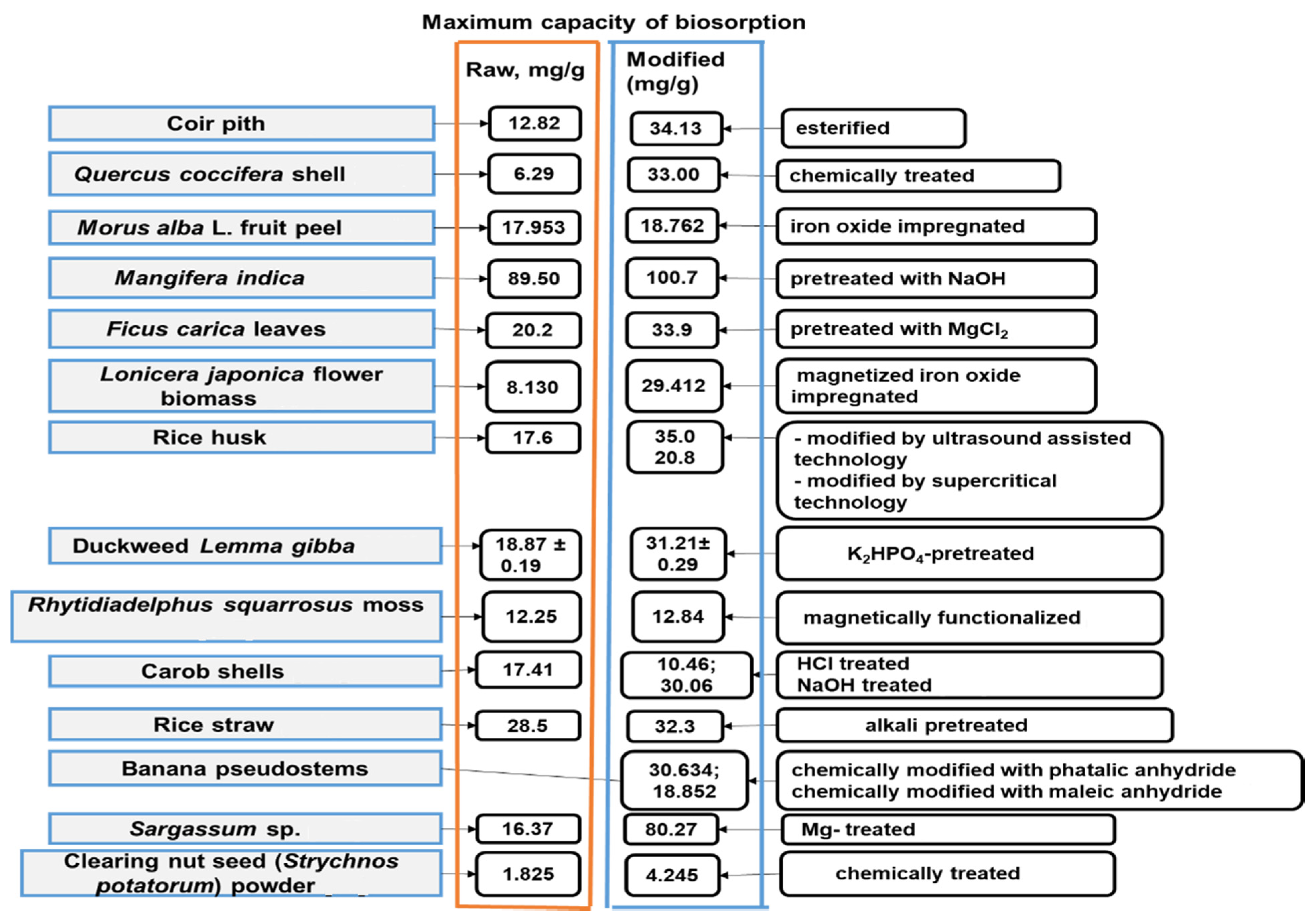

Publisher’s Note: MDPI stays neutral with regard to jurisdictional claims in published maps and institutional affiliations. |
© 2022 by the author. Licensee MDPI, Basel, Switzerland. This article is an open access article distributed under the terms and conditions of the Creative Commons Attribution (CC BY) license (https://creativecommons.org/licenses/by/4.0/).