


Abstract
This study examined Korean anglers’ willingness to pay (WTP) for the establishment of a Recreational Fishing Environment Fund (RFEF), aimed at mitigating the environmental impacts of recreational fishing on marine resources. As recreational fishing has expanded in Korea, concerns have grown over its negative effects on fishery resources and coastal pollution. Addressing these issues requires sustainable policy interventions, with financial support from stakeholders. To estimate anglers’ WTP for such a fund, a vignette survey was conducted in February 2024 among 1000 South Korean adults with experience or interest in recreational fishing. Using the Double-Bounded Dichotomous Choice Contingent Valuation Method (CVM), the present study estimated an average annual WTP of USD 8.18 per person. These findings provide essential data for designing coastal and ocean environmental policies based on the beneficiary pays principle, offering a financial framework to support conservation efforts and regulatory measures. The results highlight the potential for angler-funded environmental initiatives and can inform policymakers on the feasibility of implementing a dedicated fund for sustainable recreational fishing management.
1. Introduction
The number of recreational anglers in South Korea has steadily increased over the past 18 years, driven by rising income levels and the growing popularity of recreational fishing programs on television [1]. Recreational fishing is typically defined as the act of catching fish primarily for leisure or personal consumption, without the intent to produce food or derive income by selling or trading the catch [2]. Over the last two decades, the angling population in Korea has grown by approximately 3.5 million, from around 5 million in 2000 to 7.05 million in 2013 and 8.5 million in 2018 [1,3]. Notably, the 8.5 million anglers in 2018 accounted for more than 16% of South Korea’s total population of approximately 51.63 million, highlighting the widespread appeal of recreational fishing [3]. This significant growth has had various impacts on related industries, such as the recreational fishing tourism market and fishing equipment [4].
This surge in the fishing population has also driven a substantial increase in the number of users of marine recreational fishing boats. In 2013, approximately 1.96 million people utilized marine recreational fishing boats, a figure that surged to 5.19 million by 2022—an increase of 3.23 million or about 165% compared to 2013 (Figure A1). This remarkable growth corresponds to an average annual growth rate of 11.4% over the past decade. In addition to the rising participation in marine recreational fishing, Korea has demonstrated notable innovation in fishing equipment and services. From 1999 to 2020, the country recorded 1499 valid patents in these areas, ranking second globally after the United States among major fishing nations and regions (Table A1). These trends underline Korea’s growing prominence in recreational fishing and its related industries.
However, the sustained growth of the recreational fishing tourism market has led to a range of environmental and social challenges. These include conflicts with commercial fishing, marine waste dumping by some anglers, and the overfishing of fish resources [5]. For example, in 2023, approximately 60,000 tons of hairtail were caught through commercial fishing in Korea’s coastal waters. In addition, 5952 tons were caught through recreational fishing, indicating a significant level of fishing pressure by recreational fishing [6].
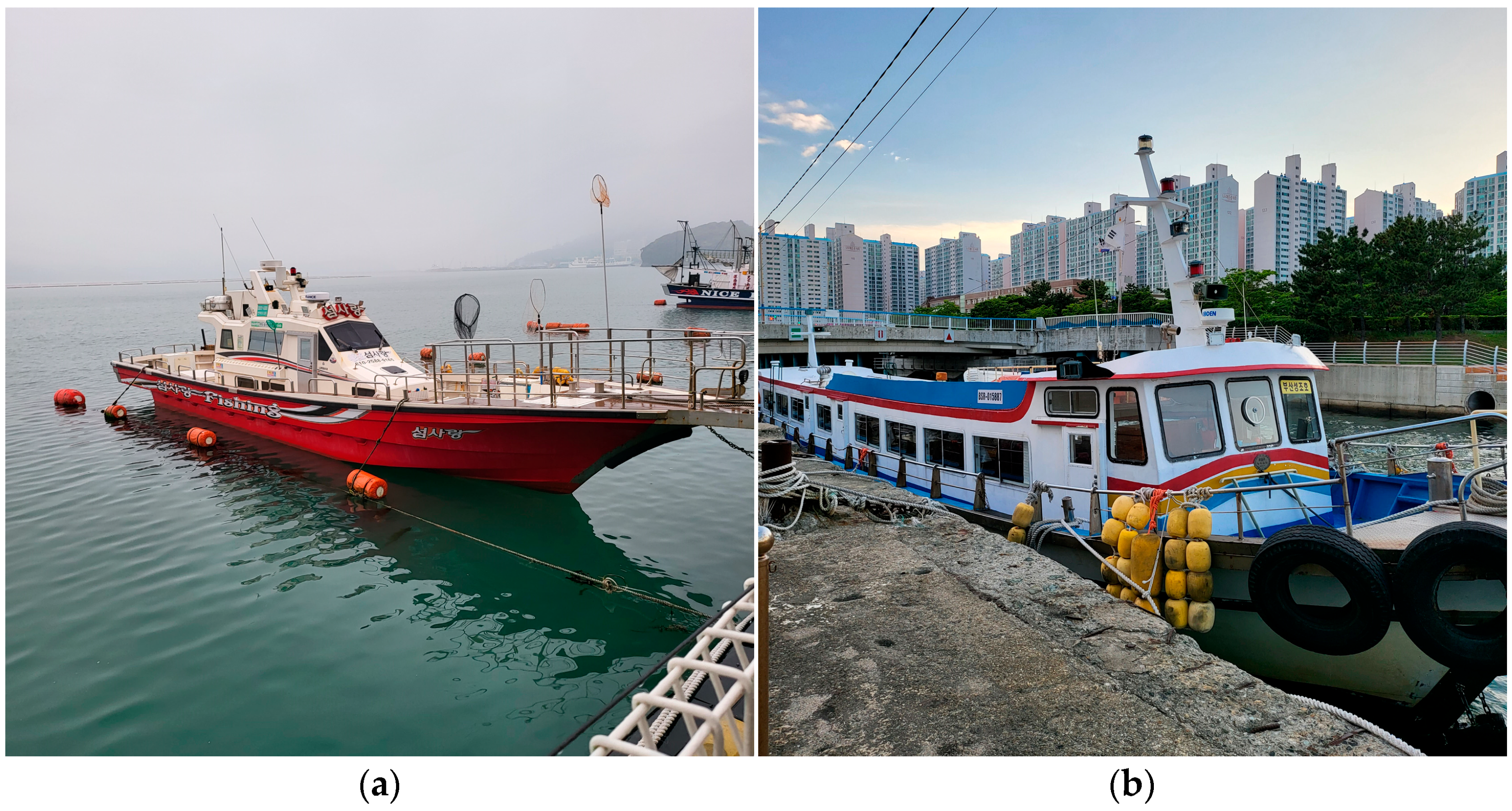
The first step in addressing these challenges could be the establishment of comprehensive statistics on the recreational fishing industry, including data on the number of respondents, the volume of fish caught, and spending patterns (Figure 1). However, investigating the impact of recreational fishing on fishery resources is a challenging task [7]. The government has emphasized the importance of raising funds for initiatives such as the restoration of fishery resources, fishery education, and the development of related industries [6]. These efforts aim to minimize negative environmental impacts, promote sustainable practices, and ensure the public’s access to sound and responsible recreational fishing activities.
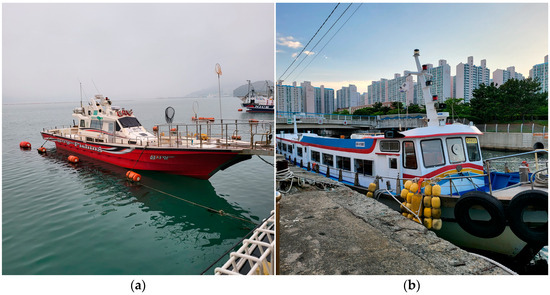
Figure 1.
National survey subjects. Fishing vessel catches for marine resource conservation: (a) recreational fishing vessel on Korea’s west coast; (b) recreational fishing vessel on Korea’s south coast.
The implementation of regulatory and financial measures in recreational fishing is not exclusive to Korea. In major recreational fishing nations such as the United States, Canada, and several European countries, where marine recreational fishing is deeply rooted, governments have introduced institutional mechanisms to address environmental and social concerns [8]. These mechanisms include the establishment of funds to mitigate the adverse effects of fishing on fishery resources while fostering healthy fishing practices and the sustainable growth of related industries. Among the most notable systems implemented by these countries is the fishing license or permit system [9]. Through this approach, advanced fishing nations generate funds for critical purposes such as compiling fisheries statistics, supporting fisheries education, and promoting the development of fisheries-related industries.
With the steady increase in the number of anglers in Korea driven by economic growth, the country has begun to encounter environmental and social challenges similar to those experienced by major fishing nations before they introduced fishing license systems. Discussions about implementing a fishing license system in Korea have been ongoing since the early 2000s. However, progress has been hindered by concerns from the recreational fishing industry, which argues that such a system would increase the cost of fishing activities, reduce demand, and ultimately have a negative impact on the industry [10].
Despite these challenges, increasing demands from recreational anglers and related organizations for enhancements to Korea’s declining fishery resources and outdated fishing tourism infrastructure have pushed the government to explore alternative solutions. Among these is the proposal to establish a dedicated fund to support critical investments in these sectors. Furthermore, there is a growing acknowledgment of the importance of involving anglers and organizations in funding initiatives such as fishery resource restoration, fishery education, and seed stocking projects. This has further strengthened the case for introducing the Recreational Fishing Environment Fund (RFEF).
Moreover, South Korea’s recent emergence as an advanced nation in the international community has reinforced its commitment to global environmental standards, including the Polluter Pays Principle (PPP). The establishment of the fund, grounded in the principles of PPP, aligns with these global norms and provides strong justification for promoting this policy [11]. By ensuring that those who benefit from fishing activities also bear responsibility for mitigating their environmental impact, this initiative represents a significant step toward sustainable development in Korea’s recreational fishing industry.
However, the establishment of an RFEF policy should be preceded by rigorous, scientific, and data-driven value assessment research. Such a study would enable the measurement of the increase in social utility resulting from the implementation of the policy, thereby providing a robust justification for the creation of the fund. Therefore, this study aims to estimate anglers’ maximum willingness to pay (WTP) for the RFEF policy using the Contingent Valuation Method (CVM) and to provide essential data for policy formulation. By offering empirical evidence on the value of the RFEF policy, this research contributes both academically and practically, serving as a critical foundation for policy development and implementation.
2. Methods
2.1. Vignette Survey Design and Implementation
To collect research data, the authors utilized an online panel data platform in South Korea and conducted a text-based vignette study in 2024. The platform specializes in building online panels and managing research data collection. The data were designed to be extracted from adults aged 20 or older living in South Korea who have experience and interest in recreational fishing.
The research panel was presented with a text-based vignette scenario describing the situation in Korea regarding recreational fishing and the required donations to establish the Recreational Fishing Environment Fund (Table 1). The scenario consisted of a description of the fund and its core values.

Table 1.
Description of text-based vignette scenario.
Subsequently, the data panel was asked regarding their willingness to contribute to the Recreational Fishing Environment Fund (Table 2). The survey respondents were initially presented with a randomly assigned suggested donation amount and asked about their willingness to pay. There were eight different suggested amounts, and the survey link was distributed to obtain 125 responses per amount. After the first response, a second question was presented based on the respondent’s initial answer. If the respondent initially agreed to donate, they were then asked about their willingness to pay an amount twice the initial suggestion. Conversely, if they initially declined, then they were asked about their willingness to pay an amount equal to half of the initial suggestion.
Table 2.
Examples of CVM survey question items.
The online survey link was distributed to 6077 panel members, yielding 1000 responses, which corresponds to a valid response rate of 16.4%. The measurement component consisted of two modules: the first assessed the WTP for a donation to the Recreational Fishing Environment Fund (RFEF), while the second gathered anonymous socioeconomic information of the panel members and their opinions on supporting the RFEF.
2.2. Research Model
The Contingent Valuation Method (CVM) serves as a tool for assessing the value of non-market goods, such as policy programs or environmental assets [12,13]. In this study, the focus is on the application of the Double-Bounded Dichotomous Choice (DBDC) model, a method extensively utilized in CVM studies for a more precise valuation [14]. The DBDC approach aims to elicit individuals’ willingness to pay (WTP) through a structured questioning process. Initially, respondents are presented with a base price for the hypothetical good in question. Based on their initial response—whether positive or negative—follow-up questions adjust the value accordingly: either doubling it for “yes” responses or halving it for “no” responses. In this case, the OBDC model consists of four possible outcome scenarios: (i) positive–positive case, (ii) negative–negative case, (iii) positive–negative case, and (iv) negative–positive case. The likelihoods of such scenarios are , respectively.
The corresponding likelihood formulas are described below [15]. In the first scenario, where both answers are “yes,” indicating that participants react positively, we have and
For the second scenario, where both answers are “no,” indicating that participants react negatively, we have
For the third scenario, where the first response is “yes” and the next is “no,” indicating that participants show the positive–negative pattern, we have
In the final scenario, where the initial response is “no” followed by a “yes,” indicating that participants show the negative–positive pattern, we have
where represent the proposed prices for the ith respondent.
The log-likelihood function is expressed by the following equation [15]:
where are binary indicator variables representing the survey participant’s response.
To analyze the data, we used STATA 18 [16]. This study employed the “doubleb” command, a user-developed tool by Lopez-Feldman, which uses maximum likelihood estimation to analyze the DBDC model within the framework of the Contingent Valuation Method (CVM) [17]. The CVM model was comprehensively developed to include an economic variable (e.g., household income), demographic characteristics (e.g., age, household size, and gender), and proxy indicators for the angler’s recreational specialization in recreational fishing (e.g., online information search related to recreational fishing), as well as the frequency of seafood consumption. Online search activity was measured using a seven-point Likert-type scale. At the same time, seafood consumption frequency was assessed based on the actual number of times seafood was consumed in a week. The model aimed to capture the participants’ behaviors using proxy variables to reflect their actual engagement. After assessing the anglers’ WTP to support the Recreational Fishing Environment Fund, the weighted average WTP of Korean anglers was calculated.
3. Results
3.1. Panel Member Information
The definitions and descriptive information of the panel members are summarized in Table 3. The participants had a mean age of 46.6 years and an average household size of 2.88 members. Marital status and gender are characterized as dummy variables that have binary values. The household income was about KRW 5.89 million per month, which is equivalent to approximately USD 4533.
Table 3.
Descriptive information of panel.
Table 4 illustrates how the responses were distributed across different bid amounts. A notable trend was observed: the proportion of respondents answering “yes” to the bid amount decreased as the bid amount rose. This observation is consistent with an economic principle that higher prices for a good or service result in a lower quantity demanded. This trend was similarly observed in the second question, reaffirming the principles of economics [18].
Table 4.
Frequency distribution of WTP across different bid amounts.
3.2. Estimation Results
The WTP for contributing to the RFEF was assessed using double-bounded choice modeling, and the results, presented in Table 5, revealed significant findings. The analysis highlighted the importance of recreational specialization in fishing activities, specifically the frequency of acquiring online fishing information, as a key proxy determinant of WTP. The participants who frequently searched for recreational fishing information online tended to demonstrate a greater WTP than those who did not. Additionally, the frequency of seafood consumption emerged as another significant factor influencing WTP, underscoring its role in shaping the participants’ attitudes. In contrast, other economic and socio-demographic variables, such as household income, marital status, gender, age, and family size, were statistically insignificant (Table 5, p-values).
Table 5.
Estimated parameters of the double-bounded choice model.
Based on the calculated mean WTP obtained from the research model, the researchers estimated the anglers’ WTP for the RFEF to be USD 8.18 (Table 6, Coef.). This calculation was performed by applying a linear combination of the significant variables, using their average values as inputs [17].
Table 6.
Estimated WTP for contributing toward the RFEF.
3.3. Reason for Supporting the RFEF
In this study, we not only estimated the WTP for the RFEF but also undertook a crucial research task: examining the arguments for and against such a policy. This process led to qualitative insights that not only enriched the interpretation of the results but also significantly contributed to the development of policy recommendations. Moreover, by exploring public opinion on the policy, we provide policymakers with a robust and compelling basis for its adoption. During the survey, we posed follow-up questions to both supporters and opponents of the RFEF, uncovering their motivations and reasons for dissent. This thorough and comprehensive methodology facilitated a deep exploration of public perceptions regarding the policy, instilling confidence in the study’s conclusions.
As shown in the survey results in Table 7, most respondents supported the policy mainly to maintain a clean natural environment and preserve the aquatic ecosystem. The following reason was the desire to contribute to the sustainability of fishing activities, followed by enjoying pleasant recreational fishing through the expansion of amenities and indirectly participating in environmental protection activities and feeling proud of protecting the environment.
Table 7.
Reasons for contributing to the RFEF.
Table 8 reveals that the primary reasons reported by the respondents opposing the RFEF were economic concerns and a lack of interest in the sustainability of the marine ecosystem. Some respondents expressed that they already paid substantial taxes or could not afford additional costs. Others attributed their opposition to indifference toward environmental issues or a lack of awareness regarding the necessity of managing recreational fishing. While the proportion of respondents opposing the fund’s establishment was relatively small, their objections were not limited to financial burdens. They also indicated a lack of understanding about recreational fishing management and an inadequate recognition of the importance of sustaining the marine ecosystem. These findings highlight the urgent need to change how anglers perceive sustainability issues in recreational fishing.
Table 8.
Reasons for not contributing to the RFEF.
4. Discussion
The present research conducted a CVM analysis to estimate Korean anglers’ willingness to pay for the Recreational Fishing Environment Fund (RFEF). The research model consisted of key variables, including economic, socio-demographic, and proxy variables, which were used to measure recreational anglers’ levels of involvement and interest in fishing activities. The authors implemented an online vignette survey to measure survey participant responses to a text-based scenario to support the RFEF by paying a specific contribution amount. The RFEF aims to maintain the sustainability of recreational fishing and aquatic resources. According to the results, the anglers’ annual WTP for the RFEF is USD 8.18 per person. Among the independent variables, the proxy variables (e.g., online information search behavior for recreational fishing) for the level of recreation specialization in fishing activities and a preference for seafood (e.g., the frequency of seafood consumption) were statistically significant. However, economic variables and other demographic variables were insignificant. The survey respondents reported that the most important reason why they supported the RFEF is that they want to maintain a clean natural environment. The next was to preserve the aquatic ecosystem. Such results reflect a collective desire for the long-term sustainability of the marine environment. Among all the respondents, 18.6% declined to contribute to the RFEF. The primary reasons for this included indifference toward the sustainability of the marine ecosystem, the perception that recreational fishing management is unnecessary, and the belief that current taxes or contributions are already sufficient.
This study investigated anglers’ WTP to contribute to the RFEF. The key variables influencing the WTP for the RFEF were the frequency of seafood consumption and the use of online fishing information. These findings can be interpreted as follows. First, regarding seafood consumption frequency, it is reasonable to expect a positive correlation between WTP and consumption frequency. Consumers who frequently consume seafood tend to place a high value on factors such as freshness and safety, which are directly influenced by the quality of fishery products and the marine environment. As the RFEF is intended to improve marine environment conditions, those who regularly consume seafood may be more willing to contribute financially to its improvement.
Second, with respect to the use of online recreational fishing information, in Korea, such information is commonly accessed via online apps to check real-time weather updates and find safe and pleasant fishing locations. A higher frequency of use of online fishing information suggests a greater interest in engaging in safe and enjoyable fishing activities. This, in turn, is associated with a higher WTP for the RFEF. The positive relationship between WTP and the use of online fishing information observed in this study reflects an aspect of recreational fishing in Korea, where digital platforms play a crucial role in enhancing fishing experiences.
Another major finding of this study is that the estimated annual WTP for the RFEF is approximately USD 8.18. This result aligns with that of previous domestic and international studies that employed the Contingent Valuation Method (CVM) to assess WTP in the context of fishing-related activities. For instance, in Korea, Nam and Park used the CVM to estimate the WTP for an increase in the abundance of saltwater recreational fish stocks [19]. Their study found that anglers were willing to pay an additional USD 12.71 per trip if saltwater fish stocks increased by 20%. Similarly, in an international context, Schuhmann (2021) examined anglers’ WTP for the creation of a special fund aimed at improving the habitat of migratory species such as striped bass in the Cape Fear River area of North Carolina, USA. The study reported an average WTP of approximately USD 18 to USD 21 [20].
These comparisons suggest that the WTP estimates presented in this study are consistent with those in the literature that applied the CVM to recreational fishing-related environmental improvements. The findings reinforce the validity of the estimated WTP for the Fishing Environment Fund and highlight its relevance in both domestic and international contexts.
Another comparable study by Bennear [9] explored the demand for recreational fishing licenses. While the license fee was intended to support the sustainability of the marine ecosystem, their study focused on identifying the key variables influencing license demand. Instead of employing the Contingent Valuation Method (CVM), they utilized a general demand estimation model for licenses. This approach indicates that their primary emphasis was not on the sustainability of the marine ecosystem but rather on the value of the recreational fishing experience.
The proxy variable of recreation specialization positively affects Korean anglers’ WTP a contribution to the RFEF. Previous studies on recreation specialization suggest a positive correlation between anglers’ level of specialization and their eco-friendly attitudes and behaviors, including a heightened sense of connection to nature [5]. As their recreation specialization increases, so does their knowledge of and interest in fisheries resources and environmental conservation. This, in turn, fosters eco-friendly attitudes and behaviors toward fishing, which can extend to promoting environmentally responsible actions in daily life [5,21].
Previous studies have explored the relationship between seafood consumption trends and recreational fishing participation [22,23]. The findings of the present study indicate that individuals with high seafood consumption tend to respond positively to contributing funds for the protection of marine ecosystems. Cooke’s research emphasized the role of fishing as a source of seafood [22]; it was revealed that recreational anglers, who are frequent seafood consumers, exhibit heightened environmental sensitivity [23]. These earlier findings provide a valuable context for interpreting the results of the current study.
As the number of recreational fishers in Korea has steadily increased over the past 18 years, the growth of Korean recreational fishing has also worsened the negative impact on the marine environment [24]. This study attempted to estimate the amount willing to be paid for the Recreational Fishing Environment Fund (RFEF) in order to minimize the negative impact of recreational fishing activities on the marine environment, thus ensuring sound fishing activities in Korea.
Meanwhile, the fishing license system that the Korean government tried to implement around the 2000s has been stalled due to opposition from various stakeholders, including anglers and recreational fishing-related industries [10]. For the fishing environment fund system, an alternative to the fishing license system, to become a more realistic and acceptable system for these stakeholders, the following institutional policies should be considered simultaneously: the need to manage recreational fishing, which has been continuously raised in the international community, and the introduction of institutional frameworks, which is supported by various international guidelines and recommendations. For instance, the Food and Agriculture Organization (FAO) emphasizes the importance of responsible recreational fishing, which advocates for sustainable practices that are environmentally sound, economically viable, and socially responsible [25].
In order for the RFEF to become a system that anglers and fishing-related industries can accept, the funds raised through the system should be reinvested in ways that promote environmental and social benefits and the interests of stakeholders. A prime example is the Sport Fishing and Wildlife Restoration program in the United States, which has its origins in 1950 with the establishment of the Sport Fish Restoration Program (SFR), a stable and highly successful funding initiative that has supported state fisheries research, propagation, and management activities since its inception [26]. The funds raised through taxes on fishing supplies and fishing boat fuel are used to restore fishing resources; provide fishing education; and improve infrastructure, including piers and parking lots. These funds have led to improvements in the fishing environment, an increase in the number of anglers, and an increase in income for the fishing industry, making it one of the most successful examples of a virtuous cycle system. To increase stakeholder acceptance of the fishing environment fund system, it is necessary to have a virtuous circle system in which the resources raised through the fund increase environmental and social benefits, thereby establishing institutional legitimacy, and the fund’s burden becomes its beneficiary.
To ensure effective utilization, the fishing environment fund should be used exclusively for its intended purposes, with transparency enhanced through the disclosure of fund usage information to stakeholders. If the RFEF is allocated for diverse objectives, such as fostering a healthy fishing culture, conserving fishery resources, improving the fishing environment, and supporting the development of the recreational fishing industry and local economies, then its purpose must be explicitly defined by law. Stakeholders should have access to comprehensive information about the fund’s operation and management. Furthermore, concerted efforts are needed to secure stakeholder support for the continued implementation of the fishing environment fund system. This can be achieved by providing regular feedback, including evaluations of improvements, challenges, and their impact on the fishing environment and industry following the fund’s usage and investments.
Finally, the promotion and education of the RFEF should be strengthened so that it can be perceived as an investment benefit rather than a type of “tax” for stakeholders. Various efforts, including the production and distribution of promotional materials and posters on the purpose of the RFEF and how to use it, and the holding of explanatory meetings in major regions, are expected to contribute greatly to strengthening the legitimacy of the RFEF and promoting consensus among stakeholders on government policies. In particular, if the purpose of establishing the RFEF and its utilization plan is linked to the protection and recovery of fishery resources and the improvement of the local fishing environment, then it is expected to play a significant role in promoting understanding between fishermen, residents, and anglers in fishing activities targeting local areas and waters, as well as in preventing conflicts and disputes over resource depletion and damage to the local environment.
This study contributes to the field of the sustainable development of the recreational fishing industry and fisheries resource management by applying the Contingent Valuation Method (CVM) to estimate Korean anglers’ willingness to pay (WTP) for the Recreational Fishing Environment Fund (RFEF). It highlights the significance of behavioral factors such as recreational specialization and seafood consumption in affecting WTP while demonstrating the limitations of traditional economic and demographic variables. These are relatively new findings in the recreational fishing tourism field. By examining barriers to stakeholder acceptance, this research provides a significant understanding for policymakers, offering actionable insights for policy design. Research implications emphasize the importance of linking environmental benefits to anglers’ gains and fostering consensus through marine environment education and promotion.
While this study provides valuable insights into the perceptions and behaviors of recreational anglers in South Korea, it has certain limitations. The research relied on a convenience sample, as practical constraints made it difficult to employ a fully randomized sampling method. The survey targeted individuals with fishing experience or a strong interest in recreational fishing, ensuring the relevance of the collected data to the study’s objectives. With a sample size of 1000 participants, the study captured meaningful perspectives within the recreational angler community. However, as the sample consisted of individuals already engaged or interested in fishing, the findings may not be generalizable to the broader Korean population, including those with no connection to fishing activities. Despite such a limitation, this study contributes to a better understanding of the perspectives of Korean recreational anglers and provides a foundation for further research in this area.
Author Contributions
Conceptualization, D.-H.G. and S.Y.; methodology, S.Y.; software, S.Y.; validation, S.Y. and D.-H.G.; formal analysis, S.Y.; investigation, Y.-G.K.; resources, S.Y. and D.-H.G.; data curation, S.Y.; writing—original draft preparation, D.-H.G. and S.Y.; writing—review and editing, S.Y.; visualization, S.Y.; supervision, S.Y. and D.-H.G.; project administration, S.Y. and D.-H.G.; funding acquisition, S.Y. All authors have read and agreed to the published version of the manuscript.
Funding
This research was supported by the Korea Institute of Marine Science & Technology Promotion (KIMST), funded by the Ministry of Oceans and Fisheries, Korea (RS-2022-KS221673). This research was also supported by the National Research Foundation of Korea (NRF) grant funded by the Korean government (2021S1A5A8064722).
Data Availability Statement
The data presented in this study are available on request from the corresponding author.
Acknowledgments
The authors appreciate the support from the Ministry of Oceans and Fisheries.
Conflicts of Interest
The authors declare no conflicts of interest.
Abbreviations
The following abbreviations are used in this manuscript:
| CVM | Contingent Valuation Method |
| DBDC | Double-Bounded Dichotomous Choice |
| FAO | The Food and Agriculture Organization |
| PPP | Polluter Pays Principle |
| RFEF | Recreational Fishing Environment Fund |
| WTP | Willingness to pay |
Appendix A
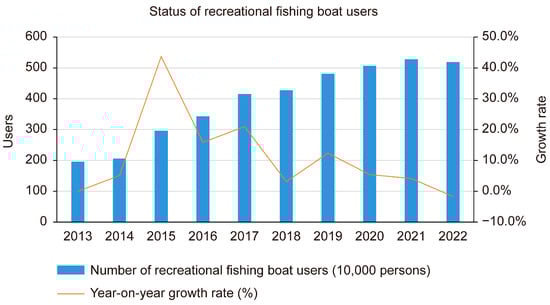
Figure A1.
Status of recreational fishing boat users [6].
Figure A1.
Status of recreational fishing boat users [6].
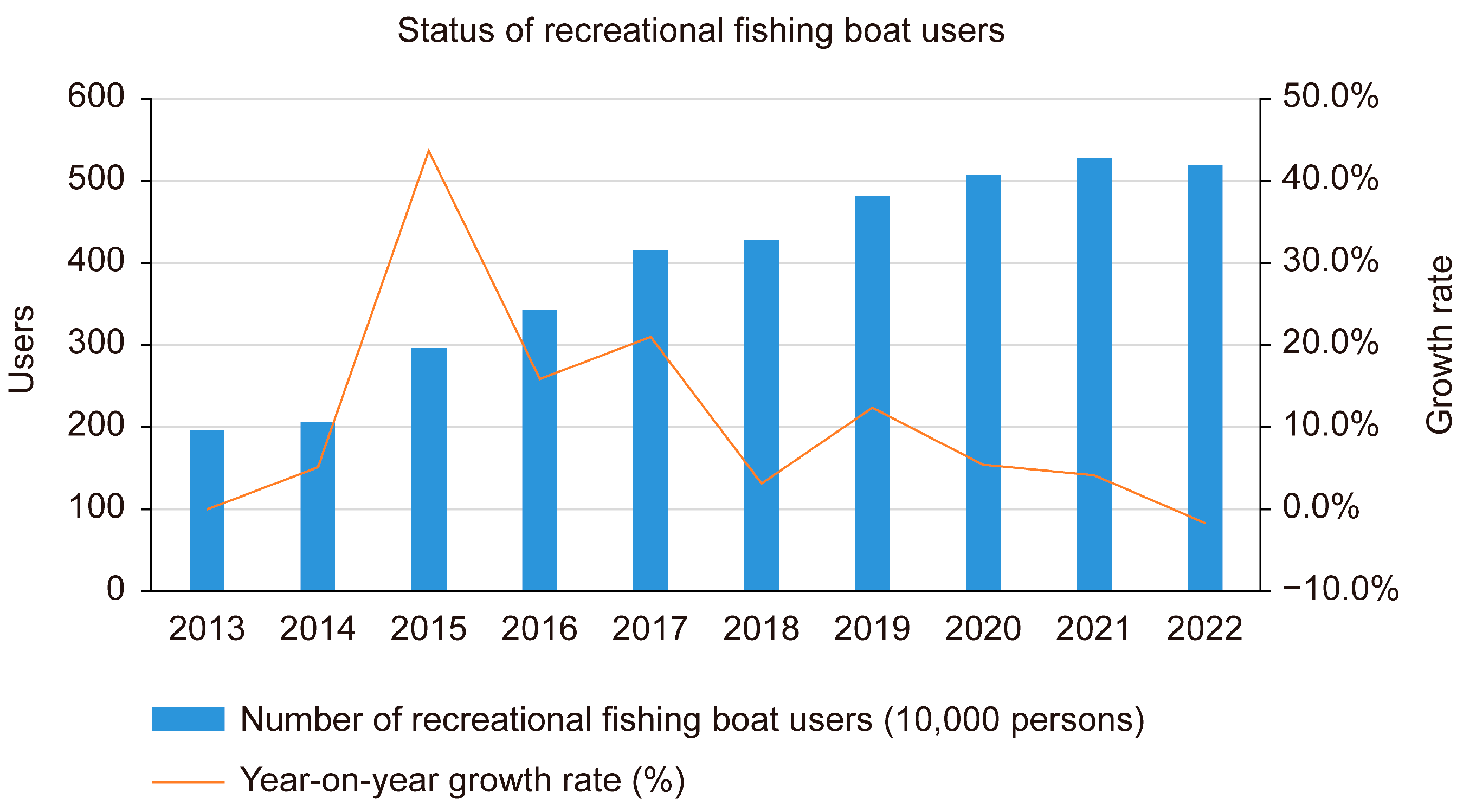
Table A1.
Number of valid patents for fishing-related equipment and services from 1999 to 2020.
Table A1.
Number of valid patents for fishing-related equipment and services from 1999 to 2020.
| Subcategory | Korea | USA | Japan | Europe | Total |
|---|---|---|---|---|---|
| Fishing equipment and applied technology | 1216 | 1474 | 913 | 224 | 3827 |
| Fishing vessels and safety technology | 210 | 383 | 158 | 40 | 791 |
| New fishing services | 73 | 51 | 36 | 3 | 163 |
| Total | 1499 | 1908 | 1107 | 267 | 4781 |
Note: The unit refers to the number of items [6].
References
- Jung, Y.H.; Park, J.B. A plan for revitalization of the fishing industry to promote marine leisure sports. Korea J. Sports Sci. 2023, 32, 407–425. [Google Scholar] [CrossRef]
- Brownscombe, J.W.; Bower, S.D.; Bowden, W.; Nowell, L.; Midwood, J.D.; Johnson, N.; Cooke, S.J. Canadian recreational fisheries: 35 years of social, biological, and economic dynamics from a national survey. Fisheries 2014, 39, 251–260. [Google Scholar] [CrossRef]
- Lee, J.; Hong, S.; Lim, S.; Lee, J.; Jung, R.; Choi, S. A lesser known but emerging issue, recreational fishing debris and the anglers’ opinions in South Korea. Mar. Pollut. Bull. 2023, 194, 115229. [Google Scholar] [CrossRef] [PubMed]
- Shih, C.H.; Wang, X.R.; Lu, Y.M.; Chu, T.J. Assessing the role of policy in the evolution of recreational fisheries in Chinese fishing villages: An analytical hierarchy process (AHP) and delphi method analysis. Fishes 2024, 9, 353. [Google Scholar] [CrossRef]
- Oh, C.O. A study on recreational anglers’ participation process of environmentally responsible behaviors using recreation specialization and consumptive orientation behaviors. J. Fish. Bus. Adm. 2023, 54, 1–16. [Google Scholar] [CrossRef]
- Ministry of Oceans and Fisheries. Research on Strategies for Advancing the Fishing Industry; Ministry of Oceans and Fisheries: Sejong, Republic of Korea, 2024. [Google Scholar]
- Stocco, A.; Gorgosalice, P.; Anelli Monti, M.; Caccin, A.; Pranovi, F. The influence of fishers’ behavior on recreational fishing dynamics and catch: Insights from a Mediterranean coastal lagoon. Coasts 2024, 4, 535–551. [Google Scholar] [CrossRef]
- Ihde, T.F.; Wilberg, M.J.; Loewensteiner, D.A.; Secor, D.H.; Miller, T.J. The increasing importance of marine recreational fishing in the US: Challenges for management. Fish. Res. 2011, 108, 268–276. [Google Scholar] [CrossRef]
- Bennear, L.S.; Stavins, R.N.; Wagner, A.F. Using revealed preferences to infer environmental benefits: Evidence from recreational fishing licenses. J. Regul. Econ. 2005, 28, 157–179. [Google Scholar] [CrossRef]
- Jang, A.S.; Oh, C.O. Analyzing important factors that influence anglers support for fishing license -Focused on the extend theory of planned behavior. J. Fish. Bus. Adm. 2017, 48, 67–82. [Google Scholar] [CrossRef]
- Aizawa, M. A Scoping Study of PPP Guidelines; United Nations: New York, NY, USA, 2018. [Google Scholar]
- Hanley, N.D. Valuing non-market goods using contingent valuation. J. Econ. Surv. 1989, 3, 235. [Google Scholar] [CrossRef]
- Park, S.; Chung, N.; Lee, W.S. Preserving the culture of Jeju Haenyeo (women divers) as a sustainable tourism resource. Sustainability 2020, 12, 10564. [Google Scholar] [CrossRef]
- Yoo, S.H.; Kwak, S.J.; Kim, T.Y. Modelling willingness to pay responses from dichotomous choice contingent valuation surveys with zero observations. Appl. Econ. 2001, 33, 523–529. [Google Scholar] [CrossRef]
- Hanemann, M.; Loomis, J.; Kanninen, B. Statistical efficiency of double-bounded dichotomous choice contingent valuation. Am. J. Agric. Econ. 1991, 73, 1255–1263. [Google Scholar] [CrossRef]
- StataCorp. Stata Statistical Software, Release 18; StataCorp LLC: College Station, TX, USA, 2023. [Google Scholar]
- Lopez-Feldman, A. Introduction to Contingent Valuation Using Stata (MPRA Paper No. 41018); Centro de Investigacion y Docencia Economicas (CIDE): Toluca, Mexico, 2012. [Google Scholar]
- Mankiw, N.G. Principles of Economics; Harcourt College Publishers: San Diego, CA, USA, 2001. [Google Scholar]
- Nam, J.; Park, C.H. Estimation of the willingness to payment of sea-anglers about Increase in abundance of fish resources using CVM. Ocean Polar Res. 2016, 38, 235–245. [Google Scholar] [CrossRef]
- Schuhmann, P.W. Anglers’ Willingness to Pay for Recreational Catch Improvements in the Cape Fear River; Department of Economics and Finance, Cameron School of Business, University of North Carolina Wilmington: Wilmington, NC, USA, 2021. [Google Scholar] [CrossRef]
- Raynal, J.M.; Weeks, R.; Pressey, R.L.; Adams, A.J.; Barnett, A.; Cooke, S.J.; Sheaves, M. Habitat-dependent outdoor recreation and conservation organizations can enable recreational fishers to contribute to conservation of coastal marine ecosystems. Glob. Ecol. Conserv. 2020, 24, e01342. [Google Scholar] [CrossRef]
- Cooke, S.J.; Twardek, W.M.; Lennox, R.J.; Zolderdo, A.J.; Bower, S.D.; Gutowsky, L.F.G.; Danylchuk, A.J.; Arlinghaus, R.; Beard, D. The nexus of fun and nutrition: Recreational fishing is also about food. Fish Fish. 2018, 19, 201–224. [Google Scholar] [CrossRef]
- Perkinson, M.T.; Faith, T.D.; Vahey, G.M.; Vena, J.E.; Williams, E.M. Quantifying the seafood consumption patterns of recreational anglers in Charleston and Berkeley counties, South Carolina. Environ. Health Insights 2016, 10, EHI.S40668. [Google Scholar] [CrossRef] [PubMed]
- Moon, S.Y.; Kim, H.; Lee, M.H.; Jung, K.M.; Kim, M.J. Spawning period and estimated recreational catch of Amphioctopus fangsiao in the coastal waters of Jeollanam-do, Korea. Korean J. Fish. Aquat. Sci. 2022, 55, 61–66. [Google Scholar] [CrossRef]
- Barrella, W.; Ramires, M.; Rotundo, M.M.; Petrere, M., Jr.; Clauzet, M.; Giordano, F. Biological and socio-economic aspects of recreational fisheries and their implications for the management of coastal urban areas of south-eastern Brazil. Fish. Manag. Ecol. 2016, 23, 303–314. [Google Scholar] [CrossRef]
- Scarnecchia, D.L.; Schooley, J.D.; Lackmann, A.R.; Rider, S.J.; Riecke, D.K.; McMullen, J.; Ganus, J.E.; Steffensen, K.D.; Kramer, N.W.; Shattuck, Z.R. The sport fish restoration program as a funding source to manage and monitor bowfishing and monitor inland commercial fisheries. Fisheries 2021, 46, 595–604. [Google Scholar] [CrossRef]
Disclaimer/Publisher’s Note: The statements, opinions and data contained in all publications are solely those of the individual author(s) and contributor(s) and not of MDPI and/or the editor(s). MDPI and/or the editor(s) disclaim responsibility for any injury to people or property resulting from any ideas, methods, instructions or products referred to in the content. |
© 2025 by the authors. Licensee MDPI, Basel, Switzerland. This article is an open access article distributed under the terms and conditions of the Creative Commons Attribution (CC BY) license (https://creativecommons.org/licenses/by/4.0/).