


Abstract
The present study reports a reconstruction scheme for gravity with the scale factor describing the pre-bounce ekpyrotic contraction, where is the big crunch time. The reconstructed is used to derive expressions for density and pressure contributions, and the equation of state parameter resulting from this reconstruction is found to behave like “quintom”. It has also been observed that the reconstructed has satisfied a sufficient condition for a realistic model. In the subsequent phase, the reconstructed is applied to the model of the chameleon scalar field, and the scalar field and the potential are tested for quasi-exponential expansion. It has been observed that although the reconstructed satisfies one of the sufficient conditions for realistic model, the quasi-exponential expansion is not available due to this reconstruction. Finally, the consequences of pre-bounce ekpyrotic inflation in gravity are compared to the background solution for matter bounce.
1. Introduction
Observational evidence in support of the late time acceleration of the universe is documented in a plethora of literature [1,2,3,4]. An exotic matter, characterized by negative pressure, is considered to be responsible for this accelerated expansion and is dubbed “dark energy” (DE) [5,6,7]. Reviews on various candidates of DE have been made in a considerable number of literature works. Some significant ones include [5,7,8,9]. An approach, an alternative to dark energy, also known as “modified gravity”, has some relative advantages. Although DE and modified gravity theories have some similarities in their basic approach, modified gravity has some features that have made it attractive in the study of the late time acceleration of the universe. One very promising modified theory of gravity is gravity [10,11,12,13,14,15,16,17,18,19].
A scheme of the reconstruction of modified gravity that is capable of realizing a unification of the acceleration of late time and early inflation was demonstrated in [20]. In this reconstruction scheme, Reference [20] reported models of modified gravity capable of presenting a successful transition from the phase of matter dominance to the late time accelerated phase of the universe. Another noteworthy reference in this context is [21], which reported gravities that are viable and are reproduced through e-folding numbers. The unification of late and early time acceleration was also reported in this study. Another reconstruction by the imposition of the restrictions of a dynamical nature was presented in [22]. Realization of CDM through gravity was elaborated in [23]. Reference [24] demonstrated how reconstruction schemes can be extended to modified gravity models so as to realize the transition from matter dominance to dark energy dominance. This is due to the non-linear character of gravity relevant to early inflation for large R [25]. The unification approach, as stated above, was also reported in [26,27,28,29].
To avoid the measurable corrections to the occurrence of the local gravity, the models have to apply the chameleon mechanism [30,31] to overcome the Solar System tests. References [32,33,34,35] suggested the models that satisfy both the cosmological and the local gravity constraints. Studies including [36,37,38,39] demonstrated exact solutions that are capable of explaining the current acceleration. For more details, see [40,41]. The exact behaviour of the exotic matter that is thought to be responsible for the acceleration of the current universe is yet to be fully understood. As a consequence, various candidates have been proposed for DE to date, and modified theories also have a considerable variability in the approach, and accordingly, the cosmological parameters have been studied. Among the several candidates proposed so far for DE, holographic dark energy (HDE) is considered to be of immense potential. HDE was proposed on the basis of the holographic principle [42,43,44,45]. The present work, as one of its primary objectives, aims to reconstruct modified gravity based on holographic dark energy. Holographic reconstruction of modified gravity has already been reported in the cosmological literature. Various authors [40,41,46,47,48] have reconstructed different candidates of modified gravity from holographic dark energy (HDE) with different IR cut-offs.
One natural query of the present day cosmology is whether the universe’s evolution actually follows the standard inflationary paradigm. In order for the standard inflation to follow, an initial singularity has to exist. Otherwise, the cosmological bounce is considered, in which case there does not exist any initial singularity [49]. Big bounce scenarios provide us with an alternative to the Big Bang cosmologies. A bounce cosmology in cosmological settings was reported in [49], where it was observed that the bouncing point is characterized by a type-IV singularity. In another interesting study, Odintsov and Oikonomou [50] provided an gravity description of a CDM bouncing model without depending on any matter fluid or cosmological constant. In another study, the authors [51] demonstrated by conformally transforming the Jordan frame singular bounce that the Einstein frame metric leads to a Big Rip singularity. The present work endeavours to demonstrate a reconstruction scheme for gravity with a scale factor describing the pre-bounce ekpyrotic contraction and to study the cosmological consequences for the chameleon scalar field model. The rest of the paper is organised as follows: In Section 1, a brief overview of gravity is presented. A reconstruction scheme for gravity is presented in Section 2 and Section 3, demonstrating the cosmology of the chameleon scalar field under reconstructed gravity. In Section 4, we discuss the background evolution of matter bounce in gravity for a different choice of the bouncing scale factor. The results and concluding remarks are presented in Section 5. Throughout the study, t represents cosmic time, and it is known that, as per the Big Bang theory, the age of the universe is billion years.
2. Brief Overview of Gravity
The action of gravity is given by [15,17]:
where , where c stands for the velocity of light, is the determinant of the metric tensor and is the matter Lagrangian. The is some function of the Ricci scalar. In the remaining part of the paper, we shall take . is a non-linear function of R that contains corrections to the EHaction. The gravitational field equations are given by:
where and are the density and pressure generated due to gravity, and they have the forms:
and:
respectively. The density due to dark matter in gravity is:
and we consider pressureless dark matter, . In the subsequent section, we will consider gravity with the scale factor describing the pre-bounce ekpyrotic contraction.
3. A Reconstruction Scheme for Gravity
In this section, we describe the reconstruction scheme for gravity in a bounce model developed by Cai et al. [52] and further demonstrated by Koehn et al. [53], Odintsov and Oikonomou [54] and Odintsov et al. [55]. In the model demonstrated by [53], a scalar field with non-canonical kinetic terms and a potential were used to develop the cosmological model in a non-supersymmetric framework. In the present work, instead of taking the potential as the ekpyrotic potential, i.e., we consider the chameleon scalar field in the framework of gravity reconstructed for a scale factor describing a pre-bounce ekpyrotic contraction, as was mentioned in [53]. It may also be noted that the reconstruction procedure is similar to that of [55]. However, instead of introducing the e-folding number N, contrary to what was presented in [55], we demonstrate a reconstruction scheme for through the cosmic time t and subsequently in terms of the Ricci scale factor R. The presence of dark matter is also considered. In Equation (7), is the big crunch time. However, instead of constraining c by the lower bound of , we constrained it by non-negativity. The scale factor describing a pre-bounce ekpyrotic contraction is [53]:
giving rise to:
It may be noted that is the big crunch time if the ekpyrotic phase were to continue until that time and c is a parameter constrained to [55]. In this connection, we would like to mention that in the present work, we do not impose any prior constraint on c; rather, we generate a constraint on c based on the solution of the reconstructed . It may further be mentioned that the constraint on c was initially presented in [53], where the constraint of is needed for the assumed form of ekpyrotic potential. In this work, instead of considering a specific form of potential, firstly we reconstruct and then consider the scalar field a chameleon one that has a non-minimal coupling with the matter Lagrangian through an analytic function. For the above choice of scale factor, the Hubble parameter and its derivatives turn out to be as follows:
Using the form of the Hubble parameter derived above the Ricci scalar, its derivatives are derived below:
It was already stated that the purpose of the present work is to reconstruct gravity and to demonstrate the cosmology of the chameleon scalar field under this reconstruction. In view of the above, gravity is reconstructed using Equations (9) and (10). Hence, the modified field equations give rise to the Friedmann equation in FRW geometry as follows:
where indicates the dark matter density and R is the Ricci scalar as stated in Equation (10). In Equation (10), we show how R can be expressed in terms of t based on the choice of the scale factor. Hence, the modified Friedmann Equation (11) written above gives rise to a differential equation with t as the independent variable, which upon solving gives us the solution for in terms of cosmic time t as follows:
where . The above equation (12) is converted to a function of R, and finally, the reconstructed takes the following form:
where:
Equation (14) shows that for to be real, one needs . This choice does not affect and .
The derivatives of up to various orders are computed below:
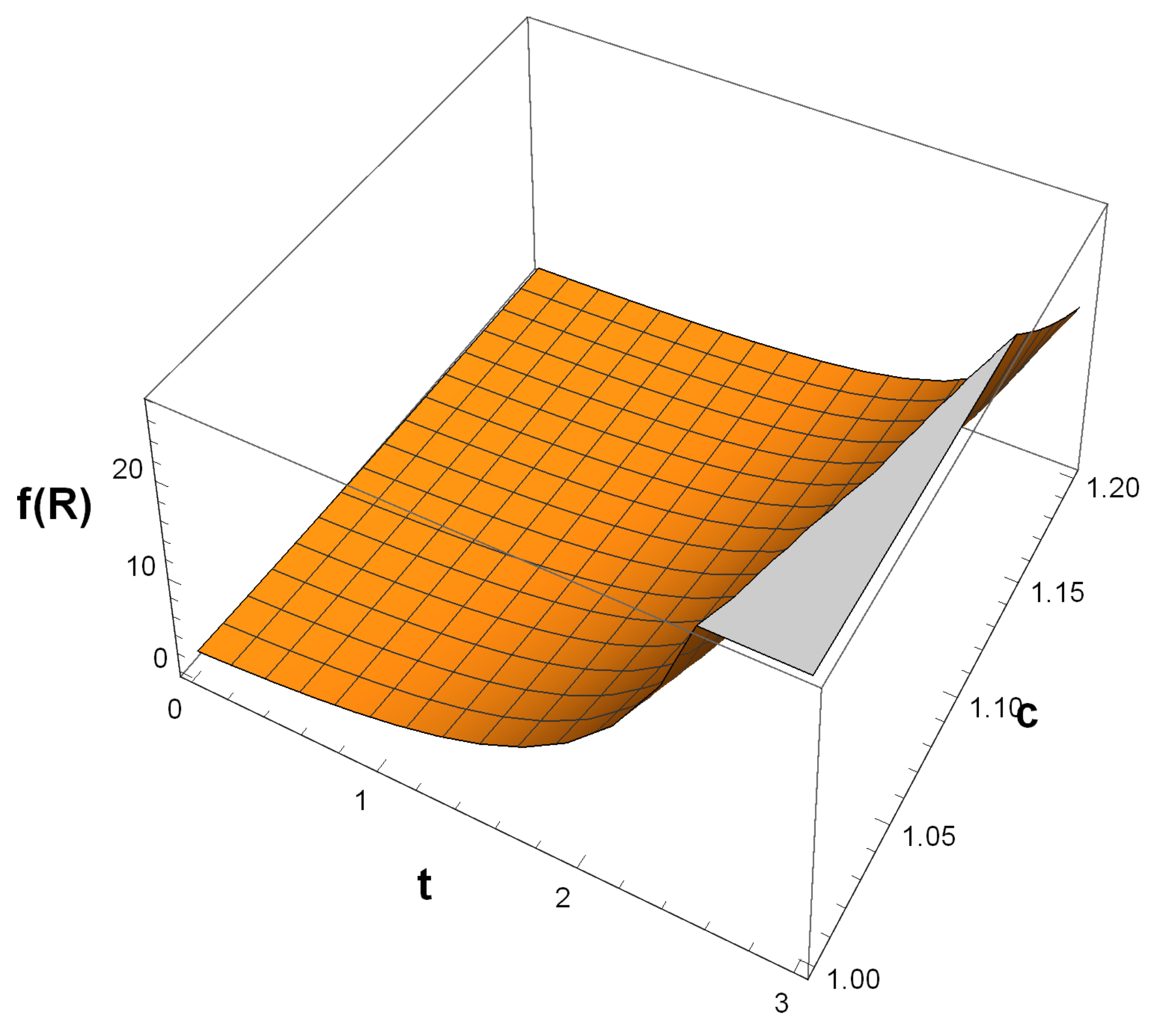
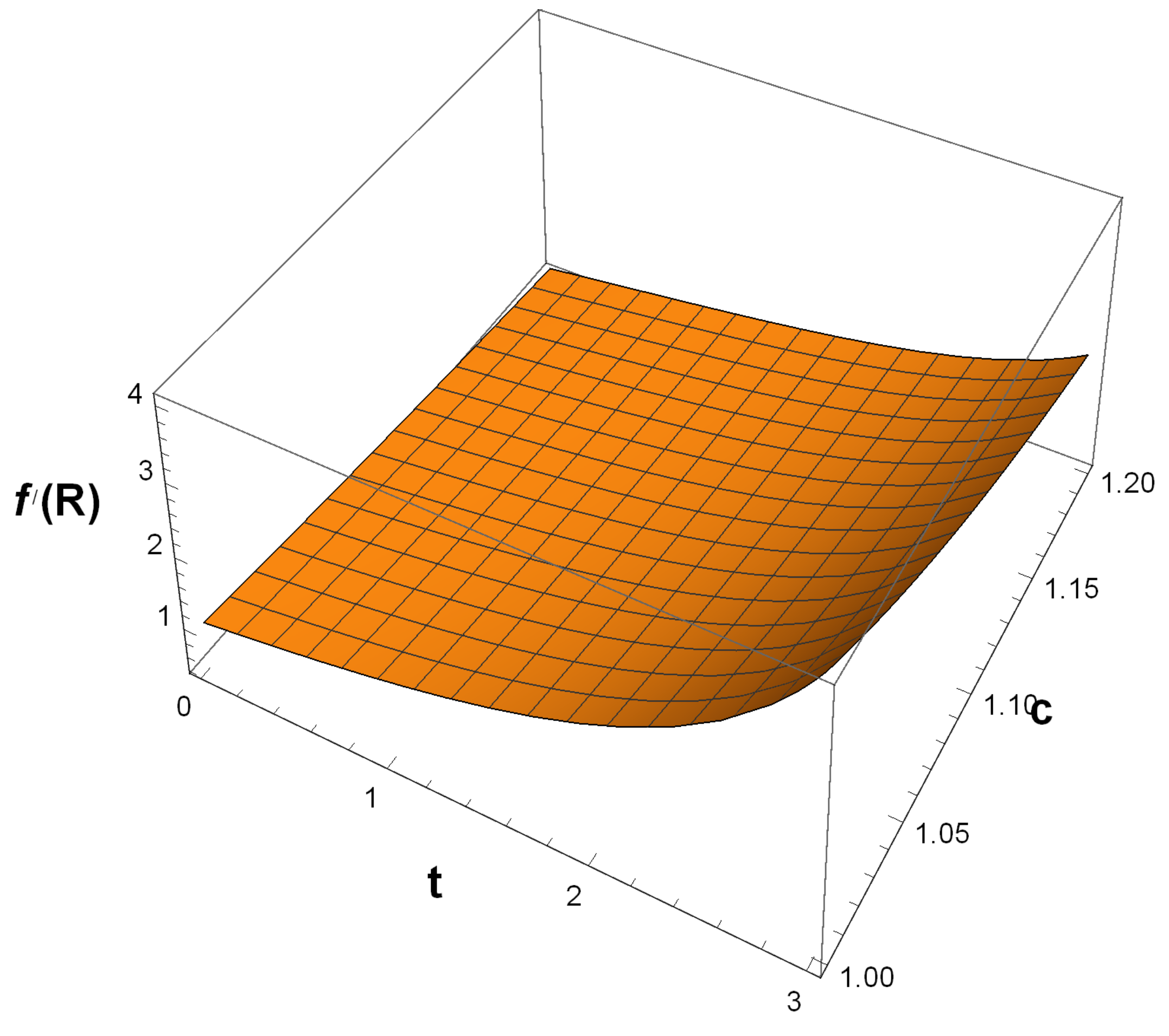
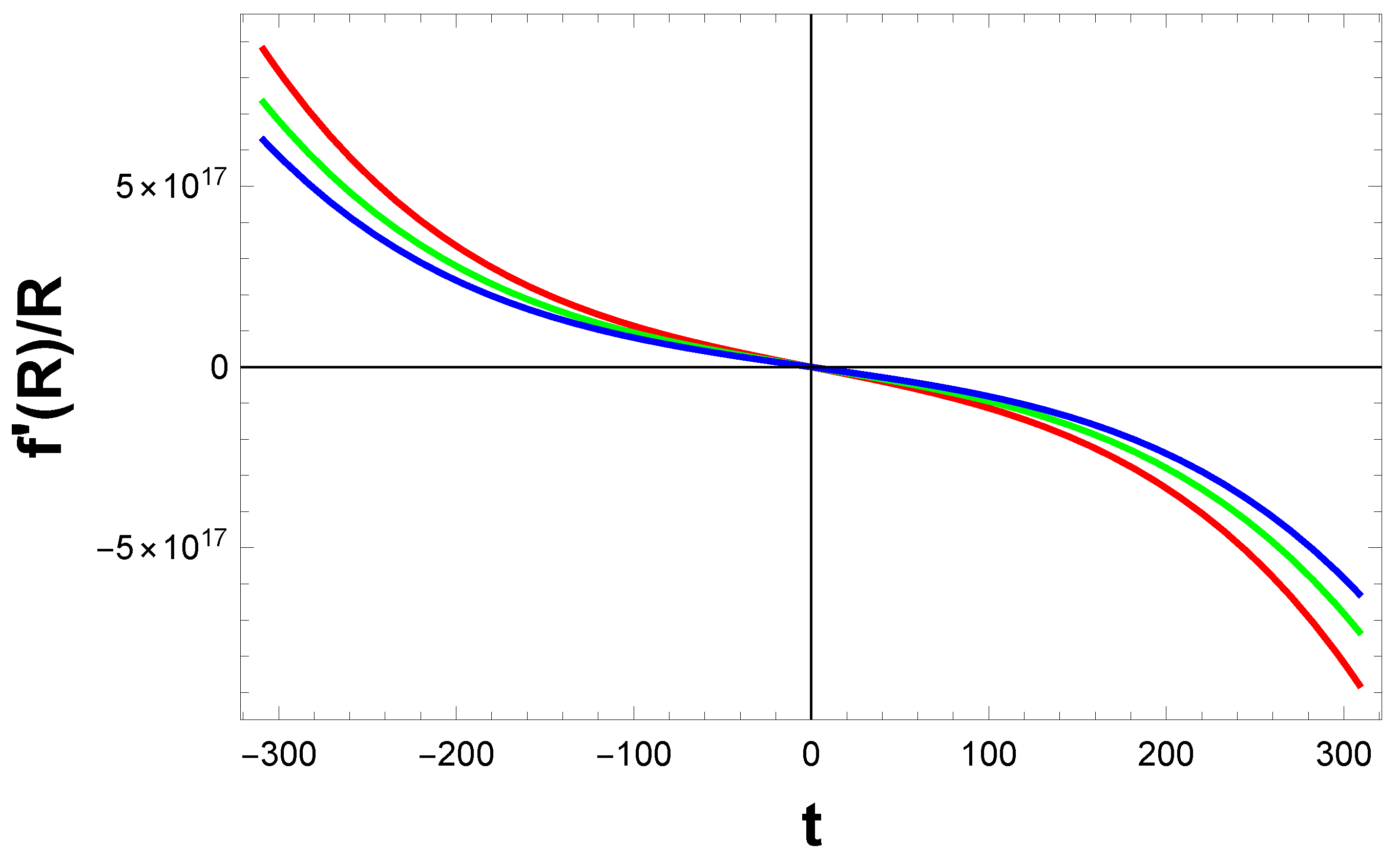
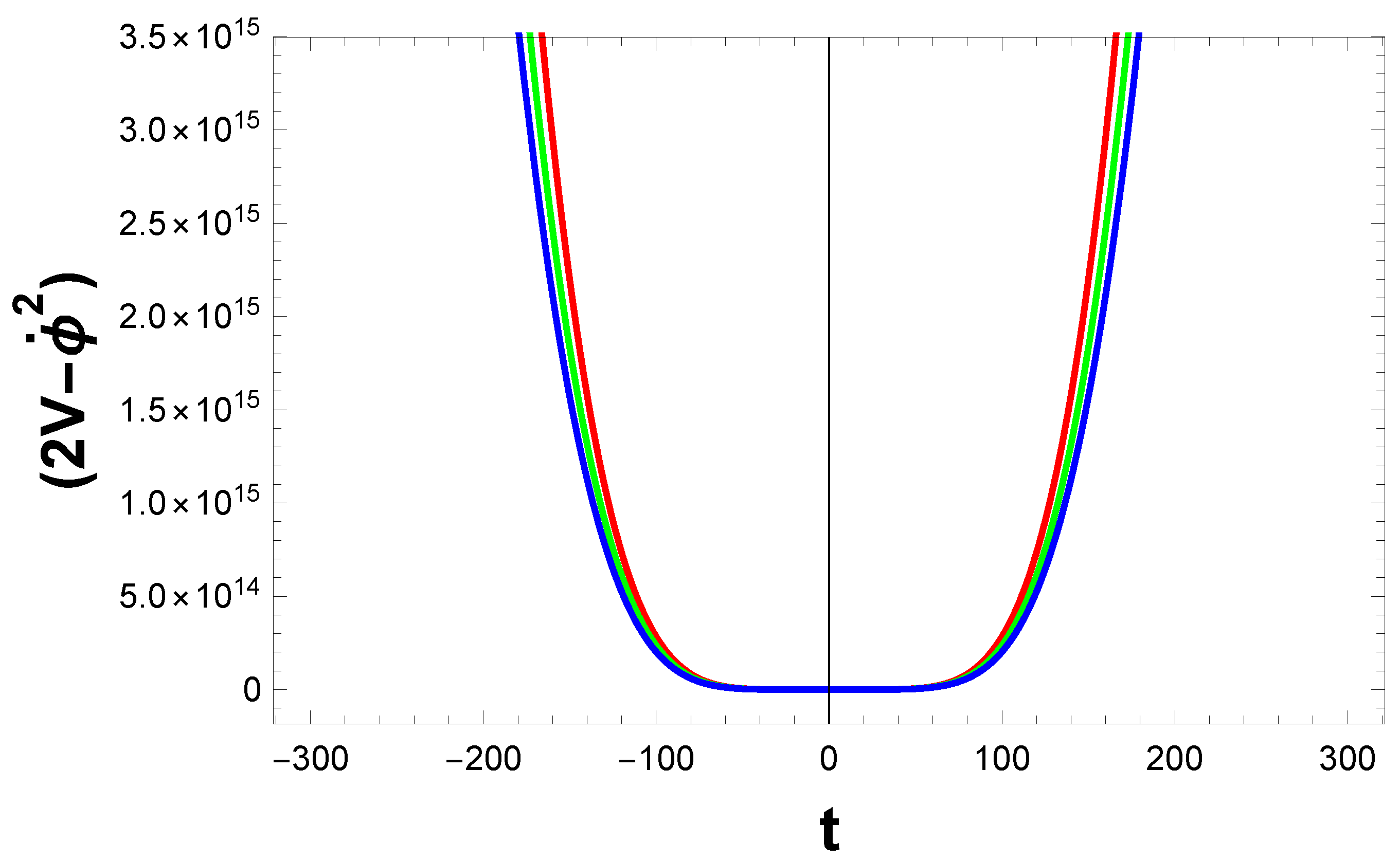
It is clear from the above expressions that the reconstructed is a real solution to Equation (11), and derivatives up to the orders shown above exist. In Figure 1, we observe that shows an increasing pattern with cosmic time for . This indicates that for . Furthermore, Equation (10) shows that for . Thus, for . Hence, it is observed that gravity so obtained is free from ghost instability. Furthermore, from Figure 2, we observe that for , we have an increasing pattern of with cosmic time t. Hence, the time derivative of would be positive. Therefore, we will have . In this connection, we would like to mention that gravity belongs to the class of modified gravity models for which the stability conditions have been investigated in the literature in an extensive manner (e.g., [56,57,58]). These literature works have demonstrated the high curvature regime stable against small perturbations to be a condition for the stability of gravity. This leads to the requirement of a positive mass squared for the scalaron, i.e., . In the present case, both and are positive, . The tachyonic instability manifests in the negative mass terms leading to an unstable low-k regime [58]. In the present case, squared mass comes out to be positive for the reconstructed . Thus, the model of obtained through the reconstruction scheme presented above is free from tachyonic instability. This proves the physical viability of the reconstructed model.
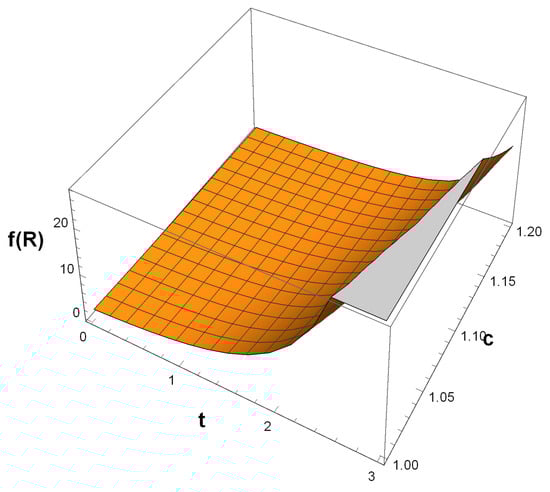
Figure 1.
Evolution of reconstructed (Equation (12)).
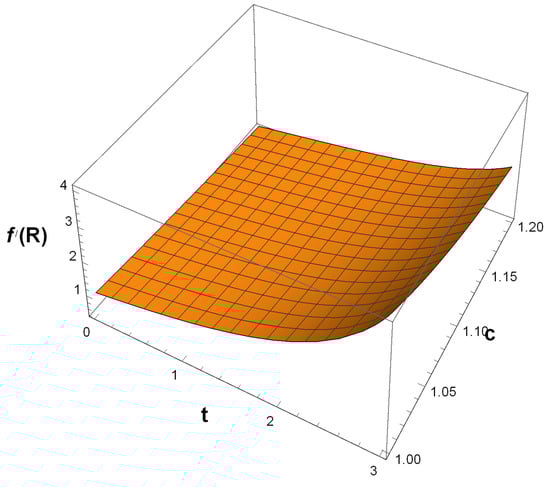
Figure 2.
Evolution of reconstructed .
4. Chameleon Scalar Field under Modified Gravity
In this section, the reconstructed gravity will be considered to reconstruct the chameleon scalar field and chameleon potential to investigate whether they can lead to quasi-exponential expansion in the framework of the reconstructed gravity. In this connection, it may be noted that an equivalence between and scalar–tensor theories was discussed in [59,60]. In these references, it was discussed how one may consider to reproduce the original action of the chameleon mechanism [61]. In a flat homogeneous universe, the action for the relevant scalar field and potential is given by [62]:
where is the chameleon scalar field and is the chameleon potential. R and G represent the Ricci scalar and Newtonian constant of gravity, respectively. is an analytic function of , and is the modified matter Lagrangian. Variation of the action with respect to metric tensor components in an FRW cosmology leads to the following modified field equation (assuming ).
It may be noted that as we consider the chameleon scalar field in the gravity framework, we chose the density to be , the pressure to be and the analytic function to be replaced by a function of the Ricci scalar R.
Solving Equations (4), we get the reconstructed density contribution due to gravity as follows:
Similarly, from Equation (5), we derive the expression for pressure contribution of this reconstructed gravity as follows:
Now, using the reconstructed and in Equation (6), the form of dark matter density in the gravity framework turns out to be the following:
The equation of the state parameters, as defined below, can be modified using the reconstructed pressure and densities elaborated above.
At this juncture, we consider the modified field equations for the reconstruction of the chameleon scalar field. Using modified field Equations (19) and (20), we can have:
where H, and were already derived. The cosmological parameters derived above will now be explored through plots, and the outcomes will be discussed in the subsequent section.
5. Background Solution for Matter Bounce
In the previous sections, we discussed the various outcomes of a scale factor describing the pre-bounce ekpyrotic contraction. In this section, we demonstrate a comparison of the results with the bounce scale factor proposed in [63]:
where is a scale factor at the bouncing point and is a positive parameter. It was demonstrated in [63] that apart from presenting bouncing behaviour corresponding to matter-dominated contraction and expansion, such an ansatz presented in Equation (27) additionally exhibits the advantage of allowing for semi-analytic solutions.
With the help of this scale factor, we derive the Hubble parameter (H), the Ricci scalar (R), and their derivatives in terms of cosmic time t as follows:
This choice of presents the bouncing behaviour corresponding to matter-dominated contraction and expansion. Furthermore, t ranges from to . Bounce occurs at . Using the expression for R, we can straight away express t as:
The above inversion is valid if . At the bouncing point, we take and . Roughly based on the CMB spectrum, .
With H, R and discussed above, clearly, with this choice,
and:
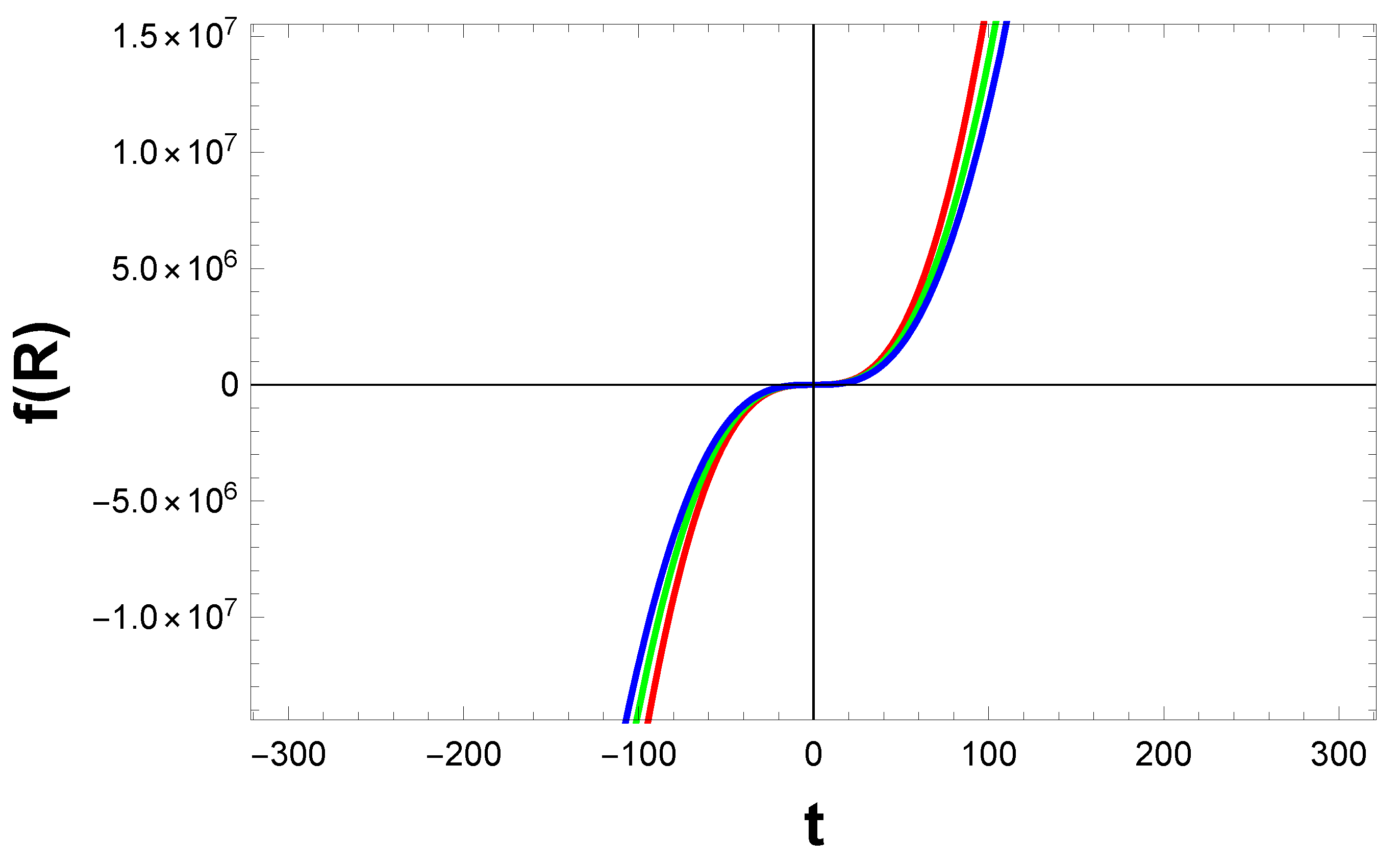
Because of the complicated form of the coefficients, the differential equation (Equation (11)) with in the above forms cannot be solved analytically. The reconstructed is obtained numerically, and the solution in terms of cosmic time t is graphically presented in Figure 3. Here, in the numerical solutions, the positive parameter plays a significant role. Therefore, we take three values of from the interval for the entire calculation. In the following figures, the red, green and blue lines indicate the values = and , respectively. It is observed in Figure 3 that as before, as well as after bounce. Before bounce, the reconstructed tends to zero from the negative side. However, after attaining zero at the bouncing point, it starts increasing towards the positive direction. Hence, irrespective of the pre- or post-bounce scenario. Hence, it is apparent that a realistic solution is available with this choice of the bounce scale factor. Secondly, Figure 4 shows that before bounce and after bounce. Hence, in the pre-bounce phase, the model is not affected by tachyon instability, and this is consistent with the pre-bounce ekpyrotic contraction presented in the previous section. However, after bounce, . Hence, the post-bounce scenario is characterized by tachyon instability. As we study , we observe that it is positive in the pre-, as well as post-bounce scenario (see Figure 5). However, for , i.e., in the vicinity of the bouncing point, is nearly flat, and after bounce, it starts increasing sharply; hence, we may consider it to be consistent with the inflationary expansion.
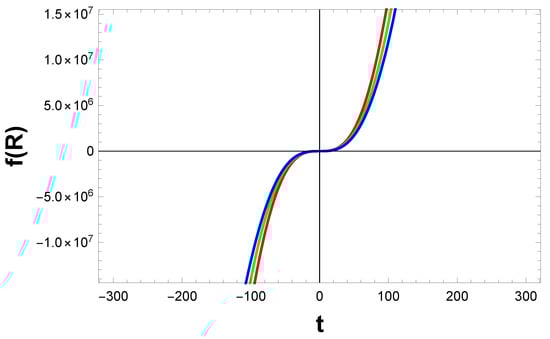
Figure 3.
Evolution of the reconstructed gravity over cosmic time t for scale factor .
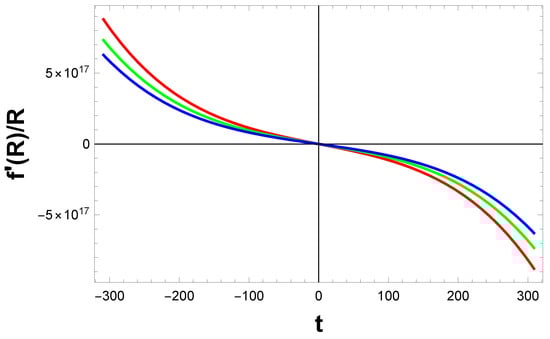
Figure 4.
Evolution of .
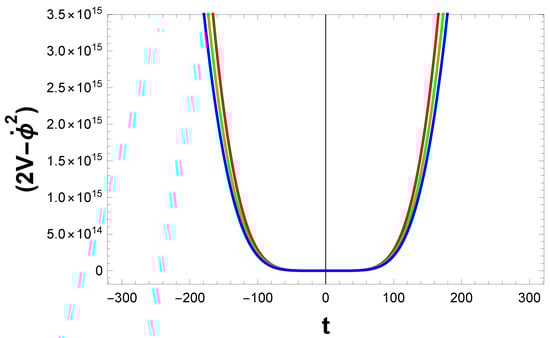
Figure 5.
Evolution of the reconstructed over cosmic time t in the reconstructed gravity (Figure 3) framework.
6. Results and Conclusions
In the present work, we carried out a reconstruction scheme for gravity with the scale factor in the form . Initially, a Hubble parameter H was computed, and its time derivatives of different orders also were derived for this scale factor to get the Ricci scalar R. Subsequently, the field equation for the gravity Equation (11) were solved in the presence of dark matter. The reconstructed was obtained this way as a function of t in Equation (12), which was reexpressed as a function of R in Equation (13). This reconstructed is plotted against cosmic time t for a range of values of in Figure 1. It is observed in Figure 1 that has an increasing pattern with t. Furthermore, Equation (13) shows that . This satisfies a sufficient condition for a realistic model [64,65]. Furthermore, the non-existence of ghost and tachyonic instability was established. Hence, it can be said that the reconstructed model is a realistic model. It may be noted that and were used while creating the plots. The choice of was made through trial and error; and were set keeping the real solution for in mind. It may be noted that the formulation of the reconstruction approach was inspired by [24].
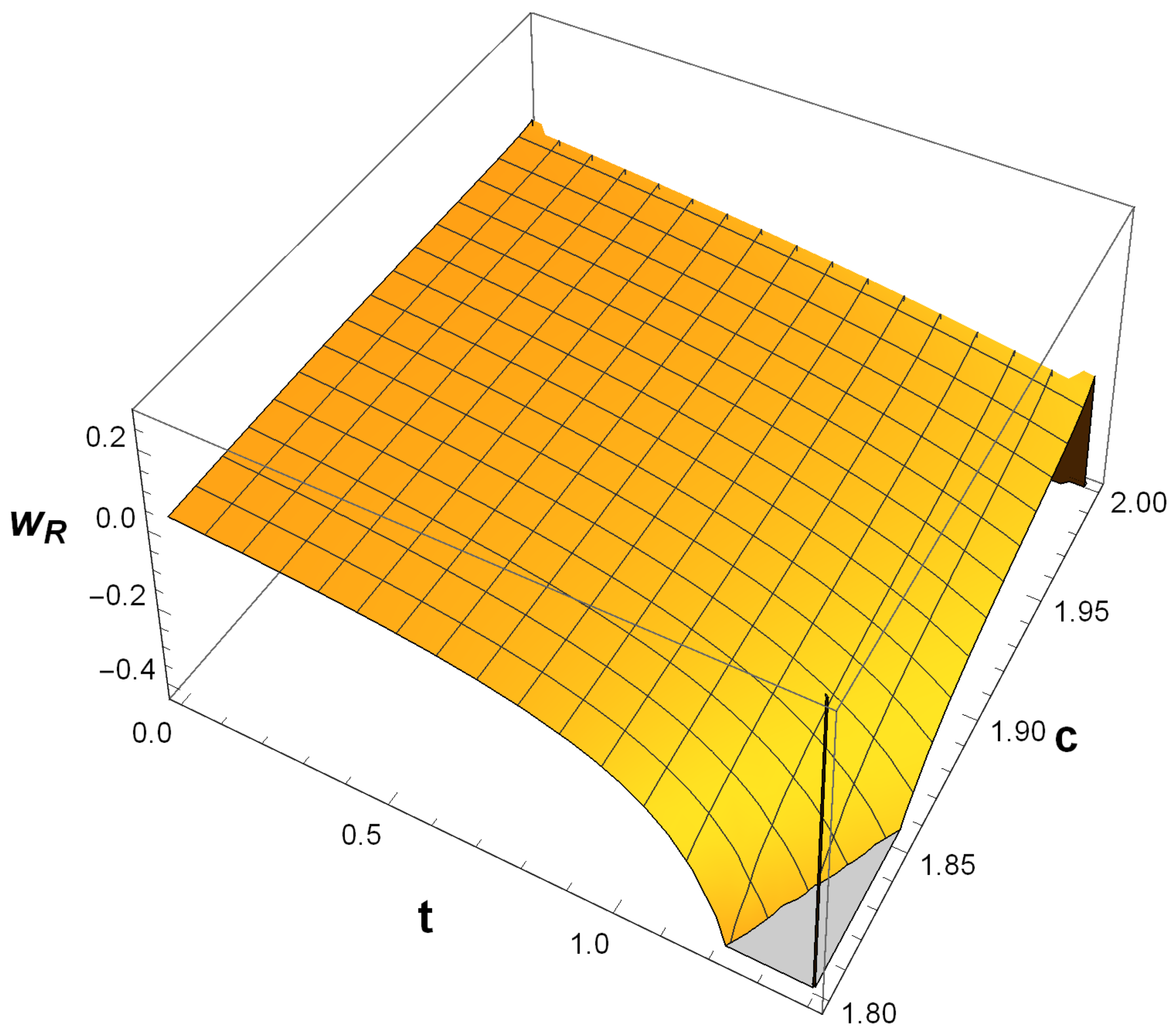
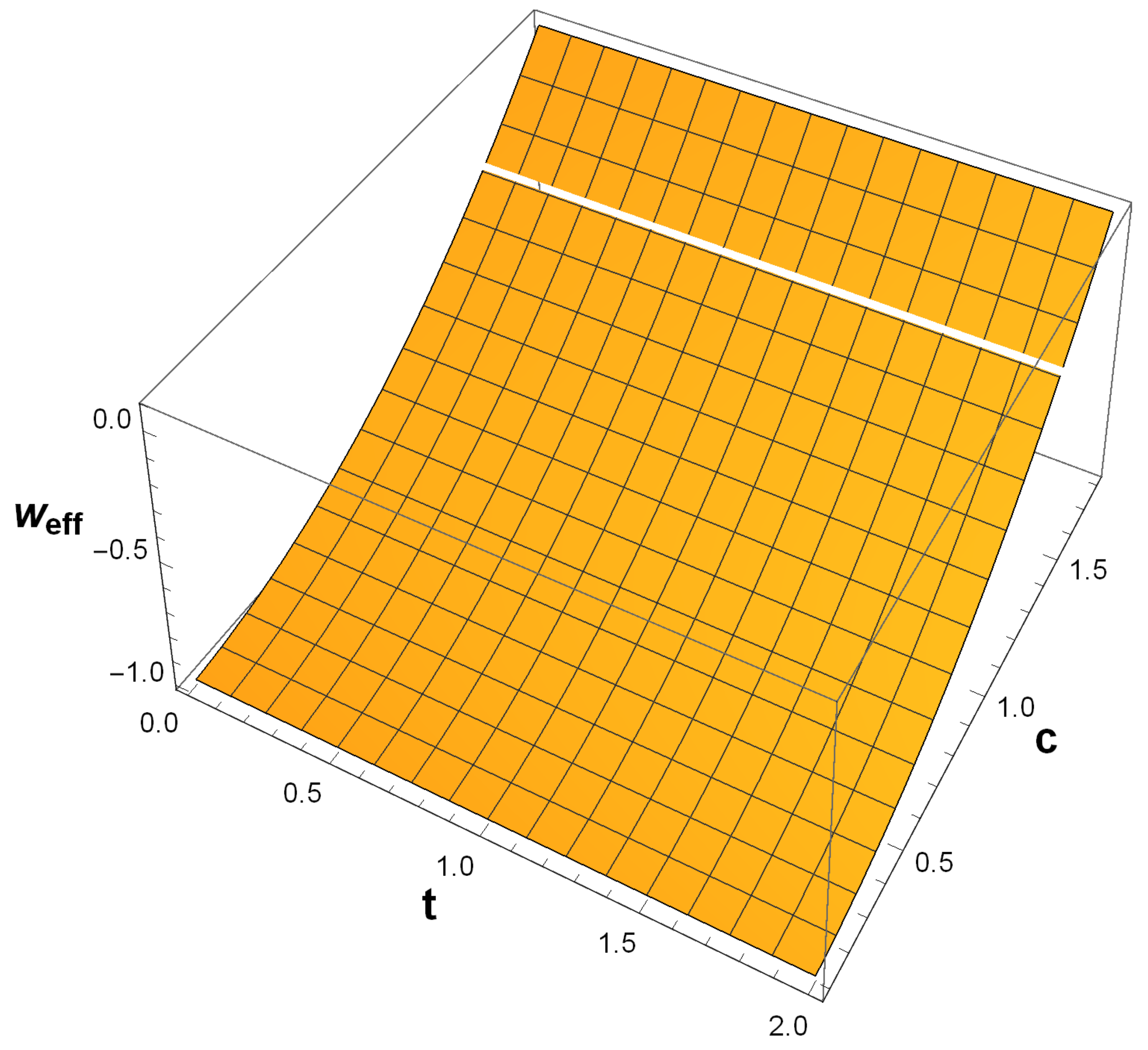
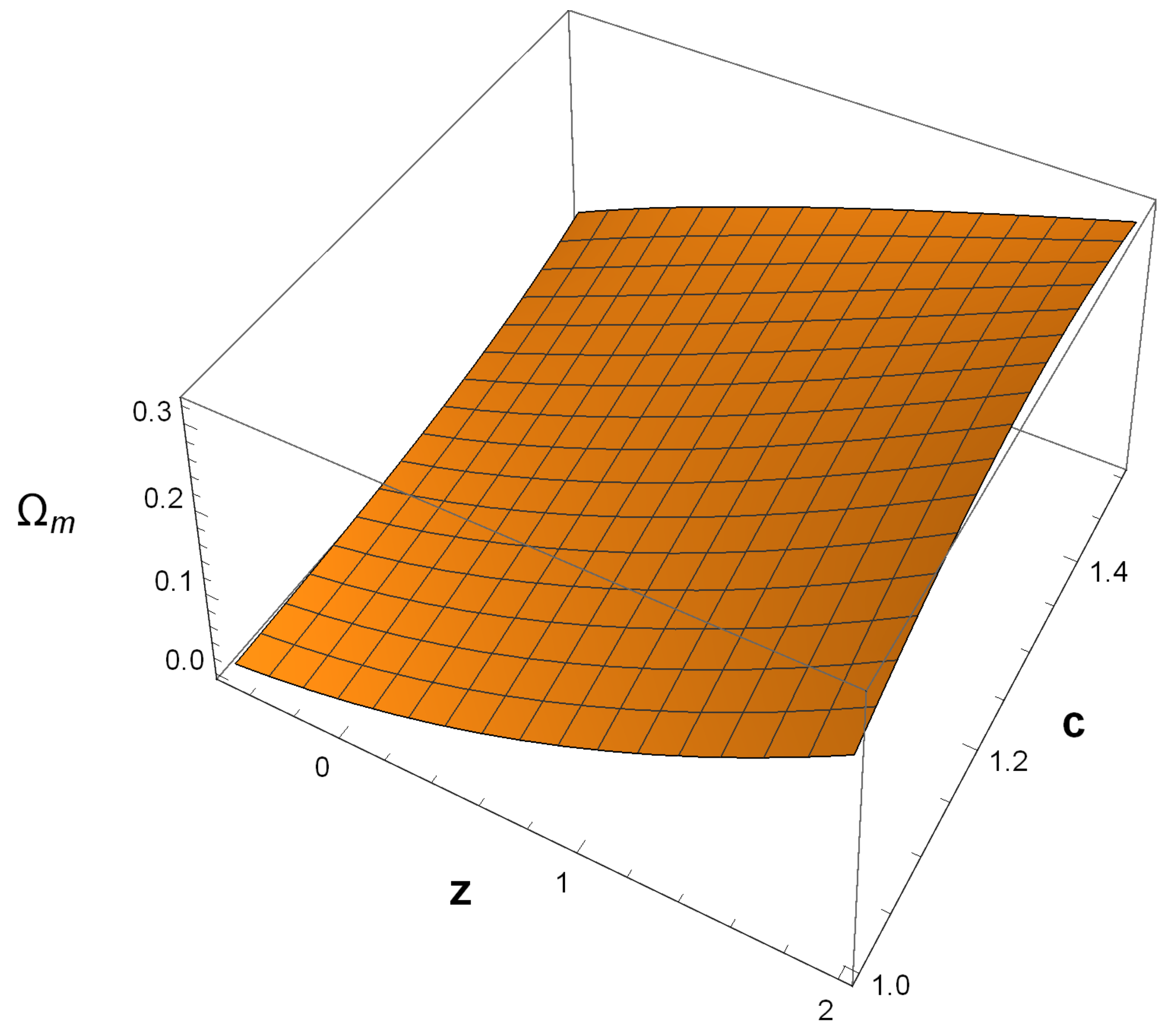
It was further observed that the increasing pattern of is influenced by the value of c. For larger values of c, maintains approximately a flat pattern for a considerable period of cosmic time and exhibits a sudden increase at a later stage of the universe. Different derivatives of this reconstructed were also computed and presented in Equations (15)–(17). In the next part of this study, we demonstrated the behaviour of the chameleon scalar field under this modified form of . The modified field equations in the presence of the chameleon scalar field and potential were presented in Equations (19) and (20). While reconstructing the chameleon scalar field and potential under this reconstructed model, we first reconstructed the density and pressure due to using Equation (13). Based on the reconstructed and , we demonstrated the behaviour of the EoS parameter due to gravity in Figure 6 and the effective EoS parameter in Figure 7. It is observed in Figure 6 that stays at the negative level for the evolution of the universe. This holds true for the entire range of c. Hence, it may be concluded that due to reconstructed gravity behaves like the phantom. The phantom behaviour is stronger for lower values of c than the higher values. However, if we consider with the same choice of parameters, it is found that for , , i.e., behaving approximately like the cosmological constant. In Figure 8, it is observed that the fractional energy density based on the reconstructed , and the scale factor describing the pre-bounce ekpyrotic contraction stays at the positive level. This satisfies the weak energy condition (WEC). Furthermore, the model produces fractional matter density that decays with the evolution of the universe. This indicates a transition from matter domination in the early stage to dark energy domination in the late stage.
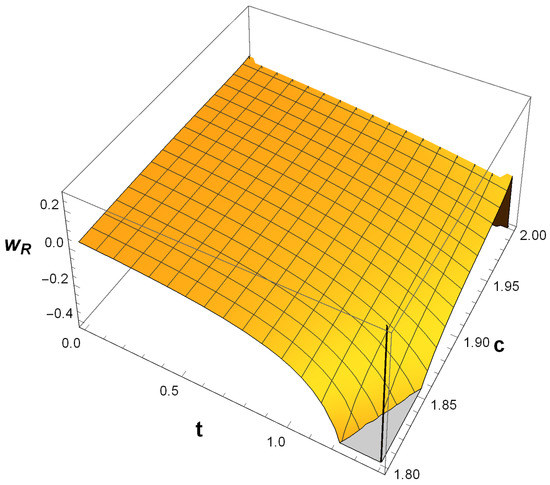
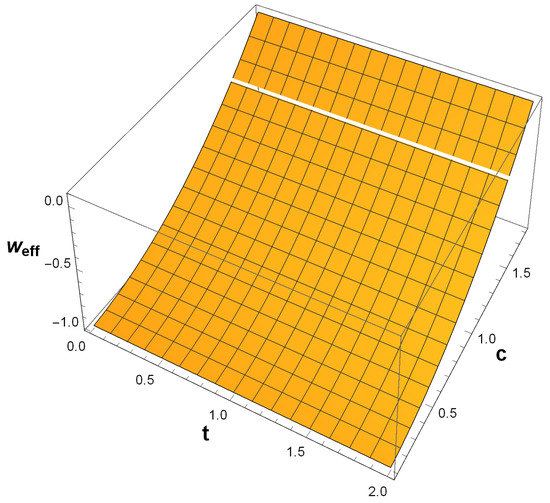
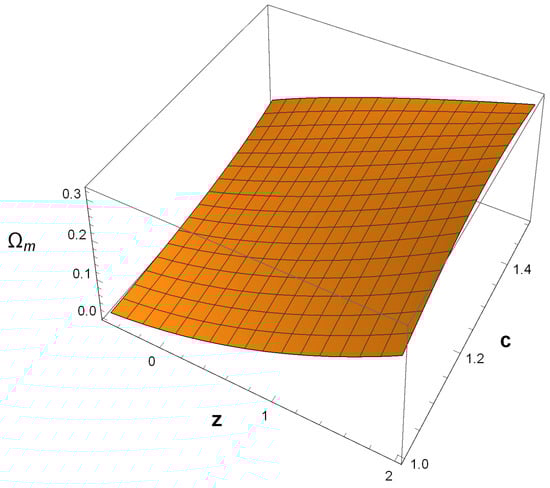
Figure 8.
The evolution of the fractional matter density in the reconstructed gravity.
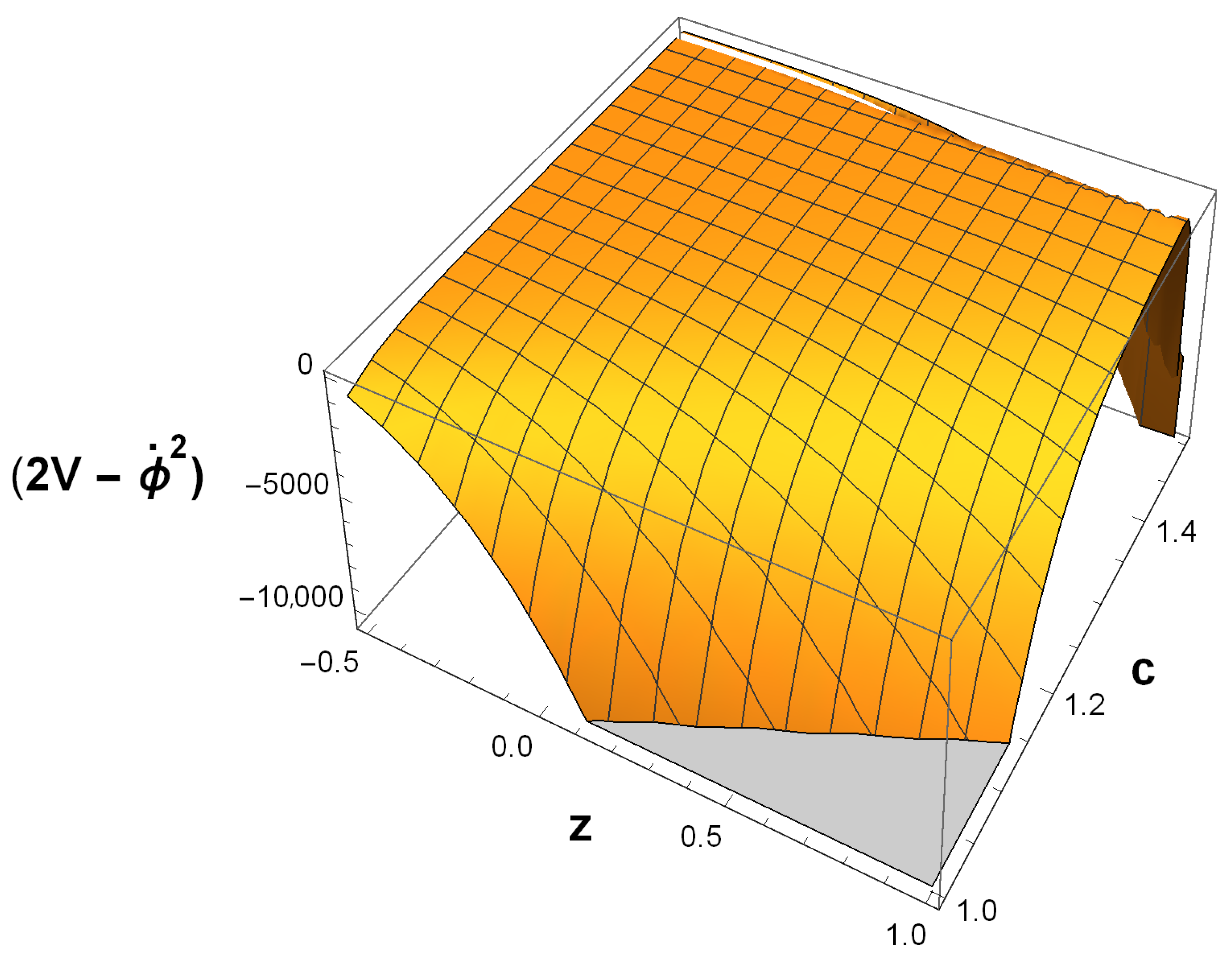
In Figure 9, the evolution of is studied against z for a range of values of c. This figure shows that , which violates the condition for inflationary expansion. Hence, quasi-exponential expansion is not available with the chameleon scalar field considered in the framework of modified gravity in the presence of the scale factor describing the pre-bounce ekpyrotic contraction. This observation is in contradiction with the study of Chattopadhyay et al. [66], where quasi-exponential expansion was found to be possible for a linear gravity based on holographic Ricci dark energy.
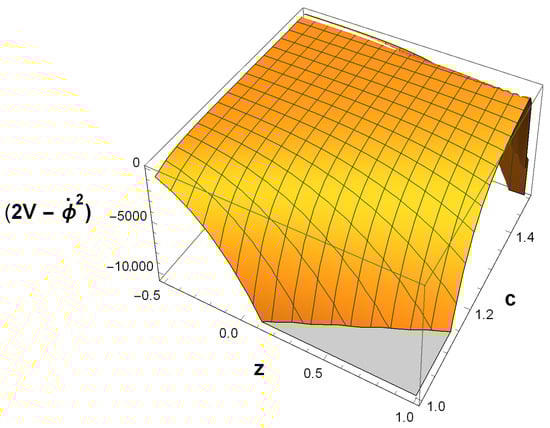
Figure 9.
The evolution of in the reconstructed gravity framework.
While concluding, we should mention that the reconstruction of gravity was demonstrated in the model to unify the bouncing behaviour in the early universe, and the late time accelerated expansion of the universe at the dark energy-dominated stage can occur within a unified model. In view of the same, a scale factor describing the pre-bounce ekpyrotic contraction was chosen, and the reconstructed was demonstrated to be capable of transiting the universe from the matter-dominated to the dark energy-dominated phase. Furthermore, the reconstructed was found to be free from ghost and tachyonic instabilities, and hence, it was interpreted that the reconstructed is realistic. We could explicitly derive the gravity model capable of demonstrating the pre-bounce ekpyrotic contraction and the late time acceleration in a single model framework. This kind of reconstruction approach was earlier demonstrated in [67] in the framework of gravity. As a future study, we propose to demonstrate whether this reconstruction scheme works for any arbitrary choice of the scale factor and to compare the results with the conventional reconstruction scheme using e-foldings.
We demonstrated the background matter bound for with another bouncing scale factor introduced in [63] and found that although in the pre-bounce scenario, the model has tachyonic stability, the tachyonic stability is lost after the bouncing point. At the bouncing point, we found that for , as well as . At this juncture, we must mention some important works in the direction of matter bounce solutions in the modified gravity framework. With the scale factor in the form , Reference [68] demonstrated that the Lagrange multiplier is more adequate than the standard in realizing the cosmological bounce. The matter bounce scenario, the singular bounce, the superbounce, and a symmetric bounce scenario in modular were discussed by [69]. The present work primarily focused on the pre-bounce ekpyrotic contraction scenario. Nevertheless, the bouncing scenarios demonstrated in [69] are proposed to be incorporated into the study of exit from the pre-bounce ekpyrotic contraction in the modified gravity framework.
Finally, let us make a note of the behaviour of the EoS parameter obtained while reconstructing gravity. In this connection, let us mention the very recent work of [70], where the authors presented unification models of gravity realizing the inflationary era along with a post-inflationary early dark energy era, with the late-time dark energy era. In line with [70], the current study can be extended to have a further insight into the unification approach by fine- tuning the EoS parameter towards a more successful unification of dark energy of the different eras.
Author Contributions
All authors made equal contributions to the work reported in this paper. All authors read and agreed to the published version of the manuscript.
Funding
The work was carried out with the financial support of the Ministry of Education and Science of the Republic of Kazakhstan, Grant No. AP08052034. Surajit Chattopadhyay acknowledges financial support from CSIR, Govt. of India, under Project Grant No. 03(1420)/18/EMR-II.
Acknowledgments
The authors thankfully acknowledge the constructive suggestions from the anonymous reviewers. Surajit Chattopadhyay is thankful to IUCAA, Pune, India, for hospitality during a scientific visit in December 2019–January 2020.
Conflicts of Interest
The authors declare no conflict of interest. The funders had no role in the design of the study; in the collection, analyses, or interpretation of data; in the writing of the manuscript; nor in the decision to publish the results.
References
- Riess, A.G.; Filippenko, A.V.; Challis, P.; Clocchiatti, A.; Diercks, A.; Garnavich, P.M.; Gilliland, R.L.; Hogan, C.J.; Jha, S.; Kirshner, R.P.; et al. Observational Evidence from Supernovae for an Accelerating Universe and a Cosmological Constant. Astron. J. 1998, 116, 1009. [Google Scholar] [CrossRef]
- Perlmutter, S.; Aldering, G.; Goldhaber, G.; Knop, R.A.; Nugent, P.; Castro, P.G.; Deustua, S.; Fabbro, S.; Goobar, A.; Groom, D.E.; et al. Measurements of Ω and Λ from 42 high-redshift supernovae. Astrophys. J. 1999, 517, 565. [Google Scholar] [CrossRef]
- De Bernardis, P.; Ade, P.A.R.; Bock, J.J.; Bond, J.R.; Borrill, J.; Boscaleri, A.; Coble, K.; Crill, B.P.; De Gasperis, G.; Farese, P.C.; et al. A flat Universe from high-resolution maps of the cosmic microwave background radiation. Nature 2000, 404, 955. [Google Scholar] [CrossRef] [PubMed]
- Knop, R.A.; Aldering, G.; Amanullah, R.; Astier, P.; Blanc, G.; Burns, M.S.; Conley, A.; Deustua, S.E.; Doi, M.; Ellis, R.; et al. New Constraints on ΩM, ΩΛ, and w from an Independent Set of 11 High-Redshift Supernovae Observed with the Hubble Space Telescope. Astrophys. J. 2003, 598, 102. [Google Scholar] [CrossRef]
- Padmanabhan, T. Cosmological constant—The weight of the vacuum. Phys. Rep. 2003, 380, 235. [Google Scholar] [CrossRef]
- Peebles, P.J.E.; Ratra, B. The cosmological constant and dark energy. Rev. Mod. Phys. 2003, 75, 559. [Google Scholar] [CrossRef]
- Copeland, E.J.; Sami, M.; Tsujikawa, S. Dynamics of dark energy. Int. J. Mod. Phys. D 2006, 15, 1753. [Google Scholar] [CrossRef]
- Sahni, V. Dark Matter and Dark Energy. Lect. Notes Phys. 2004, 653, 141–180. [Google Scholar]
- Bamba, K.; Capozziello, S.; Nojiri, S.; Odintsov, S.D. Dark energy cosmology: The equivalent description via different theoretical models and cosmography tests. Astrophys. Space Sci. 2012, 342, 155. [Google Scholar] [CrossRef]
- Nojiri, S.; Odintsov, S.D. Introduction to modified gravity and gravitational alternative for dark energy. Int. J. Geom. Methods Mod. Phys. 2007, 4, 115. [Google Scholar] [CrossRef]
- Sotiriou, T.P.; Faraoni, V. f(R) theories of gravity. Rev. Mod. Phys. 2010, 82, 451. [Google Scholar] [CrossRef]
- Tsujikawa, S. Modified gravity models of dark energy. Lect. Notes Phys. 2010, 800, 99. [Google Scholar]
- Nojiri, S.; Odintsov, S.D. Accelerating cosmology in modified gravity: From convenient F(R) or string-inspired theory to bimetric F(R) gravity. Int. J. Geom. Methods Mod. Phys. 2014, 11, 1460006. [Google Scholar] [CrossRef]
- Capozziello, S.; D’Agostino, R.; Luongo, O. Extended gravity cosmography. Int. J. Mod. Phys. D 2019, 28, 483. [Google Scholar] [CrossRef]
- Capozziello, S.; Carloni, S.; Troisi, A. Quintessence without scalar fields. Recent Res. Dev. Astron. Astrophys. 2003, 1, 625. [Google Scholar]
- Nojiri, S.; Odintsov, S.D. Where new gravitational physics comes from: M-theory? Phys. Lett. B 2003, 576, 5. [Google Scholar] [CrossRef]
- Carroll, S.M.; Duvvuri, V.; Trodden, M.; Turner, M.S. Is cosmic speed-up due to new gravitational physics? Phys. Rev. D 2004, 70, 043528. [Google Scholar] [CrossRef]
- Nojiri, S.; Odintsov, S.D.; Oikonomou, V.K. Modified gravity theories on a nutshell: Inflation, bounce and late-time evolution. Phys. Rep. 2017, 692, 1. [Google Scholar] [CrossRef]
- Nojiri, S.; Odintsov, S.D. Unified cosmic history in modified gravity: From F(R) theory to Lorentz non-invariant models. Phys. Rep. 2011, 505, 59. [Google Scholar] [CrossRef]
- Nojiri, S.; Odintsov, S.D. Modified f(R) gravity consistent with realistic cosmology: From a matter dominated epoch to a dark energy universe. Phys. Rev. D 2006, 74, 086005. [Google Scholar] [CrossRef]
- Nojiri, S.; Odintsov, S.D.; Saez-Gomez, D. Cosmological reconstruction of realistic modified F(R) gravities. Phys. Lett. B 2009, 681, 74. [Google Scholar] [CrossRef]
- Carloni, S.; Goswami, R.; Dunsby, P.K.S. A new approach to reconstruction methods in f(R) gravity. Class. Quantum Gravity 2012, 29, 135012. [Google Scholar] [CrossRef]
- Dunsby, P.K.; Elizalde, E.; Goswami, R.; Odintsov, S.; Saez-Gomez, D. ΛCDM universe in f(R) gravity. Phys. Rev. D 2010, 82, 023519. [Google Scholar] [CrossRef]
- Nojiri, S.; Odintsov, S.D. Modified gravity and its reconstruction from the universe expansion history. J. Phys. Conf. Ser. 2007, 66, 012005. [Google Scholar] [CrossRef]
- Starobinsky, A.A. A new type of isotropic cosmological models without singularity. Phys. Lett. B 1980, 91, 99. [Google Scholar] [CrossRef]
- Nojiri, S.; Odintsov, S.D. Modified gravity with negative and positive powers of curvature: Unification of inflation and cosmic acceleration. Phys. Rev. D 2003, 68, 123512. [Google Scholar] [CrossRef]
- Nojiri, S.; Odintsov, S.D. Unifying inflation with ΛCDM epoch in modified f(R) gravity consistent with Solar System tests. Phys. Lett. B 2007, 657, 238. [Google Scholar] [CrossRef]
- Nojiri, S.; Odintsov, S.D. Modified f(R) gravity unifying Rm inflation with the ΛCDM epoch. Phys. Rev. D 2008, 77, 026007. [Google Scholar] [CrossRef]
- Cognola, G.; Elizalde, E.; Nojiri, S.; Odintsov, S.D.; Sebastiani, L.; Zerbini, S. Class of viable modified f(R) gravities describing inflation and the onset of accelerated expansion. Phys. Rev. D 2008, 77, 046009. [Google Scholar] [CrossRef]
- Capozziello, S.; Tsujikawa, S. Solar system and equivalence principle constraints on f(R) gravity by the chameleon approach. Phys. Rev. D 2008, 77, 107501. [Google Scholar] [CrossRef]
- Brax, P.; Van de Bruck, C.; Davis, A.; Shaw, D.J. f(R) gravity and chameleon theories. Phys. Rev. D 2008, 78, 104021. [Google Scholar] [CrossRef]
- Starobinsky, A.A. Disappearing cosmological constant in f(R) gravity. JETP Lett. 2007, 86, 157. [Google Scholar] [CrossRef]
- Appleby, S.A.; Battye, R.A. Do consistent F(R) models mimic general relativity plus Λ? Phys. Lett. B 2007, 654, 7. [Google Scholar] [CrossRef]
- Nojiri, S.; Odintsov, S.D. Newton law corrections and instabilities in f(R) gravity with the effective cosmological constant epoch. Phys. Lett. B 2007, 652, 343. [Google Scholar] [CrossRef]
- Cognola, G.; Elizalde, E.; Odintsov, S.D.; Tretyakov, P.; Zerbini, S. Initial and final de Sitter universes from modified f(R) gravity. Phys. Rev. D 2009, 79, 044001. [Google Scholar] [CrossRef]
- Bamba, K.; Nojiri, S.; Odintsov, S.D. The future of the universe in modified gravitational theories: Approaching a finite-time future singularity. JCAP 2008, 2008, 045. [Google Scholar] [CrossRef]
- Barrow, J.D.; Clifton, T. Exact cosmological solutions of scale-invariant gravity theories. Class. Quantum Gravity 2005, 23, L1. [Google Scholar] [CrossRef]
- Clifton, T.; Barrow, J.D. Further exact cosmological solutions to higher-order gravity theories. Class. Quantum Gravity 2006, 23, 2951. [Google Scholar] [CrossRef]
- Capozziello, S.; De Felice, A. f(R) cosmology from Noether’s symmetry. JCAP 2008, 2008, 016. [Google Scholar] [CrossRef]
- Karami, K.; Khaledian, M.S. Reconstructing f(R) modified gravity from ordinary and entropy-corrected versions of the holographic and new agegraphic dark energy models. J. High Energy Phys. 2011, 2011. [Google Scholar] [CrossRef]
- Granda, L.N. Reconstructing modified gravity with holographic vacuum energy density. Int. J. Mod. Phys. D 2019, 28, 1950052. [Google Scholar] [CrossRef]
- Horava, P.; Minic, D. Probable values of the cosmological constant in a holographic theory. Phys. Rev. Lett. 2000, 85, 1610. [Google Scholar] [CrossRef] [PubMed]
- Balasubramanian, V.; Horava, P.; Minic, D. Deconstructing de Sitter. Phys. Rev. Lett. 2001, 2001, 043. [Google Scholar] [CrossRef]
- Thomas, S. Holography stabilizes the vacuum energy. Phys. Rev. Lett. 2002, 89, 081301. [Google Scholar] [CrossRef] [PubMed]
- Susskind, L. The world as a hologram. J. Math. Phys. 1995, 36, 6377. [Google Scholar] [CrossRef]
- Salako, I.G.; Jawad, A.; Chattopadhyay, S. Holographic dark energy reconstruction in f(T,τ) gravity. Astrophys. Space Sci. 2015, 358, 13. [Google Scholar] [CrossRef]
- Chattopadhyay, S.; Jawad, A.; Rani, S. Holographic Polytropic f(T) Gravity Models. Adv. High Energy Phys. 2015, 2015, 798902. [Google Scholar] [CrossRef]
- Jawad, A.; Pasqua, A.; Chattopadhyay, S. Holographic reconstruction of f(G) gravity for scale factors pertaining to emergent, logamediate and intermediate scenarios. Eur. Phys. J. Plus 2013, 128, 156. [Google Scholar] [CrossRef]
- Odintsov, S.D.; Oikonomou, V.K. Big bounce with finite-time singularity: The F(R) gravity description. Int. J. Mod. Phys. D 2017, 26, 1750085. [Google Scholar] [CrossRef]
- Odintsov, S.D.; Oikonomou, V.K. ΛCDM bounce cosmology without ΛCDM: The case of modified gravity. Phys. Rev. D 2015, 91, 064036. [Google Scholar] [CrossRef]
- Odintsov, S.D.; Oikonomou, V.K. Matter bounce loop quantum cosmology from F(R) gravity. Phys. Rev. D 2014, 90, 124083. [Google Scholar] [CrossRef]
- Cai, Y.F.; Easson, D.A.; Brandenburgers, R. Towards a nonsingular bouncing cosmology. JCAP 2012, 2012, 020. [Google Scholar] [CrossRef]
- Koehn, M.; Lehners, J.L.; Ovrut, B.A. Cosmological super-bounce. Phys. Rev. D 2014, 90, 025005. [Google Scholar] [CrossRef]
- Odintsov, S.D.; Oikonomou, V.K. Singular inflationary universe from F(R) gravity. Phys. Rev. D 2015, 92, 124024. [Google Scholar] [CrossRef]
- Odintsov, S.D.; Oikonomou, V.K.; Saridakis, E.N. Superbounce and loop quantum ekpyrotic cosmologies from modified gravity: F(R), F(G) and F(T) theories. Ann. Phys. 2015, 363, 141. [Google Scholar] [CrossRef]
- Song, Y.-S.; Hu, W.; Sawicki, I. Large scale structure of f(R) gravity. Phys. Rev. D 2007, 75, 044004. [Google Scholar] [CrossRef]
- Amendola, L.; Gannouji, R.; Polarski, D.; Tsujikawa, S. Conditions for the cosmological viability of f(R) dark energy models. Phys. Rev. D 2007, 75, 083504. [Google Scholar] [CrossRef]
- Frusciante, N.; Papadomanolakis, G.; Peirone, S.; Silvestri, A. The role of the tachyonic instability in Horndeski gravity. J. Cosmol. Astropart. Phys. 2019, 2019, 029. [Google Scholar] [CrossRef]
- Velasquez, J.; Castaneda, L. Equivalence between Scalar-Tensor theories and f(R)-gravity: From the action to Cosmological Perturbations. J. Phys. Commun. 2020, 4, 055007. [Google Scholar] [CrossRef]
- Chiba, T. 1/R gravity and scalar-tensor gravity. Phys. Lett. B 2003, 575, 1. [Google Scholar] [CrossRef]
- Burrage, C.; Sakstein, J.J. Tests of chameleon gravity. Living Rev. Relativ. 2018, 21, 1. [Google Scholar] [CrossRef] [PubMed]
- Chattopadhyay, S.; Debnath, U. Emergent universe in the chameleon, f(R) and f(T) gravity theories. Int. J. Mod. Phys. D 2011, 20, 1135. [Google Scholar] [CrossRef]
- Cai, Y.-F.; Chen, S.-H.; Dent, J.B.; Dutta, S.; Saridakis, E.N. Matter bounce cosmology with the f(T) gravity. Class. Quantum Gravity 2011, 28, 215011. [Google Scholar] [CrossRef]
- Chakrabarti, S.; Chattopadhyay, S.; Radinschi, I. A study of the bulk viscous pressure in scalar fields and holographic Ricci dark energy considered in the modified gravity framework. Can. J. Phys. 2020, 98, 664. [Google Scholar] [CrossRef]
- Chattopadhyay, S. Reconstruction of f(T) gravity with interacting variable-generalised Chaplygin gas and the thermodynamics with corrected entropies. Z. Naturforsch. 2017, 72, 231. [Google Scholar] [CrossRef]
- Chattopadhyay, S.; Pasqua, A.; Radinschi, I.; Beesham, A. Dynamics of single-field inflation in the framework of holographic f(T) gravity. Int. J. Geom. Methods Mod. Phys. 2018, 15, 1850167. [Google Scholar] [CrossRef]
- Bamba, K.; Makarenko, A.N.; Myagky, A.N.; Odintsov, S.D. Bouncing cosmology in modified Gauss–Bonnet gravity. Phys. Lett. B 2014, 732, 349. [Google Scholar] [CrossRef]
- Nojiri, S.; Odintsov, S.D.; Oikonomou, V.K.; Paul, T. Nonsingular bounce cosmology from Lagrange multiplier F(R) gravity. Phys. Rev. D 2019, 100, 084056. [Google Scholar] [CrossRef]
- Nojiri, S.; Odintsov, S.D.; Oikonomou, V.K. Bounce universe history from unimodular F(R) gravity. Phys. Rev. D 2016, 93, 084050. [Google Scholar] [CrossRef]
- Nojiri, S.; Odintsov, S.D.; Oikonomou, V.K. Unifying inflation with early and late-time dark energy in F(R) gravity. Phys. Dark Universe 2020, 29, 100602. [Google Scholar] [CrossRef]
© 2020 by the authors. Licensee MDPI, Basel, Switzerland. This article is an open access article distributed under the terms and conditions of the Creative Commons Attribution (CC BY) license (http://creativecommons.org/licenses/by/4.0/).