


Abstract
As we know, the periodic functions are symmetric within a cycle time, and it is meaningful to generalize the periodicity into more general cases, such as almost periodicity or almost automorphy. In this work, we introduce the concept of Poisson -pseudo almost automorphy (or Poisson generalized Stepanov-like pseudo almost automorphy) for stochastic processes, which are almost-symmetric within a suitable period, and establish some useful properties of such stochastic processes, including the composition theorems. In addition, we apply a Krasnoselskii–Schaefer type fixed point theorem to obtain the existence of pseudo almost automorphic solutions in distribution for some semilinear stochastic differential equations driven by Lévy noise under -pseudo almost automorphic coefficients. In addition, then we establish optimal control results on the bounded interval. Finally, an example is provided to illustrate the theoretical results obtained in this paper.
1. Introduction
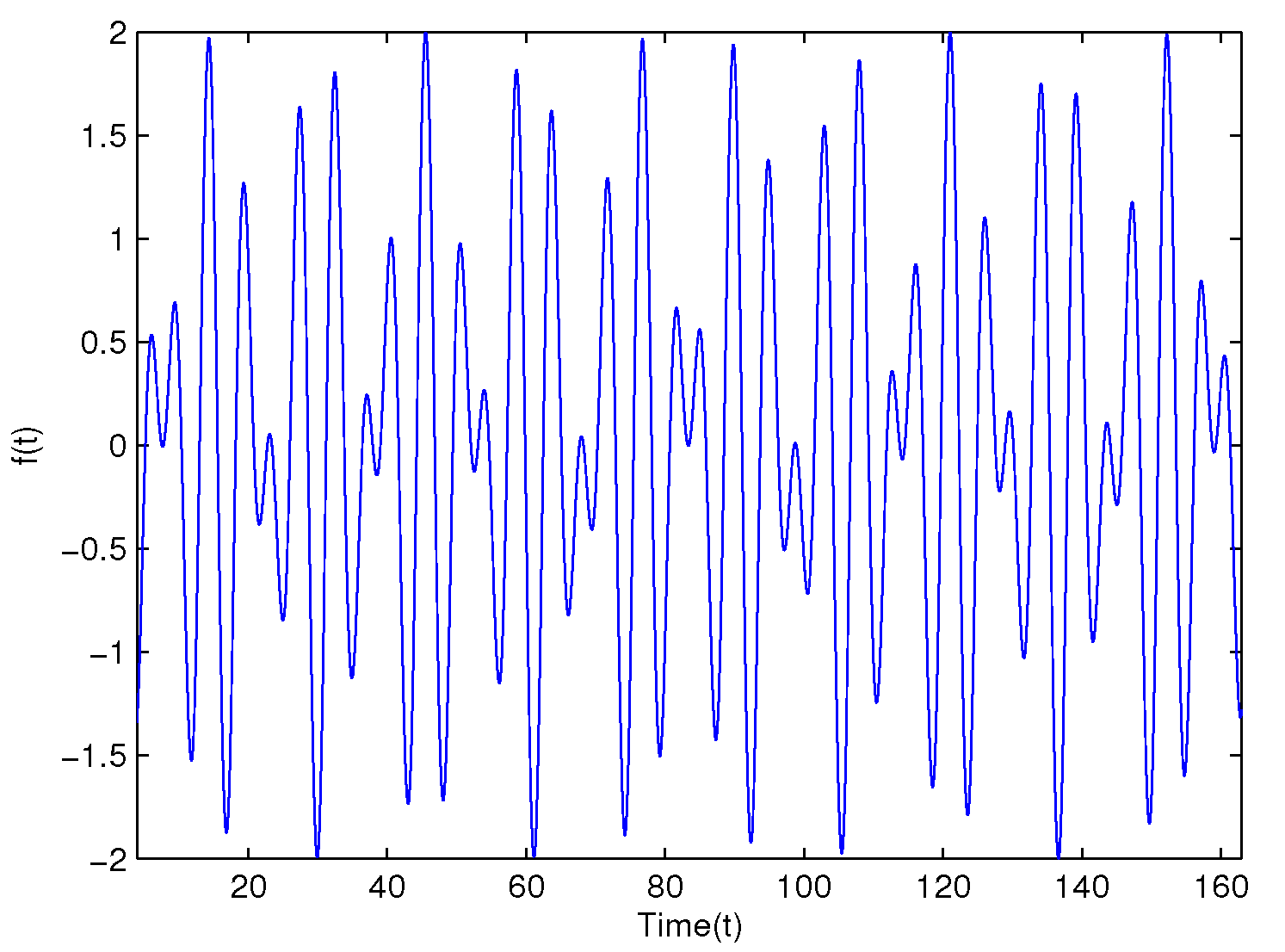
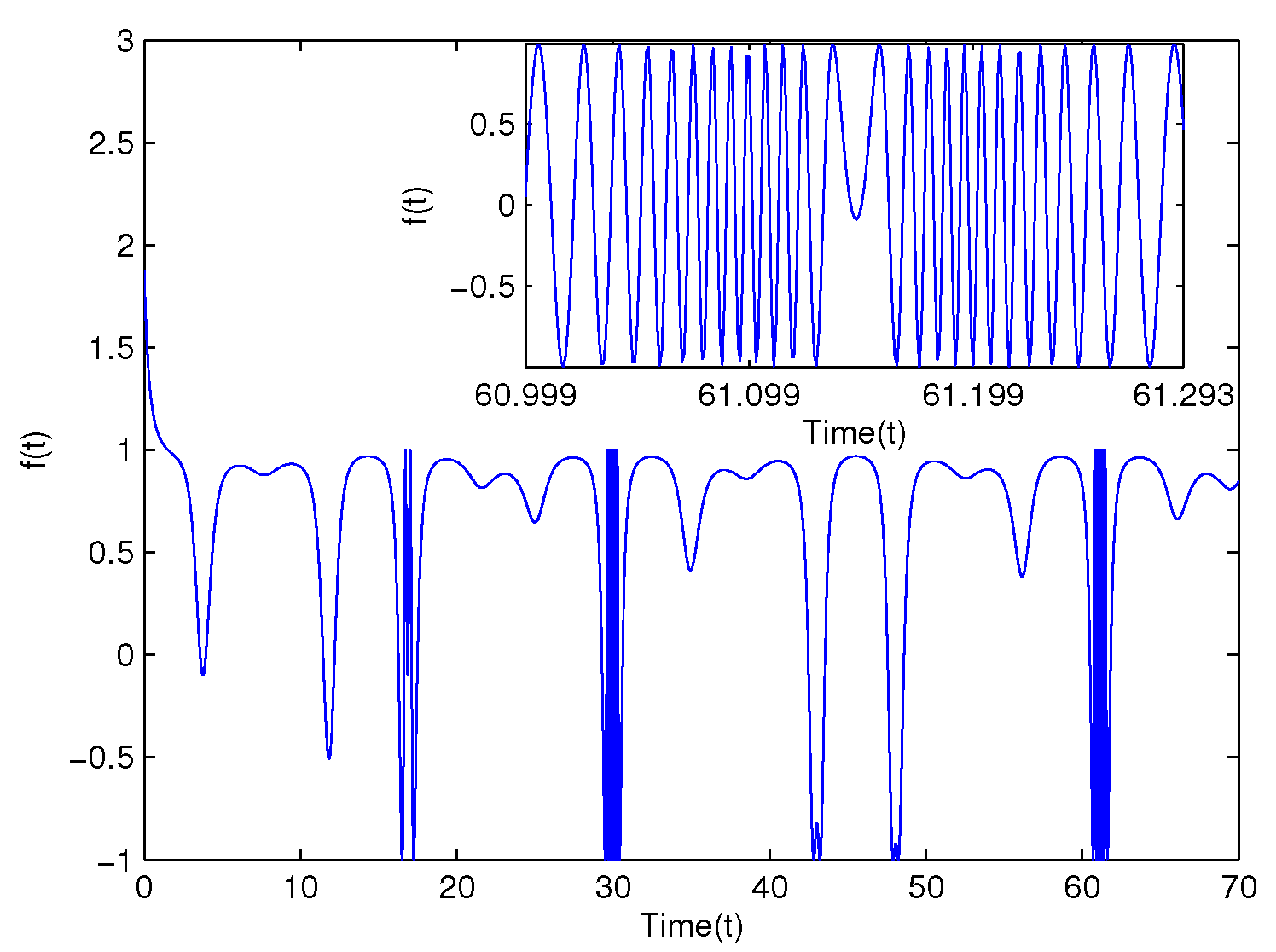
It is well known that symmetry exists in every corner of the world, which may help us explore the truth around our life. Particularly, if there is a periodic function F with a periodicity , then it holds that , which means the periodic functions are symmetric within a cycle time. However, the symmetry may not always appear in the accurate sense; it is meaningful to generalize the periodic functions into more general cases, for instance, almost periodicity or almost automorphy. For example, an almost periodic function and a pseudo almost automorphic function . (About the almost-symmetry, please see Figure 1 and Figure 2).
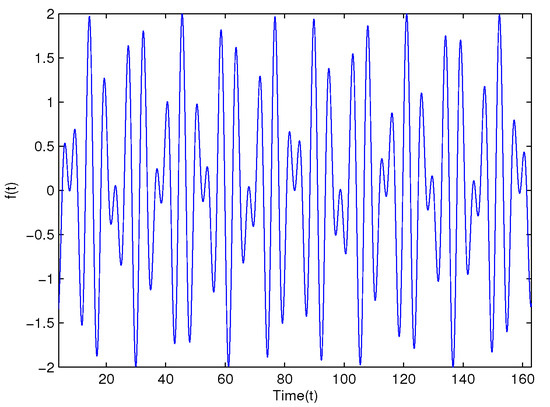
Figure 1.
The trajectory of almost periodic function.
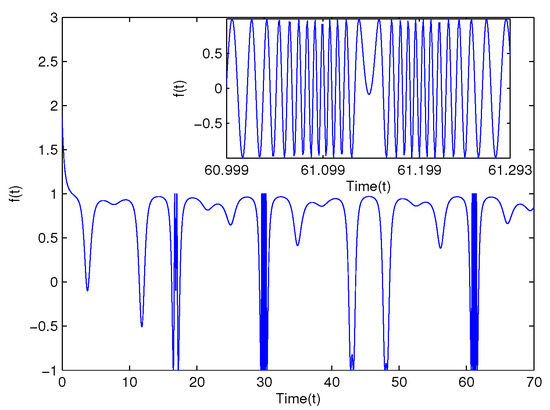
Figure 2.
The trajectory of pseudo almost automorphic function.
In this paper, we will introduce the concept of Poisson -PAA(or Poisson generalized Stepanov-like pseudo almost automorphy) for stochastic processes, which are almost-symmetric within a suitable period.
Liang et al. [1] established the concept of pseudo almost automorphy (PAA, for short) and also provided the composition theorems under a uniformly continuous condition. Diagana [2] generalized the concept of PAA into -PAA, and then obtained the asymptotic behavior of the solutions for some differential equations. Mao et al. [3] established the concept of square-mean PAA, which generalized the concept PAA into stochastic cases, and also obtained the square-mean PAA solutions. For more applications of -PAA, one can see [4] and the references therein. In 2012, the concept of -PAA was investigated by Diagana [5], and then established the existence results of differential equations of Sobolev type. After this work, Tang et al. [6] introduced the concept of -WPAA in stochastic cases, and proved some interesting results on local stability.
There is a lot of interest from researchers in almost periodic and almost automorphic solutions in stochastic cases; for more details, we refer to [7,8,9,10] and the references therein. Furthermore, stochastic equations driven by Lévy process was investigated by many researchers in the last decade. Wang and Liu [11] mainly studied the square-mean almost period stochastic processes; then, the well-posedness of stochastic evolution equations driven by Lévy noise was obtained. Liu and Sun [12] established the existence of almost automorphic solutions in distribution to some equations driven by Lévy noise. Li [13] established the existence results of WPAA solutions in distribution for some SPDEs driven by Lévy noise; for related works, we refer to [14,15,16]. Motivated by the works [5,6,12,15], we introduce the concept of Poisson -PAA (or Poisson generalized Stepanov-like pseudo almost automorphy) and provide some composition theorems of such stochastic processes, and then study the existence of PAA solutions in distribution for some semilinear stochastic equations driven by Lévy noise under -pseudo almost automorphic coefficients.
Optimal control problem has a wide impact on many fields in the real world, such as celestial mechanic, engineering, biology, economy, and so on; it always minimizes or maximizes a cost functional over some admissible control sets, see monographs [17,18]. In 2007, Mahmudov et al. [19] investigated the backward stochastic equations in infinite-dimensional spaces and obtained its optimal control. After that, fractional integro-differential systems are deeply studied by Wang et al. [20,21], and also some important optimal control problems are solved. In recent days, Rajivganthi-Muthukumar [22] mainly investigated some special optimal control problems and the control pairs were proved. However, to our best knowledge, there are only a few research works on the existence of optimal control pairs for stochastic equations driven by the Lévy process. Motivated by the works [19,20,22], we study a classic optimal control problem for stochastic equations driven by Lévy noise, and the existence of optimal control will be proved.
The outline of this paper is as follows: in Section 2, some definitions and basic properties are introduced, in particular, the concept of Poisson -AA and Poisson -PAA. The new composition theorem of such processes under some suitable conditions are also studied. After that, we investigate the asymptotic behavior of solutions for some semilinear stochastic equations driven by Lévy noise by the Krasnoselskii–Schaefer type fixed point theorem. In the 4th part, we establish the optimal control results on a bounded interval. In Section 5, an example is provided to illustrate our theoretic results.
2. Preliminaries
In the following, we introduce some basic notations and properties which will be used in the sequel. We suppose that and are real separable Hilbert space throughout the paper. Later in Section 2.1, the -valued Lévy processes are introduced. is supposed to be a completed probability space and denotes the space of all -valued random variables Y such that
Note that, when equipped with the norm
is a Hilbert space.
In addition, denotes the collection of all continuous functions from into , and stands for the collection of all bounded continuous functions from into . Note that is a Banach space with the sup norm
Furthermore, the spaces and can be explained in a similar way.
2.1. The Introduction of the Lévy Process
In this part, the Lévy process and the Lévy–Itô decomposition theorem are introduced, and we refer to the literature [12,23,24,25] for more details.
Definition 1
([23]). The Lévy process is called a -valued stochastic process , if
- (i)
- a.s.;
- (ii)
- L has independent and stationary increments;
- (iii)
- For all and ,
Poisson random measure. For a given Lévy process L, it is easy to define , which is a jump process satisfying
for each . Furthermore, by virtue of , it can define the following random counting measure
for any Borel set B in , where is the indicator function.
Next, we introduce the Poisson random measure N and the compensated Poisson random measure . Firstly, we suppose there is a bounded below Borel set B in , and denotes the intensity measure, from which it holds that almost surely for all and is a Poisson process with intensity . Meanwhile, the compensated Poisson random measure defined by
where the Poisson random measure N satisfies
Proposition 1
([23]). (Lévy–Itô decomposition) Suppose L is a-valued Lévy process; then, a -valued Wiener process W, an independent Poisson random measure N and also a constant a exist, such that
for each .
However, from Definition 1, L only is one-sided. In order to finish the research, we need a two-sided Lévy process, i.e.,
where and are two independent, identically distributed Lévy processes satisfying Proposition 1, and we assume L is defined on the filtered probability space .
Remark 1.
By (1), it holds that .
Remark 2.
Furthermore, the increment is also a two-sided Lévy process, which is identically distributed with L.
2.2. -Almost Automorphy
Definition 2
([26]). Given a function , its Bochner transform is, in the following sense,
where , .
Remark 3.
(i) If is the Bochner transform of a certain function f, then , for all and ; Similarly, the converse is also true.
(ii) It also follows that, if , then . In addition, for each scalar λ.
Definition 3
([27,28]). Given a function , for each , its Bochner transform is
Definition 4
([29]). A function is called square-mean almost automorphic if, for every sequence of real numbers , there exist a subsequence and a function such that
hold for each . We use the notation to denote the collection of all square-mean almost automorphic functions.
Definition 5
([30]). Let . A continuous function is called positively bi-almost automorphic if, for every sequence of real numbers , there exist a subsequence and a function such that
hold for each . The notation denotes the collection of all such functions.
Definition 6
([26]). The notation stands for the collection of all Stepanov bounded functions, if the measurable functions , then . If, with the norm
it is a Banach space.
Definition 7
([31]). A function is Stepanov-like almost automorphic (or -almost automorphic), if that is to say, given a function , if its Bochner transform is almost automorphic, then it is -almost automorphic, i.e., for every sequence of real numbers , there exist a subsequence and a function such that
as pointwise on . The notation denotes the collection of such functions.
In the following, we introduce a measurable (weights) function , which satisfies
Let denote the collection of all such measurable (weights) functions and the collection of all such differentiable functions denoted by .
Definition 8.
Let . A -measurable functions Y on with values in is called generalized Stepanov bounded, if its Bochner transform . If with the norm
it is a Banach space.
Definition 9
([31]). Suppose . A function is called a generalized Stepanov-like almost automorphic (or -almost automorphic), if for a function and every sequence of real numbers , there exists a subsequence such that
for each , as .
Definition 10
([31]). Let . A function , with for each , is called -almost automorphic in uniformly in if is -almost automorphic for each , that is, for a function and every sequence of real numbers , there exists a subsequence such that
for each , as pointwise on . The notation denotes the collection of all -almost automorphic functions.
Definition 11.
Let . A function , with for each , is called Poisson -almost automorphic in uniformly in if is Poisson -almost automorphic for each , that is, for a function and every sequence of real numbers , there exists a subsequence such that
for each , as pointwise on . The notation Poisson denotes the collection of all such functions.
Definition 12.
Let . A function , with
for each , is called Poisson -almost automorphic uniformly in in if is Poisson -almost automorphic for each , that is, for a function and every sequence of real numbers , there exists a subsequence such that
for each , as pointwise on . The notation Poisson denotes the collection of all such functions.
Proposition 2
([32]). Suppose and is a compact subset, where denotes the closure of the set. If and there exists 0 such that
for all and , then the mapping belongs to the space .
In this paper, we show the new composition theorem of -almost automorphic functions under the following condition.
Suppose 0 such that, for all and ,
Theorem 1.
Suppose such that is a compact subset, where denotes the closure of the set. If and satisfies , then the function given by is .
Proof.
Let be an arbitrary sequence of real numbers. Since and , there exist a subsequence and functions , such that
as for each .
for each , as pointwise on .
Define the function , . It holds that
Then, by virtue of the mean-value Inequalities and the Lipschitz condition (H1), we can obtain
We can deduce from , that
pointwise on , as . Similarly, we can deduce from , that
pointwise on , as . Thus, is . □
Remark 4.
In the proof of Theorem 1, the similar techniques have been used in the study of diffusion processes in networks; for more details, please refer to the work [33], in which the authors investigate a logistic model, which is a dependent Markov chain and allows individual variation and time-dependent infection and recovery rates.
For the Poisson term, we need the following conditions: Assume such that, for all and ,
Theorem 2.
Suppose such that is a compact subset, where denotes the closure of the set. If and satisfies , then the function given by is .
Proof.
Please the proof of Theorem 2 in Appendix A.1. □
2.3. -Pseudo Almost Automorphy
Define the classes of functions:
Definition 13
([30]). A function is called PAA if it can be given by , where and . The notation denotes the collection of such functions.
Definition 14
([30]). A function is called PAA if it can be written as , where and . The notation denotes the collection of such functions.
Definition 15.
A function is called Poisson PAA if it can be given by , where and . The notation denotes the collection of such functions.
Proposition 3
([30]). The space is a Banach space when equipped with the sup norm .
Define the following collections:
Definition 16
([5]). Let . A function is called -PAA, if it can be given by , where and . The notation denotes the collection of such functions.
Remark 5.
By the definition, -PAA spaces are translation-invariant. Moreover, the decomposition of -PAA functions is unique.
Proposition 4
([5]). If , then that is, .
Proposition 5
([5]). Let . The space is a Banach space when equipped with the norm .
Definition 17
([5]). Let . A function , with for each , is called -PAA if there exist functions such that where and . The notation denotes the collection of all such functions.
Definition 18.
Let . A function , with for each , is called Poisson -PAA, if there exist functions such that where and . The notation denotes the collection of such functions.
Definition 19.
Let . A function , with for each , is called Poisson -PAA, if there exist functions such that where and . The notation denotes the collection of such functions.
Remark 6.
Actually, Poisson generalized Stepanov-like PAA(Poisson -PAA) generalizes the concept of Poisson Stepanov-like almost automorphy [15], that is, if a stochastic process is Poisson Stepanov-like almost automorphy, then it is Poisson generalized Stepanov-like PAA, but the converse is not true, which means the function space becomes much bigger than ever before.
Proposition 6
([5]). Let such that and also . Assume that l satisfies and m satisfies . Furthermore, if with and and also is compact, where denotes the closure of the set, then belongs to .
Theorem 3.
Let such that its Bochner transform and also . Assume that l and m satisfy . Furthermore, if with and and also is compact, where denotes the closure of the set, then belongs to .
Proof.
We have
Denote by
Next, we shall show that by several steps.
Step 1: we claim that . In fact, we easily know that the function l satisfies and its Bochner transform , . Moreover, is compact. Thus, by virtue of the Theorem 1, we have .
Step 2: On the other hand, we claim that . Since satisfies , we obtain
Thus, for any ,
Since , we can obtain
which implies .
Step 3: we also claim that . There are finite open balls with center from the fact that is compact. In addition, if the radius of small enough, then , where and . Suppose , ; then, , when .
On the other hand, given the step function by , . Thus,
for all . By replacing the variable in the integral, it holds that
Thus, for any ,
Since the arbitrariness of and , we can obtain
which implies . The proof is complete. □
Theorem 4.
Let such that and . Assume that h and ϕ satisfy . Furthermore, if with and and such that is compact, where denotes the closure of the set, then belongs to .
Proof.
Please see the proof of Theorem 4 in Appendix A.2. □
3. Main Results
In this section, we consider the following abstract model:
It supposes that
- (i)
- The coefficients in the above model satisfy that , , ;
- (ii)
- W is a Brownian motion, N and are Poisson random measure and compensated Poisson random measure, respectively.
- (iii)
- satisfies the “Acquistapace–Terrani” condition.
Definition 20.
Suppose is a set of bounded linear operators on , if
- (i)
- , for and ;
- (ii)
- The strongly continuous mapping ∈ .
Thus, is an evolution family.
Definition 21.
Almost automorphy in distribution Let real -valued functions f are Lipschitz continuous and equipped with the norms
Then, define a metric in the following sense:
and assume to be the space of all Borel probability measure on endowed with the metric.
Definition 22
([12]). For a -valued almost automorphic mapping and every sequence of real numbers , there exists a subsequence such that
holds for each . Then, -valued with law is called almost automorphy in distribution.
Remark 7
([12]). A square-mean automorphic function is necessarily almost automorphy in distribution from the fact that, for a sequence of random variables, converge implies convergence in distribution, but the converse is not true.
Definition 23.
An -valued function is called pseudo almost automorphy in distribution if it can be expressed as , where x is almost automorphy in distribution and .
In order to study the asymptotic behavior of the solutions, the following hypotheses are needed:
, f satisfies the assumption of the Theorem 3, and
, g satisfies the assumption of the Theorem 3, and
, F satisfies the assumption of the Theorem 4, and
, G satisfies the assumption of the Theorem 4, and
- (i)
- satisfies , where are constants.
- (ii)
- The mapping uniformly for .
Lemma 1.
Under assumptions , then the integral operator defined by
maps into .
Proof.
Let . By Theorem 3, it holds that . Now, let , where their Bochner transform and . For each , the integral
and set and .
Let us show that . For that, letting , we obtain
By virtue, the Cauchy–Schwarz inequality and , we have
Using the fact that
We deduce that the series is uniformly convergent on by the Weirstrass theorem. Furthermore,
, and
We deduce that is bounded from the Weirstrass theorem. Here, it can be noted that a similar estimation has been done in the study of random system control processes [34], and this helps to motivate the methodology of the above estimation.
Since and , then, for functions , and every sequence of real numbers , there exists a subsequence such that
and
Let
Next, by the Cauchy–Schwarz inequality, it follows that
Now, from Lebesgue dominated convergence theorem and , , it holds that
Similarly, using , , we have
Thus, each for each k. Hence, .
Let us show that . Using the Cauchy–Schwarz inequality, we can obtain
Thus, for any ,
Since , then
that is, . Furthermore,
, and
Then,
Consequently, the uniform limit . Thus, . □
Lemma 2.
Under assumptions , then defined by
maps into .
Proof.
Let . By Theorem 3, . Now, let , where its Bochner transform and . Next,
and set and for each .
Let us show that . Assuming , we obtain
By the mean value theorem of integrals and Itô’s isometry, we have
Using the fact that
We deduce the series is uniformly convergent on by virtue of the Weirstrass theorem. Meanwhile,
, and
We deduce that is bounded by the Weirstrass theorem.
Since , then, for a function and every sequence of real numbers , there exists a subsequence such that
Let
Thus, from the Itô’s isometry and the mean value theorem of integrals, it follows that
Now, from the Lebesgue dominated convergence theorem and , , we have
Similarly, using , , it follows that
Thus, each for each k. Hence, .
Let us show that . Using the Itô’s isometry, we can obtain
Thus, for any ,
Since , then
that is, . Furthermore,
; then,
Consequently, the uniform limit . Thus, . □
Lemma 3.
Under assumptions , then is defined by
maps into .
Proof.
Let . By Theorem 4, it follows that . Now, let , where and . Next,
and set
and
Next, we prove . Assuming , we obtain
By the mean value theorem of integrals and the Itô’s isometry, we have
Using the fact that
We deduce that the series is uniformly convergent on by the Weirstrass theorem. Meanwhile,
, and
We deduce is bounded by the Weirstrass theorem.
Since , then, for a function and every sequence of real numbers , there exists a subsequence such that
Let
Then, from the mean value theorem of integrals and the Itô’s isometry, we have
Now, by the Lebesgue dominated convergence theorem and , , we have
Similarly, using , , we have
Thus, each for each k. Hence, .
Let us show that . Using the Itô’s isometry, we can obtain
Thus, for any ,
Since , then
that is, . Furthermore,
; then,
Consequently, the uniform limit . Thus, . □
Lemma 4.
Under assumptions , then defined by
maps into .
Proof.
Let . By Theorem 4, . Now, let , where and . Next,
and set
and
Let us show that . Assuming , we obtain
By Itô’s isometry and Cauchy–Schwarz inequality, we have
From
We deduce that the series is uniformly convergent on by the Weirstrass theorem. Moreover,
, and
We deduce that is bounded, by the Weirstrass theorem.
Next, since , then, for a function and every sequence of real numbers , there exists a subsequence such that
Let
Then, by Cauchy–Schwartz inequality and Ito isometry, from , it follows that
Now, by the Lebesgue dominated convergence theorem and , , we have
Similarly, using , , we have
Thus, each for each k. Hence, .
Next, we prove . Thus,
Thus, for any ,
Since , then
that is, . Furthermore,
, then
Consequently, the uniform limit . Thus, . □
Theorem 5.
Supposing that the assumptions hold, then Equation (9) has at least one PAA solution in distribution, if
Proof.
For any , define
for each . By virtue of Lemma 1–4, we deduce that is continuous and well-defined.
Next, we shall use the Krasnoselskii–Schaefer-type fixed point theorem [35] to verify the existence of solutions. Consider the space that is the operator: . Now, we decompose as where
In order to obtain the main results, we will verify that is a contraction and is a complete operator. For better readability, we prove it step by step.
Step 1: is a contraction on . Consider for each the integral
Since (where or g), and satisfies , for all and , we have
Let , . From Itô’s isometry, Cauchy–Schwarz inequality, and (18), we have
where . Using the Cauchy–Schwarz inequality and the mean value theorem of integrals, it follows that
where . Thus, is a contraction on .
Step 2: is continuous. For each , the integral
Since (where or G), and satisfies , for all and , it follows that
Let with in . From Itô’s isometry, Cauchy–Schwarz inequality, and (19), we have
Thus,
Then,
Then,
Thus, is continuous.
Step 3: maps bounded sets into bounded sets in . By the formula (19), we can obtain
Let . For each , by Itô’s isometry, Cauchy–Schwarz inequality, and (20), we have
Then, there exists a uniformly constant (not about k), such that
Step 4: maps bounded sets into equicontinuous sets of . For each , by the Itô’s isometry, Cauchy–Schwarz inequality, we have
where
and
By Itô’s isometry, Cauchy–Schwarz inequality, we have
Since is strongly continuous, so , as , then . Hence, , as . Thus, maps bounded sets into equicontinuous sets of .
Step 5: maps bounded sets into a relatively compact set in . Define an operator on by
For each , it follows that
Then,
Thus, maps bounded sets into a relatively compact set in .
Step 6: We shall show that the set
is bounded on . To do this, from [35], consider the following equation:
Next, we give a priori estimate. By the formula (18), we can obtain
Thus,
Then, there exists a uniformly constant (not about k), such that
Thus, this implies that G is bounded. Consequently, by the Krasnoselskii–Schaefer-type fixed point theorem, has a fixed point . From Remark 5 and the similar approach in ([6], Theorem 4.1), Y is necessarily pseudo almost automorphy in distribution. □
4. Optimal Control Results
Let be a reflexive Banach space and the control u is -valued. The multi-valued map is graph measurable, and is a bounded set in and has bounded, closed, and convex values. Let the admissible set . Obviously, , and is bounded, closed, and convex. For the stochastic controlled systems:
By Definition 21, for each , the solution of the Equation (22) is in the following sense:
Let denote the mild solution of Equation (22). Next, the following problem will be investigated:
Problem 1.
Find an optimal pair such that where
In order to study the Problem 1, the following hypotheses are needed:
- (i)
- The function is Borel measurable;
- (ii)
- For almost all , is sequentially lower semicontinuous on ;
- (iii)
- For almost all , is convex on for each ;
- (iv)
- There exists , , c is nonegative and such that
Theorem 6.
Equation (22) has an optimal control pair, if the hypotheses and Theorem 5 hold; meanwhile, B is a strongly continuous operator.
Proof.
Next, we shall minimize the cost function . In particular, the results are obvious if . Then, assume that , using the hypothesis , we can obtain .
Then, there exists a minimizing sequence of feasible pair by infimum, (where is a solution of Equation (22) corresponding to ), such that as . Suppose is a bounded subset of the separable reflexive Banach space then , there exists a subsequence and such that . Furthermore, by Marzur lemma, and is also closed and convex.
Assume that is the mild solution of Equation (22) corresponding to and
Similarly,
Using the Cauchy–Schwarz inequality and the Itô’s isometry, we have
and
Thus,
There exists such that
It is easy to obtain as from B is strongly continuous. Then,
We obtain that is sequentially lower semicontinuous in by Balder’s theorem [36]. Hence, is weakly lower semicontinuous in . Since , , obtains its infimum at , that is,
Thus, it completes the proof. □
Remark 8.
Here, it should be noted that the developed result above can be potentially applicable to other problems including epidemic spreading problems; for more details, please refer to the work [37].
5. An Example
In this part, we consider the stochastic heat equation in the following, for more details, please refer to the work [13] and, for some relevant background about the stochastic heat equation, please refer to [23,38],
where Z is a Lévy pure jump process on , and W is a Q-Wiener process on with . From [13], we have
Let be the Laplace operator, and
generates a -semigroup on , which is
where denotes the inner product on , , and for . Then,
generates an evolution family such that
Here, by , we get , i.e., . By the almost automorphic property of and
we get that uniformly for all in any bounded subset of .
Choose ; then, , , . Note that F, G, H satisfy the new composition theorem, with constant . If L satisfies the inequality , then, by Theorem 5, the stochastic heat Equation (20) has a mild solution.
Taking into consideration the optimal control problem and defining , we have
defined from into is measurable from the fact that . Set , such that , where }. Consider the following cost function:
Here,
From [22], the hypotheses stated in Section 4 are satisfied, and assumptions of Theorem 6; then, Theorem 6 holds. Thus, there exists an admissible control such that , for all .
6. Conclusions
In this paper, we introduce the concept of Poisson -PAA (or Poisson generalized Stepanov-like PAA) for stochastic processes, which generalizes the concept of Poisson Stepanov-like PAA in [6,15]. In addition, we provide some composition theorems of such stochastic processes, and then the existence of PAA solutions in distribution for some semilinear stochastic differential equations driven by Lévy noise by virtue of the Krasnoselskii–Schaefer type fixed point theorem is obtained, which is the main contribution throughout the paper. Finally, some sufficient conditions for ensuring the existence of optimal control pairs for stochastic differential equations driven by Lévy noise are established, which enriches our research. On the other hand, it is meaningful to generalize the Poisson -pseudo almost automorphy into more general cases, for instance, Poisson -weighted PAA or Poisson -PAA, which will be the research in the future.
Author Contributions
All authors contributed equally to this paper. The author C.T. establishes the concept of Poisson generalized Stepanov-like PAA, and also contributes the main results of the whole paper. The composition theorems and optimal control parts were proved by another author R.H. All authors have read and agreed to the published version of the manuscript.
Funding
This work was supported by the Fund of Key Laboratory of Pattern Recognition and Intelligent Information Processing, Institutions of Higher Education of Sichuan Province (MSSB-2021-11).
Institutional Review Board Statement
Not applicable.
Informed Consent Statement
Not applicable.
Data Availability Statement
Not applicable.
Conflicts of Interest
The authors declare no conflict of interests.
Appendix A
Appendix A.1. Proof of Theorem 2
Proof.
Since and , for the functions , and a subsequence such that
for each , as .
for each , as pointwise on .
Suppose . Then,
Then, we can obtain
From (A1) and (A3), we have
as pointwise on . Similarly, from (A2) and (A4), we have
pointwise on , as , which completes the proof. □
Appendix A.2. Proof of Theorem 4
Proof.
We have
In the following, we shall show that by several steps.
Step 1: we claim that . In fact, the function h satisfies and , . Moreover, is compact. Thus, by Theorem 2, we have .
Step 2: At this moment, we claim that . Since satisfies , we obtain
Thus, for any ,
Since , we obtain
which implies .
Step 3: we also claim that . There are finite open balls with center from the fact that is compact. Then, , and , if the radius is small enough. Assume , ; then, , when .
Define by , is the step function. Thus, for all . We have
Thus, for any ,
Since and the arbitrariness of , we can obtain which implies . The proof is complete. □
References
- Liang, J.; N’Guérékata, G.M.; Xiao, T.J. Composition of pseudo almost automorphic and asymptotically almost automorphic functions. J. Math. Anal. Appl. 2008, 340, 1493–1499. [Google Scholar] [CrossRef] [Green Version]
- Diagana, T. Existence of pseudo almost automorphic solutions to some abstract differential equations with Sp-pseudo almost automorphic coefficients. Nonlinear Anal. 2009, 70, 3781–3790. [Google Scholar] [CrossRef]
- Mao, Y.Z.; Mei, J.X.; Xue, Y.X. Stepanov-like square-mean pseudo almost automorphic solutions to partial neutral stochastic functional differential equations. Ann. Pol. Math. 2013, 108, 263–287. [Google Scholar]
- Hu, Z.R.; Jin, Z. Stepanov-like pseudo almost automorphic mild solutions to nonautonomous evolution equations. Nonlinear Anal. 2009, 71, 2349–2360. [Google Scholar] [CrossRef]
- Diagana, T. Evolution equations in generalized Stepanov-like pseudo almost automorphic spaces. Electron. J. Differ. Equ. 2012, 2012, 1–19. [Google Scholar]
- Tang, C.; Chang, Y.K. -WPAA Functions and Applications to Stochastic Neutral Functional Equations with Infinite Delay. Dyn. Syst. Appl. 2018, 27, 495–529. [Google Scholar]
- Chen, Z.; Lin, W. Square-mean pseudo almost automorphic process and its application to stochastic evolution equations. J. Funct. Anal. 2011, 261, 69–89. [Google Scholar] [CrossRef] [Green Version]
- Chen, Z.; Lin, W. Square-mean weighted pseudo almost automorphic solutions for non-autonomous stochastic evolution equations. J. Math. Pures Appl. 2013, 100, 476–504. [Google Scholar] [CrossRef]
- Fu, M.M.; Liu, Z.X. Square-mean almost automorphic solutions for some stochastic differential equations. Proc. Amer. Math. Soc. 2010, 138, 3689–3701. [Google Scholar] [CrossRef] [Green Version]
- Chang, Y.K.; Zhao, Z.H.; N’Guérékata, G.M.; Ma, R. Stepanov-like almost automorphy for stochastic processes and applications to stochastic differential equations. Nonlinear Anal. RWA 2011, 15, 1130–1139. [Google Scholar] [CrossRef]
- Wang, Y.; Liu, Z.X. Almost periodic solutions for stochastic differential equations driven by Lévy noise. Nonlinearity 2012, 25, 2803–2821. [Google Scholar] [CrossRef]
- Liu, Z.X.; Sun, K. Almost automorphic solutions for stochastic differential equations driven by Lévy noise. J. Funct. Anal. 2014, 266, 1115–1149. [Google Scholar] [CrossRef]
- Li, K.X. Weighted pseudo almost automorphic solutions for nonautonomous SPDEs driven by Lévy noise. J. Math. Anal. 2015, 427, 686–721. [Google Scholar] [CrossRef]
- Cui, J.; Rong, W.P. Existence and stability of μ-pseudo almost automorphic solutions for stochastic evolution equations. Front. Math. China 2019, 2, 261–280. [Google Scholar] [CrossRef]
- Li, X.Q.; Tang, C.; Huang, T.M. Poisson -almost automorphy for stochastic processes and its applications to SPDEs driven by Lévy noise. Discret. Contin. Dyn. Syst.-B 2018, 23, 3309–3345. [Google Scholar]
- Li, Z.; Xu, L.P. Almost automorphic solutions for stochastic differential equations driven by Lévy noise. Phys. A Stat. Mech. Appl. 2020, 545, 122964. [Google Scholar] [CrossRef]
- Li, X.; Yong, J. Optimal Control Theory for Infinite Dimensional Systems; Birkhauser: Boston, MA, USA, 1995. [Google Scholar]
- Yong, J.; Zhou, X.Y. Stochastic Controls: Hamiltonian Systems and HJB Equations; Springer: New York, NY, USA, 1999. [Google Scholar]
- Mahmudov, N.I.; McKibben, M.A. On backward stochastic evolution equations in Hilbert spaces and optimal control. Nonlinear Anal. Theory Methods Appl. 2007, 67, 1260–1274. [Google Scholar] [CrossRef]
- Wang, J.; Wei, W.; Zhou, Y. Fractional finite time delay evolution systems and optimal controls in infinite-dimensional spaces. J. Dyn. Control. Syst. 2011, 17, 515–535. [Google Scholar] [CrossRef]
- Wang, J.; Zhou, Y.; Medved, M. On the solvability and optimal controls of fractional integrodifferential evolution systems with infinite delay. J. Optim. Theory Appl. 2012, 152, 31–50. [Google Scholar] [CrossRef]
- Rajivganthi, C.; Muthukumar, P. Almosst automorphic solutions for fractional stochastic differential equations and its optimal control. Optim. Control Appl. 2016, 37, 663–681. [Google Scholar] [CrossRef]
- Peszat, S.; Zabczyk, J. Stochastic Partial Differential Equations with Lévy Noise; Cambridge University Press: Cambridge, UK, 2007. [Google Scholar]
- Sato, K.I. Lévy Process and Infinite Divisibility; Cambridge University Press: Cambridge, UK, 1999. [Google Scholar]
- Applebaum, S. Lévy Process and Stochastic Calculus, 2nd ed.; Cambridge University Press: Cambridge, UK, 2009. [Google Scholar]
- Pankov, A. Bounded and Almost Periodic Solutions of Nonlinear Operator Differential Equations; Kluwer: Dordrecht, The Netherlands, 1990. [Google Scholar]
- Bochner, S. Curvature and Betti numbers in real and complex vector bundles. Rend. Semin. Mat. Univ. Politec. Torino 1955, 15, 225–253. [Google Scholar]
- Diagana, T.; N’Guérékata, G.M. Stepanov-like almost automorphic functions and applications to some similinear equations. Appl. Anal. 2007, 86, 723–733. [Google Scholar] [CrossRef]
- Bezandry, P.; Diagana, T. Existence of -almost periodic solutions to a class of nonautonomous stochastic evolution equations. Electron. J. Qual. Theory Differ. Equ. 2008, 35, 1–19. [Google Scholar] [CrossRef]
- Xiao, T.J.; Liang, J.; Zhang, J. Pseudo almost automorphic solutions to semilinear differential equations in Banach space. Semigroup Forum 2008, 76, 518–524. [Google Scholar] [CrossRef]
- N’Guérékata, G.M.; Pankov, A. Stepanov-like almost automorphic functions and monotone evolution equations. Nonlinear Anal. 2008, 68, 2658–2667. [Google Scholar] [CrossRef]
- Ding, H.S.; Liang, J.; Xiao, T.J. Some properties of Stepanov-like almost automorphic functions and applications to abstract evolutions. Appl. Anal. 2009, 88, 1079–1091. [Google Scholar] [CrossRef]
- Shang, Y.L. The limit behavior of a stochastic logistic model with individual time-dependent rates. J. Math. 2013, 2013, 502635. [Google Scholar] [CrossRef]
- Shang, Y.L. Group consensus of multi-agent systems in directed networks with noises and time delays. Int. J. Syst. Sci. 2015, 46, 2481–2492. [Google Scholar] [CrossRef]
- Burton, T.A.; Kirk, C. A fixed point theorem of Krasnoselskii–Schaefer type. Math. Nachr. 1998, 189, 23–31. [Google Scholar] [CrossRef]
- Balder, E.J. Necessary and sufficient conditions for L1-strong weak lower semicotinuity of integral functionals. Nonlinear Anal. Methods Appl. 1987, 11, 1399–1404. [Google Scholar] [CrossRef] [Green Version]
- Shang, Y.L. Optimal control strategies for virus spreading in inhomogeneous epidemic dynamics. Can. Math. Bull. 2013, 56, 621–629. [Google Scholar] [CrossRef]
- Da Prato, G.; Zabczyk, J. Stochastic Equations in Infinite Dimensions; Cambridge University Press: Cambridge, UK, 1992. [Google Scholar]
Publisher’s Note: MDPI stays neutral with regard to jurisdictional claims in published maps and institutional affiliations. |
© 2021 by the authors. Licensee MDPI, Basel, Switzerland. This article is an open access article distributed under the terms and conditions of the Creative Commons Attribution (CC BY) license (https://creativecommons.org/licenses/by/4.0/).