


Abstract
In this paper, parallel q-equidistant ruled surfaces are defined such that the binormal vectors of given two differentiable curves are parallel along the striction curves of their corresponding binormal ruled surfaces, and the distance between the asymptotic planes is constant at proper points, which is related to symmetry. The characterizations and some other useful relations are drawn for these surfaces as well. If the surfaces are considered to be closed, then the integral invariants such as the pitch, the angle of the pitch, and the drall of them are given. Finally, some examples are presented to indicate that the distance between the proper points on the corresponding asymptotic planes is always constant.
MSC:
53A05; 53A55
1. Introduction and Preliminaries
In 3-dimensional Euclidean space, the surfaces generated by the motion of lines along a given curve are called as ruled surfaces [1,2,3]. As these surfaces are easy to handle by means of their mathematical formulation, they are used in many fields, such as architectural design, computer aided geometric design and kinematics. The basic theory behind the ruled surfaces and their associations on the relative fields can be found in many textbooks [1,2,3,4,5,6]. In 1986, Valeontis defined parallel p-equidistant ruled surfaces such that the generator vectors of two ruled surfaces are parallel along their striction curves, and the distance between the polar planes is constant [7]. After this conceptualization, researchers studied such ruled surfaces by means of their generalizations and geometric properties, such as integral invariants, shape operators, spherical indicatrix and the corresponding relations among them [8,9,10,11,12,13]. There are other studies that coined this practice by using other frames in different spaces [14,15,16,17]. Furthermore, the dual expression of parallel p-equidistant ruled surfaces was introduced in [18]. In addition to these, the notion of parallel z-equidistant ruled surfaces was given by As and Şenyurt, by which, this time, the principal normal vectors are considered to be parallel along the striction curves and the distance between the corresponding two central planes is constant at proper points, and these are all related to symmetry [18,19].
Motivated by these studies, in this paper, we address and introduce parallel q-equidistant ruled surfaces such that the binomial vectors of the base curve are parallel along their striction curves of two ruled surfaces and the distance between asymptotic planes is constant. We then provide some characteristics of these new q-equidistant ruled surfaces. For the case in which the ruled surfaces are closed, we compute the corresponding integral invariants and the relations among them.
Let be a regular unit speed curve in . By regular, we mean the curve is at least . A ruled surface is then defined as the motion of the line along the curve . Thus, we parameterize it as follows:
When we denote as the Frenet apparatus of the curve , then the corresponding Darboux vector is given by . If is taken to be the angle between the binormal vector and Darboux vector, then we form the unit Darboux vector as follows:
Let be a closed curve in ; then the Steiner rotation and Steiner translation vectors are
respectively. Moreover, if is a closed ruled surface and is a unit vector, then the striction curve, drall, pitch and the angle of the pitch are given as
respectively. If, instead of , one of the vectors of Frenet frame is considered to be as the generator line for a closed ruled surface, then the pitch, the angle of pitch and the distribution parameter for each case are shown as in the following:
The planes with subspaces and along the striction curves of a ruled surface are called the asymptotic plane, polar plane and central plane, respectively [20].
2. Characteristics of -Equidistant Ruled Surfaces
In this section, we first define q-equidistant ruled surfaces by following Valeontis’s introduction [7]. We then provide some relations between their Frenet elements and compute distance function. Finally, we present a couple of examples to denote that the corresponding distances are constant for various cases.
Definition 1.
Let and be any two curves in and denote their corresponding unit binormal vectors as B and , respectively. If the two ruled surfaces defined as and satisfy the following two conditions:
- the binormal vectors are parallel along the striction curves;
- the distance between two proper points on asymptotic planes is constant,
then the pair of these ruled surfaces are called q-equidistant ruled surfaces:
Theorem 1.
The relations among the Frenet vectors of the base curve of q-equidistant ruled surfaces and are given
where .
Proof.
Rewrite as . Since , we have , and . Upon substitution, , and similarly . □
Theorem 2.
The relations between the two curvatures of the base curves of q-equidistant ruled surfaces are
Proof.
By taking the derivative of and , we have
Using the advantage of the definitions of curvatures and completes the proof. □
Theorem 3.
The relations between the striction curves of the q-equidistant ruled surfaces are
Proof.
From the given relation (4), the striction curves are found to be the same as the base curves of two ruled surfaces; that is, and . Note that, as a consequence of this, we may re-express the ruled surfaces as in the following way:
Now, if we denote , and as the distances between polar, central and asymptotic planes in respective order, then the striction curve can be rewritten as
Conversely, if we consider and as the base curve, then we may write this time . By taking the derivative of the this and applying the inner product for both sides by , we have
By referring the relation (4) and considering that , the proof is complete. □
Corollary 1.
The distance between the asymptotic planes of q-equidistant ruled surfaces is given by the following relation:
Example 1.
Let us consider the two following helical curves parameterized as
The binormal vector fields of these and the corresponding ruled surfaces are given as
The striction curves of the ruled surfaces and are
Since , we have . In this case, the distances between polar and central planes denoted by p and z can be calculated by , respectively. When the derivative of z is substituted in (9), we have the final parametric form for the distance q as below:
By referring the classical definition of planes, we define two of asymptotic planes as in the following way:
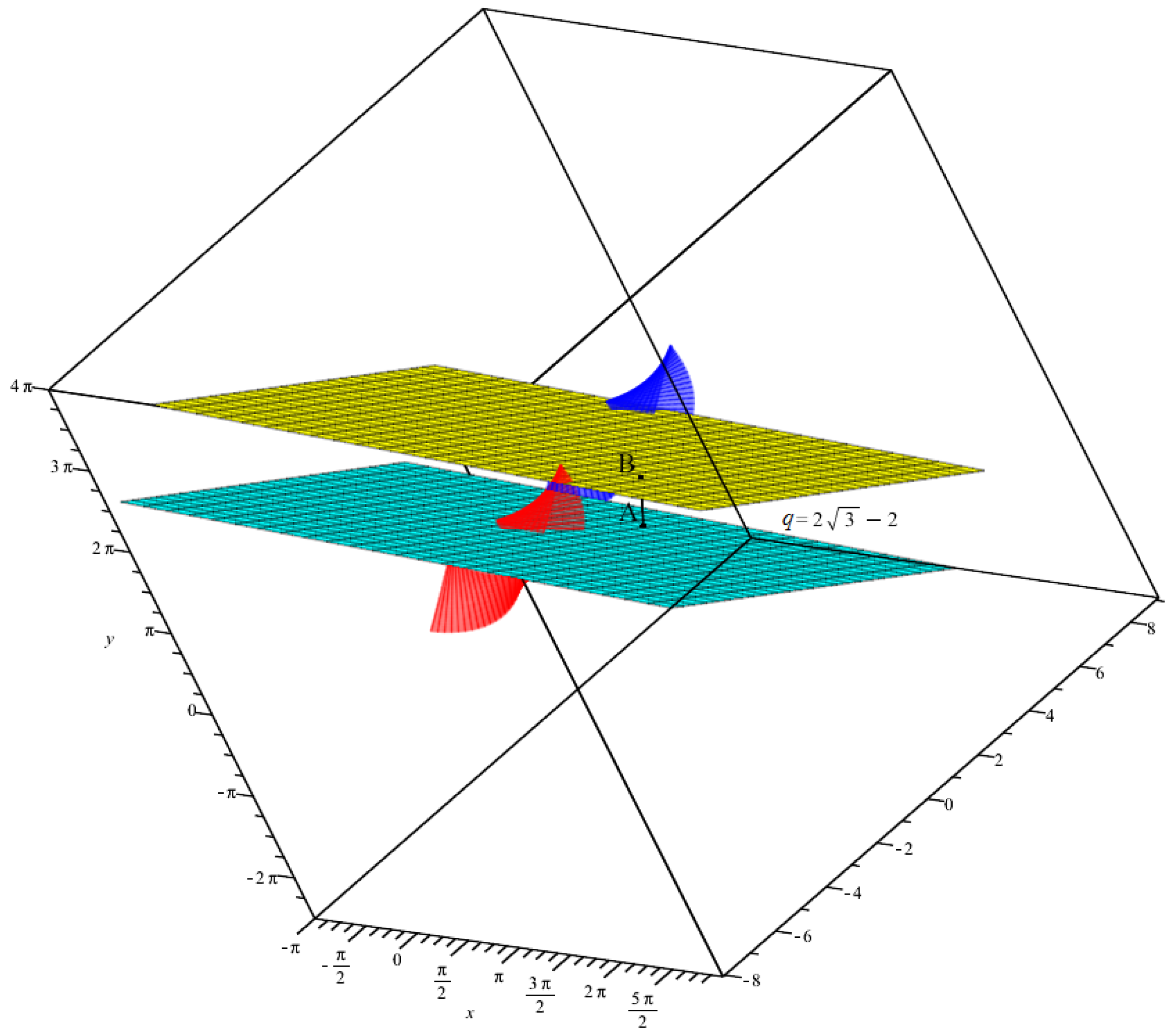
- For , the striction points, the binormal vectors, the asymptotic planes and the q distance are computed asNow, let us take two proper points from two asymptotic planes as and Since the distance , we can establish a relation for a and b as . For and , we have (See Figure 1).
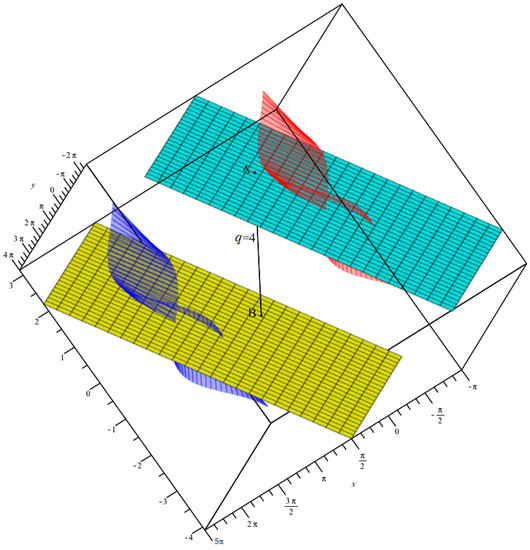 Figure 1. The equidistant ruled surfaces and the corresponding asymptotic planes for .
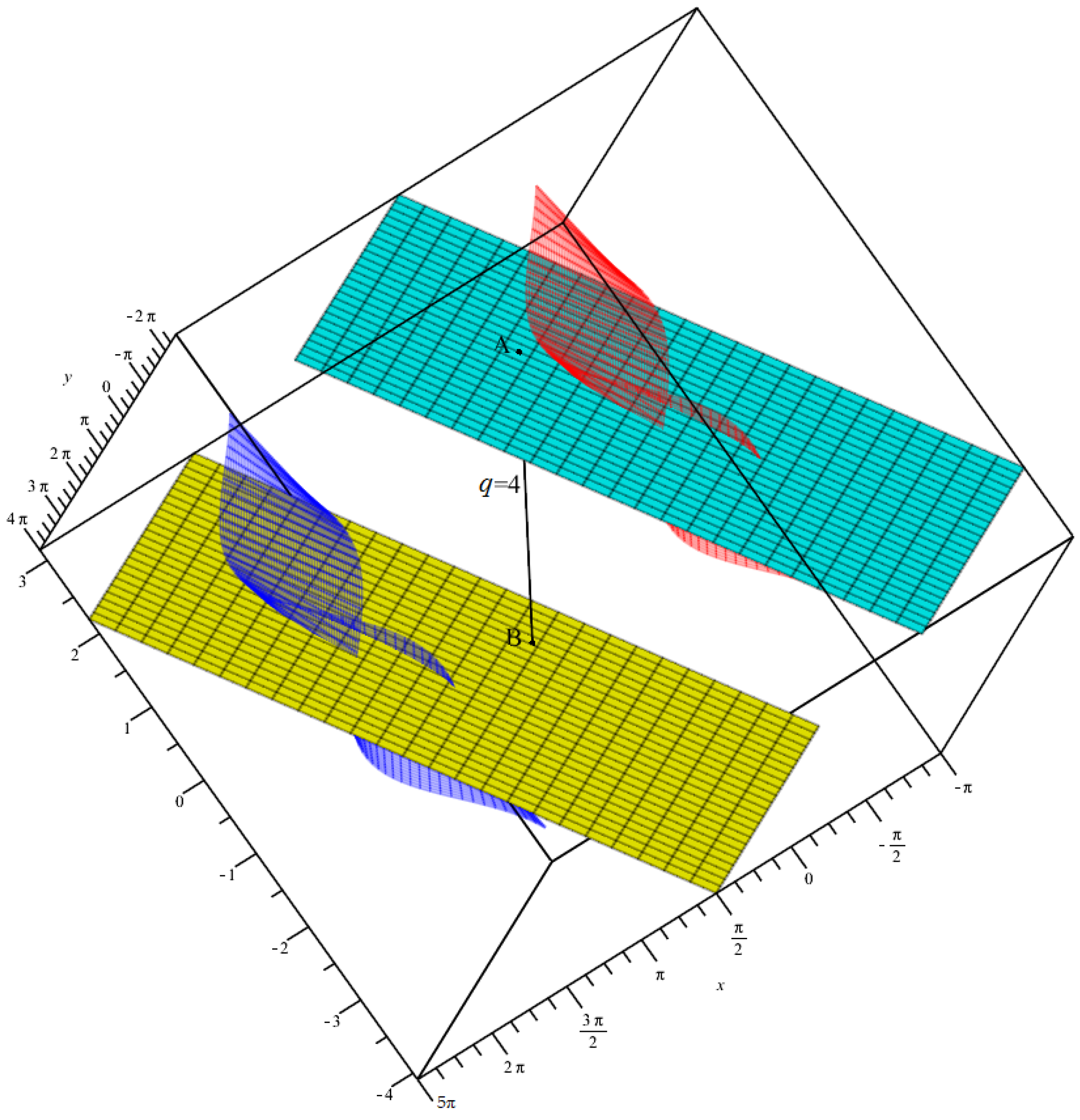
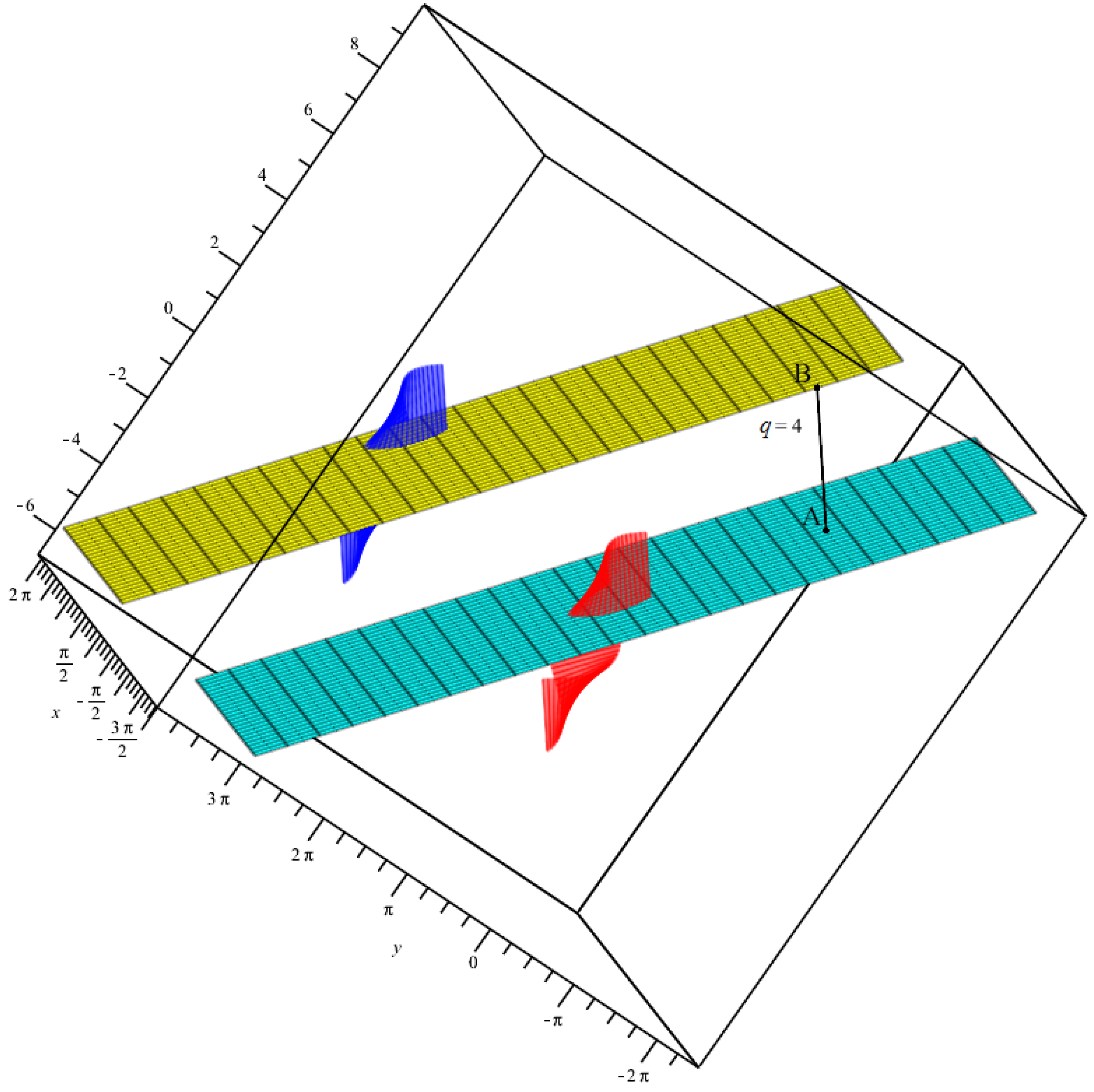
 - For the striction points, the binormal vectors, the asymptotic planes and the q distance are computed asSimilarly, when taken proper points from both asymptotic planes such asandwe may writeIf and , then we can rewrite the last relation asIf this relation is arranged for , then the roots can be computed as and ; that is, andParticularly for we have the corresponding points asSee Figure 2.
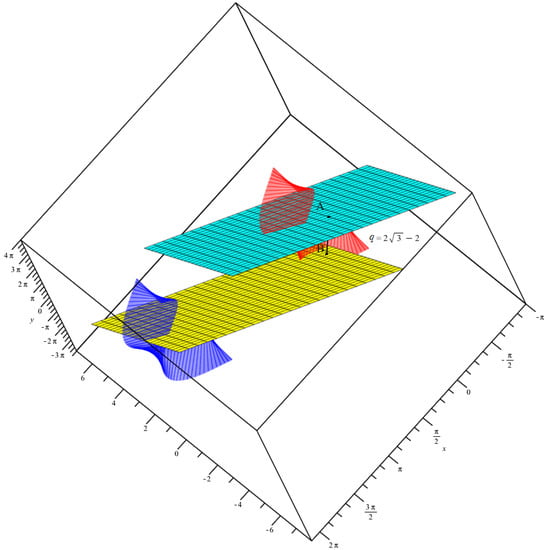 Figure 2. The q-equidistant ruled surfaces and the corresponding asymptotic planes for .Note that similar steps can be followed by considering to find different roots and distinct proper points.
 - For the striction points, the binormal vectors, the asymptotic planes and the q distance are computed asFor any two points from these asymptotic planeswe have Thus,If again and , then we re-express the last relation as By rearranging the last relation according to , the corresponding roots are found as ; that is, . Note that, in this situation, the asymptotic planes are coincided. See Figure 3.
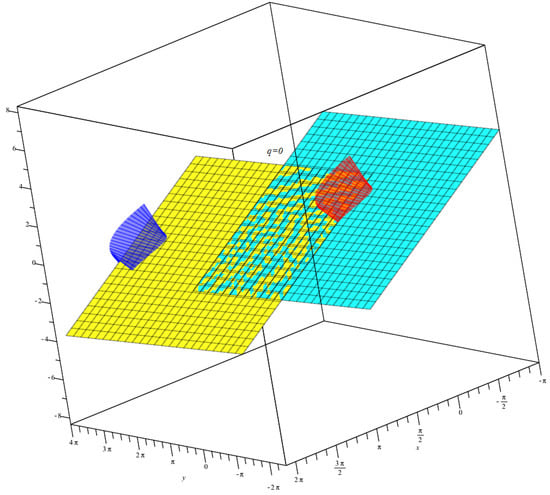 Figure 3. The equidistant ruled surfaces and the corresponding asymptotic planes for .
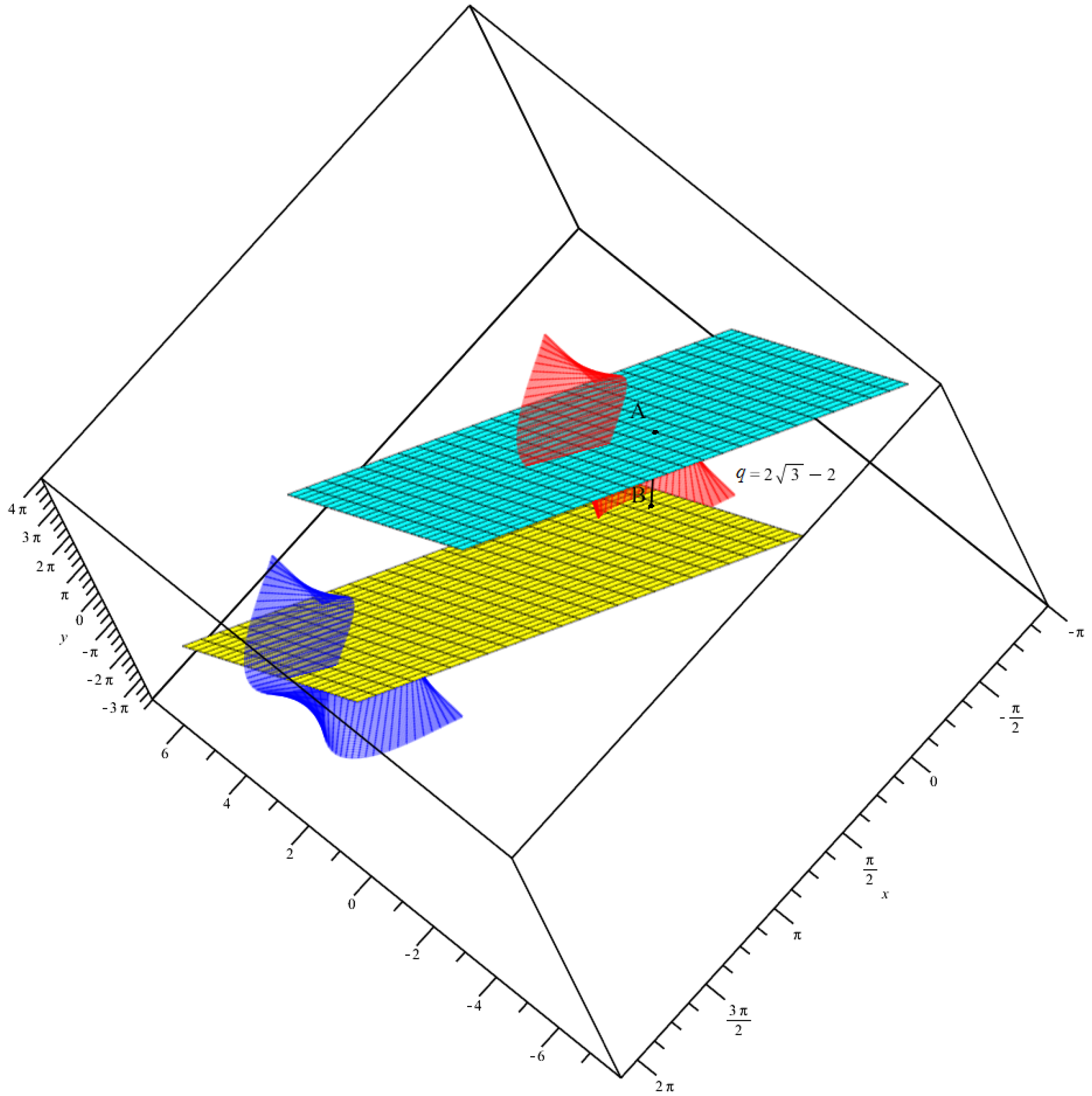
 - For the striction points, the binormal vectors, the asymptotic planes and the q distance are computed asFor such two points on asymptotic planes as the distance Hence,Following the same manner as before, if and , then the above relation takes the formBy arranging this for , the roots are found as and that is, andFor we have the following coordinates for the points A and B asSee Figure 4 If the arrangements are to be done for , another different point pairs can be obtained.
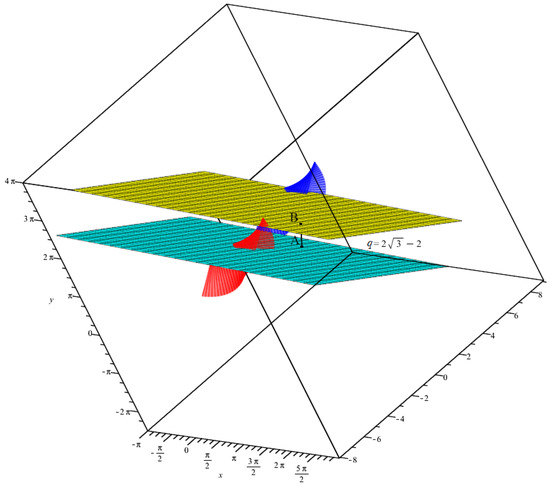 Figure 4. The equidistant ruled surfaces and the corresponding asymptotic planes for .
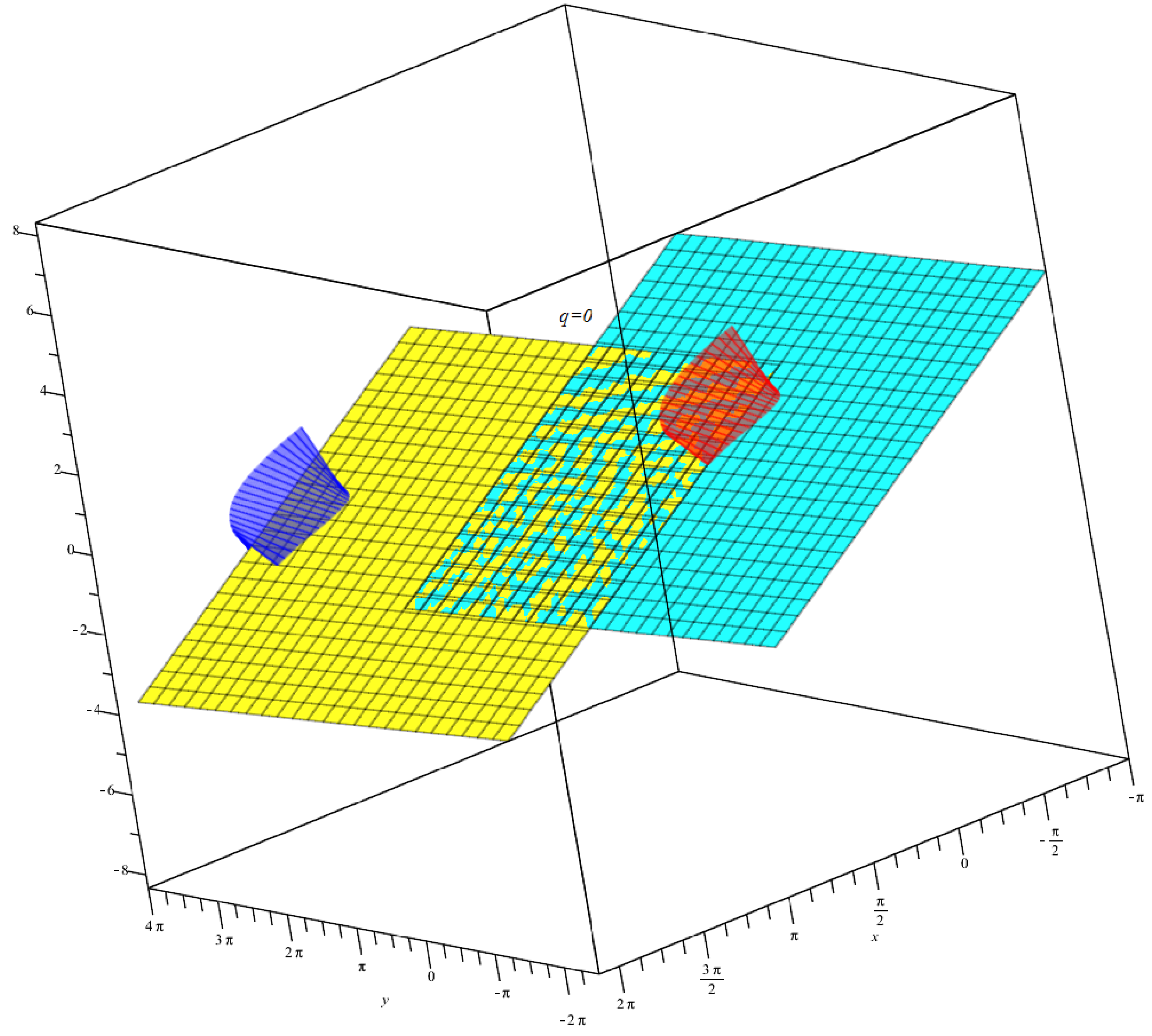
 - Lastly, for the striction points, the binormal vectors, the asymptotic planes and the q distance are computed asFor two points from the asymptotic planes,Therefore, If then we have The root to this relation is which corresponds toFor and , we have andSee Figure 5.
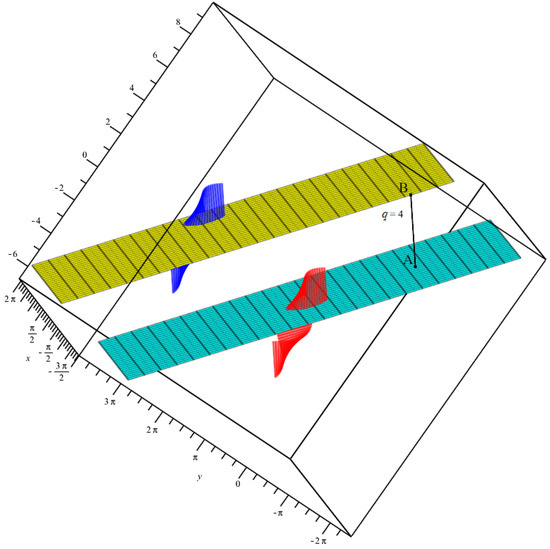 Figure 5. The q-equidistant ruled surfaces and the corresponding asymptotic planes for .
One may question the amount of the examples given; however, the concretion of the conceptualization for the equidistant ruled surface is something that literature is lacking. Therefore, the given examples are worth sharing for various cases to gain insight into main theme.
Now, let us denote the tangent vectors of the striction curves of q-equidistant ruled surfaces by and , respectively. Then, the following relations hold:
where and , respectively.
Theorem 4.
The parameters t of and of have the following relation
Proof.
If the derivative is taken from the relation (8), we have
Next, substituting (10) into this completes the proof. □
Corollary 2.
The expression for the vector in terms of Frenet vectors of the base curve is given as follows:
Theorem 5.
If σ and are taken to be the strictions of q-equidistant ruled surface, then there exist the following relations:
Corollary 3.
The tangent vectors of the base curves of q-equidistant ruled surfaces are parallel.
Proof.
Corollary 4.
The relations between the Frenet vectors of the base curve for q-equidistant ruled surfaces are given by the following.
Corollary 5.
The relations between the natural curvatures of the base curve for q-equidistant ruled surfaces are given by the following.
Corollary 6.
If is a closed ruled surface, then the pitch, the angle of pitch and the distribution parameter (drall) for each ruled surface drawn by Frenet vectors are given as
respectively.
Theorem 6.
For q-equidistant closed ruled surfaces, the following relations hold among the angles of the pitches of the closed ruled surfaces drawn by Frenet vectors of base curve as
Proof.
If we substitute of (7) into (15), then we have . By recalling the relation to substitute into the last equation, we have
When a similar procedure is followed in we have the expression
which completes the proof. □
Corollary 7.
Other useful relations among the angles of pitch can be drawn as
Theorem 7.
If the base curves of closed q-equidistant ruled surfaces are considered to be as curvature lines, then the relations between the angles of pitch are given as
Proof.
Since and the base curves are assigned to be curvature line, we write . By recalling , we complete the proof. □
Corollary 8.
If the base curves are curvature lines for the q-equidistant closed ruled surfaces, then the following relations hold among the pitches of ruled surfaces drawn by Frenet vectors.
Theorem 8.
The relations between the distribution parameters of q-equidistant ruled surfaces are
Proof.
It is clear that From (15), we write the reciprocal of as . By doing some arrangements and using (7) we have
By following similar steps, we find and this completes the proof. □
Corollary 9.
For q-equidistant ruled surfaces, the following relations exist among the dralls of ruled surface drawn by Frenet vectors:
Corollary 10.
If q-equidistant ruled surfaces have the same distribution parameter, then the angle between the tangents is If both the ruled surfaces and whose generator lines are Darboux vectors are closed, then the pitch, the angle of pitch and the distribution parameter (drall) are given as the following:
Theorem 9.
For q-equidistant ruled surfaces, if is the angle between the unit Darboux vector and the binormal vector , then the following relations exist:
Proof.
Theorem 10.
For q-equidistant ruled surfaces, the following relation exists for the unit Darboux vector of
Theorem 11.
For q-equidistant ruled surfaces the pitch, the angle of pitch and the distribution parameter of the closed ruled surface whose generator is unit Darboux vector are as follows:
where
Theorem 12.
For the two vectors defined by the Frenet vectors’ motion, which are as and , there exists the following relation.
Proof.
We can express the vector as
Next, applying (6) to the above completes the proof. □
Theorem 13.
The pitch, the angle of pitch and the distribution parameter of the closed ruled surface whose generator is the vector X are
Proof.
Theorem 14.
The angle of the pitch of the closed ruled surface whose generator vector is is as follows:
where
Proof.
By the definition of the angle of pitch, we have
which completes the proof. □
Theorem 15.
The angle of the pitch of the closed ruled surface whose generator vector is is given by
where
Proof.
Theorem 16.
The distribution parameter of the closed ruled surface whose generator vector is
where
Proof.
By differentiating the relation (26), we first have
If and of (7) are applied to the above, we then obtain
By using (4), the drall can be easily computed to complete the proof. □
Proposition 1.
When the vector X lies on osculating plane, the pitch, the angle of pitch and the distribution parameter of the two closed ruled surfaces whose generators are the vectors X and are given as the following
where
Proposition 2.
When the vector X lies on the normal plane, the pitch, the angle of pitch and the distribution parameter of the two closed ruled surfaces, whose generators are the vectors X and , are given as the following:
where
Proof.
Proposition 3.
While the vector X is on the rectifying plane, the pitch, the angle of pitch and the distribution parameter of the two closed ruled surfaces whose generators are the vectors X and are given as the following.
where
3. Conclusions and Discussion
Overall, in this study, parallel q-equidistant ruled surfaces were introduced such that the binormal vectors are parallel along the striction curves of their corresponding binormal ruled surfaces and the distance between the asymptotic planes is constant at proper points. The geometric properties of these ruled surfaces were examined, and some useful relations were given to be used for future research. In our next work, we are going to proceed to study geometric properties and symmetric properties of these ruled surfaces combined with the techniques and results in [19,20,21,22,23,24,25,26,27,28,29,30,31,32,33,34,35,36,37,38,39,40,41,42,43,44,45,46,47,48,49,50,51,52] to find more new results.
Author Contributions
Conceptualization, Y.L. and S.Ş.; methodology, S.Ş. and A.Ö.; software, D.C.; validation, Y.L., S.Ş. and D.C.; writing—original draft preparation, Y.L., S.Ş. and D.C.; writing—review and editing, Y.L. and D.C.; visualization, D.C.; supervision, Y.L. and S.Ş.; project administration, S.Ş. and A.Ö.; funding acquisition, Y.L. All authors have read and agreed to the published version of the manuscript.
Funding
This research was funded by the National Natural Science Foundation of China (grant number 12101168), the Zhejiang Provincial Natural Science Foundation of China (grant number LQ22A010014) and the Scientific Research Projects Coordination Unit of Ordu University (project number: B-1828).
Institutional Review Board Statement
Not applicable.
Informed Consent Statement
Not applicable.
Data Availability Statement
Not applicable.
Acknowledgments
We gratefully acknowledge the constructive comments from the editor and the anonymous referees.
Conflicts of Interest
The authors declare no conflict of interest.
References
- Gray, A.; Abbena, E.; Salamon, S. Modern Differential Geometry of Curves and Surfaces with Mathematica; Chapman and Hall/CRC: Boca Raton, FL, USA, 2017. [Google Scholar]
- do Carmo, M.P. Differential Geometry of Curves and Surfaces; Dover Publications: Mineola, NY, USA, 2016. [Google Scholar]
- Edge, W.L. The Theory of Ruled Surfaces; Cambridge University Press: Cambridge, UK, 2011. [Google Scholar]
- Flöry, S.; Pottmann, H. Ruled Surfaces for Rationalization and Design in Architecture. Available online: http://papers.cumincad.org/cgi-bin/works/paper/acadia10_103 (accessed on 28 July 2022).
- Farin, G. Curves and Surfaces for Computer-Aided Geometric Design: A Practical Guide; Elsevier: Amsterdam, The Netherlands, 2014. [Google Scholar]
- Hunt, K.H. Kinematic Geometry of Mechanisms; Oxford Press: Oxford, UK, 1978. [Google Scholar]
- Valenontis, I. Parallel P-Äquidistante Regelflachen. Manuscripta Math. 1986, 54, 391–404. [Google Scholar] [CrossRef]
- Masal, M.; Kuruoğlu, N. Some Characteristic Properties of the Parallel P-Equidistant Ruled Surfaces in the Euclidean Space. Pure Appl. Math. Sci. India 1999, L1, 35–42. [Google Scholar]
- Masal, M.; Kuruoğlu, N. Some Characteristic Properties of the Shape Operators of Parallel p-Equidistant Ruled Surfaces. Bull. Pure Appl. Sci. 2000, 19E, 361–364. [Google Scholar]
- Masal, M.; Kuruoğlu, N. Some characteristic properties of the Spherical Indicatrix Leading Curves of Parallel p-Equidistant Ruled Surfaces. Bull. Pure Appl. Sci. 2000, 19E, 405–410. [Google Scholar]
- Masal, M.; Kuruoğlu, N. Generalized parallel pi-equidistant ruled surfaces. Acta Comment. Univ. Tartu. Math. 2013, 171, 3–18. [Google Scholar]
- Şenyurt, S. Integral Invariants of Parallel P-Equidistant Ruled Surfaces Which are Generated by Instantaneous Pfaff Vector. Ordu Univ. J. Sci. Tecnol. 2012, 2, 13–22. [Google Scholar]
- Azak, A.Z.; Tosun, M.; Masal, M. Null parallel p-equidistant b scrolls. Bol. Soc. Parana. 2014, 32, 23–34. [Google Scholar]
- Kuruoğlu, N.; Masal, M. Timelike parallel pi-equidistant ruled surfaces by a time-like base curve in the Minkowski 3-space R31. Acta Comment. Univ. Tartu. Math. 2007, 11, 1–13. [Google Scholar]
- Kuruoğlu, N.; Masal, M. Timelike parallel equidistant ruled surfaces by a time-like base curve in the Minkowski 3-space R31. Acta Comment. Univ. Tartu. Math. 2009, 13, 3–9. [Google Scholar]
- Sarıaydın, M.T.; Korpınar, V.; Asil, V. On Parallel p-equidistant Ruled Surfaces by Using Modified Orthogonal Frame with Curvature in E3. Bol. Soc. Paran. Mat. 2022, 2022, 1–7. [Google Scholar]
- Cevahir, C. On Equidistant Parallel Ruled Surfaces Produced by Darboux Vectors in High Dimensional Spaces. Ph.D. Thesis, Institute of Sciences, Ordu University, Ordu, Turkey, 2021. [Google Scholar]
- Gür Mazlum, S.; Şenyurt, S.; Grilli, L. The Dual Expression of Parallel Equidistant Ruled Surfaces in Euclidean 3-Space. Symmetry 2022, 14, 1062. [Google Scholar] [CrossRef]
- As, E.; Şenyurt, S. Some Characteristic Properties of Parallel z-Equidistant Ruled Surfaces. Math. Probl. Eng. 2013, 2013, 587289. [Google Scholar] [CrossRef]
- Fenchel, W. On the Differential Geometry of Closed Space Curves. Bull. Am. Math. Soc. 1951, 57, 44–54. [Google Scholar] [CrossRef]
- Yang, Z.C.; Li, Y.; Erdoǧdub, M.; Zhu, Y.S. Evolving evolutoids and pedaloids from viewpoints of envelope and singularity theory in Minkowski plane. J. Geom. Phys. 2022, 104513, 1–23. [Google Scholar] [CrossRef]
- Li, Y.; Ganguly, D.; Dey, S.; Bhattacharyya, A. Conformal η-Ricci solitons within the framework of indefinite Kenmotsu manifolds. AIMS Math. 2022, 7, 5408–5430. [Google Scholar] [CrossRef]
- Li, Y.; Abolarinwa, A.; Azami, S.; Ali, A. Yamabe constant evolution and monotonicity along the conformal Ricci flow. AIMS Math. 2022, 7, 12077–12090. [Google Scholar] [CrossRef]
- Li, Y.; Khatri, M.; Singh, J.P.; Chaubey, S.K. Improved Chen’s Inequalities for Submanifolds of Generalized Sasakian-Space-Forms. Axioms 2022, 11, 324. [Google Scholar] [CrossRef]
- Li, Y.; Uçum, A.; İlarslan, K.; Camcı, Ç. A New Class of Bertrand Curves in Euclidean 4-Space. Symmetry 2022, 14, 1191. [Google Scholar] [CrossRef]
- Li, Y.; Mofarreh, F.; Agrawal, R.P.; Ali, A. Reilly-type inequality for the ϕ-Laplace operator on semislant submanifolds of Sasakian space forms. J. Inequal. Appl. 2022, 1, 1–17. [Google Scholar]
- Li, Y.; Mofarreh, F.; Dey, S.; Roy, S.; Ali, A. General Relativistic Space-Time with η1-Einstein Metrics. Mathematics 2022, 10, 2530. [Google Scholar] [CrossRef]
- Li, Y.; Dey, S.; Pahan, S.; Ali, A. Geometry of conformal η-Ricci solitons and conformal η-Ricci almost solitons on Paracontact geometry. Open Math. 2022, 20, 574–589. [Google Scholar] [CrossRef]
- Li, Y.; Alkhaldi, A.H.; Ali, A.; Laurian-Ioan, P. On the Topology of Warped Product Pointwise Semi-Slant Submanifolds with Positive Curvature. Mathematics 2021, 9, 3156. [Google Scholar] [CrossRef]
- Li, Y.; Haseeb, A.; Ali, M. LP-Kenmotsu manifolds admitting η-Ricci solitons and spacetime. J. Math. 2022, 2022, 6605127. [Google Scholar]
- Todorčević, V. Harmonic Quasiconformal Mappings and Hyperbolic Type Metrics; Springer: Berlin/Heidelberg, Germany, 2019. [Google Scholar]
- Todorčević, V. Subharmonic behavior and quasiconformal mappings. Anal. Math. Phys. 2019, 9, 1211–1225. [Google Scholar] [CrossRef]
- Kojić, V.; Pavlović, M. Subharmonicity of |f|p for quasiregular harmonic functions, with applications. J. Math. Anal. Appl. 2008, 342, 742–746. [Google Scholar] [CrossRef]
- Kojić, V. Quasi-nearly subharmonic functions and conformal mappings. Filomat 2007, 21, 243–249. [Google Scholar] [CrossRef]
- Manojlović, V.; Vuorinen, M. On quasiconformal maps with identity boundary values. Trans. Am. Math. Soc. 2011, 363, 2367–2479. [Google Scholar] [CrossRef]
- Manojlović, V. On bilipschicity of quasiconformal harmonic mappings. Novi Sad J. Math. 2015, 45, 105–109. [Google Scholar] [CrossRef]
- Manojlović, V. Bilipschitz mappings between sectors in planes and quasi-conformality. Funct. Anal. Approx. Comput. 2009, 1, 1–6. [Google Scholar]
- Manojlović, V. Bi-Lipschicity of quasiconformal harmonic mappings in the plane. Filomat 2009, 23, 85–89. [Google Scholar] [CrossRef]
- Manojlović, V. On conformally invariant extremal problems. Appl. Anal. Discret. Math. 2009, 3, 97–119. [Google Scholar] [CrossRef]
- Antić, M.; Moruz, M.; Van, J. H-Umbilical Lagrangian Submanifolds of the Nearly Kähler S3×S3. Mathematics 2020, 8, 1427. [Google Scholar] [CrossRef]
- Antić, M.; Djordje, K. Non-Existence of Real Hypersurfaces with Parallel Structure Jacobi Operator in S6(1). Mathematics 2022, 10, 2271. [Google Scholar] [CrossRef]
- Antić, M. Characterization of Warped Product Lagrangian Submanifolds in Cn. Results Math. 2022, 77, 1–15. [Google Scholar] [CrossRef]
- Antić, M.; Vrancken, L. Conformally flat, minimal, Lagrangian submanifolds in complex space forms. Sci. China Math. 2022, 65, 1641–1660. [Google Scholar] [CrossRef]
- Antić, M.; Hu, Z.; Moruz, M.; Vrancken, L. Surfaces of the nearly Kähler S3×S3 preserved by the almost product structure. Math. Nachr. 2021, 294, 2286–2301. [Google Scholar] [CrossRef]
- Antić, M. A class of four-dimensional CR submanifolds in six dimensional nearly Kähler manifolds. Math. Slovaca 2018, 68, 1129–1140. [Google Scholar] [CrossRef]
- Antić, M. A class of four dimensional CR submanifolds of the sphere S6(1). J. Geom. Phys. 2016, 110, 78–89. [Google Scholar] [CrossRef]
- Ali, A.T. Non-lightlike constant angle ruled surfaces in Minkowski 3-space. J. Geom. Phys. 2020, 157, 103833. [Google Scholar] [CrossRef]
- Ali, A.T. A constant angle ruled surfaces. Int. J. Geom. 2018, 7, 69–80. [Google Scholar]
- Ali, A.T. Non-lightlike ruled surfaces with constant curvatures in Minkowski 3-space. Int. J. Geom. Methods Mod. Phys. 2018, 15, 1850068. [Google Scholar] [CrossRef]
- Ali, A.T.; Hamdoon, F.M. Surfaces foliated by ellipses with constant Gaussian curvature in Euclidean 3-space. Korean J. Math. 2017, 25, 537–554. [Google Scholar]
- Ali, A.T.; Abdel Aziz, H.S.; Sorour, A.H. On some geometric properties of quadric surfaces in Euclidean space. Honam Math. J. 2016, 38, 593–611. [Google Scholar] [CrossRef]
- Ali, A.T.; Abdel Aziz, H.S.; Sorour, A.H. On curvatures and points of the translation surfaces in Euclidean 3-space. J. Egyptian Math. Soc. 2015, 23, 167–172. [Google Scholar] [CrossRef]
Publisher’s Note: MDPI stays neutral with regard to jurisdictional claims in published maps and institutional affiliations. |
© 2022 by the authors. Licensee MDPI, Basel, Switzerland. This article is an open access article distributed under the terms and conditions of the Creative Commons Attribution (CC BY) license (https://creativecommons.org/licenses/by/4.0/).