


Abstract
Let D be a digraph with n vertices and a arcs. The Laplacian and the signless Laplacian matrices of D are, respectively, defined as and , where represents the adjacency matrix and represents the diagonal matrix whose diagonal elements are the out-degrees of the vertices in D. We derive a combinatorial representation regarding the first few coefficients of the (signless) Laplacian characteristic polynomial of D. We provide concrete directed motifs to highlight some applications and implications of our results. The paper is concluded with digraph examples demonstrating detailed calculations.
1. Introduction
We consider a digraph of order n, where the vertex set is given by and . The set of arcs is denoted by , which contains ordered pairs of distinct vertices. Throughout this paper, digraphs mean directed graphs without loops or multiple arcs. Two vertices, u and v, of D are adjacent when they are linked via an arc , or , and they are called doubly adjacent when . For any vertex , the set
contains all vertices that are doubly adjacent of .
A sequence of vertices is called a walk W, which has length l from vertex u to vertex v. Here, is an arc in D for . W is a closed walk if . If each pair of different vertices in D admits a walk from u to v and a walk from v to u, then D is strongly connected. Let be the number of closed walks having length 2 originated from . In the digraph D, the sequence is a closed walk sequence of length 2.
A digraph D is weakly connected or connected when the undirected version G of D is connected.
A digraph D is called symmetric if and , for all . forms a one-to-one mapping between simple graphs and symmetric digraphs, where and G share the same vertices and each edge of G is mapped to symmetric arcs and . Clearly, a graph corresponds to a symmetric digraph under this mapping.
We define the adjacency matrix as a binary matrix with rows and columns indexed by the vertices. The element takes , if and otherwise. We refer the readers to [1,2] for some recent works on the spectral properties of . Denote by the diagonal matrix of out-degrees. The matrices and are known as the Laplacian and the signless Laplacian matrix of the digraph D. We call the eigenvalues of the matrices and the Laplacian and the signless Laplacian eigenvalues of D, respectively. Let and be the characteristic polynomials of the matrices and , respectively. They are the Laplacian and the signless Laplacian characteristic polynomial of D. Some recent results on the spectral properties of , and related results can be found in, e.g., [3,4,5,6,7,8,9,10,11,12].
Two graphs that are non-isomorphic are co-spectral if they have the same spectrum relevant to a given graph matrix. Apparently, two isomorphic graphs have the same spectrum relevant to a given graph matrix. If two graphs share the same spectrum relevant to a given matrix, is it true that they are isomorphic? This is one of the most investigated and difficult problems in spectral theory of graphs and digraphs. It yields the following problem.
Problem 1.
With respect to a given graph (digraph) matrix, which graphs (digraphs) are determined by their spectra?
A graph G is determined by its spectrum relevant to a given graph matrix if there is no other graph sharing the same spectrum as G relevant to the graph matrix. When two graphs admit the same spectrum relevant to a given graph matrix, they share the same characteristic polynomial as well as the coefficients of the characteristic polynomial. This observation prompted many researchers to examine carefully the coefficients of characteristic polynomial relevant to a given graph matrix. Apparently, if two graphs differ in at least one coefficient of their characteristic polynomial relevant to a given graph matrix, they cannot be co-spectral regarding the graph matrix. Many results have been reported in the literature on this problem. Sachs [13] and Mowshowitz [14] established the coefficients of the adjacency characteristic polynomial of an arbitrary digraph. It is revealed that the coefficients of the adjacency characteristic polynomial of a tree count matchings. The formulas for the first four coefficients of the Laplacian characteristic polynomial of a graph were derived in [15]. Cvetković et al. [16] presented the formulas for the first three coefficients of the signless Laplacian characteristic polynomial of a graph. Guo et. al [17] provided combinatorial expression for the first few coefficient of the (normalized) Laplacian and the signless Laplacian characteristic polynomials of a graph. Based upon the fifth coefficient of the adjacency characteristic polynomial of trees, Lepović et al. [18] showed that no starlike trees are co-spectral. The coefficients of the Laplacian characteristic polynomial were employed [19] to reveal the Laplacian spectra of three-rose graphs. Some recent results can be found in, e.g., [20,21,22].
The issue of spectral determination in digraphs related to adjacency matrices has also been considered. Some families of digraphs are characterized through adjacency spectra [23]. Recently, some researchers [11] studied the spectral determination problem for oriented graphs relevant to a generalized skew matrix.
With motivation from the above works, we aim to investigate the coefficients of the characteristic polynomial of the (signless) Laplacian matrices of a digraph. We obtain algebraic expressions for the first few coefficients of the (signless) Laplacian characteristic polynomials of a digraph.
Given a graph with the vertex set , let be the graph obtained from G by scrapping the ith vertex and its incident edges. The graph G is reconstructible if it can be determined (up to isomorphism) by all vertex-deleted graphs . Ulam’s reconstruction conjecture states that every graph with vertices is reconstructible. Many variations of this problem have been considered, and one of them is the spectral reconstruction problem. It claims that “a graph G is spectrally reconstructible if it can be determined up to isomorphism by the adjacency characteristic polynomial of G and the adjacency characteristic polynomials of its vertex deleted subgraphs ”. Our study of coefficients of the characteristic polynomial of the (signless) Laplacian matrices of a digraph is also motivated by this line of research.
2. Laplacian Coefficients of
In this section, we establish an algebraic representation for the first five Laplacian coefficients of a digraph.
To determine the coefficients of a Laplacian characteristic polynomial of a digraph D, we need the following Lemma, which can be found in [24].
Lemma 1.
Let be a matrix having the characteristic polynomial
.
Let be the trace of . Then, for the coefficients of , we have the following:
The following interesting result about the trace of the product of matrices can be found in [24].
Lemma 2.
For matrices A and B, we have .
The following result is the main result of this section and shows how the first five coefficients of the Laplacian characteristic polynomial of a digraph D can be expressed in terms of the structure of the digraph.
Theorem 1.
Let D be a connected digraph of orderwith a arcs having vertex out-degrees. Letbe the Laplacian characteristic polynomial of D. Then,
- (1)
- ,
- (2)
- ,
- (3)
- ,
- (4)
- and
Here,is the number of closed walks of length 2 at the vertex,is the number of directed cycles of length 3 at the vertex,is the number of directed cycles of length 4 at the vertex,is the number of paths on 3 verticesat the vertexwith arcs,is the number of paths on 3 verticesat the vertexwith arcsandis the sum of the out-degrees of the vertices which are both out-neighbor and the in-neighbor of the vertex.
Proof.
Let be the trace of the matrix , where is the Laplacian matrix of D and . We have, , the number of arcs. This shows by using Lemma 1 that . By a simple calculation, it can be seen that
Clearly, by Lemma 2. It is easy to establish that each of the diagonal entries of are zero, therefore we obtain
Additionally, and , where is the number of symmetric pair of arcs or the number of closed walks of length 2 at the vertex . Therefore, from (2), we obtain
Using this together with Lemma 1, we arrive at
By binomial theorem with index 3, it can be seen that
Clearly, by Lemma 2, we have
and each of the diagonal entries of are zero, it follows that
Additionally, , by Lemma 2 and the t-th diagonal entry of is , it follows that
Further, and
Therefore, from (3), we obtain
Using these observations together with Lemma 1, we arrive at
Lastly, by binomial theorem with index 4, we have
Using Lemma 2, we have
and the i-th diagonal entry of is zero, we get
Additionally, by Lemma 2
and the i-th diagonal entry of is , we obtain
Again by Lemma 2, we have
and the i-th diagonal entry of is
where is the sum of the out-degrees of the vertices which are both out and in-neighbors of the vertex . It follows that
Using Lemma 2, we have
and the i-th diagonal entry of is
where is the number of directed 3-cycles at the vertex . It follows that
Further, and
Now, from (4), we have
Using these observations together with Lemma 1, we arrive at
This completes the proof of the theorem. □
The k-th spectral moment of a digraph D is defined as the sum of the k-th powers of the adjacency eigenvalues of D. Likewise, the Laplacian spectral moments of D are defined as
where are the Laplacian eigenvalues of D.
The next result presents the formula for the first four Laplacian spectral moments of D.
Corollary 1.
Let D be a connected digraph of orderwith a arcs having vertex out-degrees. Then,
- (1)
- ,
- (2)
- ,
- (3)
- , and
- (4)
whereandare defined in Theorem 1.
3. The Signless Laplacian Coefficients of
In this section, we present algebraic representation for some of the signless Laplacian coefficients of D.
The next Theorem is the main result of this section and gives the first five coefficients of the signless Laplacian characteristic polynomial of a digraph D in terms of structure of the digraph.
Theorem 2.
Let D be a connected digraph of orderwith a arcs having vertex out-degrees. Letbe the signless Laplacian characteristic polynomial of D. Then,
- (1)
- ,
- (2)
- ,
- (3)
- ,
- (4)
- and
Here,is the number of closed walks of length 2 at the vertex,is the number of directed cycles of length 3 at the vertex,is the number of directed cycles of length 4 at the vertex,is the number of paths on verticesat the vertexwith arcs,is the number of paths on verticesat the vertexwith arcsandis the sum of the out-degrees of the vertices which are both out-neighbor and the in-neighbor of the vertex.
Proof.
Let be the trace of the matrix , where is the signless Laplacian matrix of D and . The rest of the proof follows by proceeding similar to Theorem 1 and so is omitted. □
The signless Laplacian spectral moments of D are defined as
where are the signless Laplacian eigenvalues of D.
The following Corollary 2 follows from Theorem 2 and presents formula for the first four signless Laplacian spectral moments of D.
Corollary 2.
Let D be a connected digraph of orderwith a arcs having vertex out-degrees. Then,
- (1)
- ,
- (2)
- ,
- (3)
- , and
- (4)
Here, and are defined in Theorem 1.
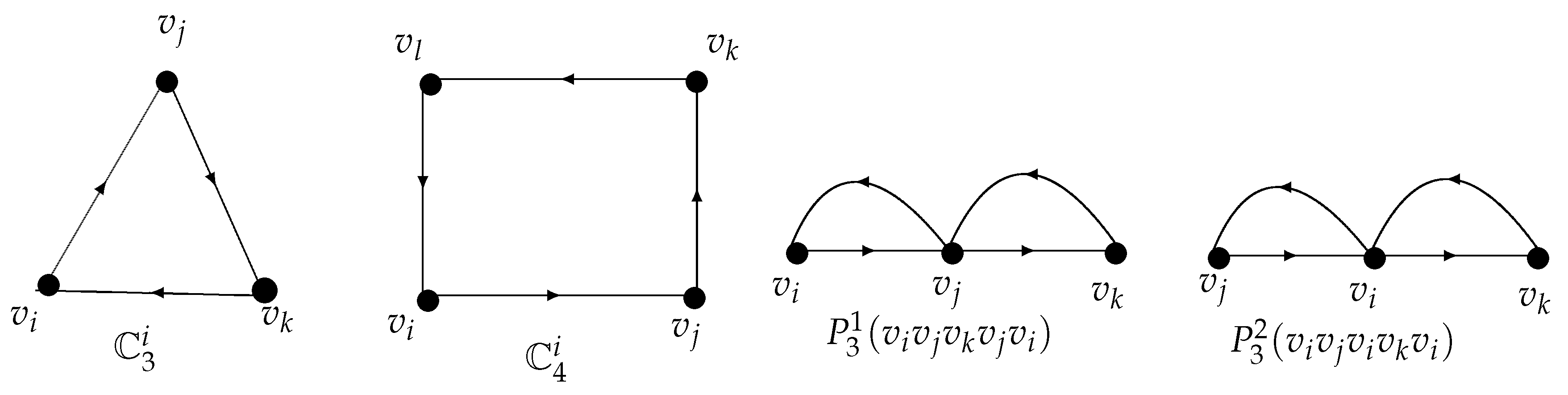
4. Examples
In this section, we consider some examples of the digraphs to highlight the applications of Theorems 1 and 2.
Example 1.
Let be the directed path on vertices with arcs of the form . For the directed path , we have for , , for , as there is no closed walk of length 2 at any vertex, , for . Additionally, as there is no triangle and 4-cycle at any vertex in . Further, it is clear that there are no paths of the form and in . With this information, it follows that
Let us add arc in and let be the resulting digraph. For , it is clear that for , for , and , for . Additionally, as there is no triangle and 4-cycle at any vertex in . Further, it is clear that there are no paths of the form and in . With this information, it follows that
Let us add another arc in and let be the resulting digraph. For , it is clear that for , for , and , for . Also, as there is no triangle and 4-cycle at any vertex in . Further, there are paths , and at the vertices and in . With this information, it follows that
Example 2.
Let be the directed cycle on vertices with arcs of the form . For the directed cycle , we have for , for , as there is no closed walk of length 2 at any vertex. Additionally, as there is no triangle and 4-cycle at any vertex in . Further, it is clear that there are no paths of the form and in . With this information, it follows that
Let us add arc in and let be the resulting digraph. For , it is clear that for , for . Additionally, as there is no triangle and 4-cycle at any vertex in . Further, it is clear that there are no paths of the form and in . With this information, it follows that
Similar to Laplacian coefficients and we can obtain the signless Laplacian coefficients and of the digraphs and .
5. Conclusions
From Theorem 1, we arrive at the following conclusion about the Laplacian spectral determination of digraphs.
Theorem 3.
If digraphs and are Laplacian co-spectral, then (i) and have the same order;
(ii) and have the same number of arcs;
(iii) the quantity is same for and ;
(iv) the quantity is the same for and ;
(v) the quantity is the same for and .
From Theorem 2, we arrive at the following conclusion about the signless Laplacian spectral determination of digraphs.
Theorem 4.
If digraphs and are signless Laplacian co-spectral, then (i) and have the same order;
(ii) and have the same number of arcs;
(iii) the quantity is the same for and ;
(iv) the quantity is the same for and ;
(v) the quantity is the same for and .
From (ii) of Theorems 3 and 4, it is clear that if two digraphs and have different numbers of arcs, then these digraphs have different (signless) Laplacian eigenvalues.
Author Contributions
Conceptualization, H.A.G. and Y.S.; investigation, H.A.G. and Y.S.; writing—original draft preparation, H.A.G. and Y.S.; writing—review and editing, H.A.G. and Y.S. All authors have read and agreed to the published version of the manuscript.
Funding
This research received no external funding.
Institutional Review Board Statement
Not applicable.
Informed Consent Statement
Not applicable.
Data Availability Statement
Not applicable.
Conflicts of Interest
The authors declare no conflict of interest.
References
- Bhat, M.A. Energy of weighted digraphs. Discret. Appl. Math. 2017, 223, 1–14. [Google Scholar] [CrossRef]
- Ganie, H.A.; Carmona, J.R. An (increasing) sequence of lower bounds for the spectral radius and energy of digraphs. Discret. Math. 2023, 346, 113118. [Google Scholar] [CrossRef]
- Alhevaz, A.; Baghipur, M.; Shang, Y. Merging the spectral theories of distance Estrada and distance signless Laplacian Estrada indices of graphs. Mathematics 2019, 7, 995. [Google Scholar] [CrossRef]
- Baghipur, M.; Ghorbani, M.; Ganie, H.A.; Shang, Y. On the second-largest reciprocal distance signless Laplacian eigenvalue. Mathematics 2021, 9, 512. [Google Scholar] [CrossRef]
- Chat, B.A.; Ganie, H.A.; Pirzada, S. Bounds for the skew Laplacian spectral radius of oriented graphs. Carpathian J. Math. 2019, 35, 31–40. [Google Scholar] [CrossRef]
- Ganie, H.A. Bounds for the skew Laplacian(skew adjacency) spectral radius of a digraph. Trans. Combin. 2019, 8, 1–12. [Google Scholar]
- Ganie, H.A.; Chat, B.A. Bounds for the energy of weighted graphs. Discret. Appl. Math. 2019, 268, 91–101. [Google Scholar] [CrossRef]
- Ganie, H.A.; Shang, Y. On the spectral radius and energy of signless Laplacian matrix of digraphs. Heliyon 2022, 8, e09186. [Google Scholar] [CrossRef]
- Lokesha, V.; Shanthakumari, Y.; Reddy, P.S.K. Skew-zagreb energy of directed graphs. Proc. Jangjeon Math. Soc. 2020, 23, 557–568. [Google Scholar]
- Pirzada, S.; Ganie, H.A.; Chat, B.A. On the real or integral spectrum of digraphs. Oper. Matrices 2020, 14, 795–813. [Google Scholar] [CrossRef]
- Qiu, L.; Wang, W.; Wang, W. Oriented graphs determined by their generalized skew spectrum. Linear Algebra Appl. 2021, 622, 316–332. [Google Scholar] [CrossRef]
- Shang, Y. More on the normalized Laplacian Estrada index. Appl. Anal. Discrete Math. 2014, 8, 346–357. [Google Scholar] [CrossRef]
- Sachs, H. Beziehungen zwischen den in einen Graphen enthalten Kreisenund seinem characterischen Polynom. Publ. Math. Debr. 1964, 11, 119–134. [Google Scholar] [CrossRef]
- Mowshowitz, A. The characteristic polynomial of a graph. J. Comb. Theory 1972, 12, 177–193. [Google Scholar] [CrossRef]
- Oliveira, C.S.; de Abreu, N.M.M.; Jurkiewicz, S. The characteristic polynomial of the Laplacian of graphs in (a, b)-linear classes. Linear Algebra Appl. 2002, 356, 113–121. [Google Scholar] [CrossRef]
- Cvetković, D.; Rowlinson, P.; Simić, S.K. Signless Laplacians of finite graphs. Linear Algebra Appl. 2007, 423, 155–171. [Google Scholar] [CrossRef]
- Guo, J.M.; Li, J.; Huang, P.; Shiu, W.C. Coefficients of the characteristic polynomial of the (signless, normalized) Laplacian of a graph. Graphs Comb. 2017, 33, 1155–1164. [Google Scholar] [CrossRef]
- Lepović, M.; Gutman, I. No starlike trees are cospectral. Discret. Math. 2002, 242, 291–295. [Google Scholar] [CrossRef]
- Wang, J.F.; Huang, Q.X.; Belardo, F. On the spectral characterizations of 3-rose graphs. Util. Math. 2013, 91, 33–46. [Google Scholar]
- Ganie, H.A.; Ingole, A.; Deshmukh, U. On the coefficients of skew Laplacian characteristic polynomial of digraphs. Discret. Math. Algorithms Appl. 2022, 14, 2250131. [Google Scholar] [CrossRef]
- Liu, X.; Liu, S. On the Aα-characteristic polynomial of a graph. Linear Algebra Appl. 2018, 546, 274–288. [Google Scholar] [CrossRef]
- Oboudi, M.R.; Abdian, A.Z. Peacock graphs are determined by their Laplacian spectra. Iran. J. Sci. Technol. Trans. Sci. 2020, 44, 787–790. [Google Scholar] [CrossRef]
- Lin, H.; Shu, J. A note on the spectral characterization of strongly connected bicyclic digraphs. Linear Algebra Appl. 2012, 436, 2524–2530. [Google Scholar] [CrossRef][Green Version]
- Prasolov, V.V. Problems and Theorems in Linear Algebra (Translations of Mathematical Monographs); American Mathematical Society: Cambridge, UK, 1994. [Google Scholar]
Disclaimer/Publisher’s Note: The statements, opinions and data contained in all publications are solely those of the individual author(s) and contributor(s) and not of MDPI and/or the editor(s). MDPI and/or the editor(s) disclaim responsibility for any injury to people or property resulting from any ideas, methods, instructions or products referred to in the content. |
© 2022 by the authors. Licensee MDPI, Basel, Switzerland. This article is an open access article distributed under the terms and conditions of the Creative Commons Attribution (CC BY) license (https://creativecommons.org/licenses/by/4.0/).