


Abstract
The aims of this paper are (a) to introduce the concept of the 0-complete m-metric spaces, (b) to obtain the results for -Caristi mapping using Kirk’s approach, (c) to investigate the problem of non-cooperative equilibrium (abbreviated as NCE) in two- and three-person games in the structure of game theory and find the solution by employing coupled and tripled fixed-point results within the framework of 0-complete m-metric spaces (m-metric spaces, respectively), and (d) to establish some coupled fixed-point results which extend the scope of metric fixed point theory. We provide some examples to support the concepts and results presented in this paper. As an application of our results in this paper, we obtain the existence of a solution for a nonlinear integral equation.
1. Introduction and Preliminaries
It is widely acknowledged that real-world problems can be represented using mathematical equations. Metrical fixed-point theory, contraction mapping theorem, and theoretical monotone iterative method are very convenient instruments for solving a variety of problems in nonlinear analysis, control theory, game theory, and economic theory. Banach’s contraction principle [1] is one of the basic results of a metric fixed-point theory which states that if f is a self mapping on a complete metric space and there exists a constant such that holds for all , then f has a unique fixed-point in Furthermore, for any initial guess , the sequence of successive approximations converges to a fixed-point of f. Due to its significance and simplicity, several authors have extended Banach’s contraction principle in various directions; see [2,3,4,5,6,7]. However, the domain of metric fixed-point theory extends beyond pure mathematics and finds application in various quantitative sciences, including engineering, economics, operations research, network theory, game theory, and many more. Within the realm of economics, game theory has utilized techniques and approaches from fixed-point theory to address its complexities.
Game theory is a formal mathematical framework used to analyze games systematically. In fact, games can be viewed as conflicts in which a set of individuals (known as players) participate, and each player aims to maximize their utility within the scope of this conflict. The games can be classified in different ways. However, in this paper, we will focus on cooperative games, where players have the option to collaborate, and non-cooperative games, where players are not permitted to cooperate.
In the subsequent sections, we illustrate the relationship between the existence of equilibria and the presence of a fixed point. In this work, we adopt the concepts and notations introduced in [8]. Let us recall some fundamental notions. In the context of normal form, a two-person game G is defined by the following data:
- (i)
- The topological spaces and are regarded as the strategies for the first player and second player, respectively;
- (ii)
- A topological subspace of the product space represents valid strategy pairs;
- (iii)
- We define a bi-loss operator as follows: , where represents the loss acquired by player j when strategies and are employed. A pair is stated as a NCE ifHence,Assume that the following maps exist:such that the following equations hold:The mappings and satisfying the above properties are called optimal decision rules. Any solution to the systemis a NCE. Let represent the function
A fixed point of is indeed a NCE. Therefore, the existence of a solution for a NCE is identified as a pair of fixed-points. Further insights into game theory can be found in [8,9].
However, if we take and and define by , a coupled fixed-point of then becomes a non-cooperative equilibrium point.
In 1995, Matthews [10] introduced the concept of a partial metric space and gave an interesting generalization of the Banach contraction principal by replacing an ordinary metric space with a partial metric space. Asadi et al. [11] proposed the notion of an m-metric space and studied its topological properties. They also obtained some fixed-point results, which extended the scope of the classic Banach and Kannan fixed-point theorems. Many authors then extended these results by introducing more general contractive conditions (see [12,13,14,15,16]).
Throughout this paper, we use the symbol to indicate the set of positive integers, and to indicate the set of nonnegative integers. Similarly, we denote the set of real numbers and the set of positive real numbers as and , respectively.
Definition 1
([11]). Consider a non-empty set ξ. Then, a mapping is called the m-metric (or ) on ξ if for all , the following conditions hold:
- (i)
- (ii)
- (iii)
- (iv)
- where , and
Then, the pair is known as the m-metric space (or -space).
Every (-metric m on generates a topology on which has a base of collection of m-open balls
where
If m is an on , then the functions , given by:
and
are ordinary metrics on . It is easy to see that and are equivalent metrics on
In the following example, we set the following notations:
- (i)
- Let and be two players, each choosing strategies from their respective strategy set and
- (ii)
- The strategy space is equipped with -space by defining the distance function m as follows:This space models the closedness of the strategies.
- (iii)
- The payoff functions are for player and for player
- (iv)
- A Nash equilibrium occurs at the strategy pair such that no player can improve their payoff by unilaterally changing their strategy:
The challenge of finding the Nash equilibrium (or NCE) can be reformulated as a fixed-point problem in -space, where the concept of distance is generalized, allowing for non-zero self-distance and modified triangle inequality ([11]).
Example 1.
Consider a simple coordination game between two players where they have the following strategy set:
- 1
- for player
- 2
- for player
Their payoffs are described in the following Table 1, where each cell contains the payoff pair corresponding to the strategies chosen by the two players.

Table 1.
In this table shows the payoffs in a coordination game where Player and Player each choose from two strategies, and the goal is to coordinate on the same strategy for the best outcome.
Payoff Analysis
- ・
- If both players choose , they both obtain a payoff of which is a mutually beneficial outcome.
- ・
- If chooses and chooses B, , gets 0 and gets
- ・
- The other combinations yield lower payoffs for at least one player.
Best Response Dynamics
- ・
- Best Response of Player :
- ・
- Given , the best response of is (since ).
- ・
- Given , the best response of is (since ).
- ・
- Best Response of Player
- ・
- Given , the best response of player is (since ).
- ・
- Given , the best response of player is (since ).
Thus, the strategy pair is a Nash equilibrium (or NCE), as neither player can improve their payoff by unilaterally deviating.
The Nash equilibrium (or non-cooperative equilibrium) corresponds to the fixed-point of the best response function , where , which implies that the strategy pair is a self-consistent solution (i.e., the Nash equilibrium or NCE).
Definition 2
([11]). Let be a -space. Then:
- (i)
- A sequence in -space converges with respect to to k if and only if
- (ii)
- A sequence in -space is called m-Cauchy ifexist (and are finite).
- (iii)
- A space is said to be complete if every m-Cauchy in ξ is m-convergent with respect to to k in ξ such that
- (iv)
- A sequence is a Cauchy sequence in if and only if it is a Cauchy sequence in the metric space
- (v)
- A space is complete if and only if is complete.
Very recently, Mohanta et al. [17] introduced the notion of 0-complete -spaces as follows:
Consistent with the concepts in [17], let us recall the following:
Definition 3
([17]). Let be a -space, then
- (ii)
- A sequence in is called 0-Cauchy sequence if
- (iii)
- A space is said to be 0-complete if every 0-Cauchy sequence in ξ is convergent with respect to to k in ξ such that
We now present the following two alternative ways to define the Caristi mapping within the context of -spaces:
Definition 4.
- (i)
- A self-mapping on a -space is called a m-Caristi mapping if there is a function ξ with lower semicontinuity in the setup of , and it satisfies the inequality
- (ii)
- Self-mapping on an -space is called a m-Caristi mapping if there is a function ξ with lower semicontinuity in , and it satisfies the inequality
In an initial endeavor to extend Kirk’s characterization of metric completeness and partial metric completeness to the setup, one might speculate that an -space is complete if and only if every m-Caristi mapping on possesses a fixed-point. However, the subsequent straightforward example demonstrates the falsity of this speculation.
Example 2.
Define the m-metric m the set of natural numbers as follows
Observing that is not complete, as the metric induces the discrete topology on and the sequence is a Cauchy sequence in . However, we establish that there are no m-Caristi mappings on , as demonstrated in the following analysis.
Certainly, consider and assume the existence of a lower semicontinuous function such that
Let , we obtain
which means that for any Therefore, , which contradicts the condition
Hence, is not m-Caristi mappings on
Following the ideas of Ran and Reurings [18] and Nieto and Rodriguez-Lopez [19,20], many authors have explored the existence and uniqueness of fixed-points in partially ordered metric spaces for contractive-type mappings. Moreover, the idea of a coupled fixed-point was proposed by Guo and Lakshmikantham in [21].
Let us recall that a pair belonging to is denoted as a coupled fixed-point for the mapping when it fulfills the conditions and (see, e.g., [21]). Bhaskar et.al [22] introduced the concept of mixed monotone properties and obtained coupled fixed-point theorems in the context of partially ordered metric spaces.
Definition 5
([22]). Consider a partially ordered set and a mapping The mapping is said to have the mixed monotone property if is monotone non-decreasing in first argument and monotone non-increasing in second argument; that is, for any , we have the following:
For more results in this direction, we refer to [23], and the relevant findings and coupled fixed-point theorems can be deduced from [24,25].
Wardowski [26] presented the novel concept of an F-contraction and provided proof for fixed-point theorems within the standard framework of metric spaces. After that, many authors extended and generalized the concept of F-contraction and proved some fixed-point results (see [27,28,29,30] for more details).
Definition 6
Here, denotes the set of all functions F that meet the criteria defined in ()-(). Note that and for all k∈ belong to
([31]). Consider a mapping that fulfills the following:
- () F is strictly increasing and continuous.
- () For any sequence ,
Note that the manifestation of a fixed point for every -Caristi mapping on -space does not serve as a characterization for the completeness of , as given in the following section of this paper.
2. Main Results
In this section, drawing inspiration from Kirk’s approach to metric completeness and using the idea in [32], we aim to characterize -space where each -Caristi mapping possesses a fixed-point. To achieve this, we introduce the concept of a 0-complete -space, defined as follows.
Definition 7.
Consider a sequence in -space is called 0-Cauchy if
We say that is 0-complete if every 0-Cauchy sequence in ξ converges to a point such that
Remark 1.
Our assumption is strong from Remark 2.14 [17]. Note that each 0-Cauchy sequence in is a Cauchy sequence in and each complete -space is 0-complete.
Next, we provide the non-trivial example of 0-complete -space, which is not complete.
Example 3.
Consider the -space , where Q represents the set of rational numbers and the m-metric m is defined as . This serves as an illustrative example of a 0-complete -space that is not complete.
Proposition 1.
Let be a -space. Then, the function given by
is a metric on ξ such that Moreover, is complete if and only if is 0-complete.
Proof.
It is clear that
and for all Let Note that , from the Equation (1), If and , then
If and , then we can easily verify that If , then
Thus, is a metric space. According to Definition 7, clearly, is complete if and only if is 0-complete. □
Lemma 1.
Let be a -space. Then, for each , the function given by is lower semicontinuous for .
Proof.
Assume that
then,
This yield because □
Theorem 1.
A -space is 0-complete if and only if every -Caristi mapping on ξ has a fixed-point.
Proof.
Put
and define a map by if k in , and for all Observe that Λ is closed in Now, define as
and for all Note that for all and so for all k in We now conclude that Ψ is a lower semicontinuity in Moreover, for every k in , we obtain
and for every in Λ,
Thus, is a Caristi -mapping on ξ lacking a fixed point, which leads to a contradiction. □
Assume that is a -Caristi mapping on ξ, then there is a function which is lower semicontinuous in the setup of and
Now, for every , consider a set given by
Observe that is nonempty because in Moreover, is closed in since is lower semicontinuous for Fix in , take in such that
Clearly, Hence, for every , we have
By following the arguments similar to those given above, we generate a sequence in set ξ, ensuring its corresponding sequence is constructed of closed subsets in and satisfies
- (i)
- , for all
- (ii)
- ∀, for all
As
based on (i) and (ii), we have
If follows that
There exist such that
and thus
and
Therefore, is a 0-Cauchy sequence in . Therefore,
In conclusion, we demonstrate that . To achieve this, observe that
Since and for all Consequently, , so based on
Since
and . Also, implies that Hence, Now, implies that Thus,
Conversely, assume that there is a 0-Cauchy sequence of distinct points in , which is not convergent in Generate a subsequence from the sequence such that
3. Coupled Fixed-Point Results in M-Metric Spaces
In this section, we prove some new coupled fixed-point results in 0-complete -spaces, which are then employed to demonstrate the existence of a NCE in a two-person game.
Throughout this section, let be a partially ordered set and m be a -metric on such that is complete -spaces and 0-complete -spaces. Further, the product spaces satisfy the following:
Theorem 2.
Let be a partially ordered set, a 0-complete -space, and a continuous mapping having a mixed monotone property on Assume that there exist some and with the following:
- (i)
(ii) There are in ξ such that ,
Then, there exists in ξ, such that and
Proof.
Assume in such that , Let
Then, and Again, let
Using the mixed monotone property of , we have and Continuing in a similar manner, we have two sequences and such that
and
For, each , from (i), we have the following:
and
Since (2) and (3) hold, we obtain that
and by , we have
It follows that the sequence is monotone decreasing. Therefore, there is some such that
Since, F is continuous, on taking the limit on both sides of (4), we determine that
As , using , we have
Therefore,
Then,
Also, we have
and
It follows that
therefore,
We now show that
Define
Based on , we have
Now, we have to prove that Suppose on the contrary that it is not true; there exist and two sequences and of positive integers such that for , we get
Without any loss of generality, let be the smallest such integer. Then,
Using (6) and (7), and based on the last property of -space, for , we obtain the following:
Letting in the above inequality and using (6) and (7), and , we have If for any and for all , , we obtain . Assume for infinitely many Now, we obtain
Put
Obviously,
Therefore,
Similarly, , we have
using (10) and (11); hence, we have
Next, since we have and , using the condition , we obtain that
Similarly,
Therefore,
From (12), letting , we have
This leads to , a contradiction. Therefore, and are M-Cauchy sequences. Since is 0-complete -space, and as for some . Therefore,
Since implies that Similarly, implies that . Now, we prove that and Indeed, since and , based on the definition of F, we obtain
This implies that
Since , as in and is m-continuous, we have Therefore,
Now, we obtain
Letting , since , we determine that , and therefore Similarly, and hence □
Our next results are obtained by dropping the continuity condition of
Theorem 3.
Let be a partially ordered set and a 0-complete -space. Suppose that ξ has the following properties:
- (a)
- If a is a nondecreasing sequence in ξ such that for all , and , then
- (b)
- If a is a nonincreasing sequence in ξ such that for all and , then
Also, assume is a mapping with a mixed monotone property on Assume there exists some F and such that:
- (i)
(ii) There are in ξ such that ,
Then, there exists in ξ such that and
Proof.
Following arguments similar to those given in the proof of Theorem 2, we now prove that
From assumptions (i) and (ii), we get and for all . Using assumption (i), we have
Letting , we deduce that Hence,
The proof is over. □
We straightforwardly develop the following corollaries:
Corollary 1.
Consider the partially ordered set , and is a 0-complete -space. Let be a mapping having a mixed monotone property on Assume that there exist some and such that:
- (i)
(ii) There are in ξ such that ,
Also, assume that either:
(1) is continuous, or (2) ξ possesses the following conditions:
(a) If is a non-decreasing sequence in ξ such that for all and then ,
(b) If is a non-increasing sequence in ξ such that for all and , then
Then, there exists in ξ such that and
Proof.
Since
the condition (13) implies the first property of Theorem 2. Hence, the desired result can be deduced from Theorems 2 and 3. □
Corollary 2.
In addition to the assumptions of Corollary 1, if and are comparable, then there exists k in ξ such that is a unique fixed-point of
Proof.
Consider the assumption (ii) of Corollary 1
Since and are comparable, we conclude that:
Consider the first case. Then, the mixed monotone property of implies that
hence, through induction, one gets , Now, based on the continuity of distance function m, we determine that
we have
Alternatively, we obtain
Therefore, based on , we deduce that
This means
Letting limit in (14), we reach at
Therefore, , or Hence, □
4. Solution of Some Non-Cooperative Equilibrium Problems of Two Persons
In this section, we utilize the findings from Section 2 to demonstrate the existence of a NCE in a two-person game. For more detailed investigation of the concepts of two-person games, we refer to [8]. Consider a partial set and assume that there exists m-metric such that be a 0-complete -space. Consistent with [9], let G be a normal-form game that admits the following data:
- (i)
- and represent strategies for the first and second players, respectively;
- (ii)
- The denotes the set of allowed strategy pairs;
- (iii)
- The biloss operator is as follows:,where represents the loss acquired by player j when strategies and are employed, assuming that there exist maps and , which are optimal decision rules.As mentioned before, any solution to the system
is a NCE. Let represent the following function:
A fixed-point of is indeed a NCE. Therefore, exploring the existence of a solution for a NCE is identified as a pair of fixed points. However, if we take and and define by , a coupled fixed point of then becomes a non-cooperative equilibrium point.
Theorem 4.
Let G be a normal-form game and ξ a strategy for players. Assume that is an 0-complete -space and the optimal decision rule is a monotone continuous operator that meets the following conditions:
- (i)
- for all and for any and ,
(ii) There are so that ,
Then, the two-person game G possesses a NCE.
Proof.
Suppose a mapping is given by
Based on the continuity and monotonicity of , is also continuous and has a mixed monotone property. For all , with , , we obtain
Therefore, the assumption (i) reduces to the following:
for each , Since
and due to , we see that the assumption (i) implies (15), and following the argument in Theorem 2, we determine that has a couple fixed-point. Hence, the two-person game G has a NCE. □
Our next results also hold for complete -space because every complete -space is considered a 0-complete -space.
Corollary 3.
Let G be a normal-form game and ξ be a strategy for players. Assume that is a complete -space and the optimal decision rule is a monotone continuous operator that meets the following conditions:
- (i)
- for all and for any and ;
(ii) There are so that ,
Then, the two-person game G possesses a NCE.
Example 4.
Let and for all Suppose that G is a non-normal two-person game with the following biloss operator:
for every , and Suppose and are the optimal decision rules. We can easily compute for G, and are the strategies of and We have
and
where As we know, for all In Table 2, we find the solution for the NCE. Table 2 shows the iterative process of calculating the NCE for the two-person non-normal game using optimal strategies for each player, where
Table 2.
This table illustrates an exponential decay process for both players’ strategies over 20 iterations.
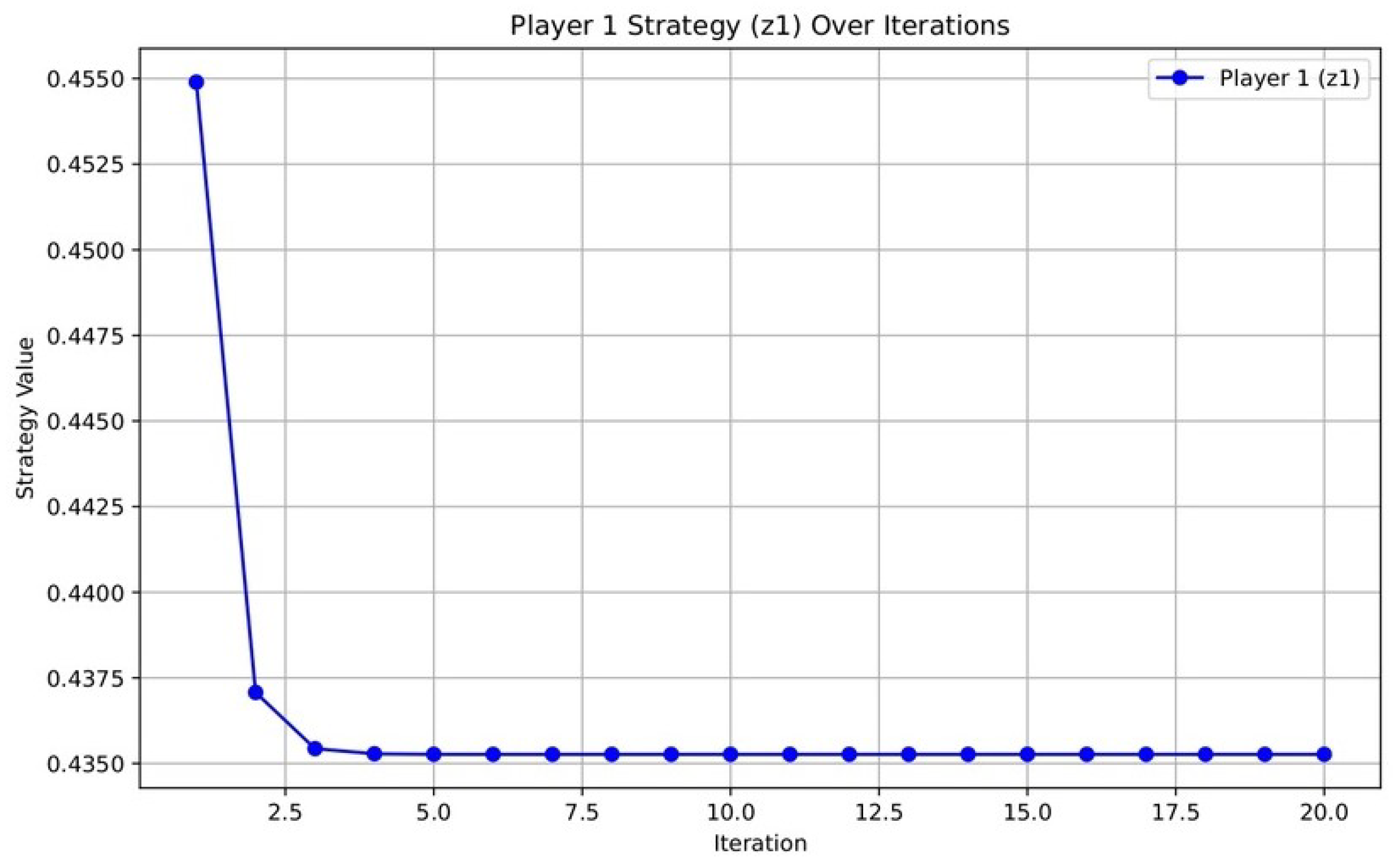
In Figure 1, we use the iteration for the player and find the strategy value of the first player.
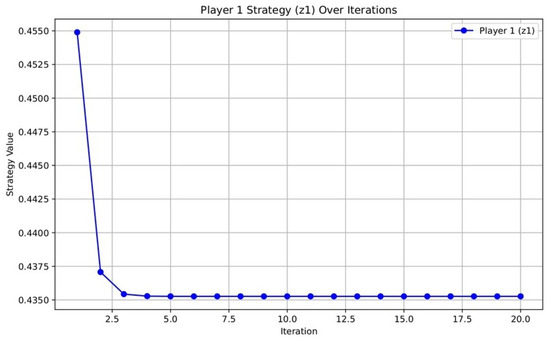
Figure 1.
Strategies of player 1.
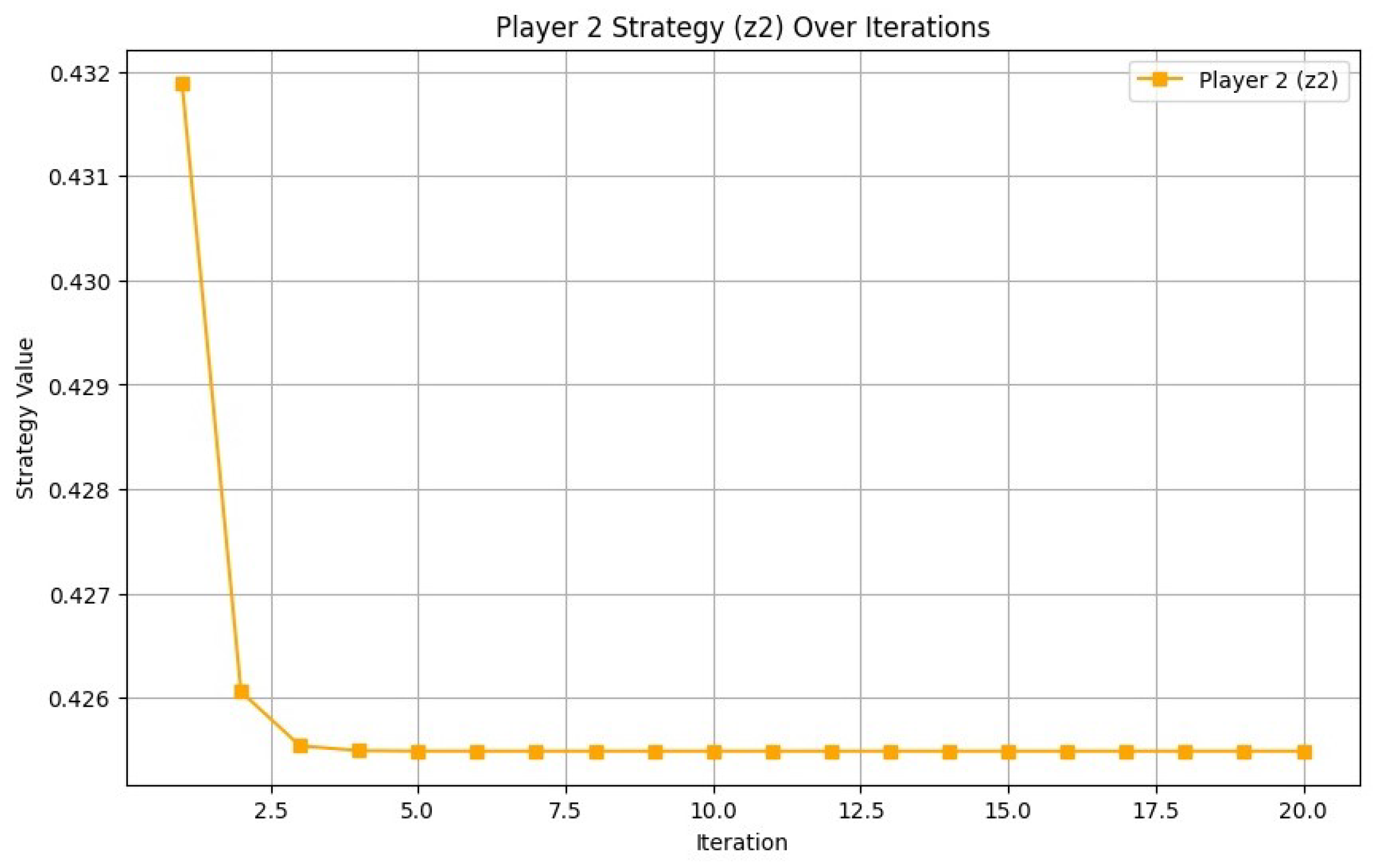
In Figure 2, we use the iteration for the player and find the strategy value of the second player.
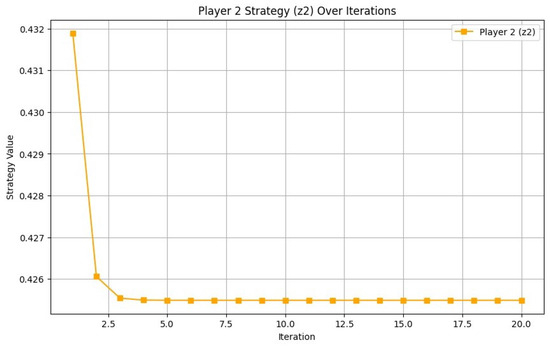
Figure 2.
Strategies of player 2.
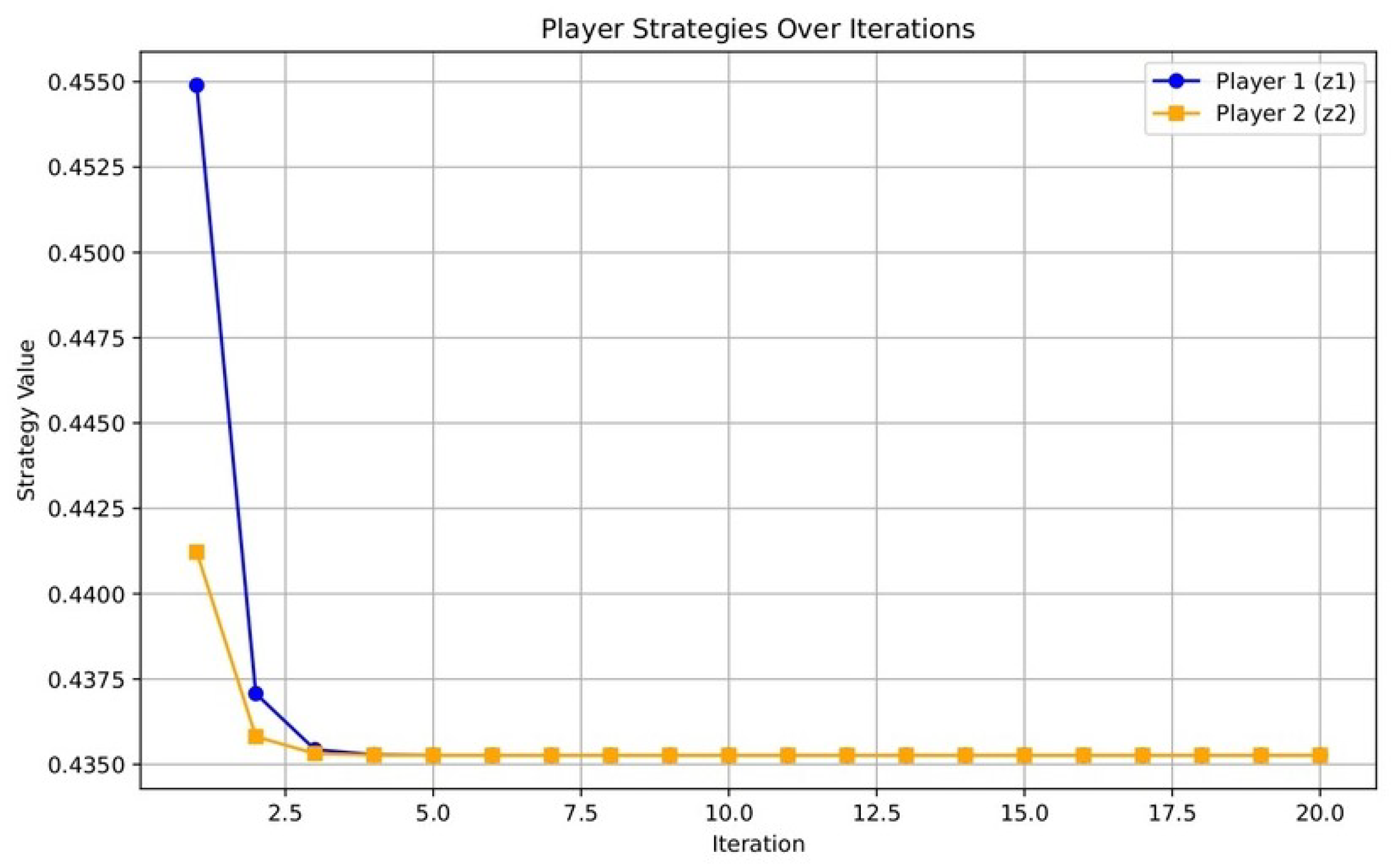
In Figure 3, the values for both players’ strategies converge to approximately 0.027943 by iteration 19, which represents the NCE of the game. Therefore, is continuous. To prove that fulfills all assumptions of Corollary 3, we have
for all . Taking the logarithm of the above inequality, we have
As we know,
Therefore, the first assumption of Corollary 3 holds. Take , we deduce and chose We obtain and
Therefore, operator satisfies all conditions of Corollary 3. Consequently, the two-person game G possesses a NCE.
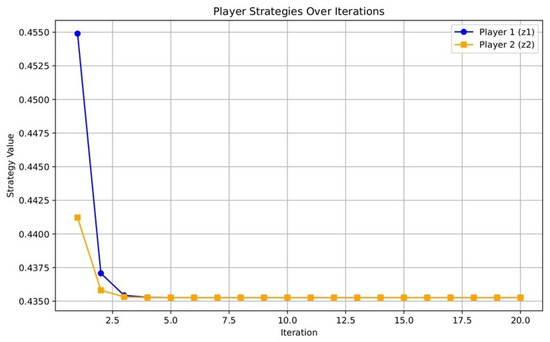
Figure 3.
Strategies of both players.
5. Tripled Fixed-Points in M-Metric Spaces
Definition 8.
Let An element is called a tripled fixed-point of if , ,
Definition 9.
Let be a partially ordered set and be a mapping. Then the map is said to have the mixed monotone property if is monotone non-decreasing in k and l, and monotone non-increasing in s; that is, for any
Theorem 5.
Consider the partially ordered set . is a 0-complete -space, and is a continuous mapping with the mixed monotone property on ξ. Assume that there exist some and with the following:
- (i)
- for all
(ii) There exists , , such that ,
Then, possesses a tripled fixed point; that is, there exists , , such that
Proof.
Assume , in ξ such that , , Let
Then, , and Again, let
Owing to the mixed monotone property of , we deduce that , and Continuing in a similar fashion, we obtain three sequences , and within ξ where each term is defined as , , and and
Now, for every , and so on, we find that
Considering Equations (17)–(19), and given that F is increasing, we conclude that
Consequently, we can deduce that
for all , and so on, it follows that the sequence is non-increasing. Hence, there exists such that . As F is continuous, by allowing μ to approach infinity in Equation (20), we reach the following:
Because , and considering the definition of F, we can conclude that This implies that B . Consequently,
By following the same approach as demonstrated in the proof of Theorem 2, we complete the proof. Hence, has tripled fixed-point; that is,
□
Remark 2.
It is important to highlight that the coupled and tripled fixed-point results presented in this article can be derived from the fixed-point results of a single mapping using the arguments in [25,33].
6. Certain Non-Cooperative Equilibrium Problems Involving Three Players
In this section, we will utilize tripled fixed-point theorems to establish the existence of a in NCE in a three-person game. For a more comprehensive understanding of the general concepts related to three-person games, interested readers are referred to [8]. Consider as a 0-complete -space, with Z having a partially ordered relation ≤. We now examine a three-person game, denoted as G in normal form, which is defined by the following data:
- (i)
- , , represent strategies for the first, second, and third players, respectively;
- (ii)
- The denotes the set of allowed strategy pairs;
- (iii)
- We define a triloss operator as follows:where represents the loss acquired by player j when strategies , and are employed. A pair is stated as a NCE ifThis implies thatTo determine the strategy pairs that succeed as non-cooperative equilibria, we examine the optimal decision rules and , defined as follows:Consider the any fixed-point mappingis a NCE.
In this section, we will assume that for all . It is straightforward to observe that if for all , then . Moreover, it is straightforward to provide an example where when the condition holds. Let be defined by
for all Assume that possesses a tripled fixed-point . Consequently, we can deduce that:
and is a fixed-point of the map Thus, the occurrence of a triple fixed-point for implies the existence of a NCE.
Corollary 4.
Consider Z and G as given above. Consider as a 0-complete -space, and suppose that the optimal decision rule is represented by monotone continuous functions that meet the following criteria:
- (i)
- for all and , for some and
(ii) There are , , such that
Then, the three-person game G possesses a NCE.
Proof.
Let be defined by
As is a continuous function,
is also continuous. Furthermore, given that is monotone. Now, to prove satisfies the mixed monotone property on Z. For all , with , , we have
Thus, condition(22) reduces to
for all Since F is increasing, we determine that the condition ⇒(23). Applying Theorem 5 leads us to conclude that a tripled fixed-point exists. Consequently, this implies the existence of a NCE in the three-person game □
Note As every complete -space can be considered a 0-complete -space, we can readily derive the following corollary.
Corollary 5.
Let G be a normal-form game and ξ be a strategy for players. Suppose is a complete -space, and the optimal decision rule is represented by monotonously continuous functions , which obeys to the following criteria for some and :
- (i)
(ii) There exists such that ,
Then, the three-person game G possesses a NCE.
Example 5.
Let Z equipped with the m-metric for all . Now, consider G to be a three-person game with a triloss operator.
where and, since , it is straightforward to calculate the optimal decision rules and for the game G.
Given , it holds that
and is a continuous map. To establish that fulfills all the conditions of Corollary 5, we observe that
for each in By taking the logarithm of both sides, we reach the following expression:
Since,
Hence, we can deduce that satisfies the initial condition of Corollary 5. When we choose , we find that
Now, if we set , we find that
On the other hand,
Therefore, fulfills the all assumptions of the Corollary 5. Utilizing this corollary leads to the inference that the three-person game G possesses a NCE.
7. Solution of an Integral Equation
In this section, we apply Corollary 2 to study the existence and uniqueness o f solution of the following integral equation ([34]).
Let us examine the following integral equation:
for all We will analyze Equation (24) under the following assumptions as in reference [34].
- (i)
- The unknown function k is real-valued,
- (ii)
- are increasing and decreasing functions, respectively, where:
- (iii)
- is a continuous function,
- (iv)
- , where , and and for all such that
- (v)
- there exists such thatand
Definition 10.
A pair is called a couple lower–upper solution to Equation (24) if then
Now, we formulate the major result of this part:
Theorem 6.
Considering the presence of coupled lower–upper solutions under assumptions (i)–(v), the Equation (24) admits a solution within the space
Proof.
Consider the mapping defined by Assume that for a monotone non-decreasing sequence , and Then, for any t in ,
the sequence of real numbers converges to Therefore, for all in , , , i.e., In the same way, we can easily see that the limit of an abstract monotone non-increasing sequence is a lower-bound for all members in the sequence, i.e., for all . Therefore, assumption (ii) holds for Corollary 2.
For arbitrary k in , define , where Note that is a norm equivalent to the maximum norm and equipped with metric , as stated by
is a Banach space ( [31]).
Now, we define a -space on as given by
Clearly, is 0-complete but not m-complete. To prove is a mixed monotone mapping. Actually, for and , i.e., , we have
where in form assumptions (iv). This produces
for every in , that is
Similarly, we can reach at
Therefore, using the mixed monotone property of Now, for and , we deduce that
It implies that
Therefore, for each such that and , since
we have
Taking the logarithms, we reach the following:
This shows that satisfies the condition. Now, let the lower–upper solution of the integral Equation (24) be a pair , and we obtain
Therefore, all assumptions of Corollary 2 hold. Hence, has a couple fixed-point say Thus, is the unique solution of Equation (24). □
8. Conclusions
In this paper, we established some coupled and tripled fixed points in the context of 0-complete -spaces and also discussed a solution to the NCE problem of two and three-person games within the framework of game theory. Additionally, as an application, we use these results to prove the existence of a solution for the class of nonlinear integral equations. Our proposed work can be extended in many directions and solve the NCE problem of two, three, and N-person games within the framework of game theory under generalized distance spaces. In essence, this research contributes valuable insights into the field of non-linear contraction principles and opens up new avenues for future exploration in various related domains.
Author Contributions
M.T.: writing—original draft, S.M.: methodolog, M.A.: conceptualization, A.A.: methodolog. All authors have read and agreed to the published version of the manuscript.
Funding
This research work was funded by Umm Al-Qura University, Saudi Arabia under grant number 25UQU4331214GSSR01.
Data Availability Statement
The original contributions presented in this study are included in the article. Further inquiries can be directed to the corresponding author.
Acknowledgments
The authors extend their appreciation to Umm Al-Qura University, Saudi Arabia for funding this research work through grant number: 25UQU4331214GSSR01.
Conflicts of Interest
The authors declare no conflict of interest.
References
- Banach, S. Sur les operations dans les ensembles abstraits et leurs applications aux equations integrales. Fund. Math. 1922, 3, 133–181. [Google Scholar]
- Alsulami, H.H.; Karapınar, E.; Piri, H. Fixed points of generalized F-Suzuki type contraction in complete metric-like spaces. Discret. Dyn. Nat. Soc. 2015, 2015, 969726. [Google Scholar]
- Beg, I.; Butt, A.R. Common fixed point for generalized set valued contractions satisfying an implicit relation in partially ordered metric spaces. Math. Commun. 2010, 15, 65–76. [Google Scholar]
- Christian, E.O. Games, Fixed Points and Mathematical Economics; School of Economics and Finance University of St Andrews: St Andrews, UK, 2007. [Google Scholar]
- Gulyaz, S.; Karapınar, E. Coupled fixed point result in partially ordered partial metric spaces through implicit function. Hacet. J. Math. Stat. 2013, 42, 347–357. [Google Scholar]
- Hancer, H.A.; Minak, G.; Altun, I. On a broad category of multivalued weakly picard operators. Fixed Point Theory 2017, 18, 229–236. [Google Scholar]
- Valero, O. On Banach fixed point theorems for partial metric spaces. Appl. Gen. Topol. 2005, 6, 229–240. [Google Scholar]
- Border, K.C. Fixed Point Theorems with Applications to Economics and Game Theory; Cambridge University Press: Cambridge, UK, 1989. [Google Scholar]
- Thanh, T.D.; Hobiny, A.; Karapınar, E. A solution for the non-cooperative equilibrium problem of two person via fixed point theory. J. Ineq. Appl. 2015, 2015, 158. [Google Scholar]
- Matthews, S.G. Partial metric topology. Proc. 8th summer conference on general topology and applications. N. Y. Acad. Sci. 1994, 728, 183–197. [Google Scholar]
- Asadi, M.; Karapinar, E.; Salimi, P. New extension of p-metric spaces with fixed points results on M-metric spaces. J. Inequal. Appl. 2014, 18, 1–18. [Google Scholar]
- Monfared, H.; Azhini, M.; Asadi, M. Fixed point results on m-metric spaces. J. Math. Anal. 2016, 7, 85–101. [Google Scholar]
- Patle, P.R.; Patel, D.K.; Aydi, H.; Gopal, D.; Mlaiki, N. Nadler and Kannan type set valued mappings in M-metric spaces and an application. Mathematics 2019, 7, 373. [Google Scholar] [CrossRef]
- Tariq, M.; Arshad, M.; Abbas, M.; Ameer, E.; Mansour, S.; Aydi, H. A relation theoretic m-metric fixed point algorithm and related applications. AIMS Math. 2023, 8, 19504–19525. [Google Scholar]
- Tariq, M.; Arshad, M.; Ameer, E.; Aloqaily, A.; Aiadi, S.S.; Mlai, N. On Relational Weak -Contractive Mappings and Their Application. Symmetry 2023, 15, 922. [Google Scholar] [CrossRef]
- Tariq, M.; Abbas, M.; Hussain, A.; Arshad, M.; Ali, A.; Al-Sulami, H. Fixed points of non-linear set-valued (α∗,ϕM) contraction mappings and related applications. Aims Math. 2022, 7, 8861–8878. [Google Scholar]
- Mohanta, S.K.; Biswas, D. Characterization of completeness for m-metric spaces and a related fixed point theorem. J. Anal. 2020, 29, 701–711. [Google Scholar]
- Ran, A.C.M.; Reurings, M.C.B. A fixed point theorem in partially ordered sets and some applications to matrix equations. Proc. Am. Math. Soc. 2004, 132, 1435–1443. [Google Scholar]
- Nieto, J.; Rodriguez-Lopez, R. Contractive mapping theorems in partially ordered sets and applications to ordinary differential equations. Order 2005, 22, 223–239. [Google Scholar]
- Nieto, J.; Rodriguez-Lopez, R. Existence and uniqueness of fixed point in partially ordered sets and applications to ordinary differential equations. Acta Math. Sin. 2007, 23, 2205–2212. [Google Scholar]
- Guo, D.; Lakshmikantham, V. Coupled fixed points of nonlinear operators with applications. Nonlinear Anal. TMA 1987, 11, 623–632. [Google Scholar]
- Bhaskar, T.G.; Lakshmikantham, V. Fixed point theorems in partially ordered metric spaces and application. Nonlinear Anal. 2006, 65, 1379–1393. [Google Scholar]
- Lakshmikantham, V.; Ciric, L. Coupled fixed point theorems for nonlinear contractions in partially ordered metric spaces. Nonlinear Anal. 2009, 70, 4341–4349. [Google Scholar]
- Rad, G.S.; Shukla, S.; Rahimi, H. Some relations between n-tuple fixed point and fixed point results. Rev. R. Acad. Cienc. Exactas Fis. Nat. Ser. A Mat. 2014, 109, 471–481. [Google Scholar]
- Samet, B.; Karapınar, E.; Aydi, H.; Rajic, V. Discussion on some coupled fixed point theorems. Fixed Point Theory Appl. 2013, 2013, 50. [Google Scholar]
- Wardowski, Fixed points of a new type of contractive mappings in complete metric spaces. Fixed Point Theory Appl. 2012, 2012, 94. [CrossRef]
- Asim, M.; Mujahid, S.; Uddin, I. Fixed point theorems for F-contraction mapping in complete rectangular M-metric space. Appl. Gen. Topol. 2022, 23, 363–376. [Google Scholar]
- Cosentino, M.; Vetro, P. Fixed point results for F-contractive mappings of Hardy-Rogers-type. Filomat 2014, 28, 715–722. [Google Scholar]
- Nadler, S.B. Multivalued contraction mappings. Pac. J. Math. 1969, 30, 475–488. [Google Scholar]
- Sahin, H.; Altun, I.; Turkoglu, D. Two fixed point results for multivalued F-contractions on M-metric spaces. Rev. Real Acad. Cienc. Exactas Fis. Nat. Ser. A Mat. 2018, 113, 1839–1849. [Google Scholar] [CrossRef]
- Paesano, D.; Vetro, C. Multi-valued F-contractions in 0-complete partial metric spaces with application to Volterra type integral equation. Rev. R. Acad. Cienc. Exactas Fís. Nat. Ser. A Mat. 2014, 108, 1005–1020. [Google Scholar]
- Romaguera, S. A Kirk Type Characterization of Completeness for Partial Metric Spaces. Fixed Point Theory Appl. 2010, 6, 493298. [Google Scholar]
- Roldan, A.; Martinez-Moreno, J.; Roldan, C.; Karapınar, E. Some remarks on multidimensional fixed point theorems. Fixed Point Theory 2014, 15, 545–558. [Google Scholar]
- Berinde, V. Generalized coupled fixed point theorems for mixed monotone mappings in partially ordered metric spaces. Nonlinear Anal. 2011, 74, 7347–7355. [Google Scholar]
Disclaimer/Publisher’s Note: The statements, opinions and data contained in all publications are solely those of the individual author(s) and contributor(s) and not of MDPI and/or the editor(s). MDPI and/or the editor(s) disclaim responsibility for any injury to people or property resulting from any ideas, methods, instructions or products referred to in the content. |
© 2025 by the authors. Licensee MDPI, Basel, Switzerland. This article is an open access article distributed under the terms and conditions of the Creative Commons Attribution (CC BY) license (https://creativecommons.org/licenses/by/4.0/).