


Abstract
The most important and emerging characteristic of Wireless Body Area Networks (WBANs), which differentiates them from other wired and wireless area networks, is mobility. Therefore, the routing protocols for WBAN are designed in such a way that they can deal with dynamic changes in topology and provide maximum throughput, packet delivery ratio, average end-to-end delay, and minimum energy consumption. Thus, achieving optimal values for every performance parameter becomes a big challenge. This work investigates the performance of three separate path discovery protocols, such as Destination-Sequenced Distance-Vector Routing (DSDV), Ad Hoc On-demand Distance Vector (AODV), and Ad Hoc On-demand Multipath Distance Vector Routing protocol (AOMDV), for two different mobility models with a fixed-positioned sink. During experimentation, the AOMDV routing protocol achieves a high packet delivery ratio (PDR), average end-to-end delay, and throughput as compared to other routing protocols.
1. Introduction
Wireless Body Area Network (WBAN) consists of several tiny, heterogeneous sensor nodes attached to the human body. The greatest use of WBAN applications is in the healthcare sector, where the body’s several vital signs are measured and sent to the medical server to receive treatment appropriately. For that, an effective routing algorithm along with a suitable sink node placement always plays a significant role in the overall performance of such a network [1]. The nodes in WBAN are free to move due to the body movement; hence network topology becomes unpredictable and hard to manage. Thus, there is always a demand to choose routing protocol efficiently to deal with various uncertainties of WBAN [2]. The node’s movement patterns of WBAN are characterized by various mobility models, and for data transfer, different routing protocols exhibit different behavior for such mobility models. In order to design an effective and efficient network model, it is very important to choose a particular routing protocol that deals with the frequently changing topologies of WBAN. This work presents the best-suited routing protocol for WBAN with respect to scalable wireless networks [3,4]. However, there are many surveys conducted on the behavior of routing on mobility models [5,6], but they were carried out only for random waypoint mobility models, and WBAN has not been evaluated yet for all routing protocols. Many wireless networks have already been evaluated for such scenarios, viz. Vehicular Ad Hoc Network (VANET), Flying Ad Hoc Network (FANET), and Mobile Ad Hoc Network (MANET) [7,8]. Work performed in this paper focuses on analyzing the performance of various routing algorithms of WBAN for different mobility models under different scenarios and network parameters.
1.1. Background and Motivation
Through WBAN, vital parameters of the body are to be sent or transferred to a medical server to attain better assistance. Well organized routing becomes the essence of the network to minimize energy dissipation and increase network lifetime. Performance comparison of various routing protocols has been performed in various research papers [6,7,8] along with different mobility models, but they have focused on various mobile networks such as VANET, MANET, and FANET whereas this work provides us the performance analysis of Various routing protocols for WBAN, which is way different from the above-mentioned mobile network due to its limitations of battery size and life, size of various sensors, and the way they are deployed on the human body. Due to the above facts, it becomes more important to choose routing protocol in an efficient way. Through this research, we evaluate different already available routing protocols and compare their performance for varying numbers of nodes in WBAN.
1.2. Overview of WBAN
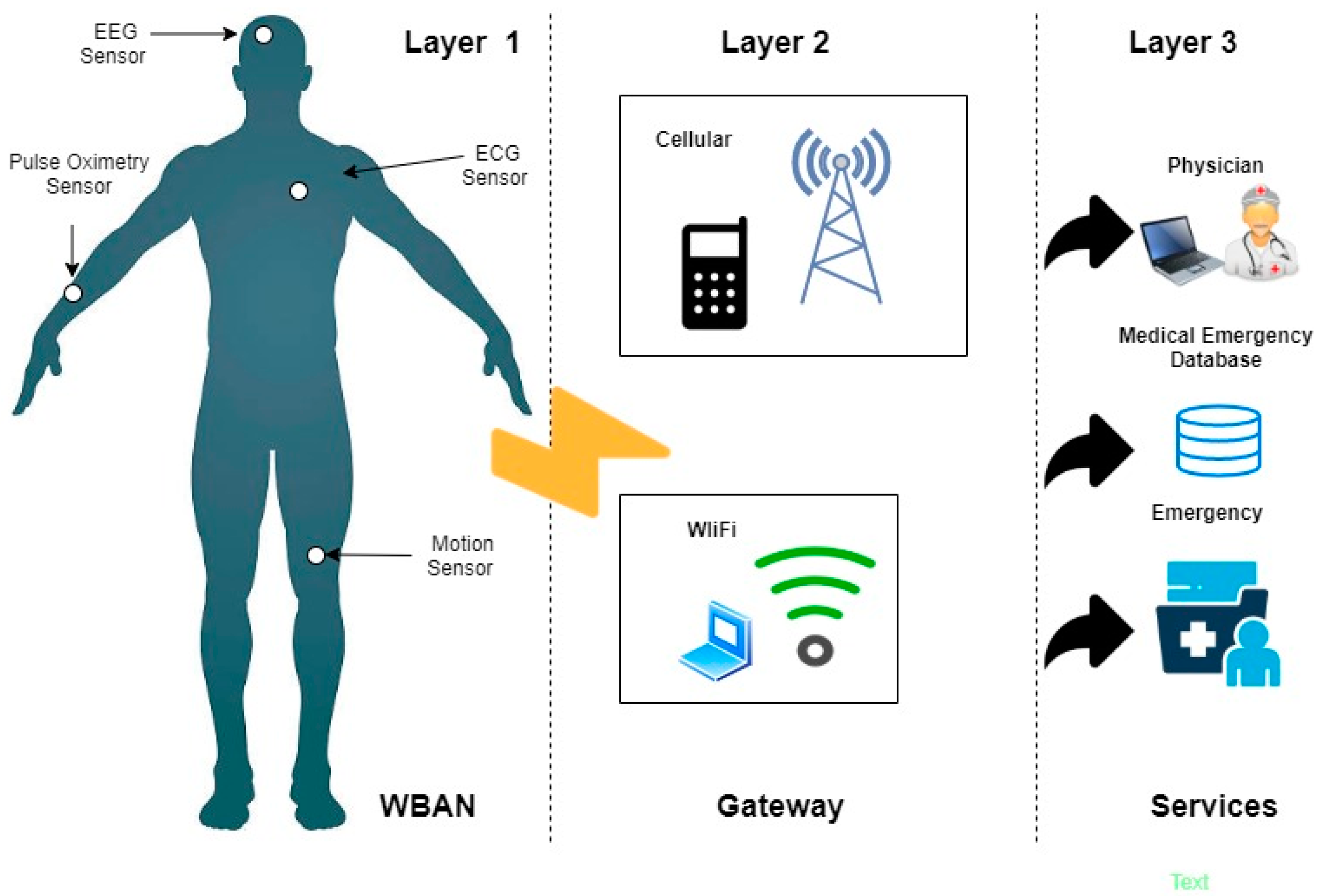
WBAN follows three-tier architecture. The first tier defines the types of sensors, and the sensor sends the data to a base station, which is known as inter tier. The base station sends data to the doctor through a sink node, which is known as an extra node. The general three-layer architecture of WBAN is shown in Figure 1.
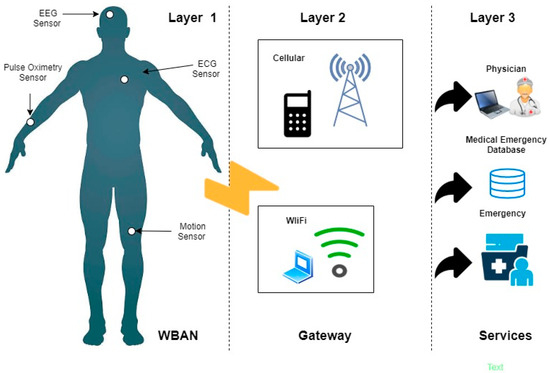
Figure 1.
General WBAN Architecture.
As shown in Figure 1, tiny sensor nodes are attached to the body parts, which are further connected to a sink node, which helps the nodes to transfer their data to the medical server. This makes the role of the sink node and routing algorithm very crucial to attain better assistance from layer 3, i.e., the medical server. This experimentation is based on identifying the best routing algorithm out of already existing algorithms for WBAN, which will help to provide better data dissemination in WBAN.
1.3. Routing Protocols: A Brief Overview
In such a dynamic environment of Wireless Body Area Network (WBAN), it is very difficult to attain the route within the stipulated time. Thus, to achieve that, we generally used two different routing protocols, i.e., proactive and reactive routing protocols. Our study has focused on the routing algorithms to figure out the best suited for WBAN. The proper overview of routing protocols has been as following as:
1.3.1. Ad Hoc On-Demand Distance Vector (AODV)
AODV is a reactive routing protocol that is one of the best routing protocols to adapt to changes in topology. Generally, it performs its complete operation with the help of three different types of messages, i.e., RREQ (route request), which performs route discovery for destination by broadcasting the same to its neighbor in the network, RREP (route reply) is a reply message which is generated by neighbor nodes to provide the information about destination node or of next node to which data are to be forwarded and if there is any kind of failure in the network it will be broadcasted by RRER (route error) [9,10].
1.3.2. Destination-Sequenced Distance Vector Routing (DSDV)
It is the most widely used table-driven routing protocol in Wireless Sensor Networks. In this protocol, every node maintains routing tables with all necessary information required to reach a particular destination in the network, along with the minimum hops required to reach that destination. Every table entry is associated with a sequence number that will be used to identify the previous existence of the root. Every node will send a periodic update with the increased sequence number to advertise its location and status in the network. Route with the most recent sequence number is considered the final route for any destination [11,12].
1.3.3. Ad Hoc On-Demand Multi-Path Distance Vector (AOMDV)
Similar to AODV, AOMDV is also based on a distance vector along with the advantage of storing multiple paths for a single destination. Generally, all duplicate RREQs are discarded in AODV, whereas AOMDV uses duplicated requests to find out the alternative path in the network. In AOMDV, RREQ flows from the source to the destination by establishing multiple reverse paths both in between nodes as well as the destination node. Multiple paths found are loop-free and disjoint. The route updations process is also very efficient in AOMDV [13,14]. The major contribution of the work is as follows:
- (a)
- Evaluated entity mobility models with proactive and reactive routing protocols in terms of quality-of-service parameters viz throughput, average end-to-end delay (AE2ED), and packet delivery ratio (PDR) for seeking a protocol that can provide the best results in terms of stated parameters.
- (b)
- Performance comparison with varied scenarios is demonstrated for different mobility patterns of sensor nodes in WBAN.
- (c)
- Suitability and limitations of different routing protocols are evaluated for WBAN.
The organization of the paper is as follows. Section 2 provides information about different mobility patterns along with available models. Section 3 covers related work performed by previous researchers in the same field, followed by Section 4, which provides an overview of the methodology and experimentation that have been used for evaluation. Section 5 provides the specification for QoS parameters, followed by Section 6, which provides us the result analysis of different parameters with different routing protocols. Lastly, the conclusion and future direction of the proposed work have been discussed in this article.
2. Mobility Models and Related Work
Mobility plays a significant role in the overall performance of WBAN as mobile nodes can produce different topology at different points of time, which may cause a deficiency in the overall performance of WBAN. Mobility models help us to identify the pattern that a node follows during its movement; hence, with the help of this, we can identify the upcoming location and make our WBAN more efficient with respect to delay, throughput, and packet delivery. In this section, we have discussed two different mobility models for WBAN, which will be evaluated later with different routing protocols.
2.1. Random Waypoint Mobility Models (RWM)
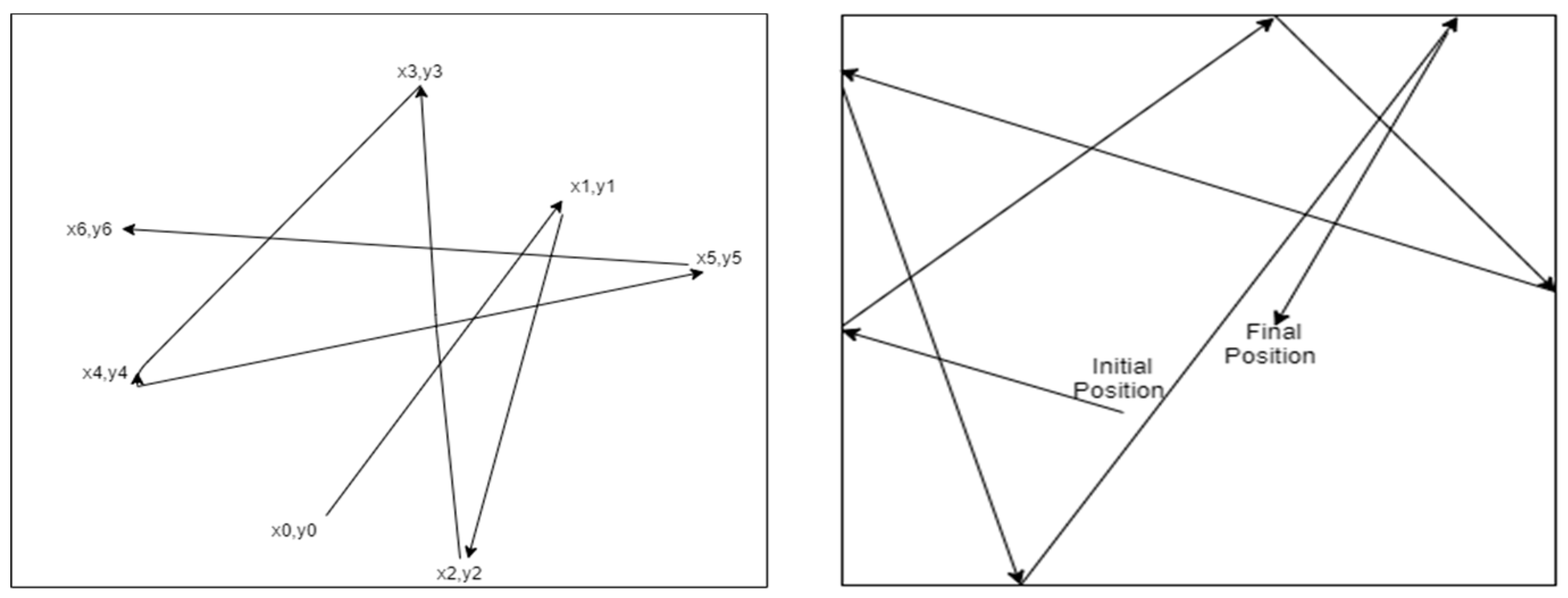
This model was first proposed and evaluated by Johnson and Maltz [15] and later became a benchmark for wireless networks. Implementation of these models includes two major factors, i.e., pause time [0 to Tpause] and velocity [0 to Vmax]. Each mobile node starts its movement by selecting any random location as a destination and then starts moving towards it. After reaching that location, it pauses for a certain time and then moves towards its further destination. The velocity and direction of each node are independent of any other node in the network. The whole process of moving and pausing is repeated until the simulation ends. The movement traces are shown in Figure 2.
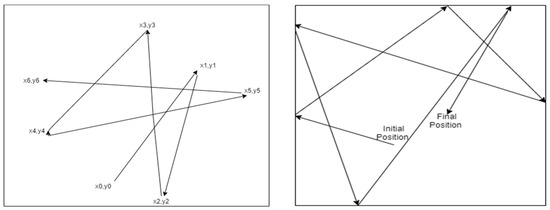
Figure 2.
Movement of Mobile Nodes in RWM (Left) and RDM (Right).
2.2. Random Direction Mobility Models (RDM)
This model is slightly different from RWM in the way that every mobile node in this model picks up a random direction in the beginning and starts moving until it reaches the end of the simulation area. Once it reaches the boundary, it halts for a specific time and then again starts its movement at an angle between 0 to 180 degrees from the halt point [16].
2.3. Related Work
Fahim et al. [17] presented an evaluation analysis for different routing protocols in MANET with different mobility models. The mobility models used were Random Way Point (RWM), Reference Point Group Mobility (RPGM), and Column Mobility Model (CMM), along with different routing protocols such as AODV, DSR, DYMO, and DSDV. This study provides us with the guidelines for choosing routing protocols for different mobility models in different scenarios and has also shown the impact of different routings on different QoS parameters. In [18], performance analysis for MANET is performed with three different mobility models for on-demand and table-driven routing protocols. This study shows that on-demand routing performs well in terms of memory consumption as compared to table-driven routing protocols. This study only focused on two ad hoc routing protocols which makes it very limited to decide what protocol is best suited for which mobility model, and also, it does not cover the use and importance of sink nodes placement and its movement as well.
Dhananjay et al. [19] reviewed different routing protocols for VANETs. According to this study, an increasing number of node size of routing tables for OLSR routing protocol increases which degrades its performance, and by increasing the number of nodes, AODV suffers the problem of route failure. Similarly, if we consider GPSR and CAR, it suffers the problem of packet loss with an increased number of nodes in VANET. This study has considered the packet loss and route failure as issues, but sink node exhaustion is not considered. Moreover, sink mobility is untouched. Atta et al. [20] selected the clustering-based routing protocols for their evaluation with different mobility models. Different categories of position and non-position-based protocols were compared in this study and have concluded that position-based routing performs well as compared to non-position-based routing protocols. Different protocols such as DECA, DEMC, and DEMC-R were evaluated and were compared with MAR, GRC, and GRC-R with different mobility models. In [21], the author compared the performance of different routing protocols, such as AODV, DSR, DSDV, AOMDV, etc., for FANET (Flying Ad Hoc Networks). Through the analysis, HWMP was found to be the best protocol suited for FANET with different mobility patterns, and OLSR is the second-best for the same. Even though these protocols perform well in terms of packet loss, overall delay, and throughput but sink node placement still needs improvement as it keeps on being exhausted very early with an increased number of nodes.
Kumar et al. [22] evaluated the outcomes of three routing protocols, i.e., AODV, DSR, and OLSR, by Varying the number and velocity of nodes. The analysis shows that OLSR was better than DSR and AODV in terms of average end-to-end delay and throughput with the increasing number of nodes in the network. Saini and Nath [23] evaluated AODV and DSR based on pause time and speed. The outcomes show, on the one hand, that AODV performs better than DSR when the speed of the node is low and the pause time is static. While the DSR has better results as compared to AODV as far as throughput and end-to-end delay are concerned. Timcenko [24] has examined the performance of mobile ad hoc network (MANET) routing protocols concerning group and entity mobility models. The following three widely used routing protocols were studied and compared: DSR, AODV, and DSDV. Network simulator version two (NS2) and its tools have been used for animation, and an analysis of findings was used in the simulations.
The authors Barakovic et al. [25] examine the performance of DSDV, AODV, and DDSR, routing protocols based on data analysis from NS2 simulations with various load and mobility scenarios. Routing protocols function similarly in low-load and low-mobility environments. DSR, on the other hand, outperforms AODV and DSDV protocols as mobility and load increase. The researchers Sharma et al. [26] determine the qualities, weaknesses, and strengths of numerous mobility models that describe mobile nodes whose movements are independent of one another. More information about these models will aid researchers in selecting a mobility model to utilize in the simulation. The authors have compared these models using numerous performance measures such as PDR, E2E, normalized routing load, and missed packets to demonstrate how the mobility models were chosen to affect the performance results of the ad hoc protocols to be simulated.
The authors Nayak and Vathasavai [27] aim to focus on the performance of two reactive routing protocols, DSR and AODV, by evaluating several random mobility models and utilizing NetSim Simulator to see if the protocol’s applicability can be improved. As a result, the authors examine the impact of communication protocols on the changeable topology of MANETs by measuring throughput, E2E delay, PDR, and routing overhead. Hossein and Rahim [28] investigated a DTN scenario, the performance of replication-based DTN routing protocols such as Epidemic, Probabilistic Routing Protocol using History of Encounters and Transitivity (PRoPHET), MaxProp, Resource Allocation Protocol for Intentional DTN (RAPID), Binary Spray and Wait (B-SNW), and Spray and Focus (SNF) is investigated against varying numbers of mobile nodes for three mobility models: Random Walk (RW), Random Direction (RD Three measures were used to evaluate and analyze performance using the Opportunistic Network Environment (ONE) simulator: delivery probability, average latency, and overhead ratio. The researched DTN routing protocols, on average, perform better in the SPMB movement model than other movement models, according to simulation data.
In Delay Tolerant Networks, the authors Spaho et al. [29] compare the performance of Epidemic, Spray, and Wait for routing protocols, as well as their counterparts with congestion control and Epidemic with TCP. Random waypoint (RWP), steady-state random waypoint (SSRWP), and Triana city map-based movement has been used for evaluation, which resulted in outperformance of SSRWP over Triana and RWP evaluation scenarios. With ten pause time values, the FCM, SCM, RWM, and HWM mobility models are developed by the researchers Abdullah et al. [30] to examine the performance of AODV, OLSR, and GRP protocols. These models are based on MANET participants’ variable speeds and pause times. In order to compare the performance of mobility models, various node statistics such as data drop rate, average end-to-end delay, media access time, network load, retransmission attempts, and throughput are employed. The simulation findings indicated that in most circumstances, the OLSR protocol outperforms the other two routing protocols and that it is better suited to networks that demand low latency, retransmission attempts, and high throughput. The authors Jawandhiya and Asole [31] have discussed the significance of efficiency considerations and looked at how different routing protocols compare in terms of performance. In terms of PDR, Jitter, E2E Delay, and throughput under various circumstances. Along with this, they researched the behavior of these routing protocols in-depth and compared their performance in various scenarios [32]. The summary is described in Table 1.

Table 1.
Summary of Related Work.
It is clear from the above table that various researchers have performed comparisons of different routing protocol’s performance, but none of the above have performed the same for WBAN. This work is focused on the performance analysis of routing for WBAN, which will contribute to better assistance in the healthcare sector.
3. Methodology and Experimentation
This section provides us the brief about the methodology followed along with different parameters used to carry out this evaluation, a description of the research protocol, an explanation of how measurements and calculations were made, and a statement of which statistical tests were used to analyze the data. This work analyses the performance of AODV, AOMD, and DSDV routing protocols in WBAN mobility models. For smooth conduction of the work, three major steps of simulation have been considered, which include the environment, parameters, and metrics of simulation as the experimental setup is fully based on simulation, which resulted in the performance of routing protocols with various mobility models. NS2 has been used for simulation-based work, as this NS2 software application replicates the similar behavior of a real-time network and can provide as accurate results as the real-time network will yield. This real-time application to accomplished by computing the interaction among various network elements such as links, points, nodes, switches, and routers. Various simulation parameters have also been taken into account as the number of nodes, type of a channel, routing protocol, propagation model, etc., which can affect the simulation environment and also the result of the network.
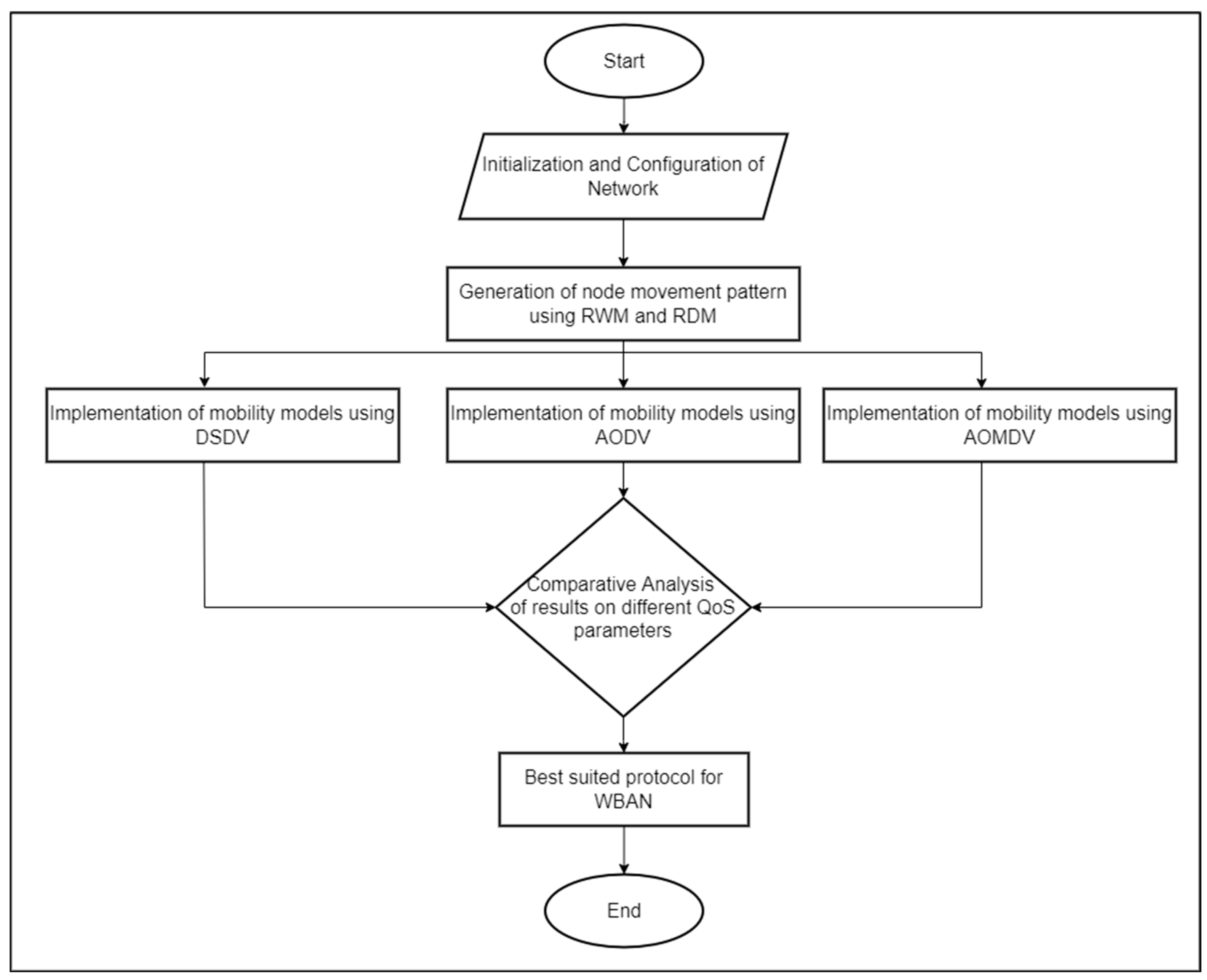
3.1. Proposed Methodology
In this study, different mobility models such as RWM and RDM have been followed to evaluate the performance of three different routing protocols. Furthermore, the performance analysis of different routing protocols with different mobility models has been analyzed through different performance parameters. The proposed methodology is shown in Figure 3. It shows the proposed evaluation scheme with all operations. Firstly, the network will initialize with different sensors and data through the sink node. Based on different movements, pattern mobility models were applied in the network (RWM and RDM). Three different routing algorithms, as discussed above, are implemented on the network, and results of different QoS parameters are noted. A comparison of the network performance based on different routing algorithms for varying number of nodes in performance. This scheme will end up providing the best-suited routing algorithm for the WBAN scenario using entity mobility of nodes. Along with this, PDR, AE2ED, and average throughput are the simulation metrics based on which 4 QoS parameters of 2 mobility models for 3 different routing protocols have been evaluated; the detailed stepwise explanation has been discussed in the following section of the paper.

Figure 3.
The current working strategy of the proposed model.
Following are the steps followed during analysis:
Step 1: Do the initial setup and configuration of network where we decide the topological aspects along with access mechanism to be followed. (WBAN)
Step 2: Generation of movement patterns for different mobility models viz., RWM and RDM is performed where we analyze the different movements of mobile nodes in simulation area.
Step 3: Apply different proactive and reactive routing algorithms for data dissemination in WBAN and evaluate the values of different QoS parameters, viz. throughput, average end to end delay, and packet delivery ratio.
Step 4: Compare the values achieved with three different routing algorithms and figure out the best performing for WBAN.
Step 5: End the Process.
3.2. Simulation Environment
Network simulator 2.35 is used to compare and evaluate the performance of AODV, AOMDV, and DSDV routing protocols in WBAN different mobility models. The position for the sink node is fixed in this scenario. The number of nodes varies from 25 to 75. Table 2 below shows the rest parameters used for simulation. All sensor nodes and both sinks use the same fixed communication radius in data transmission. This scenario considers static consumption of power and ideal conditions for different data traffic; the Pci (average power consumption) for a node is denoted as:
Table 2.
Various Simulation Parameters for Experimentation.
Nsec is taken to keep count of the number of sectors, and Nant will be providing the antennas per sector with respect to every node in place. Ptx is the average of the total power of all mobile nodes, and PBHi is the communicated power for each mobile node. The constant Ai signifies that share of the Pci, which is straight proportionate to the communicated power from a moving node, while Bj signifies that share of power that is spent without any dependence on the average communicated power from a node in WBAN. Let Thet be the period for overall data transfer of a heterogeneous network, and EEhet is the overall consumed energy; then, time efficiency can be calculated as:
Various quality-of-service constraints, including PDR, average throughput, average end-to-end delay, and consumed energy, are used to calculate the overall efficiency of WBAN. Three different scenarios with varying number of nodes (25, 50, and 75) with static sink node are implemented using the direction-finding procedure for evaluation in network simulator.
3.3. Simulation Parameters
Simulation parameters can be used to define a demographic trait of a subject or to specify covariates that will vary throughout the simulation. They can create constants and other values that can be utilized again and again throughout simulations. In the current work also, many simulation parameters have been used to attain the best and most accurately evaluated result of the conducted experiment. Some of these parameters are discussed below, and the simulation parameter acclimatized for evaluation is shown in Table 2.
3.4. Performance Metrics
Four different QoS parameters with two standard mobility models for three different routing protocols named DSDV, AODV, and AOMDV have been evaluated. The calculations of all QoS parameters are based on the below-given concepts.
- PDR: packet delivery ratio is the number of packets delivered out of the total number of packets sent.
- 2.
- AE2ED: It is the sum of the delays experienced by a packet before reaching its destination.
- 3.
- Average throughput: throughput is the number of packets delivered in a specific period.
Table 3.
Signs Used in Equations and their Meaning.
4. QoS Specification for Applications of WBAN with RWM and RDM
The QoS for three different routing models is achieved through RWM and RDM. Various factors are the implementation of WBAN applications, which are shown in Table 4.
Table 4.
QoS specifications for WBAN applications.
5. Experimental Analysis and Discussion
5.1. Experimental Environment
All the experiments have been performed in the NS-2 environment. The NS-2 provides a simulation environment and provides communication security for node-to-node connections. The number of body nodes is placed at 1500 × 1500 m2.
5.2. Performance Evaluation
The coordinators of the coordinator with 10 different nodes are shown in Table 5.
Table 5.
Coordinates of x, y coordinator with different nodes.
The simulation has been performed on the NS-2 platform with different parameters which have been shown in Table 6.
Table 6.
Simulation performance parameters.
With different performance parameters, different routing protocols have been implemented on the different number of nodes, along with each node through different routing protocols with different packets. The efficiency of the routing protocol is always affected by the increasing number of nodes because the number of packets to be transmitted will be more which causes congestion in the network and hence degradation in performance. This leads to considering different parameters in such a way that the balance should be maintained. Some of the parameters with optimal values are represented in Table 7.
Table 7.
Different degrades parameters.
Figures in Section 5 depict the performance of various routing protocols with different mobility models on different QoS parameters. All the three routing protocols are evaluated with different mobility models by a varying number of nodes from 25 to 75.
In discussion, the QoS of routing protocols through packet delivery rate (PDR), average end-to-end delay, and throughput is analyzed.
5.3. QoS in Different Routing Protocols Corresponding to Mobility Models
The performance of different routing protocols through different mobility models is analyzed. There are various factors, namely the number of nodes, and energy consumption with joule rate, to analyze the performance. Different QoS parameters for analyzing the routing parameters are as follow:
5.3.1. Packet Delivery Rate
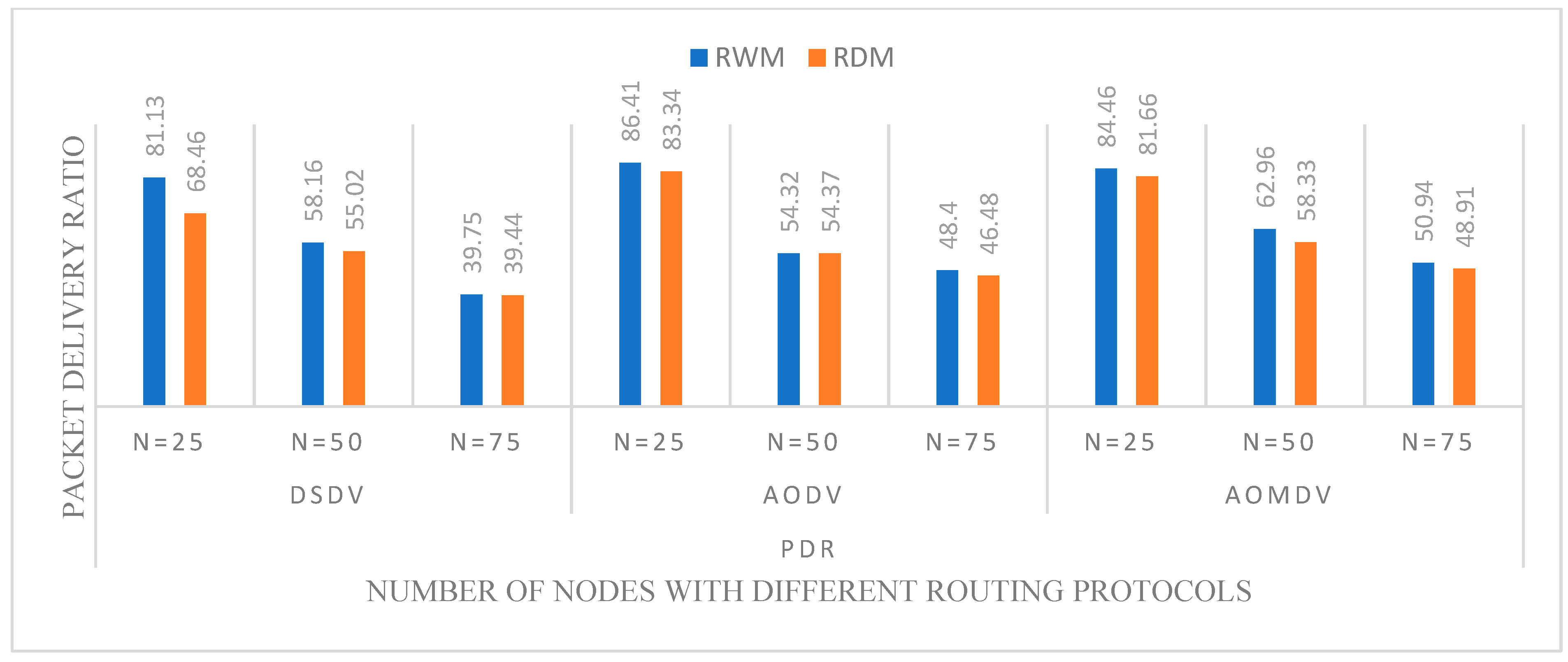
Figure 4 demonstrates the behavior of different routing protocols for both mobility models. AOMDV performs better with increasing scalability with respect to nodes because of storing multiple paths for a destination. The graph shows the better performance of AOMDV with respect to the other two routing protocols and shows 48.91% betterment in the case of RDM and 50.94% improvement in the case of RWM for a varying number of nodes. This graph is taking this shape because of the AOMDV nature of storing multiple paths for a destination and providing the alternate option in the case of failure of one path.

Figure 4.
Performance analysis of RWM and RDM on various routing protocols in terms of PDR.
5.3.2. Average End-to-End Delay
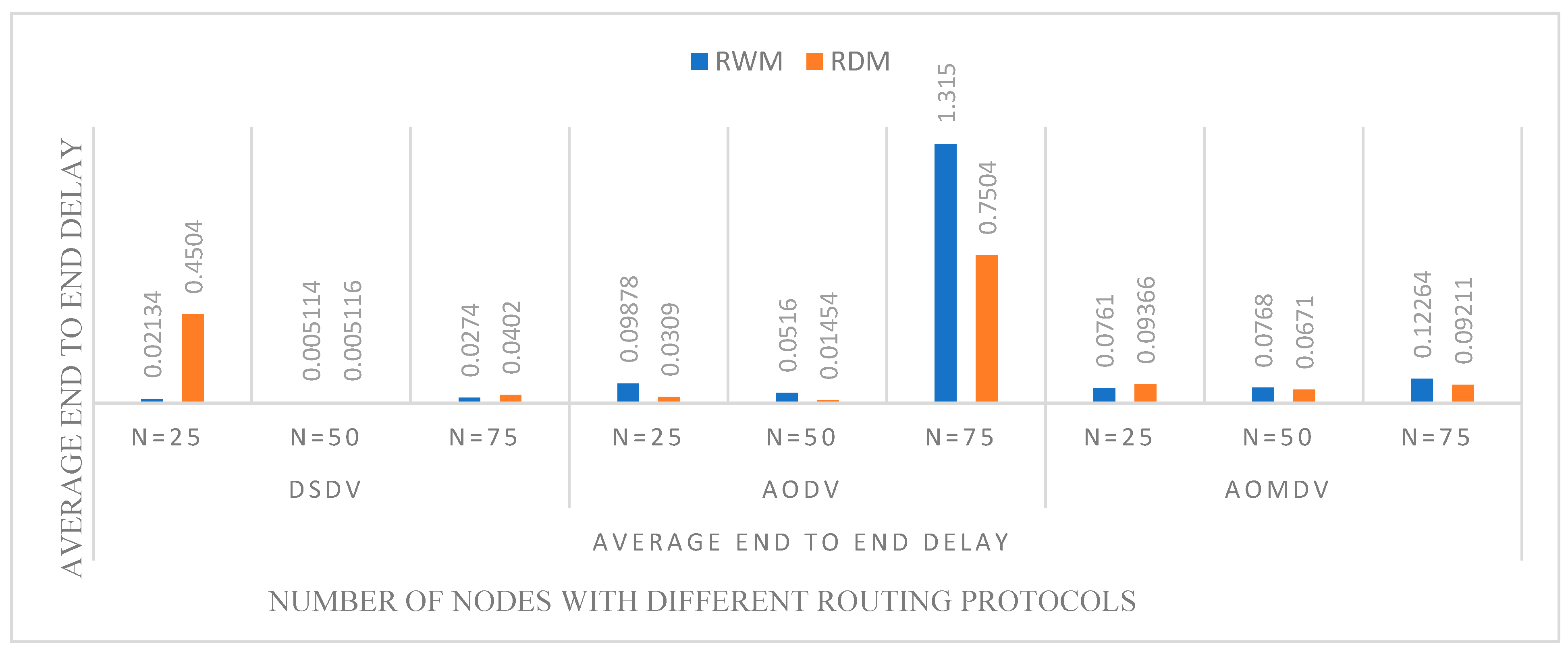
DSDV, being the proactive and table-driven protocol, performs way better in terms of average end-to-end delay for both mobility models. The graph above demonstrates the same and why this graph shows this behavior because DSDV stores a routing table along with the topology table where the routing table contains the best available paths, and the other two routing protocols are on-demand protocols, due to which their AE2ED is more, as compared to DSDV. This graph takes this shape for different values because the increased number of the node delay continues to increase due to congestion in the networks, as shown in Figure 5.
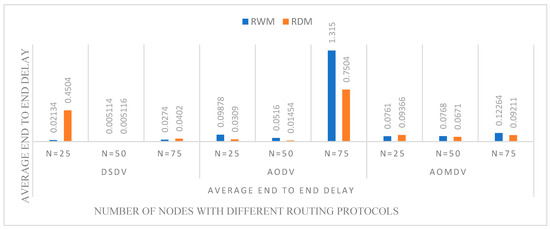
Figure 5.
Performance analysis of RWM and RDM on various routing protocols in terms of average end-to-end delay.
5.3.3. Throughput
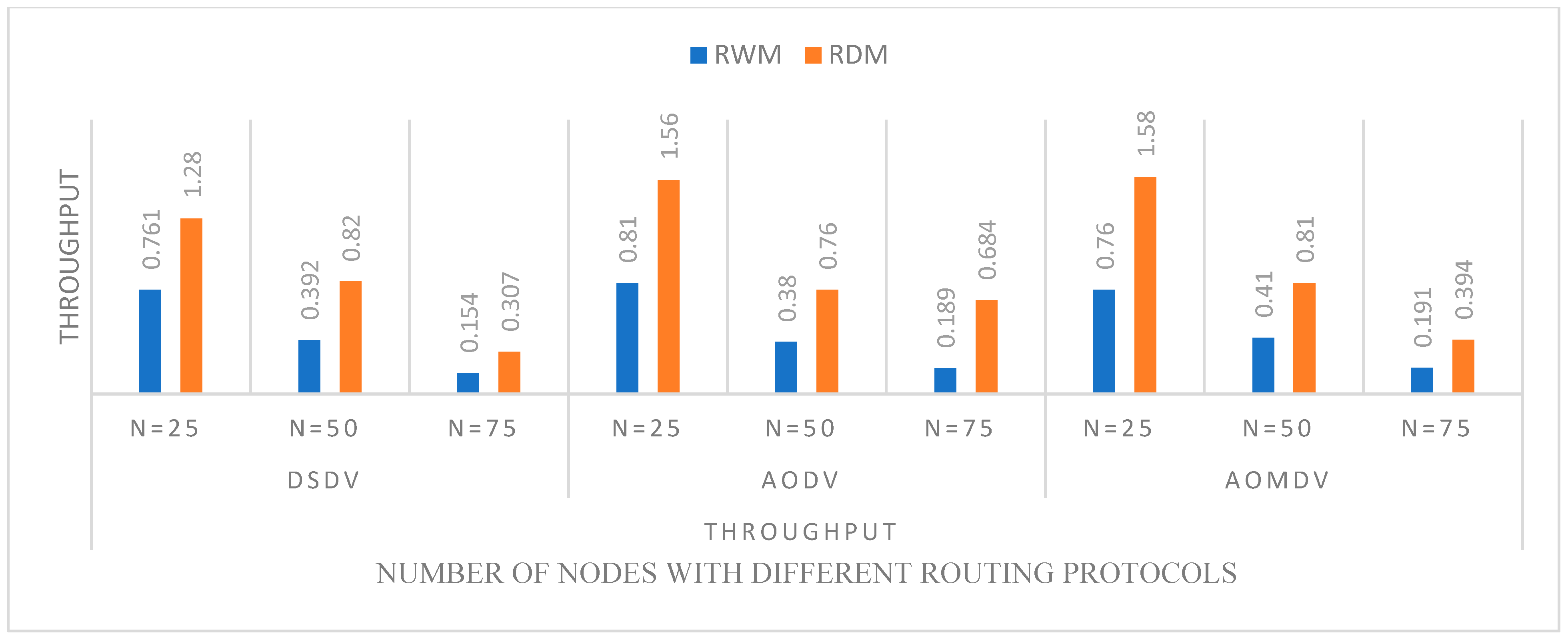
Throughput is the number of packets delivered in a specific period. Every protocol exhibits the same behavior as we increase the number of nodes, i.e., throughput value keeps on decreasing with node value increment. AOMDV here also performs better than the other two routing protocols. When increasing the number of nodes, the performance of AOMDV (0.68%) increases in the case of the RDM mobility model. During the RWM models with the increasing number of nodes, the performance of RWM (0.191%) for AOMDV is better than the other two routing protocols. The performance of RWM and RDM corresponding to different routing protocols in terms of throughput with a different number of nodes has been shown in Figure 6.
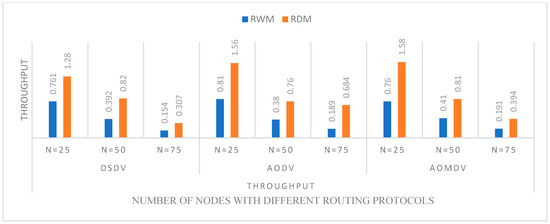
Figure 6.
Performance analysis of RWM and RDM on various routing protocols in terms of throughput.
For the analysis, we have considered two different categories of routing protocols, i.e., proactive and reactive. DSDV, being a proactive routing protocol, maintains a routing table for every possible route before a node has data transmitted, whereas the other two perform route discovery on demand, i.e., whenever a node has data to send, a suitable route is discovered. DSDV, being proactive, performs well in terms of average end-to-end delay, as shown in Figure 4. For every case, DSDV performs well, AODV exhibits a sudden increase in delay as the number of nodes passes the value of 50 because of more route requests, whereas the other two exhibit a normal increase in delay with an increasing number of nodes because DSDV is table-driven and AOMDV contains Multiple paths for a single destination.
5.4. Comparison with State of Art Models
The paper compares the performance of three alternative routing protocols, DSDV, AODV, and AOMDV, on two different mobility models, the random waypoint mobility model (RWM) and random direction mobility model (RDM), with a static sink node. During this simulation-based investigation, key factors affecting the experiment included the simulation environment, metrics, and parameters. The values of these factors have been acclimatized according to the requirement of the experiment; these values and factors are not imperative to be provided. During experimentation, all three routing protocols have been evaluated by varying numbers of nodes with different mobility models. The results of the experiment lead us to conclude that AOMDV outperforms other routing protocols at a higher number of nodes, as explained in the conclusion and future work section.
6. Conclusions and Future Directions
Mobility causes a lot of issues in the overall performance of WBAN. The most important aspect that is affected is data transfer. This work focused on evaluating the behavior of different routing protocols for several different movement patterns exhibited by different nodes in WBAN. Two basic entity mobility models were evaluated for different QoS parameters, and two different categories of routing were considered with three different variants of the same. With the above evaluations, we can clearly see that AOMDV is superior to the other two routing protocols, i.e., AODV and DSDV, in terms of both the mobility models and is highly recommended for WBAN implementations with a varying number of nodes. The evaluation is currently focused on fixed sink node placement; however, sink mobility will be added in the future, and both mobility models will be checked for all routing protocol variants. Additionally, the movement patterns we have evaluated in this work are only for individual nodes, whereas how these nodes behave when grouped together is yet to explore.
Author Contributions
Conceptualization, S.S. and D.P.; methodology, S.S., S.R. and A.S.; validation, F.S.A. and J.A. formal analysis, S.S.; investigation, D.P.; resources. F.S.A. and J.A.; data curation, S.S. and S.R.; writing—original draft preparation, D.P., A.S., S.S. and D.P. All authors have read and agreed to the published version of the manuscript.
Funding
This research was funded by Taif University Researchers Supporting Project number (TURSP-2020/347), Taif Unversity, Taif, Saudi Arabia.
Institutional Review Board Statement
Not applicable.
Informed Consent Statement
Not applicable.
Data Availability Statement
Not applicable.
Acknowledgments
This research was supported by Taif University Researchers Supporting Project number (TURSP-2020/347), Taif Unversity, Taif, Saudi Arabia.
Conflicts of Interest
The authors declare no conflict of interest.
References
- Braem, B.; Blondia, C. Supporting mobility in wireless body area networks: An analysis. In Proceedings of the 2011 18th IEEE Symposium on Communications and Vehicular Technology in the BENELUX (SCVT), Ghent, Belgium, 22–23 November 2011; pp. 1–6. [Google Scholar]
- Kim, B.S.; Kim, K.H.; Kim, K.I. A survey on mobility support in wireless body area networks. Sensors 2017, 17, 797. [Google Scholar] [CrossRef] [PubMed]
- Awan, I.; Al-Begain, K. Performance evaluation of wireless networks. Int. J. Wirel. Inf. Netw. 2006, 13, 95–97. [Google Scholar] [CrossRef]
- Jayakumar, G.; Ganapathi, G. Reference point group mobility and random waypoint models in performance evaluation of MANET routing protocols. J. Comput. Syst. Netw. Commun. 2008, 1–10. [Google Scholar] [CrossRef]
- Camp, T.; Boleng, J.; Davies, V. A survey of mobility models for adhoc network research. Wirel. Commun. Mob. Comput. 2002, 2, 483–502. [Google Scholar] [CrossRef]
- Aschenbruck, N.; Padilla, E.G.; Martini, P. A survey on mobility models for performance analysis in tactical mobile networks. J. Telecommun. Inf. Technol. 2008, 2, 54–61. [Google Scholar]
- Aschenbruck, N.; Padilla, E.G.; Gerharz, M.; Frank, M.; Martini, P. Modelling mobility in disaster area scenarios. In Proceedings of the MSWiM07, Chania, Greece, 22 October 2007. [Google Scholar]
- Yoon, J.; Noble, B.D.; Liu, M.; Kim, M. Building realistic mobility models from coarse-grained traces. In Proceedings of the 4th international Conference on Mobile Systems, Applications and Services, Uppsala, Sewden, 19–22 June 2006; pp. 177–190. [Google Scholar]
- Perkins, C.; Belding-Royer, E.; Das, S. Ad hoc on Demand Distance Vector (AODV) Routing (No. RFC 3561). 2003. Available online: https://www.rfc-editor.org/rfc/pdfrfc/rfc3561.txt.pdf (accessed on 23 January 2022).
- Marina, M.K.; Das, S.R. On-demand multipath distance vector routing in ad hoc networks. In Proceedings of the Ninth International Conference on Network Protocols, ICNP 2001, Riverside, CA, USA, 11–14 November 2001; pp. 14–23. [Google Scholar]
- He, G. Destination-sequenced distance vector (DSDV) protocol. Netw. Lab. Hels. Univ. Technol. 2002, 135, 1–9. [Google Scholar]
- Jonson, D. The Dynamic Source Routing Protocol for Mobile Ad Hoc Networks (DSR). Internet Draft, Draft-Ietf-Manet-Dsr-08. txt. 2003. Available online: https://www.ietf.org/proceedings/43/I-D/draft-ietf-manet-dsr-00.txt#:~:text=Dynamic%20Source%20Routing%20(DSR)%20is,in%20the%20ad%20hoc%20network (accessed on 2 February 2022).
- Marina, M.K.; Das, S.R. Ad hoc on-demand multipath distance vector routing. Wirel. Commun. Mob. Comput. 2006, 6, 969–988. [Google Scholar] [CrossRef]
- Kute, V.B.; Kharat, M.U. Survey on QoS for multi-path routing protocols in mobile ad-hoc networks, 3rd. Int. J. Mach. Learn. Comput. 2011, 4, 524–528. [Google Scholar]
- Broch, J.; Maltz, D.A.; Johnson, D.B.; Hu, Y.-C.; Jetcheva, J. A performance comparison of multi-hop wireless ad hoc network routing protocols. In Proceedings of the Fourth Annual ACM/IEEE International Conference on Mobile Computing and Networking(Mobicom98), Dallas, TX, USA, 25–30 October 1998. [Google Scholar]
- Karyakarte, M.; Tavildar, A.; Khanna, R. Effect of Mobility Models on Performance of Mobile Wireless Sensor Networks. Int. J. Comput. Netw. Wirel. Mob. Commun. 2013, 3, 137–148. [Google Scholar]
- Maan, F.; Mazhar, N. MANET routing protocols vs mobility models: A performance evaluation. In Proceedings of the 2011 Third international conference on ubiquitous and future networks (ICUFN), Dalian, China, 15–17 June 2011; pp. 179–184. [Google Scholar]
- Gupta, A.K.; Sadawarti, H.; Verma, A.K. Performance analysis of MANET routing protocols in different mobility models. Int. J. Inf. Technol. Comput. Sci. 2013, 5, 73–82. [Google Scholar]
- Gaikwad, D.S.; Zaveri, M. VANET routing protocols and mobility models: A survey. Trends Netw. Commun. 2011, 197, 334–342. [Google Scholar]
- Khan, A.U.R.; Ali, S.; Mustafa, S.; Othman, M. Impact of mobility models on clustering based routing protocols in mobile WSNs. In Proceedings of the 2012 10th International Conference on Frontiers of Information Technology, Islamabad, Pakistan, 17–19 December 2012; pp. 366–370. [Google Scholar]
- Kumari, K.; Sah, B.; Maakar, S. A survey: Different mobility model for FANET. Int. J. Adv. Res. Comput. Sci. Softw. Eng. 2015, 5, 1170–1173. [Google Scholar]
- Kumar, M.; Sharma, C.; Dhiman, A.; Rangra, A.K. Performance variation of routing protocols with mobility and scalability in MANET. In Next-Generation Networks; Springer: Singapore, 2018; pp. 9–21. [Google Scholar]
- Saini, A.; Nath, R. Performance Evaluation of AODV and DSR Routing Protocols in MANET Networks. In Next-Generation Networks; Springer: Singapore, 2018; pp. 313–322. [Google Scholar]
- Timcenko, V.; Stojanovic, M.; Rakas, S.B. MANET routing protocols vs. mobility models: Performance analysis and comparison. In Proceedings of the 9th WSEAS International Conference on Applied Informatics and Communications, Moscow, Russia, 20–22 August 2009; pp. 271–276. [Google Scholar]
- Baraković, S.; Kasapović, S.; Baraković, J. Comparison of MANET routing protocols in different traffic and mobility models. Telfor J. 2010, 2, 8–12. [Google Scholar]
- Sharma, M.; Kansal, M.; Bhatia, T. Simulation analysis of MANET routing protocols under different mobility models. Int. J. Wirel. Commun. Netw. Technol. 2015, 4, 1–4. [Google Scholar]
- Nayak, P.; Vathasavai, B. Impact of random mobility models for reactive routing protocols over MANET. Int. J. Simul. Syst. Sci. Technol. 2016, 17, 112–115. [Google Scholar] [CrossRef]
- Hossen, S.; Rahim, M.S. Impact of mobile nodes for few mobility models on delay-tolerant network routing protocols. In Proceedings of the 2016 International Conference on Networking Systems and Security (NSysS), Dhaka, Bangladesh, 7–9 January 2016; pp. 1–6. [Google Scholar]
- Spaho, E.; Dhoska, K.; Bylykbashi, K.; Barolli, L.; Kolici, V.; Takizawa, M. Performance evaluation of routing protocols in DTNs considering different mobility models. In Proceedings of the Workshops of the International Conference on Advanced Information Networking and Applications, Matsuv, Japan, 27–29, March 2019; Springer: Cham, Switzerland, 2019; pp. 205–214. [Google Scholar]
- Abdullah, A.M.; Ozen, E.; Bayramoglu, H. Investigating the impact of mobility models on MANET routing protocols. Int. J. Adv. Comput. Sci. Appl. 2019, 10, 25–35. [Google Scholar] [CrossRef] [Green Version]
- Jawandhiya, P.M.; Asole, S.S. Performance analysis of mobility models using routing protocols, traffic models and provides an outcome as to which routing protocol is better. In Proceedings of the 2016 International Conference on Recent Advances and Innovations in Engineering (ICRAIE), Jaipur, India, 23–25 December 2016; pp. 1–5. [Google Scholar]
- Coviello, G.; Avitabile, G.; Florio, A. The importance of data synchronization in multiboard acquisition systems. In Proceedings of the 2020 IEEE 20th Mediterranean Electrotechnical Conference (MELECON), Palermo, Italy, 16–18 June 2020; pp. 293–297. [Google Scholar]
Publisher’s Note: MDPI stays neutral with regard to jurisdictional claims in published maps and institutional affiliations. |
© 2022 by the authors. Licensee MDPI, Basel, Switzerland. This article is an open access article distributed under the terms and conditions of the Creative Commons Attribution (CC BY) license (https://creativecommons.org/licenses/by/4.0/).