


Abstract
In contrast to conventional localization methods, connectivity-based localization is a promising approach that leverages wireless links among network nodes. Here, the Euclidean distance matrix (EDM) plays a pivotal role in implementing the multidimensional scaling technique for the localization of wireless nodes based on pairwise distance measurements. This is based on the representation of complex datasets in lower-dimensional spaces, resulting from the mathematical property of an EDM being a low-rank matrix. However, EDM data are inevitably susceptible to contamination due to errors such as measurement imperfections, channel dynamics, and clock asynchronization. Motivated by the low-rank property of the EDM, we introduce a new pre-processor for connectivity-based localization, namely denoising-autoencoder-aided EDM reconstruction (DAE-EDMR). The proposed method is based on optimizing the neural network by inputting and outputting vectors of the eigenvalues of the noisy EDM and the original EDM, respectively. The optimized NN denoises the contaminated EDM, leading to an exceptional performance in connectivity-based localization. Additionally, we introduce a relaxed version of DAE-EDMR, i.e., truncated DAE-EDMR (T-DAE-EDMR), which remains operational regardless of variations in the number of nodes between the training and test phases in NN operations. The proposed algorithms show a superior performance in both EDM denoising and localization accuracy. Moreover, the method of T-DAE-EDMR notably requires a minimal number of training datasets compared to that in conventional approaches such as deep learning algorithms. Overall, our proposed algorithms reduce the required training dataset’s size by approximately one-tenth while achieving more than twice the effectiveness in EDM denoising, as demonstrated through our experiments.
1. Introduction
To configure, monitor, and control many applications in Internet of Things (IoT) networks, accurate localization of every sensor will be a key enabling technology for private 5G applications and beyond, especially for industries [1]. Many systems with localization algorithms have been developed by means of wireless sensor networks for both indoor and outdoor environments. To achieve a higher localization accuracy, additional hardware implementations are utilized by most of the existing localization solutions, which increase the cost and considerably limit location-based applications. Consequently, conventional localization methods such as global positioning systems (GPSs) are not suitable, as their direct implementation in IoT networks involves prohibitive demands for sophisticated equipment and substantial energy consumption and cannot meet the required accuracy level, for instance, in industrial setups. These limitations have significantly restricted the practical scalability of IoT networks. To overcome these challenges, massive wireless connections in IoT networks are leveraged for the cooperative location estimation of IoT devices, which is called connectivity-based localization [2,3,4,5,6,7,8,9]. This approach not only tackles the limitations of the conventional localization methods but also enhances the localization accuracy, resulting in more robust and energy-efficient localization within IoT networks.
From an algorithmic standpoint, multidimensional scaling (MDS) is a widely employed collection of statistical methods which are extensively utilized to create mappings of items based on their distance, i.e., dissimilarity [10,11,12,13,14,15]. MDS methods are able to represent complex datasets in spaces with lower dimensions; meanwhile, they maintain the dissimilarity relations among the items in the original datasets. Here, the Euclidean distance matrix (EDM) is the key information for implementing the MDS technique, which is constructed using pairwise distance measurements. The EDM serves as a useful description of the point sets and a solid foundation for localization algorithm design due to its effective description of the point sets. However, in real-world environments, EDM data are inevitably prone to contamination due to errors resulting from different sources, such as the measurement resolution, signal quality, network asynchronization, non line-of-sight (NLoS) conditions, and so on. In fact, the contamination in the EDM degrades the localization performance of the MDS, particularly in large-scale IoT networks. Errors in the EDM may lead to inaccurate and imprecise location estimations, which will result in a less reliable and robust connectivity-based localization process. Hence, it is critical to address the EDM contamination issue to ensure accurate and efficient localization in large-scale IoT networks.
To mitigate the effects of noisy measurements on the EDM, denoising techniques have been extensively utilized, and they aim to denoise a noisy EDM by resolving properly designed optimization problems such as semi-definite relaxation [16,17] and low-rank tensor completion [18]. However, they rely on solving complex optimization problems, which may limit their efficiency and effectiveness. Developments in artificial intelligence (AI) methods, particularly neural network (NN)-based denoising methods such as [19,20,21,22], have become promising in leveraging statistical inference as a novel and potentially more robust alternative for dealing with noisy measurements in EDM-based localization.
The existing NN-based EDM denoising techniques require computations that scale with the square of the total number of nodes since both the input and output of the NN framework are based on pairwise distances. This is due to the combinatorial nature of measuring and generating the distances between node pairs. As the number of nodes increases, the computational complexity grows quadratically, leading to the need for a large training dataset size and extensive NN models.
In addition, the existing NN-based denoising methods may not be suitable for IoT networks due to their resource limitations. Although major research efforts have focused on big data analysis and deep neural networks, it is crucial to consider that most IoT devices face severe limitations in terms of their data acquisition capabilities, computational power, and memory size. Hence, the successful implementation of efficient NN-based algorithms that can handle big data while considering the resource limitations of IoT devices is a critical challenge to address.
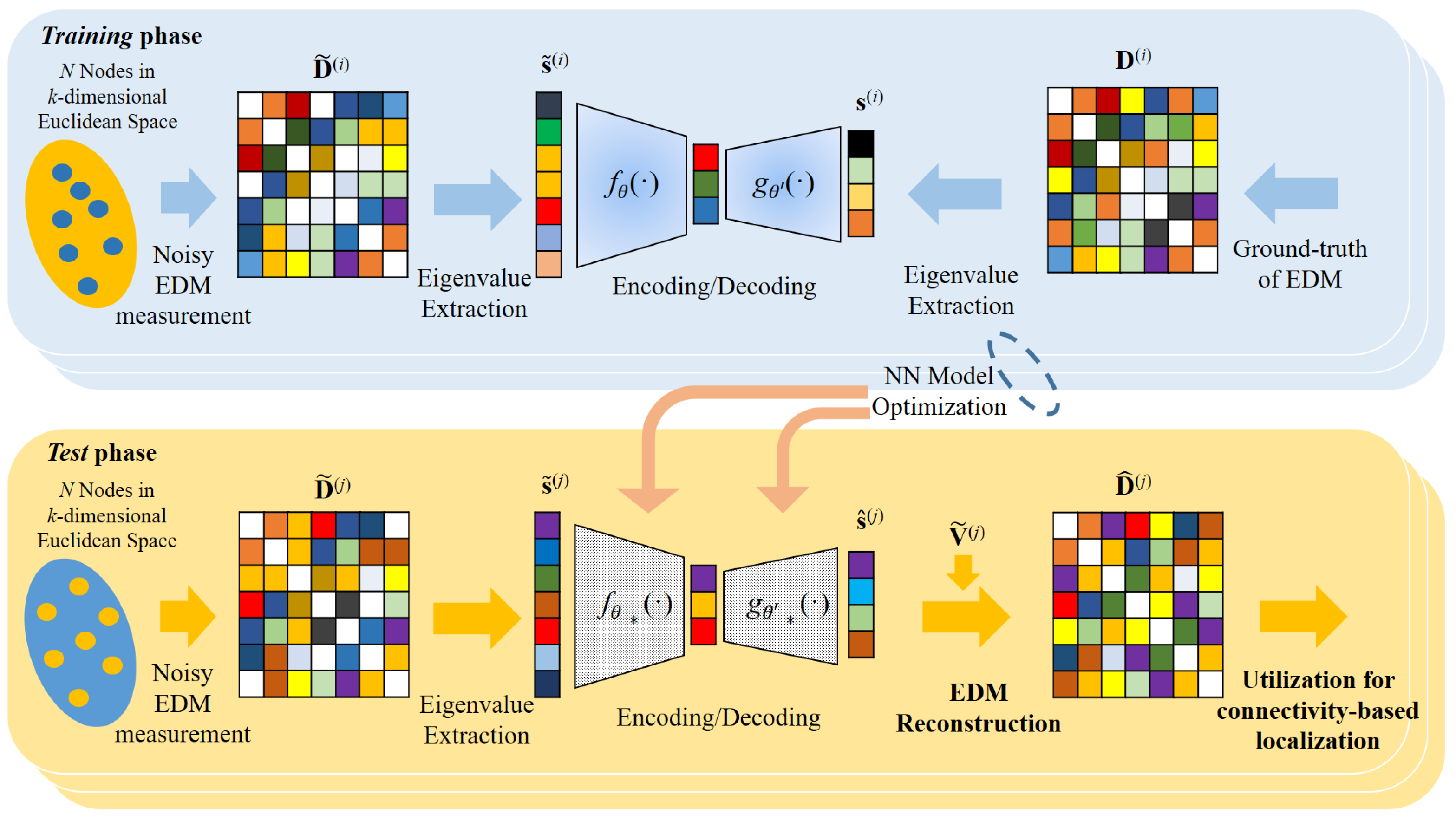
In this paper, we propose a novel denoiser for a noisy EDM, referred to as DAE-EDMR (Readers can understand our framework more easily by referring to Figure 1. Our method is based on the mathematical fact that the EDM measured from N nodes in a k-dimensional space must have a rank of at most . Abstractly, this implies that N-choose-2 pairwise distances can be rearranged into a k-dimensional structure. Consequently, if the pairwise distances are not accurately measured, reconstructing these segments would require embedding them into a higher-dimensional space. Using this concept, we optimize the NN model for EDM denoising by utilizing the eigenvalues to capture how the nodes are volumetrically distributed. A detailed explanation is given in Section 2), which leverages a denoising autoencoder (DAE). To increase the efficiency of the NN operations, we exploit the low-rank property of the EDM, which is bounded to only a number of eigenvalues, where k is the dimension of the Euclidean space, independent of the number of sensor nodes [23]. Leveraging this valuable mathematical observation, we design our NN model by inputting and outputting vectors of the eigenvalues of the noisy and original EDMs, respectively. Through these inputting/outputting rules, the proposed scheme achieves remarkable denoising results, even with a relatively small training dataset. The efficiency of the proposed denoiser is attributed to the utilization of the low-rank property of the EDM, which helps the NN model to establish better inference with limited training data. In fact, the combination of the DAE and EDM is highly attractive due to the complementary features of these two techniques. On the one hand, the DAE is a powerful NN framework for manifold learning, which enables it to effectively capture intricate data patterns and facilitate efficient denoising. On the other hand, the EDM exhibits an extremely-low-rank property, contributing to the dimensionality reduction. Regarding the online complexity, the proposed method requires eigenvalue decomposition (EVD) of the EDM as a pre-processing step for the NN operations.
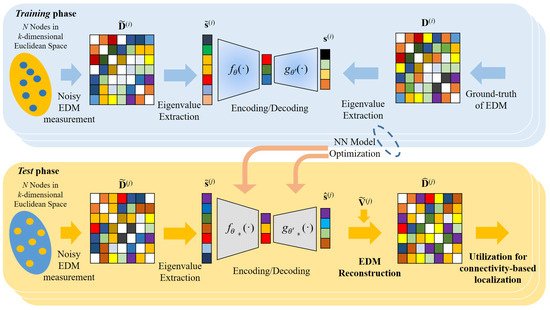
Figure 1.
An illustration of an example of the proposed DAE-EDMR (Additionally, truncated DAE-EDMR (T-DAE-EDMR) is presented as a relaxed version of DAE-EDMR. This additional work is carried out to make the optimized NN model more efficient by using the dominant eigenvalues as the input data. Details can be found in Section 2.3).
In addition, we propose a technique called truncated DAE-EDMR, i.e., T-DAE-EDMR, to enhance the robustness of DAE-EDMR to diverse environments conditions, such as changes in the number of nodes, even after NN optimization. In other words, T-DAE-EDMR offers the flexibility to be utilized in scenarios where the number of nodes varies between the training and test phases. The T-DAE-EDMR scheme involves feeding eigenvalues from the noisy EDM to the NN, which are extracted through ()-truncated EVD. In contrast, DAE-EDMR inputs N eigenvalues, making T-DAE-EDMR more versatile in accommodating different environments and simultaneously reducing the online complexity. Hence, T-DAE-EDMR is envisioned to demonstrate its superior effectiveness in environments characterized by a large number of nodes or frequent topology changes, such as vehicle-to-everything (V2X) systems.
To summarize, the main contributions of the proposed algorithms to denoising the noisy EDMs and enhancing the localization accuracy are four-fold:
- Minimizing the reconstruction errors for the EDM through the mix-up of mathematical evidence and NNs: We reveal the potential to reconstruct the EDM according to the low-rank property of the ground-truth EDM and the low-dimensional representations of the NN operation, which is robust to various noise models in distance measurements.
- Reducing the size of the training dataset and NN model: We develop an efficient NN framework requiring a small-sized training dataset and NN model. This is based on the novel inputting and outputting for the NN model, which consist of the eigenvalues of the noisy EDM and the ground-truth EDM, respectively.
- Assisting the existing connectivity-based localization algorithms as a pre-processor: We combine our proposed scheme with the connectivity-based localization technique to validate its utility in various environments. It is verified that these joint frameworks show a superior performance compared to that of the conventional approaches. This achievement is highly remarkable, as we only need to extract the eigenvalues of an EDM, requiring marginal online complexity.
- Making the NN model robust to the dynamics of wireless networks: By additionally presenting a modified model of our proposed model, we introduce an NN that can be robust to the variability in wireless networks, e.g., the number of nodes in the test phase is changed after NN optimization.
The remainder of this paper is organized as follows: Section 2 presents the system model, the problem design, and the method for the proposed algorithms. In Section 3, we provide numerical results to demonstrate the superiority of our proposed algorithms compared to other schemes even given the aspects of various environments. Finally, Section 4 presents the concluding remarks.
2. The Proposed Schemes: DAE-EDMR and T-DAE-EDMR
2.1. The System Model and Problem Formulation
Consider a collection of N nodes in a k-dimensional Euclidean space, , where the positions of all N nodes, , are randomly distributed. With the knowledge of the positions of reference nodes, we estimate the positions of the remaining N-P nodes. To accomplish this, we will utilize the concept of an EDM denoted by . It is a symmetric matrix whose -element can be represented as follows:
where is the true distance between nodes i and j.
To model practical measurements, we first consider three types of random variables due to the environment as follows:
- : ranging errors dependent on the signal quality;
- : ranging errors due to clock asynchronization;
- : non line-of-sight (NLoS) events.
We assume that , , and follow normal, uniform, and Bernoulli distributions, respectively. Hence, we can define the random variable for the bias, , as follows:
where is the distance bias in the event of NLoS conditions. Note that does not follow any known probability distribution, as it is a convolution of three different distributions.
Second, we assume that the distance is measured using a grid consisting of measurement resolutions, which is determined by the ranging configuration, e.g., the time of arrival (ToA). Thus, we define the quantization function to represent the measured distance with a resolution of G, e.g., .
Third, we formulate a function to indicate whether the distance is measured or not, based on the communication capability between nodes i and j, as follows:
Thus, the noisy measurement of the distance between the i-th and the j-th nodes is defined as follows:
where is the realization of . Then, we can define the noisy EDM using the following expression:
Finally, the objective of this paper is to find the denoising function , which is formulated as
2.2. Method I: DAE-EDMR
In the conventional approaches, the denoising function was set as : , more specifically : , such as in semi-definite relaxation and nonlocal patch tensor-based methods. These techniques require high computational complexity, as they perform iterative matrix multiplication operations while solving high-order optimization problems. In order to overcome this problem, NN-based techniques have recently been proposed. However, the dimension of the input and output data is large, which are the entire elements of the EDM. As a result, they exhibit low performance and require a large amount of training data and a large-sized neural network.
Considering the above problems, we propose a new method, namely DAE-EDMR, to denoise the noisy EDM in an efficient way.
2.2.1. A Denoising Process
Before describing the framework of DAE-EDMR, we will revisit the low-rank property of an EDM [23].
Property 1.
The , corresponding to the points in , is at most .
This is based on the following equality:
where is the one-vector of size N. According to rank characteristics, the rank of is bounded to the summation of the ranks of each term, i.e., . This determines the rank of an EDM as extremely low, i.e., , regardless of the number of nodes. It implies that it is effective to perform denoising given the small dimension of the (potential) latent space of an NN model, i.e., the similar level of the rank of the EDM, rather than treating the distance information as a whole.
Now, let and denote the vectors whose elements are the descending-order eigenvalues of and , respectively. Thus, the optimal denoising function : can be constructed as follows:
Here, we design a fully connected NN framework denoted by to approximate . To this end, we will define the required terms as follows:
- : The dimension of the latent space.
- : The weight matrices for encoding and decoding, respectively.
- : The bias vectors for encoding and decoding, respectively.
- : The activation function for neural networks. At the propagation between the final hidden layer and the output layer, , i.e., an identity function. For other types of propagation between adjacent layers, , i.e., a hyperbolic tangent function. And , where is an arbitrary input vector.
With these terms (For simplicity, the description of the NN model design throughout this article is based on a single hidden layer; however, it is obvious that deeper hidden layers can be made using multiple encoding/decoding function parameters, i.e., and , where I, , and are the depth of the NN model and the i-th encoding and decoding function parameters), we define as the encoding function where the parameter is , i.e., . In addition, we define as the decoding function where the parameter is , i.e., .
Finally, we can define consisting of the optimal encoding and decoding functions, denoted by and , respectively, as follows:
where M is the number of training datasets. Let be all of the model parameters, i.e., ; then, it simultaneously updates every parameter in at each iteration toward the direction of the steepest descent as follows:
where is the gradient operator with respect to and is the learning rate related to the step size. Through this procedure, we can optimize the fully connected NN model for denoising the eigenvalues.
Next, in the test phase, let denote the j-th denoised eigenvalues with the optimized , and this can be obtained as follows:
Finally, the denoised EDM can be reconstructed as follows:
where is the matrix consisting of eigenvectors of .
2.2.2. The Connectivity-Based Localization Process
To obtain an estimate of , which is denoted by , based on the classical MDS method, we first define the geometric centering matrix as follows:
where is the identity matrix N by N in size. Next, the estimated centered Gram matrix (GM) is obtained as
Recalling the fact that , where is the centered , we can easily obtain through the k-truncated EVD of . Based on this, we can finally obtain through a rigid linear transform, i.e., rotation and translation, of with the pre-knowledge of , which are the positions of the reference nodes.
2.3. Method II: Truncated DAE-EDMR (T-DAE-EDMR)
This subsection introduces T-DAE-EDMR, which is the relaxed version of DAE-EDMR. From the previous subsection, the low-rank property of the EDM can be used more efficiently from the NN training/test point of view. Assume that the NN model is optimized in a network with N nodes. Here, we consider a scenario where the number of nodes changes at the test phase, which is frequently shown in wireless networks. If the NN model can be used flexibly under this kind of environment change, it will be a more efficient utilization.
For this reason, we newly define the optimal denoising function : , which can be formulated as follows:
where is the ()-truncated vector of in descending order.
Again, we can design T-DAE-EDMR denoted by with a new as . In order to construct T-DAE-EDMR, we only need to change the dimension of the weight matrix for encoding to , and all the other configurations are the same as for . Now, can be obtained through the M training dataset as follows:
Next, in the test phase, let denote the j-th denoised eigenvalues with the optimized , and this can be written as
Finally, in the test phase, we can again obtain the j-th denoised EDM as follows:
After obtaining , performing connectivity-based localization involves repeating the work in Section 2.2.2 but replacing with .
Overall, Algorithms 1 and 2 describe the processes of DAE-EDMR and T-DAE-EDMR, respectively.
| Algorithm 1 The DAE-EDMR process |
|
| Algorithm 2 The T-DAE-EDMR process |
|
2.4. Computational Complexity and Memory Utilization of DAE-EDMR and T-DAE-EDMR
Since the training process is performed offline and will not affect the online denoising overhead, we mainly consider the complexity of online denoising. Recalling the dimension of the latent space and the depth of the NN model I, FLOPs of and are basically required in DAE-EDMR and T-DAE-EDMR, respectively, in terms of the online complexity for the fully connected NN model’s operation. The proposed DAE-EDMR requires an additional online complexity of FLOPs [24] for EVD of the noisy EDM compared to conventional NN-based works requiring online complexity for matrix multiplications (As is generally known, the FLOPs required to extract the eigenvalues are . Additionally, in the case of the extraction of the eigenvalues and eigenvectors together, the required FLOPs are . In our work, we only take the eigenvalues because these alone are sufficient for denoising and reducing the number of FLOPs required in offline training. Furthermore, since EDMs are inherently symmetric matrices, extracting the eigenvalues can be performed more efficiently. Investigating this aspect further could be an intriguing direction of future work, potentially leading to more computationally efficient approaches to EDM-based processing.). Additionally, T-DAE-EDMR can reduce the online complexity of DAE-EDMR to FLOPs regarding the truncated eigenproblem. Furthermore, in contrast to traditional EDM-based NNs, which require a memory storage proportional to due to their pairwise distance representations, our proposed model significantly reduces the memory usage by limiting the input and output dimensions to . This allows for a more scalable and efficeint implementation, making it particularly suitable for large-scale networks.
3. Simulation Results
In this section, we analyze the effect of DAE-EDMR and T-DAE-EDMR from various perspectives. We compare the performance of our proposed methods with that of the conventional algorithms, which are semi-definite relaxation [16], the nonlocal patch tensor-based method [18], and conventional NN-based methods referred to as deep-learning-based methods A [19] and B [22]. We also provide the result for the undenoised EDM to show the denoising performance of each algorithm. Overall, we will demonstrate the effectiveness of each scheme in denoising the noisy EDM and assess its impact on the localization performance.
3.1. The Simulation Setup
The performance of the proposed algorithms is evaluated via 5000 episodes. We define two error metrics: the EDM error and the localization error. The EDM error quantifies the deviation between the denoised EDM and the original EDM. Specifically, it is computed by first taking the Frobenius norm of their difference and then normalizing it by the Frobenius norm of the original EDM, with the final result averaged over all experimental trials. This metric provides a measure of the accuracy of the denoised pairwise distances. Meanwhile, the localization error represents the average localization error across all experimental trials, capturing the overall accuracy of the proposed method in reconstructing spatial coordinates.
In the simulations, N is set to 30, and the entire nodes are randomly distributed over a -sized space. Furthermore, the resolution of the distance measurements is assumed to be 10. Next, we set the variables of the noisy measurements, which are defined in Section 2 A, as follows: ∼∼∼ (except for Section 3C), and . In addition, in (3) follows for all , i.e., of the distance measurements are missed on average. To clearly confirm the performance in EDM denoising, all of the EDM measurements follow the above assumptions in terms of the statistical parameters for error modeling and the resolution of the distance measurements, irrespective of whether the pair measuring their distance contains the reference/target node. Additionally, except for Table 1a, the number of reference nodes (P) is 18. The classical MDS [23] is utilized as the localization method to estimate the position of the target nodes.

Table 1.
The performance of each scheme under varying cardinalities of the sensor network (left: NMSE between ground-truth and denoised EDMs; right: Localization error in meters).
Throughout all cases for NN optimization, the squared error and the scaled conjugate gradient are applied as the loss function and the optimization method, respectively. We consider a fully connected NN model. Furthermore, the depth of the hidden layer and the number of perceptrons per hidden layer are 2 and 450, respectively. With the exception of Figure 2, the size of the training dataset (M) was 10,000 for all experiments. We tested on NVIDIA RTX A2000 GPU machines (Santa Clara, CA, USA).
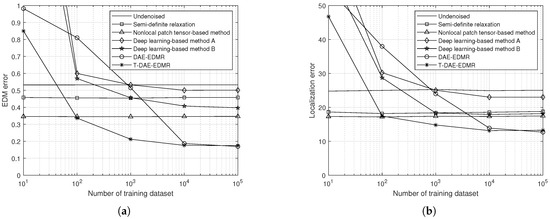
Figure 2.
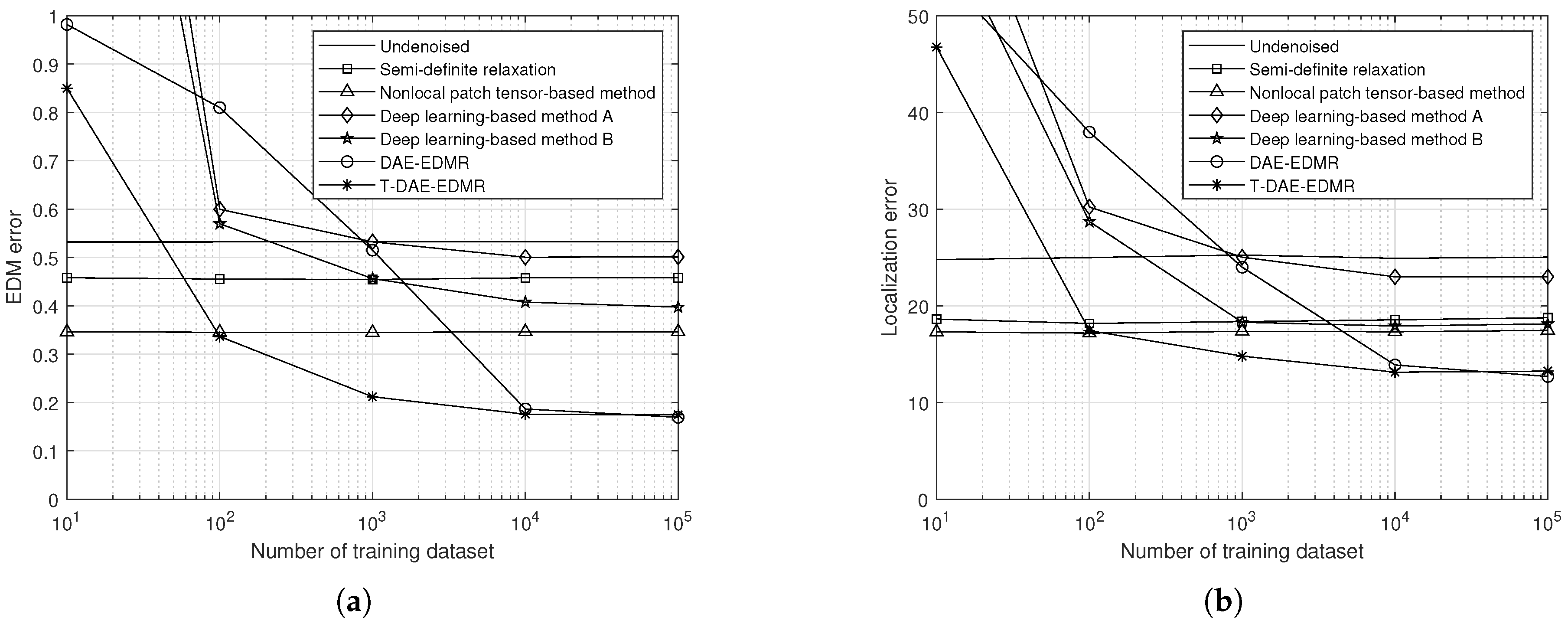
Performance comparison according to the number of training datasets. (a) NMSE between ground-truth and denoised EDMs and (b) localization error in meters.
3.2. Simulation Results According to the Number of Training Datasets
Figure 2 shows the performance of each algorithm with respect to the size of the training dataset used in the NN optimization process. Only the NN-based methods show variation in their performance with the size of the training dataset.
Despite the large size of the training dataset, such as , the conventional deep-learning-based methods are not able to surpass the performance of the nonlocal patch tensor-based method.
This can be attributed to the challenge of extracting valuable information from the raw and unrefined training dataset. Remarkably, the T-DAE-EDMR technique outperforms the other techniques even when M is just . In addition, DAE-EDMR shows a noticeable improvement when M is increased to . It is noteworthy that when M is , DAE-EDMR shows a slightly better performance than that of T-DAE-EDMR. This observation implies that extracting information from N contaminated eigenvalues, instead of solely relying on the highest values among them, can yield advantages when a large training dataset is available.
3.3. Simulation Results According to NLoS Probability
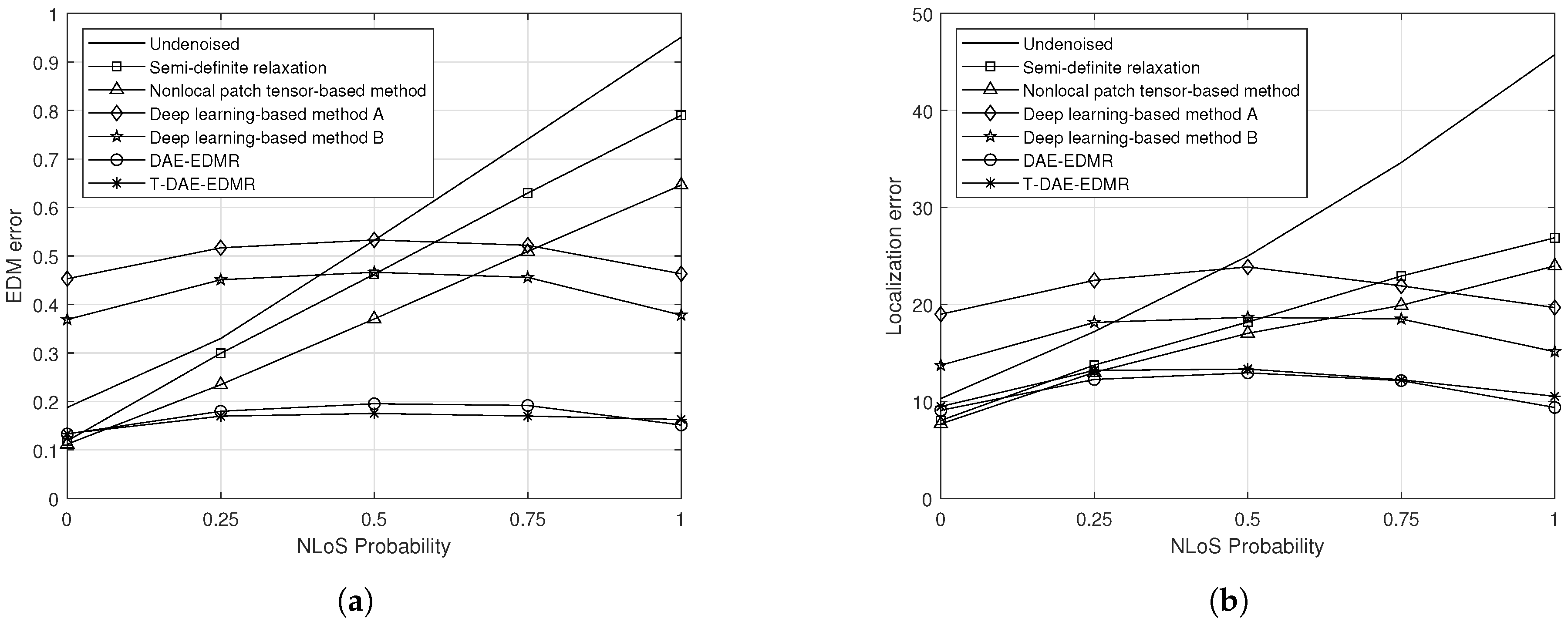
Figure 3 illustrates the impact of the NLoS probability on the EDM and localization errors. It is assumed that the NLoS probability follows a Bernoulli distribution. As the NLoS probability increases, the error for distance measurements naturally increases, resulting in a worse localization performance. Therefore, the non-NN-based techniques are in line with this general situation. On the other hand, a different phenomenon appears from the information-theoretic perspective. In the NN-based methods, i.e., deep-learning-based methods A and B, DAE-EDMR, and T-DAE-EDMR, the EDM error takes the form of a concave function for the NLoS probability. This is related to the fact that the variance in and the entropy of are and , respectively, which are in the form of concave functions. Interestingly, our proposed methods show a superior localization performance in the extreme case where the NLoS probability is 1 and can therefore be effectively applied in environments where NLoS conditions occur frequently. For future work, an interesting denoising task may involve modeling the distance measurement error due to NLoS conditions as a joint random variable, considering both the event occurrence and distance biasing. This approach could provide valuable insights into further enhancing the denoising techniques in the presence of errors due to NLoS conditions.
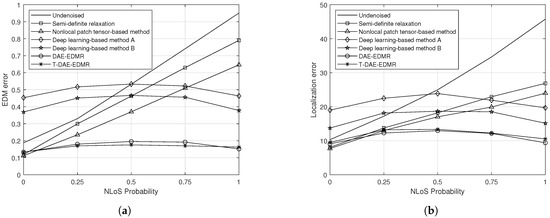
Figure 3.
Performance comparison according to the NLoS probability. (a) NMSE between ground-truth and denoised EDMs and (b) localization error in meters.
3.4. Simulation Results According to the Variation in the Cardinality of the Sensor Network
In this subsection, we deal with the dynamics of the sensor nodes. Table 1a shows the EDM and localization errors for a case where only P is changed while keeping N constant (). Since the EDM measurements are independent of P, only the denoising performance of each algorithm affects the EDM error. In the case of localization errors, it can be seen that the performance improves as P increases for all algorithms, and the two algorithms we propose show an excellent performance overall.
Table 1b shows the impact of the change in the number of nodes after NN optimization is performed, with N equal to 30. In other words, this experiment serves to verify the flexibility of T-DAE-EDMR when the number of nodes, N, changes between the training and test phases. For convenience, we will refer to the changed value of N as . In the undenoised scenario, as increases, the possibility of cooperation between the nodes increases; consequently, it can be seen that the performance marginally improves. As expected, T-DAE-EDMR shows its denoising capability well when is equal to N. In addition, since the model is optimized based on the information for a situation where N is 30, the performance of T-DAE-EDMR deteriorates as the value of increases. Nevertheless, our proposed T-DAE-EDMR can be considered an effectively designed algorithm that can adapt robustly to a change in the number of nodes between the training and test phases. Due to its potential, T-DAE-EDMR could be very useful in highly time-varying networks.
3.5. Simulation Results According to the Utilized Matrices
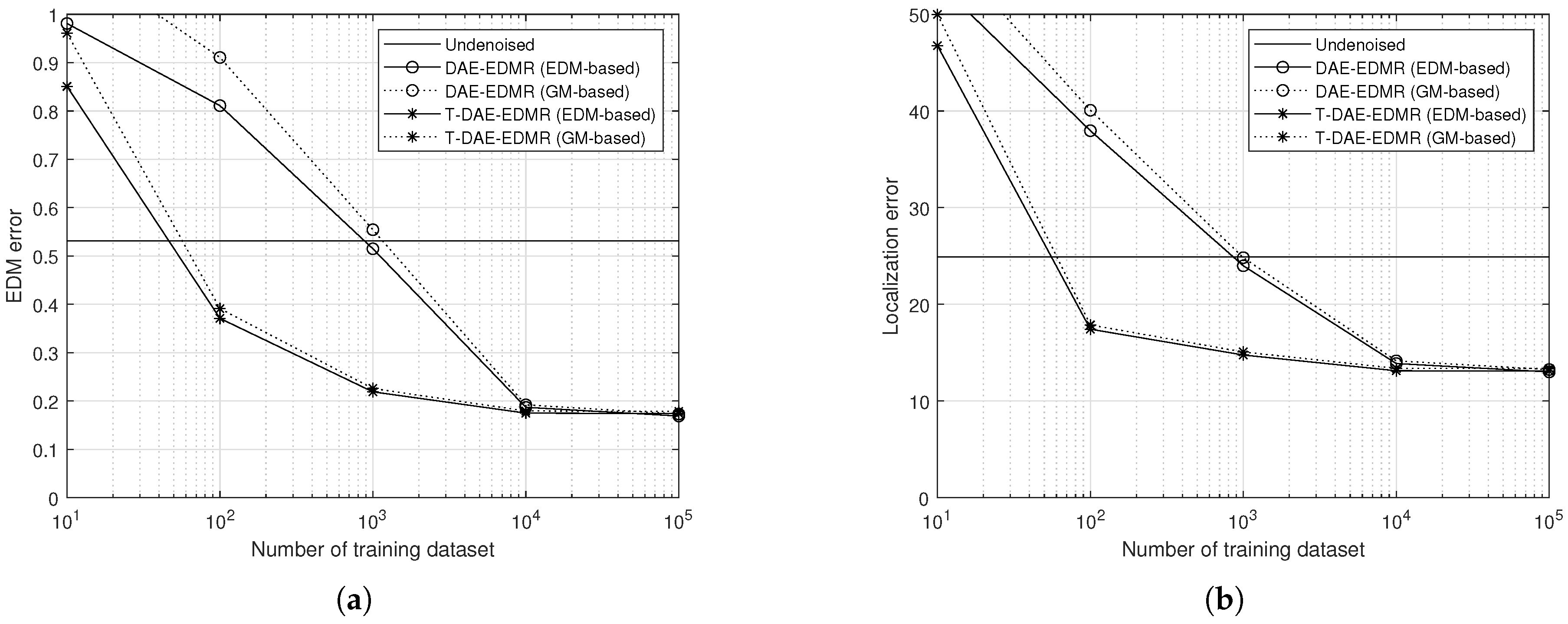
Figure 4 shows the results of applying our techniques to both an EDM and a GM, where a GM has a sharper condition in terms of its low-rank property. Under this setting, the EDM error and the localization error are investigated with respect to the size of the training dataset. A GM is created by multiplying the centering matrix on both sides of the EDM, and it is clear that it has a sharper condition than that of the EDM. In other words, where k is the dimension of the Euclidean space. As can be seen in Figure 4, both tests show a mostly similar performance when the size of the training dataset is large enough since they contain essentially the same information. However, in cases where the training dataset is insufficient, a slight deterioration in performance is observed when the GM is applied. This can be inferred because when the GM is created through the multiplication of the EDM and the centering matrix, then some useful information is contaminated during this procedure, as the centering matrix is a singular matrix.
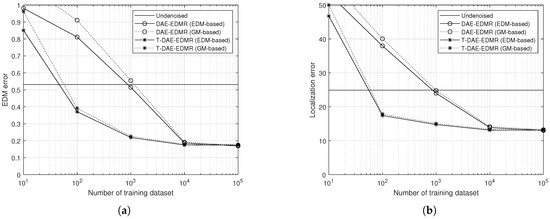
Figure 4.
Performance comparison according to the utilized matrices. (a) NMSE between ground-truth and denoised EDMs and (b) localization error in meters.
4. Discussion and Conclusions
In this paper, we investigated the problem of denoising a contaminated Euclidean distance matrix (EDM) for high-accuracy connectivity-based localization based on the mathematical fact of an EDM, i.e., its low-rank property. Compared to conventional neural network (NN)-based algorithms with large-scale frameworks, we proposed two efficient algorithms, called denoising-autoencoder-aided EDM reconstruction (DAE-EDMR) and truncated DAE-EDMR (T-DAE-EDMR), which show a superior EDM denoising performance. Notably, the latter is designed within the NN framework, enabling it to achieve a robust performance even with a limited number of training datasets. Our contributions stem from the concept of inputting N (or dominant) eigenvalues of the noisy EDM into the NN model, with the addition of marginal online complexity for eigenvalue decomposition (EVD) of the EDMs. Furthermore, T-DAE-EDMR reinforces the robustness of DAE-EDMR to variations in the number of nodes between the training and test phases. T-DAE-EDMR inputs the dominant eigenvalues of the noisy EDM into the NN, extracted through ()-truncated EVD. This approach, as opposed to inputting N eigenvalues into DAE-EDMR, enhances the robustness to changing environments while reducing the required training dataset and off/online complexity. The proposed approach effectively leverages the linear algebraic properties of wireless localization. In particular, the use of eigenvalues to optimize the NN model for EDM denoising suggests that the volume of the convex hull formed by the distributed nodes can be interpreted as the crucial information. Our experimental results demonstrate that the proposed algorithms reduce the required training dataset’s size to nearly one-tenth of its original size while achieving more than twice the effectiveness in EDM denoising. Given the suitability of the proposed methods for massive connectivity scenarios, our approach offers useful advantages for practical deployment. Furthermore, there is an opportunity to further enhance the EDM denoising performance by incorporating deeper mathematical insights, considering not only eigenvalues but also eigenvectors. Building on these strengths, future research will focus on extending our proposed schemes to localization and tracking techniques that can more robustly adapt to time-varying environments, making them even more applicable to large-scale implementations.
Author Contributions
Conceptualization: W.-H.L. and T.S. Methodology: W.-H.L. Software: W.-H.L. Validation: M.O. and U.C. Formal analysis: M.O. Investigation: U.C. Resources: W.-H.L. Data curation: W.-H.L. Writing—original draft preparation: W.-H.L. Writing—review and editing: W.-H.L., M.O., U.C. and T.S. Visualization: W.-H.L. Supervision: T.S. Project administration: T.S. Funding acquisition: W.-H.L. and T.S. All authors have read and agreed to the published version of the manuscript.
Funding
This work was supported in part by an Institute of Information & Communications Technology Planning & Evaluation (IITP) grant funded by the Korean government (MSIT) (No. RS-2023-00217885, Development of integrated interference analysis technology for improving frequency utilization efficiency) and in part by the Soonchunhyang University Research Fund.
Institutional Review Board Statement
Not applicable.
Informed Consent Statement
Not applicable.
Data Availability Statement
The data supporting the reported results in this study can be shared upon reasonable request. Interested researchers should contact the corresponding author to discuss access. Please note that data sharing may be subject to restrictions due to privacy, ethical considerations, or intellectual property agreements with funders.
Conflicts of Interest
Author Ursula Challita was employed by the company Ericsson AB. The remaining authors declare that the re-search was conducted in the absence of any commercial or financial relationships that could be construed as a potential conflict of interest.
References
- Li, Y.; Zhuang, Y.; Hu, X.; Gao, Z.; Hu, J.; Chen, L.; He, Z.; Pei, L.; Chen, K.; Wang, M.; et al. Toward Location-Enabled IoT (LE-IoT): IoT Positioning Techniques, Error Sources, and Error Mitigation. IEEE Internet Things J. 2021, 8, 4035–4062. [Google Scholar] [CrossRef]
- Yao, Y.; Zhang, H.; Lin, L.; Lin, G.; Shibasaki, R.; Song, X.; Yu, K. Internet of Things Positioning Technology Based Intelligent Delivery System. IEEE Trans. Intell. Transp. Syst. 2022, 24, 12862–12876. [Google Scholar] [CrossRef]
- Farahsari, P.S.; Farahzadi, A.; Rezazadeh, J.; Bagheri, A. A survey on indoor positioning systems for IoT-based applications. IEEE Internet Things J. 2022, 9, 7680–7699. [Google Scholar] [CrossRef]
- Alrajeh, N.A.; Bashir, M.; Shams, B. Localization techniques in wireless sensor networks. Int. J. Distrib. Sens. Netw. 2013, 9, 304628. [Google Scholar] [CrossRef]
- Chen, R.; Liu, M.; Hui, Y.; Cheng, N.; Li, J. Reconfigurable intelligent surfaces for 6G IoT wireless positioning: A contemporary survey. IEEE Internet Things J. 2022, 9, 23570–23582. [Google Scholar] [CrossRef]
- Shyam, S.; Juliet, S.; Ezra, K. An Emerging Paradigm in IoT-Based Indoor Positioning System. In Disruptive Technologies for Big Data and Cloud Applications: Proceedings of ICBDCC 2021; Springer Nature: Berlin/Heidelberg, Germany, 2022; pp. 613–620. [Google Scholar]
- Sneha, V.; Nagarajan, M. Localization in wireless sensor networks: A review. Cybern. Inf. Technol. 2020, 20, 3–26. [Google Scholar] [CrossRef]
- Chen, Z.; Xia, F.; Huang, T.; Bu, F.; Wang, H. A localization method for the Internet of Things. J. Supercomput. 2013, 63, 657–674. [Google Scholar] [CrossRef]
- Lin, X.; Bergman, J.; Gunnarsson, F.; Liberg, O.; Razavi, S.M.; Razaghi, H.S.; Rydn, H.; Sui, Y. Positioning for the Internet of Things: A 3GPP perspective. IEEE Commun. Mag. 2017, 55, 179–185. [Google Scholar] [CrossRef]
- Shang, Y.; Ruml, W.; Zhang, Y.; Fromherz, M.P. Localization from mere connectivity. In Proceedings of the 4th ACM International Symposium on Mobile ad Hoc Networking & Computing, Annapolis, MD, USA, 1–3 June 2003; pp. 201–212. [Google Scholar]
- Costa, J.A.; Patwari, N.; Hero III, A.O. Distributed weighted-multidimensional scaling for node localization in sensor networks. ACM Trans. Sens. Netw. (TOSN) 2006, 2, 39–64. [Google Scholar] [CrossRef]
- Lee, W.H.; Choi, J.; Lee, J.H.; Kim, Y.H.; Kim, S.C. Distributed power control-based connectivity reconstruction game in wireless localization. IEEE Commun. Lett. 2016, 21, 334–337. [Google Scholar] [CrossRef]
- Jin, M.; Xia, S.; Wu, H.; Gu, X. Scalable and fully distributed localization with mere connectivity. In Proceedings of the 2011 Proceedings IEEE INFOCOM, Shanghai, China, 10–15 April 2011; pp. 3164–3172. [Google Scholar]
- Shang, Y.; Rumi, W.; Zhang, Y.; Fromherz, M. Localization from connectivity in sensor networks. IEEE Trans. Parallel Distrib. Syst. 2004, 15, 961–974. [Google Scholar] [CrossRef]
- Kang, I.; Nam, H. Robust Localization System Using Vector Combination in Wireless Sensor Networks. IEEE Access 2022, 10, 73437–73445. [Google Scholar] [CrossRef]
- Alfakih, A.Y.; Khandani, A.; Wolkowicz, H. Solving Euclidean distance matrix completion problems via semidefinite programming. Comput. Optim. Appl. 1999, 12, 13–30. [Google Scholar] [CrossRef]
- Krislock, N.; Wolkowicz, H. Euclidean distance matrices and applications. In Handbook on Semidefinite, Conic and Polynomial Optimization; Springer: Berlin/Heidelberg, Germany, 2012; pp. 879–914. [Google Scholar]
- Zhang, L.; Song, L.; Du, B.; Zhang, Y. Nonlocal low-rank tensor completion for visual data. IEEE Trans. Cybern. 2019, 51, 673–685. [Google Scholar] [CrossRef] [PubMed]
- Njima, W.; Chafii, M.; Nimr, A.; Fettweis, G. Deep learning based data recovery for localization. IEEE Access 2020, 8, 175741–175752. [Google Scholar] [CrossRef]
- Zou, H.; Chen, C.L.; Li, M.; Yang, J.; Zhou, Y.; Xie, L.; Spanos, C.J. Adversarial learning-enabled automatic WiFi indoor radio map construction and adaptation with mobile robot. IEEE Internet Things J. 2020, 7, 6946–6954. [Google Scholar] [CrossRef]
- Lee, W.H.; Ozger, M.; Challita, U.; Sung, K.W. Noise learning-based denoising autoencoder. IEEE Commun. Lett. 2021, 25, 2983–2987. [Google Scholar] [CrossRef]
- Kim, S.; Nguyen, L.T.; Kim, J.; Shim, B. Deep learning based low-rank matrix completion for IoT network localization. IEEE Wirel. Commun. Lett. 2021, 10, 2115–2119. [Google Scholar] [CrossRef]
- Dokmanic, I.; Parhizkar, R.; Ranieri, J.; Vetterli, M. Euclidean distance matrices: Essential theory, algorithms, and applications. IEEE Signal Process. Mag. 2015, 32, 12–30. [Google Scholar] [CrossRef]
- Demmel, J.W. Applied Numerical Linear Algebra; SIAM: Philadelphia, PA, USA, 1997. [Google Scholar]
Disclaimer/Publisher’s Note: The statements, opinions and data contained in all publications are solely those of the individual author(s) and contributor(s) and not of MDPI and/or the editor(s). MDPI and/or the editor(s) disclaim responsibility for any injury to people or property resulting from any ideas, methods, instructions or products referred to in the content. |
© 2025 by the authors. Licensee MDPI, Basel, Switzerland. This article is an open access article distributed under the terms and conditions of the Creative Commons Attribution (CC BY) license (https://creativecommons.org/licenses/by/4.0/).