


Abstract
Battery-powered IoT sensor nodes require energy-efficient Medium Access Control (MAC) protocols to extend network lifetime while supporting priority-sensitive traffic. This paper proposes a Priority-Aware Packet Aggregation/Piggybacking-Based (Priority + Packet Aggregation) Hybrid Energy-Efficient MAC (A-HMAC) protocol that integrates bit-mapped priority signaling with lightweight packet aggregation/piggybacking to reduce control overhead. The protocol classifies traffic into emergency, buffer-overflow, priority, and normal categories, providing guaranteed access to delay-sensitive data while minimizing radio activity, idle listening, and contention. A mathematical energy model is developed for both priority- and contention-based operations. MATLAB-based evaluation demonstrates that A-HMAC consistently achieves lower energy consumption than TDMA, EA-TDMA, ASHMAC, E-BMA, and A-HMAC across varying network sizes, packet sizes, and event-generation probabilities. The proposed protocol provides substantial energy savings, particularly in large-scale and moderate-traffic networks, while maintaining priority-aware communication and QoS, making it suitable for low-power IoT and wireless sensor network applications.
1. Introduction
Energy conservation is a fundamental requirement in the design of low-power electronic systems for Internet of Things (IoT) applications. Battery-powered sensor nodes integrate sensing, embedded processing, memory, power management, and wireless communication modules within a highly constrained energy budget. Since these devices are expected to operate autonomously for months or even years without battery replacement, minimizing power consumption across both hardware and communication subsystems has become a major research challenge. Although advances in ultra-low-power microcontrollers and low-leakage electronic circuits have significantly reduced computation and standby power, wireless communication remains the dominant source of energy consumption due to packet transmission, reception, idle listening, overhearing, and collision recovery [1]. Consequently, communication-aware power optimization at the Medium Access Control (MAC) layer plays a crucial role in complementing low-power electronic design by reducing unnecessary radio activity and extending battery lifetime. The co-design of energy-efficient communication protocols with low-power embedded electronic platforms is therefore essential for achieving long-term autonomous operation, improved reliability, and sustainable IoT deployments.
From a low-power electronics perspective, MAC protocols directly influence the duty cycle of the radio transceiver, which is typically the highest power-consuming component of an IoT sensor node. Efficient channel access mechanisms reduce unnecessary state transitions between active, idle, transmit, receive, and sleep modes, thereby lowering average power consumption and improving energy utilization [2]. Furthermore, minimizing control packet exchanges, avoiding retransmissions caused by collisions, and supporting adaptive sleep scheduling reduce the overall energy expenditure of embedded wireless platforms. As emerging IoT applications generate heterogeneous traffic with varying latency and reliability requirements, MAC protocols must not only optimize communication energy but also provide intelligent resource allocation capable of supporting priority-aware and delay-sensitive transmissions while preserving battery lifetime [3].
IoT sensors are widely utilized across diverse application domains, including precision agriculture, smart cities, smart grids, smart homes, industrial monitoring, and medical and wearable devices. Each of these applications imposes unique constraints on power usage, data rate, latency, and sensing accuracy. For example, agricultural sensors may need to operate unattended for several years, while medical devices require continuous, reliable monitoring under strict power and safety constraints. Energy consumption in sensor nodes is primarily dominated by three components: sensing operations, data processing, and wireless communication, with radio transmission typically being the most energy-intensive. Therefore, energy-aware system design involves optimizing hardware selection, duty cycling mechanisms, sleep–wake scheduling, energy-efficient communication protocols, and lightweight data processing or compression techniques. By carefully managing these factors, IoT systems can achieve extended operational lifetimes while maintaining acceptable performance, making energy conservation a foundational requirement for scalable, sustainable IoT deployments.
Aims and Objectives
The key novelty of the proposed approach is not the isolated use of priority-aware access, bit mapping, or packet aggregation, but their coordinated integration within a unified MAC framework. The principal contributions are as follows:
- A priority-aware slot allocation mechanism that provides differentiated and guaranteed access for delay-sensitive and emergency traffic.
- A packet-aggregation-based reservation mechanism that embeds a future slot request within an ongoing data packet using a one-bit indicator, thereby eliminating a separate reservation-control exchange.
- A conditional reservation strategy that verifies sustained data generation before initiating reservation, thereby avoiding unnecessary slot reservations caused by transient events.
- An integrated priority-aware and bit-mapped MAC architecture that combines differentiated QoS support with reduced control signaling and energy consumption.
The remainder of this paper is organized as follows. Section 2 discusses a literature review and related works. Section 3 presents the system model and the proposed -HMAC protocol, including its operating principles, normal and priority modes, priority classification, and packet-aggregation-based slot reservation mechanism. The mathematical energy-consumption model and corresponding energy expressions are presented as a subsection of Section 3. Section 4 describes the experimental methodology, including the simulation environment, network configuration, radio characteristics, simulation parameters, and experimental cases. Section 5 presents and discusses the simulation results in terms of event-generation probability, network size, and data-packet size, along with comparisons with the considered existing MAC protocols. Finally, Section 6 concludes the paper by summarizing the key findings, limitations, and potential directions for future work.
2. Literature Review
In the pursuit of energy-efficient communication in resource-constrained wireless networks, several MAC protocols have been proposed to address both energy optimization and reliable data delivery. For instance, the work in [4] introduced an energy-aware clustering-based MAC protocol that minimizes energy consumption by preventing the formation of excessively large or closely spaced clusters, thereby reducing communication overhead. Building on the need to balance efficiency with reliability, the adaptive hybrid Burst-MAC protocol proposed in [5] effectively mitigates collisions during bursty traffic conditions while maintaining low energy expenditure.
Further advancing sensor-level adaptability, the deviation-aware MAC approach in [6] dynamically allocates transmission slots based on the sensitivity of sensed data. By incorporating a deviation function to eliminate redundant information, this scheme enhances data consistency and improves overall resource utilization. Complementarily, ref. [7] introduces a wait-time-based mechanism that ensures low latency for delay-sensitive applications, while also supporting extended waiting periods with piggybacked replica data to achieve energy-efficient transmissions.
To incorporate priority and structured access, a graph-based MAC protocol for Wireless Body Area Networks (WBANs) was proposed in [8], where graph coloring is employed to efficiently allocate transmission slots while avoiding interference. Extending this concept to industrial safety applications, UAV-assisted communication using a Priority-Aware Fast MAC protocol was presented in [9]. This framework jointly considers data-level priorities, such as emergency events and communication duration, along with device-level metrics like residual energy, to ensure reliable and timely data delivery.
In addition to these approaches, Nguyen et al. [10] proposed PriTraCon-MAC, a priority-driven contention-based protocol that dynamically adjusts the contention window according to traffic priority. This enables faster channel access for high-priority data and significantly improves performance, as demonstrated by reduced transmission delay, higher packet delivery success rate, and improved energy efficiency compared to the TMPQ-MAC protocol.
More recently, adaptive and context-aware MAC protocols have further strengthened energy-aware communication paradigms. ESMAC [11] employs priority-based duty cycling to optimize energy consumption while ensuring timely delivery of critical data. Similarly, the UAV-Trajectory Aware protocol [12] integrates TDMA scheduling with UAV mobility patterns, reducing idle listening and communication overhead during data collection. GS-MAC [13] adopts strict time synchronization based on Coordinated Universal Time (UTC) to enable collision-free transmissions and minimize energy wastage. Additionally, the Distance-Aware Bit-Mapping-based MAC protocol [14] adapts transmission energy based on the node’s proximity to the gateway, thereby improving both energy efficiency and communication reliability.
Recent studies have further demonstrated the growing role of intelligent optimization techniques in enhancing energy-efficient medium access and communication for resource-constrained IoT and wireless sensor networks. Deep reinforcement learning has been employed to jointly optimize transmission scheduling, collision avoidance, and adaptive power control, leading to significant improvements in throughput, packet delivery ratio, and network lifetime under dynamic network conditions [15]. Likewise, hybrid MAC protocols integrating CSMA/CA, TDMA, and Actor–Critic reinforcement learning have shown considerable reductions in energy consumption and latency while maintaining reliable communication in harsh environments [16]. Beyond MAC-layer optimization, edge-intelligence-assisted cross-layer congestion control has been introduced to dynamically prioritize critical traffic and improve end-to-end energy efficiency in IoT networks [17]. Furthermore, recent reviews on LEACH evolution highlight that integrating intelligent optimization algorithms with energy-aware clustering and security mechanisms remains an important direction for developing scalable and sustainable wireless sensor networks [18].
Recent studies further demonstrate the continued development of energy-efficient and intelligent MAC and communication protocols for IoT and WSN environments. Shukla and Verma [19] reviewed recent energy-efficient MAC and networking approaches for WSNs, highlighting energy consumption and network lifetime as major design considerations, while Bengheni [20] investigated an asynchronous energy-efficient MAC protocol incorporating energy harvesting. Energy-efficient communication has also been explored through data-integrity-aware transmission and packet-delivery considerations in WSNs [21], as well as contention optimization and aggregated packet transmission for IoT/WSN networks [22]. Mazlan et al. [11] enhanced S-MAC through topology-aware energy management, whereas Mim and Hossen [23] investigated idle time-slot utilization to jointly improve latency and energy efficiency. Other recent studies have addressed network lifetime through energy-aware routing [24] and reinforcement-learning-based routing and sleep scheduling [25]. Dynamic protocol reconfiguration and scalable communication for remote WSN deployments have also been investigated [26], while energy drainage and energy-related security considerations have been examined in WSNs [27]. More recent developments extend energy-efficient MAC design toward dynamic element allocation for indoor IoT networks [28], parameter-efficient learning for MAC protocol recognition in underwater networks [29], energy-efficient intelligent clustering and routing [30], and joint PHY–MAC capacity optimization for dual-mode communication systems [31]. In addition, edge-intelligence-based IoT architectures [32] and cross-layer MAC designs for heterogeneous LoRa traffic [33] demonstrate the increasing emphasis on adaptive, intelligent, and cross-layer communication. Collectively, these studies confirm the growing importance of energy efficiency, scalability, adaptive access, and intelligent resource management; however, the simultaneous integration of priority-aware access, bit-mapped contention, and lightweight packet-aggregation-based slot reservation remains insufficiently addressed.
Despite these advancements, the literature reveals that conventional MAC protocols still face challenges in simultaneously achieving energy efficiency and differentiated service provisioning. In particular, existing schemes offer limited support for priority-aware channel access, which is crucial for handling time-sensitive or emergency data. Therefore, there is a clear need for a MAC-layer design that intelligently allocates transmission opportunities based on traffic priority while minimizing energy consumption, ultimately extending network lifetime and enhancing quality of service.
In this context, this work proposes a priority-aware, packet aggregation/piggybacking-based, energy-efficient MAC protocol that leverages bit-mapping for efficient control signaling and slot allocation. By incorporating packet aggregation/piggybacking, control overhead is reduced by embedding scheduling and priority information within the contention period, avoiding separate control exchanges.
Additionally, the compact bit-mapping approach efficiently represents node status, queue priorities, and slot reservations with minimal overhead. This reduces idle listening and collisions, while improving duty cycling, thereby prolonging the operational lifetime of sensor nodes.
The comparison in Table 1 highlights that the proposed -HMAC does not introduce these mechanisms independently, but integrates priority-aware access, bit-mapped contention, and packet-aggregation-based reservation within a unified MAC framework. In particular, the 1-bit reservation mechanism embedded in ongoing data transmission, together with conditional reservation based on sustained activity, distinguishes the proposed protocol from the closely related approaches.
Table 1.
Comparison of the proposed -HMAC with closely related MAC protocols.
Although the proposed -HMAC employs mechanisms that have individually appeared in earlier MAC protocols, its contribution lies in their coordinated operation within a single priority-aware hybrid framework. In particular, priority-aware access is used to provide differentiated channel access for delay-sensitive traffic, while bit-mapped contention is retained for lightweight access of event-driven traffic. The distinguishing component is the packet-aggregation-based reservation mechanism, in which a reservation request is embedded in an ongoing data packet using a one-bit indicator rather than being transmitted as a separate control packet. In addition, reservation is initiated only after sustained activity is confirmed over a session interval, thereby avoiding unnecessary reservations caused by isolated events. This combination enables the protocol to reduce control signaling while retaining priority-aware access and lightweight contention.
3. System Model and Proposed -HMAC Protocol
This section describes the system model and the proposed -HMAC protocol for priority-aware and energy-efficient communication in IoT/WSN networks. The protocol architecture and its operating principles, including normal and priority modes, priority classification, bit-mapped access, and packet-aggregation-based slot reservation, are presented in the following subsections.
3.1. System Model
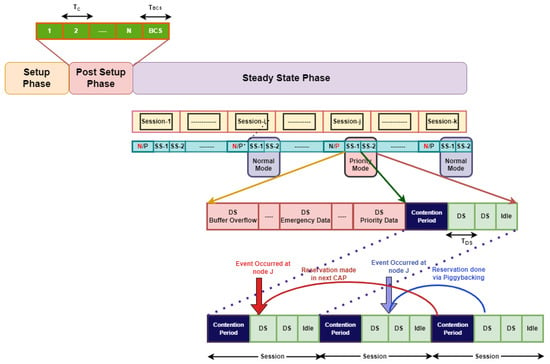
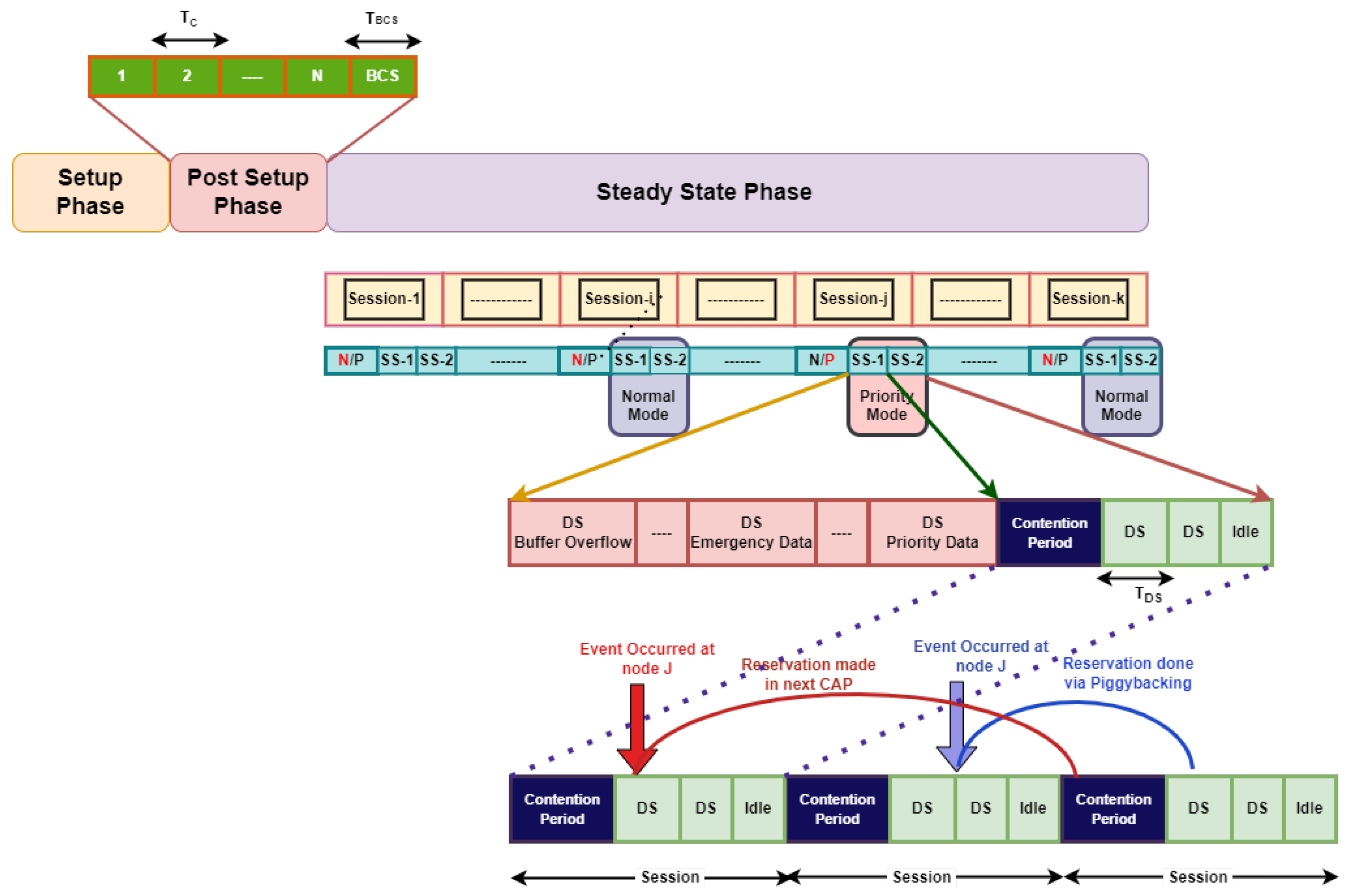
As illustrated in Figure 1, the proposed architecture functions across two operational stages: the initialization stage and the steady-state stage. During initialization, the network is configured and prepared for operation. Following this, a transitional post-setup stage classifies sensor nodes according to the type of data they produce—continuous monitoring, periodic monitoring, or event-driven reporting. This categorization allows the MAC protocol to implement differentiated access strategies aligned with the traffic profile and Quality of Service (QoS) requirements of each node category. Once the system reaches the steady-state stage, it operates either in normal mode or priority mode, depending on prevailing network conditions and the presence of urgent data.
Figure 1.
Priority-Aware Packet Aggregation-based MAC protocol.
In normal mode, each communication session is divided into two segments. The first segment serves nodes engaged in continuous and periodic monitoring. Continuous-monitoring nodes are allocated fixed transmission slots under a TDMA scheme, ensuring predictable and collision-free access. Periodic-monitoring nodes, on the other hand, rely on a machine-learning-based slot allocation mechanism that predicts activity from historical transmission behavior. Active nodes receive slots accordingly, while inactive nodes are placed in sleep mode, thereby reducing idle listening and conserving energy. The second segment is reserved for event-driven nodes, which utilize a lightweight bit-mapping MAC protocol to contend for channel access. This approach is particularly efficient under low-to-moderate traffic conditions.
When a node generates priority traffic—such as emergency alerts, buffer overflow warnings, or other delay-sensitive data—the system switches to priority mode. In this mode, the node reporting urgent information is granted reserved transmission slots to guarantee timely and reliable delivery. Meanwhile, all other nodes temporarily suspend their standard access mechanisms and revert to contention-based bit-mapping, ensuring that critical transmissions are prioritized without permanently compromising fairness or efficiency. The priority nodes are classified into three categories, as shown in Table 2. As shown in the table, the nodes operate using priority encoding utilizing a don’t care (X) condition. The system dynamically alternates between Normal Mode and Priority Mode, depending on sensor requirements within a given session. As conditions evolve—for instance, when prioritized data are detected (PD = 1), the system escalates to the urgency level (01), thereby ensuring timely handling of important information.
Table 2.
Priority encoding.
If buffer usage surpasses 75% (BOC = 1, indicating critical overflow) or emergency data arrive (ED = 1), the system further elevates its response. A critical overflow condition enforces a high-priority state (10), while the presence of emergency traffic immediately drives the system to its maximum urgency (11). Under these circumstances, Priority Mode is activated to safeguard against data loss and guarantee rapid response to critical or emergency events. When none of the urgency conditions is enabled, the system operates in normal mode.
Although the bit-mapping contention process is energy-efficient under light traffic, it introduces noticeable overhead as traffic intensity rises. This overhead stems from the contention phase itself, where nodes expend energy on sensing and signaling before actual data transmission. To mitigate this limitation, we introduce the Priority-Aware Packet Aggregation/Piggybacking-Based (Priority + Packet Aggregation A-HMAC) MAC protocol. A-HMAC integrates a packet aggregation-based slot reservation scheme in which source nodes embed reservation requests within ongoing data packets rather than transmitting separate control packets. A single-bit indicator in the packet header signals the need for future slot reservations. If a node anticipates successive transmissions, it asserts this bit, thereby reserving slots with negligible additional energy cost.
Moreover, A-HMAC incorporates a safeguard against unnecessary reservations. Upon detecting an event, a node waits for one session interval to verify whether the event leads to sustained data generation. Only if continuous activity is confirmed does the node initiate piggybacked slot reservation. While this introduces a minor one-session delay, the latency remains acceptable for most event-driven applications. In return, the A-HMAC protocol significantly reduces control overhead, enhances energy efficiency, and improves performance under heavy traffic conditions. This makes it particularly well suited for heterogeneous wireless sensor networks characterized by diverse traffic patterns and stringent energy constraints. The operation of the proposed protocol can be summarized as follows:
- The network initially operates in the normal mode, where continuous and periodic monitoring nodes follow their respective scheduled access mechanisms, while event-driven nodes use bit-mapped contention during the CAP.
- When a node generates priority traffic, such as priority data, buffer-overflow data, or emergency data, the protocol switches to priority mode and classifies the traffic according to its priority level.
- The priority node is assigned a guaranteed transmission opportunity according to the corresponding priority class, while the remaining nodes follow the appropriate access mechanism.
- If an event-driven node detects data that are expected to continue across subsequent sessions, the node first waits for one session interval to verify sustained activity.
- Once sustained activity is confirmed, the node sets the one-bit reservation indicator in its ongoing data packet. The indicator informs the receiver/cluster head that a future slot is requested.
- The requested slot is subsequently reserved for the node, allowing continuous data transmission without requiring a separate control packet for each reservation.
- If the event does not persist, the reservation is not initiated and the node returns to the normal contention-based operation.
The above procedure enables -HMAC to dynamically combine priority-aware guaranteed access with lightweight contention and packet-aggregation-based slot reservation, thereby reducing unnecessary control exchanges while preserving differentiated access for urgent traffic. The mathematical model for the proposed method is discussed in next section.
3.2. Mathematical Model for A-HMAC Priority + Packet Aggregation
This section presents the mathematical formulation of the proposed Piggybacking/Packet Aggregation-Assisted Priority-Based MAC (A-HMAC Priority + Packet Aggregation) protocol. The symbols and notations used in the derivation are listed in Table 3. In this framework, packet aggregation/piggybacking is strategically employed to enhance energy efficiency, particularly for nodes with higher transmission priority. The total number of end nodes is denoted as N. The priority nodes are categorized into three distinct classes, such as buffer overflow , emergency data , and priority data . The combined probability of these categories is represented as and is calculated as,
Table 3.
Symbols and notations used in derivation.
Priority nodes are provided with guaranteed slots. Hence, the number of guaranteed slots for priority data transmission is calculated by
The remaining active event-based monitoring slots can be calculated as
The energy consumption during the setup phase is negligible, and hence, it is ignored for all protocols. During the post-setup phase in priority mode, each node transmits a control packet to the cluster head to indicate the type of data it holds. Based on the type of data (priority data (PD), critical buffer overflow (BOC), and emergency data (ED)), each sensor is allocated a dedicated slot for transmission. During each sub-slot, the active node transmits the data in the slot, while other priority nodes remain in the Idle state. The total energy consumption during the post-setup phase in the priority mode is calculated as below:
The session j in Figure 1 represents the priority mode. In the priority mode, the communication starts with a beacon message from the cluster head to all the nodes. The energy consumption for this stage is derived as
There are nodes having the priority data. The priority data transmission starts and the energy consumption during sub session 1 where priority data transmission takes place is given by
In sub-session 2, the session is divided into two phases, i.e., the Contention Access Period (CAP) and the Contention-Free Period (CFP). During CAP, nodes with data to transmit register for slot allocation. The proposed packet aggregation/piggybacking mechanism is applied in this phase. A source node requests slot allocation during the control phase only if it has not requested a slot in the previous frame; otherwise, it remains idle for the next contention slots. Nodes without data remain idle throughout the contention period. It is important to note that if a node did not transmit a control packet in the previous frame, its control message cannot be piggybacked. If the probability of data availability is p, then the probability of a data packet not being piggybacked is . Hence, if the control message is piggybacked in the last frame, the nodes remain idle during the contention period, thereby conserving energy.
The power consumption during the contention access period is calculated as
The data transmission during the contention-free period starts after the slot allocation, and the energy consumption for the same is derived as
4. Experimental Methodology
The experimental methodology is discussed in this section.
4.1. Simulation Environment and Network Configuration
This section presents the results obtained from simulations conducted in MATLAB 2025b. The analysis primarily focuses on the energy consumption in the priority-aware mode, incorporating packet aggregation/piggybacking logic. The energy consumption expressions are derived for the proposed methods in the previous section, and the performance is compared with the existing methods like TDMA, EA-TDMA, ASHMAC, E-BMA, [34]. The baseline protocols were implemented following their established methodological and energy-consumption formulations reported in Ref. [34], while identical network, radio, packet, and traffic conditions were maintained for all protocols to ensure a fair comparative evaluation. The values of the parameters used in simulation are presented in Table 4. The control packet size is fixed at 5 bytes, while the default data packet size is set to 100 bytes. Performance is evaluated based on energy consumption. For comparative analysis, parameters such as the number of sensor nodes, data packet size, number of rounds, and event generation probability are varied across different scenarios.
Table 4.
Simulation parameters for performance analysis.
4.2. Simulation Parameters
The principal simulation parameters used for the comparative evaluation are summarized in Table 4. Unless otherwise stated, the parameters listed as constant are maintained across all protocols and experimental cases to ensure a consistent basis for comparison. The event generation probability, number of nodes, and data-packet size are varied according to the corresponding experimental case.
4.3. Experimental Cases and Evaluation Procedure
Three experimental cases are considered to examine the energy behavior of the proposed -HMAC under different operating conditions. In Case 1, the event-generation probability, , is varied from 0.1 to 1 while the network size and data-packet duration are kept constant. In Case 2, the number of sensor nodes is varied from 40 to 140 at a fixed event-generation probability of 0.4. In Case 3, the data-packet size is varied from 40 to 140 bytes while the network size and event-generation probability are kept constant. The corresponding fixed and varying parameters are summarized in Table 5.
Table 5.
Experimental parameters for performance analysis.
Figure 2.
Energy consumption vs. event probability.
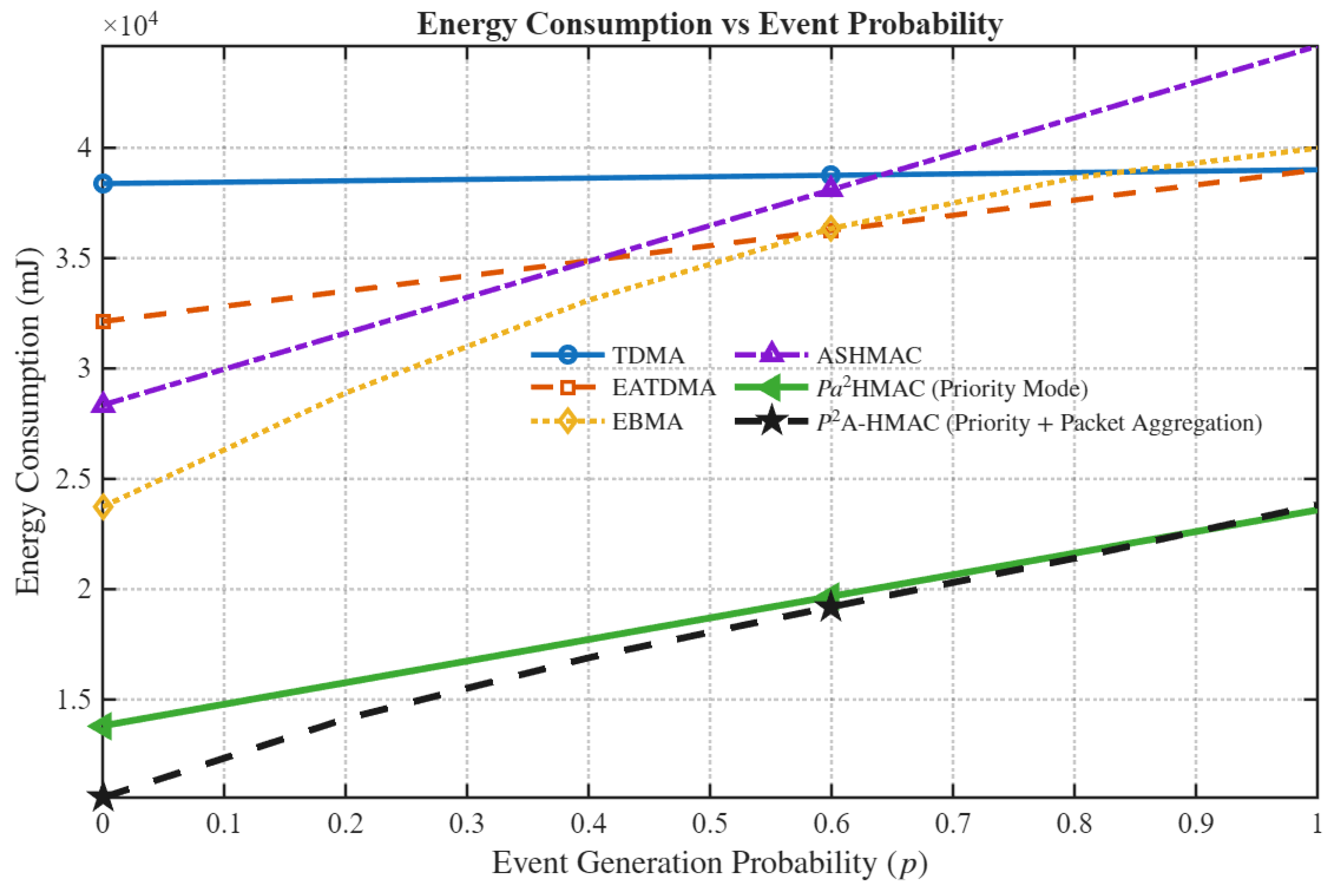
Figure 3.
Energy consumption vs. number of nodes.
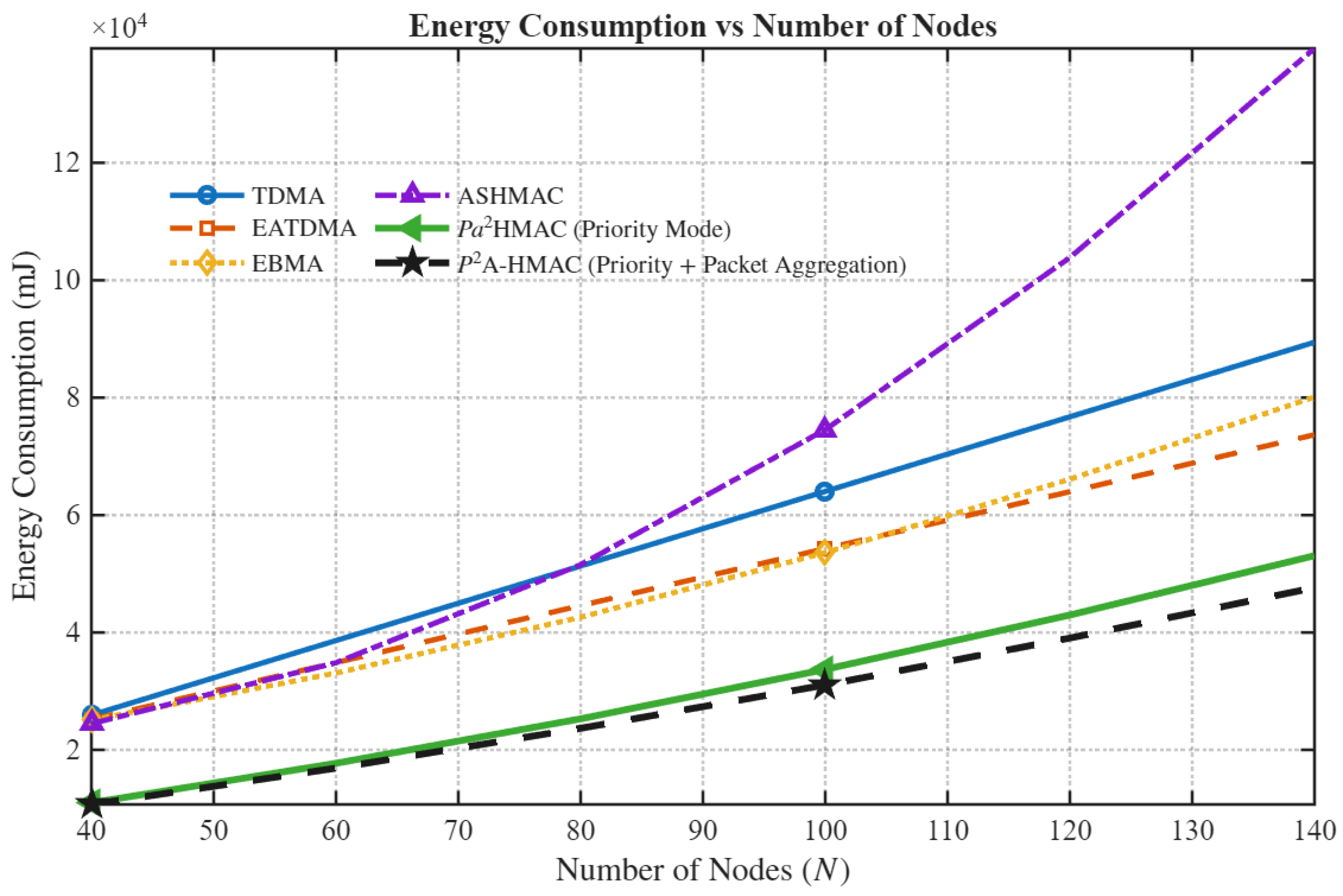
Figure 4.
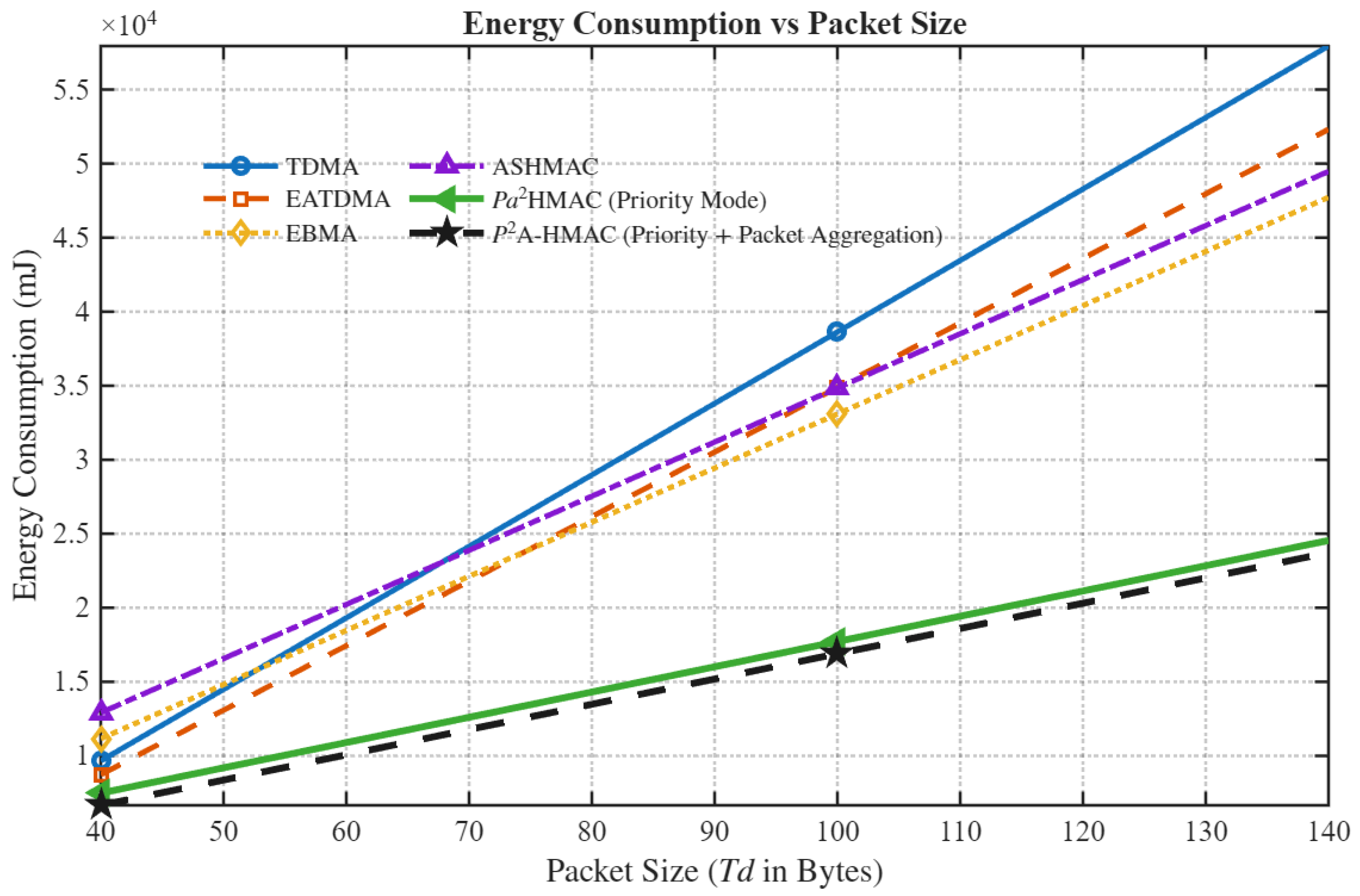
Energy consumption vs. variation in the data packet size.
The performance of the proposed protocol is evaluated primarily in terms of energy consumption and compared with TDMA, EA-TDMA, ASHMAC, E-BMA, and PA2HMAC under identical parameter settings.
5. Simulation Results and Discussion
It is assumed that the network operates using a 2.4 GHz mote module equipped with a CC2420 radio compliant with the IEEE 802.15.4 standard for energy analysis. The power consumption of the CC2420 RF module is 50 mW during transmission, 54 mW during reception, and 50 mW in standby listening (idle) mode. Based on the parameter variation, the simulation results are analyzed in the three cases below.
- Case 1: Variation in the data event generation probability
To rigorously evaluate the performance of the proposed Priority-Aware Packet Aggregation/Piggybacking (A-HMAC Priority + Packet Aggregation) MAC protocol, the data event generation probability () is varied from 0.1 to 1. This variation enables the analysis of protocol behavior across diverse traffic conditions, from light load to highly congested network scenarios. Such a study is crucial for assessing the protocol’s adaptability and robustness in dynamic environments. The comparative analysis of the protocols for this scenario is depicted in Figure 2.
For all considered protocols, it is observed that energy consumption increases monotonically with . This trend can be attributed to higher packet generation rates, leading to more frequent channel access attempts and prolonged active states of the radio transceiver. As approaches unity, nodes remain active for longer durations due to continuous transmission and reception activities, thereby reducing the time spent in low-power sleep states.
Furthermore, under heavy traffic conditions, energy overhead increases due to higher contention, collisions, retransmissions, and backoff operations, particularly in contention-based MAC protocols. In contrast, under light traffic, nodes primarily operate in low-power states, thereby reducing energy consumption.
Piggybacking-based schemes generally demonstrate superior energy efficiency compared to other protocols, including priority-aware hybrid MAC, as pre-allocation during the contention period enables continuous data transmission with reduced control overhead. However, when the event probability , A-HMAC MAC is outperformed by [34]. Under such highly saturated conditions, where data are available in more than 90% of cycles, the energy consumed in frequent data transmissions dominates overall consumption. Consequently, the benefits obtained from piggybacking-based overhead reduction become negligible.
Table 6 provides a quantitative comparison of the energy-saving capability of the proposed -HMAC across the complete range of event-generation probabilities considered in Figure 2. The proposed protocol achieves substantial energy savings over all conventional baseline protocols, with the largest improvements occurring under low-to-moderate traffic conditions. Compared with , the additional energy benefit provided by packet aggregation decreases as increases, from 23.55% at to 1.08% at . At , the saving becomes −0.99%, confirming that under fully saturated traffic the packet-aggregation mechanism no longer provides an additional energy advantage because frequent data transmissions dominate the total energy consumption.
Table 6.
Percentage energy savings of -HMAC with respect to the considered baseline protocols for different event-generation probabilities.
- Case 2: Variation in the number of nodes
In this experiment, the number of nodes is varied from 40 to 140, and the corresponding energy consumption is illustrated in Figure 3. The results demonstrate that the effectiveness of the proposed piggybacking mechanism is strongly influenced by network density. At lower node densities, the opportunities for piggybacking are relatively limited; consequently, the proposed approach exhibits energy consumption comparable to that of conventional systems without piggybacking. As the number of sensor nodes increases, the frequency of transmission opportunities and the availability of control and data information for aggregation also increase. This enables the piggybacking mechanism to combine control information with data transmissions, thereby reducing the need for separate control packets and minimizing redundant communication and associated transmission overhead. As a result, the cumulative energy savings progressively increase with network size.
Table 7 shows that the proposed -HMAC consistently achieves lower energy consumption than all considered baseline protocols as the network size increases from 40 to 140 nodes. Compared with , the additional energy saving increases from 2.54% at 40 nodes to 10.27% at 140 nodes, demonstrating that the benefit of packet aggregation becomes increasingly significant in larger networks. The proposed protocol also maintains substantial savings over TDMA, EA-TDMA, E-BMA, and ASHMAC across the complete range of network sizes.
Table 7.
Percentage energy savings of -HMAC with respect to the baseline protocols for different network sizes.
Furthermore, the proposed piggybacking-based approach consistently demonstrates lower energy consumption than the considered existing protocols across all evaluated network configurations. The performance advantage becomes increasingly pronounced as the network scales, indicating that the proposed mechanism can effectively exploit the increased communication opportunities available in dense network environments. This behavior highlights the scalability of the proposed protocol and confirms that the energy-saving benefits of piggybacking become more significant under high node density.
These findings demonstrate that the proposed approach is particularly suitable for large-scale and dense deployments, where a substantial number of sensor nodes compete for shared communication resources. By reducing redundant control transmissions and efficiently utilizing existing data packets for control information exchange, the proposed mechanism can lower communication overhead, improve channel utilization, and extend the energy efficiency of battery-powered sensor nodes. Therefore, the increasing energy-saving trend with network size validates the effectiveness of the proposed piggybacking strategy in addressing the energy and scalability challenges associated with dense networks.
- Case 3: Variation in the data packet size
To further evaluate the energy efficiency of the proposed A-HMAC protocol, the data packet size is varied from 40 to 140 bytes, with the corresponding results presented in Figure 4. The observations indicate a general increase in energy consumption as the packet size grows. This trend is primarily attributed to higher energy expenditure during contention-free periods, driven by longer data transmission durations.
Table 8 quantitatively demonstrates that the energy advantage of -HMAC becomes increasingly evident as the data-packet size increases. Compared with , the proposed packet-aggregation mechanism provides an additional energy saving of 11.04% at 40 bytes, which gradually decreases to 3.37% at 140 bytes. Nevertheless, the proposed protocol maintains lower energy consumption than all considered baseline protocols across the complete packet-size range. The increasing advantage over conventional protocols with larger packet sizes is attributed to the greater opportunity to amortize reservation and control signaling overhead over longer data transmissions.
Table 8.
Percentage energy savings of -HMAC with respect to the baseline protocols for different data-packet sizes.
Compared with existing protocols, the priority-aware schemes exhibit improved energy efficiency across all packet sizes. Additionally, piggybacking for priority nodes further reduces energy consumption. This is achieved by enabling node registration during anticipated consecutive data transmissions, facilitated through an additional indicator bit that introduces negligible overhead. Consequently, the proposed mechanism effectively reduces control signaling costs and enhances overall energy efficiency.
6. Conclusions
In this work, a priority-aware, packet aggregation-based energy-efficient MAC protocol is proposed. The protocol leverages a lightweight packet aggregation/piggybacking mechanism in which slot reservation requests for the continuous cycles are embedded in ongoing data transmissions via a 1-bit control indicator. This design significantly reduces the need for dedicated control signaling, thereby lowering protocol overhead while enabling efficient and adaptive resource allocation. The proposed approach demonstrates superior performance in dense network scenarios, where many nodes contend for channel access. Its effectiveness is further amplified as packet sizes increase, as longer transmissions provide greater opportunities for packet aggregation/piggybacking. Consequently, the protocol achieves substantial energy savings by minimizing redundant transmissions and control exchanges, making it particularly well suited for large-scale, data-intensive wireless networks.
It is further observed that the proposed protocol outperforms existing schemes when the event generation probability is below 90%. The proposed -HMAC consistently demonstrates substantial energy savings across varying event-generation probabilities, network sizes, and packet sizes. For different event-generation probabilities, the average energy savings reach 54.40%, 50.94%, 47.96%, and 52.34% over TDMA, EA-TDMA, E-BMA, and ASHMAC, respectively. Across different network sizes, the proposed protocol achieves average savings of 52.69%, 45.50%, 45.70%, and 58.07% over the same baseline protocols. Notably, the savings over ASHMAC increase from 56.23% to 65.85% as the network size increases from 40 to 140 nodes. For varying packet sizes, the average savings are 50.95%, 45.68%, 47.08%, and 50.85% compared with TDMA, EA-TDMA, E-BMA, and ASHMAC, respectively. The maximum savings over TDMA reach 72.49% at , while 59.06% is achieved for a 140-byte packet. Compared with , -HMAC provides positive savings across almost all evaluated conditions, reaching 23.55% at and 11.04% for a 40-byte packet. Overall, the results confirm that -HMAC provides robust energy-efficiency improvements under diverse traffic, network-density, and packet-size conditions.This behavior can be attributed to effective control overhead mitigation, as the energy consumed for control signaling remains lower than that in conventional protocols in this range. Consequently, the proposed approach achieves improved energy efficiency by limiting unnecessary control exchanges, thereby maintaining superior performance under moderate traffic conditions.
As a future enhancement, the proposed protocol can be extended by integrating lightweight machine learning techniques to learn and predict traffic patterns, node activity, and priority-based data generation. The predicted traffic information can be utilized to dynamically optimize slot reservation, channel access, and transmission scheduling decisions according to the prevailing network conditions. Such an adaptive mechanism can reduce unnecessary idle listening and control overhead, minimize channel contention and retransmissions, and improve resource utilization as the network density and traffic load increase. This learning-assisted extension is expected to further enhance the scalability, energy efficiency, and adaptability of the proposed protocol for large-scale and dynamic deployments.
Author Contributions
Conceptualization, M.T.; methodology, T.M., M.T., and G.S.; software, T.M.; validation, M.T., H.C., and P.K.; formal analysis, T.M. and M.T.; investigation, T.M.; writing—original draft preparation, T.M.; writing—review and editing, M.T., H.C., P.K., and S.S.; supervision, M.T.; project administration, M.T. All authors have read and agreed to the published version of the manuscript.
Funding
This research received no external funding.
Institutional Review Board Statement
Not applicable.
Informed Consent Statement
Not applicable.
Data Availability Statement
The data supporting the findings of this study are available from the corresponding author upon reasonable request.
Conflicts of Interest
The authors declare no conflict of interest.
Abbreviations
The following abbreviations are used in this manuscript:
| IoT | Internet of Things |
| WSN | Wireless Sensor Network |
| MAC | Medium Access Control |
| -HMAC | Priority-Aware Packet Aggregation Hybrid Medium Access Control |
| TDMA | Time Division Multiple Access |
| CAP | Contention Access Period |
| CFP | Contention-Free Period |
| QoS | Quality of Service |
| ML | Machine Learning |
| RF | Radio Frequency |
| IEEE | Institute of Electrical and Electronics Engineers |
| CC2420 | Chipcon 2420 Radio Transceiver |
| PD | Priority Data |
| BOC | Buffer Overflow Condition |
| ED | Emergency Data |
| UTC | Coordinated Universal Time |
| UAV | Unmanned Aerial Vehicle |
| WBAN | Wireless Body Area Network |
| EA-TDMA | Energy-Aware Time Division Multiple Access |
| E-BMA | Energy-Efficient Bit-Mapping Access |
| ASHMAC | Adaptive Sleep Hybrid Medium Access Control |
| Priority-Aware Hybrid Medium Access Control |
References
- Jurdak, R.; Ruzzelli, A.G.; O’Hare, G.M. Radio Sleep Mode Optimization in Wireless Sensor Networks. IEEE Trans. Mob. Comput. 2010, 9, 955–968. [Google Scholar] [CrossRef] [Scilit]
- Kumar, A.; Zhao, M.; Wong, K.-J.; Guan, Y.L.; Chong, P.H.J. A Comprehensive Study of IoT and WSN MAC Protocols: Research Issues, Challenges and Opportunities. IEEE Access 2018, 6, 76228–76262. [Google Scholar] [CrossRef] [Scilit]
- Gomez, C.; Kovatsch, M.; Tian, H.; Cao, Z. (Eds.) Energy-Efficient Features of Internet of Things Protocols; RFC 8352; Internet Engineering Task Force (IETF): Fremont, CA, USA, 2018. [Google Scholar] [CrossRef] [Scilit]
- Ranjan, R.; Debasis, K.; Gupta, R.; Singh, M.P. Energy-Efficient Medium Access Control in Wireless Sensor Networks. Wirel. Pers. Commun. 2022, 122, 409–427. [Google Scholar] [CrossRef] [Scilit]
- Jain, A.; Haque, M.A.; Saifullah, A.; Zhang, H. Burst-MAC: A mac protocol for handling burst traffic in Lora Network. In Proceedings of the 2024 IEEE Real-Time Systems Symposium (RTSS), York, UK, 10–13 December 2024; pp. 148–160. [Google Scholar] [CrossRef] [Scilit]
- Tolani, M.; Asad Ali Biabani, S.; Kumar, P. Energy-efficient deviation aware adaptive bit-mapping Medium Access Control Protocol for Wireless Sensor Network. IEEE Access 2024, 12, 94424–94435. [Google Scholar] [CrossRef] [Scilit]
- Rathi, S.; Borkotoky, S.S. Energy-efficient and latency-aware message replica transmission in IOT networks. IEEE Trans. Ind. Inform. 2024, 20, 6573–6581. [Google Scholar] [CrossRef] [Scilit]
- Su, H.; Huo, L.; Chen, H. Graph-Based Priority-Aware MAC Protocol for Wireless Body Area Networks. In Proceedings of the 2019 4th International Conference on Mechanical, Control and Computer Engineering (ICMCCE), Hohhot, China, 24–26 October 2019; pp. 422–4223. [Google Scholar] [CrossRef] [Scilit]
- Khisa, S.; Moh, S. Priority-Aware Fast MAC Protocol for UAV-Assisted Industrial IoT Systems. IEEE Access 2021, 9, 57089–57106. [Google Scholar] [CrossRef] [Scilit]
- Nguyen, T.C.; Le, H.C.; Sarang, S.; Drieberg, M.; Nguyen, T.H.T. Priority and Traffic-Aware Contention-Based Medium Access Control Scheme for Multievent Wireless Sensor Networks. IEEE Access 2022, 10, 87361–87373. [Google Scholar] [CrossRef] [Scilit]
- Mazlan, A.F.; Kadir, M.F.A.; Shallahuddin, A.A.; Mohamed, M.A.; Abidin, A.F.A.; Awang, W.S.W. ESMAC: Enhanced S-MAC Protocol on Network Topologies to Improve Energy-Efficient in Wireless Sensor Networks. In Proceedings of the 2023 10th International Conference on Electrical and Electronics Engineering (ICEEE), Istanbul, Turkey, 8–10 May 2023; pp. 149–153. [Google Scholar] [CrossRef] [Scilit]
- Kumar, R.; Singh, Y.N.; Nalin K. Jayakody, D. Energy-Efficient UAV Trajectory-Aware Superframe Method for Medium Access Control Protocols. In Proceedings of the 2025 IEEE Space, Aerospace and Defence Conference (SPACE), Bangalore, India, 21–23 July 2025; pp. 1–6. [Google Scholar] [CrossRef] [Scilit]
- Majham, M.; Mwaimu, M.P.; Kivevele, T.; Sinde, R.S. GS-MAC: A Scalable and Energy Efficient MAC Protocol for Greenhouse Monitoring and Control Using Wireless Sensor Networks. IEEE Access 2023, 11, 84398–84413. [Google Scholar] [CrossRef] [Scilit]
- Suman, G.; Tolani, M.; Kumar, P.; Balodi, A. Distance-Aware Bit-Mapping-Based Energy-Efficient MAC Protocol for LoRaWAN. IEEE Access 2025, 13, 166312–166325. [Google Scholar] [CrossRef] [Scilit]
- Rahman, W.U.; Gang, Q.; Zhou, F.; Tahir, M.; Ali, W.; Adil, M.; Khattak, M.I. Deep Q-Learning Based Adaptive MAC Protocol with Collision Avoidance and Efficient Power Control for UWSNs. J. Mar. Sci. Eng. 2025, 13, 616. [Google Scholar] [CrossRef] [Scilit]
- Rahman, W.U.; Gang, Q.; Zhou, F.; Tahir, M.; Ali, W.; Adil, M.; Zong Xin, S.; Khattak, M.I. Energy-Efficient MAC Protocol for Underwater Sensor Networks Using CSMA/CA, TDMA, and Actor–Critic Reinforcement Learning (AC-RL) Fusion. Acoustics 2025, 7, 39. [Google Scholar] [CrossRef] [Scilit]
- Choi, S. Energy-Efficient Dynamic Retransmission Timeouts with Enhanced Stability for Constrained Application Protocol-Based Internet of Things Networks via Edge Intelligence-Assisted Cross-Layer Congestion Control. Electronics 2026, 15, 2884. [Google Scholar] [CrossRef] [Scilit]
- Chu, A.; Zhang, T.; Wang, C. LEACH Protocol Evolution in WSN: A Review of Energy Consumption Optimization and Security Reinforcement. Sensors 2026, 26, 2272. [Google Scholar] [CrossRef] [Scilit] [PubMed]
- Shukla, M.G.; Verma, S.B. An In-Depth Analysis of Current Development in Energy Efficient Method for MAC Protocol to Extend Life Span of WSN. In Proceedings of the 2024 International Conference on Cybernation and Computation (CYBERCOM), Dehradun, India, 15–16 November 2024; pp. 20–24. [Google Scholar] [CrossRef] [Scilit]
- Bengheni, A. Energy-Efficient Asynchronous MAC Protocol for WSNs with Energy Harvesters. In Proceedings of the 2023 IEEE 11th International Conference on Systems and Control (ICSC), Sousse, Tunisia, 18–20 December 2023; pp. 641–646. [Google Scholar] [CrossRef] [Scilit]
- Gokul, K.; Gowtham, E.; Jagatheshvela, G.; Mathi Rakshana, S.; Kirthiga, S. Energy-Efficient Communication with Data Integrity in Wireless Sensor Networks. In Proceedings of the 2025 International Conference on Wireless Communications Signal Processing and Networking (WiSPNET), Chennai, India, 20–22 March 2025; pp. 1–5. [Google Scholar] [CrossRef] [Scilit]
- Portillo, C.; Martinez-Bauset, J.; Pla, V.; Casares-Giner, V. IoT WSN MAC Protocol: Simulation Analysis of Minimum Packets in Queue Nodes for Medium Access Contention. In Proceedings of the 2023 International Conference on Engineering and Emerging Technologies (ICEET), Istanbul, Turkey, 27–28 October 2023; pp. 1–6. [Google Scholar] [CrossRef] [Scilit]
- Mim, F.M.; Hossen, M. Idle Time-Slot Utilization for Latency and Energy Efficiency in Wireless Sensor Networks. In Proceedings of the 2024 IEEE International Conference on Power, Electrical, Electronics and Industrial Applications (PEEIACON), Rajshahi, Bangladesh, 12–13 September 2024; pp. 160–164. [Google Scholar] [CrossRef] [Scilit]
- Nimesh, P.; Asbe, C. Enhancement of Network Lifetime by Decreasing Energy Consumption in WSN using Goat Fish Algorithm. In Proceedings of the 2023 IEEE 4th Annual Flagship India Council International Subsections Conference (INDISCON), Mysore, India, 5–7 August 2023; pp. 1–8. [Google Scholar] [CrossRef] [Scilit]
- Lahmar, I.; Rjili, M.; Zaier, A.; Yahia, M. Energy-Aware Routing and Sleep Scheduling Using Reinforcement Learning in WSNs. In Proceedings of the 2025 IEEE International Multi-Conference on Smart Systems & Green Process (IMC-SSGP), Hammamet, Tunisia, 30 October–2 November 2025; pp. 1–5. [Google Scholar] [CrossRef] [Scilit]
- GK, S.; Ganesan, V. Dynamic Auto-Reconfigurable Protocol for Efficient IoT Communication in Remote WSNs. In Proceedings of the 2025 15th International Conference on Mathematics, Actuarial Science, Computer Science and Statistics (MACS), Karachi, Pakistan, 20–21 December 2025; pp. 1–8. [Google Scholar] [CrossRef] [Scilit]
- Bhatti, D.S.; Saleem, S.; Ali, Z.; Park, T.J.; Suh, B.; Kamran, A.; Buchanan, W.J.; Kim, K.I. Design and Evaluation of Memory Efficient Data Structure Scheme for Energy Drainage Attacks in Wireless Sensor Networks. IEEE Access 2024, 12, 41499–41516. [Google Scholar] [CrossRef] [Scilit]
- Shen, Z.; Piao, Y.; Lee, T.J. STAR-IRS-Assisted MAC Protocol with Dynamic Element Allocation for Indoor IoT Networks. Electronics 2026, 15, 3400. [Google Scholar] [CrossRef] [Scilit]
- Zhang, G.; Ma, G.; Wen, W.; Zhou, G.; Tu, Y. Parameter-Efficient Time–Frequency Temporal Convolution with Log-Percentile Normalization for Underwater Acoustic MAC Protocol Recognition. J. Mar. Sci. Eng. 2026, 14, 1470. [Google Scholar] [CrossRef] [Scilit]
- Hu, H.; Liu, S.; Kang, Q.; Zhang, S.; Tian, C. FGOGNN: An Energy-Efficient and Intelligent Cluster-Based Routing Protocol for Wireless Sensor Networks. Symmetry 2026, 18, 1319. [Google Scholar] [CrossRef] [Scilit]
- Zhao, Y.; Jiang, B.; Chen, Z. Adaptive Capacity Optimization Algorithm Leveraging Joint PHY-MAC Layer Modeling for Dual-Mode Communication Systems. Electronics 2026, 15, 3461. [Google Scholar] [CrossRef] [Scilit]
- Fiore, M.; Lanera, F. Edge Intelligence in the IoT Era: A Review of Architectural Paradigms. Electronics 2026, 15, 3689. [Google Scholar] [CrossRef] [Scilit]
- Pang, S.; Ma, Y.; Cheng, X.; Yang, F.; Zou, Z.; Pan, R.; Wang, H. Cross-Layer Protocol Design and Performance Evaluation of LoRa Ad Hoc Networks for Heterogeneous Traffic. Sensors 2026, 26, 4718. [Google Scholar] [CrossRef] [Scilit] [PubMed]
- Albalawi, N.S.; Alzahrani, Y.; Alsalmi, N.; Patidar, Y.; Tolani, M. Energy-efficient priority encoding strategies using machine learning based hybrid MAC protocol for wireless sensor networks. Sci. Rep. 2025, 15, 45054. [Google Scholar] [CrossRef] [Scilit] [PubMed]

Disclaimer/Publisher’s Note: The statements, opinions and data contained in all publications are solely those of the individual author(s) and contributor(s) and not of MDPI and/or the editor(s). MDPI and/or the editor(s) disclaim responsibility for any injury to people or property resulting from any ideas, methods, instructions or products referred to in the content. |
© 2026 by the authors. Licensee MDPI, Basel, Switzerland. This article is an open access article distributed under the terms and conditions of the Creative Commons Attribution (CC BY) license.