


Abstract
From a financial perspective, working capital represents the liquidity of firms that makes them able to deal with short-term liabilities in current assets (inventories, receivables accounts, and net financial resources). However, this concept is also considered in scientific literature as, among other meanings, stock of productive capital, or variables costs. Considering the importance of working capital in a firms’ dynamics, the principal objective of this study is to highlight the main gaps and insights in literature concerning working capital and to suggest future research. For this purpose, bibliometric analysis was carried out through bibliographic information from both the Web of Science Core Collection and from the Scopus for the topic of “working capital”. These data were first worked through bibliometric approaches, considering the VOSviewer and Gephi software and later surveyed through a literature review. As the main insights, it is worth highlighting that there are several gaps in related literature, where the most worrying is the weak reference to sustainability or sustainable development concepts. Finally, the majority of the networked research was focused on just a few authors, organizations, and countries.
Keywords:
Web of Science; Scopus; benchmarking; financial studies; VOSviewer; Gephi; centrality; literature review 1. Introduction
The concept of working capital has several dimensions interrelated with the profitability and financial performance of firms. In general, it is considered in the literature with a financial perspective, however, it is sometimes associated with other connotations, such as productive capital stock (Pena Sanchez et al. 2018), or operating costs. In any case, the fields related to working capital are vast and with space to be explored.
On the other hand, a search on the Web of Science (WoS), in November 2020, revealed that there were very few studies applying the bibliometric approach concerning the topic of working capital (da Silva Macedo and Lunga 2010; Motylska-Kuzma 2017), revealing the pertinence of this particular research. In addition, Nobanee and Dilshad (2021) shows that there is still much work to be done in these fields.
Considering the aforementioned context, the main objective of this research is to highlight the main insights produced from scientific literature about “working capital” dimensions, showing gaps and suggestions for future lines of research. Specifically, in this study, the intention is to answer the following questions related with the topic “working capital”: (1) Are there significant differences between the WoS and Scopus databases for the main items (subject areas and countries) and trends (over the last decades)?; (2) What are the main gaps in scientific literature?; (3) What is the level of network and centrality in the co-authorships?; (4) What are the most relevant insights from specific subtopics (namely “working capital management” and “policies”)?; (5) What are the main suggestions for future research?; What are the main practical implications?
Other previous studies carried out both reviews (Kayani et al. 2019) and bibliometric analysis (Nobanee and Dilshad 2021), however, these considered other approaches. In any case, the relevance given to the relationships between working capital management and policies by Nobanee and Dilshad (2021) should be highlighted, justifying the importance given to these topics in this study.
Compared with previous studies, this research focuses on the topic “working capital”, firstly benchmarking two scientific databases (WoS and Scopus), after performing bibliometric analyses and, finally, reviewing the literature on working capital management policies.
From this perspective, the main contribution of this study to the literature is focused on the various dimensions of “working capital” revealed by the literature, with special emphasis on the main highlights of working capital management policies.
As the main insights, it should be noted that this is a field to be explored in these issues, namely the relationships between working capital and sustainability and the impact of working capital management on specific sectors and economic activities. On the other hand, there is space to increase networking between authors and organizations on the topics covered.
The remaining parts of this research are intended for material and methods, bibliometric analysis, literature review on working capital management policies, discussion, and conclusions.
2. Material and Methods
Bibliometric analysis is an interesting approach towards highlighting the main insights produced from the enormous amount of scientific literature supplied every year by researchers from various countries across the globe. A search on the Web of Science (2020) shows that the interest from researchers for bibliometric approaches has increased over recent years.
Bibliometric analysis has been considered across many different fields of science, such as agriculture (Martinho 2020), forestry (Mourao and Martinho 2020), the environment (Martinho and Mourão 2020), energy (Martinho 2018), leading universities (Cancino et al. 2017), academic innovation (Merigó et al. 2016), the board of directors in certain organizations (Kent Baker et al. 2020), and food consumption (Martinho 2021). These studies show that the identification of the topic(s) considered in order to select the documents from databases is often arbitrary.
Considering the objectives proposed for this research, for a search performed on 18 November 2020 (University of Vigo, Campus of Ourense), without any constraints, namely for the years considered, so as to avoid any bias in the analysis (in fact, any refinement in the dataset used may condition the results and are always subjective), more than one thousand documents (1342 studies) were considered from Web of Science (2020) and more than two thousand studies (2200 documents) were obtained from Scopus (2020) for the topic “working capital”. These studies were first worked on with bibliometric analysis through the VOSviewer (van Eck and Waltman 2020; VOSviewer 2020) and Gephi (Bastian et al. 2009; McTavish 2020; Gephi 2020) software and then analyzed through a literature review for the more relevant topics highlighted in the bibliometric approach.
3. Bibliometric Analysis Covering “Working Capital” on Web of Science and Scopus
Considering the information related to the documents obtained from the Web of Science Core Collection (2020) and Scopus (2020) for the search topic “working capital”, in this section, bibliometric analysis will be carried out, following, for example, Motylska-Kuzma (2017). Nonetheless, for the topics “working capital” and “bibliometric” only two studies were found on the WoS (November 2020), which again highlights the pertinence of this research.
3.1. Benchmarking the Information Available on the Two Scientific Platforms
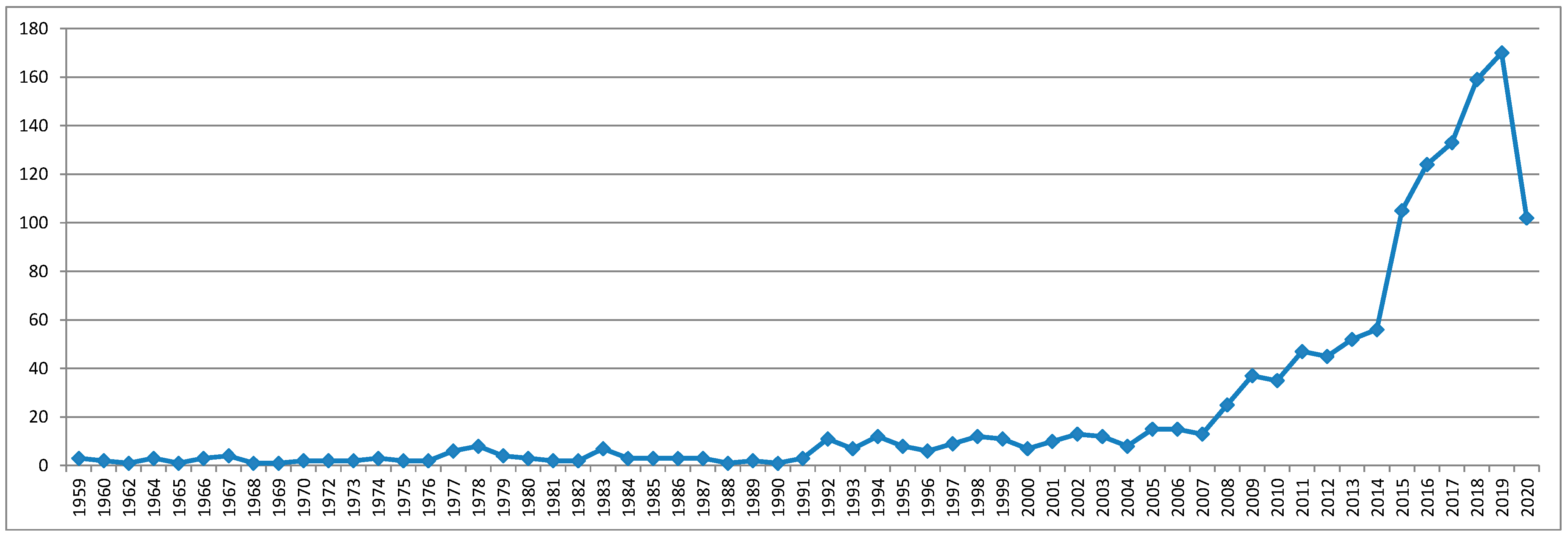
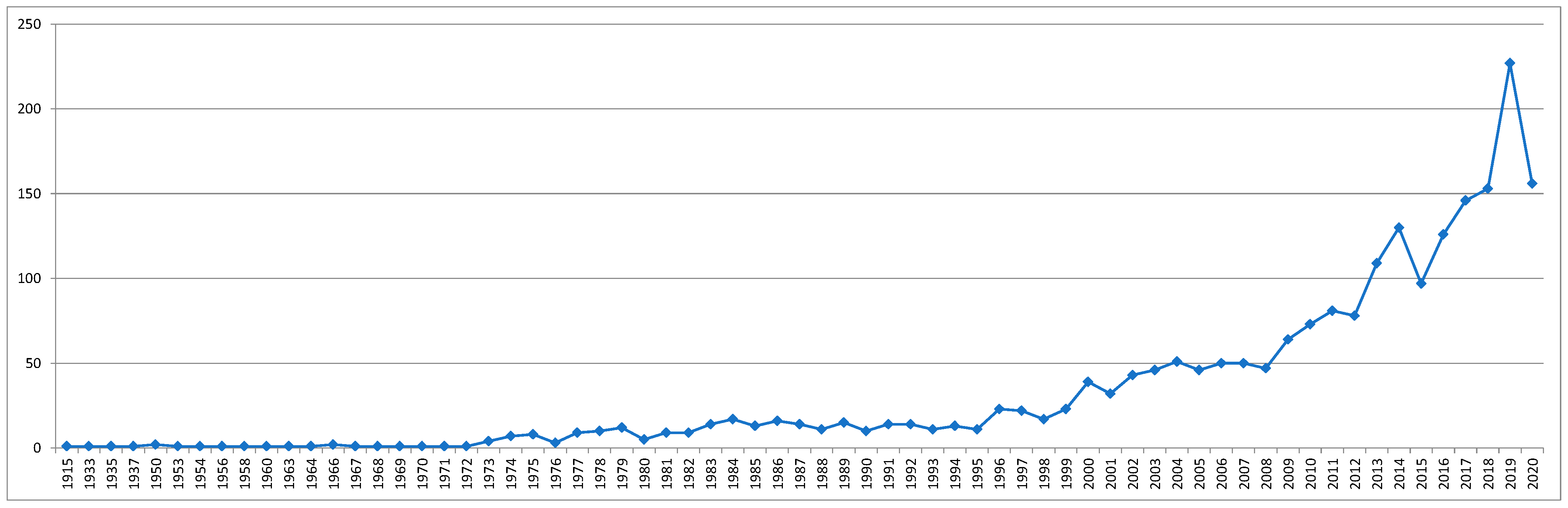
Figure 1 and Figure 2 show that there was an increased interest in scientific literature for the topic “working capital” over the past few decades, which further increased after 2007/2008 and then decreased in 2020. This may have been due to the Covid-19 pandemic, which reduced working dynamics in some cases and changed search topics in other cases. In any case, from 18 November 2020 there was almost a month and a half left to the end of the year.
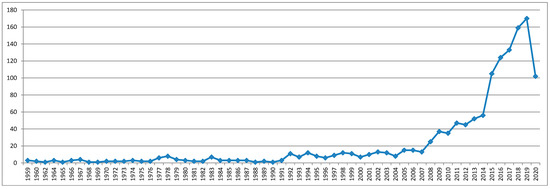
Figure 1.
Distribution of records by year (WoS).
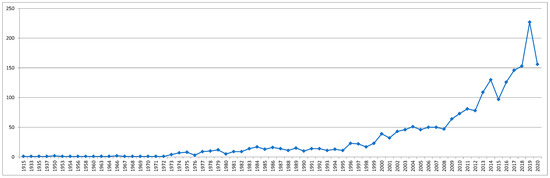
Figure 2.
Distribution of records by year (Scopus).
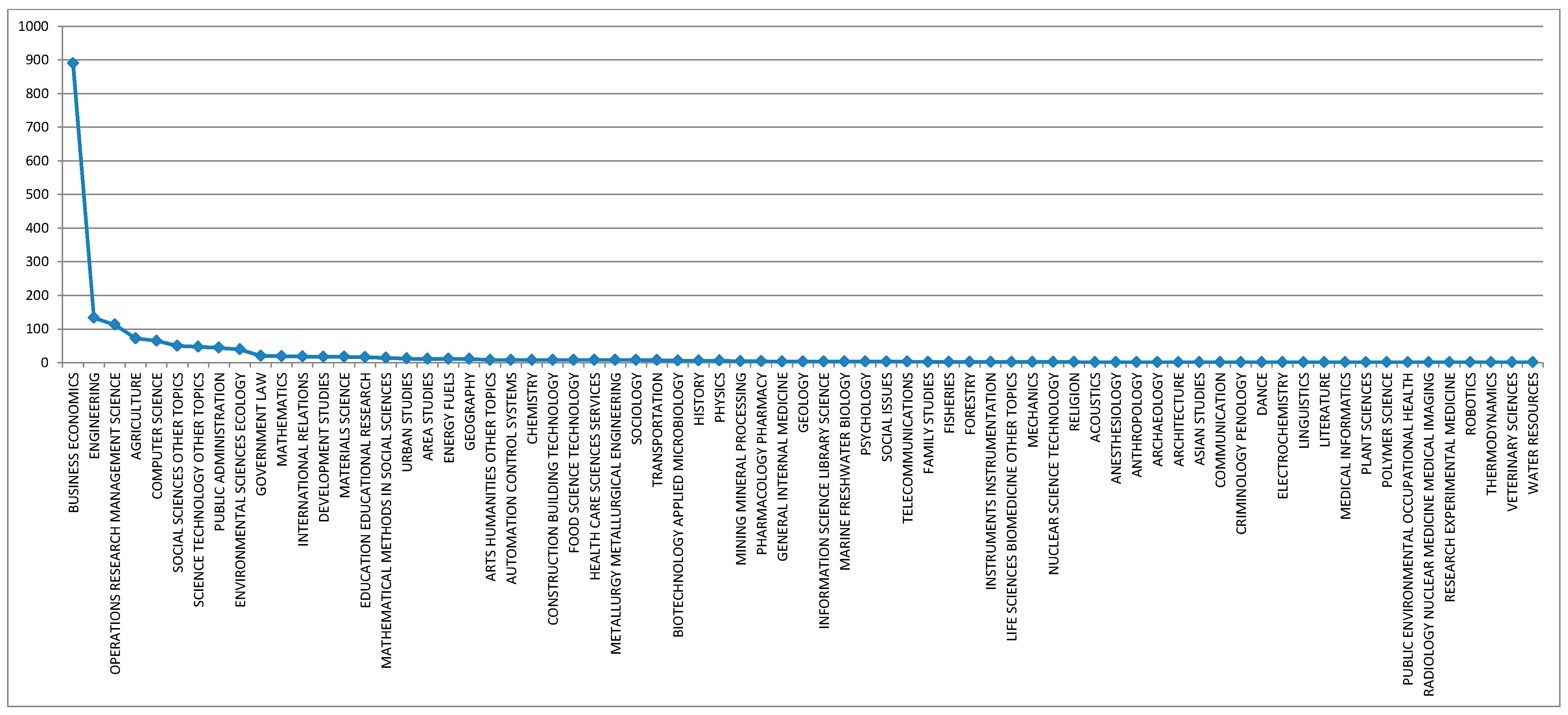
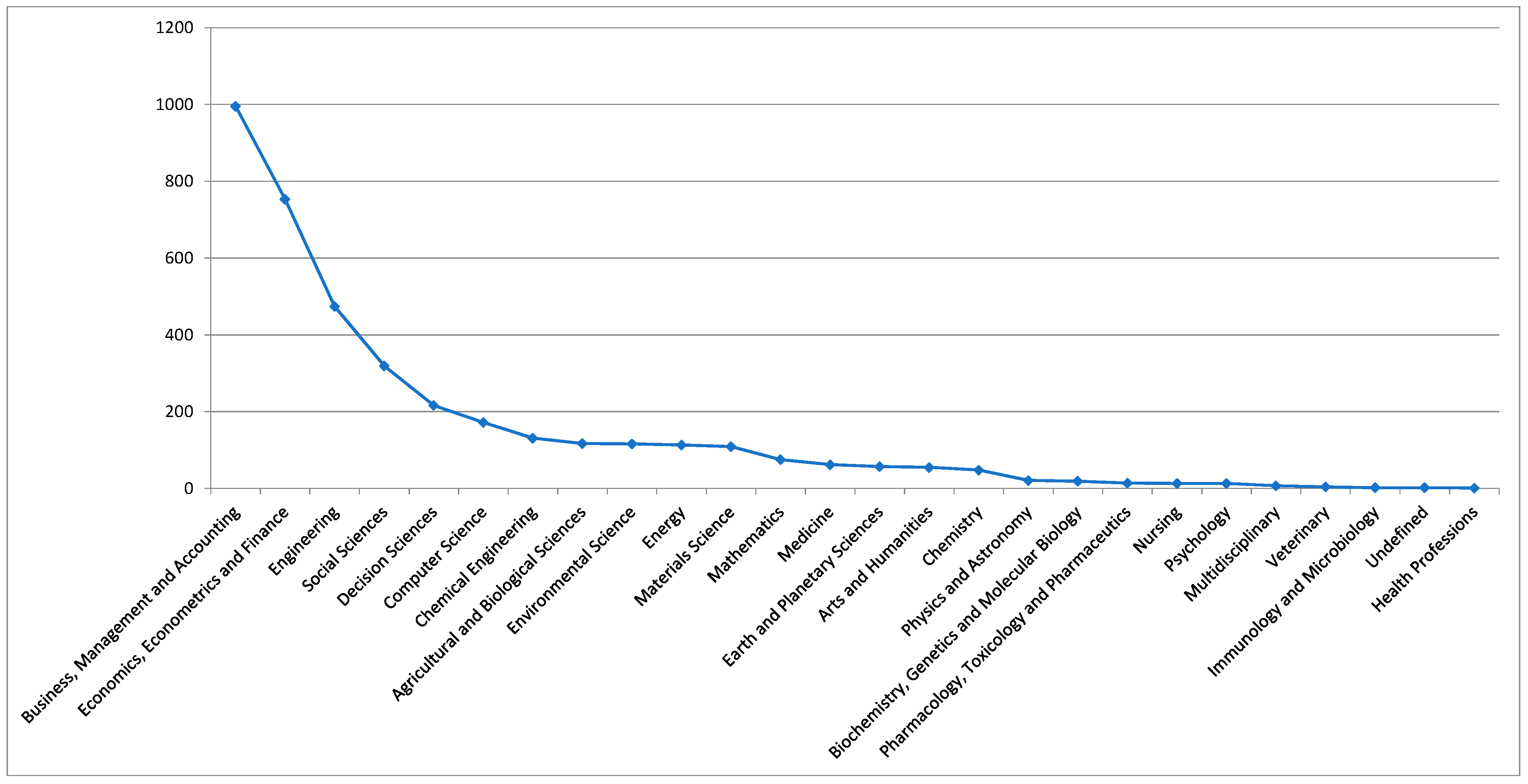
The main search areas on WoS were those relating to “Business Economics”, “Engineering”, “Operations Research Management Science”, “Agriculture”, “Computer Science”, “Social Sciences Other Topics”, “Science Technology Other Topics”, “Public Administration”, “Environmental Sciences Ecology” and “Government Law” (Figure 3). Figure 4 reveals that in the Scopus database, the main subject areas are “Business, Management and Accounting”, “Economic, Econometrics and Finance”, “Engineering”, “Social Sciences”, “Decision Sciences”, “Computer Science”, “Chemical Engineering”, “Agricultural and Biological Sciences”, “Environment Science”, “Energy”, and Material Science”. Figure 3 and Figure 4 show that the topic “working capital” is multidisciplinary, nonetheless, the great part of the research was carried out in the domains of business, economics, management, and engineering.
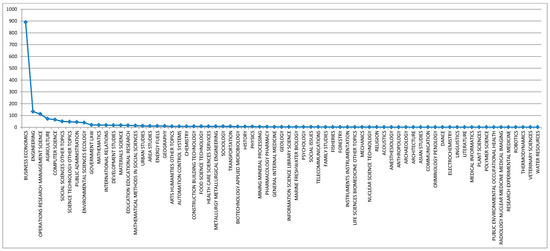
Figure 3.
Distribution of records by areas of search (WoS).
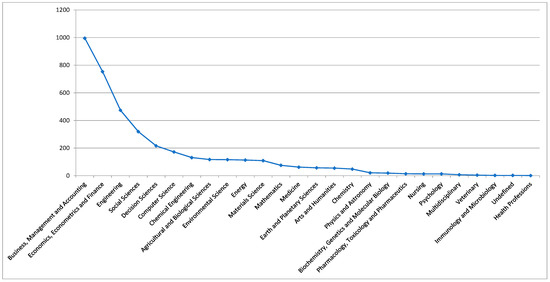
Figure 4.
Distribution of records by subject area (Scopus).
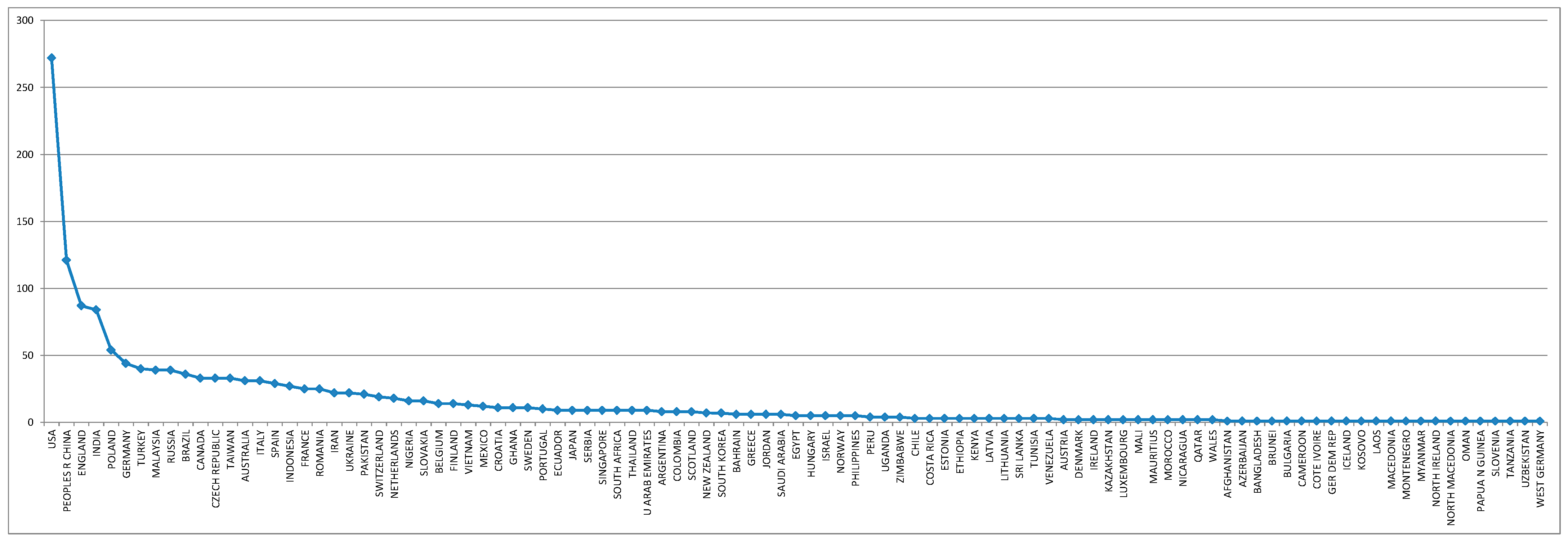
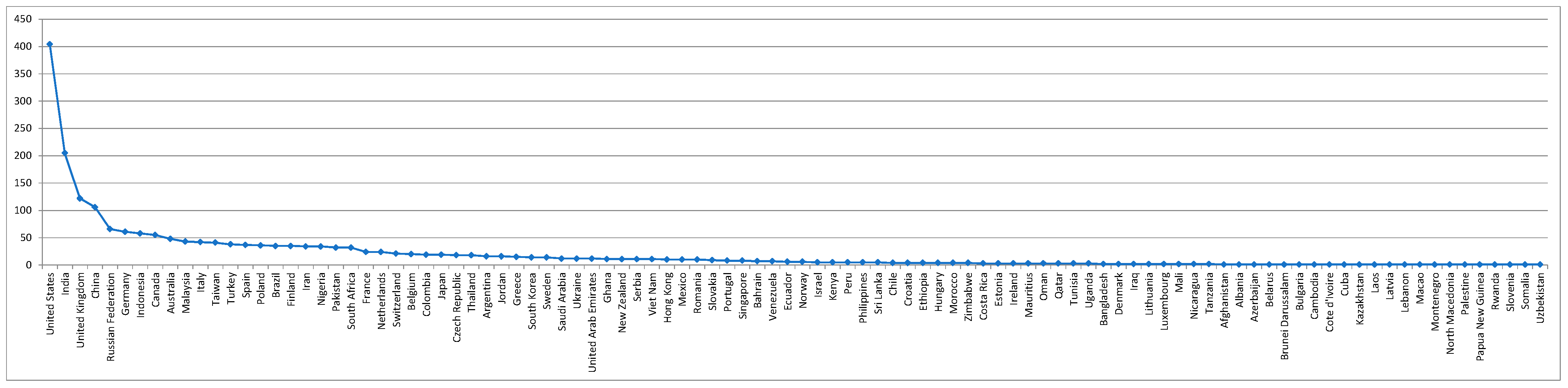
A large amount of the studies were developed by researchers affiliated to institutions from the USA and China, but also, from England, India, Poland, Germany, Turkey, Malaysia, Russia, Brazil, Canada, Czech Republic, Taiwan, Australia, Italy, and Spain (Figure 5 and Figure 6). The USA, China, India, and the United Kingdom are, in fact, the leading countries in terms of the number of studies associated with the various dimensions for working capital and this may provide interesting findings, namely, to support the identification of groups of study in these fields for future cooperation and networking.
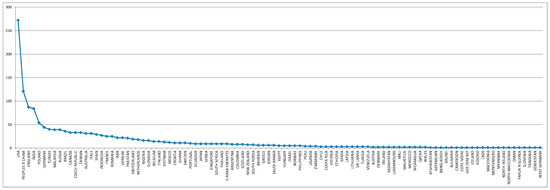
Figure 5.
Distribution of records by country/region (WoS).
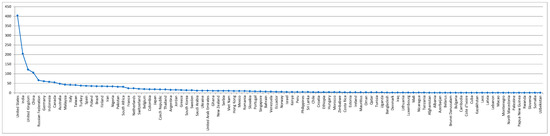
Figure 6.
Distribution of records by country (Scopus).
The benchmark carried out here, to answer the research question “(1) Are there significant differences between the WoS and Scopus databases?”, reveals that, indeed, there is very little difference between the two scientific databases concerning the topic “working capital”, showing that in terms of metadata assessment they may be considered as alternatives.
3.2. Outputs from Bibliographic Data
The great number of documents found on Scopus (2200 studies) hampers the export of information from this database. For this reason, only the information from the WoS, which was explored through the VOSviewer and Gephi supports, was considered in this subsection.
In this subsection the following concepts will be considered with the respective meanings:
- -
- Norm. Citations: number of citations of the document weighted by the average number of citations of all documents published in the same year and considered in the data that is supplied by VOSviewer. The normalization adjusts for the fact that older documents have had more time to obtain citations than more recent documents (van Eck and Waltman 2020; VOSviewer 2020);
- -
- Avg. citations: the average number of citations received by the studies in which a keyword appears or the average citations obtained by the documents published by a source, an author, an organization, or a country (van Eck and Waltman 2020; VOSviewer 2020);
- -
- Avg. pub. year: the average publication year of the studies in which a keyword appears or the average publication year of the studies published by a source, an author, an organization, or a country (van Eck and Waltman 2020; VOSviewer 2020);
- -
- Degree: number of edges that connect with a node (Bastian et al. 2009; McTavish 2020; Gephi 2020);
- -
- Eccentricity: distance from a node to the extreme node from it within the network (Bastian et al. 2009; McTavish 2020; Gephi 2020);
- -
- Closeness centrality: average distance between any two nodes within the network (Bastian et al. 2009; McTavish 2020; Gephi 2020);
- -
- Harmonic closeness centrality: variant of closeness centrality, which was carried out to deal with problems of unconnected graphs (Bastian et al. 2009; McTavish 2020; Gephi 2020);
- -
- Betweenness centrality: quantifies how often a node appears on the shortest path between any two nodes (Bastian et al. 2009; McTavish 2020; Gephi 2020);
- -
- Authority: estimates the value of the content of the node (Bastian et al. 2009; McTavish 2020; Gephi 2020);
- -
- Hub: estimates the value of its links to other nodes (Bastian et al. 2009; McTavish 2020; Gephi 2020);
- -
- Modularity: processes the division of the network into clusters (Bastian et al. 2009; McTavish 2020; Gephi 2020);
- -
- Pageranks: probability of clicking through to each node, given a certain number of casual clicks through links (Bastian et al. 2009; McTavish 2020; Gephi 2020);
- -
- Clustering: measures the connections between nodes (Bastian et al. 2009; McTavish 2020; Gephi 2020);
- -
- Triangles: number of triangles that pass through each node (Bastian et al. 2009; McTavish 2020; Gephi 2020);
- -
- Eigenvector Centrality: measures the node’s importance considering its connections to other nodes (Bastian et al. 2009; McTavish 2020; Gephi 2020).
The data obtained were bibliometrically tested through co-occurrence and co-authorship links.
3.2.1. Co-Occurrence Analysis
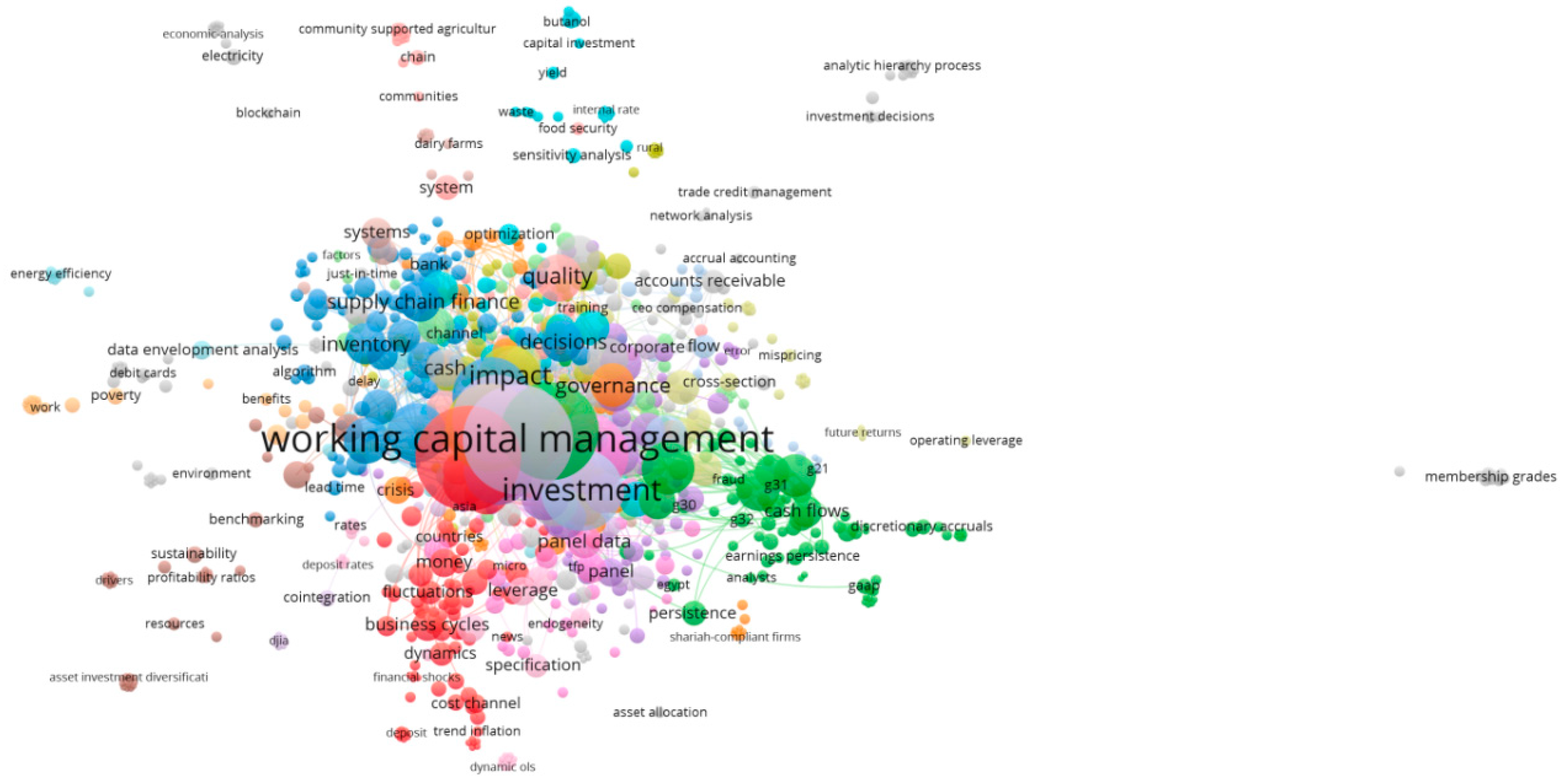
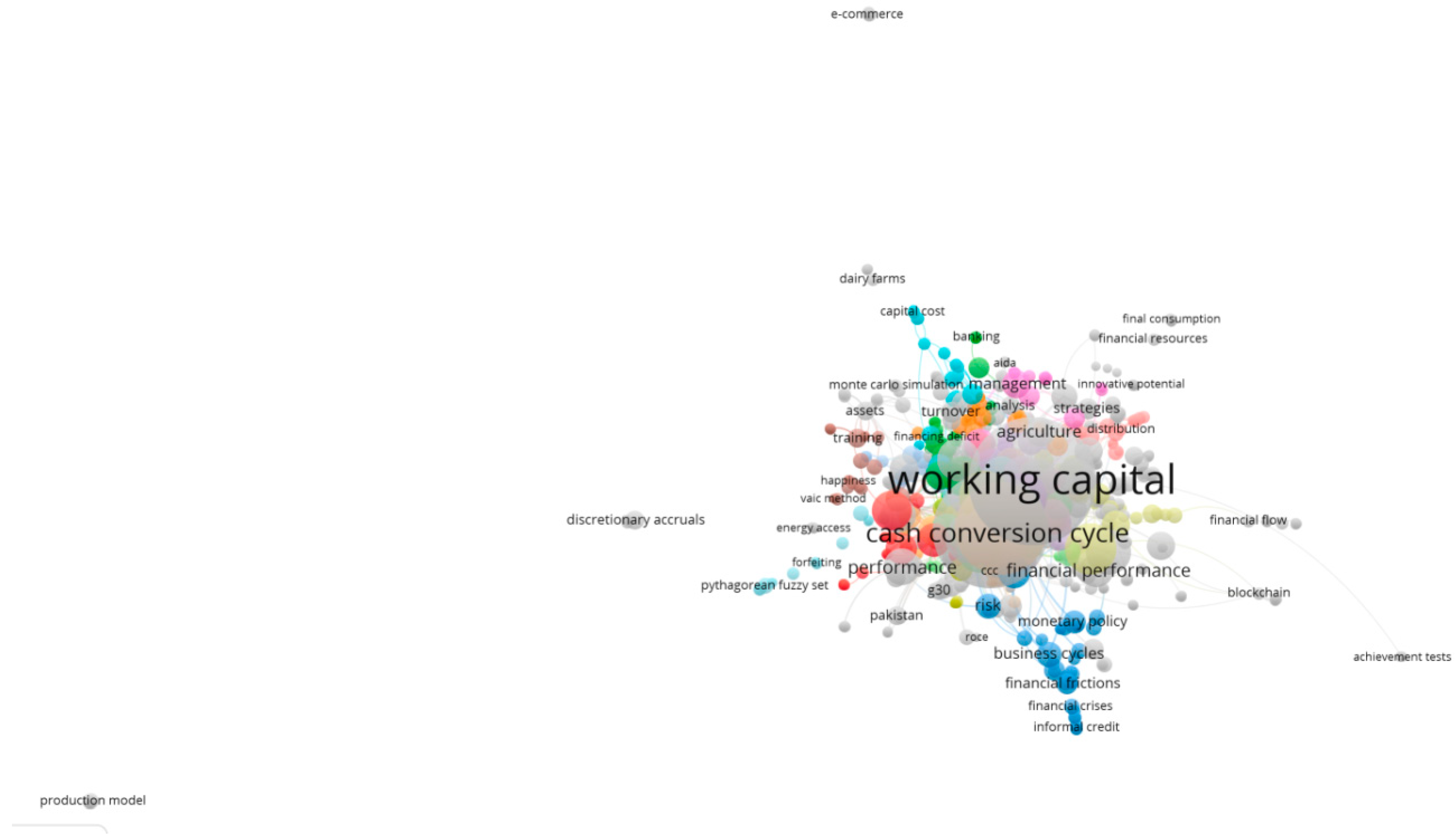
Figure 7 and Figure 8 and Table 1 and Table 2 were obtained with the VOSviewer software for the links’ co-occurrences and items all keywords and author keywords, respectively. In Figure 7 and Figure 8, the dimension of the circle represents the number of occurrences and the proximity of the relatedness (number of documents in which they occur together). In addition, each color represents a cluster. In Table 1 and Table 2 occurrences is the number of studies in which a keyword appears, (van Eck and Waltman 2020). Table 1 and Table 2 were presented to complement the readability of Figure 7 and Figure 8. In these tables only the top 15 items were presented as a compromise between avoiding presenting too much information and presenting sufficient data to support the analysis, following, for example, (Martinho 2021).
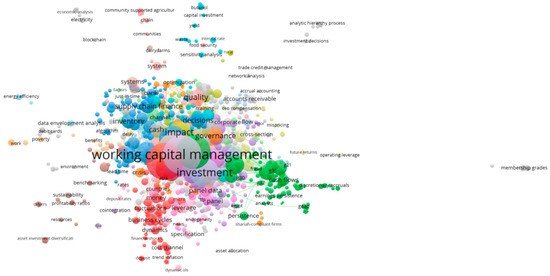
Figure 7.
Co-occurrence links and all keywords, considering 1 as the minimum number of occurrences of a keyword and 1000 as the number of keywords selected.
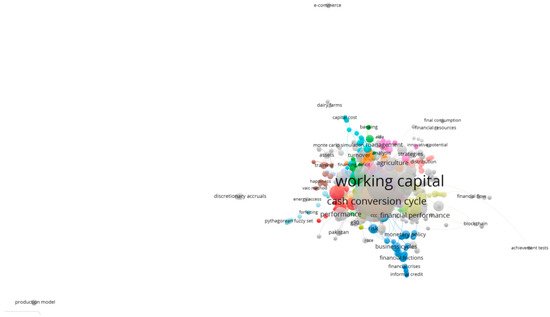
Figure 8.
Co-occurrence links and author’s keywords, considering 1 as the minimum number of occurrences of a keyword and 1000 as the number of keywords selected.

Table 1.
Co-occurrence links and top 15 (occurrences) all keyword items, considering 1 as the minimum number of occurrences of a keyword and 1000 as the number of keywords selected.
Table 2.
Co-occurrence links and top 15 (occurrences) author keywords, considering 1 as the minimum number of occurrences of a keyword and 1000 as the number of keywords selected.
When all keywords are considered, the results show that working capital management appears to be interrelated in literature with concepts such as the following: performance; profitability; management; investment; determinants; trade credit; firms; impact; liquidity; cash conversion cycle; model; policy; information; growth; risk; financial constraints; SMEs; firm performance; quality; demand; credit; constraints; finance; governance. In fact, working capital does have implications in the performance and profitability of firms, but is dependent on several factors, such as the availability of credit and financial constraints. Due to this context, good management and governance is crucial, where financial policies and information may play a decisive role. In turn, cash flows and money are older keywords, whereas coordination and leverage are more recent. The documents having a greater average of citations are those where the keyword ‘cash flows’ appears and less so with those where the keyword ‘agriculture’ occurs.
Only when the authors’ keywords are considered, concepts such as profitability, cash conversion cycle, liquidity and SMEs have greater importance. The working capital policies, such as the cash conversion cycle, are essential for a firm’s good performance, as well as the liquidity, namely in small and medium-sized enterprises (SMEs). The most recent keyword is ‘financial stability’ and the oldest ‘earnings management’. The studies having a greater average in citations are those with the keyword ‘operating cycle’ and less so for those with keywords such as ‘management’.
These findings highlight that the new concerns and interest for researchers related to the “working capital” topic are more focused on questions related to coordination, leverage, and financial stability.
- Highlighting the main gaps in literature
Concerning the research question “(2) What are the main gaps in scientific literature?”, the co-occurrence analysis complemented by the literature analysis reveals that related to the “working capital” topic, there are not many studies associated with sustainability and sustainable development, which should be a motive of concern for the several stakeholders, namely researchers. In addition, there are also few studies related to the fields of research of the author, such as, for example, the wine sector and the context of the affiliated country (Portugal) (Web of Science 2020). From this perspective, there are gaps here in the scientific literature which call for more research in these fields. In fact, working capital is an interesting indicator in order to assess the financial and economic dynamics in the European wine sector, namely in terms of liquidity. Low levels of WC (working capital) for wine producers may be signs of weaknesses in their liquidity (Migliaccio and Tucci 2019). The WC, across its several dimensions highlighted by the literature, jointly with other farm indicators such as farm labor costs and land may support in the definition of sustainable frameworks for vineyards and the wine sector as a whole (Falcone et al. 2015). It may also be a useful indicator, jointly with the cost of capital and operating costs, in the identification of the most profitable investment alternatives for vineyards (Repisky 2013). In the Portuguese context, the WC indicator was considered to carry out investment analysis in dealing with forest biomass (Cardoso et al. 2019) and to assess the interrelationships of working capital management with profitability in the SMEs (Pais and Gama 2015). The relationships between WC management and profitability were also assessed for the Spanish context, namely for cheese companies, where financial constraints were highlighted for the SMEs and the relevance of the WC policies (Fernandez-Lopez et al. 2020b). These interrelationship assessments are particularly important in order to analyze implications when the ecological variables are considered from a global context of great change in the environmental and human health dimensions (Fernandez-Lopez et al. 2020a).
Considering the relevance given by researchers to the keyword “working capital management” in this study the main insights from the documents associated in WoS with the topics “working capital management” and “policies” will be highlighted through literature review. Following, for example, Fernandez-Lopez et al. (2020b), it is interesting to further explore the dimensions for working capital management policies.
3.2.2. Co-Authorship Analysis
Considering VOSviewer procedures, the co-authorship analysis takes into account as relatedness between the items researched (authors, organizations, and countries) and networked, the number of co-authored documents. In this part of the research the network output was obtained through the VOSviewer software and this information was later worked through the Gephi software to obtain several metrics, namely centrality statistics. The intention here was to answer the research question “(3) What is the level of network and centrality in co-authorships?”.
- The most productive networked authors
The researchers Timo Karri and Miia Pirttila are the authors having more documents (3) and more total citations (37). However, when the citations are corrected from the time effects (Norm. Citations), Florian Schupp is the leading author and when the citations are considered on average the authors with more impact are Lotta Lind and Sari Viskari. These two last authors are also those with an older average for the publication year, which has influenced the high number of total and average citations received (Table 3).
Table 3.
Co-authorship links and authors items, considering 1 as the minimum number of documents from an author.
Table 4 shows that Florian Schupp is the author having a greater number of edge connections (degree), less distance with the most extreme author within the network (eccentricity), the most average distance between any two authors in the network (closeness centrality), appears the most on the shortest path between any two authors (betweenness centrality), the most estimated value over other authors (authority), the most estimated value given by other authors (hub), more importance inside the network (pageranks), greatest number of triangles that pass through this author (triangles), and more connections with other authors (eigenvector centrality).
Table 4.
Network, node, and edge statistics for co-authorship links and author items, considering 1 as the minimum number of documents of an author.
This means that this author alternatively has co-authorships with the majority of the other authors in the network. In addition, the authors Timo Karri and Miia Pirttila have the same metrics (Table 4) and this means that they are co-authors and in this case within the same documents.
- The leader networked organizations
The National Bureau of Economic Research, University of Illinois, American University, Boston University, Purdue University, University of Michigan, University of Oxford and University of Texas in Austin are the most productive organizations concerning the topic “working capital”. Nonetheless, in terms of scientific impact, the University of Michigan and University of Washington are the organizations that have a greater total and average of citations and NBER with more normalized citations. The University of Texas is among the organizations with an older average publication year and the University of North Carolina among those with the most recent. Table 5 only shows the results for the top 15 organizations, as a consequence, some of the institutions mentioned here do not appear in this table.
Table 5.
Co-authorship links and top 15 (documents) organizations items, considering 1 as the minimum number of documents of an organization.
The MIT is the most important organization in the network in terms of connections and importance (considering the higher values for the degree and for the eigenvector centrality). The same happens in terms of importance received and given to the other authors (authority and hub, respectively). However, in terms of betweenness centrality (bridge between different clusters) the NBER appears in the interface among different organizations in terms of co-authorship (Table 6). On the other hand, there are a set of organizations, such as real estate firms, banks, energy, and oil companies, which have the same metrics, revealing their interrelationships in these co-authorship analyses.
Table 6.
Network, node, and edge statistics for co-authorship links and top 15 (degree) organization items, considering 1 as the minimum number of documents of an organization.
- The most productive networked countries
Table 7 (which only presents the results for the top 15 organizations, as a consequence, some of the institutions mentioned here do not appear) reveals that the most productive networked countries are the USA, China, England, India, Poland, Germany, Malaysia, Russia, Turkey, and Brazil, in line with the findings highlighted from Figure 5. In addition, the USA, China, and England are the countries having a greater scientific impact, in terms of total and normalized. For the average citations Denmark, Ireland, Argentina, and then the USA appear. The United States is, indeed, a determinant country for these networks of co-authored documents.
Table 7.
Co-authorship links and top 15 (documents) countries items, considering 1 as the minimum number of documents of a country.
The USA, England, China, Australia, and Argentina are the most important countries inside the network, considering their connections with other countries (higher values for degree, eigenvector centrality, authority, and hub). On the other hand, the USA, England, Malaysia, Australia, India, Argentina, and Germany are the main bridges inside the network, considering the values for betweenness centrality (Table 8). These findings highlight the importance, in terms of co-authorships in the topic, “working capital”, for countries such as England and Germany in Europe, the USA in the northern America, Argentina in southern America, Malaysia, China and India in Asia, and Australia in Oceania.
Table 8.
Network, node, and edge statistics for co-authorship links and top 15 (degree) countries items, considering 1 as the minimum number of documents of a country.
4. Highlighting Insights Related to the Topics “Working Capital Management” and “Policies”
This section aims to obtain answers to the question “(4) What are the most relevant insights from specific subtopics?”.
4.1. Working Capital Dimensions
The WC dimension is dependent on the several components of the current assets and liabilities, where, for example, accounts receivable (Abdulla et al. 2020), accounts payable (Abuhommous 2017), and inventories and cash (Michalski et al. 2018) have their impacts. In turn, the trade credit strategy depends on several factors such as cash flow, sales growth, and profitability (Abuhommous and Mashoka 2018), as well as, inventories, market share, export conditions (Afrifa and Gyapong 2017), market cycles (Lorentz et al. 2016), and collateral to secure financing (Paul et al. 2018). The relationships between trade credit and profitability were found to be inverted, U-shaped, in the SMEs, characterized by the existence of an optimal (Hoang et al. 2019), influenced by the periods considered for the accounts receivable and payable (Rauscher and Wheeler 2012), and depend on the firms’ characteristics (Yazdanfar and Ohman 2016). The accounts receivable are, in some cases, negatively interrelated to the managerial risk-taking incentives (Yao and Deng 2018). Nonetheless, sometimes in some contexts, these relationships between trade credit and profitability are not the consequence of any firm strategy, but a natural implication (Nguyen and Nguyen 2018).
4.2. Working Capital Management Policies
The working capital management (WCM) policies influence the financial performance (Adam and Quansah 2019) of firms in several sectors around the world (Kabuye et al. 2019), namely in terms of liquidity (Chen 2018), their economic results (Adam et al. 2017), value creation (Frimpong 2018), and shareholder returns (Masri and Abdulla 2018). Firm value is interrelated with cash holdings (Anton and Nucu 2019). However, the shape of the relationships between the WCM and profitability are not unanimous among the researchers (Altaf and Shah 2018). In any case, the inverted U-shape relationship is defended by several findings (Botoc and Anton 2017). It would be worth highlighting that the different WCM policies have distinct impacts on firm variables (Pham et al. 2020) in several sectors around the world (Tahir and Anuar 2016). The firms’ performance dimension depends on the variable considered to quantify it (Vieira et al. 2019). Nonetheless, the performance is, also, impacted by the inventory holding strategies (Afrifa and Berchie 2019) and by the economic resource management (Maity et al. 2019). In general, firms with higher levels of WC pay their liabilities over a shorter period (Falavigna and Ippoliti 2020). The WCM policies also impact the firm’s ability to deal with adverse market cycles (Filbeck et al. 2017). The lack of WC is a constraint for firms (Maliwichi et al. 2011), because it hampers the management of current debts and obligations (Monastyrenko 2017) and may increase financing costs (Zabolotnyy and Sipilainen 2020).
The impacts from the WCM on profitability depend on internal options (Azeez et al. 2016), on external factors such as the level of globalization (Akdogan and Dinc 2019) and the current stage of the firm’s life cycle (Wang et al. 2020). Globalization and internationalization have, indeed, real implications on a firm’s performance (Shah et al. 2018). These relationships between the WCM and profitability are often influenced, specifically, by the level of financial leverage (Dalci and Ozyapici 2018), reverse factoring approaches (Damianos Lekkakos and Serrano 2016), reinvestment in the firms (Heryan 2020), inventories, receivables and payables management (Lyngstadaas and Berg 2016), and macroeconomic indicators (Simon et al. 2019). The variables considered to represent the WCM and profitability have their implications in the respective interrelationships (Vukovic et al. 2017). On the other hand, WCM practices are different around the world, between sectors and firm sizes. For example, in India the SME firms have an informal approach to WC, preferring, often, maturity of assets (Baker et al. 2019).
The Cash Conversion Cycle (CCC) is a WCM policy considered as a target by several SME firms (Banos-Caballero et al. 2010), considering its relationship with profitability (Barac and Muminovic 2018), firm performance, and value (Moussa 2018). The relationship between CCC and profitability depends on the firm strategies (aggressive or conservative) in terms of WCM (Chang 2018) and the sector considered. For example, for agricultural and food firms in Thailand a significant and inverse relationship was found between the CCC and profitability (Linh and Mohanlingam 2018). This negative relationship was found in many other contexts (Singh et al. 2017), showing that profitability may be increased through shorter CCC and lower periods for accounts receivable (Talezari et al. 2015). Women as managers adopt, in general, more conservative WC strategies (Nastiti et al. 2019). More aggressive WCM policies are often related to higher levels of profitability (Pais and Gama 2015) in firms (Prempeh and Peprah-Amankona 2020). Some studies support negative relationships between the CCC and the cash holding for SMEs, as well as for the CCC and bank credit (Sabki et al. 2019).
In turn, there is an optimal dimension for WC policies (Aktas et al. 2015) which has been persecuted by several studies (Poluyanov and Palamarchuk 2017), since it was necessary to find a satisfactory solution for several parties (Arcelus and Srinivasan 1993), in order to avoid decreases in firm returns (Banos-Caballero et al. 2012) and increases in costs (McDaniel 1995). Nonetheless, this is not a consensual approach among the researchers. In fact, in some cases, there is a relative persistence over time in working capital strategies, contradicting the idea of an effort of the firms to achieve an optimal (Chauhan 2019).
The main factors that affect the WC are market cycles, firm conditions, and macroeconomic contexts (Ali and Khan 2011). The variables for a firm’s condition are often those related to age, size (Fiador 2016), and observed utility (Orobia et al. 2016). The availability of bank credit is another variable that affects the working capital management strategies considerably and which is different among firms in terms of their dependencies on bank funding (Chen and Kieschnick 2018). Sales expectations, financial limitations and bankruptcy risks (Kieschnick et al. 2013), hedging strategies (Kieschnick and Rotenberg 2016), and inventory strategies (Luo and Shang 2019) are other factors that may impact the WC. Financial constraints are often represented by investment-cash flow sensitivities (Riaz et al. 2016).
5. Discussion
The main objective of this research was to analyze several dimensions of the “working capital” topic highlighted in scientific literature. Therefore, thousands of documents from the Web of Science Core Collection and Scopus were assessed, first through bibliometric approaches and subsequently through literature review. In this framework, the metadata from the two databases were benchmarked, gaps in the literature were identified, co-authorships between authors, organizations and countries were analyzed and insights into the specific subtopics “working capital management” and “policies” were highlighted.
The benchmark among the WoS and Scopus reveals that there are not many differences in the metadata supplied by both databases for the topic “working capital” and in this case may be considered as an alternative for meta-analysis. This is in line with the findings of Martinho (2021) for other topics. This benchmark also highlights that interest from researchers for this topic has increased over recent decades and increased significantly over the last few years, following the trend verified by science in general. On the other hand, it has also shown that the approaches concerning this topic cross several domains within science, whilst fields related to business, the economy, and engineering predominate. Finally, the USA, China, India, and the United Kingdom focus a large part of the studies produced on “working capital”.
The bibliographic data analysis reveals several gaps in the literature related to this topic. The major concern is the reduced amount of research covering the subtopics related to sustainability and sustainable development in thousands of documents associated with “working capital”. This should be a motive for concern and should be addressed appropriately by several stakeholders, namely policymakers and researchers. Another gap is the almost total absence of studies related to specific subtopics, as highlighted by Nobanee and Dilshad (2021), but relevant for many countries and regions, such as, for example, agriculture, in general. In turn, this approach shows the relevance of subtopics such as “working capital management” that were surveyed through the literature review in this study, namely in its interrelationships with the respective “policies”. Finally, a centrality analysis highlights an importance for the co-authorship network of authors such as Florian Schupp, in terms of connections with other authors and in terms of “bridging” among groups of authors. The centrality analysis also highlights the relevance of institutions such as MIT and the NBER and countries such as England, Germany (Europe), the USA, Argentina (America), Malaysia, China, India (Asia), and Australia (Oceania).
The assessments of the topics “working capital management” and “policies” highlight that the relationships between trade credit and profitability are U-shaped (Hoang et al. 2019) and dependent on firms’ characteristics, however these findings are not unanimous among researchers. Indeed, there is a continuous objective within working capital management policies in order to achieve better profitability and financial performance, thus annulling the perspective that firms intend towards finding an optimal.
6. Conclusions, Practical Implications and Suggestions for Future Research
Working capital (WC) is a concept considered in literature as being, in general, a financial indicator having impacts on profitability and is used as a balance between current assets and current liabilities. This concept is used to assess the liquidity of companies and their capacity to deal with short-term commitments (Jiang et al. 2016). Sometimes it is referred to in literature as being related to other meanings such as, for example, stock of productive capital (Pena Sanchez et al. 2018), or variable inputs.
In terms of practical implications, this research shows that there is potential for further investigation into co-authorship, and this is because the groups of networked research which already exist are few and short. On the other hand, it is important to increase research for the topics addressed here in more countries around the world, as currently, the documents found were from authors affiliated to a limited number of countries. In any case, the authors, institutions, and countries identified as being the most relevant within those networked may be considered as benchmarks and a propulsion for new networks. In turn, the databases WoS and Scopus seem to be alternatives for these topics. In addition, these studies presented that the relationships between the working capital and the sustainability could be better addressed and the impacts from the working capital management in specific sectors.
For future research, it will be necessary to create more networks, namely in terms of co-authorship in order to carry out more studies in topics related to working capital where several gaps in literature were identified, such as, those related to sustainability and agriculture, for example. In addition, it could be interesting to perform a deeper analysis of the following points:
- -
- What are the main relationships between profitability, financial performance, and the working capital management policies? In practice, are they U-shaped or inverted U-shaped?
- -
- How does globalization and internationalization impact these relationships in several sectors and regions?
- -
- What are the marginal impacts from the several dimensions of the working capital management policies on profitability and financial performance worldwide?
- -
- What are the main relationships of the working capital dimensions with the social and environmental concerns of the firms?
- -
- How do the social and environmental concerns of the firms impact the profitability and the financial performance?
Funding
This work is funded by National Funds through the FCT—Foundation for Science and Technology, I.P., within the scope of the project Refª UIDB/00681/2020.
Institutional Review Board Statement
Not applicable.
Informed Consent Statement
Not applicable.
Data Availability Statement
The data presented in this study are available on request from the corresponding author.
Acknowledgments
I would like to thank the CERNAS Research Centre and the Polytechnic Institute of Viseu for their support. I would also like to thank Ernesto Lopez-Valeiras (Business and Tourism Faculty, University of Vigo, Ourense, Spain) and Freddy Coronado (Facultad de Economía y Negocios, Universidad de Chile, Santiago, Chile) for their comments.
Conflicts of Interest
The author declares no conflict of interest.
References
- Abdulla, Yomna, Viet Anh Dang, and Arif Khurshed. 2020. Suppliers’ Listing Status and Trade Credit Provision. Journal of Corporate Finance 60: 101535. [Google Scholar] [CrossRef]
- Abuhommous, Ala’a Adden. 2017. Partial Adjustment toward Target Accounts Payable Ratio. International Journal of Islamic and Middle Eastern Finance and Management 10: 484–502. [Google Scholar] [CrossRef]
- Abuhommous, Ala’a Adden, and Tareq Mashoka. 2018. A Dynamic Approach to Accounts Receivable: The Case of Jordanian Firms. Eurasian Business Review 8: 171–91. [Google Scholar] [CrossRef]
- Adam, Anokye M., and Edward Quansah. 2019. Effects of Working Capital Management Policies on Shareholders’ Value: Evidence from Listed Manufacturing Firms in Ghana. Panoeconomicus 66: 659–86. [Google Scholar] [CrossRef] [Green Version]
- Adam, Anokye M., Edward Quansah, and Seyram Kawor. 2017. Working Capital Management Policies and Returns of Listed Manufacturing Firms in Ghana. Scientific Annals of Economics and Business 64: 255–69. [Google Scholar] [CrossRef] [Green Version]
- Afrifa, Godfred Adjapong, and Ernest Gyapong. 2017. Net Trade Credit: What Are the Determinants? International Journal of Managerial Finance 13: 246–66. [Google Scholar] [CrossRef]
- Afrifa, Godfred Adjapong, and Stephen Berchie. 2019. Inventory Holding and UK SMEs’ Performance. International Journal of Business Performance Management 20: 16–33. [Google Scholar] [CrossRef]
- Akdogan, Ece C., and Dilek Temiz Dinc. 2019. Managing Working Capital Efficiency in Turkish Agribusinesses and the Impact of Globalization: Insights from an Emerging Market. International Food and Agribusiness Management Review 22: 557–69. [Google Scholar] [CrossRef]
- Aktas, Nihat, Ettore Croci, and Dimitris Petmezas. 2015. Is Working Capital Management Value-Enhancing? Evidence from Firm Performance and Investments. Journal of Corporate Finance 30: 98–113. [Google Scholar] [CrossRef]
- Ali, Shahid, and Muhammad Ramzan Akhtar Khan. 2011. Searching for Internal and External Factors That Determine Working Capital Management for Manufacturing Firms in Pakistan. African Journal of Business Management 5: 2942–49. [Google Scholar]
- Altaf, Nufazil, and Farooq Ahmad Shah. 2018. How Does Working Capital Management Affect the Profitability of Indian Companies? Journal of Advances in Management Research 15: 347–66. [Google Scholar] [CrossRef]
- Anton, Sorin Gabriel, and Anca Elena Afloarei Nucu. 2019. Firm Value and Corporate Cash Holdings. Empirical Evidence from the Polish Listed Firms. E & M Ekonomie a Management 22: 121–34. [Google Scholar] [CrossRef]
- Arcelus, Francisco J., and Gopalan Srinivasan. 1993. Delay of Payments for Extraordinary Purchases. Journal of the Operational Research Society 44: 785–95. [Google Scholar] [CrossRef]
- Azeez, Olaniyi Taiwo, Muhammad Abdul Abubakar, and Fagbemi Temitope Olamide. 2016. Analysis of the Effects of Working Capital Management on Profitability of Listed Nigerian Conglomerate Companies. Fwu Journal of Social Sciences 10: 10–20. [Google Scholar]
- Baker, H. Kent, Satish Kumar, and Harsh Pratap Singh. 2019. Working Capital Management: Evidence from Indian SMEs. Small Enterprise Research 26: 143–63. [Google Scholar] [CrossRef]
- Banos-Caballero, Sonia, Pedro J. Garcia-Teruel, and Pedro Martinez-Solano. 2010. Working Capital Management in SMEs. Accounting and Finance 50: 511–27. [Google Scholar] [CrossRef]
- Banos-Caballero, Sonia, Pedro J. Garcia-Teruel, and Pedro Martinez-Solano. 2012. How Does Working Capital Management Affect the Profitability of Spanish SMEs? Small Business Economics 39: 517–29. [Google Scholar] [CrossRef]
- Barac, Zeljana Aljinovic, and Sasa Muminovic. 2018. Working Capital Management—Efficient Tool for Success of Milk Producers: True or False? New Medit 17: 61–72. [Google Scholar] [CrossRef]
- Bastian, Mathieu, Sebastien Heymann, and Mathieu Jacomy. 2009. Gephi: An Open Source Software for Exploring and Manipulating Networks. Paper presented at Third International AAAI Conference on Weblogs and Social Media, San Jose, CA, USA, May 17–20. [Google Scholar]
- Botoc, Claudiu, and Sorin Gabriel Anton. 2017. Is Profitability Driven by Working Capital Management? Evidence for High-Growth Firms from Emerging Europe. Journal of Business Economics and Management 18: 1135–55. [Google Scholar] [CrossRef] [Green Version]
- Cancino, Christian A., José M. Merigó, and Freddy C. Coronado. 2017. A Bibliometric Analysis of Leading Universities in Innovation Research. Journal of Innovation & Knowledge 2: 106–24. [Google Scholar] [CrossRef]
- Cardoso, Joao, Valter Silva, and Daniela Eusebio. 2019. Techno-Economic Analysis of a Biomass Gasification Power Plant Dealing with Forestry Residues Blends for Electricity Production in Portugal. Journal of Cleaner Production 212: 741–53. [Google Scholar] [CrossRef]
- Chang, Chong-Chuo. 2018. Cash Conversion Cycle and Corporate Performance: Global Evidence. International Review of Economics & Finance 56: 568–81. [Google Scholar] [CrossRef]
- Chauhan, Gaurav Singh. 2019. Are Working Capital Decisions Truly Short-Term in Nature? Journal of Business Research 99: 238–53. [Google Scholar] [CrossRef]
- Chen, Chongyang, and Robert Kieschnick. 2018. Bank Credit and Corporate Working Capital Management. Journal of Corporate Finance 48: 579–96. [Google Scholar] [CrossRef]
- Chen, Ting-Yu. 2018. An Outranking Approach Using a Risk Attitudinal Assignment Model Involving Pythagorean Fuzzy Information and Its Application to Financial Decision Making. Applied Soft Computing 71: 460–87. [Google Scholar] [CrossRef]
- da Silva Macedo, Marcelo Alvaro, and Aloizio Lunga. 2010. Bibliometric and critical mapping of the economical and financial viability analysis of agribusiness projects: An evaluation of the publication in the sober congress in the period 2006–2009. Custos E Agronegocio on Line 6: 67–88. [Google Scholar]
- Dalci, Ilhan, and Hasan Ozyapici. 2018. Working Capital Management Policy in Health Care: The Effect of Leverage. Health Policy 122: 1266–72. [Google Scholar] [CrossRef] [PubMed]
- Damianos Lekkakos, Spyridon, and Alejandro Serrano. 2016. Supply Chain Finance for Small and Medium Sized Enterprises: The Case of Reverse Factoring. International Journal of Physical Distribution & Logistics Management 46: 367–92. [Google Scholar] [CrossRef]
- Falavigna, Greta, and Roberto Ippoliti. 2020. The Impact of Institutional Performance on Payment Dynamics: Evidence from the Italian Manufacturing Industry. Journal of Business Economics and Management 21: 1285–306. [Google Scholar] [CrossRef]
- Falcone, Giacomo, Alfio Strano, Teodora Stillitano, Anna I. De Luca, Nathalie Iofrida, and Giovanni Gulisano. 2015. Integrated Sustainability Appraisal of Wine-Growing Management Systems through LCA and LCC Methodologies. Chemical Engineering Transactions 44: 223–28. [Google Scholar] [CrossRef]
- Fernandez-Lopez, Sara, Adrian Dios-Vicente, and David Rodeiro-Pazos. 2020a. Working Capital Management and Profitability on the Ecologic and Non-Ecologic Cheese Sector in Spain. Revista Espanola De Estudios Agrosociales Y Pesqueros-Reeap 255: 15–45. [Google Scholar]
- Fernandez-Lopez, Sara, David Rodeiro-Pazos, and Lucia Rey-Ares. 2020b. Effects of Working Capital Management on Firms’ Profitability: Evidence from Cheese-Producing Companies. Agribusiness 36: 770–91. [Google Scholar] [CrossRef]
- Fiador, Vera. 2016. Does Corporate Governance Influence the Efficiency of Working Capital Management of Listed Firms Evidence from Ghana. African Journal of Economic and Management Studies 7: 482–96. [Google Scholar] [CrossRef]
- Filbeck, Greg, Xin Zhao, and Ryan Knoll. 2017. An Analysis of Working Capital Efficiency and Shareholder Return. Review of Quantitative Finance and Accounting 48: 265–88. [Google Scholar] [CrossRef]
- Frimpong, Siaw. 2018. Working Capital Management Policies and Value Creation of Listed Non-Financial Firms in Ghana: A Panel FMOLS Analysis. Business and Economic Horizons 14: 725–42. [Google Scholar] [CrossRef]
- Gephi. 2020. Gephi—The Open Graph Viz Platform. 2020. Available online: https://gephi.org/ (accessed on 18 November 2020).
- Heryan, Tomas. 2020. Managers of Tourism Companies Can No Longer Expect Any Financial Support from Company Owners: Different Working Capital Management Due to the Global Financial Crisis. E & M Ekonomie a Management 23: 50–59. [Google Scholar] [CrossRef]
- Hoang, Huan Cong, Qin Xiao, and Saeed Akbar. 2019. Trade Credit, Firm Profitability, and Financial Constraints Evidence from Listed SMEs in East Asia and the Pacific. International Journal of Managerial Finance 15: 744–70. [Google Scholar] [CrossRef]
- Jiang, Wei, Meiting Lu, Yaowen Shan, and Tingting Zhu. 2016. Evidence of Avoiding Working Capital Deficits in Australia. Australian Accounting Review 26: 107–18. [Google Scholar] [CrossRef]
- Kabuye, Frank, Joachim Kato, Irene Akugizibwe, and Nicholas Bugambiro. 2019. Internal Control Systems, Working Capital Management and Financial Performance of Supermarkets. Cogent Business & Management 6: 1573524. [Google Scholar] [CrossRef]
- Kayani, Umar Nawaz, Tracy-Anne De Silva, and Christopher Gan. 2019. A Systematic Literature Review on Working Capital Management—An Identification of New Avenues. Qualitative Research in Financial Markets 11: 352–66. [Google Scholar] [CrossRef]
- Kent Baker, H., Nitesh Pandey, Satish Kumar, and Arunima Haldar. 2020. A Bibliometric Analysis of Board Diversity: Current Status, Development, and Future Research Directions. Journal of Business Research 108: 232–46. [Google Scholar] [CrossRef]
- Kieschnick, Robert, Mark Laplante, and Rabih Moussawi. 2013. Working Capital Management and Shareholders’ Wealth. Review of Finance 17: 1827–52. [Google Scholar] [CrossRef]
- Kieschnick, Robert, and Wendy Rotenberg. 2016. Working Capital Management, the Credit Crisis, and Hedging Strategies: Canadian Evidence. Journal of International Financial Management & Accounting 27: 208–32. [Google Scholar] [CrossRef]
- Linh, Nguyen Thi Phuong, and Sundaresan Mohanlingam. 2018. The Effects of Cash Conversion Cycle on Profitability: An Insight into the Agriculture and Food Industries in Thailand. Asian Journal of Business and Accounting 11: 97–119. [Google Scholar] [CrossRef]
- Lorentz, Harri, Tomi Solakivi, Juuso Toyli, and Lauri Ojala. 2016. Trade Credit Dynamics during the Phases of the Business Cycle—A Value Chain Perspective. Supply Chain Management: An International Journal 21: 363–80. [Google Scholar] [CrossRef]
- Luo, Wei, and Kevin H. Shang. 2019. Technical Note-Managing Inventory for Firms with Trade Credit and Deficit Penalty. Operations Research 67: 468–78. [Google Scholar] [CrossRef]
- Lyngstadaas, Hakim, and Terje Berg. 2016. Working Capital Management: Evidence from Norway. International Journal of Managerial Finance 12: 295–313. [Google Scholar] [CrossRef]
- Maity, Bipasha, Vidya Suresh, and Mehir Kumar Baidya. 2019. Performance of Indian Cement Industry: Drivers, Models and Empirics. Global Economy Journal 19: 1950009. [Google Scholar] [CrossRef]
- Maliwichi, L. L., S. A. Oni, and L. Sifumba. 2011. An Evaluation of the Performance of Small Scale Agribusinesses in Vhembe District of Limpopo Province, South Africa. African Journal of Agricultural Research 6: 3903–10. [Google Scholar]
- Martinho, Vítor Domingues, and Paulo Reis Mourão. 2020. Circular Economy and Economic Development in the European Union: A Review and Bibliometric Analysis. Sustainability 12: 7767. [Google Scholar] [CrossRef]
- Martinho, Vítor João Pereira Domingues. 2018. Interrelationships between Renewable Energy and Agricultural Economics: An Overview. Energy Strategy Reviews 22: 396–409. [Google Scholar] [CrossRef]
- Martinho, Vítor João Pereira Domingues. 2020. Agricultural Entrepreneurship in the European Union: Contributions for a Sustainable Development. Applied Sciences 10: 2080. [Google Scholar] [CrossRef] [Green Version]
- Martinho, Vítor João Pereira Domingues. 2021. Food and Consumer Attitude(s): An Overview of the Most Relevant Documents. Agriculture 11: 1183. [Google Scholar] [CrossRef]
- Masri, Hatem, and Yomna Abdulla. 2018. A Multiple Objective Stochastic Programming Model for Working Capital Management. Technological Forecasting and Social Change 131: 141–46. [Google Scholar] [CrossRef]
- McDaniel, Wm R. 1995. Agency Problems Associated with Managers Having Disincentives to Abandon Investments. Human Resource Management Review 5: 103–27. [Google Scholar] [CrossRef]
- McTavish, Sarah. 2020. Network Graphing with Gephi|Archives Unleashed. 2020. Available online: https://cloud.archivesunleashed.org/derivatives/gephi (accessed on 18 November 2020).
- Merigó, José M., Christian A. Cancino, Freddy Coronado, and David Urbano. 2016. Academic Research in Innovation: A Country Analysis. Scientometrics 108: 559–93. [Google Scholar] [CrossRef]
- Michalski, Grzegorz, Guenter Blendinger, Zoltan Rozsa, Anna Cierniak-Emerych, Maria Svidronova, Jan Buleca, and Hemantkumar Bulsara. 2018. Can We Determine Debt To Equity Levels In Non-Profit Organisations? Answer Based On Polish Case. Inzinerine Ekonomika-Engineering Economics 29: 526–35. [Google Scholar] [CrossRef] [Green Version]
- Migliaccio, Guido, and Luigi Tucci. 2019. Economic Assets and Financial Performance of Italian Wine Companies. International Journal of Wine Business Research 32: 325–52. [Google Scholar] [CrossRef]
- Monastyrenko, Evgenii. 2017. Eco-Efficiency Outcomes of Mergers and Acquisitions in the European Electricity Industry. Energy Policy 107: 258–77. [Google Scholar] [CrossRef]
- Motylska-Kuzma, Anna. 2017. The Financial Decisions of Family Businesses. Journal of Family Business Management 7: 351–73. [Google Scholar] [CrossRef]
- Mourao, Paulo Reis, and Vítor Domingues Martinho. 2020. Forest Entrepreneurship: A Bibliometric Analysis and a Discussion about the Co-Authorship Networks of an Emerging Scientific Field. Journal of Cleaner Production 256: 120413. [Google Scholar] [CrossRef]
- Moussa, Amr Ahmed. 2018. The Impact of Working Capital Management on Firms’ Performance and Value: Evidence from Egypt. Journal of Asset Management 19: 259–73. [Google Scholar] [CrossRef]
- Nastiti, Pambayun Kinasih Yekti, Apriani Dorkas Rambu Atahau, and Supramono Supramono. 2019. Working Capital Management Policy: Female Top Managers and Firm Profitability. Central European Management Journal 27: 107–27. [Google Scholar] [CrossRef]
- Nguyen, An Thanh Hong, and Tuan Van Nguyen. 2018. Working Capital Management and Corporate Profitability: Empirical Evidence from Vietnam. Foundations of Management 10: 195–206. [Google Scholar] [CrossRef] [Green Version]
- Nobanee, Haitham, and Mehroz Nida Dilshad. 2021. A Bibliometric Analysis on Working Capital Management: Current Status, Development, and Future Directions. Academy of Strategic Management Journal 20. Available online: https://www.abacademies.org/abstract/a-bibliometric-analysis-on-working-capital-management-current-status-development-and-future-directions-11053.html (accessed on 25 November 2021).
- Orobia, Laura Aseru, Kesseven Padachi, and John C. Munene. 2016. Why Some Small Businesses Ignore Austere Working Capital Management Routines. Journal of Accounting in Emerging Economies 6: 94–110. [Google Scholar] [CrossRef]
- Pais, Maria Amelia, and Paulo Miguel Gama. 2015. Working Capital Management and SMEs Profitability: Portuguese Evidence. International Journal of Managerial Finance 11: 341–58. [Google Scholar] [CrossRef]
- Paul, Salima Yassia, Cherif Guermat, and Susela Devi. 2018. Why Do Firms Invest in Accounts Receivable? An Empirical Investigation of the Malaysian Manufacturing Sector. Journal of Accounting in Emerging Economies 8: 166–84. [Google Scholar] [CrossRef]
- Pena Sanchez, Antonio Rafael, Mercedes Jimenez Garcia, and Jose Ruiz Chico. 2018. The Regional Distribution of the Enterprise Working Capital in Spain: Determining Factors. Revista De Estudios Regionales 113: 71–100. [Google Scholar]
- Pham, Kien Xuan, Quang Ngoc Nguyen, and Cong Van Nguyen. 2020. Effect of Working Capital Management on the Profitability of Steel Companies on Vietnam Stock Exchanges. Journal of Asian Finance Economics and Business 7: 741–50. [Google Scholar] [CrossRef]
- Poluyanov, Vladimir Petrovich, and Ntaliya Sergeevna Palamarchuk. 2017. Integrated Assessment of the Policy of Working Capital Management in Housing and Utilities Enterprises. Ekonomika Regiona-Economy of Region 13: 489–99. [Google Scholar] [CrossRef]
- Prempeh, Kwadwo Boateng, and Godfred Peprah-Amankona. 2020. Does Working Capital Management Affect Profitability of Ghanaian Manufacturing Firms? Zagreb International Review of Economics & Business 23: 1–18. [Google Scholar] [CrossRef]
- Rauscher, Simone, and John R. C. Wheeler. 2012. The Importance of Working Capital Management for Hospital Profitability: Evidence from Bond-Issuing, Not-for-Profit US Hospitals. Health Care Management Review 37: 339–46. [Google Scholar] [CrossRef] [PubMed]
- Repisky, Jozef. 2013. Scenario Model of Investment Project in Vineyards. East London-South Africa. Proceedings from VIII. International Conference on Applied Business Research (Icabr 2013). Available online: http://www.icabr.com/fullpapers/icabr2013.pdf (accessed on 18 November 2020).
- Riaz, Yasir, Yasir Shahab, Robina Bibi, and Shumaila Zeb. 2016. Investment-Cash Flow Sensitivity and Financial Constraints: Evidence from Pakistan. South Asian Journal of Global Business Research 5: 403–23. [Google Scholar] [CrossRef]
- Sabki, Sharmilawati, Woei-Chyuan Wong, and Angappan Regupathi. 2019. Sme Liquidity and Its Determinants. International Journal of Business and Society 20: 111–24. [Google Scholar]
- Scopus. 2020. Scopus Database. 2020. Available online: https://www.scopus.com/search/form.uri?display=basic (accessed on 18 November 2020).
- Shah, Said, Jamil Anwar, and S. A. F. Hasnu. 2018. Does Location Matter in Determining Firms’ Performance? A Comparative Analysis of Domestic and Multinational Companies. Journal of Asia Business Studies 12: 253–72. [Google Scholar] [CrossRef]
- Simon, Sunday, Norfaiezah Sawandi, and Mohamad Ali Abdul-Hamid. 2019. Working Capital Management and Firm Performance: The Moderating Effect of Inflation Rates. Pertanika Journal of Social Science and Humanities 27: 235–57. [Google Scholar]
- Singh, Harsh Pratap, Satish Kumar, and Sisira Colombage. 2017. Working Capital Management and Firm Profitability: A Meta-Analysis. Qualitative Research in Financial Markets 9: 34–47. [Google Scholar] [CrossRef]
- Tahir, Mohammad, and Melati Binti Ahmad Anuar. 2016. The Determinants of Working Capital Management and Firms Performance of Textile Sector in Pakistan. Quality & Quantity 50: 605–18. [Google Scholar] [CrossRef]
- Talezari, Maryam, Mansur Garkaz, and Jomadoordi Gorganlidavaji. 2015. Review Paper: Cash Conversion Cycle and Profitability in Companies. Journal of Current Research in Science 3: 49–53. [Google Scholar]
- van Eck, Nees Jan, and Ludo Waltman. 2020. VOSviewer Manual. Leiden: Universiteit Leiden, p. 53. [Google Scholar]
- Vieira, Elisabete Simoes, Maria Elisabete Neves, and Antonio Gomes Dias. 2019. Determinants of Portuguese Firms Financial Performance: Panel Data Evidence. International Journal of Productivity and Performance Management 68: 1323–42. [Google Scholar] [CrossRef]
- VOSviewer. 2020. VOSviewer—Visualizing Scientific Landscapes. VOSviewer. 2020. Available online: https://www.vosviewer.com// (accessed on 18 November 2020).
- Vukovic, Bojana, Mirko Andric, and Dejan Jaksic. 2017. The Impact of Working Capital Management on Company’s Profitability: Empirical Evidence from Serbia. Custos E Agronegocio on Line 13: 333–49. [Google Scholar]
- Wang, Zanxin, Minhas Akbar, and Ahsan Akbar. 2020. The Interplay between Working Capital Management and a Firm’s Financial Performance across the Corporate Life Cycle. Sustainability 12: 1661. [Google Scholar] [CrossRef] [Green Version]
- Web of Science. 2020. Web of Science (Core Collection). 2020. Available online: https://apps.webofknowledge.com/WOS_GeneralSearch_input.do?product=WOS&search_mode=GeneralSearch&SID=F42kRKIwDE8BIWomQpC&preferencesSaved= (accessed on 18 November 2020).
- Yao, Haibo, and Yiling Deng. 2018. Managerial Incentives and Accounts Receivable Management Policy. Managerial Finance 44: 865–84. [Google Scholar] [CrossRef]
- Yazdanfar, Darush, and Peter Ohman. 2016. The Impact of Trade Credit Use on Firm Profitability: Empirical Evidence from Sweden. Journal of Advances in Management Research 13: 116–29. [Google Scholar] [CrossRef]
- Zabolotnyy, Serhiy, and Timo Sipilainen. 2020. A Comparison of Strategies for Working Capital Management of Listed Food Companies from Northern Europe. Agricultural and Food Science 29: 239–49. [Google Scholar] [CrossRef]
Publisher’s Note: MDPI stays neutral with regard to jurisdictional claims in published maps and institutional affiliations. |
© 2021 by the author. Licensee MDPI, Basel, Switzerland. This article is an open access article distributed under the terms and conditions of the Creative Commons Attribution (CC BY) license (https://creativecommons.org/licenses/by/4.0/).