


Abstract
In this paper, we studied the Hyers–Ulam–Rassias stability of Hermite’s differential equation, using Pachpatte’s inequality. We compared our results with those obtained by Blaga et al. Our estimation for , where z is an approximate solution and y is an exact solution of Hermite’s equation, was better than that obtained by the authors previously mentioned, in some parts of the domain, especially in a neighborhood of the origin.
MSC:
34D20; 34D10; 34K20
1. Introduction
The importance of studying Hermite’s equation results from the multiple applications that the equation has in theoretical physics, electrical engineering, economics, etc. This equation has the form:
If , Hermite’s equation becomes:
and admits particular polynomial solutions , called Hermite’s polynomials (see [1]), given by:
In what follows, we study the Hyers–Ulam–Rassias and generalized Hyers–Ulam–Rassias stability of Equation (1), using Pachpatte’s inequality. The problem was also studied in [2] by Blaga et al., as an application of a result regarding the Ulam stability of a linear system of differential equations with nonconstant coefficients. We compared our results with those obtained in [2]. Pachpatte’s next inequality is used in the paper.
Theorem 1
(Pachpatte [3], p. 39, Theorem 1.7.4.). Let be nonnegative continuous functions defined on and h be a positive and nondecreasing continuous function defined on for which the inequality:
holds for Then:
for
We recall that Ulam stability was proposed by Ulam in [4]. Hyers [5] established the first result in this direction. Obloza [6] established the first result regarding the Ulam stability of differential equations and also investigated the relation between Lyapunov and Ulam stability. After that, the domain has developed rapidly. The Hyers–Ulam stability of linear differential equations of first order was studied for example in [7,8,9,10,11,12], of higher order in [13], linear difference equations in [14], and others in [15,16]. More on this topic can be found in the books [17,18]. In [19], linear differential equations of second order of the form:
were studied.
In [20], the equation:
was investigated.
Various other types of differential equations of second order have been further studied, for example in [21], the equation:
in [22,23], the equation:
in [22] with boundary conditions, in [23] with initial conditions, and in [24], the following equation:
here using the Mahgoub transform.
In [25], the generalized Hyers–Ulam stability of the equation:
was studied, if there exists a solution of the equation:
As an application, some remarks regarding generalized the Hyers–Ulam–Rassias stability of Hermite’s equation are given. In [26], the equation:
was investigated, using the Gronwall lemma. In [27], the equations:
and:
were studied, using the Bihari lemma. The results obtained in [27] generalize those established in [26].
The outline of the paper is the following: In Section 2, we present the stability notions and prove several auxiliary results useful in the following sections (Remarks 1–4). The first main result (Theorem 2) is given in the next section and concerns the Hyers–Ulam–Rassias stability of Hermite’s Equation (2). The second main result (Theorem 3), regarding the generalized Hyers–Ulam–Rassias stability of Hermite’s Equation (2), is proven in Section 4. A graphical representation illustrating the difference between our result in Theorem 2 and that established by Blaga et al. in [2] is shown in Figure 1.
2. Preliminary Notions and Results
In what follows, we consider , the equation:
and the conditions:
Let Let . We also consider the inequalities:
and:
Definition 1.
Definition 2.
Equation (2) is called generalized Hyers–Ulam–Rassias stable if there is a real number and a function so that for any solution z of the inequality (5), satisfying (3), there is a solution y of Equation (2), satisfying (3), such that:
In Definitions 1 and 2, z is called an approximate solution and y is called an exact solution of Hermite’s Equation (2).
Remark 1.
A function is a solution of (4) if and only if there exists a function such that:
- 1.
- 2.
Remark 2.
If a function is a solution of (4), then z is a solution of the inequality:
Indeed, integrating from zero to x, we have:
hence:
and:
Integrating again from zero to x, we have:
Hence, we obtain:
Remark 3.
A function is a solution of (5) if and only if there exists a function such that:
- 1.
- 2.
- where .
Analogous to Remark 2, we can prove the following result.
Remark 4.
If a function is a solution of (5), then z is a solution of the inequality:
3. Hyers–Ulam–Rassias Stability of Hermite’s Equation
We present below a result regarding the Hyers–Ulam–Rassias stability of Hermite’s Equation (2), with the conditions (3). We also make a comparison between our results and those set out in [2].
Theorem 2.
Let Then:
Proof.
1. It is a well-known result from differential equations of order two, since the coefficients of Equation (2), are continuous functions on I (see [28]);
From Remark 2, we have:
Since , we have:
Using now Pachpatte’s inequality from Theorem 1, we obtain:
□
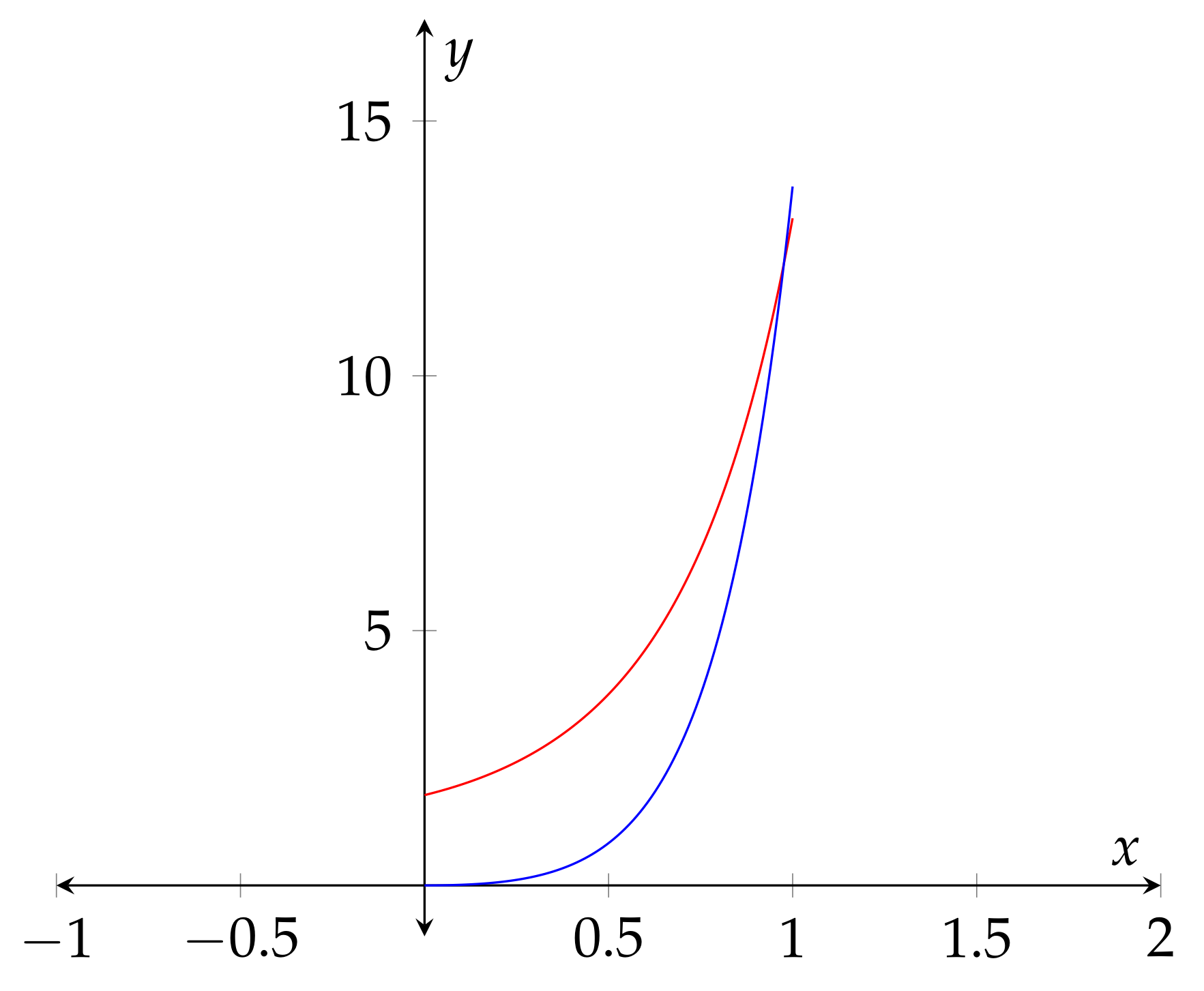
In the following, using the graphical representation from Figure 1, we make a comparison between the estimation obtained by Blaga et al. in [2] and that obtained by us in Theorem 2. For we have , and we compare the functions , which appeared in [2], and which appears in Theorem 2. In Figure 1 we graphically represent both functions. It can be seen that in some parts of the domain, our estimation was better than the one obtained in [2], especially in a neighborhood of the origin.
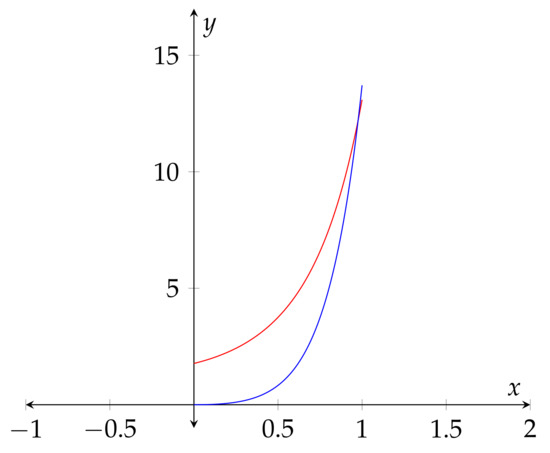
Figure 1.
Representation of the curves (red color), (blue color), on , together.
For other values of n, we have similar results.
4. Generalized Hyers–Ulam–Rassias Stability of Hermite’s Equation
We establish now a result regarding the generalized Hyers–Ulam–Rassias stability of Hermite’s Equation (2), with the conditions (3).
Theorem 3.
Let If:
- (i)
- such that
- (ii)
- is increasing;
5. Conclusions
In this paper, we studied Hyers–Ulam–Rassias and generalized Hyers–Ulam–Rassias stability of Hermite’s equation, using a new approach, namely Pachpatte’s inequality. The problem was also considered in [2] by Blaga et al., as a particular case of a general result regarding the Ulam stability of a linear system of differential equations with nonconstant coefficients. We remark, using the graphical representation from Figure 1, that our estimation for , between an approximate solution and the exact solution of Equation (2), in some parts of the domain, was better than the one obtained in [2], especially in the neighborhood of the origin.
Author Contributions
Conceptualization, D.M., S.A.C. and N.L.; investigation, D.M., S.A.C. and N.L.; writing–original draft preparation, D.M.; writing–review and editing, D.M. and S.A.C. All authors have read and agreed to the published version of the manuscript.
Funding
This research received no external funding.
Conflicts of Interest
The authors declare no conflict of interest.
References
- Corduneanu, A. Ecuatii Diferentiale cu Aplicatii in Electrotehnica; Editura Facla: Timisoara, Romania, 1981. [Google Scholar]
- Blaga, F.; Mesaroş, L.; Popa, D.; Pugna, G.; Rasa, I. Bounds for solutions of linear differential equations and Ulam stability. Miskolc Math. Notes 2020, 21, 653–664. [Google Scholar] [CrossRef]
- Pachpatte, B.G. Inequalities for Differential and Integral Equations, Mathematics in Science and Engineering; Academic Press: San Diego, CA, USA, 1997; Volume 197. [Google Scholar]
- Ulam, S.M. A Collection of Mathematical Problems; Interscience: New York, NY, USA, 1960. [Google Scholar]
- Hyers, D.H. On the stability of the linear functional equation. Proc. Natl. Acad. Sci. USA 1941, 27, 222–224. [Google Scholar] [CrossRef] [Green Version]
- Obloza, M. Hyers stability of the linear differential equation. Rocz. Nauk-Dydakt. Pr. Mat. 1993, 13, 259–270. [Google Scholar]
- Alsina, C.; Ger, R. On some inequalities and stability results related to exponential function. J. Inequal. Appl. 1998, 2, 373–380. [Google Scholar] [CrossRef]
- Takahasi, S.E.; Takagi, H.; Miura, T.; Miyajima, S. The Hyers-Ulam stability constant of first order linear differential operators. J. Math. Anal. Appl. 2004, 296, 403–409. [Google Scholar] [CrossRef] [Green Version]
- Jung, S.-M. Hyers–Ulam stability of linear differential equations of first order. Appl. Math. Lett. 2004, 17, 1135–1140. [Google Scholar] [CrossRef] [Green Version]
- Jung, S.-M. Hyers–Ulam stability of linear differential equations of first order, II. Appl. Math. Lett. 2006, 19, 854–858. [Google Scholar] [CrossRef] [Green Version]
- Jung, S.-M. Hyers-Ulam stability of linear differential equations of first order, III. J. Math. Anal. Appl. 2005, 311, 139–146. [Google Scholar] [CrossRef] [Green Version]
- Jung, S.-M. Hyers–Ulam stability of linear partial differential equations of first order. Appl. Math. Lett. 2009, 22, 70–74. [Google Scholar] [CrossRef] [Green Version]
- Cimpean, D.S.; Popa, D. On the stability of the linear differential equation of higher order with constant coefficients. Appl. Math. Comput. 2010, 217, 4141–4146. [Google Scholar] [CrossRef]
- Novac, A.; Otrocol, D.; Popa, D. Ulam stability of a linear difference equation in locally convex spaces. Results Math. 2021, 76, 33. [Google Scholar] [CrossRef]
- Rus, I.A. Ulam stability of ordinay differential equations. Studia Univ. Babes-Bolyai Math. 2009, LIV, 125–133. [Google Scholar]
- Wang, X.; Luo, D.; Zhu, Q. Ulam-Hyers stability of caputo type fuzzy fractional differential equations with time-delays. Chaos Solitons Fractals 2022, 156, 111822. [Google Scholar] [CrossRef]
- Brzdek, J.; Popa, D.; Rasa, I.; Xu, B. Ulam Stability of Operators; Elsevier: Amsterdam, The Netherlands, 2018. [Google Scholar]
- Tripathy, A.K. Hyers–Ulam Stability of Ordinary Differential Equations; Taylor and Francis: Boca Raton, FL, USA, 2021. [Google Scholar]
- Li, Y.; Shen, Y. Hyers–Ulam stability of linear differential equations of second order. Appl. Math. Lett. 2010, 23, 306–309. [Google Scholar] [CrossRef] [Green Version]
- Li, Y.; Shen, Y. Hyers–Ulam stability of nonhomogeneous linear differential equations of second order. Int. J. Math. Math. Sci. 2009, 2009, 576852. [Google Scholar] [CrossRef] [Green Version]
- Alqifiary, Q.H.; Jung, S.-M. On the Hyers–Ulam stability of differential equations of second order. Abstr. Appl. Anal. 2014, 2014, 483707. [Google Scholar] [CrossRef]
- Gavruta, P.; Jung, S.-M. Hyers–Ulam stability for second-order linear differential equations with boundary conditions. Electron. J. Differ. Equ. 2011, 80, 1–5. [Google Scholar]
- Modebei, M.I.; Olaiya, O.O.; Otaide, I. Generalized Hyers–Ulam stability of second order linear ordinary differential equations with initial condition. Adv. Inequal. Appl. 2014, 2014, 36. [Google Scholar]
- Aruldass, A.R.; Pachaiyappan, D.; Park, C. Hyers–Ulam stability of second-order differential equations using Mahgoub transform. Adv. Differ. Equ. 2021, 2021, 23. [Google Scholar] [CrossRef]
- Javadian, A.; Sorouri, E.; Kim, G.H.; Godji, M.E. Generalized Hyers–Ulam stability of the second-order linear differential equations. J. Appl. Math. 2011, 2011, 813137. [Google Scholar] [CrossRef] [Green Version]
- Qarawani, M.N. Hyers–Ulam stability of a generalized second order nonlinear differential equation. Appl. Math. 2012, 3, 1857–1861. [Google Scholar] [CrossRef] [Green Version]
- Fakunle, I.; Arawomo, P.O. Hyers–Ulam stability of certain class of nonlinear second order differential equations. Int. J. Pure Appl. Math. Sci. 2018, 11, 55–65. [Google Scholar]
- Ionescu, D.V. Ecuatii Diferentiale si Integrale; Editura Didactica si Pedagogica: Bucuresti, Romania, 1964. [Google Scholar]
Publisher’s Note: MDPI stays neutral with regard to jurisdictional claims in published maps and institutional affiliations. |
© 2022 by the authors. Licensee MDPI, Basel, Switzerland. This article is an open access article distributed under the terms and conditions of the Creative Commons Attribution (CC BY) license (https://creativecommons.org/licenses/by/4.0/).