


Abstract
This paper presents a series of important results from the theory of n-hypergroups. Connections with binary relations and with lattices are presented. Special attention is paid to the fundamental relation and to the commutative fundamental relation. In particular, join n-spaces are analyzed.
MSC:
20N20
1. Introduction
The theory of n-ary hypergroups, also called n-hypergroups, contains two generalizations of the notion of a group: n-groups and hypergroups, which are briefly presented in the next paragraph. The two concepts were introduced around the same time.
n-groups, also called polyadic groups, were introduced in 1928 by W. Dörnte [1], and they are a generalization of classical groups. An important role in n-group theory is the paper written by E.L. Post of 143 pages [2]. Such operations are used then in the study of -rings. Among those who made recently important contributions in the theory of n-groups, we mention W. Dudek and his collaborators; see for instance [3,4,5]. Let , and denote the chain by (for the above sequence is the empty symbol). For a nonempty set G with one n-operation, is a n-groupoid, which is a n-quasigroup, if, for all , there is exactly one such that An n-quasigroup with an associative operation is called an n-ary group.
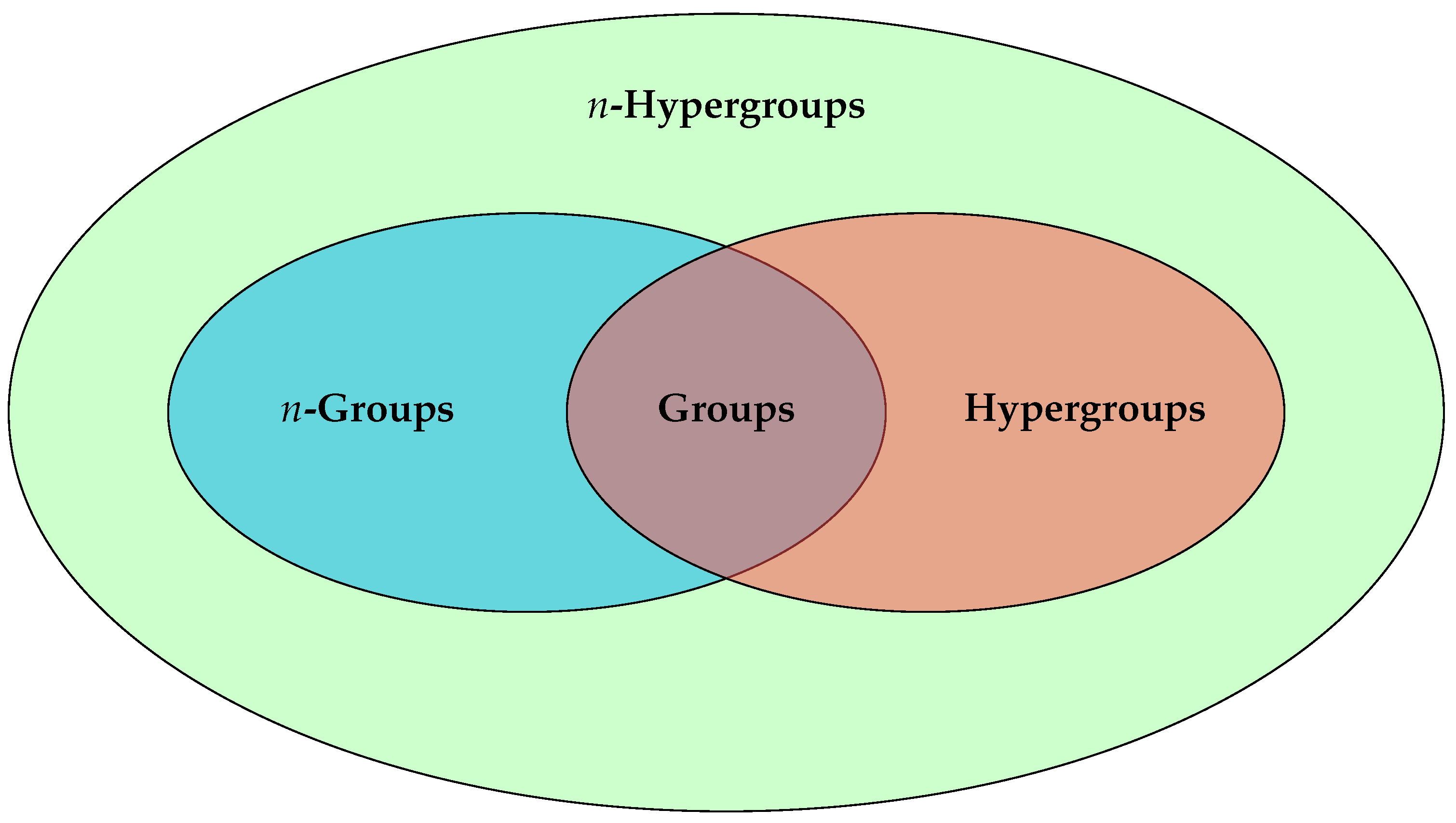
Hypergroup theory is a field of algebra that appeared in 1934 and was introduced by the French mathematician Marty [6]. The theory has known various periods of flourishing: the 1940s, then 1970s, and especially after the 1990s, the theory has been studied on all continents, both theoretically and for a multitude of applications in various fields of knowledge: various chapters of mathematics, computer science, biology, physics, chemistry, and sociology. Several books have been written in this field, which highlight both the theoretical aspects and the applications; for instance, see [7]. Figure 1 suggestively shows the connections between the previously mentioned domains.

Figure 1.
The connections between groups, n-groups, hypergroups, and n-hypergroups.
This survey is structured as follows: First, basic notions in the field of algebraic hyperstructures are recalled, followed by results, in particular characterizations in the field of n-hypergroups. Special attention is given to the connections with binary relations and fundamental relations. Finally, join n-spaces with connections to lattice theory are presented.
2. Hypergroups
An algebraic hyperstructure is a nonempty set H together with one or some functions from to the set of nonempty subsets of H. For all , one denotes by the image where f is the function Then, is called a hypergroupoid.
If denotes the set
Definition 1.
The pair is called a semihypergroup if
where denotes the union
Analogously,
Definition 2.
A hypergroup is a semihypergroup such that
Several types of hypergroup homomorphisms are analyzed. We refer to [8]. Furthermore, several classes of subhypergroups are introduced and studied, such as canonical hypergroups, join spaces, and complete hypergroups. Join Spaces were introduced by Prenowitz.
Definition 3.
Let be a commutative hypergroup. Then, is a join space if the following implication is satisfied:
where denotes the set
Example 1.
Suppose that is a lattice. Then, L is a distributive lattice if and only if is a join space, where
Example 2.
Suppose that is a lattice. Then, L is a modular lattice if and only if is a join space, where Clearly,
Canonical hypergroups have a structure close to that of a commutative group: they are commutative, have a scalar identity e (that is, , every element has a unique inverse, and they are reversible (that is, if then
An important result is the next one:
Theorem 1.
Let be a commutative hypergroup. Then, it is a canonical hypergroup iff it is a join space with a scalar identity.
One of the most-investigated hypergroups associated with binary relations is that introduced by Rosenberg [9] in 1998. It represents a theme of research of numerous papers. Rosenberg associated a partial hypergroupoid with a binary relation defined on a set H, where, for any we have and
Definition 4.
An element b in H is an outer element of ρ if there exists such that .
Theorem 2.
is a hypergroup iff:
- (1)
- ρ has full domain;
- (2)
- ρ has full range;
- (3)
- ;
- (4)
- If , then , where b is an outer element of
Special attention is paid to the fundamental relation, which leads to a group quotient structure.
Definition 5.
Suppose that is a semihypergroup and n is a natural number greater than 1. We can consider the relation on H as follows: if there exist in H, such that , and assume that , where .
In [10], Freni showed that, in every hypergroup, the relation is transitive, so the following result holds:
Theorem 3.
If is a hypergroup, then is a group, where , where z is an arbitrary element of Moreover, the canonical projection is a good homomorphism.
3. n-Hypergroups
Davvaz and Vougiouklis [11] defined the notion of n-hypergroups for the first time. This concept is a generalization of n-groups, as well as hypergroups in the sense of Marty. Some properties of such hyperstructures were investigated in [12,13,14,15,16,17,18]. Moreover, some researchers have pointed out the relation between n-hypergroup and fuzzy sets.
Suppose that H is a nonempty set. A function is called an n-hyperoperation. As usual, we may write , where H appears n times. An element of is denoted by , where for any i with . Let be nonempty subsets of H. We define
The pair is called an n-hypergroupoid. An n-hypergroupoid is called an n-semihypergroup iff
for all and . An n-semihypergroup in which the equation:
has the solution for every , and is called an n-hypergroup. If the value of is independent of the permutation of elements , then we have a commutative n-hypergroup.
Example 3.
If is a hypergroup, then obtain an n-hypergroup by defining , for all .
Example 4.
Let be the set of integer numbers. If we define
then is an n-hypergroup.
Example 5.
Assume is a modular lattice. For every and , we define
If we define:
then is a commutative n-hypergroup.
Theorem 4.
Suppose that is an n-semihypergroup. Then, is an n-hypergroup iff Equation (1) is solvable at the first place and at the last place or at least one place .
Proof.
If Equation (1) is solvable at the place and , then, for every , there are such that
If is arbitrary, then we have
Hence, there is such that .
An n-hyperoperation f is called weakly -associative if
and -associative if
holds for fixed and all .
We say that the element is in the center of an n-hypergroupoid , if
for all . An -associative n-hypergroupoid containing cancelable elements in the center (cancelable elements belong to the center) is -associative [12].
Theorem 5
([12]). An n-hypergroupoid containing cancellative elements in the center is an n-semihypergroup iff it is -associative for some .
An n-hypergroupoid is called a b-derived from a binary hypergroupoid [12], and denote this fact by if the hyperoperation f has the form
Theorem 6
([12]). An n-semihypergroup has a neutral element iff it is derived from a binary semihypergroup with the identity.
Theorem 7
([12]). An n-semihypergroup derived from a binary semihypergroup has a neutral polyad iff it has a neutral element.
Consequently, if an n-semihypergroup without neutral elements is derived from a binary semihypergroup, then it does not possess any neutral polyad.
Theorem 8
([12]). If an n-semihypergroup does not contain any neutral elements, then to , we can adjoint the neutral element if and only if is derived from a binary semihypergroup.
Theorem 9
([12]). To an n-semihypergroup we can adjoint the neutral element iff is derived from a binary semihypergroup.
Theorem 10
([12]). For any n-semihypergroup with a right neutral polyad, there is a semihypergroup with a right identity and an endomorphism φ of such that
for some .
Theorem 11
([12]). For any n-semihypergroup with a left neutral polyad, there is a semihypergroup with a left identity and an endomorphism ψ of such that
for some .
4. Binary Relations and Fundamental Relations
Suppose that R is a binary relation on a nonempty set H. We define a partial n-hypergroupoid , as follows:
for all w in H and
for every . It is clear that is commutative. The partial n-hypergroupoid is a generalization of the Rosenberg partial hypergroupoid. We denote by . The relation R is transitive iff, for any w in H, we have
Moreover, is an n-hypergroupoid if the domain of R is H.
Theorem 12
([17]). Suppose that R is a binary relation on H, with full domain. Then, is an n-semihypergroup iff and for each outer element y of R, if implies
It follows that:
Corollary 1.
Suppose that R is a binary relation with full domain. Then, is an n-hypergroup iff the following hold:
- (1)
- R has a full range;
- (2)
- ;
- (3)
- implies for every outer element .
Note that if R is a subset of , then x is an outer element of R iff for some .
If R is a subset of , then there are no outer elements of R iff, for each , we have
Theorem 13
([17]). Suppose that the relation R is reflexive and symmetric. Then, is an n-hypergroup iff, for every , we have
Corollary 2.
Suppose that the relation R is reflexive and symmetric, but not transitive. Then, is an n-hypergroup iff
The concept of mutually associative hypergroupoids was introduced by Corsini [19]. We generalize this concept to n-hypergroupoids. Two partial n-hypergroupoids and are mutually associative if, for every , we have:
- (i)
- (i)
- (i)
- …
- (i)
- (i)
Let and be two ordinary hyperoperations. Then, we obtain two mutually associative partial hypergroupoids. If R is a binary relation on H and , we denote
If , we write for . If R and S are binary relations on H, then we denote by the relation and , for some .
Theorem 14
([17]). Let R and S be two relations on H with full domains. Then, and are mutually associative iff, for every , we have
Theorem 15
([17]). If and are mutually associative n-hypergroups, then is also an n-hypergroup.
Theorem 16.
Let R and S be relations on H, such that . If is an n-hypergroup, and are mutually associative and one of the following two conditions holds:
- (1)
- (2)
- The domain of is different from H.
Then, is an n-hypergroup, as well.
Now, suppose that is an n-semihypergroup. We denote
and so on. Denote We define , where, for all of H,
Denote by , which means
For every denote
A subsets B is a complete part of if, for every
Suppose that is the complete closure of w. We have for all .
Theorem 17
([17]). Suppose that is an n-semihypergroup. The relation β is transitive iff , for all
Theorem 18
([17]). If is an n-hypergroup, then β is transitive.
Suppose that and are n-hypergroups. We define by . Clearly, is an n-hypergroup, and it is the direct hyperproduct of and .
Theorem 19
([11]). Let and be two n-hypergroups, and let , , and be fundamental equivalence relations on , , and , respectively. Then,
Let be an n-semihypergroup and be an equivalence relation on H; we define
The relation is a strongly regular relation if for all , then,
If is a strongly regular relation on an n-semihypergroup , then the quotient is an n-semigroup such that
where .
Similar to the relation defined by Freni [20,21] on semihypergroups, Davvaz et al. [13] introduced the following relation on an n-semihypergroup so that the quotient is a commutative n-semigroup. Let be an n-semihypergroup. Then, denotes the transitive closure of the relation , where , and for every integer , we define
When , there are and such that and (i.e., ), then we write and . We define as the smallest equivalence relation such that the quotient is a commutative n-semigroup.
Theorem 20
([13]). The fundamental relation is the transitive closure of the relation γ.
Proof.
The n-operation in is defined in the usual manner:
for all . Let . Then, we have:
- iff there exist with , such that
- …
- iff there exist with , such that
Therefore, we obtain
This yields that is singleton. Therefore, we can write
Moreover, since f is associative, we obtain that is associative, and consequently, is an n-semigroup.
is commutative because, if and and , then , and so, . Therefore, thus is commutative.
Now, assume that is an equivalence relation on H such that is a commutative n-semigroup. Then, for all ,
However, for any and and , we have
Therefore,
This gives that, for all ,
Since is transitively closed, it follows that
Consequently, we obtain . □
Relation is a strongly regular relation.
Now, we present some necessary and sufficient conditions such that the relation is transitive. These conditions are analogous to those determined in [20] for the transitivity of relation in hypergroups. Let M be a nonempty subset of n-semihypergroup We say that M is a - if, for any , we have
Theorem 21.
Suppose that M is a nonempty subset of an n-semihypergroup Then, the following statements are equivalent:
- (1)
- M is a γ-part of H;
- (2)
- implies that
- (3)
- implies that
Proof.
If is a pair such that and then for and such that and Since M is a -part of we have and
Assume that such that and Then, there exist and such that Since applying p times, it follows that
Suppose that and For any and we have This yields that and Finally, by we obtain This means that . □
For every element x of an n-semihypergroup set:
From the preceding notations and definitions, it follows that
Corollary 3
([13]). For every
Theorem 22
([13]). Let be an n-semihypergroup. The following statements are equivalent:
- (1)
- γ is transitive;
- (2)
- For any
- (3)
- For any is a γ-part of
Let be an n-hypergroup; we consider the canonical projection with
Corollary 4
([13]). Let be an n-hypergroup and then is a γ-part of
Corollary 5
([13]). If is a commutative n-semihypergroup, then
Theorem 23
([13]). For every nonempty subset M of an n-hypergroup , we have:
- (1)
- If has a neutral element ε and then for every
- (2)
- Moreover if is one-cancellative, then
- (3)
- If M is a γ-part of then
Proof.
(1) For any there exist and such that so therefore,
(2) For any an element exists such that . Let . Then, there exists such that Therefore,
However, , and since is one-cancellative, thus and Therefore, This and (1) prove that
(3) Clearly, we have Furthermore, if then there exists such that This yields that and □
Theorem 24
([13]). If is an n-hypergroup with neutral (identity) such that is j-cancellative, then we have:
- (1)
- If and , then
- (2)
- γ is transitive.
Proof.
(1) If and then , and such that Therefore, if is an element of H such that
Moreover, we have
Thus,
(2) By (1), we have Moreover, if then , so Therefore, there exist such that Thus, there exist , and there are , where and such that and where If , it follows that
Whence and □
5. Join -Spaces
Let be a join semi-lattice and be elements of L. We denote
for any For any of L, we define the following n-hyperoperation:
Notice that . Notice also that the n-hyperoperation f is commutative.
If is a join semi-lattice, then the following statements hold:
- (1)
- For any of L, there is such that .
- (2)
- If L has a 0, then 0 is a scalar identity for .
- (3)
- If , then any is an identity for .
- (4)
- For any of L, we have the equivalence:
- (5)
- For any of L, we have
Theorem 25
([18]). If is an n-semihypergroup, then for any of L, we have
Theorem 26
([18]). For any of L, if we denote
then
Theorem 27
([18]). If is a modular lattice, then
Proof.
Let . Set We check and . Indeed, for any , we have
Similarly, we have
Hence, On the other hand,
and for any , we have
Therefore, □
Corollary 6
([18]). If is a modular lattice, then is an n-semihypergroup.
Theorem 28
([18]). If is a lattice and is an n-semihypergroup, then the lattice is modular.
Proof.
Assume that L is not modular. Hence, L contains a five-element sublattice, isomorphic to this one: , where , , and , respectively, are not comparable. We have and , since Hence,
Therefore, there exists , such that . We have and , whence and , that is Hence, , which contradicts Therefore, is modular. □
Corollary 7
([18]). A lattice is modular iff is an n-semihypergroup.
Corollary 8
([18]). The lattice is modular iff the n-hypergroupoid is a join n-space.
Now, we can consider the following dual-n-hyperoperation on a meet semilattice , defined by: for any of L, we have:
where , and for any , By duality, the following result holds:
Theorem 29
([18]). A lattice is modular iff the n-hypergroupoid is a join n-space:
- If L has the greatest element 1, then 1 is a scalar identity for .
- If , then any is an identity for .
Theorem 30
([18]). Let be a modular lattice:
- (1)
- A subset I of L is an n-subhypergroup of iff I is an ideal of L.
- (2)
- A subset I of L is an n-subhypergroup of iff I is a filter of L.
Proof.
(1) Let be an n-subhypergroupoid of . Then, for any , we have
If and , then
“⟸” Let be elements of I. If , then , for any , whence . Since , it follows that . On the other hand, for any of I and , there is such that Hence, I is an n-subhypergroup of .
(2) It follows by duality. □
Theorem 31
([18]). Let be a lattice and a bijective map. The following conditions are equivalent:
- (1)
- For any of L, we have
- (2)
- φ is a morphism from to .
Proof.
(1⟹2): For any of L, we have , for any whence that is
Now, let Since there is x such that , it follows that
for any and according to , we obtain for any Since is bijective, it follows that , for any , that is Hence,
(2⟹1): Let be elements of L. If then
that is
for any Hence,
For we obtain On the other hand, for any , so
whence that is It follows that
Therefore, the condition (1) holds. □
By duality, we obtain the following.
Theorem 32
([18]). Let be a lattice and a bijective map. The following conditions are equivalent:
- (1)
- For any of L, we have
- (2)
- φ is a morphism from to .
Let be an arbitrary lattice. We define on L the following n-hyperoperation: for any of L, we have
The n-hypergroupoid has the following properties:
- (1)
- g is commutative;
- (2)
- For any we have
- (3)
- for any of L, we have
- (4)
- For any of we have
- (5)
- For any we have
- (6)
- For any we have iff and
Theorem 33
([18]). If the lattice is distributive, then for any of L, we have
Proof.
Indeed, for any of L, we have
Conversely, let If , then that is On the other hand,
Indeed, by distributivity, we have
and
Hence whence We obtain
□
Corollary 9
([18]). If is a distributive lattice, then is an n-hypergroup.
Proof.
Since the subset is invariant to any permutation of , it follows that
Moreover, g is commutative, so it follows that g is associative. Therefore, we obtain that is an n-hypergroup. □
Theorem 34
([18]). If is a distributive lattice, then is a join n-space.
Proof.
We still have to check the join n-space condition. Let that is
We have to prove that there is that is
We have Hence, Similarly, we have Therefore,
that is
□
Theorem 35
([18]). If is a join n-space, then the lattice is distributive.
Proof.
Suppose that L is not distributive. Then, L contains a five-element sublattice , where , , and either or are mutually non-comparable. We have , and since is a join n-space, we obtain
that is , which is a contradiction.
Therefore, is distributive. □
Corollary 10
([18]). The n-hypergroupoid is a join n-space iff the lattice is distributive.
Theorem 36
([18]). Let be a distributive lattice. If I is an ideal and F is a filter of L, then and are n-subhypergroups of .
Proof.
Let I be an ideal of L. For any of I, we have Since and , it follows Hence, On the other hand, we have for any of I. Therefore, is an n-subhypergroup of . Similarly, it follows that is an n-subhypergroup of . □
The converse fails, as can be seen from the following example:
Example 6.
Let us consider the distributive lattice , where M is a set with at least three elements. Let , and . Then, is an n-subhypergroup of , but S is neither an ideal, nor a filter of , since and , respectively.
Author Contributions
Conceptualization, B.D. and V.L.-F.; methodology, B.D. and V.L.-F.; formal analysis, B.D. and T.V.; investigation, B.D.; resources, B.D., V.L.-F. and T.V.; writing—original draft preparation, B.D. and V.L.-F.; writing—review and editing, B.D., V.L.-F. and T.V.; supervision, B.D. All authors have read and agreed to the published version of the manuscript.
Funding
This research received no external funding.
Data Availability Statement
Not applicable.
Conflicts of Interest
The authors declare no conflict of interest.
References
- Dörnte, W. Untersuchungen uber einen verallgemeinerten Gruppenbegriff. Math. Z. 1929, 29, 1–19. [Google Scholar] [CrossRef]
- Post, E.L. Polyadic groups. Trans. Amer. Math. Soc. 1940, 48, 208–350. [Google Scholar] [CrossRef]
- Dudek, W.A.; Michalski, J. On retracts of polyadic groups. Demonstr. Math. 1984, 17, 281–302. [Google Scholar] [CrossRef]
- Dudek, W.A.; Glazek, K. Around the Hosszu-Gluskin theorem for n-ary groups. Discret. Math. 2008, 308, 4861–4876. [Google Scholar] [CrossRef]
- Dudek, W.A. Varieties of polyadic groups. Filomat 1995, 9, 657–674. [Google Scholar]
- Marty, F. Sur une generalisation de la notion de groupe. In Proceedings of the 8th Congres Des Mathematiciens Scandinaves, Stockholm, Sweden, 14–18 August 1934; pp. 45–49. [Google Scholar]
- Davvaz, B.; Vougiouklis, T. A Walk through Weak Hyperstructures: Hv-Structures; World Scientific Publishing Co. Pte. Ltd.: Hackensack, NJ, USA, 2019. [Google Scholar]
- Corsini, P. Prolegomena of Hypergroup Theory; Aviani Editore: Tricesimo, Italy, 1993. [Google Scholar]
- Rosenberg, I.G. Hypergroups and join spaces determined by relations. Ital. J. Pure Appl. Math. 1998, 4, 93–101. [Google Scholar]
- Freni, D. Une note sur le coeur d’un hypergroupe et sur la cloture β* de β. Mat. Pura Appl. 1991, 8, 153–156. [Google Scholar]
- Davvaz, B.; Vougiouklis, T. N-Ary hypergroups. Iran. J. Sci. Technol. Trans. A 2006, 30, 165–174. [Google Scholar]
- Davvaz, B.; Dudek, W.A.; Vougiouklis, T. A generalization of n-ary algebraic systems. Commun. Algebra 2009, 37, 1248–1263. [Google Scholar] [CrossRef]
- Davvaz, B.; Dudek, W.A.; Mirvakili, S. Neutral elements, fundamental relations and n-ary hypersemigroups. Int. J. Algebra Comput. 2009, 19, 567–583. [Google Scholar] [CrossRef]
- Anvariyeh, S.M.; Momeni, S. n-ary hypergroups associated with n-ary relations. Bull. Korean Math. Soc. 2013, 502, 507–524. [Google Scholar] [CrossRef]
- Davvaz, B.; Leoreanu-Fotea, V. Binary relations on ternary semihypergroups. Commun. Algebra 2010, 38, 3621–3636. [Google Scholar] [CrossRef]
- Krehlik, S.; Novak, M.; Bolat, M. Properties of n-ary hypergroups relevant for modelling trajectories in HD maps. An. Stiint. Univ. “Ovidius" Constanta Ser. Mat. 2022, 30, 161–178. [Google Scholar]
- Leoreanu-Fotea, V.; Davvaz, B. n-hypergroups and binary relations. Eur. J. Comb. 2008, 29, 1207–1218. [Google Scholar] [CrossRef]
- Leoreanu-Fotea, V.; Davvaz, B. Join n-spaces and lattices. J. Mult.-Valued Log. Soft Comput. 2009, 15, 421–432. [Google Scholar]
- Corsini, P. Mutually associative hypergroupoids. In Algebraic Hyperstructures and Applications, Prague, 1996; Democritus Univ. Thrace, Alexandroupolis: Komotini, Greece, 1997; pp. 25–33. [Google Scholar]
- Freni, D. A new characterization of the derived hypergroup via strongly regular equivalences. Commun. Algebra 2002, 30, 3977–3989. [Google Scholar] [CrossRef]
- Freni, D. Strongly transitive geometric spaces: Applications to hypergroups and semigroups theory. Commun. Algebra 2004, 32, 969–988. [Google Scholar] [CrossRef]
Disclaimer/Publisher’s Note: The statements, opinions and data contained in all publications are solely those of the individual author(s) and contributor(s) and not of MDPI and/or the editor(s). MDPI and/or the editor(s) disclaim responsibility for any injury to people or property resulting from any ideas, methods, instructions or products referred to in the content. |
© 2023 by the authors. Licensee MDPI, Basel, Switzerland. This article is an open access article distributed under the terms and conditions of the Creative Commons Attribution (CC BY) license (https://creativecommons.org/licenses/by/4.0/).