


Abstract
The paper is concerned with complex fuzzy numbers and complex fuzzy inner product spaces. In the classical complex number set, a complex number can be expressed using the Cartesian form or polar form. Both expressions are needed because one expression is better than the other depending on the situation. Likewise, the Cartesian form and the polar form can be defined in a complex fuzzy number set. First, the complex fuzzy numbers (CFNs) are categorized into two types, the polar form and the Cartesian form, as type I and type II. The properties of the complex fuzzy number set of those two expressions are discussed, and how the expressions can be used practically is shown through an example. Second, we study the complex fuzzy inner product structure in each category and find the non-existence of an inner product on CFNs of type I. Several properties of the fuzzy inner product space for type II are proposed from the modulus that is newly defined. Specfically, the Cauchy-Schwartz inequality for type II is proven in a compact way, not only the one for fuzzy real numbers. In fact, it was already discussed by Hasanhani et al; however, they proved every case in a very complicated way. In this paper, we prove the Cauchy-Schwartz inequality in a much simpler way from a general point of view. Finally, we introduce a complex fuzzy scalar product for the generalization of a complex fuzzy inner product and propose to study the condition for its existence on CFNs of type I.
Keywords:
complex fuzzy numbers; modulus; inner product; scalar product; complex fuzzy inner product space MSC:
Primary 54A40; 03E72; Secondary 46Cxx
1. Introduction
In classical complex analysis, we have two different types of notations in the complex number set . One is the Cartesian form (), and the other one is the polar form . Even though we have the Cartesian form, the polar form is needed depending on the situation. The Cartesian form is generally convenient, but if we have to use the angle such as in triangular functions, the polar form is better. Likewise, in fuzzy complex analysis or ; see Section 3), we can first consider the Cartesian complex fuzzy number form, but depending on the situation, it is necessary to define the polar form to express some special cases (see Example 2). Sometimes, the polar form in or is better than the Cartesian form. For example, if we want to express some situation with a “periodic” time series that has a fuzzy amplitude, the polar form is better than the Cartesian form. As we see in Example 2, we can express the periodicity easily if the data include the monthly property or the seasonality. However, due to the complexity of or , not all the properties in hold in or Therefore, in this paper, we discuss similar properties in that we can even have in or , and we also discuss some properties that we cannot have in or . For example, as we discuss in the paper, the complex fuzzy inner product does not exist based on the polar form. The Cauchy-Schwartz inequality holds using the Cartesian form in the complex fuzzy number set.
The definitions of complex fuzzy numbers have been introduced in several studies [1,2,3]. The complex fuzzy numbers can be applied to many real applications [3]. Buckley [1] first introduced a complex number approach to fuzzy numbers, which was named “fuzzy complex numbers”. He defined the Cartesian form and the polar form of fuzzy complex numbers z based on their membership function, which is a mapping from the complex numbers into . On the other hand, Ramot et al. [3] introduced a complex-valued grade of fuzzy membership functions to the magnitude (modulus) and argument of the polar form to define complex fuzzy numbers. Fu and Shen [2] introduced a complex-valued grade of fuzzy membership functions to the real part and the imaginary part to define fuzzy complex numbers. There were some studies that dealt with the fuzzy inner product [4,5,6] and the fuzzy Hilbert space [7,8]. Recently, we [9] discussed the absence of non-trivial fuzzy inner product spaces and the Cauchy-Schwartz inequality in the fuzzy real number system.
In this paper, we discuss more properties of the complex fuzzy numbers as an extension of the previous study [1]. This approach is different from Buckley’s [1]. We deal with complex fuzzy numbers, not “fuzzy complex numbers”.
In Section 3 and Section 4, the complex fuzzy numbers (CFNs) are categorized into two types, as CFNs of type I for the polar form and CFNs of type II for the Cartesian form. The basic properties of the operations in each category are checked.
A fuzzy Hilbert space has been introduced in [7,8]. This paper suggests a complex fuzzy inner product space based on our new approach. In Section 5, we discuss the complex fuzzy inner product on each category of CFN, which shows that, unlike the complex number, the complex fuzzy number of the polar form (type I) has no relation to that of the Cartesian form (type II). In fact, the non-existence of inner products on CFN of type I is proved. We introduce the definition of a complex fuzzy inner product space for type II. Also, several properties of the fuzzy inner product space for type II have been proposed from the modulus defined in Section 5. Especially, the Cauchy-Schwartz inequality for type II is proved in in a compact way, not only the one for fuzzy real numbers. In fact, it was already dealt with in [7], however they proved every case in a very complicated way. In this paper, we prove the Cauchy-Schwartz inequality in a much simpler way in a general point of view.
In Section 6, we introduce a complex fuzzy scalar product and investigate its properties.
2. Preliminaries
In this section, we provide basic definitions and notations for this study.
Definition 1
([10] (p. 390)). A mapping is called a fuzzy real number with α-level set , if it satisfies the following conditions:
(i) there exists such that
(ii) for each , there exist real numbers such that the α-level set is equal to the closed interval
Remark 1.
The condition (ii) of Definition 1 is equivalent to convex and upper semi continuous:
(1) a fuzzy real number η is convex if where
(2) a fuzzy real number η is called upper semi-continuous if for all and with , there is such that i.e., for all and is open in the usual topology of
The set of all fuzzy real numbers is denoted by . If and whenever , then is called a non-negative fuzzy real number and denotes the set of all non-negative fuzzy real numbers. We note that real number for all and all . Each can be considered as the fuzzy real number denoted by
hence it follows that can be embedded in .
Definition 2
([11] (p. 216)). The arithmetic operations and ⊘ on are defined by
which are special cases of Zadeh’s extension principles.
Definition 3
([11] (p. 216, Equation (2.7))). The absolute value of is defined by
Lemma 1
([11] (p. 217)). Let and . Then for all ,
Definition 4
([11]). Let and for all . Define a partial ordering by in if and only if for all . The strict inequality in is defined by if and only if for all .
3. Complex Fuzzy Numbers of Type I
Recall that the polar representation of a complex number, where and [3]. In this section, we consider its extension in fuzzy category, called complex fuzzy numbers of type I, and investigate their basic properties under some structure.
Definition 5
([3] (p. 171)). A complex fuzzy set S of type I defined on a universe of discourse U, is characterized by a membership function
that assigns a complex-valued grade of membership in S where and are both real-valued and is a fuzzy real number on U. Here, is called the amplitude of .
The complex fuzzy set S may be represented as the set of ordered pairs
Set . We now give examples of a complex fuzzy set S of type I.
Example 1.
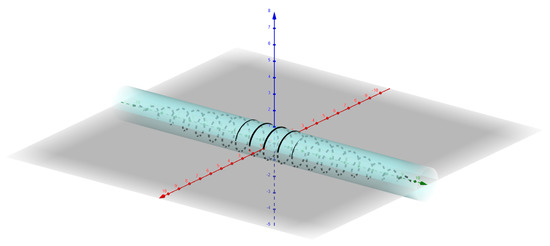
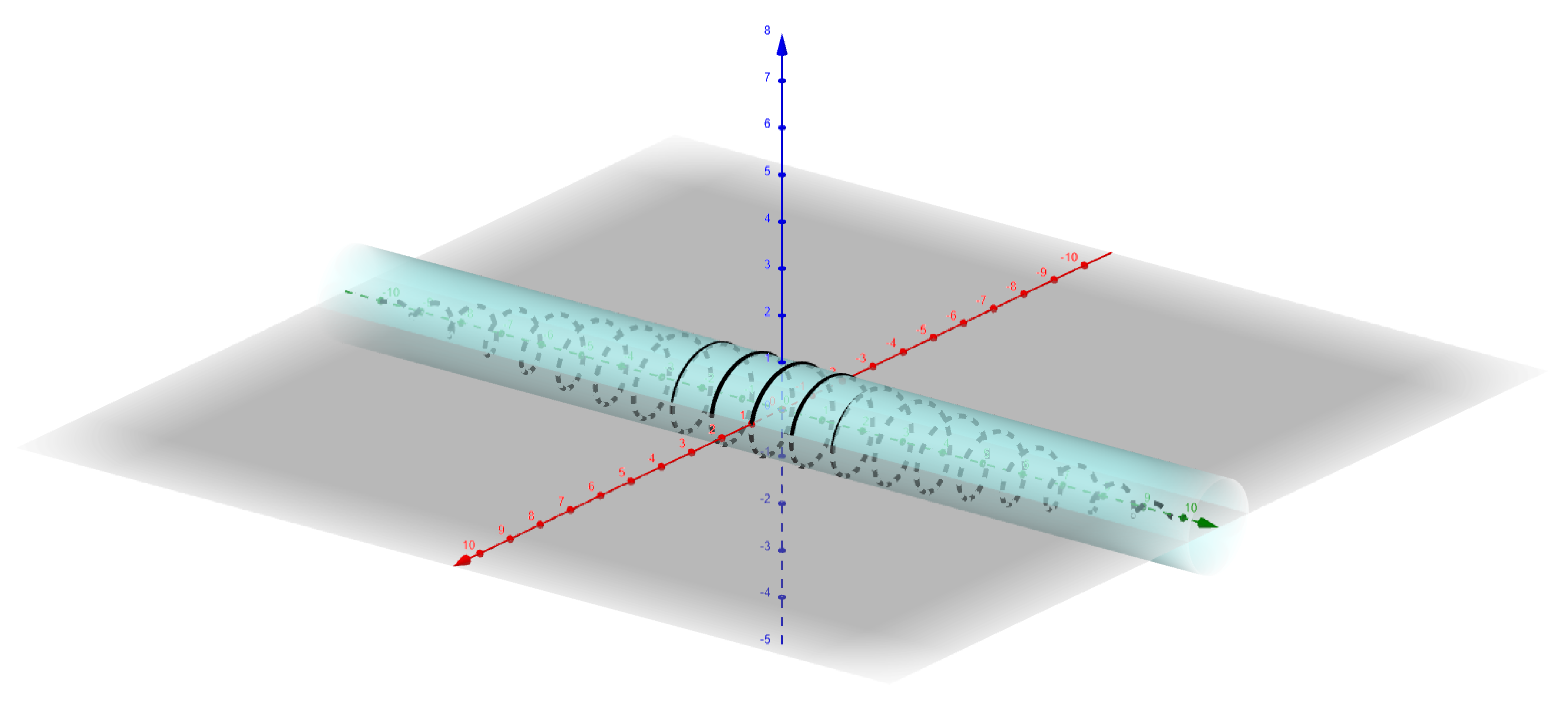
Let us consider a complex fuzzy set
defined by
Then can be expressed in Figure 1.
Figure 1.
The complex fuzzy number of type I in Example 1.
Example 2
([3] (p. 184, Equation (49))). Let U be the set of financial indicators or indexes of the American economy. Possible elements of this set are unemployment rate, inflation, interest rates, growth rate, GDP, Dow-Jones industrial average, etc. Let V be the set of financial indicators of the Japanese Economy. Let the complex fuzzy relation represent the relation of influence of American financial indexes on Japanese financial indexes: y is influenced by x”, where and . The membership function for the relation and , can be presented by complex valued, with an amplitude term and a phase term. The amplitude term indicates the degree of influence of an American financial index on a Japanese financial index. Consider, for example, , i.e., the grade of membership associated with the statement: “American growth rate influences Japanese Export”. Assume the interactions between American and Japanese financial indicators are measured in the limited time frame of 12 months, then it can be represented by
Note that the amplitude term was selected to be 0.8, similar to the grade of membership of a traditional fuzzy set. The phase term was chosen to be as an average of three-five months, normalized by 12 months.
Consider the case both and respectively, which given and .
Definition 6.
A mapping (or respectively) is called a complex fuzzy number (CFN) on or , respectively, whose α-level set is denoted by
if it satisfies two axioms;
(i) There exists (or , respectively, such that .
(ii) For each , is a compact connected convex set in .
Note that if then there exists real numbers such that
It is obvious that both and can be embedded in . Furthermore, both and can be embedded in . In this section, and will be written by and for the simplicity, respectively.
Example 3.
Let
where Then for all .
Example 4.
Let and . Define
where Then .
Given , recall that the definition of given by
Let be the set of all s on or Note that each can be considered as the defined by
Then, is the extension of . Moreover, can be embedded in
Since each can be considered as the complex fuzzy number defined by
it follows that can be embedded in
In this paper, we focus on based on .
Definition 7.
Let and be complex fuzzy numbers on . Then
Note that means for all
Note that for each so that . As the square root of a polar form of a complex number, that of a complex fuzzy number is done as follows:
Definition 8.
For a on R, we define the square root of by
where is the amplitude of and defined by
Definition 9.
The absolute value of of type I is defined by
The Definition 9 implies
Based on [3] (p. 181), Definitions 10 and 11 are suggested.
Definition 10.
The arithmetic operation ⊕ is given by
where can be defined by .
Remark that, in Definition 10, can be defined in several ways as follows;
(i)
(ii)
(iii)
Similarly, we can think the following definitions in may cases related to angle terms.
Definition 11.
(i) The arithmetic operation ⊖ is given by
where can be defined by .
(ii) The arithmetic operation ⊗ is given by
where can be defined by .
(iii) The arithmetic operation ⊘ is given by
where can be defined by .
Lemma 2.
Let , and Then for all ,
(i)
(ii)
(iii)
(iv) if , ,
(v)
4. Complex Fuzzy Numbers of Type II
Note that each can be considered as the of type II, , defined by
where “” is the imaginary unit of a complex fuzzy number of type , (not of a complex number). Then, is the extension of . Moreover, can be embedded in In this section, will be written by for the simplicity.
Definition 12.
A complex fuzzy set S of type defined on a universe of discourse U, is characterized by a membership function
that assigns a complex-valued grade of fuzzy membership in S where both and are fuzzy real numbers on S.
Definition 13
([2] (p. 1405)). Let and be complex fuzzy numbers where and d are fuzzy real numbers. The basic arithmetic operations on and are defined as follows;
(i) Addition: ,
(ii) Subtraction: ,
(iii) Multiplication:
(iv) Division:
(v) Conjugate:
Remark 2.
In [2] (p. 1405), for , the definition on the modulus of complex fuzzy number of type II is given by
which satisfies . However, given a fuzzy real number need not be greater than or equal to . For example, let be defined by
Then
Hence
Thus the definition on the modulus might need to be changed as follows:
Definition 14.
The modulus of a complex fuzzy number of type II is
Note that the modulus of the Definition 14 is different from the absolute value of the Definition 9 even though they are equivalent in The triangle inequality on modulus may be shown in Theorem 1 with respect to type II.
Theorem 1.
Given two fuzzy real numbers it holds that
Proof.
Let be given. Recall that for any fuzzy real number with it holds that Then
Similarly, we get □
5. Complex Fuzzy Inner Product Space
In this section, we introduce the definition and investigate some properties of a complex fuzzy inner product space for type . We will use operations in [2] (p. 1405).
Definition 15.
Let X be a vector space over . Assume the mappings are symmetric and non-decreasing in both arguments, and that and . Let . The quadruple is called a fuzzy normed space [12] with the fuzzy norm , if the following conditions are satisfied:
(F1) if , then
(F2) if and only if ,
(F3) for and ,
(F4) for all ,
(F4L) whenever and
(F4R) whenever and
Here, we fix and for all and we write .
Definition 16.
Let X be a vector space over A complex-valued fuzzy inner product on X is a mapping such that for all vectors ans , we have
,
,
if
if and only if .
The vector space X with a complex-valued fuzzy inner product is called a complex fuzzy inner product space.
5.1. Non-Existence of the Inner Product on s of Type I
In this subsection, a complex fuzzy inner product in view of type I can not be defined. Let V be a given complex n-dimensional vector space. To show by a contradiction, assume that is a complex fuzzy inner product on It is well known that there is a basis on a real vector space Let and Recall that, for the is given by
Lemma 3.
If then for some function satisfying
Proof.
Assume and let for some fuzzy real number and for a function Then, Equation (3) says that, for
which implies that for For , it also does that
which gives both and Thus we get □
The following example shows that the inner product of CFN of type I on a vector space cannot be defined.
Example 5.
Let and From the Lemma 3, there are two functions such that and satisfying and Then
and
Thus, we get
which implies from the α-level sets:
Therefore, which is a contraction.
5.2. Complex Fuzzy Inner Product Spaces Based on s of Type II
A complex fuzzy inner product on X defines a fuzzy number
for all In fact, from the the positive-definite property of an inner product.
To begin with, for real numbers Especially, with .
Theorem 2.
Given a complex fuzzy inner product space and for given two element if for some fuzzy real numbers then and for some real numbers
Proof.
Note that
implies that
is a fuzzy real number. Thus and so for some And, from
we get
which implies that
thus for some □
We give a simple application regarding the inner product of complex fuzzy numbers which is of type II.
Example 6.
Let be a given inner product of some Hilbert space X over . If is given by where
that is, (Case I) If , then
(Case II) If , then
Then and are clearly holds. For ,
Hence is an inner product of the given Hilbert space X.
Remark 3.
Theorem 2 shows that an inner product complex fuzzy space is trivial. To find more meaningful complex fuzzy space, we will change the condition of positive definiteness in Definition 16 to that of non-degeneracy (see the Section 5).
Lemma 4.
([7] (Lemma 3.2)). A real fuzzy inner product space X together with its corresponding norm satisfy the Cauchy-Schwartz inequality
for all .
From now on, the result of Theorem 2 is not used, which enables us to apply the arguments below to the real fuzzy inner product space by letting the imaginary part be
Remark 4.
Given a complex fuzzy number where both x and y are fuzzy real numbers, and given the equalities
and
hold.
Remark 5.
For a vector v in a fuzzy inner product space and for
which implies and for each
The following lemma is easily checked:
Lemma 5.
Given a fuzzy real number
(i) if then and
(ii) if then and
Theorem 3.
For vectors , and for each we have
Hence, it holds that
Proof.
Since all of and are fuzzy real numbers, it suffices to show that the inequality holds for each If w is a zero vector , then
which implies and so the theorem holds. Assume that w is not a zero vector. Then from the Definition 16 (IP5), Denote by fuzzy real numbers x and Let
and put related to and in a similar way. Consider Then, the inequality
holds and becomes a fuzzy real number. Thus we can rewrite the equality as follows:
From Lemma 5,
Similarly, we get
which gives
and
□
6. Complex Fuzzy Scalar Product
We already saw that no inner product can exist on the complex fuzzy numbers of type I. In Linear Algebra, recall the concept of a scalar product, which is a weaker version of the concept on an inner product. We introduce a complex fuzzy scalar product for a generalization of a complex fuzzy inner product. In this section, does not restrict to the case of type II, except Theorem 4.
Definition 17.
Let X be a vector space over A complex-valued fuzzy scalar product on X is a mapping such that for all vectors ans , we have
,
()
whenever and
()
whenever and
The vector space X with a complex-valued fuzzy scalar product is called a complex fuzzy scalar product space.
Theorem 4.
Any complex-valued fuzzy inner product, on a vector space X over is a complex-valued fuzzy scalar product.
Proof.
It suffices to show that both and hold. To begin with, recall that Let Note that if both s and t are nonnegative, then Theorem 3 gives
so we get either or holds.
To show consider its hypothesis, and which implies either
or
holds, in other words, either or Thus we get either or and obtain the inequality in
To show consider its hypothesis, and which implies either
or
holds (even in case that either s or t is negative). Thus we get either or and obtain the inequality in □
Remark 6.
Theorem 4 is meaningful only in case of type II. See Section 5.1.
Lemma 6.
() is equivalent to
Proof.
Assume the Equation (7) holds. Given s and t satisfying the hypothesis of (), let Then,
from the Equation (7). The convexity and the hypothesis of () say that either
or
which implies that, at least, one of and is bigger than or equal to Therefore,
Conversely, suppose that () holds. To show by contradiction, assume that there exist a number and vectors v and w such that
Then we can find two positive numbers s and t satisfying
and
Then, both of and is less than which, together with (), gives
It is a contradiction. □
Lemma 7.
() is equivalent to
Proof.
Assume the Equation (8) holds. Given s and t satisfying the hypothesis of (), the conclusion of () holds trivially if one of or is zero. So assume that both of them are greater than zero. Let and Then, both and hold. Thus, the Equation (8) and the nondecreasing property of give
which, together with the convexity property, implies
Conversely, suppose that () holds. Let be given.
Case (1)
For and both and are greater than or equal to thus () says that
Therefore,
Case (2)
The Equation (8) holds since
□
A complex fuzzy scalar product on X defines a fuzzy number
for all Lemmas 6 and 7 imply that
Theorem 5.
For vectors , we have the following inequalities
Proof.
(ii) By the definition and (i), we have
□
7. Conclusions
In this study, we defined complex fuzzy numbers (CFNs) of the Cartesian form and the polar form and took a look at the advantage for each type, providing examples. To study them, we proposed some operations and properties such as triangular inequality in fuzzy real number set. Based on proposed definitions and properties, complex fuzzy inner product space has been proposed based on CFN of the Cartesian form. Especially, we made a more clear definition of modulus, which gave an easy proof for Cauchy-Schwartz inequality. We also showed the non-existence of the inner product on CFNs of the polar form. This implies that the polar form cannot substitute Cartesian form, so we need to apply each type in the right situation. And we proposed a new concept, called complex fuzzy scalar product, and proved its some basic properties such as both Cauchy-Schwartz inequality and triangular inequality. Regarding this, the condition for the existence of a scalar product on CFN of type I will be discussed in our further study.
Author Contributions
The individual contributions of the authors are as follows: conceptualization, T.B., J.E.L., K.Y.L., and J.H.Y.; methodology, T.B., J.E.L., K.Y.L., and J.H.Y.; writing—original draft preparation, T.B., J.E.L.; writing—review and editing, J.E.L. All authors have read and agreed to the published version of the manuscript.
Funding
Jin Hee Yoon was supported by the National Research Foundation of Korea (NRF) grant funded by the Korea government (MSIT) (No. 2020R1A2C1A01011131). Taechang Byun was supported by Basic Science Research Program through the National Research Foundation of Korea (NRF) funded by the Ministry of Education (2018R1D1A1A02047995). Ji Eun Lee was supported by the National Research Foundation of Korea (NRF) grant funded by the Korea government (MSIT) (2019R1A2C1002653). Keun Young Lee was supported by NRF-2017R1C1B5017026 funded by the Korean Government.
Acknowledgments
The authors wish to thank the referees for their invaluable comments on the original draft.
Conflicts of Interest
The authors declare no conflict of interest.
References
- Buckley, J.J. Fuzzy complex numbers. Fuzzy Sets Syst. 1989, 33, 333–345. [Google Scholar] [CrossRef]
- Fu, X.; Shen, Q. Fuzzy complex numbers and their application for classifiers performance evaluation. Pattern Recognit. 2011, 44, 1403–1417. [Google Scholar] [CrossRef]
- Ramot, D.; Milo, R.; Friedman, M.; Kandel, A. Complex Fuzzy Sets. IEEE Trans. Fuzzy Syst. 2002, 2, 171–186. [Google Scholar] [CrossRef]
- El-Abyad, A.M.; El-Hamouly, H.M. Fuzzy inner product space. Fuzzy Sets Syst. 1991, 44, 309–326. [Google Scholar] [CrossRef]
- Mukherjee, S.; Bag, T. Fuzzy inner product and its properties. Int. J. Fuzzy Math. Syst. 2015, 5, 57–69. [Google Scholar]
- Saheli, M.; Gelousalar, S.K. Fuzzy inner product spaces. Fuzzy Sets Syst. 2015, 303, 149–162. [Google Scholar] [CrossRef]
- Hasanhani, A.; Nazari, A.; Saheli, M. Some properties of Fuzzy Hilbert spaces and norm of operators. Iran. J. Fuzzy Syst. 2010, 7, 129–157. [Google Scholar]
- Daraby, B.; Solimani, Z.; Rahimi, A. Some properties of Fuzzy Hilbert spaces. Complex Anal. Oper. Theory 2017, 11, 119–138. [Google Scholar] [CrossRef]
- Byun, T.; Lee, J.E.; Lee, K.Y.; Yoon, J.H. Absence of Non-Trivial Fuzzy Inner Product Spaces and the Cauchy-Schwartz Inequality. Mathematics 2020, 8, 571. [Google Scholar] [CrossRef]
- Xiao, J.; Zhu, X. Fuzzy normed space of operators and its completeness. Fuzzy Sets Syst. 2002, 125, 153–161. [Google Scholar] [CrossRef]
- Kaieva, O.; Seikkala, S. On fuzzy metric spaces. Fuzzy Sets Syst. 1984, 12, 215–229. [Google Scholar]
- Felbin, C. Finite dimensional fuzzy normed linear space. Fuzzy Sets Syst. 1992, 48, 239–248. [Google Scholar] [CrossRef]
© 2020 by the authors. Licensee MDPI, Basel, Switzerland. This article is an open access article distributed under the terms and conditions of the Creative Commons Attribution (CC BY) license (http://creativecommons.org/licenses/by/4.0/).