


Abstract
The aim of this study was to perform a narrative review to identify the modifications applied to the chemical structure of third- and fourth-generation zirconia ceramics and to determine the influence of these changes on the mechanical and optical properties. A bibliographical search using relevant keywords was conducted in the PubMed® and EBSCO databases. The abstracts and full texts of the resulting articles were reviewed for final inclusion. Fifty-four articles were included in this review. The analyzed topics were: (1) the composition of first- and second-generation zirconia materials (Y-TZP), (2) the behavior of the studied generations in relation to mechanical and optical properties, and (3) the modifications that were carried out on third-generation (5Y-TZP) and fourth-generation (4Y-TZP) zirconia materials. However, studies focusing on these specific characteristics in third- and fourth-generation zirconia materials are scarce. The review shows that there is a lack of sufficient knowledge about the chemical modifications of zirconia in the new generations.
1. Introduction
The natural appearance results in fixed dental prosthesis (FDPs) treatments have been guided by the evolution of dental ceramics; zirconium dioxide (ZrO2) is part of this evolution [1,2,3,4,5,6].
The polycrystalline structure of zirconium dioxide (ZrO2) is arranged on cells (mesh) shaped in three different phases: cubic, tetragonal, and monoclinic. They transform from one phase into another, induced by a combination of temperature, humidity, and stress stimulus [7,8,9,10,11,12,13,14,15,16].
Three mol% yttria-stabilized tetragonal zirconia polycrystalline (3Y-TZP) is a ceramic system that exhibits high strength, fracture toughness, hardness, wear resistance, good frictional and non-magnetic behavior, electrical insulation, low thermal conductivity, corrosion resistance in acids and alkalis, modulus of elasticity similar to steel, and coefficient of thermal expansion similar to iron. However, poor translucency has been one of the characteristics to improve in this material [17,18,19,20,21,22,23,24,25,26,27,28,29].
Yttria-stabilized tetragonal zirconia polycrystalline is termed Y-TZP. Zirconia-based ceramics used for biomedical purposes typically exist as a metastable tetragonal partially stabilized zirconia (PSZ), which means that trapped energy still exists within the material, preventing the system from transforming into the monoclinic phase at room temperatures. However, 3 mol% yttria-stabilized tetragonal zirconia polycrystalline (3Y-TZP) suffers a phase transformation when mechanical or physical stress is applied. It has been observed that fatigue creates micro-cracks in the structure of zirconia materials. When a crack propagates in 3Y-TZP (that has these metastable tetragonal particles), a stress-induced transformation occurs at the end of the crack and only the particles near this transform from the tetragonal into the monoclinic phase; this process is called transformation toughening (TT) [6,10]. This transformation toughens the material in the following two different ways: the energy needed for fracture is first dissipated during transformation and second through residual compressive stress [4,7,11,21,25].
On the other hand, 3Y-TZP under oral conditions has shown an accelerated aging, affecting a long lasting prosthesis. Scientists who have investigated the biomaterial behavior have named this phenomenon as “low temperature degradation (LTD)”, where the tetragonal zirconia (t-ZrO2) phase spontaneously transforms to the monoclinic (m-ZrO2) phase as a response to the variation of temperature in the mouth and the presence of humidity (hydrothermal aging), regardless of any mechanical stress. The consequences of hydrothermal aging are surface roughening due to loss of crystals, enhanced wear rates, detrimental strength, and fracture toughness, followed by catastrophic failures [4,8,11,12,16].
To maintain stability of the crystalline form at room temperature yttria, magnesia, and other oxides have been added to zirconia materials. Güth et al. [6] described four generations of zirconia material based on its chemical structure: first-generation 3 mol% Y2O3 0.25% Al2O3 (3Y-TZP); second-generation 3 mol% Y2O3 0.05% Al2O3; third-generation 5 mol% Y2O3 0.05% Al2O3 53% cubic structure (5Y-TZP); fourth-generation 4 mol% Y2O3 0.05% Al2O3 (4Y-TZP).
In 2015, a new ceramic system was introduced to the market: the third-generation 5-mol% yttria-stabilized tetragonal zirconia polycrystal (5Y-TZP). Increasing the yttria content (Y₃O₂) to 5 mol% was a modification that offered enhancement in the translucency of zirconia. The result is a fully stabilized zirconia with a stable cubic–tetragonal microstructure. The cubic phase reaches approximately 50% of the structure. The size and number of the crystals, which are larger than the 3Y-TZP, favor the light transmission, reducing the refraction effect and giving better translucency. On the other hand, an increase in the number of cubic crystals affects the crack propagation pattern, reducing the flexural strength and the fracture toughness of the material [1,6,10,12,30].
It is relevant to recall the findings attained by Zhang et al. [13] in 2020 that describe 3Y-TZP ceramics. These ceramics allow less light transmission because of the large refraction of light in two different directions (optically anisotropic)—an effect of the tetragonal phase—causing light diffusion and light deflection at the grain boundaries that enhance the translucency of zirconia ceramics [12,17,31,32,33,34].
The mechanism for increasing yttria oxide as a strategy to reach a higher translucency in the zirconia materials involves better aging stability but lower flexural strength and fracture toughness, mainly due to the change in the phase composition [35,36,37,38,39]. Compared with 3Y-TZP that consists of ~80 wt% tetragonal phase and ~20 wt% cubic phase, PSZ stabilized with 4–6 mol% yttria used for dental purposes contains a 40–70 wt% cubic phase influenced by the yttria stabilizer concentration and the sintering temperature. Increasing the cubic phase in the zirconia structure transforms the composition into a nonbirefringent (refraction in two directions) and non-transformable (loss of grains and aging) under humidity and stress conditions [13,14,15,17,18,19].
In 2017, manufacturing companies launched the fourth-generation 4-mol% yttria-stabilized tetragonal zirconia polycrystals (4Y-TZP) of zirconia. Compared with the third-generation, the yttria content was reduced to 4-mol%, which led to an enhancement of the flexural strength and fracture toughness, with a combined reduction in translucency [6,10,14,31]. Comparing the strength, toughness, and translucency of zirconia restorations allows clinicians and dental lab technicians to make assertive decisions based on the evidence of prosthetic restoration on one or more than three units. For this reason, the research question sought to identify the expectancy of an enhancement of the different properties when comparing the third- and fourth-generation of zirconia materials.
The aim of this study was to retrieve the papers that analyze the modifications performed in the chemical structure of third- and fourth-generation zirconia ceramics in order to determine how these structural changes have influenced the strength, toughness, and translucency of these materials.
2. Materials and Methods
2.1. Study Selection
This study consisted of an extensive search of the literature available on dental materials worldwide. The search was limited exclusively to papers in English, between 2015 and 2022, that feature on the two main search engines (PubMed® and EBSCO) and that are published in of the most influential indexed journals in the materials and dental field. A first search was performed in October 2021 and a second search was conducted in July of 2022.
2.2. Inclusion Criteria
Clinical trials (randomized controlled trials), meta-analysis, systematic reviews, in vitro studies, and literature reviews were included in the present study. The following characteristics were taken into account: zirconia materials, translucent zirconia, cubic zirconia, ultra-translucent zirconia, mechanical properties, chemical structure, and load bearing of translucent zirconia.
2.3. Exclusion Criteria
Books and documents, all papers in a foreign language (not in the English language), and zirconia materials investigated in other applications different from fixed prosthodontics were excluded.
2.4. Study Quality Assessment
The search strategy was designed and set up by one reviewer (A.A.), who also performed the electronic search. All the studies that fulfilled the inclusion criteria were included in this review. The title and abstracts of all articles identified by the electronic search were read and assessed by one of the authors (A.A.). A shortlist of studies was then compiled and subjected to full text analysis and data extraction by the contributing authors. A manual search of the analyzed articles was also carried out. The methodological quality of all selected full-text articles was assessed using the guidelines given by PRISMA and CONSORT [40].
First, the authors analyzed those papers that described zirconium oxide as a pure element in nature and its modifications, including its chemical structure, phase transformation, and low-temperature degradation. Second, the authors classified those papers that reported data on third- and fourth-generation zirconia materials.
3. Results
The original search strategy—based on keywords mentioned—resulted in 322 papers. However, the total number of papers that met the inclusion criteria for the review was 64, whereby 45.6% addressed first- and second-generation zirconia materials and 54.3% studied third- and fourth-generation zirconia materials. A total of 64 articles was reviewed, of which 20 were discarded and 44 related to third- and fourth-generation zirconia were used, with a further 10 articles added to address generalities of the review. The flow chart of the obtained results of the literature search is given in Figure 1.
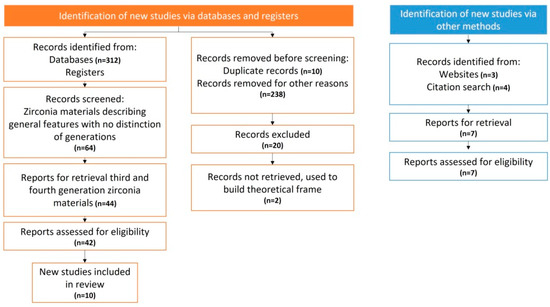
Figure 1.
Flow chart of the literature search.
This study aimed to understand the chemical composition of zirconia ceramics and to determine which modifications have been carried out. The first selection of papers allowed the authors to categorize the composition of first- and second-generation zirconia materials (Y-TZP) and to identify the behavior of the studied generations of zirconia materials regarding abrasiveness and wear, marginal accuracy, and cementation. The second selection permitted to establish the modifications that were carried out in third-generation (5Y-TZP) and fourth-generation (4Y-TZP) zirconia materials, allowing to understand how these modifications have influenced the flexural strength, fracture toughness, and translucency of the available materials. Studies that addressed these specific characteristics in third- and fourth-generation are scarce.
All selected papers are distributed according to the information they offer regarding the composition and features of zirconia materials. A summary of the in vitro studies and the observational study articles reviewed in this paper can be found in Table 1.

Table 1.
Summary of clinical and in vitro studies analyzed.
4. Discussion
Zirconia materials have evolved into several formulations, depending on powder composition, sintering additives, heat treatment, and other processing factors.
4.1. Third-Generation Y-TZP: Increasing Yttria Content
For Y-TZP, the translucency properties are tailored by its cubic content, which can be controlled by both the yttria content and the sintering temperature. Increasing the yttria content gives way to third-generation zirconia materials (5Y-TZP or 5Y-0.05Al) 5 mol% Y2O3 0.05% Al2O3. Due to 53% of its structure being found in cubic polycrystals, it received the name of cubic zirconia or the so-called fully stabilized zirconia (FSZ) [3,4,5,6,7,8,9,10,11,12,15,17,18,19,35,36].
In general, a higher yttria content and sintering temperature will have a greater cubic content and better translucency. Nevertheless, this also triggers a lower strength and toughness [1,5,10,12]. The structure allowed (5Y-0.05Al) to have a much higher translucency than other (3Y-TZP) ceramic systems, which contained about 90% birefringent tetragonal zirconia. Cubic zirconia is optically isotropic, without light scattering at the grain boundaries [29,34,43,47,48,49]. Moreover, since cubic zirconia is a stable phase and the yttria content in the residual tetragonal zirconia of (5Al-0.05Al) was high (about 3.9 mol%), 5Y-0.05Al was resistant to hydrothermal aging [16]. However, the mechanical properties of (5Y-0.05Al) are a crucial drawback. Cubic zirconia is brittle and the tetragonal zirconia with a higher yttria content has a lower ability of transformation toughening. Therefore, (5Y-0.05Al) had lower fracture toughness. The low toughness, combined with the larger grain size of (5Y0.05Al), also resulted in a much lower strength [5,10,12,15,17]. Third-generation zirconia (5Y-TZP) exhibits 35–40% translucency and 500 MPa BFS, which does not fulfill the mechanical requirements for multiple-unit fixed dental prosthesis [9,15]. Increasing the content of yttrium oxide in an attempt to improve the optical properties can reduce the strength and toughness after aging of the ceramic [9,15,17].
4.2. Fourth-Generation Y-TZP: Decreasing Yttria Content
Fourth-generation zirconia materials are created to enhance strength and toughness, but again translucency and light reflection are diminished. The (4Y-TZP) 4 mol% Y2O3 0.05% Al2O3 exhibits 30% translucency, 900 MPa BFS, and better aging resistance [9,15,18,19].
Currently, three zirconia grades based on the percentage of yttria content are available for monolithic dental restorations, namely 3Y-, 4Y-, and 5Y-PSZ (mol% yttria partially stabilized zirconia). These three grades have a broad and inversely proportional balance between translucency and strength and, therefore, offer different clinical indications [6,18,20,21,22].
Zhang investigated the remaining tetragonal phase and its role in 4Y- and 5Y-PSZ (mol% yttria partially stabilized zirconia). Both materials had similar basic properties. However, 5Y-PSZ (mol% yttria partially stabilized zirconia) had a variation on the microstructure. When 5Y-PSZ was processed from an yttria co-precipitated powder, in which the 5 mol% Y2O3 stabilizer was already homogeneously distributed inside, the zirconia starting powder had a significantly higher translucency, biaxial strength, and aging stability, demonstrating that the cubic content and the microstructure of the remaining tetragonal grains had considerable influence on the properties of 4Y- and 5Y-PSZ (mol% yttria partially stabilized zirconia) [13,23,24,25,26,27].
The literature supports the findings regarding the difference in the properties between third- and fourth-generation zirconia materials. The third-generation shows better optical properties than the fourth-generation zirconia materials, but the fourth-generation zirconia exhibits better strength.
The abrasiveness and wear are closely related to grain size; thus, third- and fourth-generation zirconia show a similar grade of wear that is very close to enamel wear [4,7,12,15,23]. Regarding surface treatment and cementation, third- and fourth-generation zirconia lack adhesiveness and need to undergo the same surface treatments to improve the surface roughness [25,26,27,28,29,33,50,51]. Alammar et al. [52], in 2022, conducted a systematic review on the bonding of high translucency zirconia and concluded that the bonding protocols already applied on conventional zirconia (particle abrasion treatment, MDP primers, and resin cements) provide the best results also on this type of zirconia, as they provide a long-term adhesive bond without compromising the physical properties.
Most of the studies that analyze the ageing of zirconia ceramics focus on the study of the influence of changes generated by hydrothermal conditions in the oral environment. These changes are influenced by the phase transformation of the zirconia and at the same time the affectation caused by crack propagation in the fracture, which is studied by using compressive stress. The aging resistance is higher in third- than fourth-generation zirconia due to the cubic phase percentage [4,7,12,17,32,38,42]. No differences were found in the marginal accuracy and internal fit of zirconia materials in the third and fourth generation [24,30,46]. Nevertheless, in recent years, especially after the emergence of translucent zirconia, there has been an increase in research on the cyclic fatigue of these materials to fill the gap in the literature on the dynamic ageing of these materials. As commented by Baldi et al. [53] in 2022, it is observed that there is a lower strength and marginal sealing of high translucent zirconia compared with zirconia-reinforced lithium silicate under cyclic fatigue, so there is still a need for further research.
The manufacturing and processing techniques affect the optical properties of zirconia-based restorations [3,9,12,17,30,45]. Restorations manufactured with the full-contour technique using 4YT ZP-MT were the darkest and most translucent. The 3YTZP-LT produces the lightest and least-translucent restorations [3,5,10,12,14,30,31,32,36,43,45,46,54]. UV aging caused zirconia-based restorations to be darker and more yellow, red, saturated, and opaque [17,31,32,33,34].
Despite the previous efforts that have been devoted to the study of this material, there is evidently a lack of a comprehensive understanding of the chemical structure. An absence of unified terminology and several strategies adopted by manufacturing companies to improve the characteristics of this ceramic system originate a gap in the knowledge that allows mistakes when clinicians and lab technicians are using Y-TZP as a ceramic material. A limitation of this review of the literature is that the behavior of new generations of zirconia under cyclic fatigue has not been analyzed. Future research needs to analyze the cyclic fatigue and the clinical behavior of this material.
5. Conclusions
Zirconia ceramics are widely used in the biomedical field. Regarding the physicochemical features and optical and mechanical properties, the expectancy of an enhancement of the mechanical properties with a combined reduction in its light optical properties when comparing the third- and fourth-generation zirconia was confirmed. The fourth-generation zirconia material 4Y-TZP shows better mechanical properties but less percentage of translucency. Clinicians should be careful when zirconia material is their choice when performing fixed restorations. Translucency is not always an advantage; if discolored stumps were the base of their restoration, translucent zirconia materials would become disadvantageous.
Author Contributions
Conceptualization, A.M.A.M. and M.A.; methodology, A.M.A.M., L.P., and M.A.; writing—original draft preparation, A.M.A.M. and M.A.; writing—review and editing, L.P., R.C. and L.G.-T.; supervision, M.A. and R.C. All authors have read and agreed to the published version of the manuscript.
Funding
this research received no external funding.
Institutional Review Board Statement
Not applicable.
Informed Consent Statement
Not applicable.
Conflicts of Interest
The authors declare no conflict of interest.
References
- Cokic, S.M.; Cóndor, M.; Vleugels, J.; Van Meerbeek, B.; Van Oosterwyck, H.; Inokoshi, M.; Zhang, F. Mechanical properties-translucency-microestructure relationships in commercial monolayer and multilayer monolithic zirconia ceramics. Dent. Mater. 2022, 38, 797–810. [Google Scholar] [CrossRef] [PubMed]
- Zhigachev, A.O.; Rodaev, V.V.; Zhigacheva, D.V. The effect of titania doping on structure and mechanical properties of calcia-stabilized zirconia ceramic. J. Mater. Res. Technol. 2019, 8, 6086–6093. [Google Scholar] [CrossRef]
- Vieira Cardoso, K.; Adabo, G.L.; Mariscal-Muñoz, E.; Gutierres Antonio, S.; Neudenir Arioli Filho, J. Effect of sintering temperature on microstructure, flexural strength, and optical properties of a fully stabilized monolithic zirconia. J. Prosthet. Dent. 2020, 124, 594–598. [Google Scholar] [CrossRef] [PubMed]
- Vagkopoulou, T.; Koutayas, S.; Koidis, P.; Strub, J.R. Zirconia in Dentistry: Part 1. Discovering the Nature of an Upcoming Bioceramic. Eur. J. Esthet. Dent. 2009, 4, 130–151. [Google Scholar] [PubMed]
- Stawarczyk, B.; Keul, C.; Eichberger, M.; Figge, D.; Edelhoff, D.; Lümkemann, N. Three generations of zirconia: From veneered to monolithic. Part II. Quintessence Int. 2017, 48, 441–450. [Google Scholar] [PubMed]
- Güth, J.; Stawarczyk, B.; Edelhoff, D.; Libermann, A. Zirconia and its novel compositions: What do clinicians need to know? Quintessence Int. 2019, 50, 512–520. [Google Scholar] [PubMed]
- Zarone, F.; Di Mauro, M.; Ausiello, P.; Ruggiero, G.; Sorrentino, R. Current status on lithium disilicate and zirconia: A narrative review. BMC Oral Health 2019, 19, 134. [Google Scholar] [CrossRef]
- Zhang, F.; Inokoshi, M.; Batuk, M.; Hadermann, J.; Naert, I.; Van Meerbeek, B.; Vleugens, J. Strength, toughness and aging stability of highly-translucent Y-TZP ceramics for dental restorations. Dent. Mater. 2016, 32, e327–e337. [Google Scholar] [CrossRef]
- Jansen, J.; Lümkemann, N.; Letz, I.; Pfefferle, R.; Sener, B.; Stawazcyk, B. Impact of the high-speed sintering on translucency phase content, grain size, and flexural strength of 3Y-TZP and 4Y-TZP zirconia materials. J. Prosthet. Dent. 2019, 122, 396–403. [Google Scholar] [CrossRef]
- Stawarczyk, B.; Keul, C.; Eichberger, M.; Figge, D.; Edelhoff, D.; Lümkemann, N. Three generations of zirconia: From veneered to monolithic. Part I. Quintessence Int. 2017, 48, 369–380. [Google Scholar]
- Özkurt-Kayahan, Z. Monolithic zirconia: A review of the literature. Biomed. Res. 2016, 27, 1427–1436. [Google Scholar]
- Camposilvan, E.; Leone, R.; Gremillard, L.; Sorrentino, R.; Zarone, F.; Ferrari, M.; Chevalier, J. Aging resistance, mechanical properties and translucency of different Yttria-stabilized zirconia ceramics for monolithic dental crown applications. Dent. Mater. 2018, 34, 879–890. [Google Scholar] [CrossRef] [PubMed]
- Zhang, F.; Van Meerbeek, B.; Vleugels, J. Importance of tetragonal phase in high-translucent partially stabilized zirconia for dental restorations. Dent. Mater. 2020, 36, 491–500. [Google Scholar] [CrossRef] [PubMed]
- Tang, Z.; Zhao, X.; Wang, H. Quantitative analysis on the wear of monolithic zirconia crowns on antagonist teeth. BMC Oral Health 2021, 21, 94. [Google Scholar] [CrossRef] [PubMed]
- Moqbel, N.; Al-Akhali, M.; Wille, S.; Kern, M. Influence of Aging on Biaxial Flexural Strength and Hardness of Translucent 3Y-TZP. Materials 2020, 13, 27. [Google Scholar] [CrossRef] [PubMed]
- De Araújo-Junior, E.N.S.; Bérgamo, E.T.P.; Bastos, T.M.C.; Benalcázar Jalkh, E.B.; Lopes, A.C.O.; Monteiro, K.N.; Cesar, P.F.; Tognolo, F.C.; Migliati, R.; Tanaka, R.; et al. Ultra-translucent zirconia processing and aging effect on microstructural, optical, and mechanical properties. Dent. Mater. 2022, 38, 587–600. [Google Scholar] [CrossRef]
- Turgut, S. Optical properties of currently used zirconia-based esthetic restorations fabricated with different techniques. J. Esthet. Restor. Dent. 2020, 32, 26–33. [Google Scholar] [CrossRef]
- Sulaiman, T.A. Materials in digital dentistry—A review. J. Esthet. Restor. Dent. 2020, 32, 171–181. [Google Scholar] [CrossRef]
- Tovar-Vargas, D.; Turon-Vinasc, M.; Anglada, M.; Jimenez-Pique, E. Enhancement of mechanical properties of ceria-calcia stabilized zirconia by alumina reinforcement. J. Eur. Cer. Soc. 2020, 40, 3714–3722. [Google Scholar] [CrossRef]
- Vardhamana, S.; Borbaa, M.; Kaizer, M.; Kima, D.; Zhang, Y. Wear behavior and microstructural characterization of translucent multilayer zirconia. Dent. Mater. 2020, 36, 1407–1417. [Google Scholar] [CrossRef]
- Hjerppe, J.; Steyern, P. Two decades of zirconia as a dental biomaterial—What have we learned? Tandlægebladet 2019, 123, 28–34. [Google Scholar] [CrossRef]
- Hayashi, S.; Homma, S.; Takanashi, T.; Hirano, T.; Yoshinari, M.; Yajima, Y. Wear properties of esthetic dental materials against translucent zirconia. Dent. Mater. J. 2019, 38, 250–256. [Google Scholar] [CrossRef] [PubMed]
- Zhang, F.; Spies, B.; Vleugels, J.; Reveron, H.; Wesemann, C.; Müller, W.D.; Van Meerbeek, B.; Chevalier, J. High-translucent Yttria-stabilized zirconia ceramics are wear-resistant and antagonist-friendly. Dent. Mater. 2019, 35, 1776–1790. [Google Scholar] [CrossRef] [PubMed]
- Skjold, A.; Schriwer, C.; Øilo, M. Effect of margin design on fracture load of zirconia crowns. Eur. J. Oral Sci. 2019, 127, 89–96. [Google Scholar] [CrossRef] [PubMed]
- Pozzobon, J.; Missaua, T.; Druck, C.C.; Özcan, M.; Valandro, L.F. Effects of different particle deposition parameters on adhesion of resin cement to zirconium dioxide and phase transformation. J. Adh. Sci. Tech. 2016, 30, 412–421. [Google Scholar] [CrossRef]
- Pilo, R.; Kaitsas, V.; Zinellis, S.; Eliades, G. Interaction of zirconia primers with Yttria-stabilized zirconia surfaces. Dent. Mater. 2016, 32, 353–362. [Google Scholar] [CrossRef] [PubMed]
- Atoche-Socola, K.; Arriola-Guillén, L.; López-Flores, A.; Garcia, I.; Huertas-Mogollón, G.; Mezzomo, F.; Castelo, V. Microshear bond strength of dual-cure resin cement in zirconia after different cleaning techniques: An in vitro study. J. Adv. Prosthodont. 2021, 13, 237–245. [Google Scholar] [CrossRef] [PubMed]
- Kurtulmus-Yilmaz, S.; Önöral, Ö.; Aktore, H.; Ozan, O. Does the application of surface treatments in different sintering stages affect flexural strength and optical properties of zirconia? J. Esthet. Restor. Dent. 2020, 32, 81–90. [Google Scholar] [CrossRef] [PubMed]
- Schatz, C.; Strickstrock, M.; Roos, M.; Edelhoff, D.; Eichberger, M.; Zylla, I.M.; Stawarczyk, B. Influence of Specimen Preparation and Test Methods on the Flexural Strength Results of Monolithic Zirconia Materials. Materials 2016, 9, 180. [Google Scholar] [CrossRef]
- Bömicke, W.; Rues, S.; Hlavacek, V.; Rammelsberg, P.; Schmitter, M. Fracture Behavior of Minimally Invasive, Posterior, and Fixed Dental Prostheses Manufactured from Monolithic Zirconia. J. Esthet. Restor. Dent. 2016, 28, 367–381. [Google Scholar] [CrossRef]
- Auzani, M.L.; Dapieve, K.S.; Zucuni, C.P.; Rocha Pereira, G.K.; Valandro, L.F. Influence of shading technique on mechanical fatigue performance and optical properties of a 4Y-TZP ceramic for monolithic restorations. J. Mech. Behav. Biomed. Mater. 2020, 102, 103457. [Google Scholar] [CrossRef] [PubMed]
- Zucuni, C.P.; Rocha Pereira, G.K.; Valandro, L.F. Grinding, polishing and glazing of the occlusal surface do not affect the load-bearing capacity under fatigue and survival rates of bonded monolithic fully-stabilized zirconia simplified restorations. J. Mech. Behav. Biomed. Mater. 2020, 103, 103528. [Google Scholar] [CrossRef] [PubMed]
- Della Bona, A.; Pecho, O.; Alessandretti, R. Zirconia as a Dental Biomaterial. Materials 2015, 8, 4978–4991. [Google Scholar] [CrossRef] [PubMed]
- Tabatabaian, F.; Khodaei, M.; Namdari, M.; Mahshid, M. Effect of cement type on the color attributes of a zirconia ceramic. J. Adv. Prosthodont. 2016, 8, 449–456. [Google Scholar] [CrossRef]
- Sui, Y.; Han, L.; Jiang, Y. Effect of Ta2O5 addition on the microstructure and mechanical properties of TiO2-added Yttria-stabilized zirconia-toughened alumina (ZTA) composites. Ceramics Int. 2018, 44, 1481–14816. [Google Scholar] [CrossRef]
- Elsayed, A.; Meyer, G.; Wille, S.; Kern, M. Influence of the Yttrium content on the fracture strength of monolithic zirconia crowns after aging. Quintessence Int. 2019, 50, 344–348. [Google Scholar]
- Kolakarnprasert, N.; Kaizer, M.; Kim, D.K.; Zhang, Y. New multi-layered zirconias: Composition, microstructure and translucency. Dent. Mater. 2019, 35, 797–806. [Google Scholar] [CrossRef]
- Benalcázar Jalhh, E.B.; Bergamo, E.T.P.; Monteiro, K.N.; Cesar, P.F.; Genova, L.A.; Lopes, A.C.O.; Lisboa Filho, P.N.; Coelho, P.G.; Santos, C.F.d.; Bortolin, F.; et al. Aging resistance of an experimental zirconia-toughened alumina composite for large span dental prostheses: Optical and mechanical characterization. J. Mech. Behav. Biomed. Mater. 2020, 104, 103659. [Google Scholar] [CrossRef]
- Yan, J.; Kaizer, M.; Zhang, Y. Load-bearing of Lithium Disilicate and Ultra-translucent Zirconias. J. Mech. Behav. Biomed. Mater. 2018, 88, 170–175. [Google Scholar] [CrossRef] [PubMed]
- Page, M.J.; Moher, D.; Bossuyt, P.M.; Boutron, I.; Hoffman, T.C.; Mulrow, C.D.; Shamseer, L.; Tetzlaff, J.M.; Akl, E.A.; Brennan, S.E.; et al. PRISMA 2020 explanation and elaboration: Updated guidance and exemplars for reporting systematic reviews. BMJ 2021, 372, n160. [Google Scholar] [CrossRef]
- Yu, N.-K.; Mi-Gyoung, P. Effect of different coloring liquids on the flexural strength of multilayered zirconia. J. Adv. Prosthodont. 2019, 11, 209–214. [Google Scholar] [CrossRef] [PubMed]
- Kou, W.; Gabrielsson, K.; Borhani, A.; Carlborg, M.; Thóren, M.M. The effect of artificial aging on high translucent zirconia. Biomat. Investig. Dent. 2019, 6, 54–60. [Google Scholar] [CrossRef] [PubMed]
- Elsaka, S. Optical and Mechanical properties of newly developed Monolithic Multilayer Zirconia. J. Prosthodont. 2019, 28, e279–e284. [Google Scholar] [CrossRef] [PubMed]
- Ebeid, K.; Wille, S.; Salah, T.; Wahsh, M.; Zohdy, M.; Kern, M. Evaluation of surface treatments of monolithic zirconia in different sintering stages. J. Prosthodont. Res. 2018, 62, 210–217. [Google Scholar] [CrossRef]
- Juntavee, N.; Attashu, S. Effect of different sintering process on flexural strength of translucency monolithic zirconia. J. Clin. Exp. Dent. 2018, 10, e821–e830. [Google Scholar] [CrossRef] [PubMed]
- Schriwer, C.; Skjold, A.; Gjerdet, N.; Øilo, M. Monolithic zirconia dental crowns, internal fitting, margin quality, fracture mode and load at fracture. Dent. Mater. 2017, 33, 1012–1020. [Google Scholar] [CrossRef]
- Kontonasaki, E.; Athanasios, E.; Rigos, A.; Ilia, C.; Istantos, T. Monolithic Zirconia: An Update to Current Knowledge. Optical Properties, Wear, and Clinical Performance. Dent. J. 2019, 7, 90. [Google Scholar] [CrossRef]
- Mao, L.; Kaizer, M.R.; Zhao, M.; Guo, B.; Song, Y.F.; Zhang, Y. Graded Ultra-Translucent Zirconia (5Y-PSZ) for Strength and Functionalities. J. Dent. Res. 2018, 97, 1221–1228. [Google Scholar] [CrossRef] [PubMed]
- Papageorgiou-Kyrana, K.; Fasoula, M.; Kontonasaki, E. Translucency of Monolithic Zirconia After Hydrothermal Aging: A Review of In Vitro Studies. J. Prosthodont. 2020, 29, 489–500. [Google Scholar] [CrossRef]
- Souza Dantas, T.; Silveira Rodrigues, R.C.; Zago Naves, L.; Lapria Faria, A.C.; Palma-Dibb, R.G.; Faria Ribeiro, R. Effects of Surface Treatments on Mechanical Behavior of Sintered and Pre-sintered Yttria-Stabilized Zirconia and Reliability of Crowns and Abutments Processed by CAD-CAM. Int. J. Oral Maxillofac. Implant. 2019, 34, 907–919. [Google Scholar] [CrossRef] [PubMed]
- Chena, B.; Yana, Y.; Xieb, H.; Mengc, H.; Zhang, H.; Chen, C. Effects of Tribochemical Silica Coating and Alumina-Particle Air Abrasion on 3Y-TZP and 5Y-TZP: Evaluation of Surface Hardness, Roughness, Bonding, and Phase Transformation. J. Adhes. Dent. 2020, 22, 373–382. [Google Scholar]
- Alammar, A.; Blatz, M.B. The resin bond to high-translucent zirconia—A systematic review. J. Esthet. Restor. Dent. 2022, 34, 117–135. [Google Scholar] [CrossRef] [PubMed]
- Baldi, A.; Comba, A.; Ferrero, G.; Italia, E.; Michelotto Tempesta, R.; Paolone, G.; Mazzoni, A.; Breschi, L.; Scotti, N. External gap progression after cyclic fatigue of adhesive overlays and crowns made with high translucency zirconia or lithium silicate. J. Esthet. Restor. Dent. 2022, 34, 557–564. [Google Scholar] [CrossRef] [PubMed]
- Tang, Z.; Zhao, X.; Wang, H.; Liu, B. Clinical evaluation of monolithic zirconia crowns for posterior teeth restorations. Medicine 2019, 98, e17385. [Google Scholar] [CrossRef]
Disclaimer/Publisher’s Note: The statements, opinions and data contained in all publications are solely those of the individual author(s) and contributor(s) and not of MDPI and/or the editor(s). MDPI and/or the editor(s) disclaim responsibility for any injury to people or property resulting from any ideas, methods, instructions or products referred to in the content. |
© 2023 by the authors. Licensee MDPI, Basel, Switzerland. This article is an open access article distributed under the terms and conditions of the Creative Commons Attribution (CC BY) license (https://creativecommons.org/licenses/by/4.0/).