


Abstract
Consumer demand for healthier foods with improved taste and convenience has urged the food industry to develop functional foods added with bioactive ingredients that can supplement basic nutrition (food supplement) or exert a pharmacological effect (nutraceuticals). Chocolate could be used as an ideal carrier to deliver bioactive ingredients, mainly due to its high acceptability by consumers. However, a drawback of using chocolate as functional food is its high sugar content, which impedes its commercialization with the diabetic population. Therefore, there is need to develop sugar-free chocolate formulations added with bioactive ingredients. Nevertheless, sugar replacement and bioactive ingredients addition is a major technological challenge that affects texture, rheology, and sensory properties of chocolate. This review is designed as a practical guide for researchers and food industries to develop the next generation of functional chocolates. Different functional chocolate formulations, including sugar-free, are reviewed as potential carriers for the delivery of bioactive compounds. The physicochemical properties and sensory acceptability of the functional chocolates presented are also highlighted. Finally, future perspectives, such as the use of nanotechnology to improve the bioaccessibility and bioavailability of active ingredients, as well as the need for clinical trials to validate the pharmacological effect of functional chocolates, are also discussed.
1. Introduction
Over time, the population’s diet has been adapting due to socio-economic and demographic changes, leading to the development of novel foods with improved taste, nutrition, and convenience. In this context, the food industry has focused on developing foods that can supplement basic nutrition (food supplements) or foods with pharmacological effect (nutraceuticals) that can aid on the prevention and treatment of chronic and degenerative diseases [1,2]. These products are known as functional foods and can be obtained by adding bioactive compounds as ingredients to food formulations [2,3]. The basic principle to design functional foods is inspired by the phrase stated by Hippocrates, the Greek philosopher and father of medicine: “Allow your food to be your medicine and your medicine to be your food”. In this context, to develop functional foods, it is of major relevance to identify bioactive ingredients that ensure health benefits either by complementing basic nutrition or by inducing proven health beneficial effects [1]. Examples of these bioactive ingredients include amino acids, proteins, polyphenols, prebiotics, probiotics, omega-3 polyunsaturated fatty acids (ω-3 PUFAs), carotenoids, vitamins, minerals, and plant extracts, among others [2,4].
The addition of bioactive ingredients to foods is a challenge, mainly due to the interactions between the added compound with the food matrix, which generate changes in quality attributes [4]. As a result, the acceptability of functional foods strongly depends on the food matrix selected as carrier of the bioactive ingredients [5]. In this context, chocolate could be used as an adequate vehicle for the delivery of active compounds such as ω-3 PUFAs, probiotics, plant extracts, vitamins, and minerals, among others [1,6,7,8,9,10,11,12,13]. In addition, chocolate formulations naturally contain flavonoids, which are found in cocoa [14,15]. These compounds are highly antioxidant and when administered at adequate amounts have the potential to prevent different chronic and degenerative diseases [15].
A drawback of using chocolate as carrier for the delivery of bioactive ingredients, is its high sugar content in classical formulations. Thus, common chocolates are not suitable for the diabetic population. In this tenor, the demand for sugar-free chocolates has increased over time, urging the food industry and the scientific community to develop sugar-free chocolate formulation through the use of artificial sweeteners (i.e., stevia, erythritol, and isomalt) as sugar replacers [16,17]. However, the development of sugar-free chocolate formulations is a major challenge because the absence of sugar modifies several physicochemical properties related with the acceptability of the product [18,19].
In the present review article, different chocolate formulations added with nutraceuticals are presented as carriers for the delivery of bioactive ingredients. The article presents classical and sugar-free functional chocolates, highlighting the effects of bioactive ingredients addition and/or sugar replacement on the physicochemical properties and sensory acceptability of chocolate. Furthermore, a general protocol that can be used as a guide by the chocolate industry and food scientists, is presented as a tool to develop functional chocolates to be commercialized in the food supplement or nutraceutical markets. Future perspectives such as the use of nanotechnology to improve the bioaccessibility and bioavailability of bioactive ingredients, as well as the need for clinical trials to validate the pharmacological effect of functional chocolates are also discussed.
2. Chocolate and Its Natural Flavonoid Composition
Chocolate is generally known as a confectionery product, but humans have consumed it for many years because of its believed health benefits. Indigenous people in Mesoamerica initially consumed chocolate for medical uses as a remedy or a vehicle to deliver medicines. Evidence on the health benefits of chocolate comes from the Kuna Indians in Panama, who consume daily 30 ounces of cocoa base beverage that contains approximately 1880 mg of procyanidins. This tribe presents lower hypertension prevalence and lower rates of diabetes, cancer, and strokes. Therefore, it has been hypothesized that the high intake of procyanidins in this beverage is partially responsible for the lower prevalence of these chronic diseases among the islanders [14]. Once chocolate diffused to Europe, almost 150 uses have been documented for medical treatment, including the improvement of digestion, stimulation of the nervous system, anti-depressant, and improvement of mental performance [14,20].
The health benefits of chocolate are mainly attributed to the antioxidant properties of flavonoids found in cocoa. The cocoa bean is one of the primary sources of dietary phenolics with a 12–18% total dry weight [15]. The main flavonoids found in chocolate cocoa are epicatechin, catechins, and procyanidins; being procyanidins the main contributors to the antioxidant activity of cocoa products [14]. Flavonoids are mainly detected in dark chocolate at approximately the following content per g: 21.5 mg of epicatechin, 10.4 mg catechin, and 821 mg of total procyanidins [14,15]. These compounds have the potential to reduce cardiovascular diseases. Moreover, according with a meta-analysis, cocoa-rich food intake potentially reduces blood pressure [15]. In addition, consumption of cocoa and chocolate have been linked to improve cognitive performance. Animal studies have shown that flavonoids interact directly with molecular targets in the brain generating an antioxidative effect. This effect suggests neuroprotection by improving brain tissue and certain regions involved on memory, learning, and cognition [21].
3. Technological Properties to Consider When Developing Functional Chocolate Formulation
Chocolate is one of the most popular confectionary foods due to its pleasant flavor and positive effect on emotions. Chocolate is a complex multiphase system, and thus refining and conching are critical steps to determine the consistency and particle size of the product and reach a specific texture and adequate sensory properties [22]. The milk chocolate system comprises solid particles (cocoa, sugar, and milk powder) dispersed in the fat phase (cocoa butter). The composition of these ingredients affects the final sensory properties and rheological behavior as a fluid mass. To obtain high-quality products, the determination of these properties in chocolate manufacture must be well defined to obtain the right palatable products and fulfill consumers’ preferences [23].
Rheological properties affect the final texture of chocolates, which plays a crucial role in the confectionery industry elaboration process [19]. For instance, if chocolate viscosity is too low, the texture would not be optimal, and if it is too high, bubbles may appear in the molded tablet. In addition to modify texture, viscosity also affects the flavor of chocolate because the taste depends on the order and rate of contact, which is dependent on viscosity and melt rate. Chocolate rheology is usually quantified by yield stress and apparent viscosity parameters. Yield stress provides information related with the transition behavior from elastic to viscous deformation. In other words, it analyzes the change of chocolate from a pseudo-solid to a pseudo-liquid state; this pseudo-liquid state is related to minimum shear stress values. On the other hand, molten chocolate has moisture content mainly from cocoa solids and sugar particles, which may increase friction and apparent viscosity values. Consequently, it is crucial to remove or avoid as much free water as possible to maintain the chocolate’s flow properties and avoid non-desirable microbial growth [24,25].
Furthermore, sensory evaluation is also a key element to evaluate the elaboration process of chocolate and ensure high-quality products that reach consumer’s preferences [26]. Crucial sensory descriptors that determine the acceptability of a chocolate (drivers of liking), include sweetness, melting rate, and sweet aroma; whereas adherence, sandiness, bitterness, and bitter aftertaste are the major drivers of disliking [26].
In general, ingredient composition and processing techniques are essential factors that affect chocolate quality parameters, such as physicochemical properties, rheological behavior, and sensory perception [22].
4. Chocolate as Carrier for the Delivery of Bioactive Ingredients
As earlier described, consumers’ demand has led to the development of new products with good taste, health benefits, and conveniences. Thus, confectionary products must adapt to these new challenges through reformulation by adding bioactive components. Chocolate is a suitable matrix, because of its organoleptic characteristics and the protective effect that exerts on bioactive compounds during digestion. One of the benefits of using chocolate as carrier for the delivery of bioactive compounds is that it can mask unpleasant flavors. Therefore, bioactive ingredient such as ω-3 PUFAs, probiotics, phenolic extracts, vitamins, and minerals have been successfully added to chocolate formulations [9,11,12,13,27,28,29,30,31,32,33,34,35,36,37,38,39,40,41]. Likewise, chocolate is also used as an ingredient for different food formulations, thus functional chocolates could also be used to fortify different foods. Furthermore, bioactive ingredients present in functional chocolates could also function as preservative to enhance the shelf-life stability of foods [42]. Results from previous scientific reports on the development of functional chocolate formulations are summarized in Table 1.

Table 1.
Effect of bioactive ingredients addition on the physicochemical and sensory properties of chocolate formulations.
4.1. Phenolic Compounds
Chocolates added with phenolic compounds have been obtained through the incorporation of plant extracts to formulations (Table 1). Flavonoids are one of the main groups of phenolic compounds present in fruits and vegetables [43]. They can act individually or synergistically with other bioactive compounds to prevent different chronic diseases [44,45]. Flavonoids have been found to regulate protein kinases by the inhibition of transcription factors such as NF-κB which regulates various cytokines and molecules involved in the cellular adhesion associated with inflammation. Consequently, inflammation produces dysregulation of physiological processes, resulting in inflammatory disorders such as cardiovascular, asthma, diabetes, and neurodegenerative diseases or cancer [46]. Therefore, phenolic compounds addition in chocolate in the form of plant extract, in addition to the natural flavonoid content present in cocoa would be highly beneficial to improve human health [33].
Different phenolic extracts from cherry, mulberry, and coffee have been successfully added to chocolate matrices without affecting the sensory acceptability, while increasing their antioxidant activity (Table 1). For instance, it has been found that the addition of cherry fruit (3% w/w), and coffee waste (2% w/w) powder in white or dark chocolate matrices increased the total phenol content and DPPH radical scavenging activity [11,34]. Also, the addition of mulberry pomace and peach phenolic extracts to chocolate matrices showed higher flavonoid content and higher antioxidant activity [12,13], the combination of a dark chocolate matrix and encapsulation technologies using chitosan-coated liposomal powders with mulberry phenolic extract, provided better protection of anthocyanins from mulberry and enhanced the in vitro bioaccessability as compared with phenolics added as spray-dried powder [33]. In all these cases, different chocolate formulations added with powders containing phenolic extracts from cherry fruit (3%, w/w), mulberry pomace (1.5%, w/w) or coffee waste (2%, w/w) proved to be a suitable vehicle for the delivery of antioxidant phenolic compounds while preserving the sensory acceptability of chocolate [11,13,34]. On the contrary, dark chocolate added with spray-dried phenolic extracts from peach did not show consumers acceptability due to the bitterness flavor coming from the peach cultivar used [12]. Therefore, it is important to choose the correct source and percentage of phenolic extract added to chocolate formulations to improve the antioxidant effect, while maintaining the acceptability of the product.
4.2. Omega-3 Polyunsaturated Fatty Acids (ω-3 PUFAs)
Omega-3 fatty acids (ω3) are polyunsaturated fatty acids (PUFAs) of 18–22 carbons with a double bond at the n-3 position. Mammalian cells cannot synthesize these compounds, and thus they are usually obtained through the human diet. Eicosapentaenoic acid (EPA) and docosahexaenoic acid (DHA) are the two essential ω-3 PUFAs [47]. These fatty acids play a crucial role in maintaining cognitive function in individuals through their neuroprotective properties [47,48]. Populations with a higher intake of DHA present lower risk for developing cognitive decline [49]. Likewise, it has been found that ω-3 PUFAs have a beneficial effect on neuronal function, oxidation, inflammation, and cell death. The ω-3 PUFAs are the major constituents of neuronal membranes, having DHA in a higher proportion (up to 60%). DHA is more rapidly incorporated into gray matter, where neuron cell bodies are located, thus it is essential to develop important brain functions. Therefore, it is important the adequate intake of DHA during childhood to have normal brain function, neurotransmission, vision, and synapsis plasticity [47].
Moreover, several studies suggest that dietary ω-3 PUFAs found in fish oil fight against chronic and degenerative diseases by the inhibition of adipose tissue inflammation. This effect can be reflected in the improvement of insulin sensitivity or reduction of type 2 diabetes incidence [50,51,52]. EPA/DHA anti-inflammatory activity acts on specific receptors and on cell membrane reorganization. Also, EPA helps decrease activation of cyclooxygenase-1 (COX-1) gene, which is involved in inflammation [52]. Furthermore, DHA and EPA improve insulin sensitivity by metabolic pathways such as hepatic lipogenesis, improvement in ketogenesis, reduction of total cholesterol in serum, among others. In addition, ω-3 PUFAs help to increase GLUT4 protein which is involved on glucose transport through plasma membrane [53].
Chocolate formulations have been developed to add ω3 PUFAs using different sources. Milk, white, and dark chocolate have been successfully used as a delivery agent of microencapsulated EPA/DHA from fish oil powder without compromising sensory acceptability [9,35,36]. Likewise, other functional chocolate was developed with the objective to serve as delivery system of ω-3 fish oil and probiotics (L. plantarum 299v and L. rhamnosus), which could act synergistically to enhance cognitive development in children [30]. The formulation presented optimal results in the rheological, texture, and color analysis, and thus it was concluded that milk chocolate is a suitable vehicle to deliver probiotics and an adequate amount of ω-3 PUFAs (76 mg per 12 g of chocolate). Likewise, the authors stated that if higher levels of ω-3 PUFAs are desirable in the formulation, it would be required to evaluate other sources or presentation of the active compounds (i.e., microalgae oil, microencapsulated fish oil), since fish oil addition at higher concentrations resulted on a product with low sensory acceptability by consumers [30] (Table 1). Additionally, new trends in the nanotechnology field have shown a solution to improve the bioavailability and stability of ω-3 PUFAs. An example is ω-3 PUFAs nano-capsules developed to mask odors and taste of fish oil [54].
4.3. Probiotics
The human gut is the site with the highest number of microorganisms in the human body. It has been reported that the intestinal microbiota is involved in various physiological processes, including the activation of the central nervous system (CNS), and there is evidence of communication of the gut–microbiota–brain (GMB) axis [55]. The microorganisms present in the intestine affect the immune system’s regulation; therefore, it can help in the communication of the immune system of the CNS. These could be attributed to the synthesis of neuroactive molecules and metabolites that can modulate the pathogenesis of various neurodegenerative diseases such as Parkinson’s, Alzheimer’s, Multiple Sclerosis, and Amyotrophic Lateral Sclerosis. Intestinal dysbiosis may be behind these diseases by increasing pro-inflammatory cytokines, facilitating the pathogenesis of these disorders. Various studies have revealed that probiotic intake can help intestinal integrity by improving the mentioned disorders [56].
In recent studies, neuroinflammation and oxidative stress have also been associated with an essential role in the pathogenesis of Alzheimer’s influenced by the intestinal microbiota [57]. Therefore, new therapeutic solutions using probiotics have emerged to regulate Alzheimer’s symptoms, such as inflammatory reactions, oxidative stress, β-amyloid plaque deposition, and cognitive functions [58]. Also, probiotics have shown potential to prevent metabolic syndrome and type 2 diabetes. The mechanism of action is through the improvement of lipid profiles by reducing lipopolysaccharide (LPS), low-density lipoprotein (LDL)-cholesterol triglycerides and by decreasing the endoplasmic reticulum stress. In addition, probiotics improve peripheral insulin sensitivity, thus, improving type 2 diabetes [59,60,61]. Furthermore, specific probiotics can promote short chain fatty acids (SCFAs) which maintains secretion of incretin hormone glucagon-like peptide-1 (GLP-1) which inhibits glucagon secretion, improves insulin sensitivity, decreases hepatic gluconeogenesis and enhancer central society [62,63,64].
Different types of chocolates have proven to be an adequate vehicle for the delivery of different probiotic strains (Lactobacillus and Bifidobacterium) (Table 1). Formulation of a milk chocolate added with freeze-dried probiotic strains (Lactobacillus acidophilus NCFM, Lactobacillus rhamnosus HN001, and Bifidobacterium lactis HN019) proved to maintain 1 × 10⁸ CFU per g of chocolate and >90% of viability after six months of storage at 20 °C [37]. Similar results were reported for the formulation of a dark chocolate added with Lactobacillus plantarum showing a final concentration of 6.5 log CFU/g and 81% survival rate after 84 days of storage. In addition, a milk chocolate was developed using two strains of Lactobacillus (Lactobacillus casei and Lactobacillus paracasei) and demonstrated that the use of the chocolate matrix was suitable to maintain bacterial viability between functional level (1 × 10⁶–1 × 10⁸ CFU/g) for 12 months of storage at 18 °C [38].
Moreover, dark chocolate formulation was added with A. muciniphila and L. casei showing a final bacterial count of >1 × 10⁷ CFU/g after 60 days of storage at 4 °C and 15 °C. Using this chocolate, an in vitro study was performed under gastric transit, where from an initial concentration of 9 log CFU/g the bacterial count was reduced by 1.9 log CFU/g during exposure for 35 min [40]. Similarly, three chocolate formulations (milk, white, and dark) added with immobilized Lactobacillus casei 01 and Lactobacillus acidophilus LA5 showed to maintain the viability of probiotics > 1 × 10⁶ CFU/g during 60 days of storage at 4 °C. In addition, the three chocolate matrices were appropriate to protect probiotics under in vitro gastrointestinal conditions resulting in 1 × 10² CFU/mL of probiotics at the final stage [41]. Furthermore, the formulation of a milk chocolate matrix using encapsulated probiotics (Lactobacillus casei NCDC 298) using sodium alginate (4%) and maize starch (2%) also confirmed that chocolate was a protective matrix to maintain the viability of probiotics. The functionality of this chocolate was tested in an in vivo study, where male albino mice showed an increase in the fecal levels of lactobacilli and a decrease in total coliforms [39]. Finally, a semi-sweet chocolate was added with freeze dried probiotics (Lactobacillus acidophilus LA3, and Bifidobacterium animalis subsp. lactis BLC1) and showed to be a successful matrix maintaining bacterial viability during the chocolate production process (108 CFU/g). In addition, probiotic viability just decreased 1.4 and 0.7 logarithmic cycles during storage (120 days, 25 °C). Finally, formulation of a milk chocolate combined with fish oil and probiotics (L. plantarum 299v and L. rhamnosus GG) not only maintained ω-3 PUFAs stability, but also maintained the viability of probiotics at 1 × 10⁶ CFU per chocolate portion of 12 g [30]. All chocolate formulations above described, showed that the addition of probiotics to chocolate did not affect the physicochemical properties and sensory acceptability of the final products; demonstrating that chocolate is an excellent food matrix to be used as a vehicle for the delivery of beneficial probiotic bacteria. Furthermore, probiotics in microencapsulated presentation demonstrated higher bacterial viability than when added as freeze-dried powder, thus it would be relevant to perform microencapsulation prior to addition to chocolate formulation. In this context, the use of nanoparticles has shown to be an excellent alternative to improve the viability of probiotics added to chocolates [53]. In addition to the nutraceutical properties of probiotics they also serve for the bio-preservation of food products exerting a dual effect [42].
4.4. Vitamins and Minerals
Vitamins and minerals are vital for a proper function of the body and to improve human health. These essential nutrients improve fatigue, cognition, and physiological functions. The inadequate intake of vitamins and minerals vary between countries, because of the different diets and food availability. Therefore, to meet the recommended daily intakes, supplementation of vitamins and minerals is needed [65]. Fortification of foods has gained relevance in the last year, since it has been demonstrated that low blood levels of vitamins C and D, zinc, and selenium correlates with the development of severe cases of COVID-19 disease [66]. Also, the deficiency of minerals such as iron is a frequent nutritional problem around with a significant impact on growth as well as on intellectual and psychomotor development in children.
Food fortification with iron is a practical strategy to prevent iron deficiency. For instance, iron has been added to cookies, candies, brownies, and instant drinks. Likewise, milk chocolate added with iron has been used as vehicle for the delivery of this mineral, while maintaining rheological and sensory properties of the product (Table 1) [28,29]. Moreover, fortification of dark chocolate with vitamin D3, has been achieved, obtaining a formulation with no significant changes in the sensory, rheological, melting, and color properties of the final product. Furthermore, when vitamin D3 was added in liposomes, the retention of the vitamin was improved during storage (15, 30, 45, and 60 days at 25 °C) as compared to vitamin D3 added as free compound (Table 1). Therefore, there is evidence that chocolate could be used as an effective carrier for the supplementation of vitamins and minerals. It is also important to consider that dark chocolate is a natural good source of essential elements, such as potassium and phosphorus [67].
5. Sugar-Free Chocolates as Carrier for the Delivery of Bioactive Ingredients
While the use of sucrose as an ingredient prevails in the traditional chocolate industry, numerous low-caloric and non-caloric sweeteners offer new manufacturing opportunities. As mentioned before, sucrose in chocolate manufacture is essential due to its functionality as a bulking agent, texture modifier, mouthfeel modifier, flavor enhancer, and as a preservative [68,69,70]. However, high sugar content of chocolate led to the search for low-calorie and healthier sugar-free alternatives.
Several sugar-free chocolate formulations added with bioactive compounds have been previously reported in literature and are summarized in Table 2. Some of the typical sweeteners used are erythritol, stevia, polydextrose, and inulin. Sugar-free chocolate formulations added with nutraceuticals developed until now contain probiotics, herbs/fruits extracts, and peptides. For instance, inulin with different degrees of polymerization (DP <10 and DP >23) were added as sugar replacer to a white chocolate formulation containing probiotics (4 × 10⁸ CFU/g of Lactobacillus paracasei Lpc-37 and 2 × 10⁸ CFU/g of L. acidophilus La-14). Results showed that the sugar-free white chocolate formulation was suitable to maintain probiotic viability at 4 × 10⁶ CFU/g after storage (90 days, 20 °C), and showed adequate acceptability by consumers [8]. Similarly, dark chocolates were formulated using probiotics (Lactobacillus paracasei and Lactobacillus acidophilus) in different formulations of inulin (9% w/w DP > 23 or 9%w/w DP < 10) and sucrose (32.5% w/w), or inulin (9% w/w DP >23 or 9% w/w DP < 10) and maltitol (32.5% w/w). Results showed that sugar-free chocolate samples maintained the viability of probiotics at 1 × 10⁶ CFU/25 g after 90 days of storage. Inulin DP < 10 was more suitable for chocolate production adding probiotics and did not affect physicochemical properties. Quality parameters (color, melting properties, and texture) changed slightly compared with the sucrose control samples [69]. Likewise, Gómez-Fernández et al. [31] evaluated sugar replacement in dark chocolate formulation added with microencapsulated probiotics, considering different sweeteners options (inulin, isomalt, stevia, and polydextrose). Probiotics added were Lactobacillus plantarum 299v (L.p299v) and Lactobacillus acidophilus La3 20 (DSMZ 17742) at a ratio of 1 × 10¹³ CFU/g which have potential for the treatment of diabetes [31]. The viability of probiotic was maintained at 1 × 10⁶ CFU per chocolate portion (12 g) after the production process, while the formulation with the highest acceptability contained isomalt and stevia as sugar replacers. This formulation has potential to be commercialized as a functional food for the diabetic population [31].
Table 2.
Effect of bioactive compounds addition on the physicochemical and sensory properties of sugar-free chocolate formulations.
Similarly, a sugar-free milk chocolate formulation added with microencapsulated probiotics and fish oil rich in EPA/DHA was developed, using isomalt and stevia as sugar replacers (Table 2) [32]. The authors observed that the sugar-free milk chocolate matrix added with probiotic and fish oil was capable to maintain probiotic viability (>2 × 10⁷ CFU per portion of 12 g) as well as the concentration of PUFAs (>130 mg per portion of 12 g) [32]. On the other hand, other authors [16] developed a sugar-free dark chocolate functional formulation, using erythritol, stevia, and isomalt as sugar replacers and extracts from beetroot, jamun seed, and pink pitahaya as bioactive ingredients, as well as coffee to mask the aftertaste. Beetroot powder addition resulted in an increase in protein and fiber content in chocolate [16]. Finally, sugar-free functional dark chocolate was developed using isomalt, inulin, and maltitol as sweeteners, and added with αs1-casein peptide as functional ingredient to alleviate stress [71]. The nutraceutical property o the chocolate formulation was proven through a double-blind randomized controlled trial. All the studies above-described show that sugar substitution with sweeteners and the addition of bioactive compounds under certain concentrations, could result in innovative chocolate formulations with similar rheological and sensory parameters as compared with traditional chocolates. Thus, sugar-free chocolates added with nutraceuticals have a high potential to be introduced as a next-generation of functional foods that can effectively be used as carrier for the delivery bioactive ingredients.
There is a need to continue developing functional sugar-free chocolates that could be used as a vehicle for the delivery of bioactive compounds. Therefore, in the present article, the main findings on physicochemical properties and sensory acceptability of sugar-free formulations previously reported in the literature are summarized in Table 3 [73,74,75,76,77,78,79,80]. All those formulations showed adequate rheological properties and acceptability as compared with traditional chocolates. For instance, milk chocolate added with inulin (15% w/w) or with maltitol (34% w/w) and inulin (9% w/w) showed similar physicochemical characteristics as compared with the control [73,77]. Furthermore, the use of isomalt (38% w/w) as sugar replacer, showed better results for apparent viscosity and yield stress (presenting a solid-like behavior) as compared with inulin (38% w/w) and maltitol (38% w/w) formulations [78]. In addition, sugar-free dark chocolate formulations containing inulin (12% w/w) and polydextrose (36% w/w) or polydextrose (75% w/w) and inulin (24% w/w) showed increased hardness and improved rheological properties [68,74]. Other formulations of sugar-free milk chocolates using polydextrose (60% w/w) and lactitol (40% w/w) as sugar replacers presented acceptable and similar sensory characteristics as compared with the control [75]. Similarly, milk chocolate formulated with polydextrose (17% w/w), erythritol (26% w/w), and sucralose (0.06% w/w), showed better quality characteristics as compared with chocolates using stevia and sucralose [76]. This could be attributed to the increase on bitter flavor generated by stevia addition [79]. The information presented in (Table 3) could be used as starting point to further evaluate the addition of compounds with different bioactivities, that could function synergistically for the prevention and treatment of chronic diseases. In this context, a practical guide previously published in literature could be used to design effective nutraceutical combinations and use chocolate as vehicle for their delivery [2]. Moreover, it is important to recall that chocolate, regardless of the addition of sugar or sweeteners, contains antioxidant phenolic compounds that can prevent different chronic diseases, thus formulations shown in (Table 3) may also provide beneficial effect to human health.
Table 3.
Effect of sugar replacement by sweeteners on the physicochemical and sensory properties of chocolate formulations.
6. The Chocolate Making Process: Where to Add the Bioactive Ingredients?
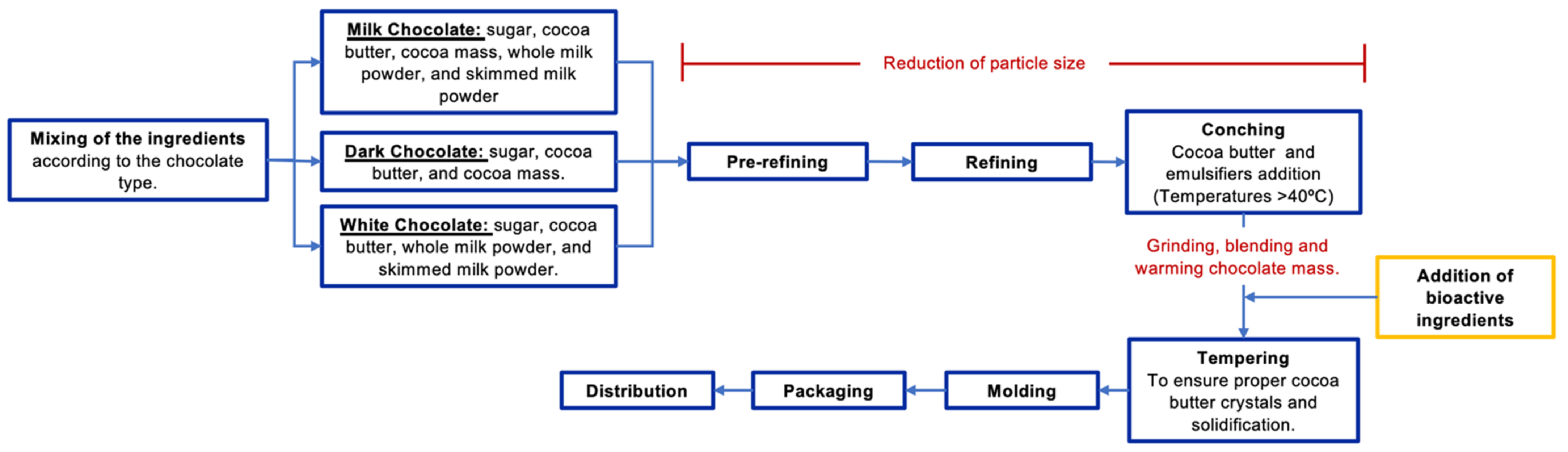
To produce functional chocolates, it is important to adapt the general chocolate making process and select a proper step to add the bioactive ingredients. Factors to consider are the stability of the bioactive molecules to processing conditions (i.e., temperature) and the homogeneous distribution of the bioactive compound in the final product. The general procedure to obtain different types of functional chocolates is shown in Figure 1. The process starts by mixing chocolate liquor/cacao and cocoa butter with sugar and other ingredients, such as milk. Thereafter, the chocolate mix is subjected to pre-refining, refining, and conching, where cocoa butter and emulsifier ingredients are added [70]. Refining and conching are two crucial steps since both determine the particle size, which affects physicochemical properties that could affect consumers’ acceptability [8]. The aim of refining is to reduce the particle size from 100–150 μm to 15–20 μm, since particle size higher than 20 μm are detected by the human tongue [24].
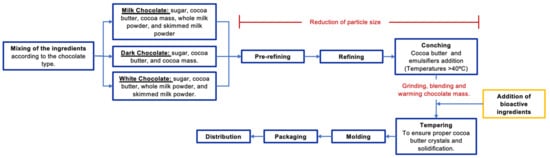
Figure 1.
General bioprocess to obtain functional chocolates added with bioactive ingredients. Bioactive ingredients are added at the beginning of the tempering process to minimize degradation of chemical compounds induced by temperature during conching, and to preserve the viability of probiotic bacteria added.
Conching is a critical step, where the inactivation of micro-organisms occurs and is directly associated with the development of quality characteristics such as color, texture, aroma, and flow behavior [81]. In general, this process consists of mixing, shearing, and aeration of the chocolate mass during heating at a specific temperature (>40 °C) [81]. Once the chocolate mass is conched, the next step is tempering; this is another critical step in chocolate’s physicochemical characteristics since this step aims to obtain a solidified chocolate bar. Therefore, it is needed to ensure proper cocoa butter crystals such as β V [82]. These β V crystals can be obtained through temperature and depend on the fat phase’s nature in the chocolate [70]. At the beginning of the tempering process, bioactive ingredients are added into the chocolate matrix to maintain their chemical stability or their viability in the case of probiotic bacteria. Bioactive ingredients are not added during conching because the high temperature affects the stability and/or viability of the bioactive compounds or probiotic bacteria added [9,30,35,36]. After bioactive ingredients addition and tempering, the chocolate is ready for molding, packaging, and distribution for sale (Figure 1).
7. General Protocol to Develop Functional Chocolates to Be Commercialized in the Food Supplement of Nutraceutical Markets
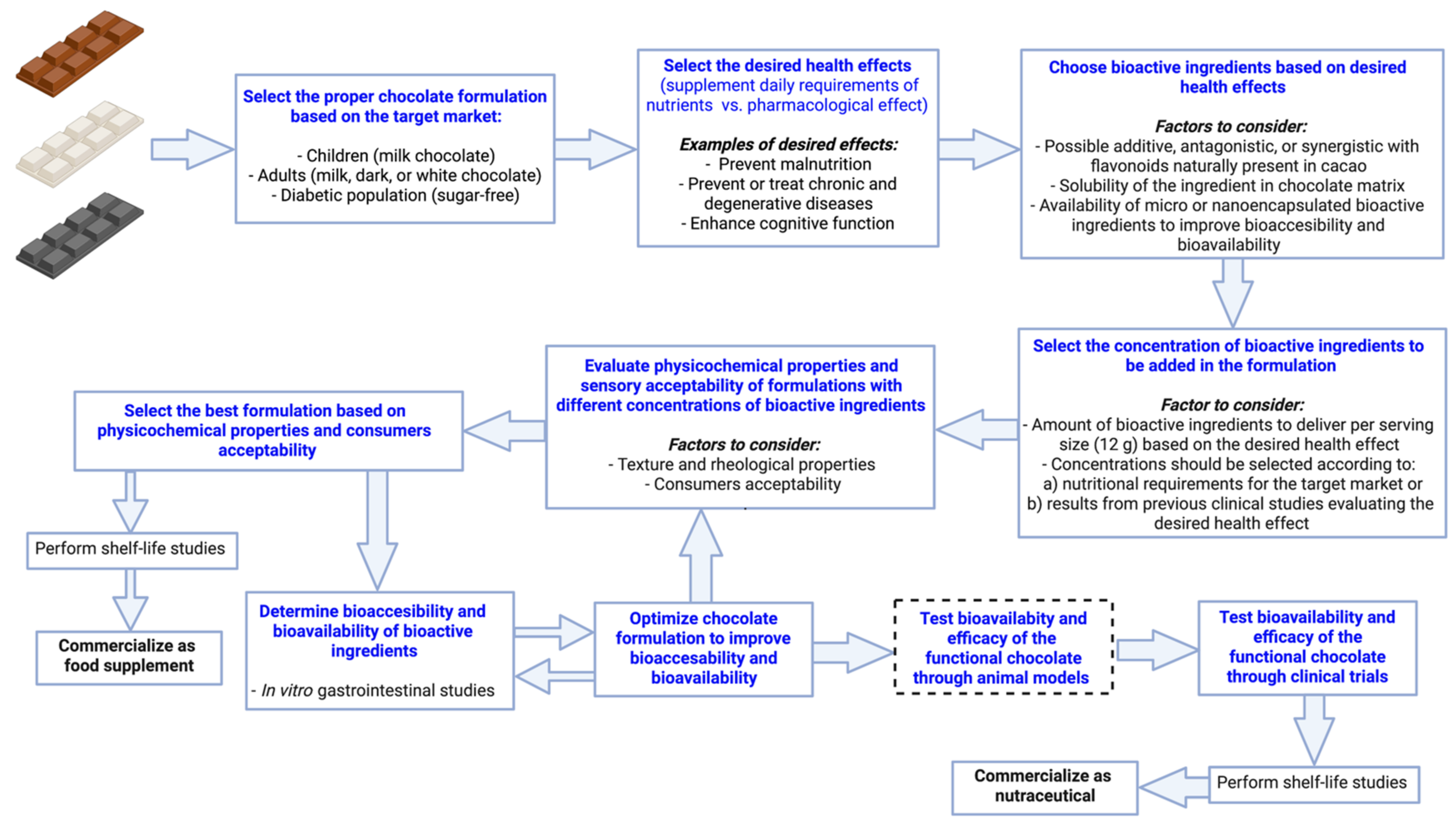
As described in the previous sections of this review article, developing functional chocolates involve several steps to ensure that the final product reach the desired characteristics. Figure 2 shows a proposed general protocol to develop functional chocolates to be commercialized either as a food supplement or as a nutraceutical. First, the chocolate type (dark, milk, or white) should be selected based on the target market. For instance, if the chocolate is intended for children, a milk chocolate formulation would be adequate, whereas if the chocolate is to be consume by the diabetic population a sugar-free formulation should be considered. After selecting the chocolate type, the desired health effect should be determined to choose the adequate bioactive ingredients to incorporate in the formulation. For example, if malnutrition should be prevented or overcome in a certain population, vitamins and minerals showing deficiencies in children should be selected. Moreover, if the desired pharmacological effect is the enhancement of cognitive function, bioactive ingredients such as ω-3 PUFAs could be incorporated. At this point, it is highly relevant to consider the possible additive, antagonistic, or synergistic effect that flavonoids naturally present in cocoa could exert on the desired pharmacological effect when mixed with the selected bioactive ingredients. If this potential interaction is not desirable, it is recommended to opt for a chocolate type with low flavonoid content, such as white chocolate. Furthermore, when searching for the sources of the bioactive compounds it is important to search for ingredients that contain the compounds either as micro or nonencapsulated form to enhance the bioaccesibility.
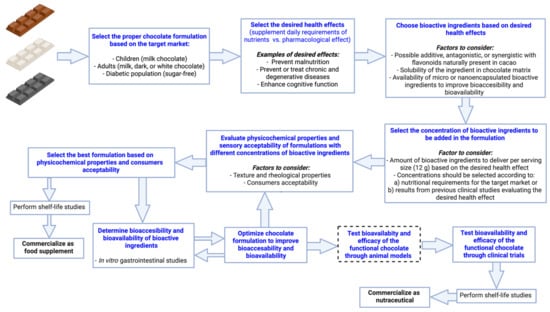
Figure 2.
Proposed general protocol to develop functional chocolates to be commercialized in the food supplement or nutraceutical markets. The step marked with dashed lines could be avoided depending on the bioactive compounds selected and their concentrations in the formulations. The in vivo studies with animal models and the clinical trials need previous approval by an ethical committee.
Once the chocolate type, desired health effect, and bioactive ingredients are chosen, the next step is to determine the concentrations at which bioactive ingredients should be added to provide enough in one serving size of chocolate (12 g). These concentrations must be defined based on previous in vivo studies or clinical trials. If the objective is to design a functional chocolate to be commercialized in the food supplement market, the concentration of bioactive ingredients should be selected according to the nutritional requirements for the target market selected (children, adult, or the elderly). On the other hand, if chocolate is intended to be commercialized as a nutraceutical, concentration of bioactive ingredients should be selected based on results from previous clinical studies evaluating the pharmacological effect of the selected compounds. After the selection of bioactive ingredient concentrations, different chocolate formulations (i.e., varying bioactive ingredient sources and/or concentrations) should be produced in sufficient amounts to evaluate their physicochemical and sensory acceptability. Also, sensory studies with trained panels evaluating the drivers of liking (sweetness, melting rate, and sweet aroma) and disliking (adherence, sandiness, bitterness, and bitter aftertaste) could be evaluated. The results obtained at this step (from physicochemical and sensory evaluations) would be the basis to select the best chocolate formulation. If the functional chocolate is to be commercialized as a food supplement, a shelf-life study would be required. Chocolate is a shelf-stable food matrix, mainly due to the natural antioxidants present in cocoa, which protect the product from oxidation. Therefore, chocolate could be cataloged as a medium or long shelf-life food product. Typical parameters to consider for the determination of the stability of chocolate during storage include oxidative rancidity, fat migration, moisture migration, texture, and graining [24]. Also, since chocolate is, in general, a microbiologically stable food, sensory acceptability during storage would mandate the expiration date, and thus it must be evaluated in shelf-life studies in addition to the physiochemical properties mentioned. Simple methodologies to determine the sensory shelf-life of microbiologically stable foods, such as the survival analysis, could be followed to stablish the expiration date of chocolate [83]. Moreover, when referring to functional chocolates, where a bioactive ingredient is added, the stability of the active compound must be determined during the shelf-life, to ensure that the amount stated in labeling will be available at the time of consumption. Once the shelf-life is validated, the product is ready to go to the market.
If the new chocolate formulation is to be commercialized as a nutraceutical, further steps in the product development process are required. First, it is important to determine the bioaccesibility and bioavailability of the bioactive compounds added in the formulation. This step could be performed using in vitro gastrointestinal assays, through enzymatic digestion that simulates different intestinal conditions [84]. If the bioaccesability and bioavailability are not as expected, it would be recommended to search for additional sources of the bioactive compounds, for instance nano and microencapsulated bioactive compounds have shown improved bioaccesibility and bioavailability. This step of optimization would require changes in the formulation; thus, it would be needed an additional validation of the physicochemical properties and acceptability of the product prior to going further in the development process. After obtaining the formulation with adequate physicochemical and sensory properties, and with the bioactive compounds bioaccessible and bioavailable, the next steps are to test the bioavailability and efficacy (pharmacological effect) of the functional chocolate either through animal models or clinical trials. Here, depending on the bioactive compounds selected and concentrations, the pharmacological effect of the new chocolate could be directly tested through clinical trials with a previous approval of an ethical committee. Once the health effects of the chocolate are validated, a shelf-life of the final formulation should be performed and, after all these steps, the chocolate could be commercialized as a nutraceutical.
8. Conclusions and Further Research Needs
In the present review, the current advances from different research groups on the development of functional chocolates were summarized. The research in this fascinating area of food science has been driven by the constant increase of the functional and medicated confectionery market, which is estimated to growth at a compound annual growth rate (CAGR) of 3.8% [85]. It can be concluded that although significant advances have been achieved in this research field, still several steps on the product development process are needed prior to launch these innovative products into the market as nutraceuticals. Most chocolate formulations added with bioactive ingredients have been developed following an approach that would allow their commercialization as food supplements but not as nutraceuticals. However, all these formulations could be further investigated to determine the bioaccesibility and bioavailability of the bioactive compounds added, as well as to determine their pharmacological effect either through animal models or clinical studies.
There are few studies on the health benefits of chocolates added with bioactive ingredients. Examples of these studies include clinical trials to determine of effect of chocolate on cognitive function, glucose metabolism [86], cardiovascular diseases [87], and body mass composition [88]. However, the number of clinical trials are scarce and, thus, there is an urgent need to perform clinical trials focused on validating the pharmacological activity of chocolates added with bioactive ingredients, since most clinical trials performed evaluating chocolate until now, have been focused on determining the effects of flavonoids present in dark chocolate.
The general protocol proposed herein to develop functional chocolates could be used by the chocolate industry or food scientists as a practical guide that considers all basic steps required prior to launching a new chocolate formulation into the market either as a food supplement or as a nutraceutical. Further research effort in this area should consider the use of nanotechnology to generate bioactive ingredients with higher bioaccesibility and bioavailability of bioactive compounds. This review demonstrates that chocolate is a quite versatile food matrix, with ideal characteristics to be used as carrier for the delivery of bioactive compounds, either for their commercialization as food supplements or as nutraceuticals.
Author Contributions
Conceptualization, P.F.-B. and D.A.J.-V.; investigation, P.F.-B., A.R.G.-F. and D.A.J.-V.; literature search, P.F.-B., A.R.G.-F. and D.A.J.-V.; writing—original draft preparation, P.F.-B., A.R.G.-F. and D.A.J.-V.; writing—review and editing, P.F.-B., A.R.G.-F., A.S. and D.A.J.-V.; supervision, D.A.J.-V. and A.S. All authors have read and agreed to the published version of the manuscript.
Funding
This study was based upon research supported by Tecnologico de Monterrey—Bioprocess Research Group and NutriOmics Research Group. Authors P.F.-B. and A.R.G.-H., also acknowledge their scholarships #923811 and #966535, respectively, from CONACYT.
Institutional Review Board Statement
Not applicable.
Informed Consent Statement
Not applicable.
Data Availability Statement
Not applicable.
Conflicts of Interest
The authors declare no conflict of interest.
References
- Santini, A.; Novellino, E. Nutraceuticals—Shedding light on the grey area between pharmaceuticals and food. Expert Rev. Clin. Pharmacol. 2018, 11, 545–547. [Google Scholar] [CrossRef] [PubMed]
- Santana-Gálvez, J.; Cisneros-Zevallos, L.; Jacobo-Velázquez, D.A. A practical guide for designing effective nutraceutical combinations in the form of foods, beverages, and dietary supplements against chronic degenerative diseases. Trends Food Sci. Technol. 2019, 88, 179–193. [Google Scholar] [CrossRef]
- Jacobo-Velázquez, D.A.; Santana-Gálvez, J.; Cisneros-Zevallos, L. Designing next-generation functional food and beverages: Combining nonthermal processing technologies and postharvest abiotic stresses. Food Eng. Rev. 2020. [Google Scholar] [CrossRef]
- Fernandes, S.S.; Coelho, M.S.; Salas-Mellado, M.D.L.M. Bioactive Compounds as Ingredients of Functional Foods: Polyphenols, carotenoids, peptides from animal and plant sources new. In Bioactive Compounds: Health Benefits and Potential Applications; Segura-Campos, M.R., Ed.; Woodhead Publishing: Cambridge, UK, 2019; pp. 129–142. [Google Scholar] [CrossRef]
- Cencic, A.; Chingwaru, W. The role of functional foods, nutraceuticals, and food supplements in intestinal health. Nutrients 2010, 2, 611–625. [Google Scholar] [CrossRef]
- Ackar, D.; Lendić, K.V.; Valek, M.; Šubarić, D.; Miličević, B.; Babić, J.; Nedić, I. Cocoa polyphenols: Can we consider cocoa and chocolate as potential functional food? J. Chem. 2013, 2013, 289392. [Google Scholar] [CrossRef]
- Annunziata, A.; Vecchio, R.; Kraus, A. Factors affecting parents’ choices of functional foods targeted for children. Int. J. Consum. Stud. 2016, 40, 527–535. [Google Scholar] [CrossRef]
- Konar, N.; Palabiyik, I.; Toker, O.S.; Polat, D.G.; Kelleci, E.; Pirouzian, H.R.; Akcicek, A.; Sagdic, O. Conventional and sugar-free probiotic white chocolate: Effect of inulin DP on various quality properties and viability of probiotics. J. Funct. Foods 2018, 43, 206–213. [Google Scholar] [CrossRef]
- Konar, N.; Toker, O.S.; Pirouzian, H.R.; Oba, S.; Polat, D.G.; Palabiyik, I.; Poyrazoglu, E.S.; Sağdiç, O. Enrichment of milk chocolate by using EPA and DHA originated from various origins: Effects on product quality. Sugar Tech. 2018, 20, 745–755. [Google Scholar] [CrossRef]
- Foong, Y.J.; Lee, S.T.; Ramli, N.; Tan, Y.N.; Ayob, M.K. Incorporation of potential probiotic Lactobacillus plantarum Isolated from fermented cocoa beans into dark chocolate: Bacterial viability and physicochemical properties analysis. J. Food Qual. 2013, 36, 164–171. [Google Scholar] [CrossRef]
- Yoon, M.-H.; Kim, K.-H.; Hwang, H.-R.; Jo, J.-E.; Kim, M.-S.; Yook, H.-S. Quality characteristics and antioxidant activity of chocolate containing flowering cherry (Prunus serrulata L. var. spontanea Max. wils.) Fruit Powder. J. Korean Soc. Food Sci. Nutr. 2009, 38, 1600–1605. [Google Scholar] [CrossRef]
- Jung, K.-M.; Park, S.-G.; Lee, Y.; Kim, S.R. Development and characterization of peach powder-added chocolate and chocolate-covered freeze-dried peach snack. J. East Asian Soc. Diet. Life 2017, 27, 521–528. [Google Scholar] [CrossRef]
- Hwang, M.-H.; Jeon, H.-L.; Kim, H.-D.; Lee, S.-W.; Kim, M.-R. Quality characteristics and antioxidant activities of chocolate added with mulberry pomace. Korean J. Food Cook. Sci. 2012, 28, 479–487. [Google Scholar] [CrossRef][Green Version]
- Katz, D.L.; Doughty, K.; Ali, A. Cocoa and chocolate in human health and disease. Antioxid. Redox Signal. 2011, 15, 2779–2811. [Google Scholar] [CrossRef]
- Meng, C.C.; Jalil, A.M.M.; Ismail, A. Phenolic and theobromine contents of commercial dark, milk and white chocolates on the malaysian market. Molecules 2009, 14, 200–209. [Google Scholar] [CrossRef] [PubMed]
- Paranjape, A.; Sonawane, S.; Patil, S. Development of sugar free and fortified chocolates with D-optimal design approach. J. Food Eng. Technol. 2021, 10, 28–33. [Google Scholar] [CrossRef]
- Gómez-Fernández, A.R.; Santacruz, A.; Jacobo-Velázquez, D.A. The complex relationship between metabolic syndrome and sweeteners. J. Food Sci. 2021, 86, 1511–1531. [Google Scholar] [CrossRef]
- Sarfarazi, M.; Mohebbi, M. An investigation into the crystalline structure, and the rheological, thermal, textural and sensory properties of sugar-free milk chocolate: Effect of inulin and maltodextrin. J. Food Meas. Charact. 2020, 14, 1568–1581. [Google Scholar] [CrossRef]
- Gonçalves, E.V.; Lannes, S. Chocolate rheology. Food Sci. Technol. 2010, 30, 845–851. [Google Scholar] [CrossRef]
- Jalil, A.M.M.; Ismail, A. Polyphenols in cocoa and cocoa products: Is there a link between antioxidant properties and health? Molecules 2008, 13, 2190–2219. [Google Scholar] [CrossRef]
- Sokolov, A.N.; Pavlova, M.A.; Klosterhalfen, S.; Enck, P. Chocolate and the brain: Neurobiological impact of cocoa flavanols on cognition and behavior. Neurosci. Biobehav. Rev. 2013, 37, 2445–2453. [Google Scholar] [CrossRef]
- El-Kalyoubi, M.; Khallaf, M.; Abdelrashid, A.; Mostafa, E.M. Quality characteristics of chocolate—Containing some fat replacer. Ann. Agric. Sci. 2011, 56, 89–96. [Google Scholar] [CrossRef]
- Glicerina, V.; Balestra, F.; Rosa, M.D.; Romani, S. Effect of manufacturing process on the microstructural and rheological properties of milk chocolate. J. Food Eng. 2015, 145, 45–50. [Google Scholar] [CrossRef]
- Afoakwa, E.O.; Paterson, A.; Fowler, M. Factors influencing rheological and textural qualities in chocolate—A review. Trends Food Sci. Technol. 2007, 18, 290–298. [Google Scholar] [CrossRef]
- Rezaei, F.; VanderGheynst, J.S. Critical moisture content for microbial growth in dried food-processing residues. J. Sci. Food Agric. 2010, 90, 2000–2005. [Google Scholar] [CrossRef] [PubMed]
- De Melo, L.; Bolini, H.; Efraim, P. Sensory profile, acceptability, and their relationship for diabetic/reduced calorie chocolates. Food Qual. Prefer. 2009, 20, 138–143. [Google Scholar] [CrossRef]
- Silva, M.; Tulini, F.; Marinho, J.F.; Mazzocato, M.C.; De Martinis, E.C.; Luccas, V.; Favaro-Trindade, C.S. Semisweet chocolate as a vehicle for the probiotics Lactobacillus acidophilus LA3 and Bifidobacterium animalis subsp. lactis BLC1: Evaluation of chocolate stability and probiotic survival under in vitro simulated gastrointestinal conditions. LWT 2017, 75, 640–647. [Google Scholar] [CrossRef]
- Méndez, A.S.; Pérez, L.A.C. Adición de hierro hemo, proveniente de hemoglobina bovina a un chocolate de consumo directo. Bistua Rev. Fac. Cienc. Básicas 2011, 9, 21–31. [Google Scholar]
- Didar, Z. Enrichment of dark chocolate with vitamin D3 (free or liposome) and assessment quality parameters. J. Food Sci. Technol. 2020, 58, 3065–3072. [Google Scholar] [CrossRef] [PubMed]
- Faccinetto-Beltrán, P.; Gómez-Fernández, A.; Orozco-Sánchez, N.; Pérez-Carrillo, E.; Marín-Obispo, L.; Hernández-Brenes, C.; Santacruz, A.; Jacobo-Velázquez, D. Physicochemical properties and sensory acceptability of a next-generation functional chocolate added with omega-3 polyunsaturated fatty acids and probiotics. Foods 2021, 10, 333. [Google Scholar] [CrossRef] [PubMed]
- Gómez-Fernández, A.; Faccinetto-Beltrán, P.; Orozco-Sánchez, N.; Pérez-Carrillo, E.; Santacruz, A.; Jacobo-Velázquez, D. Physicochemical properties and sensory acceptability of sugar free dark chocolate formulations added with probiotics. Rev. Mex. Ing. Quim. 2021, 20, 697–709. [Google Scholar] [CrossRef]
- Gómez-Fernández, A.R.; Faccinetto-Beltrán, P.; Orozco-Sánchez, N.E.; Pérez-Carrillo, E.; Marín-Obispo, L.M.; Hernández-Brenes, C.; Santacruz, A.; Jacobo-Velázquez, D.A. Sugar-free milk chocolate as a carrier of omega-3 polyunsaturated fatty acids and probiotics: A potential functional food for the diabetic population. Foods 2021, 10, 1866. [Google Scholar] [CrossRef]
- Gültekin-Özgüven, M.; Karadag, A.; Duman, Ş.; Ozkal, B.; Özçelik, B. Fortification of dark chocolate with spray dried black mulberry (Morus nigra) waste extract encapsulated in chitosan-coated liposomes and bioaccessability studies. Food Chem. 2016, 201, 205–212. [Google Scholar] [CrossRef]
- Yoo, K.-M.; Song, M.-R.; Ji, E.-J. Preparation and sensory characteristics of chocolate with added coffee waste. Korean J. Food Nutr. 2011, 24, 111–116. [Google Scholar] [CrossRef][Green Version]
- Toker, O.S.; Konar, N.; Pirouzian, H.R.; Oba, S.; Polat, D.G.; Palabiyik, I.; Poyrazoglu, E.S.; Sagdic, O. Developing functional white chocolate by incorporating different forms of EPA and DHA—Effects on product quality. LWT 2018, 87, 177–185. [Google Scholar] [CrossRef]
- Toker, O.S.; Konar, N.; Palabiyik, I.; Pirouzian, H.R.; Oba, S.; Polat, D.G.; Poyrazoglu, E.S.; Sagdic, O. Formulation of dark chocolate as a carrier to deliver eicosapentaenoic and docosahexaenoic acids: Effects on product quality. Food Chem. 2018, 254, 224–231. [Google Scholar] [CrossRef] [PubMed]
- Zarić, D.B.; Bulatović, M.L.; Rakin, M.B.; Krunić, T.; Lončarević, I.S.; Pajin, B.S. Functional, rheological and sensory properties of probiotic milk chocolate produced in a ball mill. RSC Adv. 2016, 6, 13934–13941. [Google Scholar] [CrossRef]
- Żyżelewicz, D.; Nebesny, E.; Motyl, I.; Libudzisz, Z. Effect of milk chocolate supplementation with lyophilised Lactobacillus cells on its attributes. Czech J. Food Sci. 2010, 28, 392–406. [Google Scholar] [CrossRef]
- Mandal, S.; Hati, S.; Puniya, A.K.; Singh, R.; Singh, K. Development of synbiotic milk chocolate using encapsulated Lactobacillus casei NCDC 298. J. Food Process. Preserv. 2012, 37, 1031–1037. [Google Scholar] [CrossRef]
- Marcial-Coba, M.S.; Saaby, L.; Knøchel, S.; Nielsen, D.S. Dark chocolate as a stable carrier of microencapsulated Akkermansia muciniphila and Lactobacillus casei. FEMS Microbiol. Lett. 2018, 366, fny290. [Google Scholar] [CrossRef]
- Kemsawasd, V.; Chaikham, P.; Rattanasena, P. Survival of immobilized probiotics in chocolate during storage and with an in vitro gastrointestinal model. Food Biosci. 2016, 16, 37–43. [Google Scholar] [CrossRef]
- Denkova-Kostova, R.S.; Goranov, B.G.; Teneva, D.G.; Tomova, T.G.; Denkova, Z.R.; Shopska, V.; Mihaylova-Ivanova, Y. Bio-preservation of chocolate mousse with free and immobilized cells of Lactobacillus plantarum D2 and lemon (Citrus lemon L.) or grapefruit (Citrus paradisi L.) zest essential oils. Acta Sci. Pol. Technol. Aliment. 2015, 20, 5–16. [Google Scholar] [CrossRef]
- Santana-Gálvez, J.; Jacobo-Velázquez, D.A. Classification of phenolic compounds. In Phenolic Compounds in Food, 1st ed.; Nollet, L.M.L., Gutierrez-Uribe, J.A., Eds.; CRC Press: New York, NY, USA, 2017; pp. 3–21. [Google Scholar]
- Caleja, C.; Ribeiro, A.; Barreiro, M.F.; Ferreira, I.C. Phenolic compounds as nutraceuticals or functional food ingredients. Curr. Pharm. Des. 2017, 23, 2787–2806. [Google Scholar] [CrossRef] [PubMed]
- Santana-Gálvez, J.; Villela-Castrejón, J.; Serna-Saldívar, S.O.; Cisneros-Zevallos, L.; Jacobo-Velázquez, D.A. Synergistic combinations of curcumin, sulforaphane, and dihydrocaffeic acid against human colon cancer cells. Int. J. Mol. Sci. 2020, 21, 3108. [Google Scholar] [CrossRef]
- Maleki, S.J.; Crespo, J.F.; Cabanillas, B. Anti-inflammatory effects of flavonoids. Food Chem. 2019, 299, 125124. [Google Scholar] [CrossRef]
- Robinson, J.G.; Ijioma, N.; Harris, W. Omega-3 fatty acids and cognitive function in women. Women Health 2010, 6, 119–134. [Google Scholar] [CrossRef] [PubMed]
- Dyall, S.C. Long-chain omega-3 fatty acids and the brain: A review of the independent and shared effects of EPA, DPA and DHA. Front. Aging Neurosci. 2015, 7, 52. [Google Scholar] [CrossRef] [PubMed]
- Orellana, P.; Valenzuela, R.; Valenzuela, A.; Morales, G.I. Efectos neuro protectores del ácido araquidónico y del ácido docosahexaenoico en las etapas extremas de la vida: Una visión integradora. Rev. Chil. Nutr. 2018, 45, 80–88. [Google Scholar] [CrossRef]
- Gao, H.; Geng, T.; Huang, T.; Zhao, Q. Fish oil supplementation and insulin sensitivity: A systematic review and meta-analysis. Lipids Health Dis. 2017, 16, 1–9. [Google Scholar] [CrossRef]
- Tacon, A.G.J.; Metian, M. Fish Matters: Importance of aquatic foods in human nutrition and global food supply. Rev. Fish. Sci. 2013, 21, 22–38. [Google Scholar] [CrossRef]
- Punia, S.; Sandhu, K.S.; Siroha, A.K.; Dhull, S.B. Omega 3-metabolism, absorption, bioavailability and health benefits—A review. PharmaNutrition 2019, 10, 100162. [Google Scholar] [CrossRef]
- Valdés-Ramos, R.; Guadarrama-López, A.L.; Martínez-Carrillo, B.E.; Harbige, L.S. n-3 Polyunsaturated fatty acids in type 2 diabetes mellitus. In Bioactive Food as Dietary Interventions for Diabetes, 2nd ed.; Watson, R.R., Preedy, V.R., Eds.; Elsevier: Amsterdam, The Netherlands, 2019; pp. 193–209. [Google Scholar] [CrossRef]
- Neethirajan, S.; Jayas, D.S. Nanotechnology for the food and bioprocessing industries. Food Bioprocess Technol. 2010, 4, 39–47. [Google Scholar] [CrossRef]
- Cheng, L.-H.; Liu, Y.-W.; Wu, C.-C.; Wang, S.; Tsai, Y.-C. Psychobiotics in mental health, neurodegenerative and neurodevelopmental disorders. J. Food Drug Anal. 2019, 27, 632–648. [Google Scholar] [CrossRef]
- Sarkar, S.R.; Banerjee, S. Gut microbiota in neurodegenerative disorders. J. Neuroimmunol. 2019, 328, 98–104. [Google Scholar] [CrossRef] [PubMed]
- Agahi, A.; Hamidi, G.A.; Daneshvar, R.; Hamdieh, M.; Soheili, M.; Alinaghipour, A.; Taba, S.M.E.; Salami, M. Does severity of alzheimer’s disease contribute to its responsiveness to modifying gut microbiota? A double blind clinical trial. Front. Neurol. 2018, 9, 662. [Google Scholar] [CrossRef]
- Wong, C.B.; Kobayashi, Y.; Xiao, J.-Z. Probiotics for Preventing Cognitive Impairment in Alzheimer’s Disease. In Gut Microbiota Brain Axis; Evrensel, A., Ünsalver, B.Ö., Eds.; Intech Open: London, UK, 2018; pp. 85–104. [Google Scholar] [CrossRef]
- Larsen, N.; Vogensen, F.; Van Den Berg, F.; Nielsen, D.S.; Andreasen, A.S.; Pedersen, B.K.; Abu Al-Soud, W.; Sørensen, S.; Hansen, L.H.; Jakobsen, M. Gut microbiota in human adults with type 2 diabetes differs from non-diabetic adults. PLoS ONE 2010, 5, e9085. [Google Scholar] [CrossRef] [PubMed]
- Yoo, J.Y.; Kim, S.S. Probiotics and prebiotics: Present status and future perspectives on metabolic disorders. Nutrients 2016, 8, 173. [Google Scholar] [CrossRef]
- Balakumar, M.; Prabhu, D.; Sathishkumar, C.; Prabu, P.; Rokana, N.; Kumar, R.; Raghavan, S.; Soundarajan, A.; Grover, S.; Batish, V.K.; et al. Improvement in glucose tolerance and insulin sensitivity by probiotic strains of Indian gut origin in high-fat diet-fed C57BL/6J mice. Eur. J. Nutr. 2016, 57, 279–295. [Google Scholar] [CrossRef] [PubMed]
- Simon, M.-C.; Strassburger, K.; Nowotny, B.; Kolb, H.; Nowotny, P.; Burkart, V.; Zivehe, F.; Hwang, J.-H.; Stehle, P.; Pacini, G.; et al. Intake of Lactobacillus reuteri improves incretin and insulin secretion in glucose-tolerant humans: A proof of concept. Diabetes Care 2015, 38, 1827–1834. [Google Scholar] [CrossRef] [PubMed]
- Ahrén, B.; Schmitz, O. GLP-1 Receptor agonists and DPP-4 inhibitors in the treatment of type 2 diabetes. Horm. Metab. Res. 2004, 36, 867–876. [Google Scholar] [CrossRef]
- Sun, Z.; Sun, X.; Li, J.; Li, Z.; Hu, Q.; Li, L.; Hao, X.; Song, M.; Li, C. Using probiotics for type 2 diabetes mellitus intervention: Advances, questions, and potential. Crit. Rev. Food Sci. Nutr. 2019, 60, 670–683. [Google Scholar] [CrossRef]
- Tardy, A.-L.; Pouteau, E.; Marquez, D.; Yilmaz, C.; Scholey, A. Vitamins and minerals for energy, fatigue and cognition: A narrative review of the biochemical and clinical evidence. Nutrients 2020, 12, 228. [Google Scholar] [CrossRef] [PubMed]
- Gastélum-Estrada, A.; Serna-Saldívar, S.O.; Jacobo-Velázquez, D.A. Fighting the COVID-19 pandemic through biofortification: Innovative approaches to improve the immunomodulating capacity of foods. ACS Food Sci. Technol. 2021, 1, 480–486. [Google Scholar] [CrossRef]
- Kruszewski, B.; Obiedziński, M.W. Multivariate analysis of essential elements in raw cocoa and processed chocolate mass materials from three different manufacturers. LWT 2018, 98, 113–123. [Google Scholar] [CrossRef]
- Aidoo, R.P.; Afoakwa, E.O.; Dewettinck, K. Optimization of inulin and polydextrose mixtures as sucrose replacers during sugar-free chocolate manufacture—Rheological, microstructure and physical quality characteristics. J. Food Eng. 2014, 126, 35–42. [Google Scholar] [CrossRef]
- Skytte, U.P.; Kaylegian, K.E. Ingredients from milk. In Beckett’s Industrial Chocolate Manufacture and Use; Beckett, S.T., Fowler, M.S., Ziegler, G.R., Eds.; Wiley-Blackwell: Hoboken, NJ, USA, 2017; pp. 102–134. [Google Scholar]
- Hartel, R.W.; Von Elbe, J.H.; Hofberger, R. Fats, Oils and Emulsifiers. In Confectionery Science and Technology; Hartel, R.W., von Elbe, J.H., Hofberger, R., Eds.; Springer: Cham, Switzerland, 2017; pp. 85–124. [Google Scholar] [CrossRef]
- Yeganehzad, S.; Pahlevanloo, A.; Kiumarsi, M.; Zayerzadeh, A.; Sadjadi, S.A.; Shahidi, M.; Nadali, N. Effects of sugar-free, αs1-casein–enriched chocolate on stress: Based on salivary cortisol measurement and questionnaire data collection. J. Nutr. Sci. Diet. 2018, 4, 112–119. [Google Scholar]
- Konar, N.; Palabiyik, I.; Toker, O.S.; Polat, D.G.; Sener, S.; Akcicek, A.; Sagdic, O. Effect of inulin DP on various properties of sugar-free dark chocolates containing Lactobacillus paracasei and Lactobacillus acidophilus. Int. J. Food Eng. 2017, 13, 20170045. [Google Scholar] [CrossRef]
- Konar, N. Influence of conching temperature and some bulk sweeteners on physical and rheological properties of prebiotic milk chocolate containing inulin. Eur. Food Res. Technol. 2012, 236, 135–143. [Google Scholar] [CrossRef]
- Aidoo, R.P.; Afoakwa, E.O.; Dewettinck, K. Rheological properties, melting behaviours and physical quality characteristics of sugar-free chocolates processed using inulin/polydextrose bulking mixtures sweetened with stevia and thaumatin extracts. LWT 2015, 62, 592–597. [Google Scholar] [CrossRef]
- De Melo, L.L.M.M.; Bolini, H.; Efraim, P. Equisweet Milk chocolates with intense sweeteners using time-intensity method. J. Food Qual. 2007, 30, 1056–1067. [Google Scholar] [CrossRef]
- Palazzo, A.; Carvalho, M.; Efraim, P.; Bolini, H. The determination of isosweetness concentrations of sucralose, rebaudioside and neotame as sucrose substitutes in new diet chocolate formulations using the time-intensity analysis. J. Sens. Stud. 2011, 26, 291–297. [Google Scholar] [CrossRef]
- Shah, A.B.; Jones, G.P.; Vasiljevic, T. Sucrose-free chocolate sweetened with Stevia rebaudiana extract and containing different bulking agents—Effects on physicochemical and sensory properties. Int. J. Food Sci. Technol. 2010, 45, 1426–1435. [Google Scholar] [CrossRef]
- Kiumarsi, M.; Rafe, A.; Yeganehzad, S. Effect of different bulk sweeteners on the dynamic oscillatory and shear rheology of chocolate. Appl. Rheol. 2017, 27, 64123. [Google Scholar] [CrossRef]
- Rad, A.H.; Pirouzian, H.R.; Toker, O.S.; Konar, N. Application of simplex lattice mixture design for optimization of sucrose-free milk chocolate produced in a ball mill. LWT 2019, 115, 108435. [Google Scholar] [CrossRef]
- Belščak-Cvitanović, A.; Komes, D.; Dujmović, M.; Karlović, S.; Biškić, M.; Brnčić, M.; Ježek, D. Physical, bioactive and sensory quality parameters of reduced sugar chocolates formulated with natural sweeteners as sucrose alternatives. Food Chem. 2015, 167, 61–70. [Google Scholar] [CrossRef] [PubMed]
- Toker, O.S.; Palabiyik, I.; Konar, N. Chocolate quality and conching. Trends Food Sci. Technol. 2019, 91, 446–453. [Google Scholar] [CrossRef]
- Kinta, Y.; Hartel, R.W. Bloom formation on poorly-tempered chocolate and effects of seed addition. J. Am. Oil Chem. Soc. 2009, 87, 19–27. [Google Scholar] [CrossRef]
- Hough, G.; Langohr, K.; Gomez, G.; Curia, A. Survival analysis applied to sensory shelf life of foods. J. Food Sci. 2003, 68, 359–362. [Google Scholar] [CrossRef]
- Paz-Yépez, C.; Peinado, I.; Heredia, A.; Andrés, A. Lipids digestibility and polyphenols release under in vitro digestion of dark, milk and white chocolate. J. Funct. Foods 2018, 52, 196–203. [Google Scholar] [CrossRef]
- Medicated Confectionary Market—Growth, Trends, Covid-19 Impact, and Forecasts (2021–2026). Available online: https://www.mordorintelligence.com/industry-reports/medicated-confectionery-market (accessed on 21 August 2021).
- Shahidan, N.; Salleh, N.; Zakaria, Z.; Anwar, N.R. Glycemic index of chocolate fortified with pumpkin (Cucurbita moshata) and taro (Colocasia esculenta) powder and its effect on mood and cognitive functions of female students. J. Fundam. Appl. Sci. 2018, 9, 876. [Google Scholar] [CrossRef]
- Allen, R.R.; Carson, L.; Kwik-Uribe, C.; Evans, E.M.; Erdman, J.W. Daily consumption of a dark chocolate containing flavanols and added sterol esters affects cardiovascular risk factors in a normotensive population with elevated cholesterol. J. Nutr. 2008, 138, 725–731. [Google Scholar] [CrossRef]
- Milagres, M.P.; Silva, D.M.; Pereira, I.d.O.; Senhorinho, L.M.; Sant’Ana, A.E.G.; Matos, T.B. Health benefits of chocolate consumption with high concentration of cocoa incorporated from triterpenic acids, isolated from Mansoa Hirsuta DC. Food Sci. Technol. 2020, 40, 305–311. [Google Scholar] [CrossRef]
Publisher’s Note: MDPI stays neutral with regard to jurisdictional claims in published maps and institutional affiliations. |
© 2021 by the authors. Licensee MDPI, Basel, Switzerland. This article is an open access article distributed under the terms and conditions of the Creative Commons Attribution (CC BY) license (https://creativecommons.org/licenses/by/4.0/).