


Abstract
Service-based learning belongs to experiential education. It emphasizes experience in learning with services that benefit a provider and a recipient. Around 100,000 foreign students are coming to Taiwan to study every year. Most of them are from ASEAN countries. Taiwan provides an excellent experience in studying for foreign students. To strengthen their learning effect, we applied service-based learning through cooperation with professors from the Department of Environmental Engineering. Through the production, discussion, and revision of service-based learning and materials in-person or in online teaching, foreign students learn air quality-related knowledge effectively. Service-based learning was integrated into the competition method to enhance the learning memories of foreign students. As the ASEAN region is prone to climate change, service-based learning helps ASEAN countries cultivate governance leaders for a sustainable environment.
1. Introduction
Service-based learning has the function of encouraging and assisting the self-learning of students. In service-based learning, students need to cooperate. Service-based learning can cultivate a spirit of teamwork, an understanding of the power of teams, and communication skills. In addition, contact with society (community) allows students to step out of their boundaries and encounter diverse people. In the process, students engage in conversations and interactions, understand different perspectives and needs, and interpret various matters from objective perspectives. This is beneficial for students to expand their worldviews and thoughts, encouraging their growth.
Service-based learning originated in the United States in the 1960s. John Dewey proposed that student learning must be the basis, and through planning courses and participating in service-based learning, students can develop themselves and learn how to communicate and cooperate. By participating in society (community), students can experience and engage in social (community) affairs. Through this participation, they discover social (community) problems and think about their causes to solve problems or help improve them. Society (community) activities make students aware of the community and assist in its development as citizens [1].
Taiwan has promoted service-based learning since 1980, beginning with various universities and colleges. In 2008, with the implementation of the nine-year integrated curriculum, service-based learning was incorporated into the educational activity. In the twelve-year national education system of 2014, service-based learning was included as a scoring item for admission without examination to encourage students to engage more in community service or participate in charitable activities and promote students’ learning and civic literacy.
Battistoni (1997) [2] believed that service-based learning strengthens problem-solving skills, which are obtained through participating in community services. This involves many factors: searching for relevant information, taking action, and tracking results. Moreover, Jacoby (1996) [3] stated that service-based learning boosts the absorption and application of courses and improves students’ interaction, participation, cooperation ability, and communication skills. Chen (2016) [4] thought that positive service-based learning experiences in self-growth, civic responsibility, and interpersonal relationships contribute to students’ overall development. Indicators of psychological adjustment and self-identity are also positive, assisting students to amend their negative psychological status and explore and reassess their values or capabilities. Fertman et al. (1996) [5] proposed a four-stage model of service-based learning, which becomes a learning cycle. The four stages are preparation, service, reflection, and celebration. The preparation stage involves identifying the service target and direction; the service stage involves starting the service and contacting the service target; the reflection stage involves introspection after activities or contact, which can be carried out through group discussions or reports; the celebration stage involves affirming the students’ previous service, such as through rewards, prizes, or certificates of recognition.
2. Method
Air quality-related knowledge is taught in English to ASEAN students in Taiwan. The topics include air pollution control equipment, air pollution policies, and solutions for air pollution. By imparting this knowledge, students are aware of the current status of air quality management and compare the situation with their countries. To motivate students’ learning, the activity was provided in a service-based learning mechanism in this study. A total of 32 students participated in the activity in 14 groups. Each group designed a service-based activity for air quality knowledge. The participants served at least 10 students who were not the participants. Seven groups of the participants competed in the service-based learning activity, while the other group did not. The competition was evaluated based on the creativity and innovation of teaching materials (such as PPT design, pictures or video supplementary, Q&A game, etc.) by three judges. The participants completed a questionnaire (Table 1), which was designed to understand the effectiveness of service-based learning and the effect of competition. The questionnaire adopted a 5-point scale of the satisfaction degree. Service-based learning allowed students to transition from learners to instructors and strengthen their learning motivation.

Table 1.
Questionnaire on a Likert 5-point scale.
3. Results
Most groups adopted webinars for service-based learning activities (Figure 1). The served students were from different countries, such as Taiwan, Indonesia, the Philippines, Vietnam, Pakistan, and Thailand. The language of communication was English. The shared topics included restaurant fume problems, the traditional Taiwanese culture of burning incense, indoor air quality issues, and others (Table 2). The fourteen groups in this study completed the service-based learning content. Each group conducted at least one webinar, with participants per session ranging from 14 to 108. A total of 589 participants joined the service-based learning activities. Coupled with interactions in the webinar, the service-based learning activities attracted participants’ attention, deepened their impressions, and made the sharing more effective.
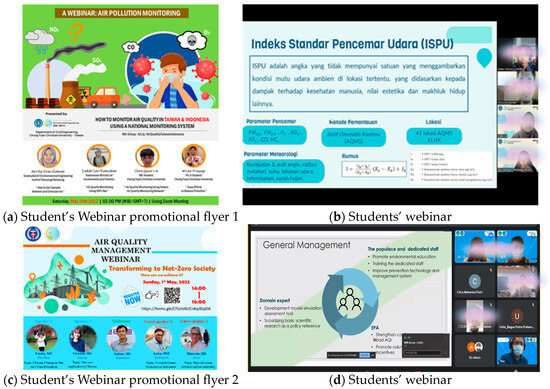
Figure 1.
Examples of student service-based learning activities.
Table 2.
Service-based learning activity for air quality management-related topics.
The independent t-test results showed that the effect of competition on teaching material creativity was statistically significant at p < 0.01 (Table 3). The service-based learning activities of Q&A and interactive teaching (e.g., Slido) were beneficial for served students. They strengthened increased air quality-related knowledge (p < 0.01). Webinar teaching made education borderless, inspiring more students interested in the topic of air quality. It also allowed students to plan service-based learning activities and have opportunities to learn and practice. The questionnaire survey result (Figure 2) showed that competition enhanced the students’ motivation for interactive service activities and made them search for more information on air quality or pollution. It also strengthened the knowledge of the air quality of the students who planned the service-based learning activities (p < 0.01). However, with competition, the participants had a limited impact on social contributions. It is necessary to explore how competition can be combined in cooperation for social benefits.
Table 3.
Effect of competition on teaching material.
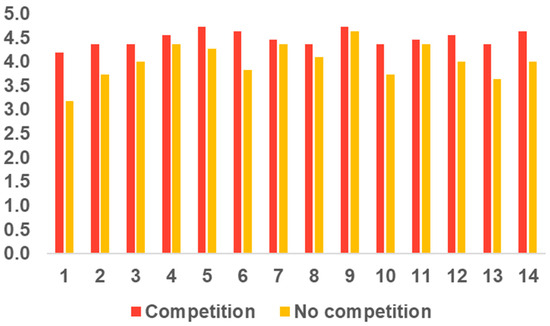
Figure 2.
Questionnaire survey results.
4. Conclusions
Teamwork is valuable as it is used to coordinate diverse perspectives on problem-solving and enhance efficient and effective access to solutions. In air quality knowledge teaching, students were encouraged to think about related issues and actions. A competitive environment helps to absorb knowledge actively and increase extensive reading. Competition is a motivating factor for learning. Group activities help students cultivate teamwork and understand its importance. During teamwork, relationships and cohesion are formed, making tasks successful and complete. Students contributed their best performance and put in their efforts regardless of the result. The incentive-driven design of service-based learning activities strengthened teamwork, inspired participants’ interest, and reinforced team members’ learning about air quality-related knowledge.
Author Contributions
I.-F.L.: Writing—original draft, Writing—review and editing, Data curation, Formal analysis, Investigation, Methodology, Resources, Validation, Visualization. D.D.: Data curation, Validation, Investigation, Visualization. Methodology. S.-J.Y.: review and editing, Formal analysis, Resources, Investigation, Project administration, Funding acquisition. All authors have read and agreed to the published version of the manuscript.
Funding
This research received no external funding.
Institutional Review Board Statement
Not applicable.
Informed Consent Statement
Informed consent was obtained from all subjects involved in the study.
Data Availability Statement
No data were used for the research described in the article.
Acknowledgments
This research was supported by the Sustainable Environmental Education Center of Chung Yuan Christian University.
Conflicts of Interest
The authors declare no conflicts of interest.
References
- Xu, M.; Lin, Z. Service-Based Learning: Basic Concepts and Theoretical Foundations; Hungyeh Publishing Co., Ltd.: Taipei, Taiwan, 2009. [Google Scholar]
- Battistoni, R.M. Service-based learning and Democratic Citizenship. Theory Into Pract. 1997, 36, 150–156. [Google Scholar] [CrossRef]
- Jacoby, B. Associates, Service-Based Learning in Higher Education: Concepts and Practices; Jossey-Bass: Hoboken, NJ, USA, 1996. [Google Scholar]
- Chen, K.H. Preliminary Exploration of College Students’ Service-based learning Experience and Growth Scale. J. Holist. Educ. 2016, 14, 63–103. [Google Scholar]
- Fertman, C.I.; White, G.P.; White, L.J. Service-Based Learning in the Middle School: Building a Culture of Service; National Middle School Association: Westerville, OH, USA, 1996. [Google Scholar]
Disclaimer/Publisher’s Note: The statements, opinions and data contained in all publications are solely those of the individual author(s) and contributor(s) and not of MDPI and/or the editor(s). MDPI and/or the editor(s) disclaim responsibility for any injury to people or property resulting from any ideas, methods, instructions or products referred to in the content. |
© 2024 by the authors. Licensee MDPI, Basel, Switzerland. This article is an open access article distributed under the terms and conditions of the Creative Commons Attribution (CC BY) license (https://creativecommons.org/licenses/by/4.0/).