You are currently viewing a new version of our website. To view the old version click .

Catalysts

Catalysts is an international, peer-reviewed, open access journal of catalysts and catalyzed reactions, published monthly online by MDPI.
The Romanian Catalysis Society (RCS) is affiliated with Catalysts and its members receive discounts on the article processing charges.
Quartile Ranking JCR - Q2 (Chemistry, Physical)

All Articles (10,998)

Ag-Pt/Al2O3-WOx Catalysts Supported on Cordierite Honeycomb for the Reduction of NO with C3H8, CO, and H2

  • Naomi Nalleli González Hernández,
  • José Luis Contreras Larios and
  • Beatriz Zeifert Soares
  • + 8 authors

Selective catalytic reduction (SCR) of NO using various reducing agents is a critical area of research for mitigating environmental pollution. In this study, the influence of active phase loading was investigated in four bimetallic Pt-Ag/Al2O3-WOx catalysts, one monometallic Ag/Al2O3-WOx catalyst, and one Pt-Ag/Al2O3-WOx catalyst subjected to high-severity air-SO2 pretreatment. All catalysts were supported on cordierite monoliths, and their performance in NO SCR was evaluated using H2, C3H8, and CO as reducing agents. An increase in the active phase loading (Pt-Ag/Al2O3) from 10.7 wt% to 17.4 wt% resulted in higher conversions of NO, C3H8, and H2, as well as improved N2 selectivity. However, CO conversion decreased as the active phase loading increased, which was attributed to competitive reduction by H2, since both reactions occur within the same temperature range (100–200 °C). The presence of N2O below 6 ppm was observed in some catalysts. Furthermore, higher active phase loadings led to increased carbon deposition; the Ag/Al2O3-WOx catalyst exhibited the highest carbon content (5 wt.). The deposited carbon was identified as ordered graphitic carbon. In the Pt-Ag catalysts, the presence of Ag+ and Agⁿδ+ species, as well as the Ag° plasmon, was identified by UV-Vis spectroscopy. STEM analysis showed Ag-Pt crystallites with an average size of 24 nm, which may have contributed to the higher NO conversion observed at 350 °C and the improved N2 selectivity at 100 °C in the Pt-Ag bimetal catalysts, compared to the activity of the Ag/Al2O3-WOx catalyst.

23 December 2025

Textural properties of the support (γ-Al2O3-WOx/Cordierite), CAT.1 and CAT.5 fresh catalysts calcined at 500 °C. (a) N2 adsorption isotherms; (b) Pore size distribution.

New Anionic Rhodium Complexes as Efficient Hydroboration and Hydrosilylation Catalysts

  • Magdalena Jankowska-Wajda,
  • Anna Schulmann and
  • Izabela Dąbek
  • + 3 authors

This paper presents the synthesis and characterization of anionic rhodium(I) complexes obtained by the reaction of a homogeneous Wilkinson catalyst or a rhodium cyclooctadiene dimer with ionic liquids as precursors. All newly produced complexes were characterized spectroscopically (NMR, ESI-MS, FT-IR) and their thermal stability was examined (TGA, melting point). Moreover, their catalytic activity was determined in the hydrosilylation of octene or allyl glycidyl ether with 1,1,1,3,3,5-heptamethyltrisiloxane and in the hydroboration reaction of styrene with pinacolborane (HBpin). All catalysts used were insoluble in the reactants, which allowed for their isolation and repeated use. Their activity was compared in subsequent 10 (hydrosilylation) or 5 (hydroboration) catalytic cycles. The obtained results allowed the selection of the most effective catalytic systems, which can be a real alternative to traditional homogeneous catalysts, offering greater ease of recovery and reuse.

23 December 2025

Application of Recombinant [NiFe]-Hydrogenase for Sustainable Coenzyme Regeneration

  • Renata Vičević,
  • Zrinka Karačić and
  • Maja Milunić
  • + 3 authors

Hydrogenases are key enzymes in microbial energy metabolism, catalyzing the reversible conversion between molecular hydrogen and protons. Among them, [NiFe]-hydrogenases are particularly attractive for biocatalytic applications due to the oxygen tolerance of several members of this class and their ability to couple hydrogen oxidation with redox cofactor regeneration. In this study, a recombinant soluble [NiFe]-hydrogenase from Cupriavidus necator H16 was successfully expressed in Escherichia coli BL21 (DE3), purified, and characterised with a focus on its applicability for NAD+ regeneration. Unlike previous studies that primarily used native C. necator extracts or complex maturation systems, this work provides the first quantitative demonstration that an aerobically purified recombinant soluble [NiFe]-hydrogenase expressed in E. coli can function effectively as an NAD+ regeneration catalyst and operate within multi-enzymatic cascade reactions under application-relevant conditions. The crude recombinant enzyme displayed a volumetric activity of 0.273 ± 0.024 U/mL and a specific activity of 0.018 ± 0.002 U/mgcells in the hydrogen oxidation assay, while purification yielded a specific activity of 0.114 ± 0.001 U/mg with an overall recovery of 79.2%. The enzyme exhibited an optimal temperature of 35 °C and a pH optimum of 7.00. Thermal stability analysis revealed rapid deactivation at 40 °C (kd = 0.4186 ± 0.0788 h−1, t1/2 ≈ 1.7 h) and substantially slower deactivation at 4 °C (kd = 0.1141 ± 0.0139 h−1, t1/2 ≈ 6.1 h). Batch NADH oxidation experiments confirmed efficient cofactor turnover and high specificity towards NADH over NADPH. Finally, integration of the hydrogenase into a one-pot two-enzyme glucose oxidation system demonstrated its capacity for in situ NAD+ regeneration, although the reaction stopped after approximately 5 min due to acidification from gluconic acid formation, highlighting pH control as a key requirement for future process optimization.

23 December 2025

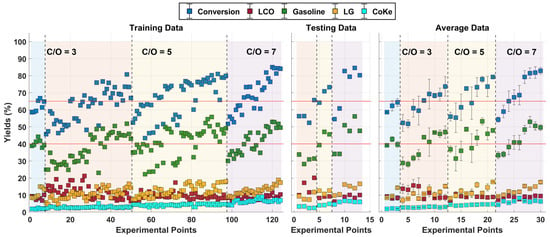
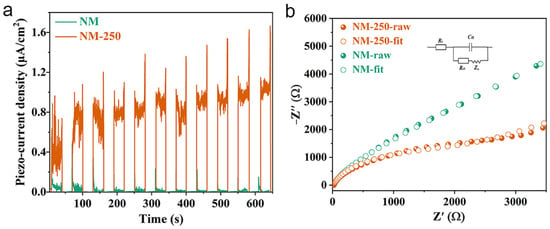
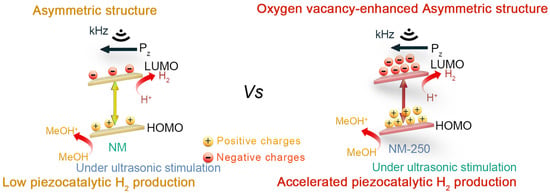
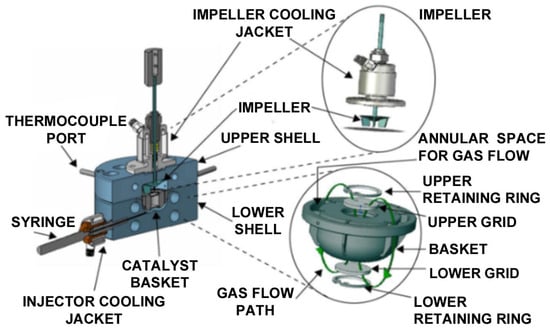
The paper studied the effect of high-voltage short-pulse electrohydraulic discharge (HVSPED) on the processes of catalytic cracking of oil sludge in order to increase the yield of light hydrocarbon fractions. A set of laboratory experiments was carried out varying the key parameters of HVSPED—discharge voltage, capacitance of capacitor banks and processing time. As a catalyst, the developed nanocomposite catalyst bentonite was used, with nickel packed. The optimal electrophysical parameters of oil sludge treatment by HVSPED were determined, providing the maximum yield of gasoline and kerosene fractions. The effectiveness of HVSPED treatment of oil sludge in the presence of a catalyst was confirmed by DTA–thermogravimetric analysis and chromatographic-mass spectral analysis of the light and middle fractions of the hydrogenate. The proposed approach made it possible to enhance the resource and energy efficiency of oil sludge processing using HVSPED, demonstrating high potential for further industrial application
23 December 2025

News & Conferences

Issues

Open for Submission

Editor's Choice

Reprints of Collections

Environmentally Friendly Catalysts for Energy and Water Treatment Applications
Reprint

Environmentally Friendly Catalysts for Energy and Water Treatment Applications

Editors: José Ignacio Lombraña, Hugo Olvera Vargas, Sandra Yazmin Arzate Salgado
Zeolites as Catalysts
Reprint

Zeolites as Catalysts

Applications in Chemical Engineering, Energy Sources and Environmental Protection, 2nd Edition
Editors: De Fang

Get Alerted

Add your email address to receive forthcoming issues of this journal.

XFacebookLinkedIn
Catalysts - ISSN 2073-4344