


Abstract
With the significant and rapid growth observed in bridge projects worldwide, the associated environmental, economic, and social concerns are on the rise. A systematic review of bridge sustainability with meta-analysis according to the PRISMA guidelines was performed, aiming to improve understanding of the importance of using building information modeling (BIM) in bridge projects by investigating the role of proper implementation of this technology to avoid and mitigate risks and improve sustainability. The relevant international literature was collected and scrutinized. The findings demonstrated that the accurate implementation of BIM significantly enhances the efficient management of risks in bridge projects. Consequently, this has a positive effect on improving the three essential (environmental, economic, and social) aspects of sustainability. The impact mentioned is especially apparent in enhancing the management of information throughout the entire lifespan of a bridge. This, in turn, facilitates precise decision-making during the design phase, aligns with assessments of environmental impact, enables real-time monitoring during execution, effectively manages the maintenance of the structure, facilitates efficient allocation and utilization of resources, and improves design practices by providing designers with accurate information. Delving into the nuances of this review has shed light on the transformative potential of BIM in shaping sustainable bridge projects, laying the groundwork for future advancements in this critical field.
1. Introduction
Nowadays, bridges are critical for transportation infrastructure networks in countries worldwide, serving as essential conduits for the movement of passengers and goods over obstacles without interrupting roadways. Their development has surged in recent years due to significant economic growth and urbanization [1,2,3,4,5,6]. However, bridges, despite their undeniable utility, pose environmental, economic, and societal challenges. They contribute significantly to the emission of greenhouse gases (GHGs) and exhibit diverse life scenarios and complex characteristics. Over their extended lifetimes, they consume substantial materials and energy, often exacerbated by reworks during the construction due to design phase errors and other factors [7,8,9,10,11]. Furthermore, the imminent need for significant bridge rehabilitation, reconstruction, and new construction, coupled with evolving infrastructure demands and the preservation of aging structures, presents an imperative to understand and mitigate potential risks associated with these projects [9,12].
To address these challenges, it is crucial to study potential risks in bridge projects comprehensively and to employ effective tools and technologies for their proper management and mitigation. Building information modeling (BIM) has emerged as a pivotal technology garnering attention from corporations and organizations due to its high number of benefits for project stakeholders, including cost reduction, enhanced productivity, and reduced greenhouse gas emissions [8,13,14]. BIM, as defined by Autodesk, represents a holistic process for creating and managing information related to building assets. It integrates multidisciplinary data to provide a digital representation of an asset throughout its lifecycle, from planning and design to construction and operation [15]. Although BIM is relatively new to the bridge construction industry, it possesses the potential to significantly elevate design quality by improving drawing accuracy, collaboration, and constructability through 3D models that precisely represent design outcomes [16,17,18]. Scholars have conducted comprehensive inquiries into many aspects of building information modeling (BIM) applications, intending to transform the field of bridge construction. This all-encompassing strategy includes a wide range of crucial components, each contributing to the overall improvement of bridge project management. Researchers have examined the complexities of material quality assurance, aiming to ensure that BIM not only enhances design and construction processes but also ensures the use of high-quality materials. Furthermore, the inquiry encompasses the interoperability of lifecycle processes, with BIM playing a vital role in facilitating smooth collaboration and data interchange over the full lifespan of the bridge. The integration of BIM with bridge management systems (BMS) is a key focus, highlighting how it increases the efficiency and effectiveness of bridge management procedures. Time and cost management are essential aspects of these academic investigations, acknowledging the potential of BIM to reduce project delays and cost overruns while ensuring efficient resource allocation. The simultaneous focus on design and construction efficiency highlights the versatility of BIM in improving the entire project delivery process. Ensuring precision in asset management is of the highest priority, and BIM provides strong solutions for maintaining an accurate inventory and assessing the health of bridge assets. Researchers utilize BIM technology to conduct thorough studies and monitoring of bridges, ensuring their structural integrity and safety, which is an important aspect of structural evaluation. One important aspect is the incorporation of building information modeling (BIM) with geographic information systems (GIS) to improve the effectiveness of building management systems (BMS). This combination promotes a comprehensive approach by integrating geographical data, geographic mapping, and information management, thus enhancing the effectiveness and knowledge of bridge management strategies [2,3,14,16,19,20,21,22,23,24,25,26,27,28,29]. Moreover, some studies have investigated the application of building information modeling (BIM) in the field of risk management for bridge construction. These studies have a specific focus on the management of risk information and its integration with the building information modeling (BIM) model. The purpose of this integration is to improve the effectiveness of recognizing and analyzing hazards in bridge construction [30,31]. Despite these efforts, the full extent to which BIM can enhance bridge construction and mitigate associated risks to help in achieving a higher level of sustainability is not yet understood. Thus, further research is imperative to establish a comprehensive understanding of this technology and its potential contributions to sustainable industry development and risk reduction in bridge projects.
Given the significance of bridge projects and the scantiness of research on BIM’s role in mitigating bridge project risks across various dimensions, this paper aims to evaluate BIM’s effectiveness as a risk management tool in sustainable bridge construction projects. Specifically, it seeks to synthesize existing information and data to address the following crucial question:
- How does building information modeling (BIM) contribute to better risk management outcomes in sustainable bridge projects, specifically in avoiding potential risks and achieving greater sustainability?
By answering this question, it is feasible to gain valuable insights into the subject of sustainable bridge construction and risk management through thorough investigation and evaluation, ultimately enhancing the understanding of BIM’s role in promoting sustainability and resilience for one of the main components of infrastructure networks, which can be applied to the other parts of these networks.
2. Methodology
To answer the study’s major objectives and fulfill the main goal of evaluating the effectiveness of employing building information modeling (BIM) as a risk management tool for sustainable bridge projects, the following protocol shown in Table 1 was used.

Table 1.
Research protocol.
2.1. Study Tools
2.1.1. Systematic Review and Meta-Analysis
The research presented in this paper adopts a systematic review as its foundational approach to comprehensively examine prior studies related to the topic and assess the quality of the available evidence. A systematic review is a robust method for gathering scientific evidence transparently, avoiding redundancy in research efforts, and ensuring unbiased selection and honest appraisal of research quality. It stands as the most reliable source of evidence for addressing research questions [13,32,33,34,35,36,37,38,39]. To effectively address the research question, this study employs a systematic review with meta-analysis.
2.1.2. Meta-Analysis in Systematic Review
Within the systematic review, meta-analysis is employed as a research procedure and quantitative technique that employs statistical tools to compute an overall or “absolute” effect by synthesizing findings from individual, independent studies. This approach utilizes specific measurements to quantify the strength of correlations between variables under investigation. In recent years, meta-analysis has found applications in diverse fields such as biomedicine, healthcare, government initiatives, business operations, and academic disciplines. Its utility extends to evaluating clearly defined subjects, making it relevant to engineering, environmental studies, economics, and more [32,34,35,37,38,40,41,42,43].
2.1.3. Adherence to PRISMA Guidelines
This review and analysis strictly adhere to the PRISMA (Preferred Reporting Items for Systematic Reviews and Meta-Analysis) guidelines, which were developed by a committee of experts to enhance the transparency, quality, completeness, and frequency of documented systematic reviews and meta-analyses. PRISMA provides a comprehensive framework for empirically supported publishing, involving keyword searches to identify relevant scientific literature in extensive academic databases, the application of well-defined inclusion and exclusion criteria, and a meticulous review of relevant materials to analyze research data. The PRISMA 2020 version, comprising a 27-item checklist (see Supplementary Materials) and a flow diagram, encompasses critical components of a systematic review report, spanning the introduction, methods, results, and discussion sections. While PRISMA was primarily designed to enhance reporting in reviews assessing the efficacy of interventions, it is versatile and applicable to systematic reviews with diverse objectives, including those in the built environment and BIM-related studies [13,39,44].
2.2. Databases Search Strategies
2.2.1. Selection of Databases
Although there are numerous specialized databases for scientific publications and research available today, there are still significant gaps in their coverage, particularly for recent content. Given the study’s specific focus and objectives, as well as the scarcity of papers and research on the subject, it was determined that it would be beneficial to include a variety of databases spanning various disciplines associated with sustainable bridge projects, building information modeling (BIM), and risk management. Upon investigating several databases, it became clear that the best ones start with the first main source, SCOPUS, which is the largest abstract and citation database of peer-reviewed literature and high-quality web sources in the world. It offers innovative features for tracking, analyzing, and visualizing research. It also provides a variety of search strategies, including Boolean search, phrase matching, wildcards, and truncation, to assist scientists in quickly and accurately retrieving the information they seek. Notably, SCOPUS has a larger selection of indexed articles than PubMed, Web of Science (WOS), and Google Scholar [13,45,46,47]. Moreover, ScienceDirect, which is Elsevier’s comprehensive full-text platform, offers users access to an extensive collection of journals. It serves as an exceptional bibliographic and comprehensive full-text electronic repository that primarily focuses on science, technology, and medicine. It enables a thorough examination of the limitations and capabilities it provides [48,49]. Additionally, IEEE Xplore, which contains abstract and citation information for all IEEE and IEE journals, transactions, magazines, and conference proceedings published since 1988, proves valuable. While its primary concentration is on electrical engineering, electronics, and computer science, it also includes papers and research on infrastructure engineering, namely the use of BIM in bridge projects [50,51].
2.2.2. Search Strings and Keywords
To navigate through the chosen databases, the search strings listed in Table 2 were employed. These search strings were selected in accordance with the research questions.
Table 2.
The systematic review process’s search string.
In addition, a secondary search was conducted using the keywords and phrases given in Table 3 to ensure that as many articles relating to the issue as possible were found to cover all the required concepts in this research.
Table 3.
Search keywords and phrases.
Table 4 shows the total number of papers from all sources after applying the research strings with the keywords and phrases and based on the foregoing.
Table 4.
The number of papers from all sources.
2.3. Inclusion and Exclusion Criteria
To identify the most pertinent publications related to the research topic, a set of inclusion and exclusion criteria aligned with the PRISMA 2020 guidelines was established. These criteria are detailed in Table 5. The first criterion, “Relevance to the Topic,” requires that studies address the use of building information modeling (BIM) as a risk management tool in sustainable bridge projects. Considering the lack of research in this field, particularly in the first two databases, this criterion was expanded to incorporate the three points listed below: (1) the use of BIM in risk management for sustainable bridge projects; (2) the use of BIM for sustainable bridge projects; and (3) risk management approaches for sustainable bridge projects. The second criterion addresses “Publication Type.” In accordance with this criterion, selected papers must be peer-reviewed journal articles, while all other forms of publication are to be excluded. Furthermore, the selected articles are required to be in the English language to ensure accuracy and prevent information transmission and translation errors. Additionally, the publication dates of these articles should fall within the timeframe of 2010 to 2024.
Table 5.
The inclusion and exclusion criteria.
2.4. Eligibility Criteria
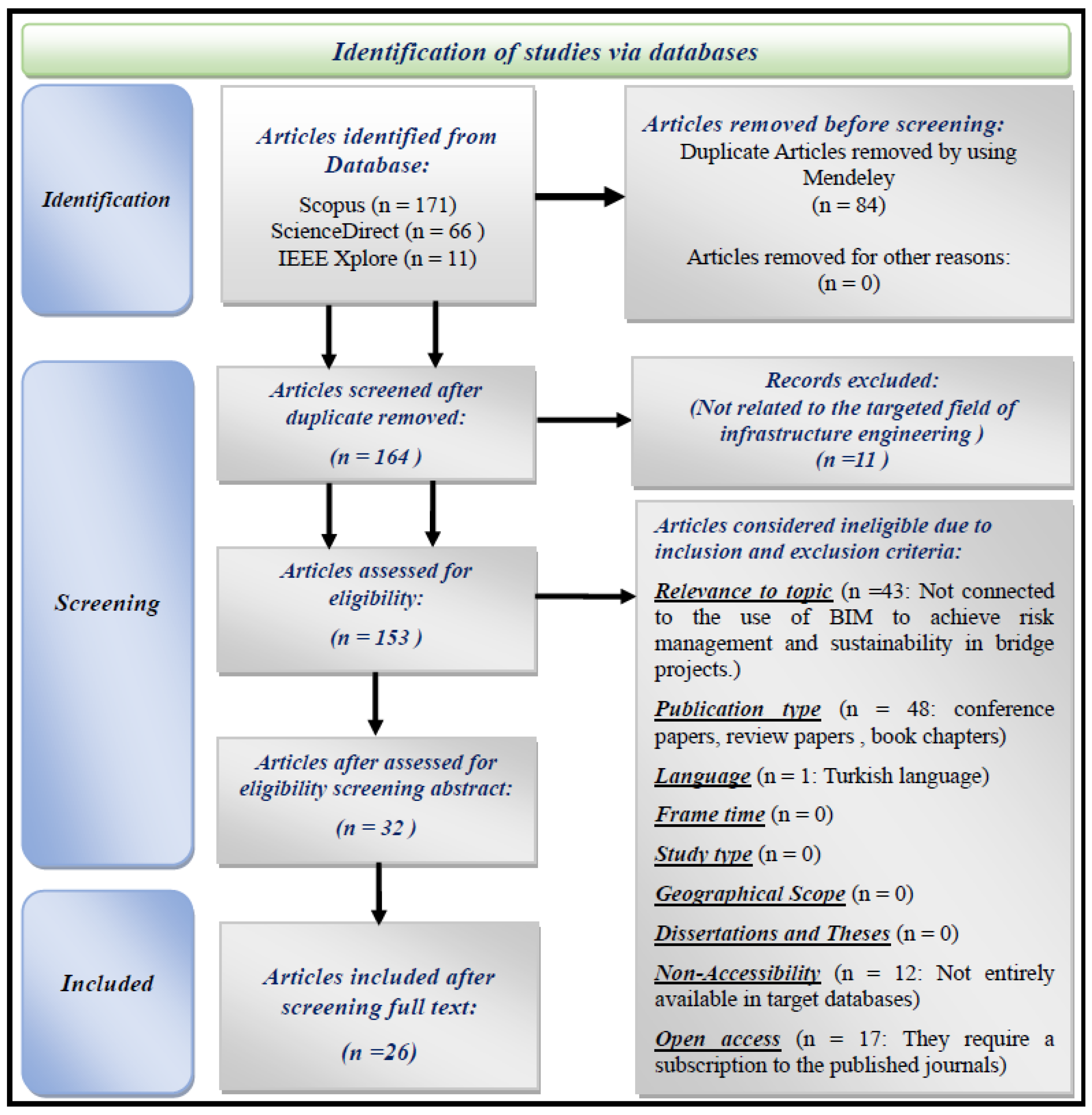
After an Excel spreadsheet with 248 articles was imported into Mendeley, the purpose was to remove any duplicate entries. Following this, each study was evaluated to determine its relevance to the field of infrastructure engineering. As a result, 153 papers were retained. After the criteria for inclusion and exclusion were applied and eligibility screening was conducted, it was found that 78 articles did not meet the specified criteria, and another 49 articles were not relevant to the use of BIM in risk management for the purpose of achieving more sustainable bridge construction, as depicted in Figure 1. Ultimately, a total of 26 papers were considered suitable for inclusion in the analysis following a comprehensive evaluation of their full texts.
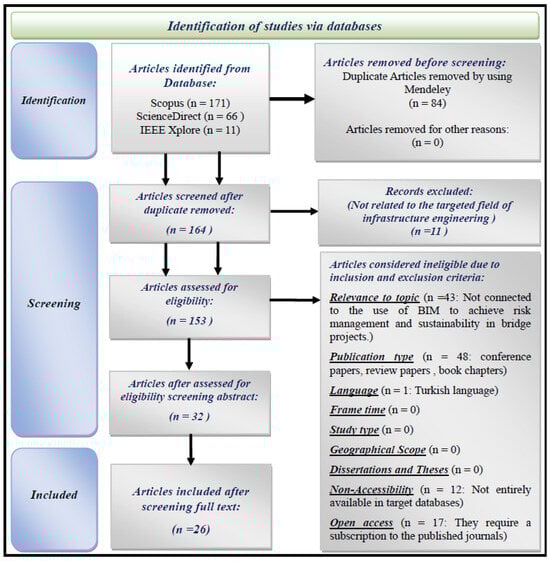
Figure 1.
PRISMA 2020 flowchart: paper selection process.
2.5. Risk of Bias
To guarantee the suitability of the studies chosen for this review and to prevent any form of bias, the ROBINS-I (Risk of Bias in Non-randomized Studies—of Interventions) tool was employed. This tool is a rigorous quality assessment instrument specifically created for evaluating bias in non-randomized studies. The evaluation of bias in this study thoroughly assessed various sources in several areas, including confounding, selection bias, classification of interventions, deviations from intended interventions, missing data, measurement of outcomes, and selection of the reported result. The evaluation was conducted based on the steps presented in Table 6. Implementing ROBINS-I is considered an essential method for guaranteeing the accuracy and dependability of the results in the context of this study, which includes non-randomized studies [52].
Table 6.
ROBINS-I to assess the studies’ bias.
2.6. Data Extraction and Evaluation of Study Quality
To analyze the remaining articles that are shown in Table 7, thematic analysis was used, which involves a systematic procedure to identify and analyze patterns or themes in a dataset. This methodology entails a methodical procedure that can be delineated into numerous pivotal stages. At first, researchers acquaint themselves with the data, developing a profound comprehension through multiple readings. Subsequently, they produce preliminary codes to discover and categorize significant characteristics within the dataset. Afterwards, these codes are categorized into prospective themes, which are broad patterns that encompass significant components of the content. The themes are subjected to meticulous examination and fine-tuning to guarantee their logical consistency and pertinence to the study query. After being formed, every theme is precisely delineated and given a name that encapsulates its fundamental nature. The last stage entails composing a coherent report, wherein the findings are presented in a narrative structure, substantiated by pertinent examples derived from the data. During this procedure, researchers demonstrate reflexivity by recognizing and dealing with possible biases. Thematic analysis provides researchers with the ability to modify the phases according to the distinct attributes of their study and data, hence offering flexibility [53,54,55]. According to this analysis, the main and sub-themes that connect to the role and importance of BIM in managing and reducing risks in bridge projects with the aim of achieving higher levels of sustainability are defined.
Table 7.
The selected studies that satisfy the required criteria.
2.7. Protocol Registration
To ensure transparency and avoid redundancy, the protocol for this systematic review was registered on PROSPERO (International Prospective Register of Systematic Reviews) after the research procedure was completed. Although it is preferable to register at an early stage, we assured the thorough documentation of our study by completing the PROSPERO registration after the research was conducted.
3. Results and Discussion
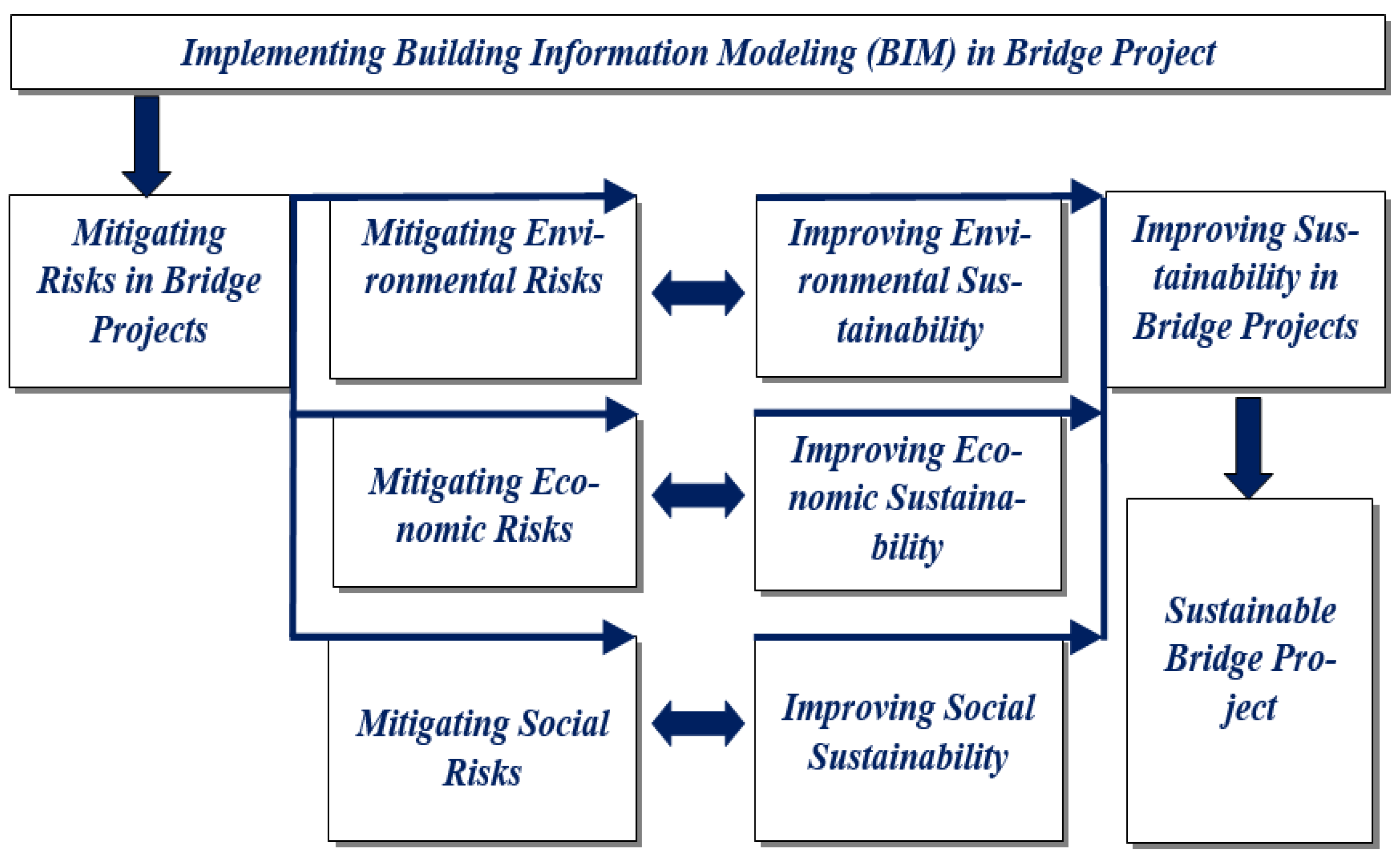
While conventional meta-analyses use statistical techniques for numerical data, there are situations where a qualitative synthesis is suitable for analyzing narrative or qualitative findings. This methodology enables a thorough comprehension of the qualitative data from many investigations, even when there are no numerical findings available. The qualitative analysis of the papers that satisfied the criteria of this systematic review produced the findings reported in Table 7. The analysis identified three primary themes: environmental risk management, economic risk management, and social risk management. The selection of the three main themes was predicated on the overarching objective of enhancing sustainability in bridge projects. Hence, it was imperative to select the three main pillars of sustainability, namely environment, economy, and society. Given the emphasis on the risk management process in this specific improvement, the study focuses on the role of building information modeling in enhancing sustainability by examining its impact on environmental, economic, and social risk management. Each main theme is associated with a set of sub-themes (six sub-themes for environmental risks, ten for economic risks, and six for social risks). The sub-themes connected with each main theme were chosen through analysis of the research papers contained in this review. There are common sub-themes that are shared across the themes, which are important for studying the role of BIM in managing and mitigating risks in bridge projects to enhance sustainability, as is shown in Figure 2.
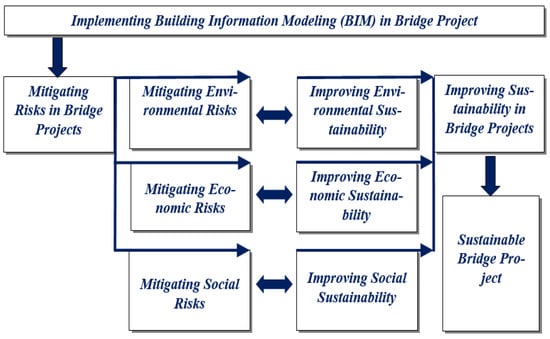
Figure 2.
The role of BIM in improving bridge sustainability through risk management.
Table 8 indicates that eleven articles employ the qualitative method, eleven articles utilize the mixed method, and only four articles employ the quantitative method. Researchers choose qualitative methodologies to explore unexplored areas, gain contextual understanding, examine subjective perspectives, prioritize flexibility, and address small sample sizes. Qualitative methodologies are particularly efficient in providing a thorough and deep comprehension of subtle and complex phenomena. On the other hand, mixed-methods research is preferred for attaining comprehensive understanding, validation, and confirmation of findings. It is highly beneficial for addressing complex research questions, employing systematic analysis, and generating findings that have practical implications. Researchers may opt to utilize mixed methods to overcome limitations and capitalize on the benefits of both qualitative and quantitative methodologies.
Table 8.
Summary of results.
The Role of BIM in Managing Risks to Achieve More Sustainable Bridge Projects
- Environmental risk management using BIM
There are a total of 20 studies specifically focused on investigating the application of BIM to effectively manage environmental risks. Table 9 illustrates the categorization of environmental themes that will be improved through the utilization of BIM in a bridge project.
Table 9.
Environmental themes.
Regarding environmental risk management, only four studies addressed the theme of selecting the most environmentally friendly materials that are suitable for the climate and surrounding ecosystem and two studies for examining the carbon footprint throughout the duration of the project and mitigating the release of greenhouse emissions, despite its major importance. This is despite the fact that bridge projects, as a crucial component of transportation infrastructure networks, significantly contribute to the production of greenhouse gases over their entire life cycle, including the manufacturing of materials, execution, and regular maintenance.
- Economic risk management using BIM
All the studies primarily examined—even in an indirect manner—the application of building information modeling (BIM) to manage economic risks. Table 10 categorizes the economic themes that BIM will improve in the bridge project.
Table 10.
Economic risk management themes.
Considering economic risk management, the primary emphasis was placed on planning costs and schedules for the project to prevent any claims and delays and to achieve the required level of quality through 18 comprehensive studies. This is of greatest significance for the bridge project, as cost, time, and quality are the primary goals that must be prioritized to foster a more sustainable outcome. However, there was a lack of emphasis on optimizing the efficiency of the supply chain process and facilitating the selection of an appropriate supplier by providing accurate information in two studies, which is a critical aspect of these projects and has adverse effects on various processes within the project. Any mistakes or delays in the supply of materials will have a negative impact on the construction process, leading to disruptions and potential claims.
- Social risk management using BIM
There are a total of 18 articles that expressly discuss social risk management and its reduction through the implementation of BIM in bridge projects. Table 11 presents the classification of the social themes that BIM will improve in the bridge project.
Table 11.
Social risk management themes.
Within the realm of social risk management, significant emphasis was placed on the enhancement of information management and document automation processes through the bridge project lifespan and the improvement of the structural maintenance process to optimize efficiency, quality, and speed, with an average of 13 studies conducted for each improvement. The issue of least interest was community engagement and meticulous organization of the required work teams, each consisting of five studies.
By reviewing the information presented in Table 9, Table 10 and Table 11, certain sub-themes are shared among the three main themes, and most of the studies focused on these themes. One of these sub-themes is the enhancement of information management and document automation processes, which significantly influences the entire life cycle of the bridge project, from the initial design phase to the ongoing maintenance phase. Furthermore, there is a focus on the improvement of the structural maintenance process to optimize efficiency, quality, and speed. This is achieved by establishing control and monitoring strategies to determine the maintenance protocols necessary for maintaining an acceptable level of safety and ensuring appropriate functional performance. These strategies also aim to minimize maintenance operations, thereby managing resource consumption and saving time. Consequently, this helps to reduce the duration of work area closures and minimize their impact on the surrounding community.
- BIM tools utilized in previous studies
Multiple software tools are commonly employed for construction and infrastructure projects within the BIM environment. Upon analyzation of the study papers for this review, it became evident that most of them heavily relied on Revit 2021 software to acquire a 3D BIM model that aligned with the specific needs of the work at hand. Revit is a comprehensive BIM software that facilitates 3D modeling for architecture, engineering, and construction. It enables collaborative design, automates documentation, and supports the entire building lifecycle. With parametric modeling, Revit enhances efficiency in project coordination and design iterations. Furthermore, many studies frequently used Revit in tandem with Dynamo, an open-source visual programming extension designed for Autodesk Revit. Only two studies, conducted by Bui (2019) [73] and Marzok et al. (2014) [21], specifically examined the utilization of Tekla Structure, a specialized BIM software designed for structural engineering. This software allows for intricate 3D modeling with support for various materials. It simplifies the process of providing detailed information, makes cooperation easier, and seamlessly interacts with analysis tools, thereby making construction management more efficient. By providing an open API, it enables customization to fulfill individual project needs. Navisworks was employed in the research conducted by Jiang (2022) [65] and Kaewunruen et al. (2021) [72]. It is a robust tool for project review and collaboration within the BIM framework, facilitating the consolidation of 3D models, clash detection, and the simulation of construction procedures. This program promotes collaboration and assists in identifying and resolving potential problems throughout the project.
4. Limitations
Bridge projects, characterized by their complex design and construction intricacies, pose significant challenges to the traditional application of building information modeling (BIM). The continuous requirement for developments in BIM technology customized specifically for bridge construction highlights the inherent complexity. An important constraint, as determined in this analysis of the relevant literature, is the requirement to incorporate BIM with diverse tools such as blockchain, enterprise resource planning (ERP), life cycle assessment (LCA), and the Internet of Things (IoT). Although this integration is a determined and calculated solution to address certain difficulties, it also brings attention to a possible disadvantage. The reliance on several technologies can introduce intricacies and increase the amount of time and effort required for project stakeholders to become proficient. Although BIM’s ability to link with many tools and technologies is smooth, this interoperability can also present hurdles, failing to achieve the necessary level of data consistency and causing potential coordination problems among stakeholders. Looking ahead, while upcoming BIM breakthroughs have the potential to enhance operational efficiency, it is crucial to recognize that certain projects may be constrained by the need to keep up with these advancements. The complex intricacy of bridge construction necessitates a meticulous balance between embracing novel technologies and tackling the accompanying difficulties. The advancement of BIM raises concerns about its efficiency in bridge construction, highlighting the necessity for a flexible and sophisticated strategy.
5. Conclusions
Despite the significance of bridge projects, the full utilization of the potential offered by information modeling, which can significantly enhance these projects, has not been realized yet. The extensive exploration into the intersection of sustainable bridge projects and building information modeling (BIM) has revealed profound insights. It highlights the underutilization of information modeling in bridge projects and, more importantly, demonstrates its transformative potential. This systematic review and meta-analysis have uncovered that BIM plays a crucial role in risk management, going beyond procedural aspects and addressing the core issue of sustainability. The precise execution of BIM not only serves as a procedural improvement but also acts as a catalyst for beneficial environmental, economic, and social effects. This study reveals the detailed ways in which building information modeling (BIM) contributes to the whole lifespan of a bridge, including exact planning to prevent claims and delays as well as the careful selection of ecologically friendly materials. While strides made in information management, decision-making, and structural maintenance are accentuated by this work, themes requiring heightened attention in future research are also illuminated. Pivotal areas demanding deeper exploration, such as the selection of eco-friendly materials, carbon footprint examination, supply chain optimization, and supplier selection, are brought to the forefront due to their lasting impact on a bridge’s lifecycle. In essence, the transformative power of BIM in fostering sustainability is unveiled, urging the scholarly community to delve deeper into nuanced aspects for future advancements. This imperative extends beyond a mere recapitulation of processes; it underscores the importance of following up on the general steps outlined and thoroughly studying each process and sub-theme to achieve the greatest improvement.
Supplementary Materials
The following supporting information can be downloaded at: https://www.mdpi.com/article/10.3390/su16031242/s1. PRISMA checklist.
Author Contributions
Data curation, D.M.A.; formal analysis, D.M.A. and R.A.M.; methodology, D.M.A., L.G., Z.B. and R.A.M.; validation, D.M.A., L.G., Z.B. and R.A.M.; writing—original draft, D.M.A.; writing—review and editing, D.M.A., L.G., Z.B. and R.A.M. All authors have read and agreed to the published version of the manuscript.
Funding
This research received no external funding.
Institutional Review Board Statement
Not applicable.
Informed Consent Statement
Not applicable.
Data Availability Statement
Data will be available on request from the corresponding author.
Conflicts of Interest
The authors declare no conflict of interest.
References
- Jeong, Y.; Kim, W.; Lee, I.; Lee, J. Bridge Inspection Practices and Bridge Management Programs in China, Japan, Korea, and U.S. J. Struct. Integr. Maint. 2018, 3, 126–135. [Google Scholar] [CrossRef]
- Wan, C.; Zhou, Z.; Li, S.; Ding, Y.; Xu, Z.; Yang, Z.; Xia, Y.; Yin, F. Development of a Bridge Management System Based on the Building Information Modeling Technology. Sustainability 2019, 11, 4583. [Google Scholar] [CrossRef]
- Zhao, Z.; Gao, Y.; Hu, X.; Zhou, Y.; Zhao, L.; Qin, G.; Guo, J.; Liu, Y.; Yu, C.; Han, D. Integrating BIM and IoT for Smart Bridge Management. In IOP Conference Series: Earth and Environmental Science; Institute of Physics Publishing: Bristol, UK, 2019; Volume 371. [Google Scholar]
- Zhao, R.; Yuan, Y.; Wei, X.; Shen, R.; Zheng, K.; Qian, Y.; Pu, Q.; Zhang, Q.; Liao, H.; Li, X.; et al. Review of Annual Progress of Bridge Engineering in 2019. Adv. Bridge Eng. 2020, 1, 11. [Google Scholar] [CrossRef]
- Hang, H.W. Analysis of the Sustainability of Bridges. In IOP Conference Series: Earth and Environmental Science, Proceedings of the 2nd International Conference on Geology, Mapping and Remote Sensing, Zhangjiajie, China, 23–25 April 2021; IOP Publishing Ltd.: Bristol, UK, 2021; Volume 783. [Google Scholar]
- Nizwa, F.; Kassim, E.R.; Philip, S. Risk Analysis in Bridge Construction. In Proceedings of the International Conference on Structural Engineering and Construction Management, Angamaly, India, 7–9 June 2023. [Google Scholar]
- Du, G.; Karoumi, R. Life Cycle Assessment of a Railway Bridge: Comparison of Two Superstructure Designs. Struct. Infrastruct. Eng. 2013, 9, 1149–1160. [Google Scholar] [CrossRef]
- Kaewunruen, S.; Sresakoolchai, J.; Zhou, Z. Sustainability-Based Lifecycle Management for Bridge Infrastructure Using 6D BIM. Sustainability 2020, 12, 2436. [Google Scholar] [CrossRef]
- Zhang, W. Research on Risk Management of Cross-Sea Bridges Based on Analytic Hierarchy Process—Taking Hangzhou Bay Bridge as an Example. World J. Eng. Technol. 2021, 9, 624–636. [Google Scholar] [CrossRef]
- Ongkowijoyo, C.S.; Gurmu, A.; Andi, A. Investigating Risk of Bridge Construction Project: Exploring Suramadu Strait-Crossing Cable-Stayed Bridge in Indonesia. Int. J. Disaster Resil. Built Environ. 2021, 12, 127–142. [Google Scholar] [CrossRef]
- Fang, Z.; Yan, J.; Lu, Q.; Chen, L.; Yang, P.; Tang, J.; Jiang, F.; Broyd, T.; Hong, J. Systematic Literature Review of Carbon Footprint Decision-Making Approaches for Infrastructure and Building Projects. Appl. Energy 2023, 335, 120768. [Google Scholar] [CrossRef]
- Nahangi, M.; Guven, G.; Olanrewaju, B.; Saxe, S. Embodied Greenhouse Gas Assessment of a Bridge: A Comparison of Preconstruction Building Information Model and Construction Records. J. Clean. Prod. 2021, 295, 126388. [Google Scholar] [CrossRef]
- Shahruddin, S.; Zairul, M. BIM Requirements across a Construction Project Lifecycle: A PRISMA-Compliant Systematic Review and Meta-Analysis. Int. J. Innov. Creat. Chang. 2020, 12, 569–590. [Google Scholar]
- Ahmad, M.D.; Gáspár, L.; Bencze, Z. BIM and LCSA applications for managing bridge projects to achieve sustainability: A literature review. In Proceedings of the Congress of Finance and Tax, Konya, Türkiye, 10–11 March 2023; pp. 389–405. [Google Scholar]
- Autodesk Building Information Modeling. Available online: https://www.autodesk.com/solutions/aec/bim (accessed on 3 August 2023).
- Shim, C.S.; Yun, N.R.; Song, H.H. Application of 3D Bridge Information Modeling to Design and Construction of Bridges. Proc. Procedia Eng. 2011, 14, 95–99. [Google Scholar] [CrossRef]
- Huang, Z.; Tu, C.; Li, G. Application of BIM Technology in Bridge Engineering and Obstacle Research. In IOP Conference Series: Earth and Environmental Science, Proceedings of the 7th International Conference on Environment and Renewable Energy, Qingdao, China, 26–28 March 2021; IOP Publishing Ltd.: Bristol, UK, 2021; Volume 798. [Google Scholar]
- Rolfsen, C.N.; Lassen, A.K.; Han, D.; Hosamo, H.; Ying, C. The Use of the BIM-Model and Scanning in Quality Assurance of Bridge Constructions. In ECPPM 2021—eWork and eBusiness in Architecture, Engineering and Construction; Taylor & Francis Group: Abingdon, UK, 2021; ISBN 9781003191476. [Google Scholar]
- Marzouk, M.M.; Hisham, M.; Ismail, S.; Youssef, M.; Seif, O. On the Use of Building Information Modeling in Infrastructure Bridges. In Proceedings of the 27th International Conference—Applications of IT in the AEC Industry (CIB W78), Cairo, Egypt, 16–18 November 2010; pp. 1–10. [Google Scholar]
- Marzouk, M.M.; Hisham, M. Bridge Information Modeling in Sustainable Bridge Management. In Proceedings of the ICSDC 2011: Integrating Sustainability Practices in the Construction Industry, Kansas City, MO, USA, 23–25 March 2011. [Google Scholar]
- Marzouk, M.; Hisham, M. Implementing Earned Value Management Using Bridge Information Modeling. KSCE J. Civil. Eng. 2014, 18, 1302–1313. [Google Scholar] [CrossRef]
- Liu, W.; Guo, H.; Li, H.; Li, Y. Using BIM to Improve the Design and Construction of Bridge Projects: A Case Study of a Long-Span Steel-Box Arch Bridge Project. Int. J. Adv. Robot. Syst. 2014, 11, 125. [Google Scholar] [CrossRef]
- Chan, B.; Guan, H.; Hou, L.; Jo, J.; Blumenstein, M.; Wang, J. Defining a Conceptual Framework for the Integration of Modelling and Advanced Imaging for Improving the Reliability and Efficiency of Bridge Assessments. J. Civ. Struct. Health Monit. 2016, 6, 703–714. [Google Scholar] [CrossRef]
- Dawood, M. BIM Based Bridge Management System. In 8th International Conference on Engineering, Project, and Product Management (EPPM 2017) Proceedings; Springer International Publishing: Cham, Switzerland, 2018; pp. 161–170. [Google Scholar]
- Zhu, J.; Tan, Y.; Wang, X.; Wu, P. BIM/GIS Integration for Web GIS-Based Bridge Management. Ann. GIS 2021, 27, 99–109. [Google Scholar] [CrossRef]
- Wei, J.; Chen, G.; Huang, J.; Xu, L.; Yang, Y.; Wang, J.; Sadick, A.M. BIM and GIS Applications in Bridge Projects: A Critical Review. Appl. Sci. 2021, 11, 6207. [Google Scholar] [CrossRef]
- Ciccone, A.; Suglia, P.; Asprone, D.; Salzano, A.; Nicolella, M. Defining a Digital Strategy in a BIM Environment to Manage Existing Reinforced Concrete Bridges in the Context of Italian Regulation. Sustainability 2022, 14, 11767. [Google Scholar] [CrossRef]
- Zhou, Z. An Intelligent Bridge Management and Maintenance Model Using BIM Technology. Mob. Inf. Syst. 2022, 2022, 7130546. [Google Scholar] [CrossRef]
- Li, S.; Zhang, Z.; Lin, D.; Zhang, T.; Han, L. Development of a BIM-Based Bridge Maintenance System (BMS) for Managing Defect Data. Sci. Rep. 2023, 13, 846. [Google Scholar] [CrossRef]
- Zou, Y.; Kiviniemi, A.; Jones, S.W. Developing a Tailored RBS Linking to BIM for Risk Management of Bridge Projects. Eng. Constr. Archit. Manag. 2016, 23, 727–750. [Google Scholar] [CrossRef]
- Zou, Y.; Kiviniemi, A.; Jones, S.W.; Walsh, J. Risk Information Management for Bridges by Integrating Risk Breakdown Structure into 3D/4D BIM. KSCE J. Civil. Eng. 2019, 23, 467–480. [Google Scholar] [CrossRef]
- Uman, L.S. Systematic Reviews and Meta-Analyses. J. Can. Acad. Child Adolesc. Psychiatry 2011, 20, 57–59. [Google Scholar] [PubMed]
- Clarke, J. What Is a Systematic Review? Evid. Based Nurs. 2011, 14, 64. [Google Scholar] [CrossRef] [PubMed]
- Moher, D.; Shamseer, L.; Clarke, M.; Ghersi, D.; Liberati, A.; Petticrew, M.; Shekelle, P.; Stewart, L.A.; Estarli, M.; Barrera, E.S.A.; et al. Preferred Reporting Items for Systematic Review and Meta-Analysis Protocols (PRISMA-P) 2015 Statement. Syst. Rev. 2016, 20, 148–160. [Google Scholar] [CrossRef]
- Ahn, E.; Kang, H. Introduction to Systematic Review and Meta-Analysis. Korean J. Anesthesiol. 2018, 71, 103–112. [Google Scholar] [CrossRef] [PubMed]
- Lame, G. Systematic Literature Reviews: An Introduction. In Proceedings of the International Conference on Engineering Design, ICED, Delft, The Netherlands, 5–8 August 2019; Cambridge University Press: Cambridge, UK, 2019; Volume 1, pp. 1633–1642. [Google Scholar]
- Siddaway, A.P.; Wood, A.M.; Hedges, L.V. How to Do a Systematic Review: A Best Practice Guide for Conducting and Reporting Narrative Reviews, Meta-Analyses, and Meta-Syntheses. Annu. Rev. Psychol. 2019, 70, 747–770. [Google Scholar] [CrossRef] [PubMed]
- Nunn, J.; Chang, S. What Are Systematic Reviews? Wiki Journal of Medicine. Available online: https://en.wikiversi-ty.org/wiki/WikiJournal_of_Medicine/What_are_Systematic_Reviews%3F (accessed on 3 August 2023).
- Parums, D.V. Editorial: Review Articles, Systematic Reviews, Meta-Analysis, and the Updated Preferred Reporting Items for Systematic Reviews and Meta-Analyses (PRISMA) 2020 Guidelines. Med. Sci. Monit. 2021, 27, e934475-1. [Google Scholar] [CrossRef] [PubMed]
- Shelby, L.B.; Vaske, J. Understanding Meta-Analysis: A Review of the Methodological Literature. Leis. Sci. 2008, 30, 96–110. [Google Scholar] [CrossRef]
- Shorten, A.; Shorten, B. What Is Meta-Analysis? Evid. Based Nurs. 2013, 16, 3–4. [Google Scholar] [CrossRef]
- Khan, S. Introduction to Systematic Review. In Meta-Analysis, Methods for Health and Experimental Studies; Springer: Berlin/Heidelberg, Germany, 2020; pp. 3–13. [Google Scholar]
- Myung, S.K. How to Review and Assess a Systematic Review and Meta-Analysis Article: A Methodological Study (Secondary Publication). J. Educ. Eval. Health Prof. 2023, 20, 25. [Google Scholar] [CrossRef]
- PRISMA Prisma Checklist. Available online: http://www.prisma-statement.org/PRISMAStatement/Checklist.aspx (accessed on 13 August 2023).
- Schotten, M.; el Aisati, M.; Meester, W.J.N.; Steiginga, S.; Ross, C.A. A Brief History of Scopus: The World’s Largest Abstract and Citation Database of Scientific Literature. In Research Analytics; Auerbach Publications: Boca Raton, FL, USA; Taylor & Francis: Abingdon, UK, 2017; pp. 31–58. [Google Scholar]
- Scopus Scopus Search Guide. Available online: http://schema.elsevier.com/dtds/document/bkapi/search/SCOPUSSearchTips.htm (accessed on 3 August 2023).
- Martín-Martín, A.; Thelwall, M.; Orduna-Malea, E.; Delgado López-Cózar, E. Google Scholar, Microsoft Academic, Scopus, Dimensions, Web of Science, and Open Citations’ COCI: A Multidisciplinary Comparison of Coverage via Citations. Scientometrics 2021, 126, 871–906. [Google Scholar] [CrossRef]
- Reza Samadzadeh, G.; Rigi, T.; Reza Ganjali, A. Comparison of Four Search Engines and Their Efficacy with Emphasis on Literature Research in Addiction (Prevention and Treatment). Int. J. High Risk Behav. Addict. 2013, 1, 166. [Google Scholar] [CrossRef] [PubMed]
- ScienceDirect ScienceDirect. Available online: https://www.sciencedirect.com/ (accessed on 13 August 2023).
- Durniak, A. Welcome to IEEE Xplore. IEEE Power Eng. Rev. 2000, 20, 12. [Google Scholar] [CrossRef]
- IEEE Xplore IEEE Xplore Online Website. Available online: https://ieeexplore.ieee.org/Xplore/home.jsp (accessed on 13 August 2023).
- Sterne, J.A.C.; Hernán, M.A.; Reeves, B.C.; Savović, J.; Berkman, N.D.; Viswanathan, M.; Henry, D.; Altman, D.G.; Ansari, M.T.; Boutron, I.; et al. ROBINS-I: A tool for assessing risk of bias in non-randomized studies of interventions. BMJ 2016, 355, i4919. [Google Scholar] [CrossRef] [PubMed]
- Dawadi, S. Thematic Analysis Approach: A Step-by-Step Guide for ELT Research Practitioners. J. NELTA 2020, 25, 62–71. [Google Scholar] [CrossRef]
- Wæraas, A. Thematic Analysis: Making Values Emerge from Texts. In Researching Values; Springer International Publishing: Cham, Switzerland, 2022; pp. 153–170. [Google Scholar]
- Clarke, V.; Braun, V.; Hayfield, N. Thematic Analysis. In Qualitative Psychology: A Practical Guide to Research Methods; Smith, J.A., Ed.; SAGE Publications: London, UK, 2015; pp. 222–248. [Google Scholar]
- Zhang, J.; Li, J.; Liu, B.; Li, H.; Yang, W. The Design and Application of BIM + Refined Management and Control Platform for the Jingxiong Railway Bridge. High-Speed Railw. 2023, 1, 211–218. [Google Scholar] [CrossRef]
- Mohammadi, M.; Rashidi, M.; Yu, Y.; Samali, B. Integration of TLS-Derived Bridge Information Modeling (BrIM) with a Decision Support System (DSS) for Digital Twinning and Asset Management of Bridge Infrastructures. Comput. Ind. 2023, 147, 103881. [Google Scholar] [CrossRef]
- Celik, Y.; Petri, I.; Rezgui, Y. Integrating BIM and Blockchain across Construction Lifecycle and Supply Chains. Comput. Ind. 2023, 148, 103886. [Google Scholar] [CrossRef]
- Salzano, A.; Miano, A.; Nicolella, M.; Prota, A. The Structural Maintenance Process of Existing Bridges Integrated in BIM Tools. In Materials Today: Proceedings; Elsevier Ltd.: Amsterdam, The Netherlands, 2023; Volume 85, pp. 9–13. [Google Scholar]
- Wang, Y.G.; He, X.J.; He, J.; Fan, C. Virtual Trial Assembly of Steel Structure Based on BIM Platform. Autom. Constr. 2022, 141, 104395. [Google Scholar] [CrossRef]
- Ariza-López, F.J.; Reinoso-Gordo, J.F.; García-Balboa, J.L.; Ariza-López, Í.A. Quality Specification and Control of a Point Cloud from a TLS Survey Using ISO 19157 Standard. Autom. Constr. 2022, 140, 104353. [Google Scholar] [CrossRef]
- Scianna, A.; Gaglio, G.F.; La Guardia, M. Structure Monitoring with BIM and IoT: The Case Study of a Bridge Beam Model. ISPRS Int. J. Geoinf. 2022, 11, 173. [Google Scholar] [CrossRef]
- Kaewunruen, S.; AbdelHadi, M.; Kongpuang, M.; Pansuk, W.; Remennikov, A.M. Digital Twins for Managing Railway Bridge Maintenance, Resilience, and Climate Change Adaptation. Sensors 2023, 23, 252. [Google Scholar] [CrossRef]
- Celik, Y.; Petri, I.; Barati, M. Blockchain Supported BIM Data Provenance for Construction Projects. Comput. Ind. 2023, 144, 103768. [Google Scholar] [CrossRef]
- Jiang, F.; Ma, L.; Broyd, T.; Chen, K.; Luo, H. Underpass Clearance Checking in Highway Widening Projects Using Digital Twins. Autom. Constr. 2022, 141, 104406. [Google Scholar] [CrossRef]
- Jarallah, D.S.; Mohammed, A.; Mahjoob, R. Supply Chain Management of Infrastructure Projects in Iraq. Eng. Technol. Appl. Sci. Res. 2022, 12, 8611–8616. [Google Scholar] [CrossRef]
- Ershadi, M.; Davis, P.; Jefferies, M.; Mojtahedi, M. Implementation of Building Information Modeling in Infrastructure Construction Projects: A Study of Dimensions and Strategies. Int. J. Inf. Syst. Proj. Manag. 2021, 9, 43–59. [Google Scholar] [CrossRef]
- Previtali, M.; Brumana, R.; Banfi, F. Existing Infrastructure Cost Effective Informative Modelling with Multisource Sensed Data: TLS, MMS and Photogrammetry. Appl. Geomat. 2022, 14, 21–40. [Google Scholar] [CrossRef]
- Hamdan, A.H.; Taraben, J.; Helmrich, M.; Mansperger, T.; Morgenthal, G.; Scherer, R.J. A Semantic Modeling Approach for the Automated Detection and Interpretation of Structural Damage. Autom. Constr. 2021, 128, 103739. [Google Scholar] [CrossRef]
- Bono, A.; D’alfonso, L.; Fedele, G.; Filice, A.; Natalizio, E. Path Planning and Control of a UAV Fleet in Bridge Management Systems. Remote Sens. 2022, 14, 1858. [Google Scholar] [CrossRef]
- van Eldik, M.A.; Vahdatikhaki, F.; dos Santos, J.M.O.; Visser, M.; Doree, A. BIM-Based Environmental Impact Assessment for Infrastructure Design Projects. Autom. Constr. 2020, 120, 103379. [Google Scholar] [CrossRef]
- Kaewunruen, S.; Sresakoolchai, J.; Ma, W.; Phil-Ebosie, O. Digital Twin Aided Vulnerability Assessment and Risk-Based Maintenance Planning of Bridge Infrastructures Exposed to Extreme Conditions. Sustainability 2021, 13, 2051. [Google Scholar] [CrossRef]
- Bui, N. Implementation of Building Information Modeling in Vietnamese Infrastructure Construction: A Case Study of Institutional Influences on a Bridge Project. Electron. J. Inf. Syst. Dev. Ctries. 2020, 86, 12128. [Google Scholar] [CrossRef]
- Lu, R.; Brilakis, I. Digital Twinning of Existing Reinforced Concrete Bridges from Labelled Point Clusters. Autom. Constr. 2019, 105, 102837. [Google Scholar] [CrossRef]
- Liu, Y.; Van Nederveen, S.; Wu, C.; Hertogh, M. Sustainable Infrastructure Design Framework through Integration of Rating Systems and Building Information Modeling. Adv. Civil. Eng. 2018, 2018, 8183536. [Google Scholar] [CrossRef]
- Kang, L.S.; Kim, H.S.; Moon, H.S.; Kim, S.K. Managing Construction Schedule by Telepresence: Integration of Site Video Feed with an Active ND CAD Simulation. Autom. Constr. 2016, 68, 32–43. [Google Scholar] [CrossRef]
- Akula, M.; Lipman, R.R.; Franaszek, M.; Saidi, K.S.; Cheok, G.S.; Kamat, V.R. Real-Time Drill Monitoring and Control Using Building Information Models Augmented with 3D Imaging Data. Autom. Constr. 2013, 36, 1–15. [Google Scholar] [CrossRef]
- Moon, H.; Dawood, N.; Kang, L. Development of Workspace Conflict Visualization System Using 4D Object of Work Schedule. Adv. Eng. Inform. 2014, 28, 50–65. [Google Scholar] [CrossRef]
Disclaimer/Publisher’s Note: The statements, opinions and data contained in all publications are solely those of the individual author(s) and contributor(s) and not of MDPI and/or the editor(s). MDPI and/or the editor(s) disclaim responsibility for any injury to people or property resulting from any ideas, methods, instructions or products referred to in the content. |
© 2024 by the authors. Licensee MDPI, Basel, Switzerland. This article is an open access article distributed under the terms and conditions of the Creative Commons Attribution (CC BY) license (https://creativecommons.org/licenses/by/4.0/).