


Abstract
In this article, an axisymmetric three-dimensional stagnation point flow of a nanofluid on a moving plate with different slip constants in two orthogonal directions in the presence of uniform magnetic field has been considered. The magnetic field is considered along the axis of the stagnation point flow. The governing Naiver–Stokes equation, along with the equations of nanofluid for three-dimensional flow, are modified using similarity transform, and reduced nonlinear coupled ordinary differential equations are solved numerically. It is observed that magnetic field M and slip parameter increase the velocity and decrease the boundary layer thickness near the stagnation point. Also, a thermal boundary layer is achieved earlier than the momentum boundary layer, with the increase in thermophoresis parameter and Brownian motion parameter . Important physical quantities, such as skin friction, and Nusselt and Sherwood numbers, are also computed and discussed through graphs and tables.
1. Introduction
The phenomenon of stagnation point flow has various uses in and aerodynamic industries. Such flows mainly compact with the movement of fluid close to the stagnated region of a rigid surface flowing in the fluid material, or retained with dynamics of fluid. Stagnation point has been studied by many researchers in the past because of its wide range of applications in engineering. Initially, stagnation point flow was analyzed by Hiemenz in 1911. He studied the two-dimensional stagnation point flow on a stationary plate. Stagnation point flow applications include cooling of electronic devices by fans, cooling of nuclear reactors, polymer extrusion, wire drawing, drawing of plastic sheets, and many hydrodynamic processes in engineering applications. Stagnation point flow possesses much physical significance, as it is used to calculate the velocity gradients and the rate of heat and mass transfer abutting to stagnation area of frames in high-speed flows, cooling of transpiration, rustproof designs of bearings, etc.
Recently, Borrelli et al. [1] deliberated over the impact of buoyancy on three-dimensional (3D) stagnation point flow. They stated that the buoyancy forces tend to favor an opposite flow. Later, Lok et al. [2] expanded on the work of Weidman [3] with buoyancy forces. They observed the discrete results for free convection and forced convection due to a singularity rising in the convection term. Steady oblique stagnation point flow of a viscous fluid was studied by Grosan et al. [4]. They solved the nonlinear coupled differential equation numerically using the Runge–Kutta method. It is observed that the location of the stagnation point depends strongly on the value of the shear parameter and magnetic parameter. Wang [5,6,7] discussed the three-dimensional stagnation flow in the absence of MHD and nanofluids on a flat plate, shrining disk, and rotating disk. Two-dimensional (2D) stagnation flow was discussed by Nadeem et al. [8] using HAM on a stretchable surface.
A fluid, heated by electric current in the presence of strong magnetic field, for example crystal growth in melting, has relevance in manufacturing industries. During the fluid motion, the association of electric current and magnetic field produces a divergence of Lorentz forces. This phenomenon prevents the convective motion of fluid and heat transfer characteristic changes accordingly. Ariel [9] investigated the flow near the stagnation point numerically for small magnetic fields; for large magnetic numbers, the perturbation technique was used. Raju and Sundeep [10] proved that with an increase in the magnetic number, there is an increase in the heat and mass transfer rates. They studied numerically the MHD flow of non-Newtonian fluid over a rotating cone or plate.
Generally, the size of nanoparticles is (1–100 nm). Currently, nanofluids are used for drug delivery in infected areas of the human body. Self-propagating objects containing drugs are used to remove blood clots in sensitive areas such as the brain, eye, heart, etc. Kleinstreuer [11] discussed the drug delivery system in humans at normal body temperature under the influence of some physical parameters such as nanoparticle length, artery diameter, and velocity of fluid. Recently, a mathematical model of nanofluid was developed by Choi [12]. Later, a contribution to heat transfer analysis in nanofluid was made by Buongiorno [13]. His mathematical model dealt with the non-homogeneous model for transport phenomena and heat transfer in nanofluids with applications to turbulence. Saleem et al. [14] discussed the effects of Brownian diffusion and thermophoresis on non-Newtonian fluid models, using HAM in the domain of a vertical rotating cone. Bachok et al. [15] studied the three-dimensional stagnation flow of a viscous fluid numerically, analyzed the velocity and heat transfer for different physical parameters, and compared three nanoparticles, namely . In [16] Ellahi et al. explored the heat and mass transfer of non-Newtonian fluid in an annulus in a porous medium using HAM. Recently, Sheikholeslami et al. [17] studied the effects of thermal radiation on steady viscous nanofluid in the presence of MHD numerically. Khan [18] explored Brownian diffusion and thermophoresis on stagnation point flow. He considered dual solutions for shrinking/stretching parameters and heat transfer in the presence of buoyancy forces on a stretchable surface. Mustafa et al. [19] investigated 3D nanofluid flow and heat transfer in two opposite directions on a plane horizontal stretchable surface. Thermal and momentum boundary layers were discussed using physical parameters such as Brownian motion and thermophoretic forces. Some more useful studies related to nanofluids can be found in [20,21,22,23,24,25,26,27,28,29].
In this article, an axisymmetric 3D stagnation point flow of a nanofluid on a moving plate with different slip constants in two orthogonal directions in the presence of uniform magnetic field has been considered and solved numerically.
2. Mathematical Formulation
Consider a stagnation point flow of a nanofluid over a plate with anisotropic slip in a Cartesian coordinate system, so that the x-axis is taken along the corrugations of plates, the y-axis is normal to the corrugations, and the z-axis is considered with the axis of stagnation flow. The velocities of the moving plate are in directions, respectively. A constant magnetic field is applied perpendicular to the corrugation along the axis of the stagnation flow in such a way that the magnetic Reynolds number is small. According to Wang [5], the potential flow far from the plate is defined as:
and the boundary conditions are:
where are the velocity components in the directions, is the kinematic viscosity, T is the temperature, is the thermal diffusivity, C is the volume of nanoparticles, is the effective heat capacity of nanoparticles, is the heat capacity of fluid, is the Brownian diffusion coefficient and is the thermophoretic diffusion coefficient. For the non-dimensionalization, we use the following similarity variables:
where . Using Equation (7) in Equations (5) and (6) finally we get:
and boundary conditions are:
here and are the slip parameters, the prantle number, the Schmidt number, and are thermophoresis parameter, Brownian motion parameters, respectively.
The expression for the skin friction coefficient, the local Nusselt number, and Sherwood number for second-grade fluid are defined as:
where is the local Reynolds number. The solution of above coupled nonlinear differential equations are found numerically and discussed in the following section.
3. Result and Discussion
A system of nonlinear ordinary differential Equations (8)–(13) subject to the boundary conditions of Equation (14) are solved numerically using the Richardson extrapolation enhancement method. Richardson extrapolation is generally faster, and capable of handling BVP systems with unknown parameters. The values of these parameters can be determined under the presence of a sufficient number of boundary conditions. The solutions are discussed through graphs from Figure 1, Figure 2, Figure 3, Figure 4, Figure 5, Figure 6, Figure 7, Figure 8, Figure 9 and Figure 10, and values of physical quantities, such as skin friction and Nusselt and Sherwood numbers, are presented in Table 1, Table 2 and Table 3.
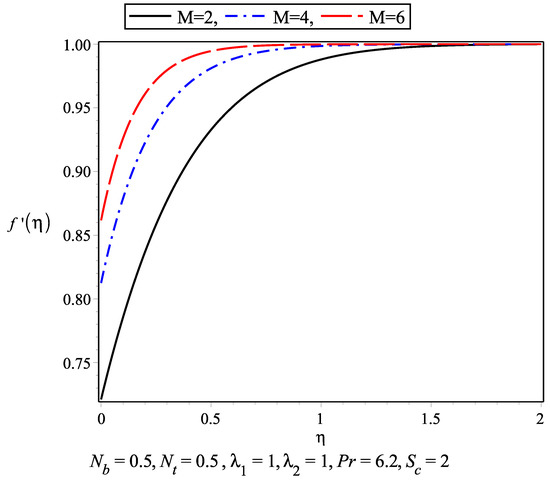
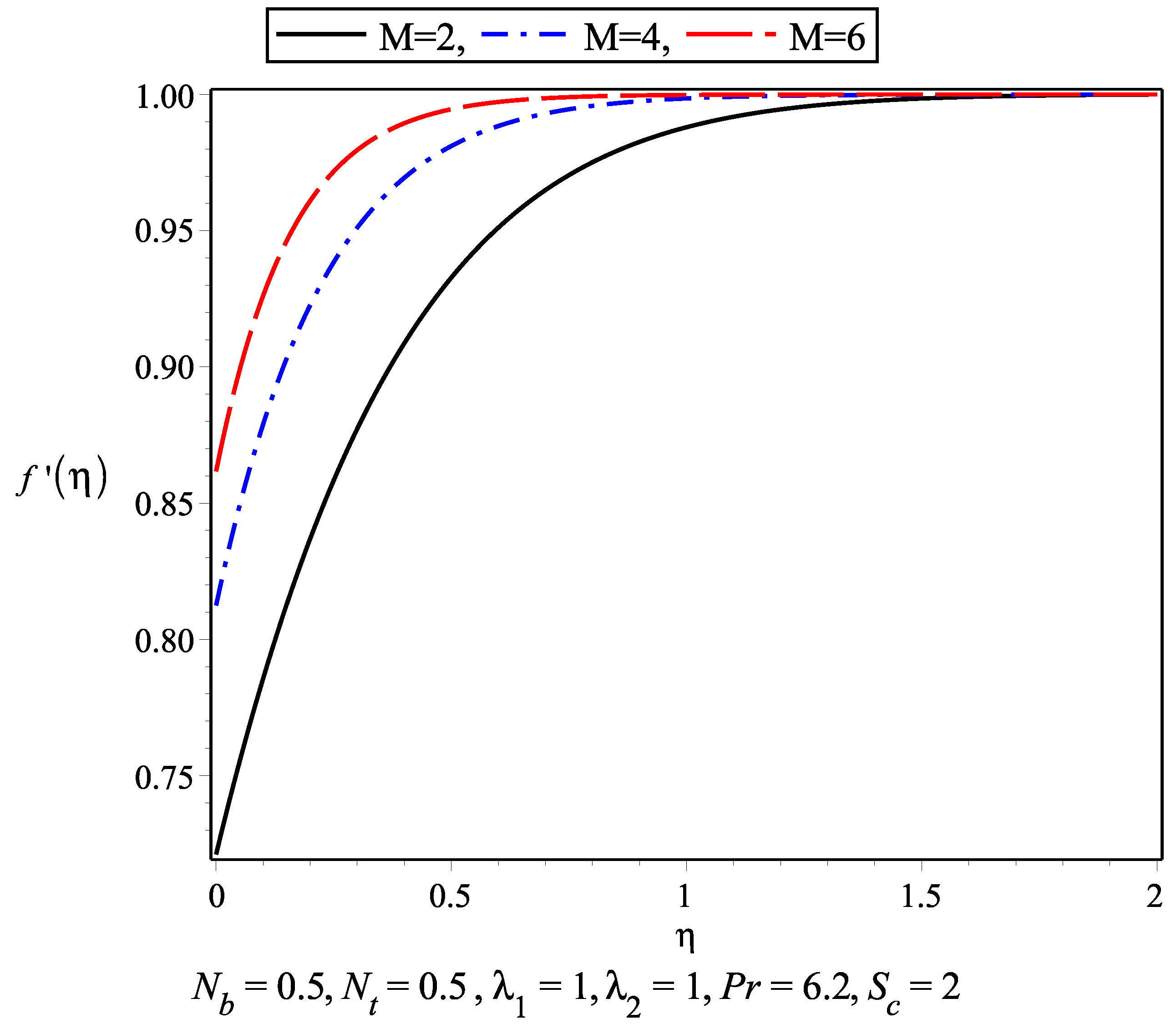
Figure 1.
Variation of for different M.
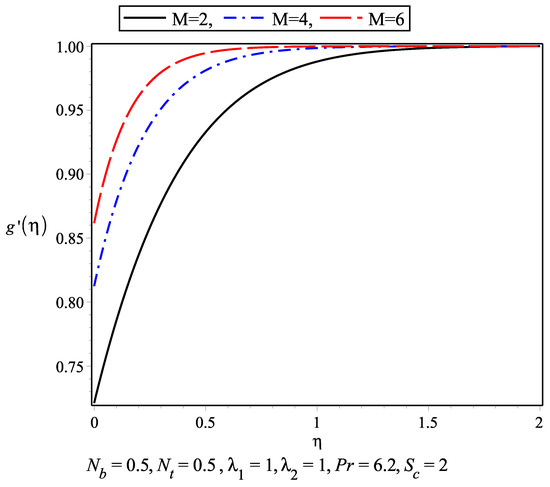
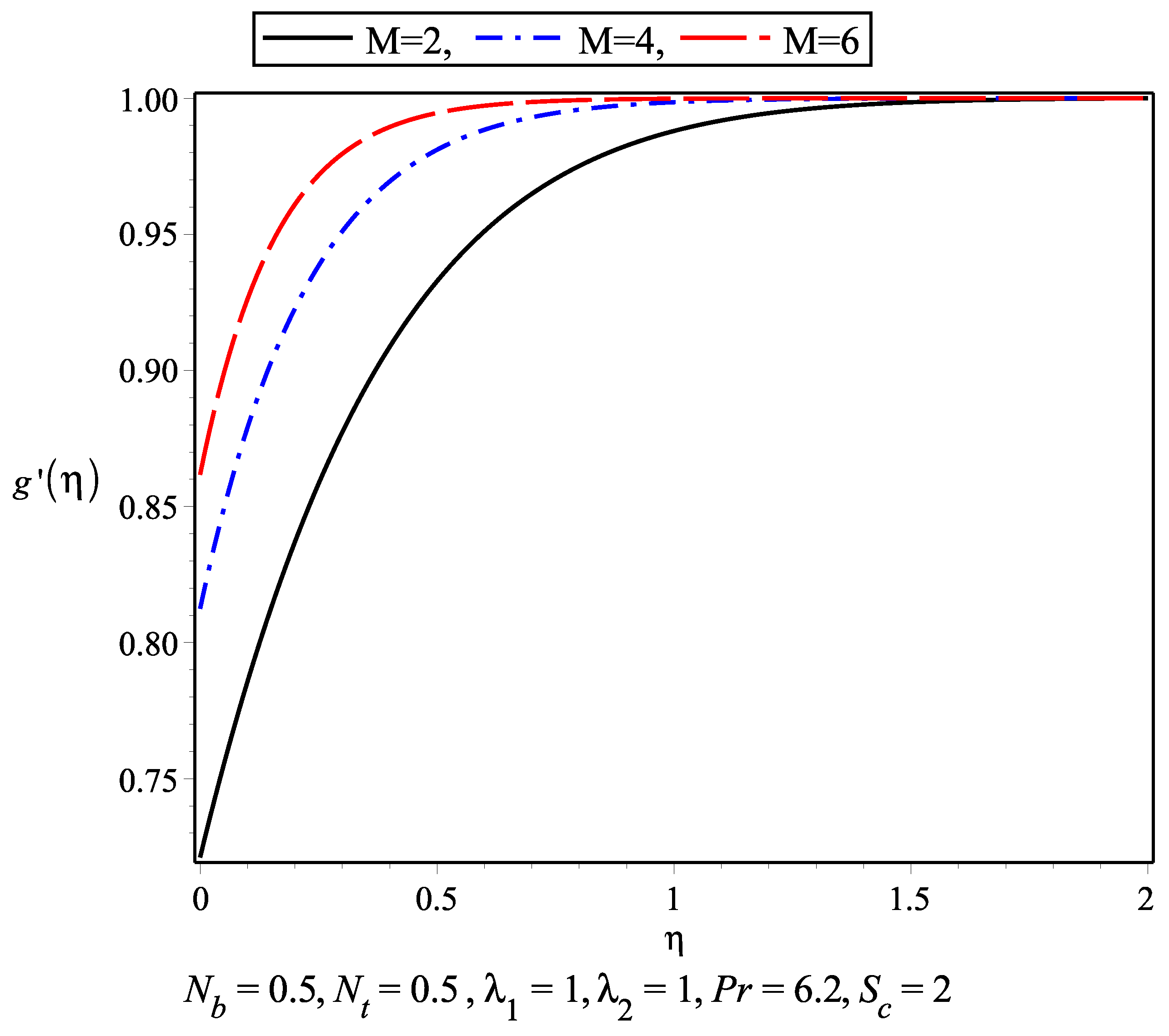
Figure 2.
Variation of for different M.
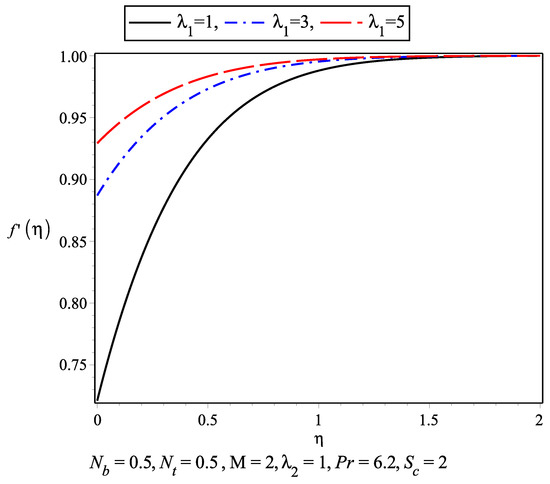
Figure 3.
Variation of for different .
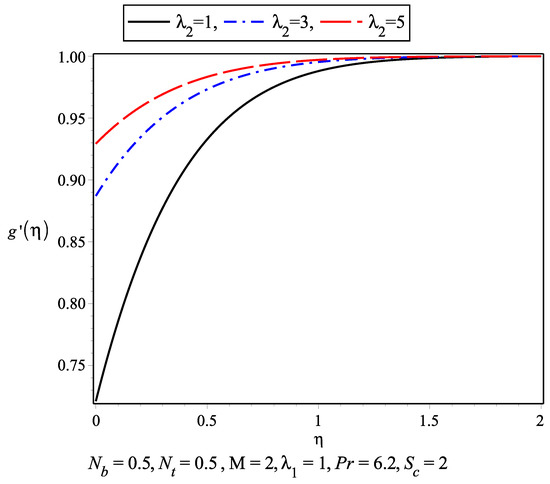
Figure 4.
Variation of for different .
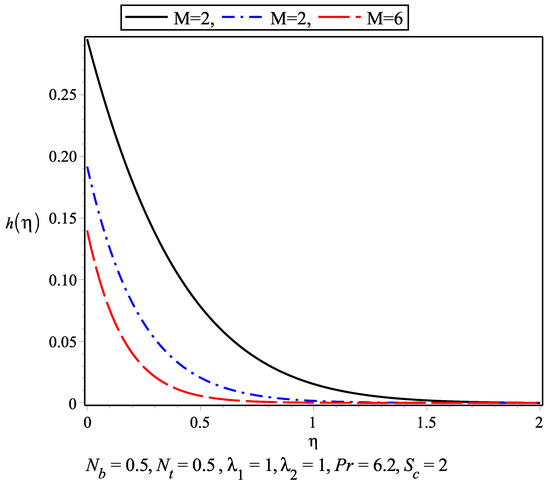
Figure 5.
Variation of for different M.
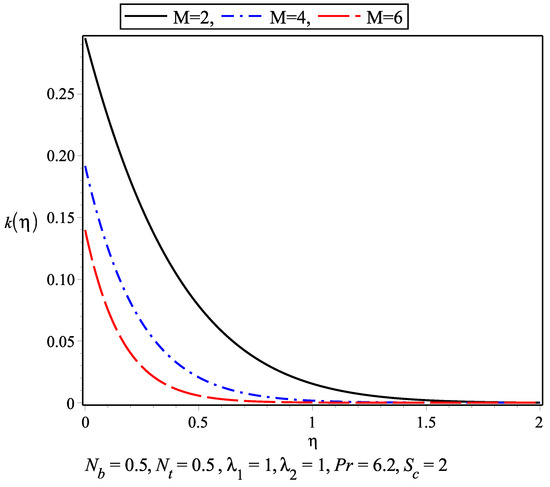
Figure 6.
Variation of for different M.
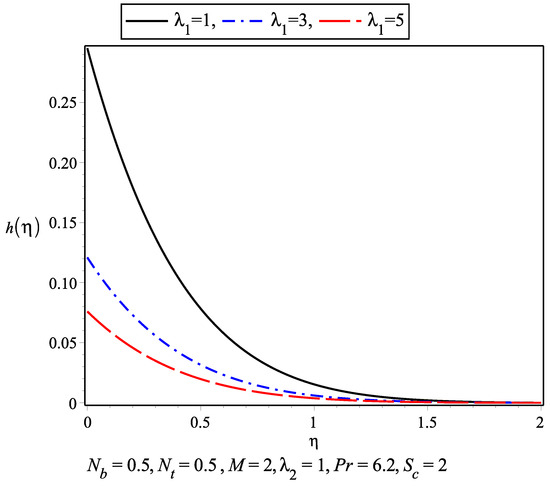
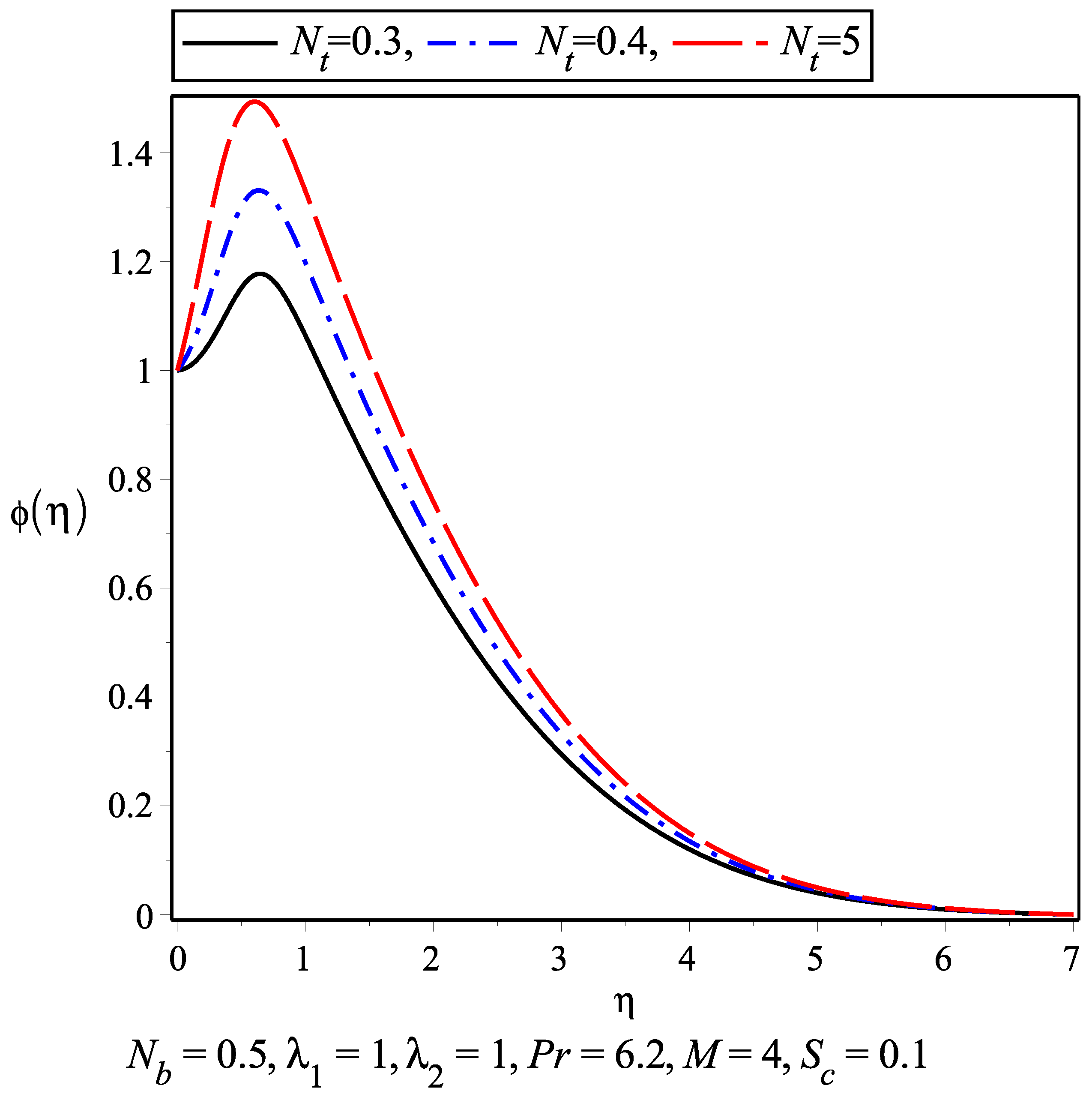
Figure 7.
Variation of for different .
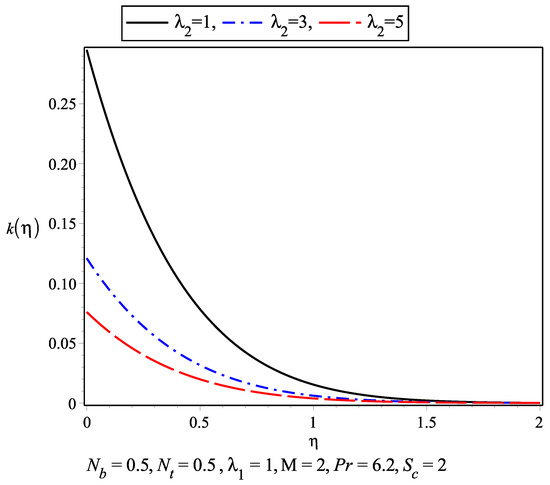
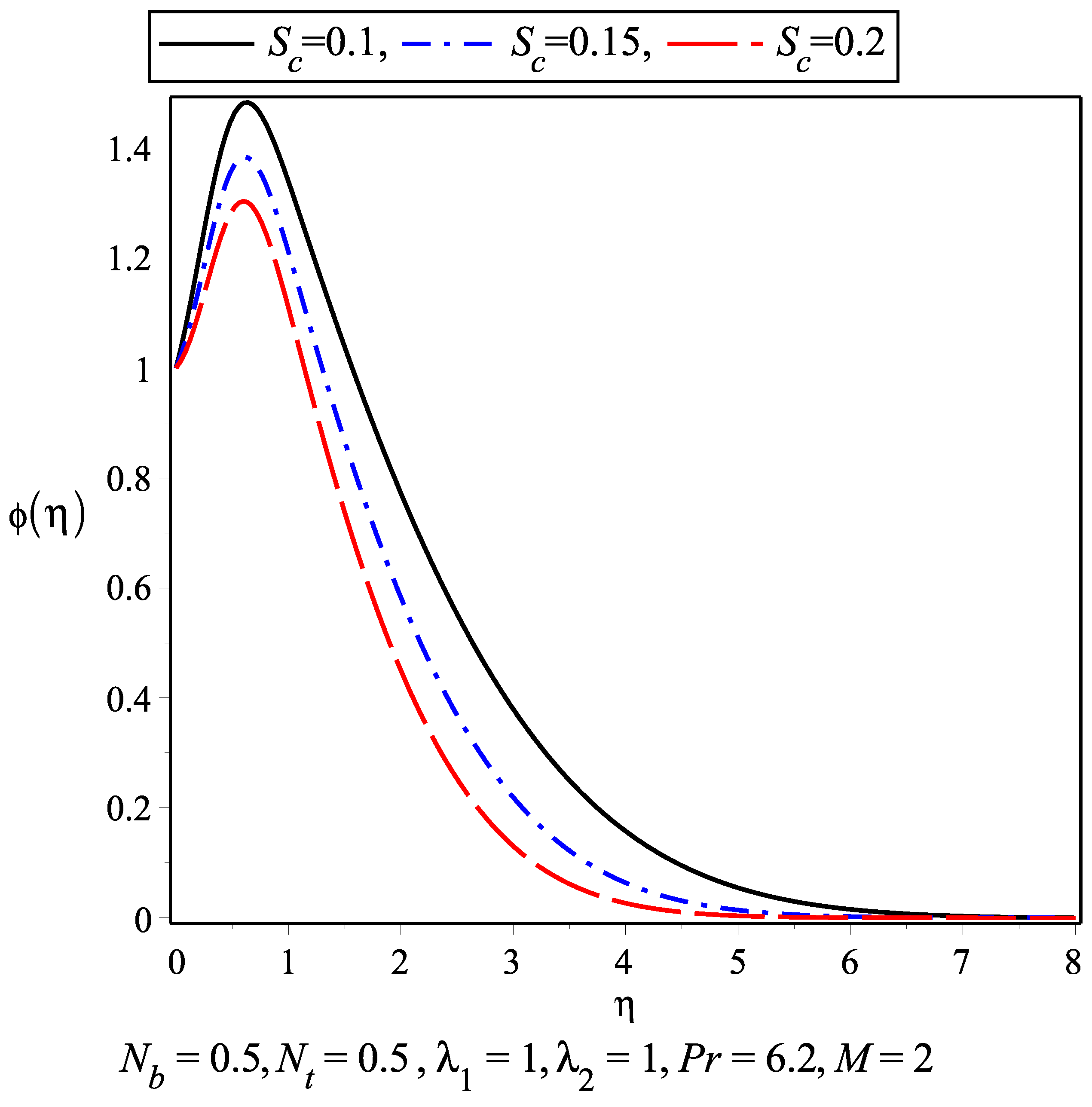
Figure 8.
Variation of for different .
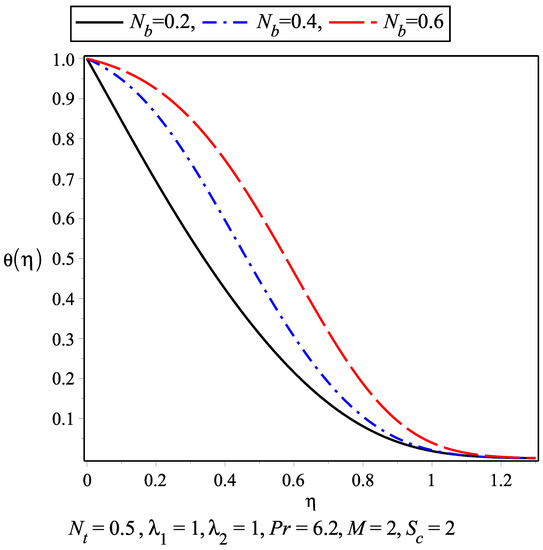
Figure 9.
Variation of for different .
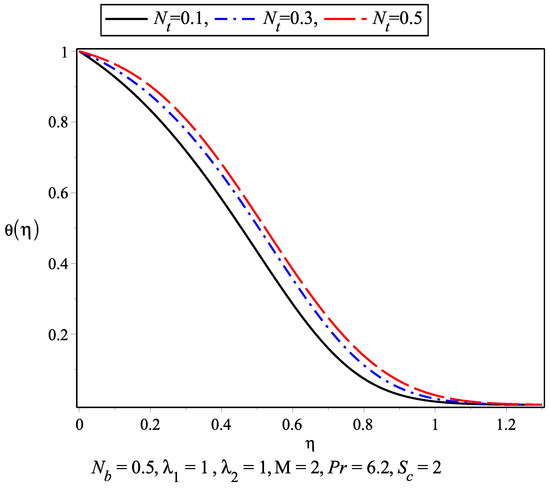
Figure 10.
Variation of for different .

Table 1.
Variation of Local Nusselt number and Sherwood number for different and .
Table 2.
Variation of Local Nusselt number and Sherwood number for different M and .
Table 3.
Variation of Skin friction coefficient for different M and .
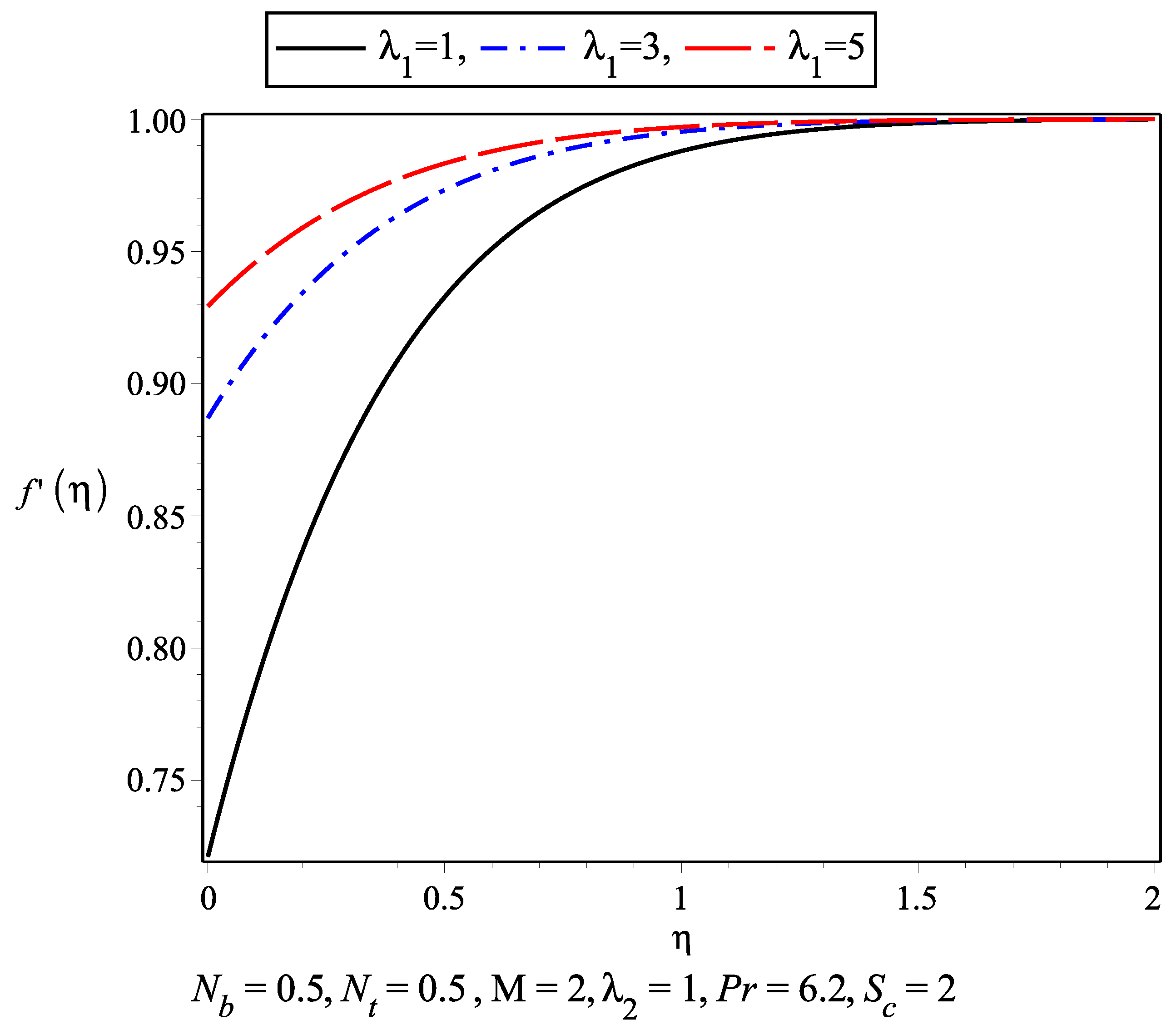
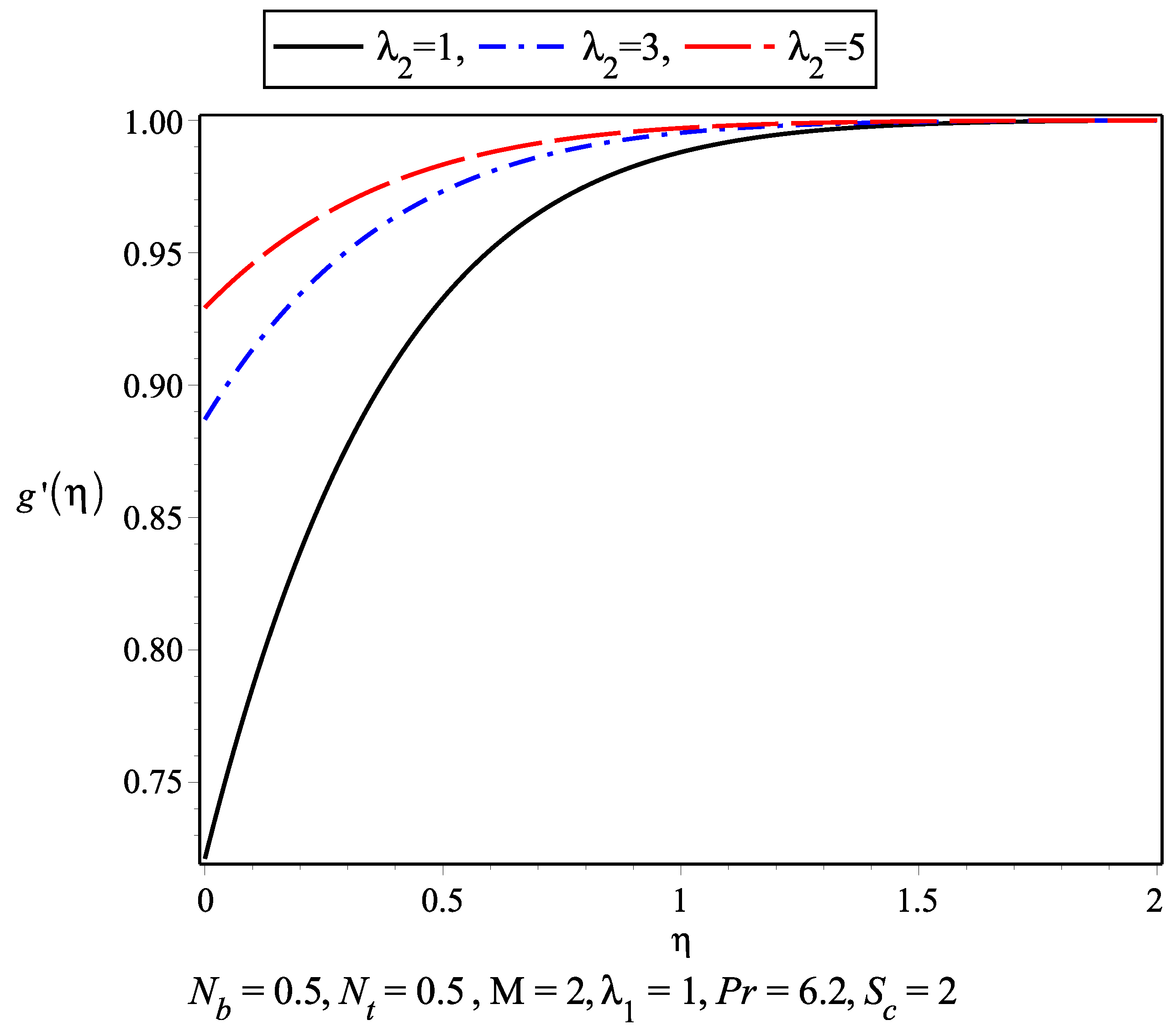
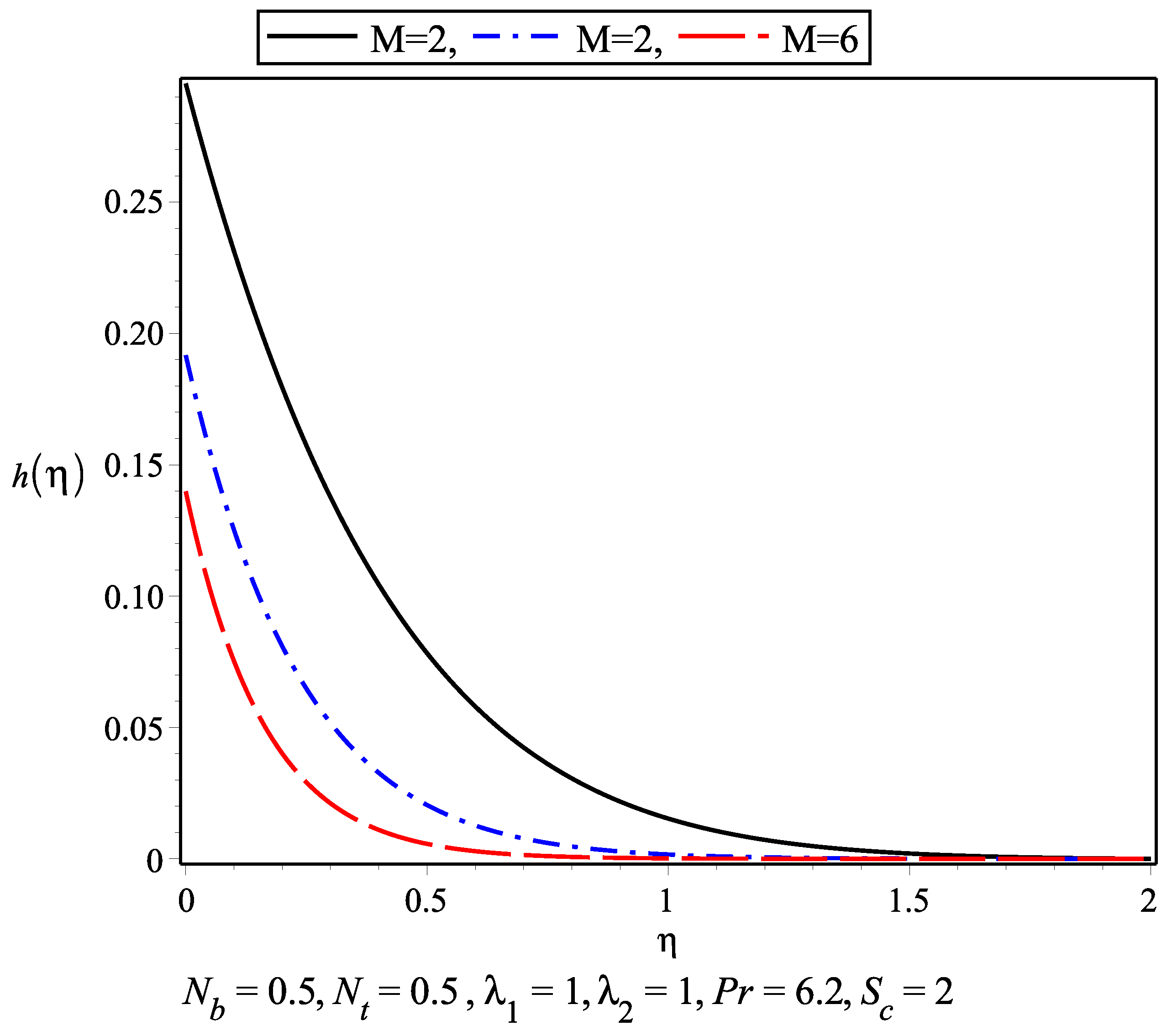
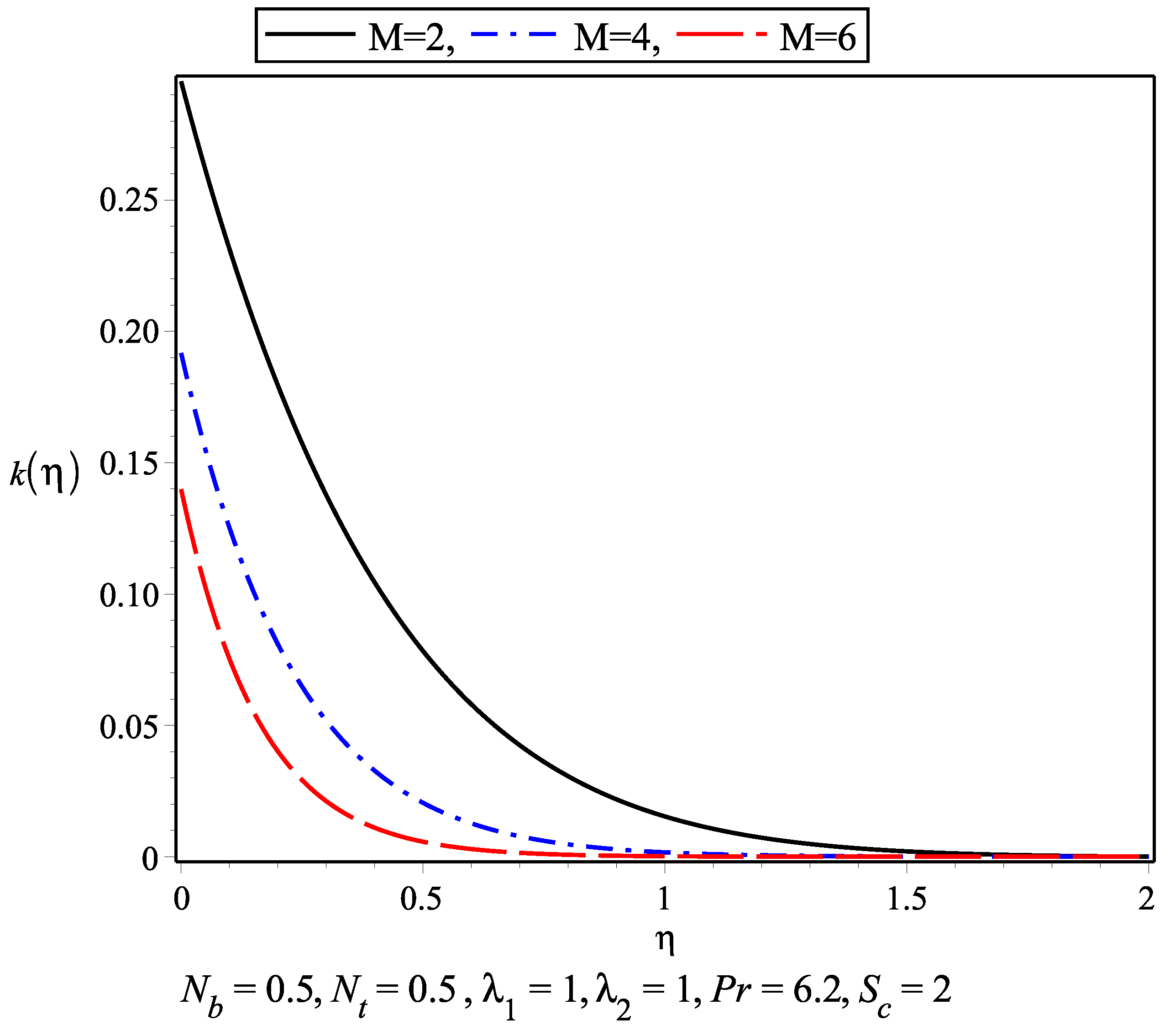
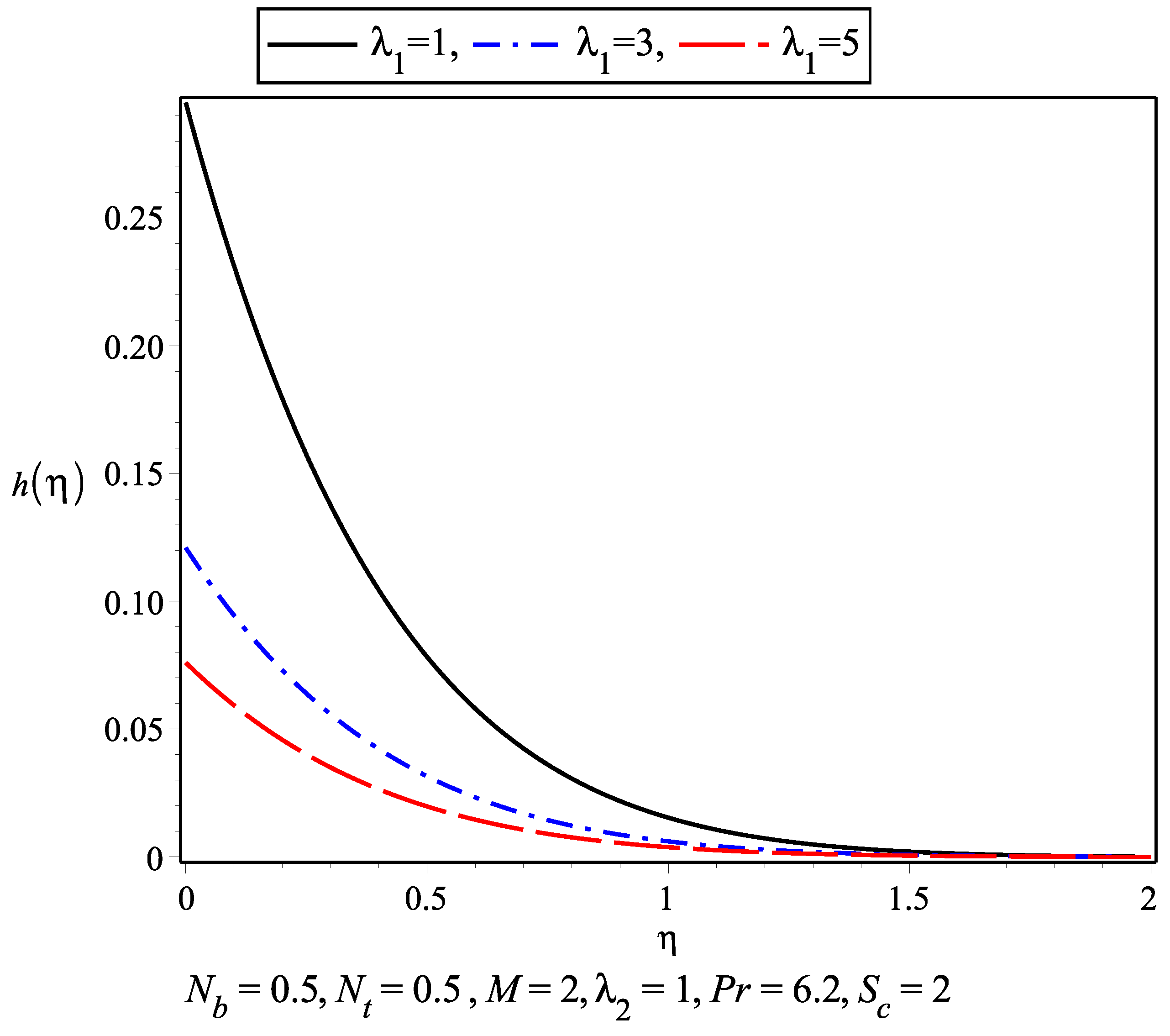
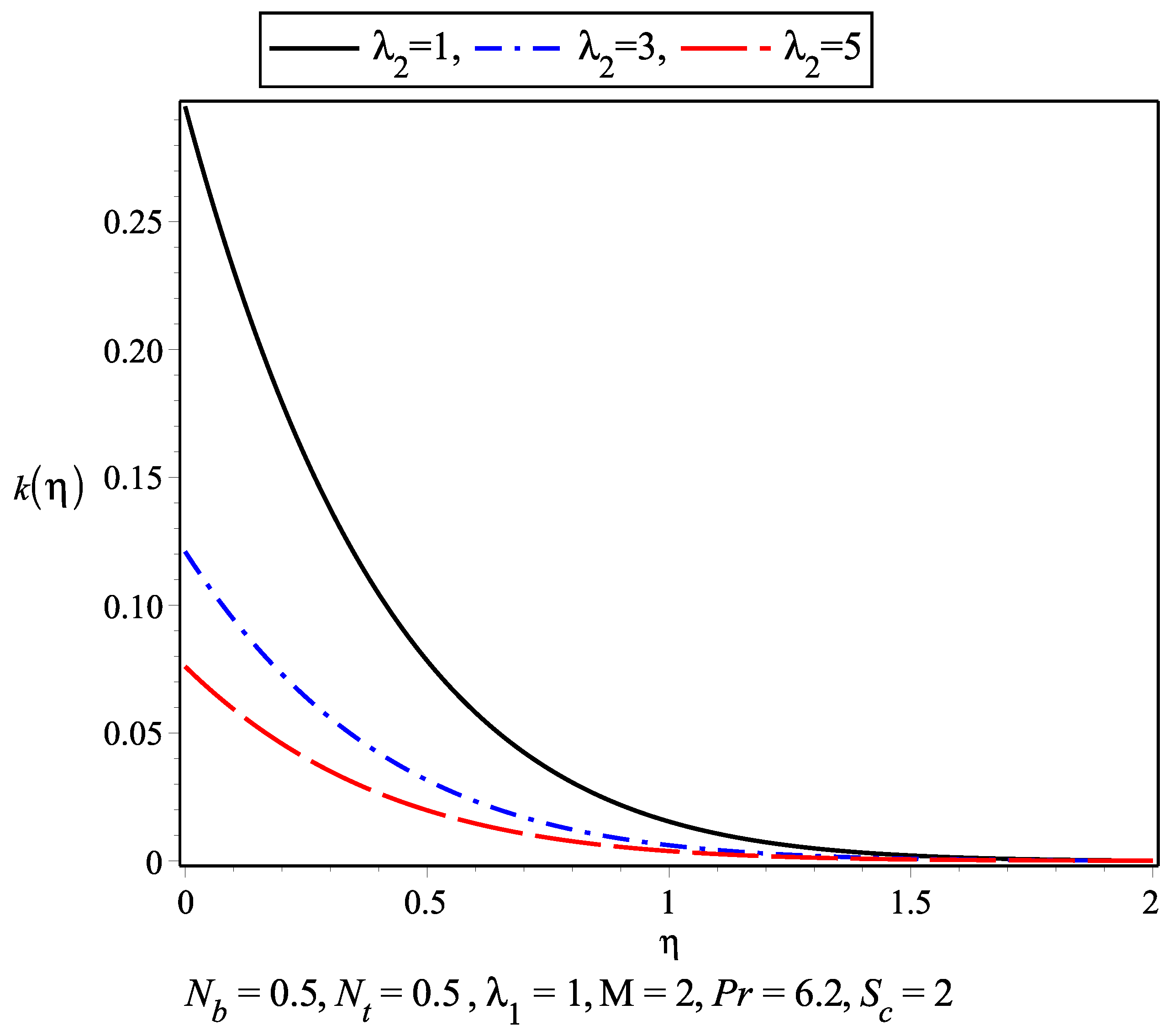
Figure 1 and Figure 2 show the variation of velocity profile and against for different values of magnetic field M and slip parameter . It was observed that increasing in the values of M and causes increase in the velocity profile, while boundary layer thickness reduces. Thus, these parameters cause a reduction in the momentum boundary layer. Analysis shows that increasing the values of these parameters to a sufficiently large level shows the monotonic behavior of velocity throughout the whole domain. Figure 3 and Figure 4 shows the opposite behavior of h and k with the increment of M and , such that with the increase in value of these parameters, h and k decreases.
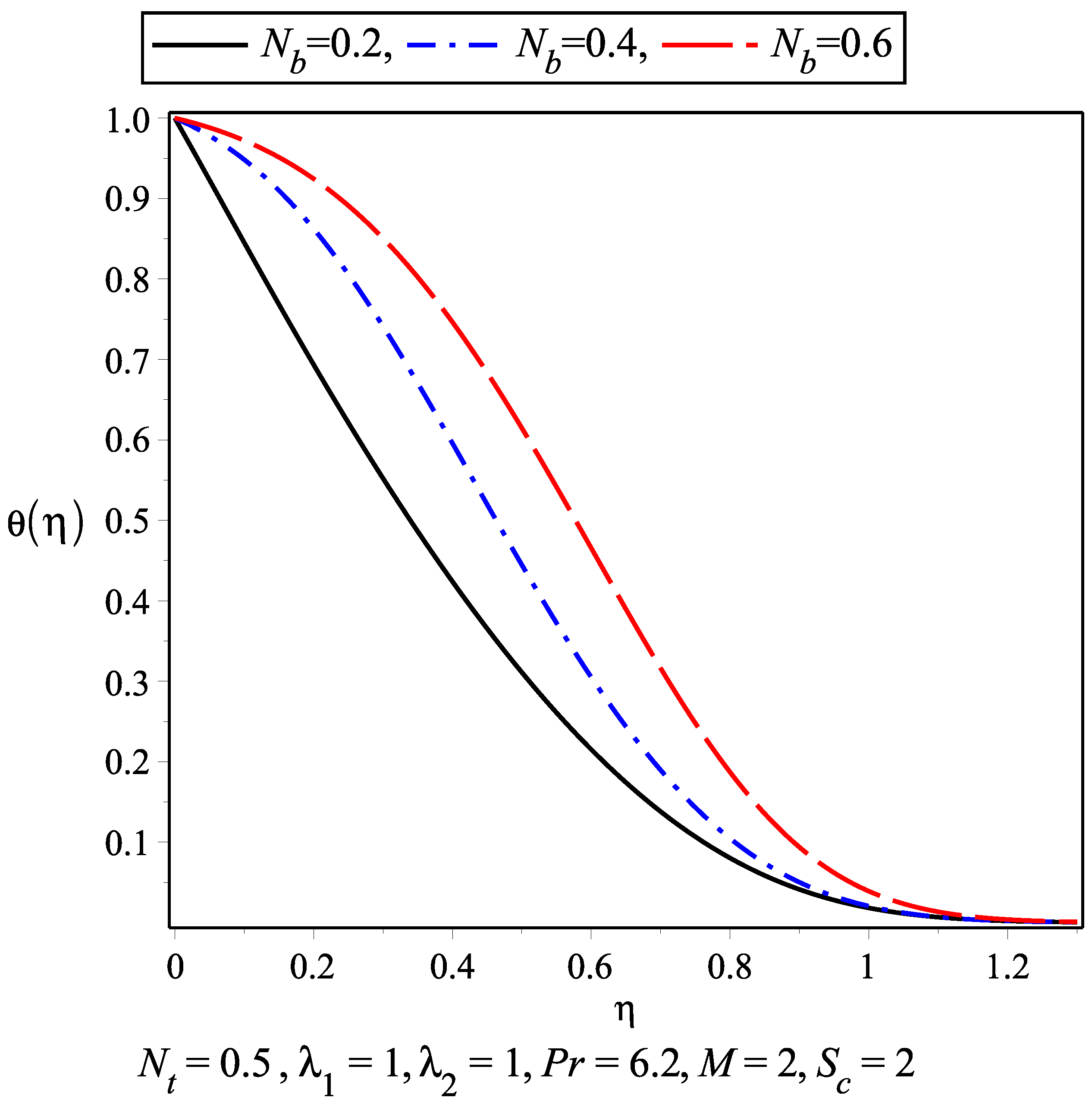
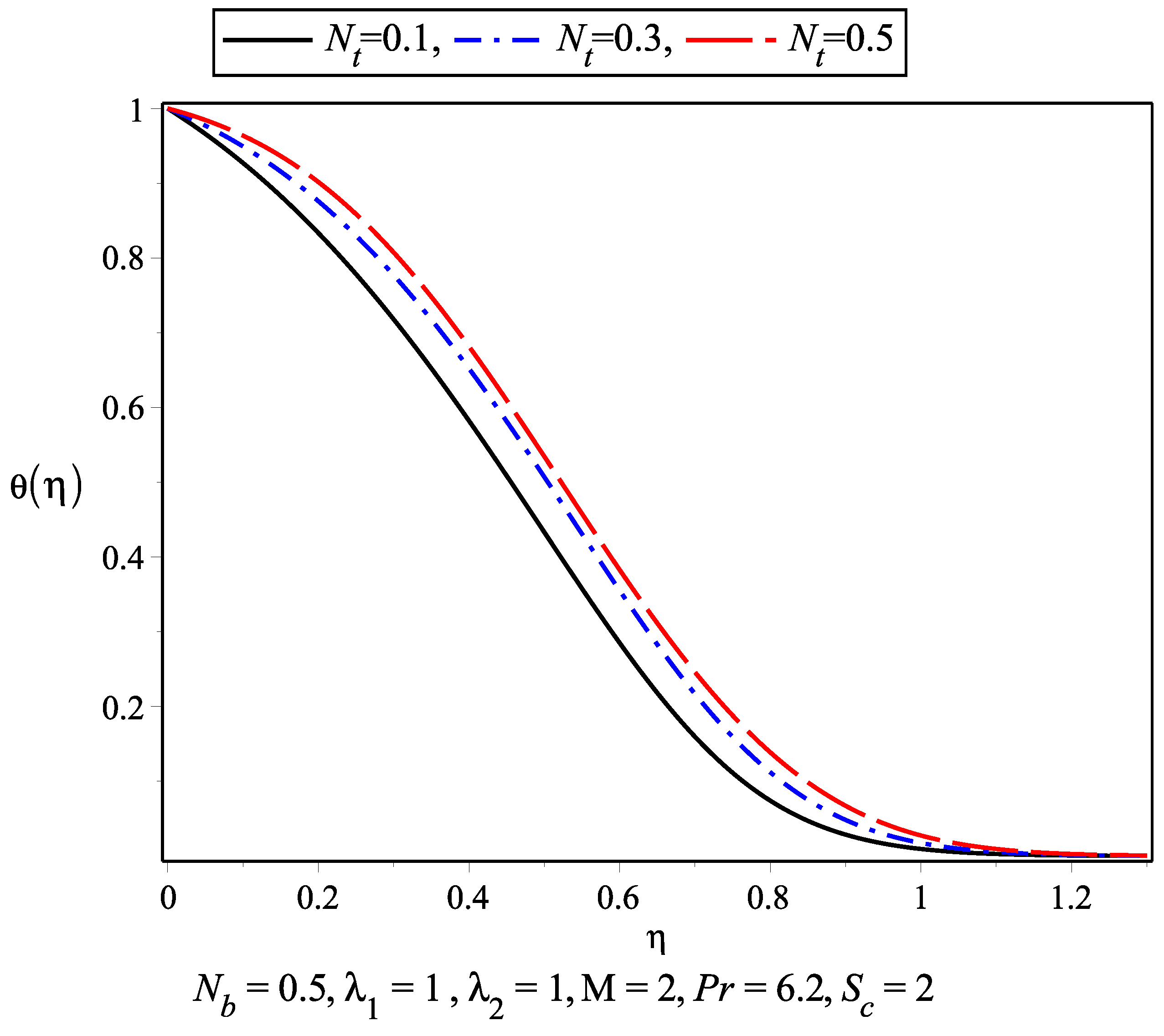
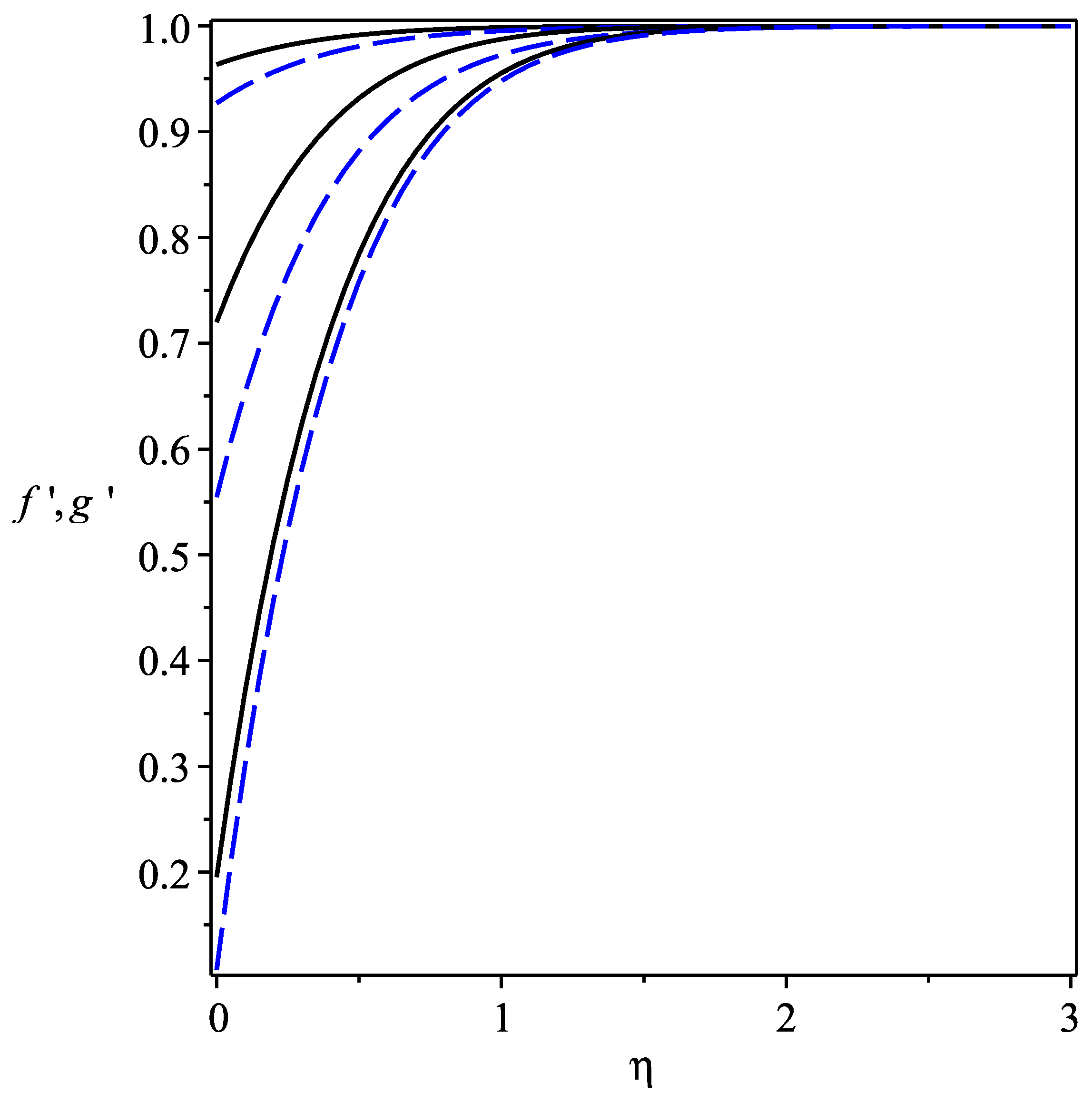
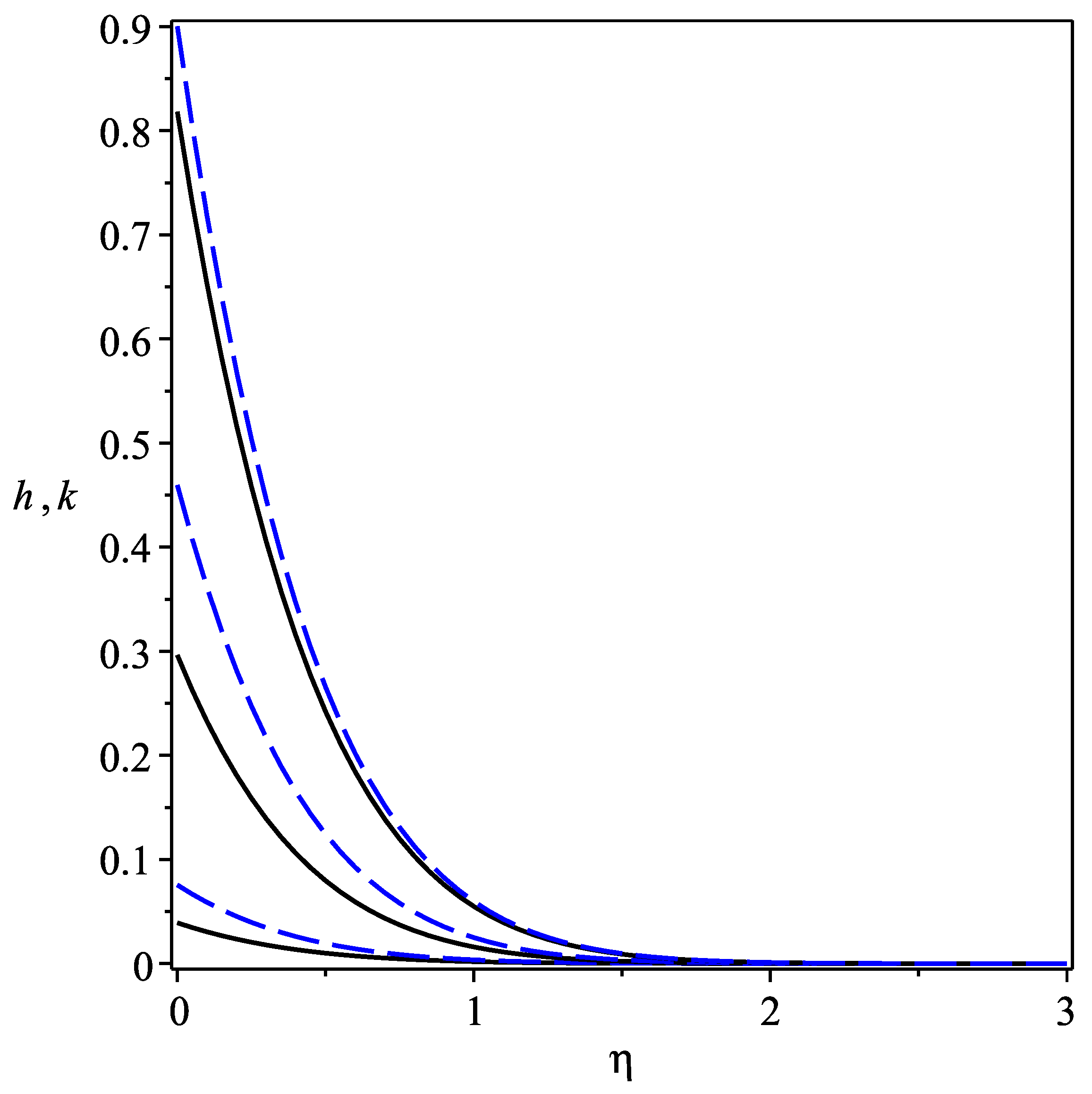
The temperature profile for the nanofluid against different values of thermophoresis parameter and Brownian motion parameter are plotted in Figure 5 and Figure 6. As the temperature increase within the boundary layer, the values of these parameters increase. The thermal boundary layer is achieved earlier than the momentum boundary layer. The variation of nanoconcentration for different values of Schmidt number and is presented in Figure 7 and Figure 8, respectively. It is observed that nanoconcentration decreases as the increase in and boundary layer thickness decreases. Also, with the increase in , the nanoconcentration decreases. Figure 9 and Figure 10 show the velocity profile for different values of magnetic parameter and for . It is observed that in the absence of magnetic parameter M, the boundary layer thickness is larger than while M is present. in Figure 11 and Figure 12 represents the results of Wang [5]. The slip parameter ratio can be defined as . Figure 13 and Figure 14 describe the for . The range of varies from 0.2 to 10. represents the isotropic case where and .
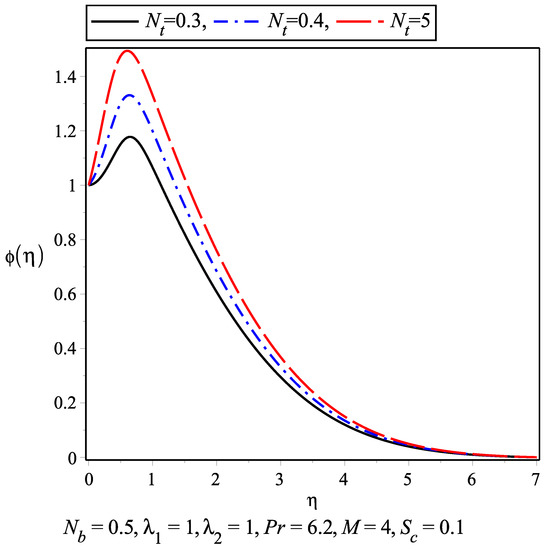
Figure 11.
Variation of for different .
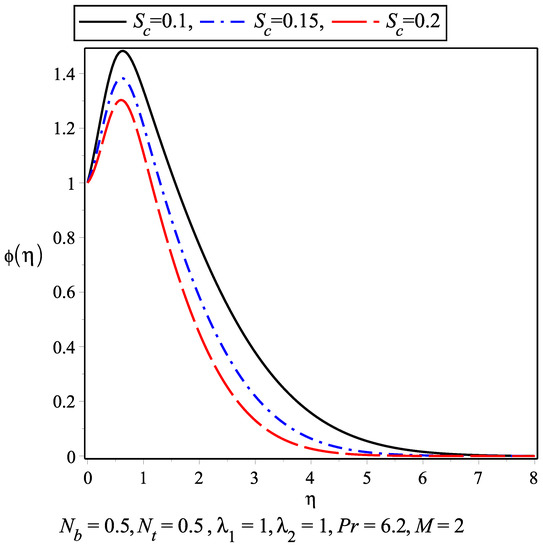
Figure 12.
Variation of for different .
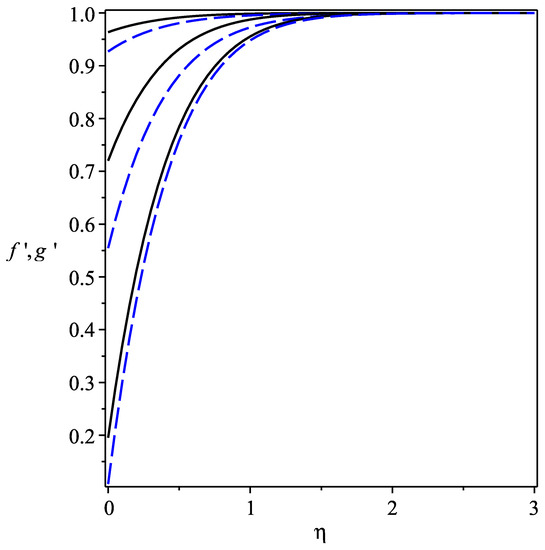
Figure 13.
solid curves and dashed curves for . From top: .
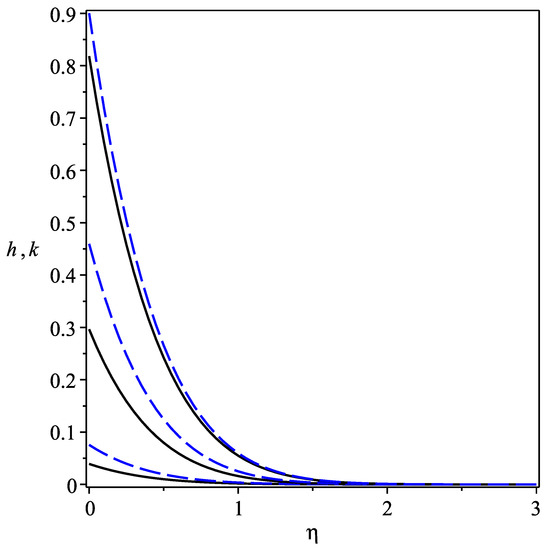
Figure 14.
solid curves and dashed curves for . From top: .
Table 1 shows local Nusselt number and local Sherwood number for the variation of and thermophoresis parameter . Here we see that with the increase of , the local Nusselt number decreases, while local Sherwood number gives opposite results, meaning increases. Moreover, with the increase of , the results are again the opposite for and . Table 2 shows local Nusselt number and local Sherwood number for variations of slip parameter and Brownian motion . Here it is observed that with the increase of both Nusselt number and local Sherwood number increase. Table 3 shows the skin friction coefficient for different values of and magnetic parameter M. Note that with the increment in , the value of skin friction decreases. A high value of M gives larger values of skin friction.
4. Conclusions
The current paper investigated the effects of uniform magnetic field of axisymmetric three-dimensional stagnation point flow of a nanofluid on a moving plate with different slip constants. The governing equations were made dimensionless and then solved using the Richardson extrapolation enhancement method. The following are the findings of the above work:
- An increase in the magnetic field M and slip parameter causes an increase in the velocity profile and decrease in the boundary layer thickness near the stagnation point.
- It is observed that in the absence of magnetic parameter M the boundary layer thickness is larger than while M is present.
- The thermal boundary layer increases with an increase in the thermophoresis parameter and Brownian motion parameter . It is observed that the thermal boundary layer is achieved earlier compared to the momentum boundary layer.
- It is observed that with the increase in and the nanoconcentration decreases and vice versa.
Funding
The author wishes to express his thanks for financial support received from King Fahd University of Petroleum and Minerals.
Acknowledgments
The author wishes to express his thanks to King Fahd University of Petroleum and Minerals and reviewers to improve the manuscript.
Conflicts of Interest
The author declares that there is no conflict of interest.
Abbreviations
The following abbreviations are used in this manuscript:
| velocity Components | |
| kinematic viscosity | |
| slip coefficient | |
| T | temperature |
| thermal diffusivity | |
| C | volume of nano particles |
| heat capacity of fluid | |
| Brownian diffusion coefficient | |
| thermophoretic diffusion coefficient | |
| slip parameters | |
| thermophoresis parameter | |
| browning motion parameter | |
| skin friction coefficient | |
| local Nusselt number | |
| Sherwood number | |
| local Reynolds number | |
| Schmidt number | |
| prantle number | |
| ratio of slip parameters | |
| nano concentration | |
| M | magnetic parameter |
References
- Borrelli, A.; Giantesio, G.; Patria, M.C. Numerical simulations of three-dimensional MHD stagnation-point flow of a micropolar fluid. Comput. Math. Appl. 2013, 66, 472–489. [Google Scholar] [CrossRef]
- Lok, Y.Y.; Amin, N.; Pop, I. Non-orthogonal stagnation point flow towards a stretching shee. Int. J. Non Linear Mech. 2006, 41, 622–627. [Google Scholar] [CrossRef]
- Tilley, B.S.; Weidman, P.D. Oblique two-fluid stagnation-point flow. Eur. J. Mech. B Fluids 1998, 17, 205–217. [Google Scholar] [CrossRef]
- Grosan, T.; Pop, I.; Revnic, C.; Ingham, D.B. Magnetohydrodynamic oblique stagnation-point flow. Meccanica 2009, 44, 565. [Google Scholar] [CrossRef]
- Wang, C.Y. Stagnation flow on a plate with anisotropic slip. Eur. J. Mech. B Fluids 2013, 38, 73–77. [Google Scholar] [CrossRef]
- Wang, C.Y. Off-centered stagnation flow towards a rotating disc. Int. J. Eng. Sci. 2008, 46, 391–396. [Google Scholar] [CrossRef]
- Wang, C.Y. Stagnation flow towards a shrinking sheet. Int. J. Non Linear Mech. 2008, 43, 377–382. [Google Scholar] [CrossRef]
- Nadeem, S.; Hussain, A.; Khan, M. HAM solutions for boundary layer flow in the region of the stagnation point towards a stretching sheet. Commun. Nonlinear Sci. Numer. Simul. 2010, 15, 475–481. [Google Scholar] [CrossRef]
- Ariel, P.D. Hiemenz flow in hydromagnetics. Acta Mech. 1994, 103, 31–43. [Google Scholar] [CrossRef]
- Raju, C.S.; Sandeep, N. Heat and mass transfer in MHD non-Newtonian bio-convection flow over a rotating cone/plate with cross diffusion. J. Mol. Liq. 2016, 215, 115–126. [Google Scholar] [CrossRef]
- Kleinstreuer, C.; Li, J.; Koo, J. Microfluidics of nano-drug delivery. Int. J. Heat Mass Trans. 2008, 51, 5590–5597. [Google Scholar] [CrossRef]
- Choi, S.U.S. Enhancing thermal conductivity of fluids with nanoparticles. ASME Publ. Fed 1995, 231, 99–106. [Google Scholar]
- Buongiorno, J. Convective transport in nanofluids. J. Heat Transf. 2006, 128, 240–250. [Google Scholar] [CrossRef]
- Nadeem, S.; Saleem, S. Analytical study of third grade fluid over a rotating vertical cone in the presence of nanoparticles. Int. J. Heat Mass Transf. 2015, 85, 1041–1048. [Google Scholar] [CrossRef]
- Bachok, N.; Ishak, A.; Nazar, R.; Pop, I. Flow and heat transfer at a general three-dimensional stagnation point in a nanofluid. Phys. B Condens. Matter 2010, 405, 4914–4918. [Google Scholar] [CrossRef]
- Ellahi, R.; Aziz, S.; Zeeshan, A. Non Newtonian nanofluids flow through a porous medium between two coaxial cylinders with heat transfer and variable viscosity. J. Porous Media 2013, 16, 205–216. [Google Scholar] [CrossRef]
- Sheikholeslami, M.; Ganji, D.; Javed, M.Y.; Ellahi, R. Effect of thermal radiation on nanofluid flow and heat transfer using two phase model. J. Magn. Magn. Mater. 2015, 374, 36–43. [Google Scholar] [CrossRef]
- Makinde, O.D.; Khan, W.A.; Khan, Z.H. Buoyancy effects on MHD stagnation point flow and heat transfer of a nanofluid past a convectively heated stretching/shrinking sheet. Int. J. Heat Mass Transf. 2013, 62, 526–533. [Google Scholar] [CrossRef]
- Junaid Ahmad Khan, M.; Mustafa, T.; Hayat, A.; Alsaedi, A. Three-dimensional flow of nanofluid over a non-linearly stretching sheet: An application to solar energy. Int. J. Heat Mass Transf. 2015, 86, 158–164. [Google Scholar] [CrossRef]
- Upadhya, M.; Mahesha, S.; Raju, C.S.K. Unsteady Flow of Carreau Fluid in a Suspension of Dust and Graphene Nanoparticles With Cattaneo–Christov Heat Flux. J. Heat Transf. 2018, 140, 092401. [Google Scholar] [CrossRef]
- Li, Z.; Sheikholeslami, M.; Ahmad Shafee, S.; Ali J Chamkha, S. Effect of dispersing nanoparticles on solidification process in existence of Lorenz forces in a permeable media. J. Mol. Liq. 2018, 266, 181–193. [Google Scholar] [CrossRef]
- Raju, C.S.K.; Saleem, S.; Mamatha, S.U. Iqtadar Hussain, Heat and mass transport phenomena of radiated slender body of three revolutions with saturated porous: Buongiorno’s model. Int. J. Therm. Sci. 2018, 132, 309–315. [Google Scholar] [CrossRef]
- Ram, P.; Kumar, A. Analysis of Heat Transfer and Lifting Force in a Ferro-Nanofluid Based Porous Inclined Slider Bearing with Slip Conditions. Nonlinear Eng. 2018. [Google Scholar] [CrossRef]
- Soomro, F.A.; Hammouch, Z. Heat transfer analysis of CuO-water enclosed in a partially heated rhombus with heated square obstacle. Int. J. Heat Mass Transf. 2018, 118, 773–784. [Google Scholar]
- Hayat, T.; Qayyum, S.; Alsaedi, A.; Ahmad, B. Results in Physics, Significant consequences of heat generation/absorption and homogeneous-heterogeneous reactions in second grade fluid due to rotating disk. Results Phys. 2018, 8, 223–230. [Google Scholar] [CrossRef]
- Hussain, S.; Aziz, A.; Aziz, T.; Khalique, C.M. Slip Flow and Heat Transfer of Nanofluids over a Porous Plate Embedded in a Porous Medium with Temperature Dependent Viscosity and Thermal Conductivity. Appl. Sci. 2016, 6, 376. [Google Scholar] [CrossRef]
- Anuar, N.; Bachok, N.; Pop, I. A Stability Analysis of Solutions in Boundary Layer Flow and Heat Transfer of Carbon Nanotubes over a Moving Plate with Slip Effect. Energies 2018, 11, 3243. [Google Scholar] [CrossRef]
- Fetecau, C.; Vieru, D.; Azhar, W.A. Natural Convection Flow of Fractional Nanofluids Over an Isothermal Vertical Plate with Thermal Radiation. Appl. Sci. 2017, 7, 247. [Google Scholar] [CrossRef]
- Khan, N.S.; Gul, T.; Islam, S.; Khan, I.; Alqahtani, A.M.; Alshomrani, A.S. Alqahtani and Ali Saleh Alshomrani, Magnetohydrodynamic Nanoliquid Thin Film Sprayed on a Stretching Cylinder with Heat Transfer. Appl. Sci. 2017, 7, 271. [Google Scholar] [CrossRef]
© 2019 by the author. Licensee MDPI, Basel, Switzerland. This article is an open access article distributed under the terms and conditions of the Creative Commons Attribution (CC BY) license (http://creativecommons.org/licenses/by/4.0/).