


Abstract
Recently, the generalized type I progressive hybrid censoring scheme (GenTPrHyCS) and generalized type II progressive hybrid censoring scheme (GenTPrHyCS) have become quite popular in reliability studies. These two type censoring schemes are very complex due to the large number of parameters used to specify the censoring procedure. Therefore, in this paper, we consider a more general and more complex new censoring scheme. Also, we consider the exponential distribution(ExpD) and derive an expression for the density function of the MLE. We prove the exact distribution of the maximum likelihood estimator (MLE) and conditional moment generating function (CondMGF) of the MLE for the mean of the ExpD under a new censoring scheme. We then derive the exact confidence intervals (ConfItv) for the mean of the ExpD under a new censoring scheme. Finally, we present an example to explain the methods of inference derived for this paper. From the example data, it can be seen that PDF of MLE for ExpD under new censoring scheme is almost symmetrical.
1. Introduction
For reasons of cost and time, life-testing and reliability studies must be terminated before all failures are observed. Censoring techniques are extensively employed to reduce test duration and costs. In this reason, the progressive censoring scheme (PrgCS) has become quite popular in reliability studies (Ref. [1]).
One of the drawbacks of the PrgCS is that the time of the reliability test can be very long if the units are highly reliable. Therefore, Ref. [2] and Ref. [3] introduced GenTPrHyCS and GenTPrHyCS, respectively. Recently, some studies on GenTPrHyCS and GenTPrHyCS have been carried out by many authors (Refs. [4,5,6,7,8,9,10,11,12,13]). Ref. [4] discussed the Bayes estimator and MLE for the entropy of Weibull distribution under GenPrHyCS. Ref. [5] considered the Bayes estimators and MLEs for the parameters of Weibull distribution under generalized progressive hybrid censored competing risks data. Ref. [6] introduced different methods of estimating the parameters of ExpD under generalized progressive hybrid censored competing risks data. Ref. [7] discussed the Bayes estimators for the parameters of kumarawamy distribution under GenPrHyCS. Ref. [8] considered improved MLEs for the parameters of shape-scale family distribution under GenPrHyCS. Ref. [9] discussed the Bayes estimators and MLEs for the parameters of BurrType-XII lifetime distribution under GenPrHyCS. Ref. [10] introduced different methods of estimating the parameters of Rayleigh distribution under generalized progressive hybrid censored competing risks data. Ref. [11] discussed the Bayes estimators and MLEs for the parameters of truncated normal distribution under GenPrHyCS. Ref. [12] considered the Bayes estimators and MLEs for the parameters of generalized ExpD under GenPrHyCS. Ref. [13] discussed the multicomponent stress-strength model based on GenPrHyCS.
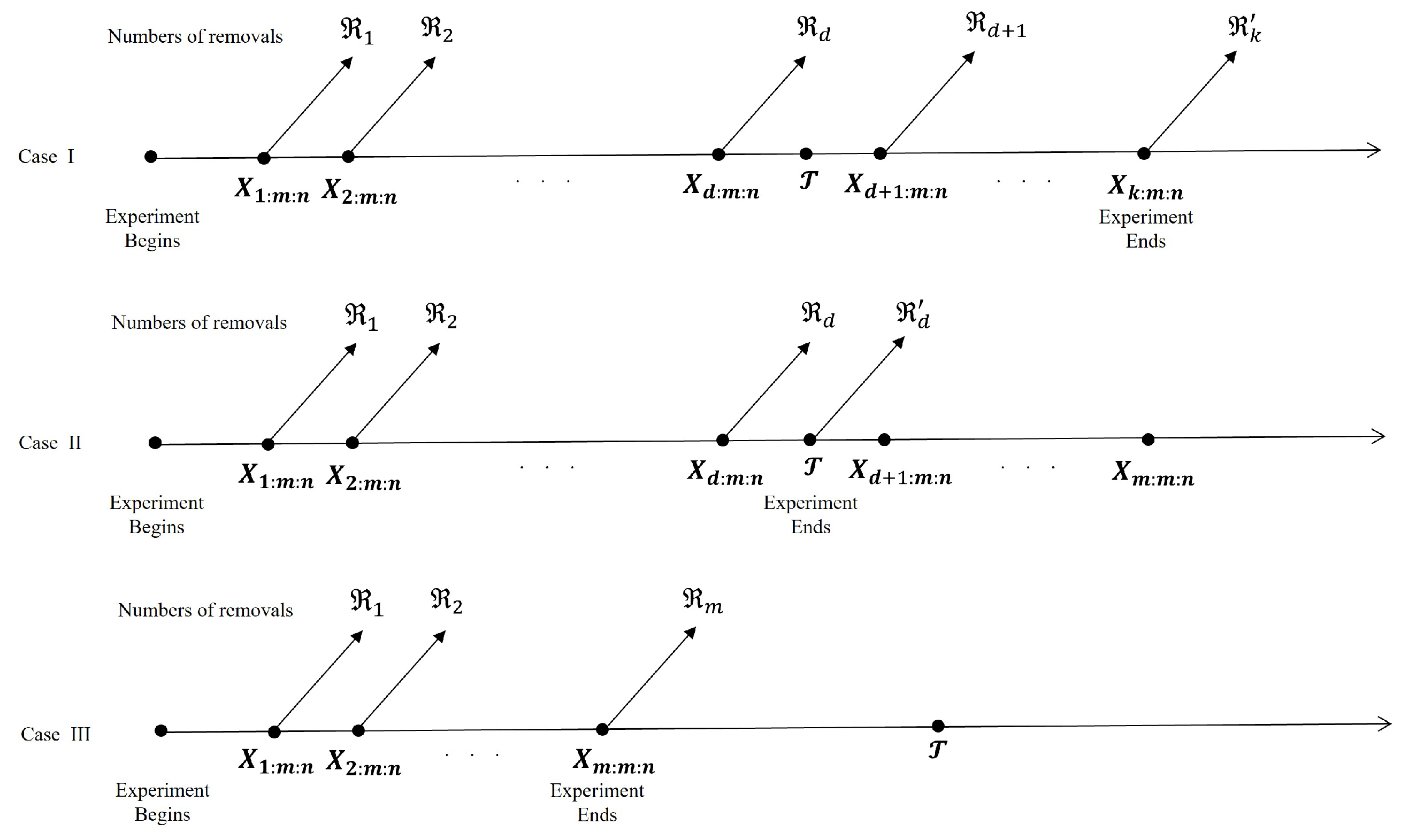
In GenTPrHyCS, the integer k and m, and the time are pre-fixed such that . If kth failures () occur after , finish the reliability test at (Case I). If kth failures () occur before and mth failures () occur after , finish the reliability test at (Case II). If mth failures () occur before , finish the reliability test at (Case III). Under GenTPrHyCS, the a minimum number k of failures is guaranteed (Figure 1).
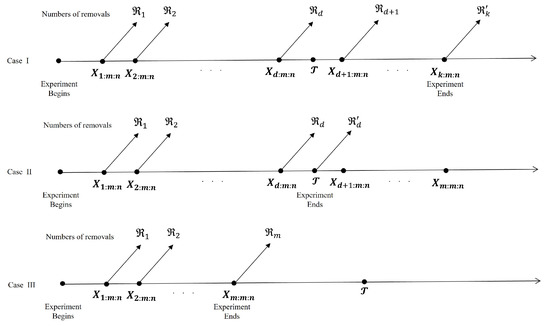
Figure 1.
Schematic representation of GenTPrHyCS.
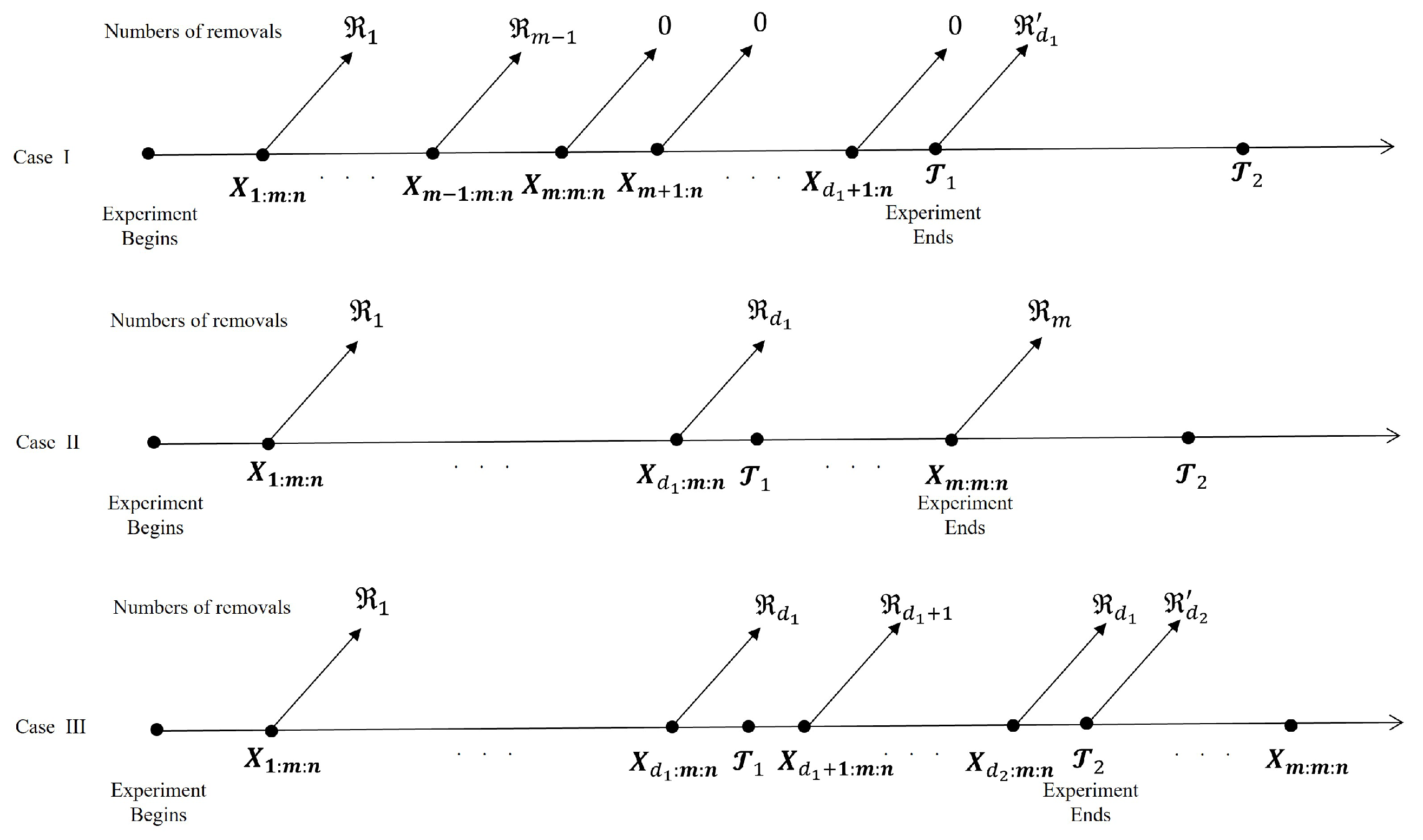
In GenTPrHyCS, the integer m, and the time and are pre-fixed such that . If mth failures () occur before , finish the reliability test at (Case I). If mth failures () occur between and , finish the reliability test at (Case II). If mth failures () occur after , finish the reliability test at (Case III). The GenTPrHyCS assures that the test will be completed at time (Figure 2).
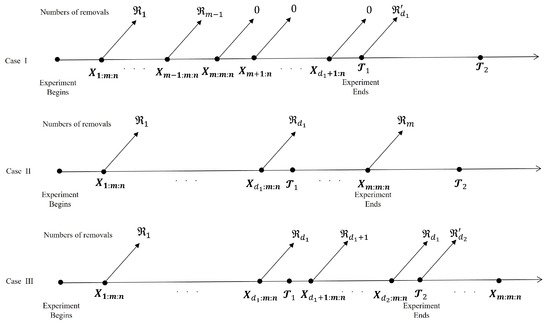
Figure 2.
Schematic representation of GenTPrHyCS.
These two type censoring schemes are very complex due to the large number of parameters used to specify the censoring procedure. Therefore, in this paper, we consider a more general and more complex new censoring scheme. Also, we considered the exponential distribution (ExpD) and derived an expression for the density function of the MLE.
The ExpD is the probability distribution of the time between events in a Poisson point process. Reliability studies make extensive use of the exponential distribution. It is the continuous analogue of the geometric distribution, and it has the key property of being memory-less. Because of the memory-less property of this distribution, it is well-suited to model the constant hazard rate portion of the bathtub curve used in reliability theory. It is also very convenient because it is so easy to add failure rates in the reliability model.
The aim of this paper is to suggest a new combined generalized progressive hybrid censoring scheme (ComGenPrHyCS) that covers two famous generalized progressive hybrid censoring schemes. ComGenPreHyCS provides the tester with more options to overcome limitations such as long test duration and the possibility of not observing any failures. For ComGenPrHyCS, basic distributional results as well as likelihood inference is conducted. Further, distributional results for the MLE with respect to the ExpD are established.
The detailed ComGenPrHyCS description will be explained in next Section 2. We prove the CondMGF of the MLE and distribution of the MLE for the mean of the ExpD under ComGenPrHyCS in Section 3. Also, we derive exact ConfItv for the mean of the ExpD under ComGenPrHyCS. Then, in Section 4, we present the results (confidence length (ConfLen), coverage percentage (Cov%), mean squared error (MSE) and bias of the MLE) of a simulation study under ComGenPrHyCS. Also, in Section 4, we present an example to explain the methods of inference derived in this paper. Finally, the conclusions are presented in Section 5.
2. Combined Generalized Progressive Hybrid Censoring
Consider a test in which n units are put on a reliability test. The PrgCS arises in reliability studies as follows. remaining test units are eliminated from the test when the 1st failure () occurs. Whenever the 2nd failure () takes place, the remaining test units are also eliminated from the test. This goes on until the failure is observed, where the test is terminated and the remaining surviving units () are eliminated. In this test, the PrgCS and the integer m are pre-assigned. The ordered failure time () is called progressive censored data (PrgCD), and the joint PDF (Ref. [1]) of PrgCD can be expressed by
where X denote the absolutely continuous random variable with PDF and CDF .
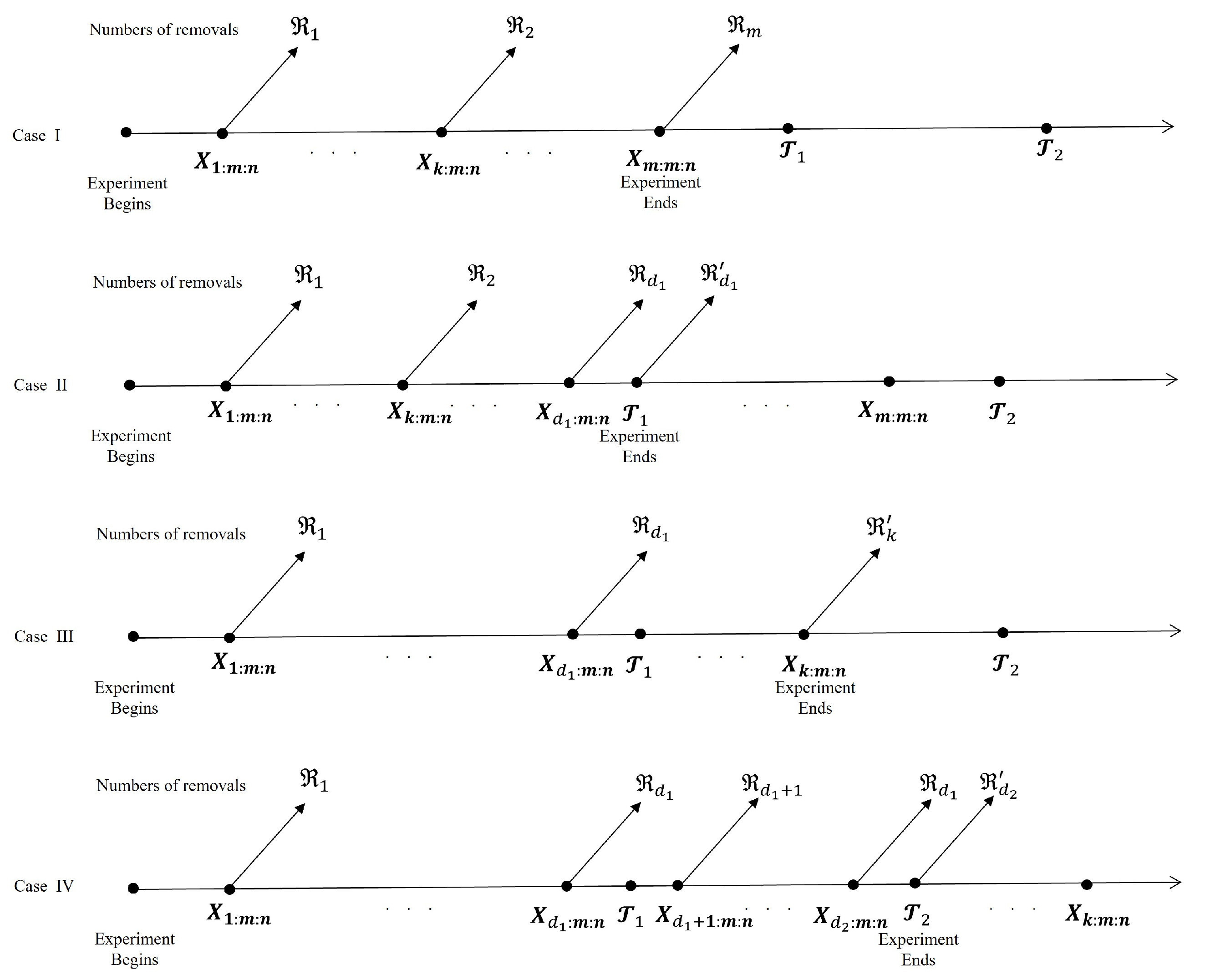
Using the PrgCS, ComGenPrHyCS can be described as follows. The and (), and integer m and k are pre-assigned (). Also, PrgCS are pre-assigned. Let denote the number of failures up to pre-assigned times , and be the observed value of , . When the 1st failure () is observed, randomly, the remaining units are eliminated from the reliability test. When the 2nd failure () is observed, randomly, the remaining units are eliminated from the reliability test and so on. If , finish the reliability test at (Case I). If , finish the reliability test by eliminating all remaining units at (Case II). If , finish the reliability test by eliminating all remaining units at (Case III). If , finish the reliability test by eliminating all remaining units at (Case IV). Briefly, there are four cases in ComGenPrHyCS (Figure 3) as follow:
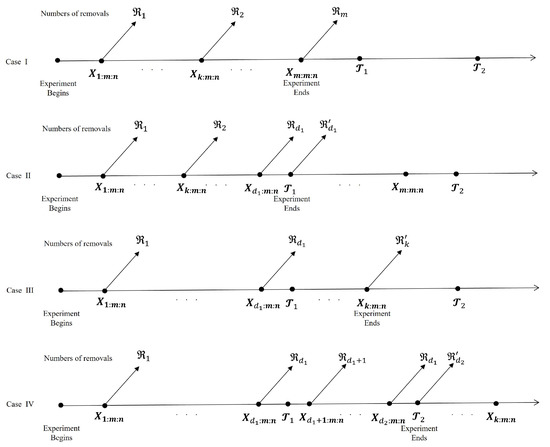
Figure 3.
Schematic representation of ComGenPrHyCS.
Case I: , if .
Case II: , if .
Case III: , if .
Case IV: , if .
Here, , and are not observed for Case II. For Case IV, , and are not observed.
This ComGenPrHyCS combined the GenTPrHyCS and GenTPrHyCS. It is clear that the proposed ComGenPrHyCS includes a second termination time in addition to and the second number k in addition to m in order to provide more flexibility than the GenTPrHyCS and GenTPrHyCS, also to have more observations that will develop the inference. Under ComGenPrHyCS, we can assure that the reliability test would be finished at most in time . Here, the denotes the longest test time that the tester is willing to grant the reliability test to continue.
3. Inference
3.1. Conditional Maximum Likelihood Estimator
Based on the four scenarios, as explained in the Section 2, the likelihood function () of ComGenPrHyCS can be derived as;
where for Case II, for Case III, and for Case IV. Here, the MLE does not exist when . In order to estimate MLE, the inference results that follow are conditional on .
A random variable X is said to have a ExpD with parameter if its PDF is given by
The corresponding CDF and reliability function are given, respectively, as
3.2. Exact Inference for Conditional MLE
The following Lemma 1 (Ref. [14]) is used to derive the explicit form of the CondMGF of .
Lemma 1.
Let where , and let X denote the absolutely continuous random variable with PDF and CDF . Then for , we have
where ; , . Here, assume that and .
Lemma 2.
(a) The conditional joint density of given , is
where .
(b) For , the conditional joint density of given and , is
(c) For and , the conditional joint density of given and , is
(d) For , the conditional joint density of given , is
Proof.
From Equation (1), Lemma 2 (a) and Lemma 2 (c) are straightforward. Lemma 2 (b) is derived by writing the event as and integrating with respect to (from to ∞) in the joint density function obtained from Equation (1). Lemma 2 (d) is derived by writing the event as and integrating with respect to (from to ∞) in the joint density function obtained from Equation (1). □
Theorem 1.
Conditional on , the CondMGF of is given by
where , , and .
Proof.
Theorem 2.
With conditional , the conditional PDF of is given by
where , and .
Proof.
From Theorem 1, the CondMGF of is given by
Because is the MGF of at , where Y is a gamma random variable with PDF , the theorem readily follows. □
Corollary 1.
Conditional on , the expectation and MSE of are given by
Theorem 3.
Conditional on , it can be explained as
where , and .
Proof.
Let
Then,
In order to derive a lower confidence bound (LowCB) for , the expression for , which is presented in the Theorem 3, is needed. Here, suppose that is an increasing function of . Then, a LowCB for is . Similarly, a ConfItv for is , where and satisfy the equations and , respectively. is the observed value of . □
4. Example and Simulation Results
4.1. Example
A PrgCD generated from the failure times (number of cycles in 1000 times) of 18 ball bearings (Ref. [15]) is used to explain the inference for . Table 1 represents the PrgCD generated from the failure times (number of cycles in 1000 times) of 18 ball bearings. We use the Kolmogorov–Smirnov test to test if this data set fits the ExpD or not. The p-value for this test is 0.9715 and it shows that this data fits the ExpD.

Table 1.
Failure times of 18 ball bearings.
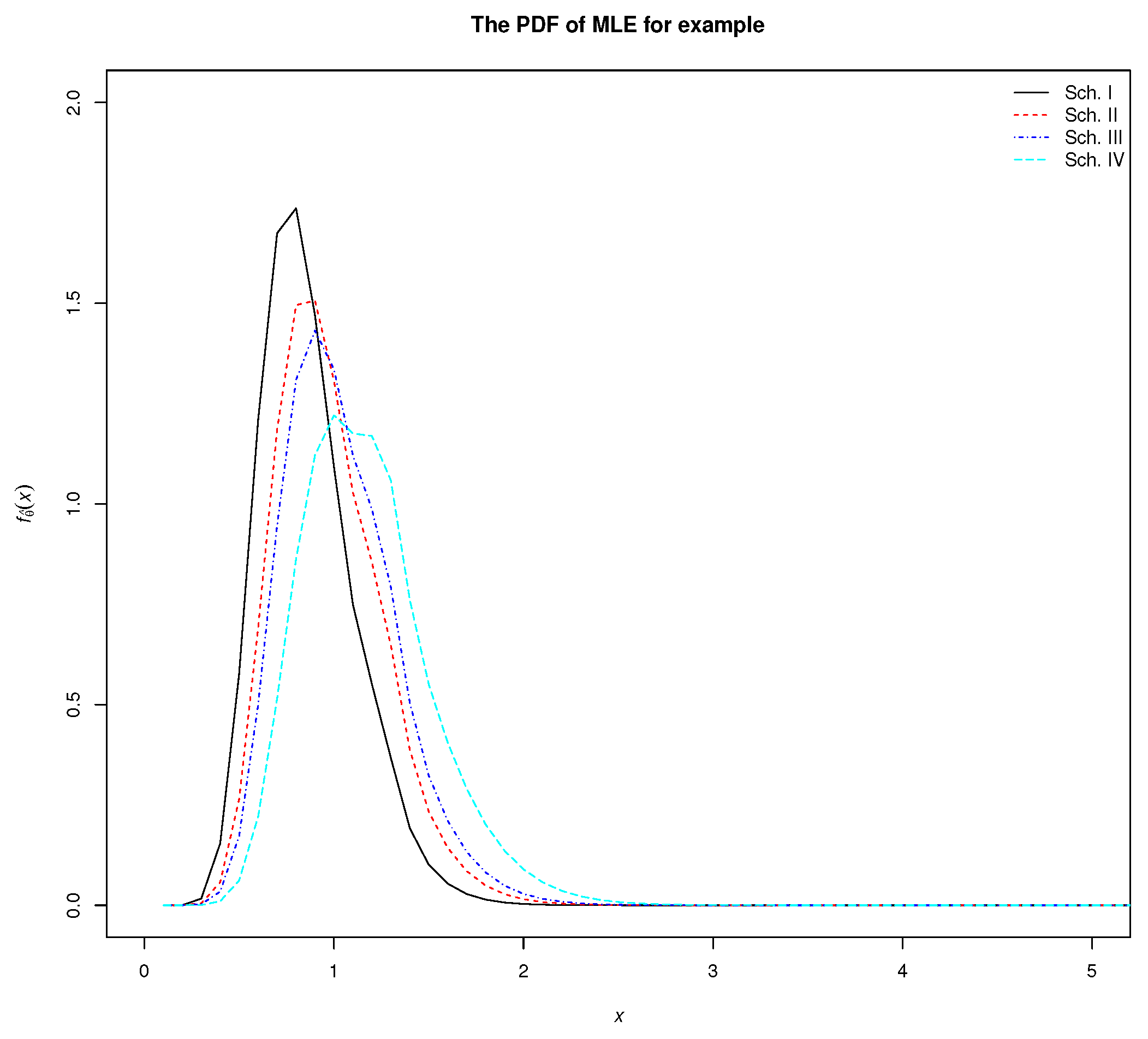
In this example, we take , , (Sch. I), , , (Sch. II), , , (Sch. III) and , , (Case IV). Table 2 presents the MLE, MSE, and SE calculated from Equation (5) and Corollary 1. Also, we have contained the ConfItv for of ComGenPrHyCS. Using breakdown data, the PDF of ComGenPrHyCS is presented in Figure 4. It can be seen that PDF of MLE for ExpD under new censoring scheme is almost symmetrical.
Table 2.
Inference for .
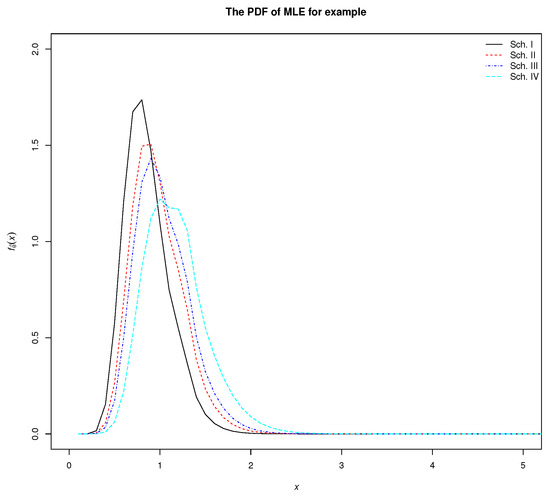
Figure 4.
The PDF of MLE for example.
4.2. Simulation Results
We consider various ComGenPrHyCS(n, m, k, , and ). Also, we have used four PrgCSs as; Sch. I: and . Sch. II: and . Sch. III: and . Sch. IV: and . For four different PrgCSs, we generate PrgCD. If (Case I), the combined generalized progressive hybrid censored data (ComGenPrHyCD) is . If (Case II), we find such that , and the ComGenPrHyCD is . If (Case III), the ComGenPrHyCD is . If (Case IV), we find such that , and the ComGenPrHyCD is .
In each case, we take . In each ComGenPrHyCS, we reiterate the procedure 1000 times. We calculate the average biases, MSEs, ConfLen, and Cov% of . The results are presented in Table 3 and Table 4. And, the simulation code is presented in Appendix A.
Table 3.
The MSE and bias of under ComGenPrHyCS.
Table 4.
The Cov% and ConfLen of under ComGenPrHyCS.
From Table 3, the ConfLen decrease as n increases. For fixed n, generally, the ConfLen decrease as m increases. For fixed n and m, generally, the ConfLen decreases as the increases. For fixed n, m, and , generally, the ConfLen decreases as the increases. The Cov% is close to their corresponding nominal levels as the n, m, , and increase. Also, the Sch. I has smaller ConfLen than the Sch. II, III, and IV.
From Table 4, the MSEs decrease as n(sample size) increases. For fixed n, generally, the MSEs and biases decrease as m(PrgCD size) increases. For fixed n and m, generally, the MSEs and biases decrease as increases. For fixed n, m and , generally, the MSEs and biases decrease as the increases. That is, when n, m, , and grow, is all closer to the true value. Also, the Sch. I has smaller MSE and bias than the Sch. II, III, and IV. When n, k, m and are fixed, no specific pattern is observed with the increasing of . This is understandable because for some ComGenPryHyCS, the observed data may remain unchanged with the increasing of .
5. Conclusions, Limitations, and Future Research
GenTPrHyCS and GenTPrHyCS are very complex due to the large number of parameters used to specify the censoring procedure. Therefore, in this paper, we consider a more general and more complex new censoring scheme—ComGenPrHyCS. Using the ComGenPrHyCS, we prove the exact distribution of the conditional MLE and CondMGF of the conditional MLE for the mean of the ExpD under ComGenPrHyCS. We then derive exact ConfItv for the mean of the ExpD under ComGenPrHyCS.
Consequently, the MSEs, biases, and ConfLen decrease as n increases. For fixed n, generally, the MSEs, biases and ConfLen decrease as m increases. For fixed n and m, generally, the MSEs, biases and ConfLen decrease as the increases. For fixed n, m and the , generally, the MSEs, biases, and ConfLen decrease as the increases. Also, the Sch. I has smaller MSE, biases, and ConfLen than the Sch. II, III and IV. The Cov% is close to their corresponding nominal levels as the n, m, , and increase. From the example data, it can be seen that PDF of MLE for ExpD under new censoring scheme is almost symmetrical.
Although we focused on the inference for scale parameter of the ExpD, the suggested ComGenPrHyCS can be extended to other distributions such as Rayleigh, Burr, and Weibull distributions. However, in these distributions, the exact distributions of the MLEs cannot be obtained.
Author Contributions
Conceptualization, K.L. and Y.S.; software, K.L. and Y.S.; supervision, K.L.; writing—original draft preparation, K.L. and Y.S.; writing—review and editing, K.L.; visualization, V; funding acquisition, K.L. All authors have read and agreed to the published version of the manuscript.
Funding
This research was supported by Deagu University Research Grant, 2020.
Institutional Review Board Statement
Not applicable.
Informed Consent Statement
Not applicable.
Data Availability Statement
The data is presented in the text.
Conflicts of Interest
The authors declare no conflict of interest.
Abbreviations
The following abbreviations are used in this manuscript:
| GenTPrHyCS | generalized type I progressive hybrid censoring scheme |
| GenTPrHyCS | generalized type II progressive hybrid censoring scheme |
| ComGenPrHyCS | combined generalized progressive hybrid censoring scheme |
| ExpD | exponential distribution |
| MLE | maximum likelihood estimator |
| CondMGF | conditional moment generating function |
| ConfItv | confidence intervals |
| PrgCS | progressive censoring scheme |
| PrgCD | progressive censored data |
| ConfLen | confidence length |
| Cov% | coverage percentage |
| MSE | mean squared error |
| LowCB | lower confidence bound |
| ComGenPrHyCD | combined generalized progressive hybrid censored data |
Appendix A. Simulation Code
c100<-function(d){
cc<-NA;
for(j in 1:d){ RR<-NA;
for(k1 in j:m){RR[k1]<-R[k1]+1}
cc[j]<-sum(RR)
}
prod(cc)
}
c1<-function(i,d){
cc1<-NA;
for(j in 1:i){ RR1<-NA;
for(k1 in (d-i+1):(d-i+j)){
RR1[k1]<-R[k1]+1
}
cc1[j]<-sum(RR1)
}
prod(cc1)
}
⋮
q<-function(th){exp(-T/th)}
ff1<-function(th){1/k*q(th)^c3(1)*(th^2+T^2*c3(1)^2/k)}
ff2<-function(th){c100(1)/k*(q(th)^c3(2)/c2(0,1)*(th^2+T^2*c3(2)^2/k)-q(th)
^c3(1)/c1(1,1)*(th^2+T^2*c3(1)^2/k))}
⋮
ff7<-function(th){
ee2<-NA;
for(d in 2:(k-1)){
ee2[d]<-c100(d)/k*(ff3(d,th)+ff5(d,th)+ff6(d,th))
}
sum(ee2)
}
⋮
gg7<-function(th){
ee4<-NA;
for(d in k:(m-1)){
ee4[d]<-c100(d)/d*(gg3(d,th)+gg5(d,th)+gg6(d,th))
}
sum(ee4)
}
⋮
gg12<-function(th){
c100(m)/m*(gg8(th)+gg10(th)+gg11(th))
}
fff1<-function(th){T/k*c3(1)*q(th)^c3(1)}
fff2<-function(th){T*c100(1)/k*(c3(2)*q(th)^c3(2)/c2(0,1)-c3(1)*q(th)^c3(1)
/c1(1,1))}
⋮
fff7<-function(th){
eee2<-NA;
for(d in 2:(k-1)){
eee2[d]<-T*c100(d)/k*(fff3(d,th)+fff5(d,th)+fff6(d,th))
}
sum(eee2)
}
⋮
ggg7<-function(th){
eee4<-NA;
for(d in k:(m-1)){
eee4[d]<-T*c100(d)/d*(ggg3(d,th)+ggg5(d,th)+ggg6(d,th))
}
sum(eee4)
}
⋮
ggg12<-function(th){T*c100(m)/m*(ggg8(th)+ggg10(th)+ggg11(th))}
n<-20;m<-18;k<-10;T1<-.5;T2<-1.2
R<-c(rep(0,17),2);SIR<-cumsum(R)
MSE<-NA;bias<-NA;cp<-NA;cl<-NA;
set.seed(1)
for(zz in 1:1000){
z<-NA;x<-NA;z<-rexp(m,1);x[1]<-z[1]/n
for(j in 1:(m-1)){x[j+1]<-z[j+1]/(n-SIR[j]-j)+x[j]}
D1 <- sum(x<T1);D2 <- sum(x<T2);
RRR1<-n-D1-sum(R[1:D1]);RRR2<-n-D2-sum(R[1:D2]);RRRk<-n-k-sum(R[1:(k-1)])
D<-ifelse(x[m]<T1,m,ifelse(x[k]<T1&x[m]>T1,D1,ifelse(x[k]>T1&x[k]<T2,k,D2)))
sumx<-NA;
for(i in 1:D){sumx[i]<-(1+R[i])*x[i]}
th[zz]<-ifelse(x[m]<T1,1/D*sum(sumx),
ifelse(x[k]<T1&x[m]>T1,1/D*(sum(sumx)+RRR1*T1),
ifelse(x[k]>T1&x[k]<T2,1/D*(sum(sumx)+RRRk*x[k]),1/D*(sum(sumx)+RRR2*T2))))
MSE[zz]<-ff1(th)+ff2(th)+ff7(th)+gg7(th)+gg12(th)
bias[zz]<-fff1(th)+fff2(th)+fff7(th)+ggg7(th)+ggg12(th)
}
References
- Balakrishnan, N.; Aggarwala, R. Progressive Censoring: Theory, Methods and Applications; Birkhauser: Boston, MA, USA, 2000. [Google Scholar]
- Cho, Y.; Sun, H.; Lee, K. Exact likelihood inference for an exponential parameter under generalized progressive hybrid censoring scheme. Stat. Methodol. 2015, 23, 18–34. [Google Scholar] [CrossRef]
- Lee, K.; Sun, H.; Cho, Y. Exact likelihood inference of the exponential parameter under generalized Type II progressive hybrid censoring. J. Korean Stat. Soc. 2016, 45, 123–136. [Google Scholar] [CrossRef]
- Cho, Y.; Sun, H.; Lee, K. Estimating the entropy of a Weibull distribution under generalized progressive hybrid censoring. Entropy 2015, 17, 102–122. [Google Scholar] [CrossRef]
- Wang, L. Inference for Weibull competing risks data under generalized progressive hybrid censoring. IEEE Trans. Reliab. 2018, 67, 998–1007. [Google Scholar] [CrossRef]
- Wang, L.; Li, H. Inference for exponential competing risks data under generalized progressive hybrid censoring. Commun. -Stat.-Simul. Comput. 2019, 51, 1–17. [Google Scholar] [CrossRef]
- Tu, J.; Gui, W. Bayesian Inference for the kumaraswamy distribution under generalized progressive hybrid censoring. Entropy 2020, 22, 1032. [Google Scholar] [CrossRef] [PubMed]
- Maswadah, M. Improved maximum likelihood estimation of the shape-scale family based on the generalized progressive hybrid censoring scheme. J. Appl. Stat. 2021, 49, 1–20. [Google Scholar] [CrossRef]
- Nagy, M.; Sultan, K.S.; Abu-Moussa, M.H. Analysis of the generalized progressive hybrid censoring from Burr Type-XII lifetime model. AIMS Math. 2021, 6, 9675–9704. [Google Scholar] [CrossRef]
- Singh, D.P.; Lodhi, C.; Tripathi, Y.M.; Wang, L. Inference for two-parameter Rayleigh competing risks data under generalized progressive hybrid censoring. Qual. Reliab. Eng. Int. 2021, 37, 1210–1231. [Google Scholar] [CrossRef]
- Zeng, X.; Gui, W. Statistical inference of truncated normal distribution based on the generalized progressive hybrid censoring. Entropy 2021, 23, 186. [Google Scholar] [CrossRef] [PubMed]
- Nagy, M.; Alrasheedi, A.F. Estimations of generalized exponential distribution parameters based on type I generalized progressive hybrid censored data. Comput. Math. Methods Med. 2022, 2022, 8058473. [Google Scholar] [CrossRef] [PubMed]
- Ma, H.; Yan, Z.; Jia, J. Multicomponent stress-strength model based on generalized progressive hybrid censoring scheme: A statistical analysis. Entropy 2022, 24, 619. [Google Scholar] [CrossRef] [PubMed]
- Balakrishnan, N.; Childs, A.; Chandrasekar, B. An efficient computational method for moments of order statistics under progressive censoring. Stat. Probab. Lett. 2002, 60, 359–365. [Google Scholar] [CrossRef]
- Lawless, J.F. Statistical Models and Methods for Lifetime Data; Wiley: New York, NY, USA, 1982. [Google Scholar]
Publisher’s Note: MDPI stays neutral with regard to jurisdictional claims in published maps and institutional affiliations. |
© 2022 by the authors. Licensee MDPI, Basel, Switzerland. This article is an open access article distributed under the terms and conditions of the Creative Commons Attribution (CC BY) license (https://creativecommons.org/licenses/by/4.0/).