


Abstract
This study uses an effective, recently extended Farlie–Gumbel–Morgenstern (EFGM) family to derive the distribution of concomitants of K-record upper values (CKRV). For this CKRV, the negative cumulative residual extropy (NCREX), weighted NCREX (WNCREX), negative cumulative extropy (NCEX), and weighted NCEX (WNCEX) are theoretically and numerically examined. This study presents several beautiful symmetrical and asymmetric relationships that these inaccuracy measurements satisfy. Additionally, empirical estimations are provided for these measures, and their visualizations enable users to verify their accuracy.
Keywords:
FGM family; concomitants; K-record values; weighted negative cumulative residual extropy; weighted negative cumulative extropy; non-parametric estimation MSC:
60B12; 62G30
1. Introduction
One of the most fundamental techniques in stochastic multivariate analysis is the concept of a family of multivariate distributions. Families of bivariate distributions with known marginals have drawn attention for many years. The Farlie–Gumbel–Morgenstern (FGM) family is regarded as one of the world’s first bivariate distribution families. When the FGM family turns into a copula (i.e., when the marginals are uniform), the correlation coefficient between the FGM family’s marginals reaches its minimum value of −0.33 and highest value of 0.33. The FGM distribution is, therefore, best suited for data with low correlation coefficients. Despite this constraining restriction, the FGM family has increasingly replaced conventional multivariate normal models in various applications and is now extensively used in several different fields. In a study by Ghosh et al. [1], the FGM family was applied to model the interdependence between environmental and biological variables. In another study by Shrahili and Alotaibi [2], variants of this copula were employed to simulate real-world datasets with symmetric characteristics.
Numerous modifications to the FGM copula that have been discussed in the literature aim to improve the correlation between the inner marginals. Ebaid et al. [3] presented the symmetric generalization of the FGM copula, and Barakat et al. [4] have since considered it. They discovered that the admissible range and correlation claims made by Ebaid et al. [3] were false. Barakat et al. [4] revised the copula’s allowable range. The symbol for this extension is EFGM, and it has a more straightforward function than many known generalizations of the FGM family, such as Bairamov–Kotz–Becki–FGM, Huang–Kotz FGM (see [5,6]), and iterated FGM (see Barakat and Husseiny, [7]). Recently, Abd Elgawad et al. [8] revealed and discussed some distributional traits of concomitants of order statistics (OSs) arising from the EFGM family. The work by Abd Elgawad et al. [8] is expanded upon in this research to include record values in the perspective of some recent information measures. The cumulative distribution function (CDF) and probability density function (PDF) of the EFGM family, denoted by EFGM are given, respectively, by (cf. [4])
and
where the marginals and are continuous, and . Barakat et al. [4] clarified that the natural parameter space (the admissible set of parameters c and d that ensure is a bonafide CDF) is convex. The set is given by where
Let be a set of independent random variables (RVs) with the same continuous CDF and PDF The observation is called an upper record value when for every A similar definition can be given for lower record values. Due to the rarity of upper record values, which restricts their use in various applications, we can switch to a more flexible model, which is record upper values (KRVs), where we can always expect the occurrence of KRVs more frequently than upper record values. Considering the KRV model, refer to Dziubdziela and Kopociński [9]. For a fixed the PDF of the Nth KRV is given by
where is the gamma function. For more details about this model and its applications, refer to [10,11,12,13].
Let a random bivariate sample have a common continuous CDF When the investigator is just interested in studying the sequence of records, of the first component the second component associated with the KRV of the first one is termed as the concomitant of that KRV, denoted by Several papers, including [14,15,16,17], discussed the PDF of CKRV This concomitant’s PDF is provided by
where is the conditional PDF of W, given T.
The extropy (EX) was proposed by Lad et al. [18]. Earlier in academic literature, EX was used to contrast with entropy. The EX refers to an organism’s intelligence, functional order, vitality, energy, life, experience, and capacity for growth and improvement. The EX of an RV T with PDF is defined as (see [18,19])
Qiu [20] reviewed several characterizations, as well as the EX-lower bounds for OSs and record values. Qiu and Jia [21] examined residual EX using OSs. Irshad et al. [22] refined the concept of past EX for concomitants of OSs from the FGM family. In addition, they studied the cumulative past EX and dynamic cumulative past EX for the concomitant of rth OS. There have been many studies of EX measures in conjunction with generalized OSs, such as Almaspoor et al. [23], Husseiny and Syam [24], and Husseiny et al. [25]. Additionally, Jahanshahi et al. [26] proposed a measure of uncertainty for RVs, known as cumulative residual extropy, abbreviated by CREX, which is given by
which is always negative. Consequently, the negative CREX (NCREX) shall be
Recently, Hashempour et al. [27] proposed a new information measure called weighted CREX (WCREX), which assigns more importance to large values of the considered RV, as well as EX and CREX; this measure is permanently negative and is defined by
Thus, the positive one would be called weighted negative cumulative residual extropy (WNCREX) and is expressed as
Also, a negative cumulative extropy (NCEX) has been introduced, similar to (7), by Tahmasebi and Toomaj [28]; that is,
Furthermore, Chaudhary et al. [29] investigated another new information measure called weighted negative cumulative extropy (WNCEX), which is defined by
Motivations of the Work
This study builds upon the work of Abd Elgawad et al. [8] regarding the OSs model, developing a significant parallel model about record values. Numerous real-world experiments lead to the concomitants of record values. These concomitants offer a practical and effective method for organizing and analyzing bivariate record data. One of the main motivations for this work is the practicality and realism of the KRV model, especially considering the rarity of record values. Another driving factor is the application of recent uncertainty measures to our model, which have broad implications across various scientific fields.
This paper is organized as follows: In Section 2, we derive the marginal distribution of CKRV based on the EFGM family and obtain the EX, NCREX, WNCREX, NCEX, and WNCEX for CKRV. In addition, in Section 3, numerical studies based on some well-known distributions are carried out. Moreover, Section 4 introduces the issue of non-parametric estimation of the mentioned measures through simulation studies. Finally, Section 5 presents the study’s conclusion.
2. CKRV Based on EFGM(c,d) and EX, with Some of Its Associated Measures
In this section, we derive the marginal distribution of CKRV based on the EFGM family. Moreover, the EX, NCREX, WNCREX, NCEX, and WNCEX for CKRV are obtained.
2.1. The Marginal Distribution of CKRV Based on EFGM(c,d)
In the next theorem, we obtain a useful representation for the PDF of We use the notation to signify that T is distributed as .
Theorem 1.
Let and Then
where
Proof.
Remark 1.
If in Theorem 1, we obtain the case of upper record values.
Remark 2.
When the value of K is large, we can use the approximation Moreover, when the value of N is large, we can use the approximation Finally, when both K and N are large, such that we have
Corollary 1.
By using Theorem 1, the marginal CDF of CKRV and its survival function satisfy the following two elegant symmetry relationships:
and
2.2. EX and Some of Its More Recent Related Measures
In this section, the measures EX, NCREX, WNCREX, NCEX, and WNCEX for CKRV based on EFGM are derived.
2.2.1. EX of CKRV for EFGM(c,d)
We can write in terms of the quantile function (QF). Let the QF be , then the quantile density function is given by where the derivative of is respect to u and is denoted by (i.e., ). Thus, is given by
where is the EX of and U is a uniformly distributed RV on .
Example 1.
Assume that the random vector follows the extended Weibull family (denoted by EWF). As mentioned in [30], the EWF has its CDF and PDF described as follows
respectively, where , τ is a vector of parameters, and is a non-negative, continuous, monotonically increasing, differentiable function of t, dependent on the parameter vector τ, such that as and as . is the derivative of . Using (18) in (1), the CDF of EFGM with EWF (denoted by EFGM-EWF) is given by
According to (17), the EX of is
Example 2.
2.2.2. NCREX of CKRV for EFGM(c,d)
Example 4.
Let follow EFGM.
2.2.3. WNCREX of CKRV for EFGM(c,d)
Using (9) and (16), the WNCREX of can be simply obtained as follows:
Then,
In addition, it can be written in terms of QF. Thus, the corresponding based on the QF is given by
Example 5.
Let T and W follow EFGM.
- Putting (i.e., ) in EFGM-EWF, we obtain EFGM with Rayleigh distribution marginals (denoted by EFGM-RD), which is given byTherefore, the WNCREX of would be
- Choosing (i.e., ), in EFGM- EWF, we obtain EFGM with Pareto type-I distribution marginals (denoted by EFGM-PID), as followsFurther, by using (27), we have
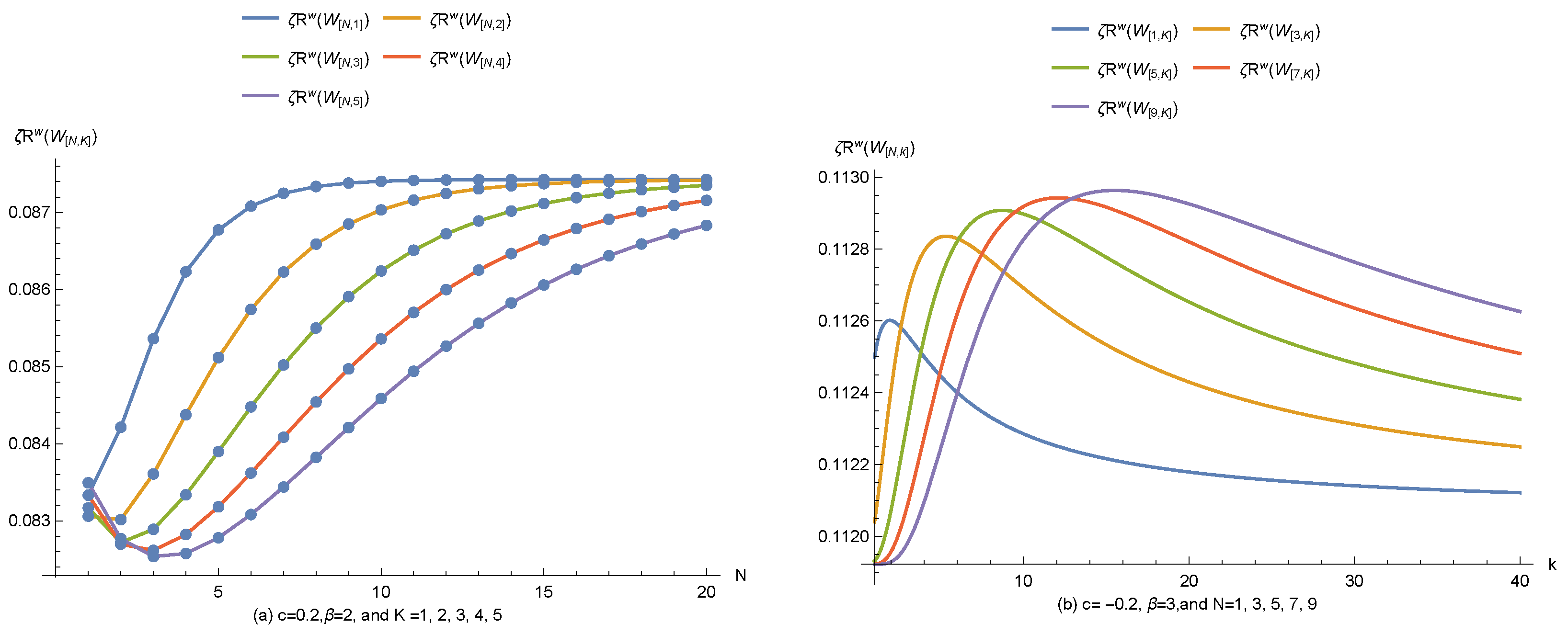
Figure 1a,b depicts the WNCREX of from EFGM-PFD for various values of N and K at The following properties can be extracted from Figure 1.
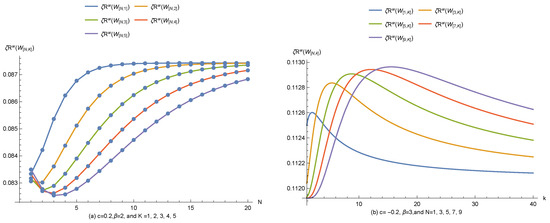
Figure 1.
WNCREX of from EFGM-PFD.
- 1.
- With fixed N, and the value of increases as K decreases (see Figure 1a) and stability occurs for large
- 2.
- For the fixed large the value of increases with the increasing N; see Figure 1b.
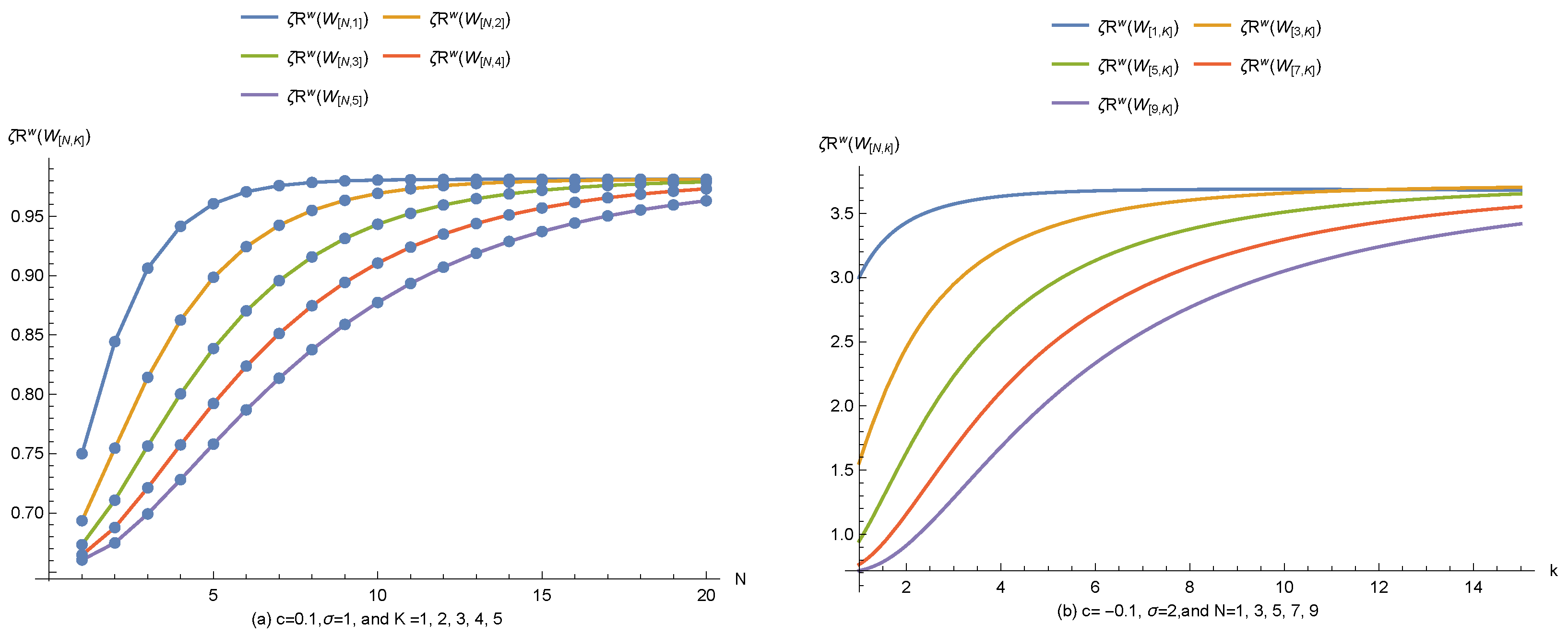
Figure 2a,b depicts the WNCREX of from EFGM-RD for various values of N and K at The following properties can be extracted from Figure 2.
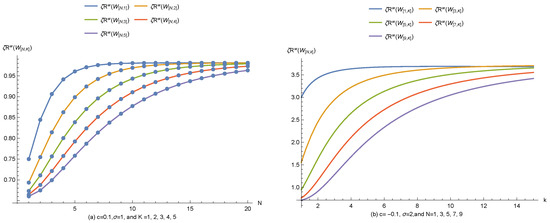
Figure 2.
WNCREX of from EFGM-RD.
- 1.
- Stability occurs for large N and see Figure 2a,b.
- 2.
- With fixed c and the values of are very near to each other as N and K rise.
2.2.4. NCEX of CKRV for EFGM(c,d)
We can calculate the NCEX of CKRV as follows:
Using (23) and simple algebra, we have
According to QF, is given by
Example 6.
Let T and W follow the EFGM family
2.2.5. WNCEX of CKRV for EFGM(c,d)
Similar to we can obtain of as
3. Numerical Study for the EX, NCREX, WNCREX, NCEX, and WNCEX
Table 1, Table 2, Table 3, Table 4, Table 5 and Table 6 display the EX, NCREX, and WNCREX of from EFGM. The following properties can be extracted:

Table 1.
EX in from the EFGM copula.
Table 2.
EX in from EFGM-ED at .
Table 3.
NCREX in based on EFGM copula.
Table 4.
NCREX in based on EFGM-ED at .
Table 5.
WNCREX in based on EFGM copula.
Table 6.
WNCREX in based on EFGM-ED at .
Table 1 displays the EX of from the EFGM copula.
- The value of at
- For large K (), and the value of increases as the value of N increases.
- For large K (), and the value of decreases as the value of N increases.
Table 2 displays the EX of based on EFGM-UD.
- For and large K (), the value of increases as the value of N increases along with the values of parameters as and
- For and large K (), the value of decreases as the value of N increases along with the values of parameters as , , , , and
NCREX in based on EFGM copula, NCREX in based on EFGM-ED, WNCREX in based on EFGM copula, and WNCREX in based on EFGM-ED all satisfy the same asymmetry properties extracted for EX in from EFGM-ED (Table 2).
Moreover, in the earlier version of this paper, we presented an extra four tables for NCEX in based on EFGM copula, NCEX in based on EFGM-ED, WNCEX in based on EFGM copula, and WNCEX in based on EFGM-ED. Responding to the reviewers’ comments about the excessive number of tables, we removed these extra tables, knowing that the same asymmetry properties, as extracted for EX in from EFGM-ED, also hold for these removed tables.
4. Non-Parametric Estimation of NCREX, WNCREX, NCEX, and WNCEX
In this section, we study the non-parametric estimators of NCREX, WNCREX, NCEX, and WNCEX of the CKRV, Furthermore, the mean and variance of the empirical measures (EMs) of the CKRV, are deduced. Let be a random sample from an absolutely continuous CDF and display the OSs of Then the EM of is given by
From (33) into (15), we have the EM of as
4.1. EM of NCREX in CKRV Based on EFGM(c,d)
According to (33), the EM of is given by
where are sample spacings. Thus, the expectation and variance of the empirical NCREX are given by
and
Example 8.
Example 9.
Let be a random sample from EFGM-ED with parameters and , respectively. Then, we have
and
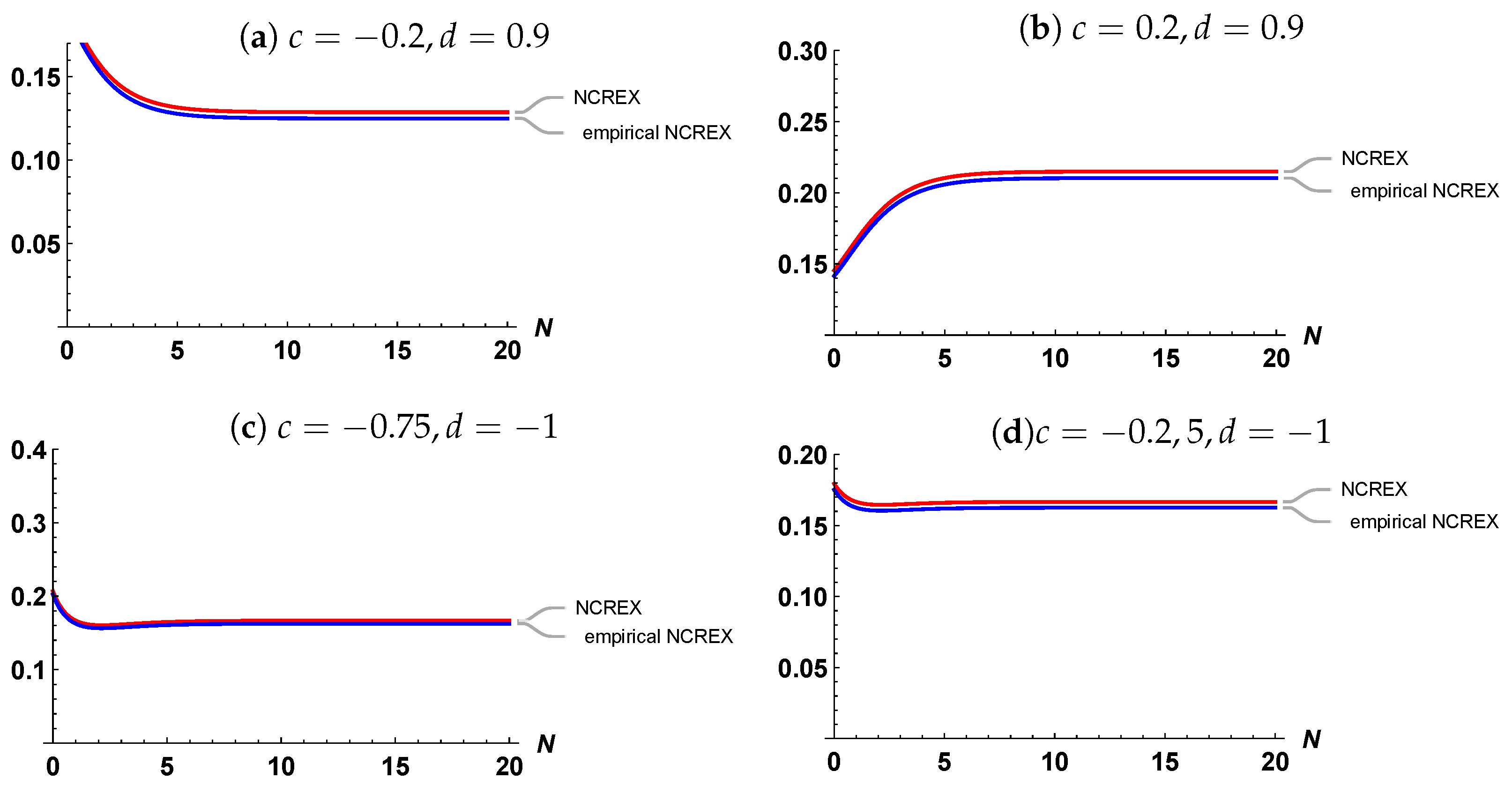
Figure 3 shows the relation between NCREX and the empirical NCREX in from EFGM-UD, at It can be extracted that, at any value of N, the values of NCREX are very close to the values of the empirical NCREX, as long as n is large.
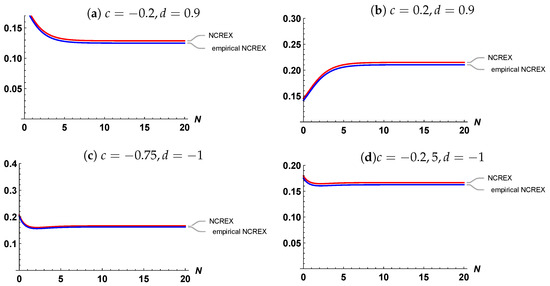
Figure 3.
Representation of NCREX and empirical NCREX based on from EFGM-UD.
Table 7 displays the values of and for the EFGM-ED model at and The following features can be extracted:
- With fixed N and and increase as c increases.
- With fixed N and and increase as increases.
Table 7.
and for EFGM-ED at and .
Table 7.
and for EFGM-ED at and .
| N | |||||||||
|---|---|---|---|---|---|---|---|---|---|
| 3 | 0.5 | 0.102492 | 0.107408 | 0.117768 | 0.123213 | 0.001551 | 0.001662 | 0.001911 | 0.002051 |
| 3 | 1 | 0.204985 | 0.214816 | 0.235537 | 0.246426 | 0.006204 | 0.006646 | 0.007643 | 0.008204 |
| 3 | 2 | 0.409970 | 0.429632 | 0.471073 | 0.492852 | 0.024818 | 0.026585 | 0.030574 | 0.032817 |
| 5 | 0.5 | 0.092915 | 0.102344 | 0.123384 | 0.134995 | 0.001350 | 0.001548 | 0.002056 | 0.002377 |
| 5 | 1 | 0.185829 | 0.204687 | 0.246767 | 0.269990 | 0.005400 | 0.006191 | 0.008222 | 0.009507 |
| 5 | 2 | 0.371659 | 0.409375 | 0.493535 | 0.539980 | 0.021598 | 0.024766 | 0.032889 | 0.038028 |
| 8 | 0.5 | 0.087208 | 0.099217 | 0.127056 | 0.142886 | 0.001238 | 0.001480 | 0.002154 | 0.002612 |
| 8 | 1 | 0.174415 | 0.198434 | 0.254113 | 0.285773 | 0.004954 | 0.005921 | 0.008616 | 0.010449 |
| 8 | 2 | 0.348831 | 0.396868 | 0.508226 | 0.571545 | 0.019815 | 0.023684 | 0.034463 | 0.041796 |
| 10 | 0.5 | 0.085830 | 0.098448 | 0.127985 | 0.144904 | 0.001212 | 0.001464 | 0.002179 | 0.002675 |
| 10 | 1 | 0.171660 | 0.196897 | 0.255971 | 0.289808 | 0.004850 | 0.005856 | 0.008717 | 0.010699 |
| 10 | 2 | 0.343320 | 0.393793 | 0.511941 | 0.579617 | 0.019399 | 0.023423 | 0.034869 | 0.042796 |
4.2. EM of WNCREX in CKRV Based on EFGM(c,d)
Example 10.
Let be a random sample from the EFGM family. Furthermore, let have a distribution with PDF According to Chakraborty et al. [31], has a standard UD. Furthermore, the RVs follow beta distribution with a mean and variance Thus,
and
Example 11.
Suppose is a random sample from the EFGM family. If has RD with PDF Then, the RVs follow the exponential distribution with a mean and variance Moreover, the mean and variance of are, respectively, given by
and
- Generally, with fixed N and and increase with increasing
- Generally, with fixed N and and increase with increasing .
Table 8.
and for EFGM-ED at and .
Table 8.
and for EFGM-ED at and .
| N | |||||||||
|---|---|---|---|---|---|---|---|---|---|
| 3 | 0.5 | 0.051246 | 0.053704 | 0.058884 | 0.061607 | 0.000388 | 0.000415 | 0.000478 | 0.000513 |
| 3 | 1 | 0.102492 | 0.107408 | 0.117768 | 0.123213 | 0.001551 | 0.001662 | 0.001911 | 0.002051 |
| 3 | 2 | 0.204985 | 0.214816 | 0.235537 | 0.246426 | 0.006204 | 0.006646 | 0.007643 | 0.008204 |
| 5 | 0.5 | 0.046457 | 0.051172 | 0.061692 | 0.067497 | 0.000337 | 0.000387 | 0.000514 | 0.000594 |
| 5 | 1 | 0.092915 | 0.102344 | 0.123384 | 0.134995 | 0.001350 | 0.001548 | 0.002056 | 0.002377 |
| 5 | 2 | 0.185829 | 0.204687 | 0.246767 | 0.269990 | 0.005400 | 0.006191 | 0.008222 | 0.009507 |
| 8 | 0.5 | 0.043604 | 0.049609 | 0.063528 | 0.071443 | 0.000310 | 0.000370 | 0.000538 | 0.000653 |
| 8 | 1 | 0.087208 | 0.099217 | 0.127056 | 0.142886 | 0.001238 | 0.001480 | 0.002154 | 0.002612 |
| 8 | 2 | 0.174415 | 0.198434 | 0.254113 | 0.285773 | 0.004954 | 0.005921 | 0.008616 | 0.010449 |
| 10 | 0.5 | 0.042915 | 0.049224 | 0.063993 | 0.072452 | 0.000303 | 0.000366 | 0.000545 | 0.000669 |
| 10 | 1 | 0.085830 | 0.098448 | 0.127985 | 0.144904 | 0.001212 | 0.001464 | 0.002179 | 0.002675 |
| 10 | 2 | 0.171660 | 0.196897 | 0.255971 | 0.289808 | 0.004850 | 0.005856 | 0.008717 | 0.010699 |
4.3. EM of NCEX in CKRV Based on EFGM(c,d)
Example 12.
Suppose that is a random sample from EFGM-UD with parameters 0 and 1. Thus,
and
Example 13.
Let be a random sample from EFGM-ED. Then, we have
and
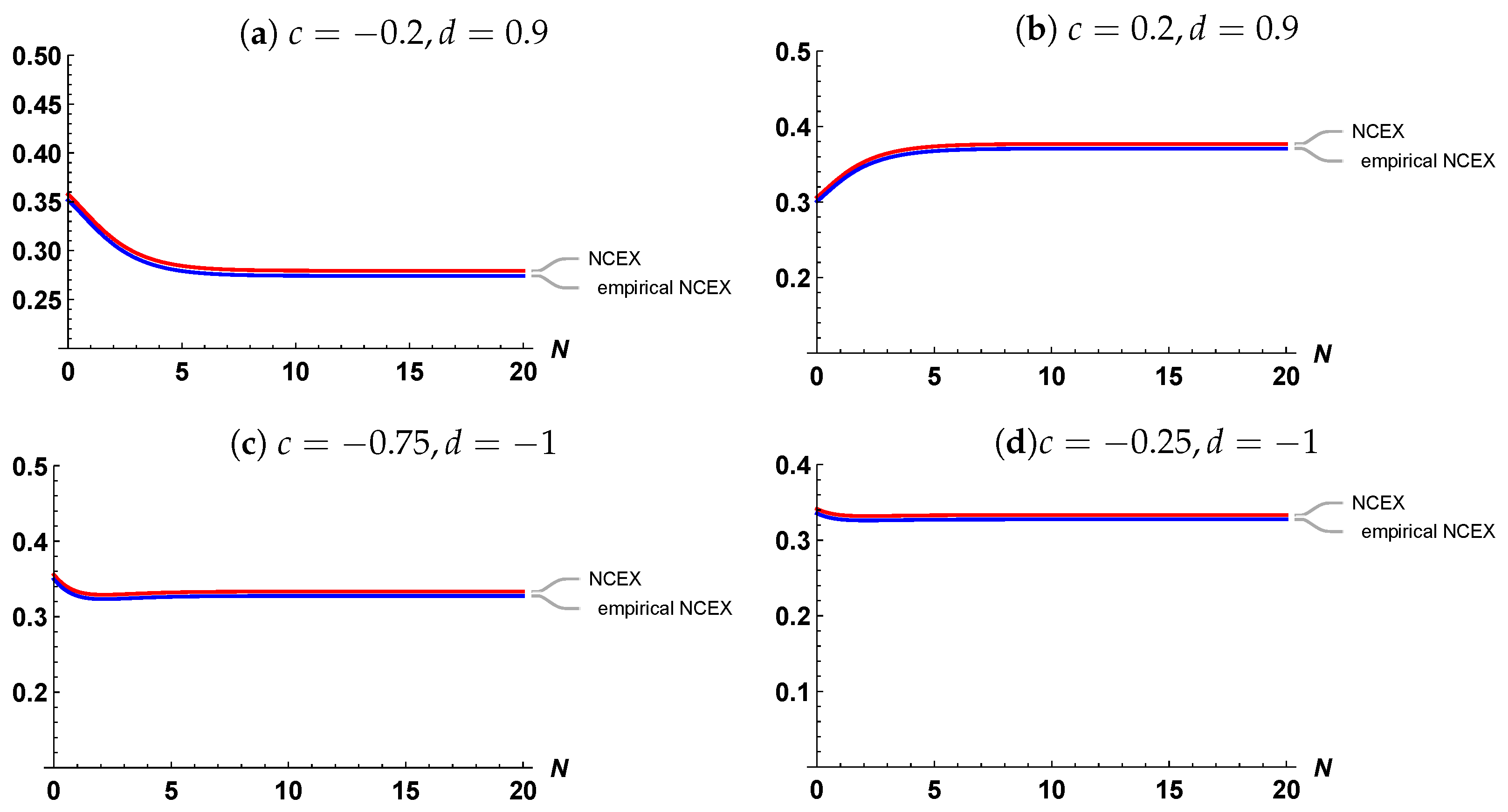
Figure 4 shows the relation between NCREX and the empirical NCEX in from EFGM-UD, at It can be concluded that NCREX and empirical NCREX have very similar values.
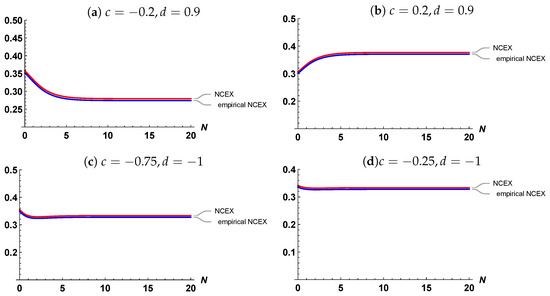
Figure 4.
Representation of NCEX and empirical NCEX based on from EFGM-UD.
Table 9 shows and for EFGM-ED at and It is observed that:
- At fixed N and and increase as the value of c increases.
- At fixed N and and increase as the value of increases.
Table 9.
and for EFGM-ED at and .
Table 9.
and for EFGM-ED at and .
| N | |||||||||
|---|---|---|---|---|---|---|---|---|---|
| 3 | 0.5 | 0.317745 | 0.327711 | 0.347113 | 0.356549 | 0.011409 | 0.012208 | 0.013878 | 0.014747 |
| 3 | 1 | 0.635491 | 0.655422 | 0.694226 | 0.713098 | 0.045635 | 0.048830 | 0.055513 | 0.058989 |
| 3 | 2 | 1.270980 | 1.310840 | 1.388450 | 1.426200 | 0.182540 | 0.195321 | 0.222053 | 0.235954 |
| 5 | 0.5 | 0.296643 | 0.317435 | 0.356837 | 0.375448 | 0.009847 | 0.011385 | 0.014774 | 0.016601 |
| 5 | 1 | 0.593286 | 0.634870 | 0.713675 | 0.750895 | 0.039389 | 0.045538 | 0.059097 | 0.066403 |
| 5 | 2 | 1.186570 | 1.269740 | 1.427350 | 1.501790 | 0.157557 | 0.182153 | 0.236388 | 0.265614 |
| 8 | 0.5 | 0.282818 | 0.310796 | 0.362931 | 0.387088 | 0.008918 | 0.010875 | 0.015356 | 0.017820 |
| 8 | 1 | 0.565635 | 0.621591 | 0.725862 | 0.774177 | 0.035674 | 0.043501 | 0.061424 | 0.071280 |
| 8 | 2 | 1.131270 | 1.243180 | 1.451720 | 1.548350 | 0.142696 | 0.174003 | 0.245696 | 0.285121 |
| 10 | 0.5 | 0.279318 | 0.309126 | 0.364441 | 0.389948 | 0.008695 | 0.010750 | 0.015503 | 0.018129 |
| 10 | 1 | 0.558636 | 0.618252 | 0.728881 | 0.779895 | 0.034780 | 0.042999 | 0.062010 | 0.072515 |
| 10 | 2 | 1.117270 | 1.236500 | 1.457760 | 1.559790 | 0.139120 | 0.171997 | 0.248041 | 0.290061 |
4.4. EM of WNCEX in CKRV Based on EFGM(c,d)
Based on (11), the EM of is given by
Using the CDF representation of CKRV that is established in (15) and substituting into (37), the empirical measure of can be calculated as
Example 14.
Assume is a random sample from the EFGM family and the RV follows a distribution with the PDF Therefore, we obtain
and
Example 15.
Suppose is a random sample from the EFGM family. If the RV follows the Rayleigh distribution with the PDF then, we have
and
Table 10 clarifies a numerical application of Example 15 at and and some distinct values of the parameters and It is apparent that
- For fixed N and and increase as c increases.
- For fixed N and and increase as increases.
Table 10.
and for EFGM-ED at , , and .
Table 10.
and for EFGM-ED at , , and .
| N | |||||||||
|---|---|---|---|---|---|---|---|---|---|
| 3 | 0.5 | 0.158873 | 0.163855 | 0.173556 | 0.178275 | 0.002852 | 0.003052 | 0.003470 | 0.003687 |
| 3 | 1 | 0.317745 | 0.327711 | 0.347113 | 0.356549 | 0.011409 | 0.012208 | 0.013878 | 0.014747 |
| 3 | 2 | 0.635491 | 0.655422 | 0.694226 | 0.713098 | 0.045635 | 0.048830 | 0.055513 | 0.058989 |
| 5 | 0.5 | 0.148321 | 0.158718 | 0.178419 | 0.187724 | 0.002462 | 0.002846 | 0.003694 | 0.004150 |
| 5 | 1 | 0.296643 | 0.317435 | 0.356837 | 0.375448 | 0.009847 | 0.011385 | 0.014774 | 0.016601 |
| 5 | 2 | 0.593286 | 0.634870 | 0.713675 | 0.750895 | 0.039389 | 0.045538 | 0.059097 | 0.066403 |
| 8 | 0.5 | 0.141409 | 0.155398 | 0.181465 | 0.193544 | 0.002230 | 0.002719 | 0.003839 | 0.004455 |
| 8 | 1 | 0.282818 | 0.310796 | 0.362931 | 0.387088 | 0.008918 | 0.010875 | 0.015356 | 0.017820 |
| 8 | 2 | 0.565635 | 0.621591 | 0.725862 | 0.774177 | 0.035674 | 0.043501 | 0.061424 | 0.071280 |
| 10 | 0.5 | 0.139659 | 0.154563 | 0.182220 | 0.194974 | 0.002174 | 0.002687 | 0.003876 | 0.004532 |
| 10 | 1 | 0.279318 | 0.309126 | 0.364441 | 0.389948 | 0.008695 | 0.010750 | 0.015503 | 0.018129 |
| 10 | 2 | 0.558636 | 0.618252 | 0.728881 | 0.779895 | 0.034780 | 0.042999 | 0.062010 | 0.072515 |
5. Conclusions
Despite the fact that the EFGM family is as efficient as many other generalizations of the FGM family in terms of correlation level, its flexibility, and usability render it superior to many of these generalizations. Owing to this advantage, most PDFs in this paper are linear functions of other simpler distributions. This study has yielded useful representations of the PDF, CDF, and survival function of CKRV, along with some elegant symmetry relationships between them.
EX and its more recent related measures for CKRV were derived from the EFGM family, where a numerical study was carried out to reveal some features of these measures. Also, the QF based on these measures was derived. In addition, we derived non-parametric estimators of NCREX, WNCREX, NCEX, and WNCEX. An empirical analysis of the NCREX and NCEX has produced distinct results.
Author Contributions
Conceptualization, M.A.A.E., H.M.B., M.A.A., I.A.H., A.F.H. and N.A.; Methodology, M.A.A.E., H.M.B., M.A.A., D.A.A.E.-R., I.A.H., A.F.H. and N.A.; Software, M.A.A.E., D.A.A.E.-R., I.A.H., A.F.H. and N.A.; Validation, M.A.A.E., H.M.B., M.A.A., D.A.A.E.-R., I.A.H., A.F.H. and N.A.; Formal analysis, H.M.B., M.A.A., D.A.A.E.-R., I.A.H., A.F.H. and N.A.; Investigation, M.A.A.E., H.M.B., M.A.A., I.A.H., A.F.H. and N.A.; Resources, M.A.A.E., H.M.B., M.A.A., D.A.A.E.-R., I.A.H., A.F.H. and N.A.; Data curation, M.A.A.E., H.M.B., M.A.A., I.A.H., A.F.H. and N.A.; Writing—original draft, M.A.A.E., D.A.A.E.-R. and A.F.H.; Writing—review & editing, M.A.A.E., M.A.A., D.A.A.E.-R., I.A.H. and N.A.; Visualization, H.M.B. All authors have read and agreed to the published version of this manuscript.
Funding
This work was supported and funded by the Deanship of Scientific Research at Imam Mohammad Ibn Saud Islamic University (IMSIU) (grant number IMSIU-RG23114).
Data Availability Statement
The data used to support the findings of this study are available within the article.
Acknowledgments
The authors would like to express their sincere gratitude to the anonymous reviewers for their insightful comments and recommendations that raised the caliber of this paper.
Conflicts of Interest
The authors declare that they have no competing interests.
Abbreviations
| RVs | random variables |
| CDF | cumulative distribution function |
| probability density function | |
| QF | quantile function |
| FGM | Farlie–Gumbel–Morgenstern |
| EFGM | extended Farlie–Gumbel–Morgenstern |
| OSs | order statistics |
| KRVs | K-record upper values |
| EX | extropy |
| CREX | cumulative residual extropy |
| CKRV | K-record upper values |
| NCREX | negative cumulative residual extropy |
| WNCREX | weighted negative cumulative residual extropy |
| NCEX | negative cumulative extropy |
| WNCEX | weighted negative cumulative extropy |
| EFGM-UD | EFGM family with uniform marginals |
| EFGM-ED | EFGM family with exponential marginals |
| EFGM-PFD | EFGM family with power function distribution marginals |
| EFGM-PID | EFGM family with Pareto type-I distribution marginals |
References
- Ghosh, S.; Sheppard, L.W.; Holder, M.T.; Loecke, T.D.; Reid, P.C.; Bever, J.D.; Reuman, D.C. Copulas and their potential for ecology. Adv. Ecol. Res. 2020, 62, 409–468. [Google Scholar]
- Shrahili, M.; Alotaibi, N. A new parametric life family of distributions: Properties, copula and modeling failure and service times. Symmetry 2020, 12, 1462. [Google Scholar] [CrossRef]
- Ebaid, R.; Elbadawy, W.; Ahmed, E.; Abdelghaly, A. A new extension of the FGM copula with an application in reliability. Comm. Statist. Theory Meth. 2022, 51, 2953–2961. [Google Scholar] [CrossRef]
- Barakat, H.M.; Alawady, M.A.; Husseiny, I.A.; Abd Elgawad, M.A. A more flexible counterpart of a Huang-Kotz’s copula-type. Comptes Rendus Acad. Bulg. Sci. 2022, 75, 952–958. [Google Scholar] [CrossRef]
- Bairamov, I. New generalized Farlie-Gumbel-Morgenstern distributions and concomitants of order statistics. J. Appl. Statist. 2001, 28, 521–536. [Google Scholar] [CrossRef]
- Mohamed, M.S. On concomitants of ordered random variables under general forms of Morgenstern family. Filomat 2019, 33, 2771–2780. [Google Scholar] [CrossRef]
- Barakat, H.M.; Husseiny, I.A. Some information measures in concomitants of generalized order statistics under iterated Farlie-Gumbel-Morgenstern bivariate type. Quaest. Math. 2021, 44, 581–598. [Google Scholar] [CrossRef]
- Abd Elgawad, M.A.; Barakat, H.M.; Abd El-Rahman, D.A.; Alyami, S.A. Scrutiny of a more flexible counterpart of Huang-Kotz-FGM-distributions in the perspective of some information measures. Symmetry 2023, 15, 1257. [Google Scholar] [CrossRef]
- Dziubdziela, W.; Kopociński, B. Limiting properties of the k-th record values. Appl. Math. 1976, 2, 187–190. [Google Scholar] [CrossRef]
- Aly, A.E. Prediction of the exponential fractional upper record-values. Math. Slovaca 2022, 72, 491–506. [Google Scholar] [CrossRef]
- Alawady, M.A.; Barakat, H.M.; Mansour, G.M.; Husseiny, I.A. Information measures and concomitants of k-record values based on Sarmanov family of bivariate distributions. Bull. Malays. Math. Sci. Soc. 2023, 46, 9. [Google Scholar] [CrossRef]
- Berred, M. K-record values and the extreme-value index. J. Stat. Plann. Inf. 1995, 45, 49–63. [Google Scholar] [CrossRef]
- Fashandi, M.; Ahmadi, J. Characterizations of symmetric distributions based on Renyi entropy. Statist. Probab. Lett. 2012, 82, 798–804. [Google Scholar] [CrossRef]
- Bdair, O.M.; Raqab, M.Z. Mean residual life of kth records under double monitoring. Bull. Malays. Math. Sci. Soc. 2014, 37, 457–464. [Google Scholar]
- Chacko, M.; Shy Mary, M. Concomitants of k-record values arising from Morgenstern family of distributions and their applications in parameter estimation. Stat. Papers 2013, 54, 21–46. [Google Scholar] [CrossRef]
- Chacko, M.; Muraleedharan, L. Inference based on k-record values from generalized exponential distribution. Statistica 2018, 78, 37–56. [Google Scholar]
- Thomas, P.Y.; Anne, P.; Veena, T.G. Characterization of bivariate distributions using concomitants of generalized (k) record values. Statistica 2014, 74, 431–446. [Google Scholar]
- Lad, F.; Sanfilippo, G.; Agro, G. Extropy: Complementary dual of entropy. Stat. Sci. 2015, 30, 40–58. [Google Scholar] [CrossRef]
- Husseiny, I.A.; Barakat, H.M.; Mansour, G.M.; Alawady, M.A. Information measures in records and their concomitants arising from Sarmanov family of bivariate distributions. J. Comp. Appl. Math. 2022, 408, 114120. [Google Scholar] [CrossRef]
- Qiu, G. The extropy of order statistics and record values. Stat. Probab. Lett. 2017, 120, 52–60. [Google Scholar] [CrossRef]
- Qiu, G.; Jia, K. The residual extropy of order statistics. Stat. Probab. Lett. 2018, 133, 15–22. [Google Scholar] [CrossRef]
- Irshad, M.R.; Archana, K.; Al-Omari, A.I.; Maya, R.; Alomani, G. Extropy based on concomitants of order statistics in Farlie-Gumbel-Morgenstern Family for random variables representing past life. Axioms 2023, 12, 792. [Google Scholar] [CrossRef]
- Almaspoor, Z.; Tahmasebi, S.; Jafari, A.A. Measures of extropy for concomitants of generalized order statistics in Morgenstern family. J. Stat. Theory Appl. 2021, 21, 1–20. [Google Scholar] [CrossRef]
- Husseiny, I.A.; Syam, A.H. The extropy of concomitants of generalized order statistics from Huang-Kotz-Morgenstern bivariate distribution. J. Math. 2022, 6385998. [Google Scholar] [CrossRef]
- Husseiny, I.A.; Alawady, M.A.; Alyami, S.A.; Abd Elgawad, M.A. Measures of extropy based on concomitants of generalized order statistics under a general framework from iterated morgenstern family. Mathematics 2023, 11, 1377. [Google Scholar] [CrossRef]
- Jahanshahi, S.; Zarei, H.; Khammar, A. On cumulative residual extropy. Probab. Eng. Inf. Sci. 2020, 34, 605–625. [Google Scholar] [CrossRef]
- Hashempour, M.; Kazemi, M.R.; Tahmasebi, S. On weighted cumulative residual extropy: Characterization, estimation and testing. Statistics 2022, 56, 681–698. [Google Scholar] [CrossRef]
- Tahmasebi, S.; Toomaj, A. On negative cumulative extropy with applications. Commun. Stat. Theory Methods 2021, 51, 5025–5047. [Google Scholar] [CrossRef]
- Chaudhary, K.S.; Gupta, N.; Kumar Sahu, P. On general weighted cumulative residual extropy and general weighted negative cumulative extropy. Statistics 2023, 57, 1117–1141. [Google Scholar] [CrossRef]
- Jafari, A.A.; Almaspoor, Z.; Tahmasebi, S. General results on bivariate extended Weibull Morgenstern family and concomitants of its generalized order statistics. Ric. Mat. 2021, 1–22. [Google Scholar] [CrossRef]
- Chakraborty, S.; Das, O.; Pradhan, B. Weighted negative cumulative extropy with application in testing uniformity. Phys. A Stat. Mech. Appl. 2023, 624, 128957. [Google Scholar] [CrossRef]
Disclaimer/Publisher’s Note: The statements, opinions and data contained in all publications are solely those of the individual author(s) and contributor(s) and not of MDPI and/or the editor(s). MDPI and/or the editor(s) disclaim responsibility for any injury to people or property resulting from any ideas, methods, instructions or products referred to in the content. |
© 2023 by the authors. Licensee MDPI, Basel, Switzerland. This article is an open access article distributed under the terms and conditions of the Creative Commons Attribution (CC BY) license (https://creativecommons.org/licenses/by/4.0/).