

Skip Content
You are currently on the new version of our website. Access the old version .

Fermentation, Volume 5, Issue 2

2019 June - 22 articles

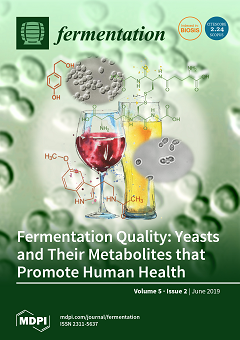
Cover Story: This review summarizes the import role that the alcoholic fermentation of certain Saccharomyces and non-Saccharomyces yeast strains plays in the production of metabolites that promote human health and, therefore, attract consumer attention and promote the consumption of fermented beverages. For instance, yeast metabolism produces compounds derived from tryptophan, melatonin, and serotonin, which are found in wine and beer. Moreover, some compounds, such as phenylethanol, can also act as natural preservatives in wine and beer to prevent spoilage. Fermented drinks can serve as vehicles for beneficial compounds that play an important role in human health, namely in the prevention of particular 21st century diseases. View this paper.
  • Issues are regarded as officially published after their release is announced to the table of contents alert mailing list .
  • You may sign up for email alerts to receive table of contents of newly released issues.
  • PDF is the official format for papers published in both, html and pdf forms. To view the papers in pdf format, click on the "PDF Full-text" link, and use the free Adobe Reader to open them.

Articles (22)

  • Article
  • Open Access
56 Citations
17,816 Views
18 Pages

Spent Yeast from Brewing Processes: A Biodiverse Starting Material for Yeast Extract Production

  • Friedrich Felix Jacob,
  • Lisa Striegel,
  • Michael Rychlik,
  • Mathias Hutzler and
  • Frank-Jürgen Methner

Spent yeast from beer manufacturing is a cost-effective and nutrient-rich starting material for the production of yeast extracts. In this study, it is shown how physiologically important ingredients in a yeast extract are influenced by the compositio...

  • Article
  • Open Access
35 Citations
11,697 Views
9 Pages

The basidiomycete brown rot fungus Neolentinus lepideus is capable of assimilating and fermenting lactose to ethanol with a conversion yield comparable to those of lactose-fermenting yeasts. The ability of the fungus to ferment lactose is not influen...

  • Article
  • Open Access
13 Citations
4,418 Views
11 Pages

The term biorefinery is related to the sustainable production of value-added bioproducts and bioenergy from biomass. Esters from fatty acids are important compounds synthesized from by-products of the oleochemical industry. In agreement with the bior...

  • Review
  • Open Access
32 Citations
12,534 Views
13 Pages

Most monosaccharides in nature are hexoses, which have six carbon atoms; the most well-known hexose is d-glucose. Various hexoses with distinct characteristics can be produced from inexpensive polysaccharides for applications in the food industry. Th...

  • Review
  • Open Access
44 Citations
17,931 Views
12 Pages

Non-Saccharomyces are important during wine fermentation once they influence wine composition. In the early stages of wine fermentation, and together with indigenous or commercial strains of Saccharomyces cerevisiae, non-Saccharomyces are able to tra...

  • Article
  • Open Access
9 Citations
8,206 Views
17 Pages

Previously, we developed a novel production technique for giant masu salmon (GMS). This study aimed to develop a fish sauce from GMS to explore ways to efficiently utilize the salmon and to enrich the fish sauce with γ-aminobutyric acid (GABA)...

  • Communication
  • Open Access
26 Citations
9,355 Views
8 Pages

Upgrading the Nutritional Value of Rice Bran by Solid-State Fermentation with Pleurotus sapidus

  • Alejandra B. Omarini,
  • Diana Labuckas,
  • María P. Zunino,
  • Romina Pizzolitto,
  • Marcelo Fernández-Lahore,
  • Damián Barrionuevo and
  • Julio A. Zygadlo

Solid-state fermentation (SSF) of rice bran (RB) employing the edible fungus Pleurotus sapidus was investigated as a process strategy to improve the nutritional quality of this low-cost and abundant substrate. During fermentation, samples were withdr...

  • Article
  • Open Access
17 Citations
6,213 Views
11 Pages

Koji, which is used for manufacturing Japanese traditional fermented foods, has long been safely used as a cosmetic product. Although its cosmetic effect has been empirically established, the underlying mechanism has not been reported. We and other g...

  • Review
  • Open Access
106 Citations
58,871 Views
17 Pages

Scientific and commercial interest of probiotics, prebiotics and their effect on human health and disease has increased in the last decade. The aim of this review article is to evaluate the role of pro- and prebiotics on the normal function of health...

  • Article
  • Open Access
10 Citations
8,614 Views
18 Pages

Conversion of Plant Secondary Metabolites upon Fermentation of Mercurialis perennis L. Extracts with two Lactobacteria Strains

  • Peter Lorenz,
  • Marek Bunse,
  • Simon Sauer,
  • Jürgen Conrad,
  • Florian C. Stintzing and
  • Dietmar R. Kammerer

Microbial fermentation of plant extracts with Lactobacteria is an option to obtain microbiologically stable preparations, which may be applied in complementary medicine. We investigated the metabolic conversion of constituents from Mercurialis perenn...

  • Article
  • Open Access
24 Citations
6,771 Views
10 Pages

Dry Anaerobic Digestion of Food and Paper Industry Wastes at Different Solid Contents

  • Anette T. Jansson,
  • Regina J. Patinvoh,
  • IIona Sárvári Horváth and
  • Mohammad J. Taherzadeh

A large volume of food is being wasted every year, while the pulp and paper industry also generate a large amount of solid wastes on a daily basis, causing environmental challenges around the world. Dry anaerobic digestion (AD) of these solid wastes...

  • Article
  • Open Access
8 Citations
7,052 Views
11 Pages

Lactic acid bacteria (LAB) alone or with special adjunct probiotic strains are inevitable for the preparation of specific functional foods. Moreover, because of their growth and metabolism, final products are preserved for a certain time. Thus, in th...

  • Article
  • Open Access
55 Citations
9,946 Views
10 Pages

Production and Purification of l-lactic Acid in Lab and Pilot Scales Using Sweet Sorghum Juice

  • Agata Olszewska-Widdrat,
  • Maria Alexandri,
  • José Pablo López-Gómez,
  • Roland Schneider,
  • Michael Mandl and
  • Joachim Venus

Sweet sorghum juice (SSJ) was evaluated as fermentation substrate for the production of l-lactic acid. A thermophilic Bacillus coagulans isolate was selected for batch fermentations without the use of additional nutrients. The first batch of SSJ (Bat...

  • Review
  • Open Access
15 Citations
17,657 Views
11 Pages

Yeast Life Span and its Impact on Food Fermentations

  • Agustín Aranda,
  • Helena Orozco,
  • Cecilia Picazo and
  • Emilia Matallana

Yeasts are very important microorganisms for food production. The high fermentative capacity, mainly of the species of the genus Saccharomyces, is a key factor for their biotechnological use, particularly to produce alcoholic beverages. As viability...

  • Article
  • Open Access
15 Citations
5,044 Views
14 Pages

The effects of various carbon sources and cultivation conditions on the growth kinetics, lipid accumulation, and medium-chain fatty acid (MCFA) production of Mucor circinelloides (MC) was investigated for 72 h in shake flask cultivation. Our previous...

  • Article
  • Open Access
12 Citations
5,982 Views
7 Pages

Capnophilic Lactic Fermentation from Thermotoga neapolitana: A Resourceful Pathway to Obtain Almost Enantiopure L-lactic Acid

  • Genoveffa Nuzzo,
  • Simone Landi,
  • Nunzia Esercizio,
  • Emiliano Manzo,
  • Angelo Fontana and
  • Giuliana d’Ippolito

The industrial production of lactic acid (LA) is mainly based on bacterial fermentation. This process can result in enantiopure or racemic mixture according to the producing organism. Between the enantiomers, L-lactic acid shows superior market value...

  • Article
  • Open Access
17 Citations
6,572 Views
13 Pages

A direct bioconversion of gelatinized starchy waste (GSW) to lactic acid by amylolytic lactic acid bacterium Lactobacillus plantarum S21 was investigated. Corn steep liquor (CSL) was selected as the most suitable low-cost nitrogen source for replacin...

  • Review
  • Open Access
41 Citations
10,792 Views
20 Pages

The undesirable effects of some hazardous compounds involved in the different steps of the winemaking process may pose health risks to consumers; hence, the importance of compliance with recent international food safety standards, including the Hazar...

  • Article
  • Open Access
19 Citations
6,691 Views
8 Pages

Optimized pH and Its Control Strategy Lead to Enhanced Itaconic Acid Fermentation by Aspergillus terreus on Glucose Substrate

  • Péter Komáromy,
  • Péter Bakonyi,
  • Adrienn Kucska,
  • Gábor Tóth,
  • László Gubicza,
  • Katalin Bélafi-Bakó and
  • Nándor Nemestóthy

Biological itaconic acid production can by catalyzed by Aspergillus terreus (a filamentous fungi) where the fermentation medium pH is of prominent importance. Therefore, in this work, we investigated what benefits the different pH regulation options...

  • Feature Paper
  • Article
  • Open Access
77 Citations
10,506 Views
23 Pages

Fungal pretreatment is a biological process that uses rotting fungi to reduce the recalcitrance and enhance the enzymatic digestibility of lignocellulosic feedstocks at low temperature, without added chemicals and wastewater generation. Thus, it has...

Get Alerted

Add your email address to receive forthcoming issues of this journal.

XFacebookLinkedIn
Fermentation - ISSN 2311-5637