


Skip Content
You are currently on the new version of our website. Access the old version .

Brain Sciences, Volume 9, Issue 3

2019 March - 26 articles

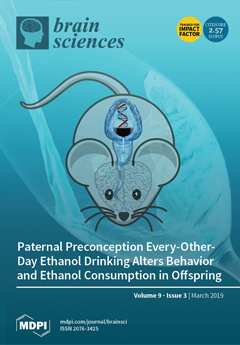
Cover Story: Alcohol use disorder (AUD) is a chronic relapsing brain disease with a lifetime prevalence of ~29%. AUD has devastating consequences for the affected individual and their families. In addition, the financial burden to society is enormous. While previous work has found that AUD has a high rate of heritability, DNA variants identified by genetic studies only explain a small amount of this heritability. Beeler et al. tested the hypothesis that alcohol-induced epigenetic changes contribute to the effects of alcohol across generations. Using an inbred mouse model, Beeler et al. demonstrated that paternal preconception voluntary alcohol drinking altered various behaviors and alcohol consumption in adult offspring. This study adds to a growing literature that one’s alcohol drinking behavior is impacted by ancestral alcohol exposure. Images used under license from Shutterstock.com. View this paper
  • Issues are regarded as officially published after their release is announced to the table of contents alert mailing list .
  • You may sign up for email alerts to receive table of contents of newly released issues.
  • PDF is the official format for papers published in both, html and pdf forms. To view the papers in pdf format, click on the "PDF Full-text" link, and use the free Adobe Reader to open them.

Articles (26)

  • Editorial
  • Open Access
3,539 Views
2 Pages

In this Special Issue we bring together papers demonstrating the need for both detailed genomic and phenotypic studies to aid our scientific and clinical understanding of neurogenetic disorders [...]

  • Article
  • Open Access
6 Citations
5,016 Views
7 Pages

Parkinsonism Risk Factors in Salt Lake City, Utah: A Community-Based Study

  • David Shprecher,
  • Nan Zhang,
  • Matthew Halverson and
  • Rodolfo Savica

Background: The prevalence of dream enactment behavior and other risk factors for a parkinsonian disorder is not well documented. Methods: A survey on prevalence of parkinsonism risk factors was designed using two validated instruments (REM behavior...

  • Article
  • Open Access
31 Citations
10,129 Views
7 Pages

The 10/20 electroencephalogram (EEG) measurements system often guides electrode placement for transcranial direct current stimulation (tDCS), a form of non-invasive brain stimulation. One targeted region of the brain is the primary motor cortex (M1)...

  • Review
  • Open Access
37 Citations
10,738 Views
17 Pages

Prosodic cues in speech are indispensable for comprehending a speaker’s message, recognizing emphasis and emotion, parsing segmental units, and disambiguating syntactic structures. While it is commonly accepted that prosody provides a fundament...

  • Review
  • Open Access
85 Citations
46,387 Views
20 Pages

Abnormal sensory-based behaviors are a defining feature of autism spectrum disorders (ASD). Dr. A. Jean Ayres was the first occupational therapist to conceptualize Sensory Integration (SI) theories and therapies to address these deficits. Her work wa...

  • Review
  • Open Access
3 Citations
6,674 Views
17 Pages

Sketching the Power of Machine Learning to Decrypt a Neural Systems Model of Behavior

  • Monique Ernst,
  • Joshua L. Gowin,
  • Claudie Gaillard,
  • Ryan T. Philips and
  • Christian Grillon

Uncovering brain-behavior mechanisms is the ultimate goal of neuroscience. A formidable amount of discoveries has been made in the past 50 years, but the very essence of brain-behavior mechanisms still escapes us. The recent exploitation of machine l...

  • Article
  • Open Access
20 Citations
6,461 Views
15 Pages

Dual Mode Gait Sonification for Rehabilitation After Unilateral Hip Arthroplasty

  • Julia Reh,
  • Tong-Hun Hwang,
  • Gerd Schmitz and
  • Alfred O. Effenberg

The pattern of gait after hip arthroplasty strongly affects regeneration and quality of life. Acoustic feedback could be a supportive method for patients to improve their walking ability and to regain a symmetric and steady gait. In this study, a new...

  • Review
  • Open Access
83 Citations
20,525 Views
20 Pages

Anxiety disorders that develop in adolescence represent a significant burden and are particularly challenging to treat, due in no small part to the high occurrence of relapse in this age group following exposure therapy. This pattern of persistent fe...

  • Review
  • Open Access
10 Citations
5,956 Views
15 Pages

Local and Relayed Effects of Deep Brain Stimulation of the Pedunculopontine Nucleus

  • Edgar Garcia-Rill,
  • Alan J. Tackett,
  • Stephanie D. Byrum,
  • Renny S. Lan,
  • Samuel G. Mackintosh,
  • James R. Hyde,
  • Veronica Bisagno and
  • Francisco J. Urbano

Our discovery of low-threshold stimulation-induced locomotion in the pedunculopontine nucleus (PPN) led to the clinical use of deep brain stimulation (DBS) for the treatment of disorders such as Parkinson’s disease (PD) that manifest gait and p...

  • Article
  • Open Access
10 Citations
4,896 Views
17 Pages

Prior work showed differential alterations in early somatosensory evoked potentials (SEPs) and improved motor learning while in acute tonic pain. The aim of the current study was to determine the interactive effect of acute tonic pain and early motor...

  • Article
  • Open Access
7 Citations
5,534 Views
12 Pages

Effect of Paired Associative Stimulation on Corticomotor Excitability in Chronic Smokers

  • Andrew P. Lavender,
  • Hiroki Obata,
  • Noritaka Kawashima and
  • Kimitaka Nakazawa

Chronic smoking has been shown to have deleterious effects on brain function and is an important risk factor for ischemic stroke. Reduced cortical excitability has been shown among chronic smokers compared with non-smokers to have a long-term effect...

  • Reply
  • Open Access
2 Citations
4,602 Views
4 Pages

Reply to “Dyslexia: Still Not a Neurodevelopmental Disorder”

  • Gorka Fraga González,
  • Iliana I. Karipidis and
  • Jurgen Tijms

In a recent opinion article, we explained why we think that defining developmental dyslexia as a neurodevelopmental disorder and neuroimaging studies on dyslexia are useful. A recent response has made some claims of generalized misinterpretation and...

  • Case Report
  • Open Access
3 Citations
5,614 Views
9 Pages

Endogenous Neurostimulation and Physiotherapy in Cluster Headache: A Clinical Case

  • Gonzalo Navarro-Fernández,
  • Lucía de-la-Puente-Ranea,
  • Marisa Gandía-González and
  • Alfonso Gil-Martínez

Objective: The aim of this paper is to describe the progressive changes of chronic cluster headaches (CHs) in a patient who is being treated by a multimodal approach, using pharmacology, neurostimulation and physiotherapy. Subject: A male patient, 42...

  • Article
  • Open Access
9 Citations
5,958 Views
13 Pages

Reasoning on Figurative Language: A Preliminary Study on Children with Autism Spectrum Disorder and Klinefelter Syndrome

  • Sergio Melogno,
  • Maria Antonietta Pinto,
  • Teresa Gloria Scalisi,
  • Margherita Orsolini,
  • Luigi Tarani and
  • Gloria Di Filippo

In this study we explored metaphor and idiom competencies in two clinical populations, children with autistic spectrum disorder (ASD) and children with Klinefelter syndrome (KS), (age range: 9–12), compared to typically developing (TD) children...

  • Review
  • Open Access
10 Citations
6,322 Views
12 Pages

The most conserved molecular phenotype of Fragile X Syndrome (FXS) is aberrant protein synthesis. This has been validated in a variety of experimental model systems from zebrafish to rats, patient-derived lymphoblasts and fibroblasts. With the advent...

  • Article
  • Open Access
83 Citations
7,908 Views
15 Pages

Type 2 diabetes is associated with diabetic cognopathy. Anti-hyperglycemic sodium glucose transporter 2 (SGLT2) inhibitors have shown promise in reducing cognitive impairment in mice with type 2 diabetes mellitus. We recently described marked ultrast...

  • Case Report
  • Open Access
6 Citations
4,526 Views
4 Pages

Stromal Vascular Fraction Cell Therapy for a Stroke Patient—Cure without Side Effects

  • Jaroslav Michalek,
  • Alena Vrablikova,
  • Karl Georg Heinrich and
  • Zuzana Dudasova

A 48-year-old male, who suffered from a stroke resulting in cerebellum damage and occlusion of the left vertebral artery, underwent stromal vascular fraction therapy. The clinical status of the patient was monitored by a modified Stroke Specific Qual...

  • Article
  • Open Access
26 Citations
6,146 Views
19 Pages

Alcohol use disorder is a devastating disease with a complex etiology. Recent preclinical studies have revealed that paternal preconception chronic intermittent ethanol (EtOH) exposure via vaporized EtOH altered drinking behaviors and sensitivity to...

  • Article
  • Open Access
20 Citations
16,719 Views
8 Pages

Massage therapy is widely used as a complementary therapy in the elderly. Here, we investigate the effect of hand and foot massage therapy on psychological factors and electroencephalographic (EEG) activity in elderly people requiring long-term care....

  • Review
  • Open Access
65 Citations
11,340 Views
12 Pages

Wearable devices (WD) are starting to increasingly be used for interventions to promote well-being by reducing anxiety disorders (AD). Electrocardiogram (ECG) signal is one of the most commonly used biosignals for assessing the cardiovascular system...

  • Article
  • Open Access
11 Citations
5,321 Views
10 Pages

Electrode Location in a Microelectrode Recording-Based Model of the Subthalamic Nucleus Can Predict Motor Improvement After Deep Brain Stimulation for Parkinson’s Disease

  • Rens Verhagen,
  • Lo J. Bour,
  • Vincent J. J. Odekerken,
  • Pepijn van den Munckhof,
  • P. Richard Schuurman and
  • Rob M. A. de Bie

Motor improvement after deep brain stimulation (DBS) in the subthalamic nucleus (STN) may vary substantially between Parkinson’s disease (PD) patients. Research into the relation between improvement and active contact location requires a correc...

  • Perspective
  • Open Access
18 Citations
5,577 Views
15 Pages

Repeat Instability in the Fragile X-Related Disorders: Lessons from a Mouse Model

  • Xiaonan Zhao,
  • Inbal Gazy,
  • Bruce Hayward,
  • Elizabeth Pintado,
  • Ye Hyun Hwang,
  • Flora Tassone and
  • Karen Usdin

The fragile X-related disorders (FXDs) are a group of clinical conditions that result primarily from an unusual mutation, the expansion of a CGG-repeat tract in exon 1 of the FMR1 gene. Mouse models are proving useful for understanding many aspects o...

  • Review
  • Open Access
17 Citations
6,358 Views
18 Pages

This paper explores the importance of preconceptual meaning in speech and music, stressing the role of affective vocalizations as a common ancestral instrument in communicative interactions. Speech and music are sensory rich stimuli, both at the leve...

  • Review
  • Open Access
38 Citations
11,098 Views
13 Pages

Haemodynamic Instability and Brain Injury in Neonates Exposed to Hypoxia–Ischaemia

  • Shiraz Badurdeen,
  • Calum Roberts,
  • Douglas Blank,
  • Suzanne Miller,
  • Vanesa Stojanovska,
  • Peter Davis,
  • Stuart Hooper and
  • Graeme Polglase

27 February 2019

Brain injury in the asphyxic newborn infant may be exacerbated by delayed restoration of cardiac output and oxygen delivery. With increasing severity of asphyxia, cerebral autoregulatory responses are compromised. Further brain injury may occur in as...

  • Article
  • Open Access
51 Citations
7,691 Views
13 Pages

Active Navigation in Virtual Environments Benefits Spatial Memory in Older Adults

  • Melissa E. Meade,
  • John G. Meade,
  • Hélène Sauzeon and
  • Myra A. Fernandes

26 February 2019

We investigated age differences in memory for spatial routes that were either actively or passively encoded. A series of virtual environments were created and presented to 20 younger (Mean age = 19.71) and 20 older (Mean age = 74.55) adults, through...

  • Article
  • Open Access
6 Citations
5,457 Views
16 Pages

26 February 2019

Recent work suggests complementary roles of the prelimbic and infralimbic regions of the rat medial prefrontal cortex in cognitive control processes, with the prelimbic cortex implicated in top-down modulation of associations and the infralimbic cort...

Get Alerted

Add your email address to receive forthcoming issues of this journal.

XFacebookLinkedIn
Brain Sci. - ISSN 2076-3425